


1. Carney secures Liberal minority in April Election
Mark Carney had a busy year to say the least. The former central banker transitioned into elected politics in 2025 and won he Liberal Party leadership in March, defeating Chrystia Freeland and others with an overwhelming majority. He became Canada’s prime minister and led the party in a snap federal election. That election, thought to be Pierre Poilievre and the Conservative Party’s coronation just months prior, was swung by Donald Trump, and specifically the idea that Carney – not Poilievre – would be the best man to take on this unique challenge. Carney’s “Elbows Up” though receiving criticism in subsequent months, proved a rallying cry for many, including Saturday Night Live alum Mike Myers who appeared in an ad with candidate-Carney.
The Liberal Party’s deficit of nearly 30-points in late December dissipated and its vote share steadily rose through January, February, and March. Carney was preferred by close to a two-to-one margin on issues like the Canada-U.S. trade dispute, expanding trade outside of the U.S., and protecting Canada’s economy more broadly.
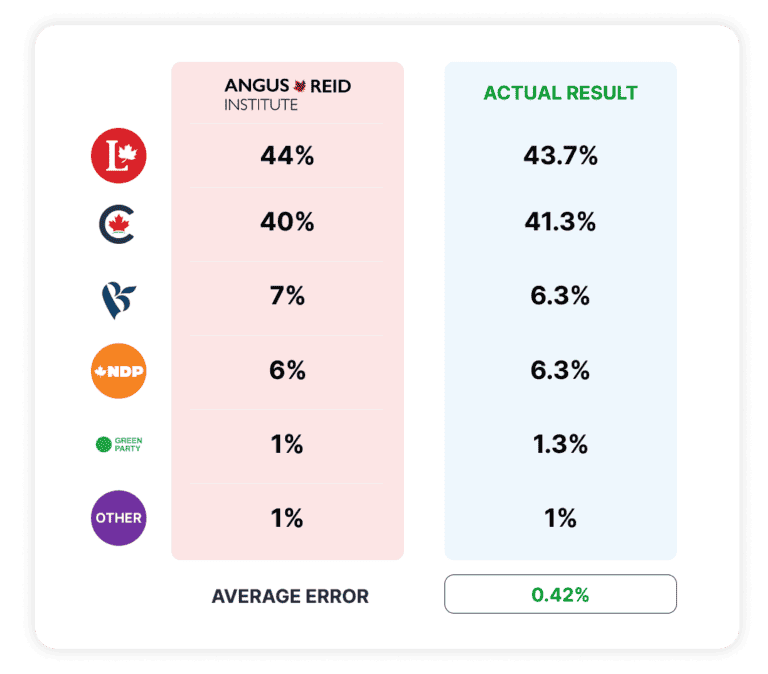
Angus Reid Institute’s vote projection hit the mark near-perfectly, which led the Liberals to win a minority government. Recent floor crossings have pushed the party close to a majority and will be worth monitoring in the coming months.
More:
- Federal Politics: Carney (widely) and Freeland (narrowly) more trusted to handle Trump than Poilievre
- Conservatives Crumble: Liberals surge past CPC into majority territory, but Grits’ vote commitment is softer
- All down to E-Day: Liberal voters dominate early voting but election day support splits evenly between CPC, LPC
2. Trump tariff saga and 51st state threats
While they began in late 2024, American President Donald Trump’s talk of making Canada the 51st state persisted into 2025, becoming a significant if not defining element in this country’s domestic politics this calendar year. Canadians began the year feeling inclined to say Trump was joking, with just 32 per cent feeling that his annexation musings were serious after he made them to then Prime Minister Justin Trudeau. That jumped to 54 per cent in March as Trump continued to repeat the idea. Americans showed little interest in acquiring Canada, and nearly all Canadians said “no way”.
Foundational in these threats from Trump were tariffs and economic pressure. While Canada was spared from the prop chart seen around the world when nearly every nation in the world was tariffed by the Trump administration, targeted tariffs on Canadian goods have caused considerable disruption in the Canadian economy. Negotiations have come and gone throughout the year, and the drama endures. The latest reports suggest the U.S. is targeting supply management and the Online Streaming Act in USMCA negotiations if Canada wants to renew the accord.
More:
- Canada as 51st State? Four-in-five Americans say a merger should be up to Canadians; 90% of us say ‘no’
- Americans oppose Trump’s tariff against Canada 2:1; support drops further when they consider the price of gas
- Shopping Shift: Four-in-five say they’re buying more Canadian products in face of tariff threat
- Amid tariff-related chaos, nine-in-10 Canadians concerned about domestic recession in next year
3. Trudeau resignation
After years of increasing acrimony among Canadians toward Prime Minister Justin Trudeau, overtures to his eventual replacement to join his cabinet cost Trudeau his finance minister, and an ill-advised sales-tax holiday and rebate check announcement didn’t reverse the Liberals’ plummeting electoral fortunes. Trudeau resigned on January 6 and gave way to Mark Carney as Liberal leader. Asked about his legacy, Canadians were gracious to a point. A majority say he made genuine efforts to take on Canada’s biggest problems, though just three-in-ten said he made progress.
Half felt he would go down in history as an average or better PM, while 47 per cent said he would be remembered poorly. His biggest successes? Marijuana legalization (52% said it was a success), handling the COVID-19 pandemic (47%), and expanding the social safety net (46%). His biggest failures? Immigration (64% said it was a failure), the inflation crisis (55%) and the carbon tax (53%) which was rescinded early in Carney’s term.
More:
- The Federal Liberals’ New Year’s Eve Nightmare: Party vote intent sinks to 16%, Trudeau approval at all-time low
- Trudeau Legacy: Majority say he took on the country’s biggest problems, but split over progress
4. Major projects and Interprovincial cooperation
One of the key promises from Prime Minister Mark Carney during his election campaign was to get major projects moving and reduce provincial barriers to decrease dependence on the United States. Angus Reid Institute found Canadians enthusiastically supporting both concepts, but with key caveats.
Nine-in-10 said that government efforts through Bill C-5 to reduce labour and trade barriers between provinces were well placed. When asked specifically about subjects of provincial barriers, however, preferential procurement and supply management were both divisive. National trucking regulations, free movement of alcohol, and other policies, however, were largely supported.
When it came to the One Canadian Economy act, the idea of deeming projects in the national interest to speed them up was supported by a strong majority, though many pushed back about potentially reducing environmental and Indigenous reviews.
When it came to the projects themselves, Canadians were supportive of the list of major infrastructure priorities, but three-in-five said oil and gas should be more of a focus.
More:
- Major Projects Reaction: Mixed reviews to first five proposals; most say oil & gas needs more focus
- Bill C-5: Canadians support fast-tracking projects, but conflicted over individual elements of the legislation
- Trade barriers: Canadians support national standards, tension over supply management, procurement
5. Future of the CPC and Poilievre
Pierre Poilievre and the Conservative Party won’t have much time to rest after the holidays. The CPC leader will face a mandatory leadership review in January. And though he says he’s “very” confident that he will be the leader going forward, there are doubts creeping into the minds of some CPC supporters that he is the right person for the job.
ARI research late in 2025 found a majority (58%) of recent Conservative voters wanted Poilievre to lead the CPC into the next election, but that this majority had shrunk ten points compared to August.
Poilievre remains a popular figure among those who would “definitely” support the CPC in a future election: 92 per cent have a favourable view and 75 per cent want him to stay on as leader. But those who are wavering in their support of the party have more doubts about his leadership. The “certainly consider” crowd are divided as to whether they want Poilievre to be the leader after January (40% stay, 38% leave), while the “maybes” want him to go (61% leave).
More:
- Poilievre’s Prospects: CPC voters back him; those who could’ve put him over the top are far less supportive
- Future of the CPC: A (declining) majority of Conservative voters would keep Poilievre as leader in January
6. Pipelines
With so much attention on diversifying resources beyond the United States, a key part of the conversation in Canada became oil and gas expansion and pipelines. Angus Reid Institute surveyed Canadians early in the year and more recently. In February, half said the federal government needed to do more to build pipeline capacity. Two-thirds supported resurrecting the Energy East project and 54 per cent supported the idea of Northern Gateway. The latter picked up steam throughout the year, and culminated with a memorandum of understanding between Ottawa and Alberta that lays out conditions for a project to the west coast of B.C. Residents in that province are largely supportive of the idea, but hold significant reservations about the existing ban on oil tankers in the region expected to host the terminus.
More:
- Pipeline Politics: Post MOU announcement, Carney’s approval unchanged in B.C., picks up in Alberta
- 60% could support Alberta-BC pipeline nationally, but sign-off in Canada’s westernmost province no sure thing
- Pipeline Possibilities? In wake of Trump tariff threats, majorities support Energy East, Northern Gateway
7. Canada Post and Air Canada strife
Over the past two years, Canada Post has faced repeated labour disruptions amid contentious contract negotiations with the Canadian Union of Postal Workers (CUPW), focused on wages, job security, pensions, and how the corporation should adapt to declining letter mail and a growing parcel business. Just before Christmas, CUPW and Canada Post announced they reached a tentative agreement that addresses some of the unions concerns and takes strike action off the table, although the deal needs to be ratified in the new year. The agreement includes a model for weekend parcel delivery. Canadians showed a keen interest in changes to the Canada Post model, if necessary, when ARI asked earlier in 2025. Full privatization is a no-go, but reduced delivery, allowing for temporary workers, or paying $20 a year for the service, were all supported by a majority. Overall, two-thirds (64%) said it was important to them that Canada Post remained publicly owned.
Labour strife continues to be a major issue in the post pandemic world, after a federal public worker strike in 2023. Air Canada flight attendants grounded the airline with labour action in the summer, demanding payment for work done prior to takeoff, among other requests. Canadians saw the previous arrangement as unfair to the flight attendants, who reached a new agreement with Air Canada shortly after the beginning of the strike.
More:
- Delivering Canada Post’s future: Less support for privatization, but appetite exists for big changes
- Flight risk: Canadians side with flight attendants in ‘ground pay’ dispute with Air Canada
8. Blue Jays Boost
The Toronto Blue Jays captured the nations hearts and eyeballs this autumn with an unforgettable run to the World Series for the first time since 1993. The end result was dramatic and devastating as the Jays fell inches short of defeating the Los Angeles Dodgers. Attention on the sport exploded, with the number who said they were following the Jays closely doubling the number who normally watch baseball. Not everyone was aligned on the team being “Canada’s”, however. Two-in-five GTA residents said the team was Toronto’s (43%), equal the number who said they would share with the rest of the country (45%). Offseason attention turns now to re-signing star Bo Bichette and pursuit of outfielder Kyle Tucker.
More:
9. Israel-Gaza
A ceasefire between Israel and Hamas was agreed to on Oct. 10, brokered by the United States. Despite it, people continue to die in the region from both humanitarian crises and ongoing violations of the ceasefire, which Al Jazeera attributes primarily to Israel. Canada took the step of recognizing a Palestinian state on Sept. 21 this year, something a firm majority of Canadians said they supported. As the conflict has worn on, sympathies have shifted toward the Palestinians, with two-thirds saying in August that the situation had become a moral outrage, after famine spread through Gaza. Twice as many (52% vs 25%) said that they believed Israel was committing a genocide as disagreed.
More:
- Two-in-three call humanitarian situation in Gaza a ‘moral outrage’; most say Israel is deliberately blocking aid
- Majority of Canadians support Palestine recognition even if Trump objects amid trade dispute
10. Indigenous consultation, title claims, and UNDRIP
Canada’s relationship with First Nations and Indigenous Peoples once again generated considerable discussion with the federal government and provincial governments seeking to speed up infrastructure and resource projects while facing down threats from American President Donald Trump. This, at the expense of Indigenous consultation and self-determination, according to Indigenous groups. Broad agreement on many issues in this realm is difficult to find. For example, three-in-10 Canadians say that the federal government is offering too much funding to First Nations’ communities, but the same number feel the current allocation is too little (27%). One-in-five (21%) say that based on what they know, the funding level is about right. Men are largely divided about whether or not it would be better for Indigenous People to integrate more into “modern Canadian” culture, whereas women tend to support these groups maintaining their traditional cultural if that’s what they prefer.
On the question of streamlining infrastructure projects, one-quarter would give First Nations a veto over projects on their traditional territory. Two-in-five would accept meaningful consultation, with the government making the final decision. One-quarter would not consider First Nations’ objections.
Overall, more Canadians say Canada should “scale back” its UNDRIP commitments (43%) than prioritize them (30%), in the face of this development push. Many are unsure (27%).
More:
- Bills, Treaties, and UNDRIP: Canadian views of contemporary Indigenous land issues
- B.C. divided about UNDRIP: Equal numbers say it’s a necessary step, goes too far to limit provincial authority
- Cowichan Ruling: Most in B.C. believe court decision on Aboriginal title has potential to damage reconciliation