


Conservative Party leads in vote intent by three points over Carney-led Liberals
March 5, 2025 – As Canadians get their first taste of U.S. President Donald Trump’s second term tariffs, many are giving more thought to which Canadian leader they’d prefer to deal with the president in the coming months and years.
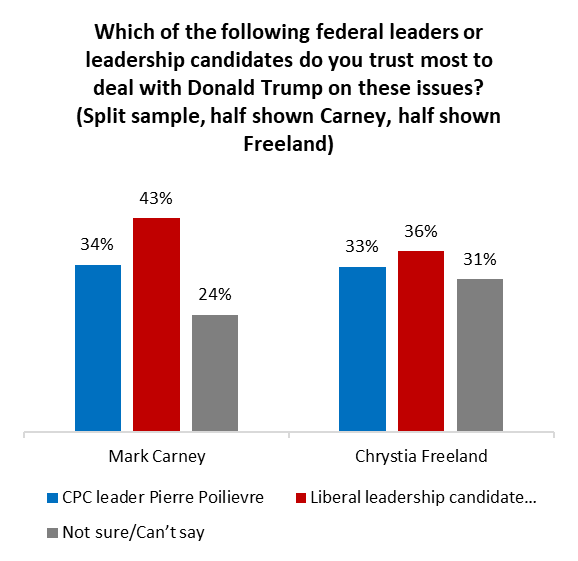
With days left before a new Liberal leader is announced, new data from the non-profit Angus Reid Institute finds 43 per cent of Canadians say Mark Carney would be best to square off against the U.S. president in the scenario he wins the leadership race, compared to 34 per cent who choose Conservative Party leader Pierre Poilievre. In a scenario where Chrystia Freeland were to win the leadership race, the former finance minister also – albeit more narrowly – edges Poilievre as the more trusted choice to take on Trump (36 per cent Freeland vs. 33 per cent Poilievre).
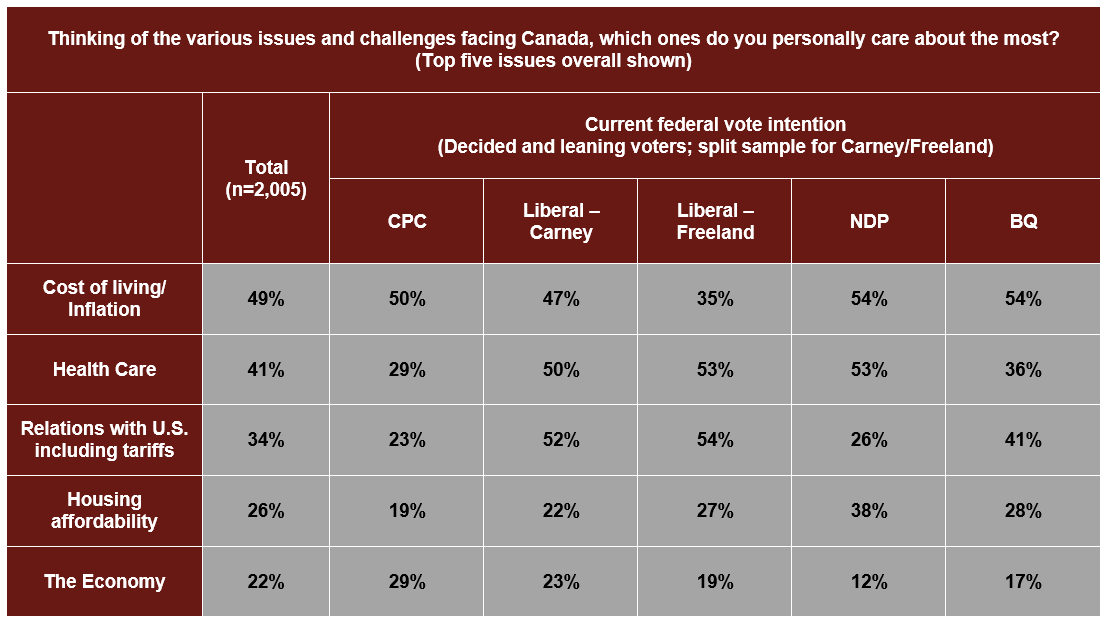
This comes as Canadians await the next in a string of unpredictable decisions from Trump and at a time when one-in-three Canadians (34%) say the U.S. relationship is the top issue facing the country, behind only the cost of living (49%) and health care (41%).

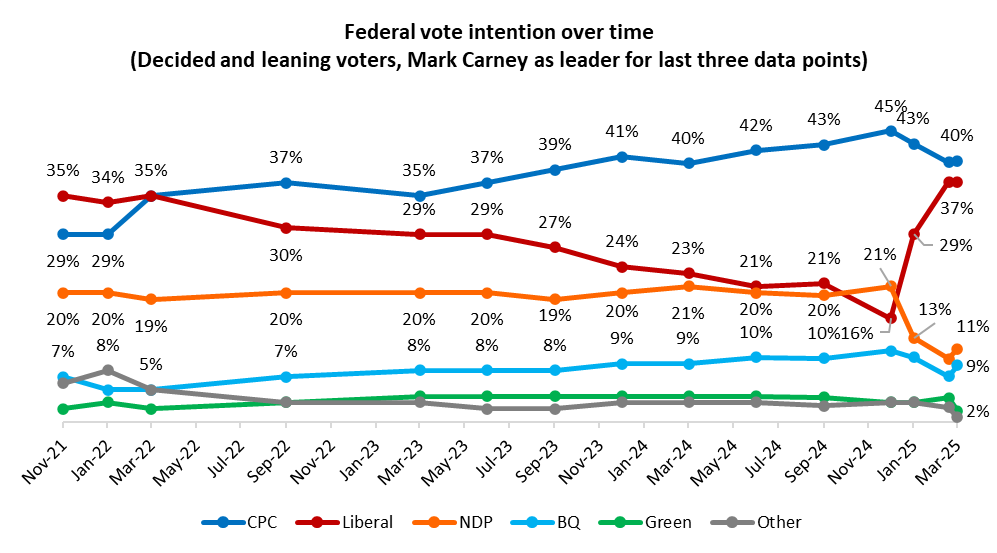
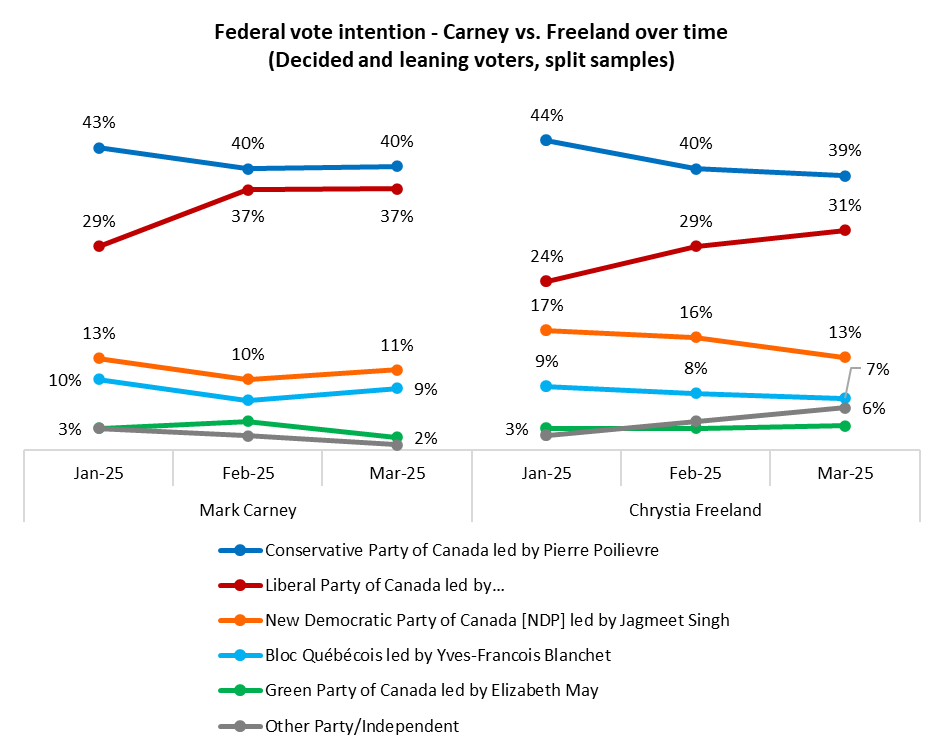
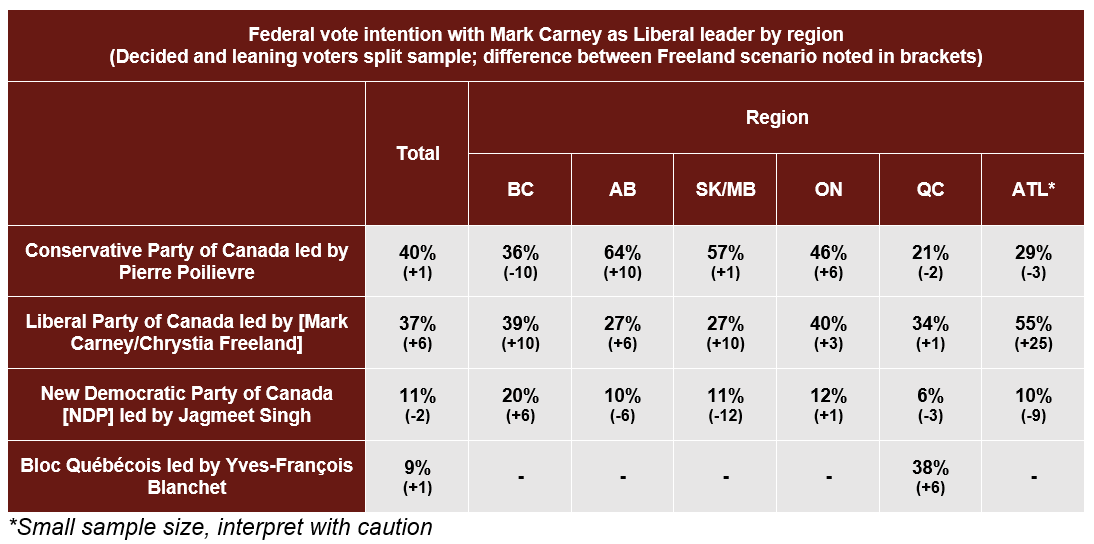
With domestic and cross-border machinations unfolding day by day, the Canadian vote intention picture remains a neck-and-neck contest between the Conservatives and the Liberals. For the second consecutive survey the Conservatives hold a 40 per cent to 37 per cent advantage of the Liberals, assuming Carney as leader. With Freeland holding that post the CPC advantage rises to eight points.
The picture continues to reveal itself in key battleground provinces between a Carney-led Liberal Party and Poilievre’s CPC. With these two leaders in place, the Liberals hold a three-point edge in B.C. (39% to 36%), and a 13-point advantage in Quebec (34% to 21%) – though in that province the Bloc Québécois garners 38 per cent of vote intention. In Ontario, the CPC lead by six points (46% to 40%).
About ARI
The Angus Reid Institute (ARI) was founded in October 2014 by pollster and sociologist, Dr. Angus Reid. ARI is a national, not-for-profit, non-partisan public opinion research foundation established to advance education by commissioning, conducting and disseminating to the public accessible and impartial statistical data, research and policy analysis on economics, political science, philanthropy, public administration, domestic and international affairs and other socio-economic issues of importance to Canada and its world.
INDEX
Part One: Top issues
Part Two: Federal vote intent
-
Carney vs. Freeland vs. Poilievre
-
Regional picture
-
Age and gender
Part Three: Best to handle Trump?
Part One: Top issues
The long-threatened tariffs from U.S. President Donald Trump have arrived this week. And while tariffs and the relationship with their southern neighbour are near the top of Canadians’ minds – 34 per cent say it is one of the country’s top issues – concern remains over the high cost of living (49% select it as a top issue) and health care (41%). All three issues are selected at similar rates as they were in February.
There is a political divide when it comes to which issues are on voters’ minds. To gauge potential support for the two leading candidates to replace Prime Minister and Liberal leader Justin Trudeau, the Angus Reid Institute split respondents into equal sized groups. One group was asked how they would vote in the scenario former Bank of Canada governor Mark Carney wins the race while the other was asked instead about former Deputy Prime Minister Chrystia Freeland.
Both sets of potential Liberal voters are much more concerned with U.S. relations (52% of Carney Liberals select it as a top issue; 54% of Freeland Liberals) than those who say they would vote CPC (23%) or NDP (26%). The issue of tariffs also ranks high for likely Bloc Québécois voters (41%). Notably, Conservative Party voters are less unified over which issues are most important for the country, with only one issue (cost of living) garnering more than 29 per cent support:
On the key issue of handling Trump, Carney appears to have a considerable advantage. Facing off with Conservative leader Pierre Poilievre on just that file, Carney holds a nine-point edge. That lead for the Liberals drops to three with Freeland, though the same number choose Poilievre in both cases:

Part Two: Federal vote intent
Carney vs. Freeland
The end is in sight for the Liberal leadership race as the votes roll in for the 400,000 party members who registered to vote to select Trudeau’s replacement. As has been the case since the early days of the leadership contest, the Liberals perform better among likely voters in the scenario where Carney is the leader. The hypothetical Freeland Liberals have closed some of the gap between them and the Conservatives, but still trail by eight points in the scenario the former finance minister is selected as the next party leader:
While both candidates have elevated the party out of the low trough where Trudeau had left it at the end of 2024, the Carney Liberals perform better than the Liberals have at any point since the 2021 Federal Election. But this climb appears to be more at the expense of third parties such as the NDP and Greens. Conservative support has fallen from December, but is still near levels seen throughout 2024:
Regional picture
Carney more than Freeland appears to be able to improve the Liberals’ fortunes in B.C. and the Prairies. While the latter will likely do little to improve the Liberals’ electoral chances in a region where a majority say they will vote Conservative, the former will likely be key to fostering a competitive federal election whenever that comes:
Age and gender
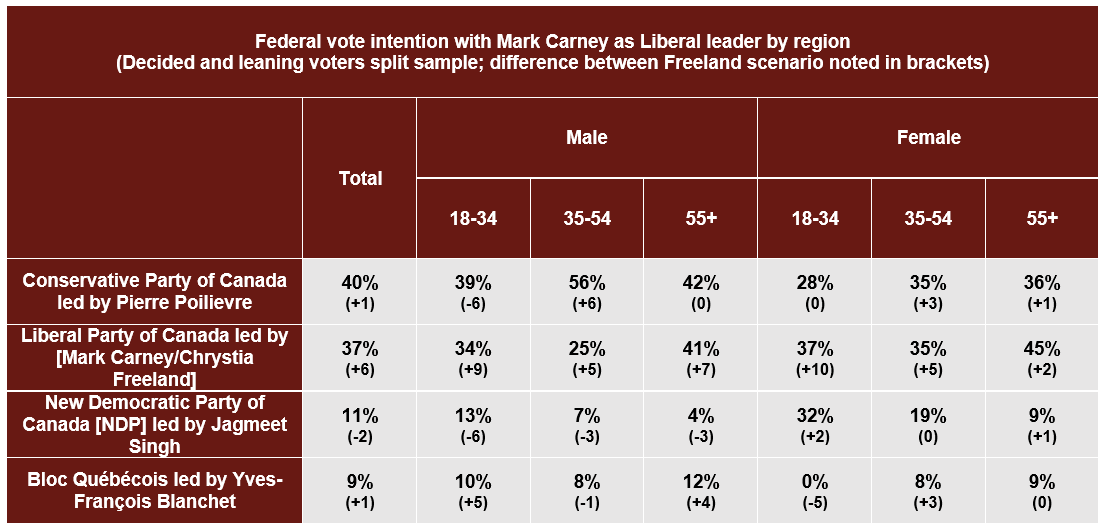
Carney also holds the advantage over Freeland across all demographics. Men and women of all ages are more likely to vote Liberal in the scenario Carney wins the leadership race than in the one where Freeland succeeds Trudeau. And all those same groups are less likely to say they will vote for a third party currently outside of parliament if Carney is named leader on March 9:
Carney also performs better among 2021 Federal Liberal voters. In the scenario where he wins the leadership race, more than four-in-five (85%) of those who voted Liberal in 2021 say they would vote for the Carney Liberals. Under Freeland, seven-in-ten (69%, see detailed tables) say they would repeat their Liberal vote.
Either of the two leading candidates for the Liberal leadership winning appears to be bad news for the NDP. In the Carney scenario, half (51%) of 2021 NDP voters repeat their vote. Against the Freeland Liberals, 46 per cent of 2021 NDP voters say they intend to vote again for the party:

Survey Methodology:
The Angus Reid Institute conducted an online survey from February 27 – March 3, 2025, among a representative randomized sample of 2,005 Canadian adults who are members of Angus Reid Forum. For comparison purposes only, a probability sample of this size would carry a margin of error of +/- 2.0 percentage points, 19 times out of 20. Discrepancies in or between totals are due to rounding. The survey was self-commissioned and paid for by ARI.
For detailed results by age, gender, region, education, and other demographics, click here.
For full release including methodology, click here.
For the questionnaire, click here.
MEDIA CONTACT:
Shachi Kurl, President: 604.908.1693 shachi.kurl@angusreid.org @shachikurl
Dave Korzinski, Research Director: 250.899.0821 dave.korzinski@angusreid.org
Jon Roe, Research Associate: 825.437.1147 jon.roe@angusreid.org