

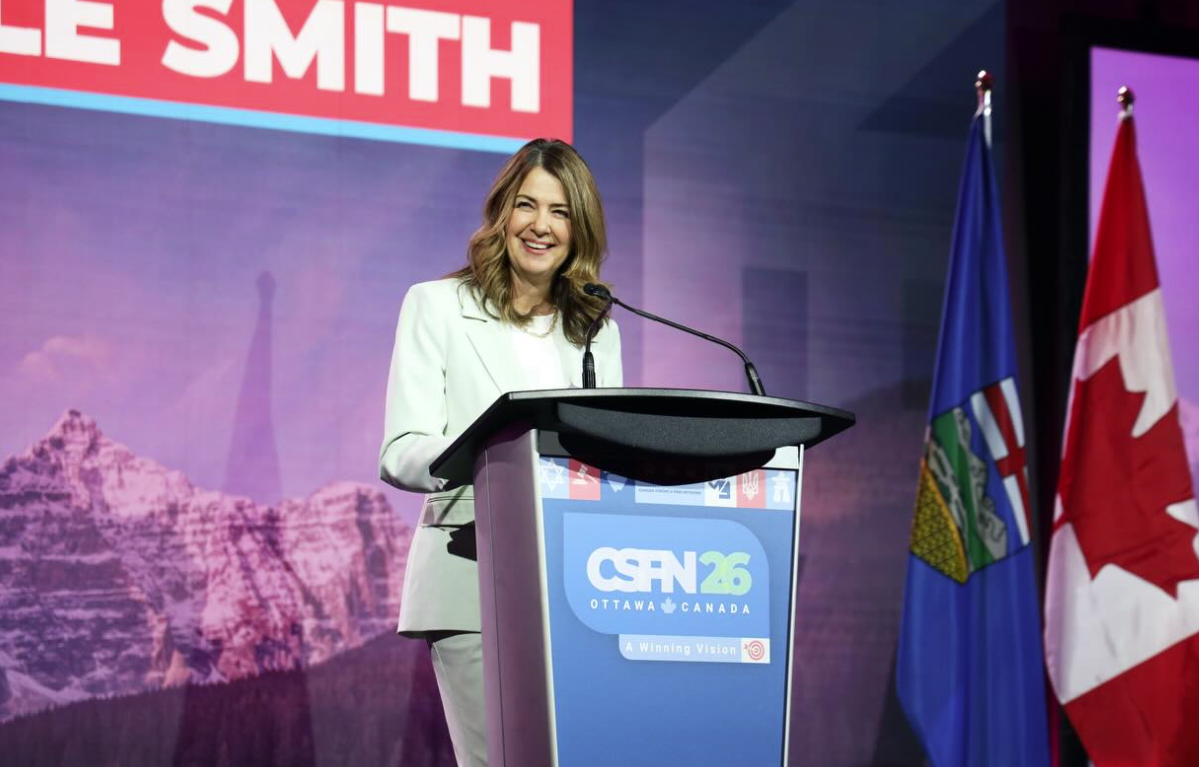
May 25, 2026 – A long-simmering "what if" has become a reality in Alberta, with federalists and separatists now on a five-month clock to convince Albertans to either stay in Canada or "start a legal process" for a binding referendum on separation. The UCP government led by Premier Danielle Smith will put a 37-word question to Albertans in an Oct. 19 referendum.
New data from the non-profit Angus Reid Institute finds most Albertans would vote against proceeding with the separation process — 60% would vote No to the official October question, compared to 35% who would vote Yes. When asked a simpler hypothetical — leave or stay — the federalist position strengthens, with 67% opting to stay and 30% choosing to leave. Half (51%) find the official question confusing, and 56% say Premier Smith has handled the issue poorly.
Three-in-five would vote No — but UCP voters back starting the process 64-30, and rural Alberta is split
The official Oct. 19 referendum question asks: "Should Alberta remain a province of Canada or should the Government of Alberta commence the legal process required under the Canadian Constitution to hold a binding provincial referendum on whether or not Alberta should separate from Canada?" Across Albertans overall, 60% would vote No (Alberta stays) and 35% would vote Yes (begin the process). Edmonton is the most federalist city (73% No), while rural Alberta is evenly split at 48-48. NDP voters are near-unanimous in choosing to stay (90% No), while UCP voters lean toward Yes (64-30).
Half find the official question confusing — and a simpler leave/stay test shows even stronger support for staying
Premier Smith said the 37-word question was designed to "appease both sides of the debate," but half of Albertans (51%) find it confusing — including 38% of UCP voters. When Albertans are instead asked a direct hypothetical — should Alberta leave Canada or stay? — support for remaining in Canada rises from 60% to 67%, while the Leave/Yes side falls from 35% to 30%. Both sides report strong commitment to their positions, with 75–78% saying they are absolutely or mostly committed to their referendum vote.
56% say Smith has handled the separation file poorly — including nearly a third of her own UCP voters
A slight majority of Albertans (56%) say Premier Smith has handled the separation issue poorly, while 37% say she has done well. Criticism comes from nearly all NDP voters (86%) and, notably, from nearly one-third (28%) of past UCP voters — a significant erosion within her own base. The split is most dramatic by separation intent: those who would vote to stay overwhelmingly disapprove (79% poorly), while those who would vote to leave are equally critical from the opposite direction (85% poorly), feeling Smith isn't truly on the separatist side.
Most Albertans think Smith called the referendum to appease separatists in her party — her own voters disagree
A majority of Albertans (58%) agree that Smith's only reason for calling the referendum is to appease the separatists within the UCP. Past NDP voters agree in large numbers (84%), while most past UCP voters disagree (55%). Even so, one-third of UCP voters (33%) are sympathetic to the view that the referendum was a political calculation to manage her party's separatist wing. And when asked what Smith actually wants, a plurality of all Albertans (40%) say she doesn't care what happens as long as she stays in power — with just 31% believing she genuinely wants Alberta to remain in Canada.
Seven-in-ten say separatists would never accept a No vote — those who'd vote Leave are more divided on this
Smith has said she would honour the referendum's outcome and hopes separatist advocates "would honour the outcome as well." But most Albertans are skeptical. Seven-in-ten (69%) believe that if Albertans vote No in October, separatists will never accept the result. Those who would themselves vote to Stay are even more convinced of this (83%). Among those who would vote to Leave in a hypothetical separation referendum, opinion is split — 41% agree separatists would reject a loss, while 45% believe they would accept it.
Methodology and downloads
The Angus Reid Institute conducted an online survey from May 22–24, 2026, among a randomized sample of 800 Albertan adults. Respondents are drawn from the Angus Reid Forum. This sample was weighted to be representative of adults provincewide according to region, gender, age, household income, and education, based on the Canadian census. For comparison purposes only, a probability sample of this size would carry a margin of error of +/– 3 percentage points, 19 times out of 20. The survey was self-commissioned and paid for by ARI.