

Cost concerns linger; only one-in-six would pay five per cent or more on airfare to fund pay increase
August 15, 2025 – As hundreds of thousands of Air Canada ticket holders navigate alternative travel arrangements and brace for the impact of cancelled trips, new data from the non-profit Angus Reid Institute finds the airline’s reputation appears to be rapidly losing altitude amid a battle between the company and unionized flight attendants.
The flight attendants have issued a Saturday strike warning amid a labour dispute that revolves around whether in-flight service crews should be compensated for work they do before their flights push back from the gate, such as safety checks, boarding passengers, or deplaning after landing.
Air Canada is offering flight attendants half of their hourly rates to do this work; the union is demanding their full hourly amount.
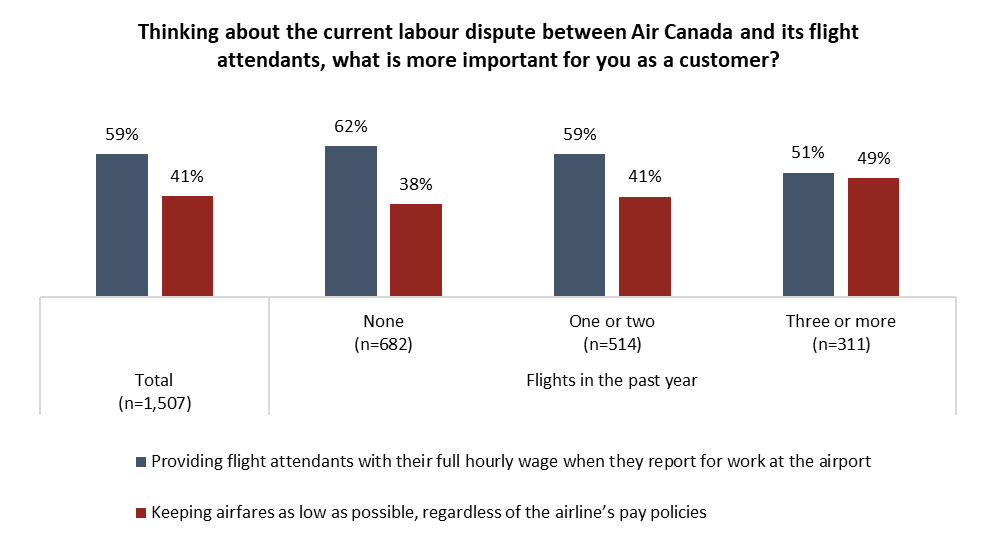
For their part, a majority of Canadians are calling on the airline to pay up before the planes tilt up and compensate service crew for the full breadth of their flight duties. An independent, self-commissioned and self-funded poll finds three-in-five (59%) say Air Canada providing full hourly wages for all aspects of the flight attendants’ work is most important to them, while the rest (41%) say keeping airfares low should be the priority. Notably, however, more frequent fliers – those who have taken to the skies three times or more in the last year – are evenly split on the matter, with half (51%) siding with flights attendants demands, and the other half more focused on not seeing the increased costs of such compensation passed along to them.
One-third of Canadians (34%) say they don’t want to see airfare increases, even if it means boosting flight attendants’ compensation, while three-in-10 (29%) would accept a price increase of less than five per cent on their ticket. Just one-in-six (14%) say they would pay five per cent or more if it meant flight attendants were paid as soon as they clocked in for their shifts.

Three-quarters (74%) support federal legislation to require airlines to pay employees when they report for their shift as scheduled as more than four-in-five (84%) describe the current conditions as “unfair”.

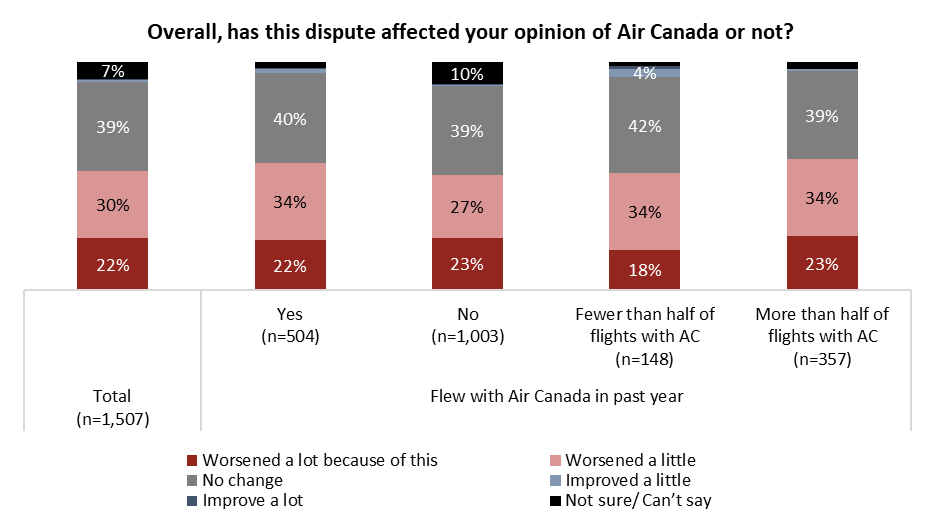
Regardless of where they stand on the labour dispute – and noting that hating airlines is something of a societal pastime – half say this conflict has damaged their own opinions of Air Canada. Where one-in-five say their views of the company have “worsened a lot” as a result of the conflict and uncertainty.

Part One: The ground pay dispute
-
Canadians overwhelmingly believe it’s ‘unfair’ flight attendants are only paid in the air
-
Majority side with flight attendants over ground pay
-
Three-quarters support legislation to enact ground pay
Part Two: The issue of cost
-
Two-in-five say airfares should be kept ‘as low as possible’
-
More frequent fliers split over higher costs to support ground pay
Part Three: The effect on Air Canada’s reputation
-
Half say their opinion of Air Canada has ‘worsened’ because of labour dispute
Part One: The ground pay dispute
Canadians find themselves caught in the middle of another labour dispute as Air Canada’s flight attendants could be on strike as soon as Saturday over stalled contract negotiations. This follows major strikes by Canada Post and the federal public service in the past two years.
Related:
- Most Canadians support union demands for wage premiums, but more divided over higher pay
- Seven-in-10 Canadians affected by Canada Post strike, sympathy falls near evenly on both sides
- Delivering Canada Post’s future: Less support for privatization, but appetite exists for big changes
Air Canada and its flight attendants are at an impasse because they have been unable to find acceptable terms on pay, both in total amount and in “ground pay”. As it stands, Air Canada flight attendants are only paid when the plane is in the air, which they argue leaves them with unpaid work loading and unloading passengers, or in the event of cancellations and delays.
Flights have already been suspended in advance of the potential strike, and should the flight attendants walk off the job on Saturday, it could affect more than 130,000 customers, including 25,000 who may be stranded abroad due to the work stoppage.
Canadians overwhelmingly believe it’s ‘unfair’ flight attendants are only paid in the air
The issue of so-called “ground pay” is central to this labour dispute between Air Canada and its more than 10,000 flight attendants. More than four-in-five (84%) Canadians say the fact that flight attendants are only paid when the plane is in the air is “unfair”:

Majority side with flight attendants over ground pay
Air Canada has requested that the dispute go to binding arbitration, which would end the labour stoppage. However, the union representing the flight attendants say it plans to reject that request and continue with the strike.
Air Canada’s most recent offer would give flight attendants half of their salary for work done on the ground, while flight attendants say they want to be paid in full for all hours worked. On that issue, a majority of Canadians say they would side with flight attendants if they were the arbitrator:

Three-quarters support legislation to enact ground pay
The issue of ground pay is one of rare cross-partisan agreement. The Conservatives and NDP introduced separate bills last year that would have ensured flight attendants were paid for duties performed before and after flights. However, the bills died when the House of Commons was prorogued prior to former Prime Minister Justin Trudeau’s resignation. The governing Liberals have so far not supported a change to the labour code which would make ground pay law.
Three-quarters (74%) of Canadians, including a majority of past voters of all major parties say they would support legislation that would require airlines to pay employees when they report for work:

*Smaller sample size, interpret with caution
Part Two: The issue of cost
Two-in-five say airfares should be kept ‘as low as possible’
Air Canada has described the union’s request in negotiations as “unsustainable wage increases”; labour costs represented nearly a quarter of Air Canada’s operating costs last year.
While most (59%) Canadians say it’s more important to them that flight attendants are paid as soon as they report for work than keeping airfares low, two-in-five (41%) say low prices are more of a concern to them as a customer. The latter proportion is higher among those who are more frequent flyers:

More frequent fliers split over higher costs to support ground pay
As well, those frequent flyers, who would bear much of the cost in this scenario, are less inclined to accept an increase in airfare. Among those who have flown three or more times in the past year, 44 per cent are unwilling to pay anything additional to boost flight attendant compensation, while 17 per cent are unsure. Among those who have flown once or twice, unwillingness is nine points lower, and willingness to eat some of the cost is seven points higher:

Part Three: The effect on Air Canada’s reputation
Half say their opinion of Air Canada has ‘worsened’ because of labour dispute
One of the risks of high-profile labour disputes is reputational, and for Air Canada, it appears that any protracted conflict could cause significant damage. Half (52%) of Canadians already say their opinion of Air Canada has worsened because of the conflict between the company and its flight attendants.
The negative reputational impact appears to be even higher among those who are regular Air Canada customers. Approaching three-in-five (57%) Canadians who say more than half of their flights were with Air Canada in the past year also say their opinion of the airline has worsened in the wake of this labour clash:
Survey Methodology
The Angus Reid Institute conducted an online survey from Aug. 14-15, 2025, among a randomized sample of 1,507 Canadian adults who are members of Angus Reid Forum. The sample was weighted to be representative of adults nationwide according to region, gender, age, household income, and education, based on the Canadian census. For comparison purposes only, a probability sample of this size would carry a margin of error of +/- 2.0 percentage points, 19 times out of 20. Discrepancies in or between totals are due to rounding. The survey was self-commissioned and paid for by ARI.
For more information on our polling methods, click here.
For detailed results by age, gender, region, education, and other demographics, click here.
For PDF of full release, click here.
For questionnaire, click here.
CONTACT:
Shachi Kurl, President: 604.908.1693 shachi.kurl@angusreid.org @shachikurl
Dave Korzinski, Research Director: 250.899.0821 dave.korzinski@angusreid.org
Jon Roe, Research Associate: 825.437.1147 jon.roe@angusreid.org