

British Columbians more aware of UNDRIP than others in the country; most would hold referendum on it
August 25, 2025 – British Columbia has seen historic and controversial developments in Indigenous land rights. In April 2024, the Haida Nation’s title to Haida Gwaii was formally recognized, while in May 2025 the Cowichan Tribes’ court victory over land title in Richmond sparked a provincial appeal. These events underscore both progress and tension as B.C. works to align with its commitment to the United Nations Declaration of the Rights of Indigenous Peoples, while also maintaining a robust development pace to deal with threats from south of the border and the private property rights of residents.
New data from the non-profit Angus Reid Institute finds British Columbians largely divided over this commitment from their province, the only in Canada to have signed on to UNDRIP.
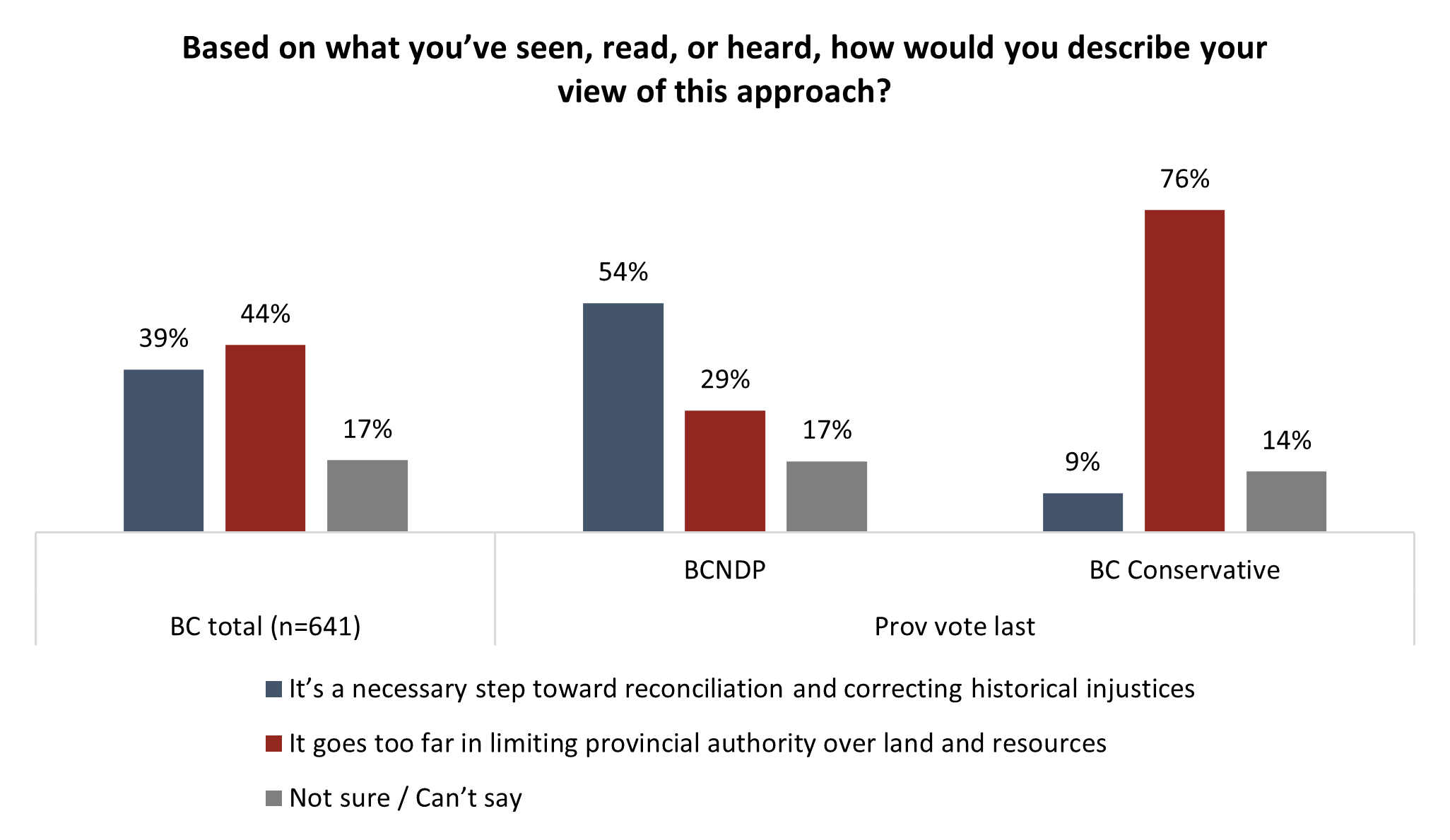
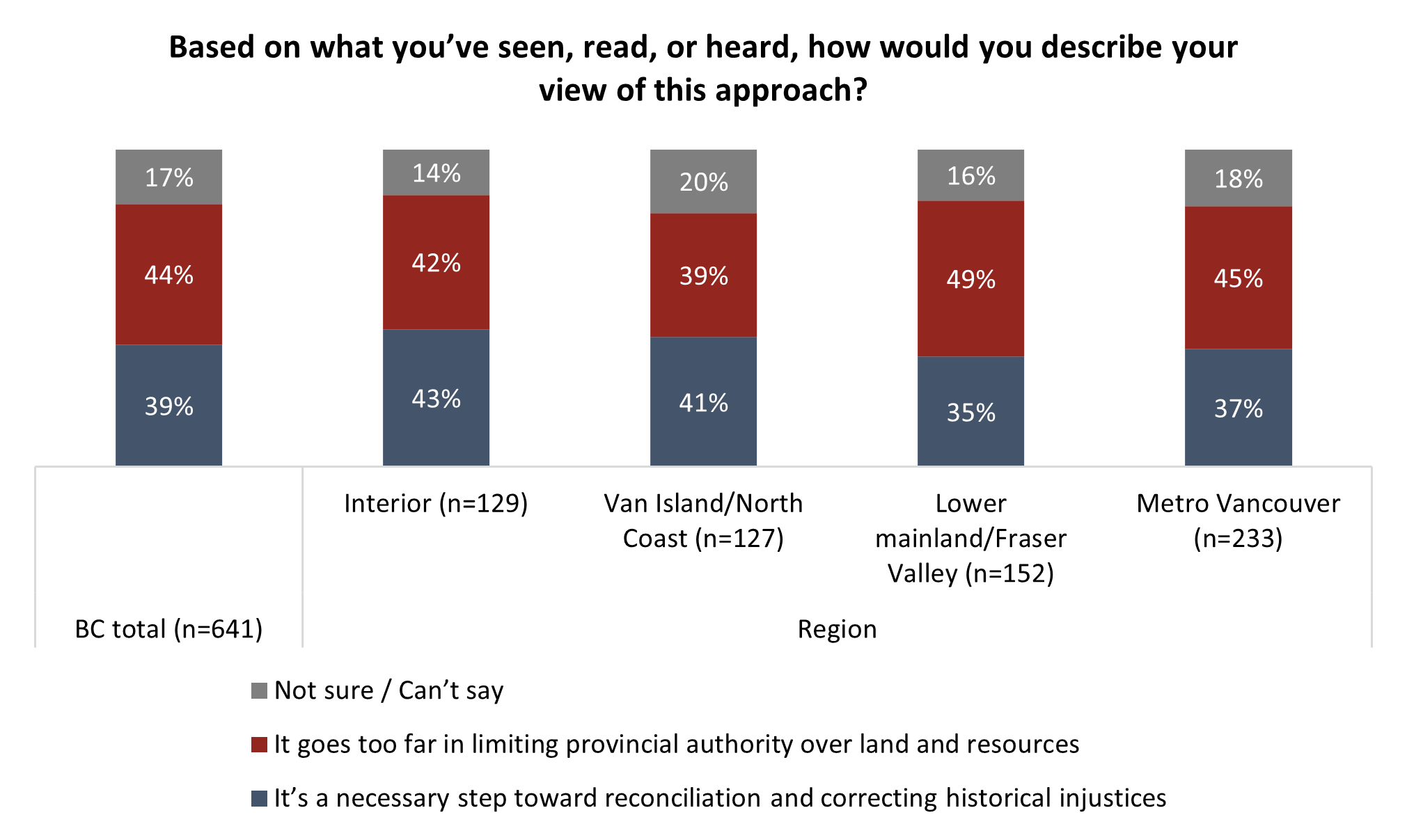
Overall, two-in-five (39%) say this commitment is necessary as a step toward reconciliation, while slightly more (44%) say UNDRIP goes too far in limiting provincial authority over land and resources. The tension between Indigenous title claims and private property has been on display this summer after the B.C. Supreme Court issued a landmark ruling affirming the Cowichan Tribes’ Aboriginal title to roughly 800 acres of land in Richmond. The province swiftly appealed, warning of potential ripple effects for private land titles across B.C.
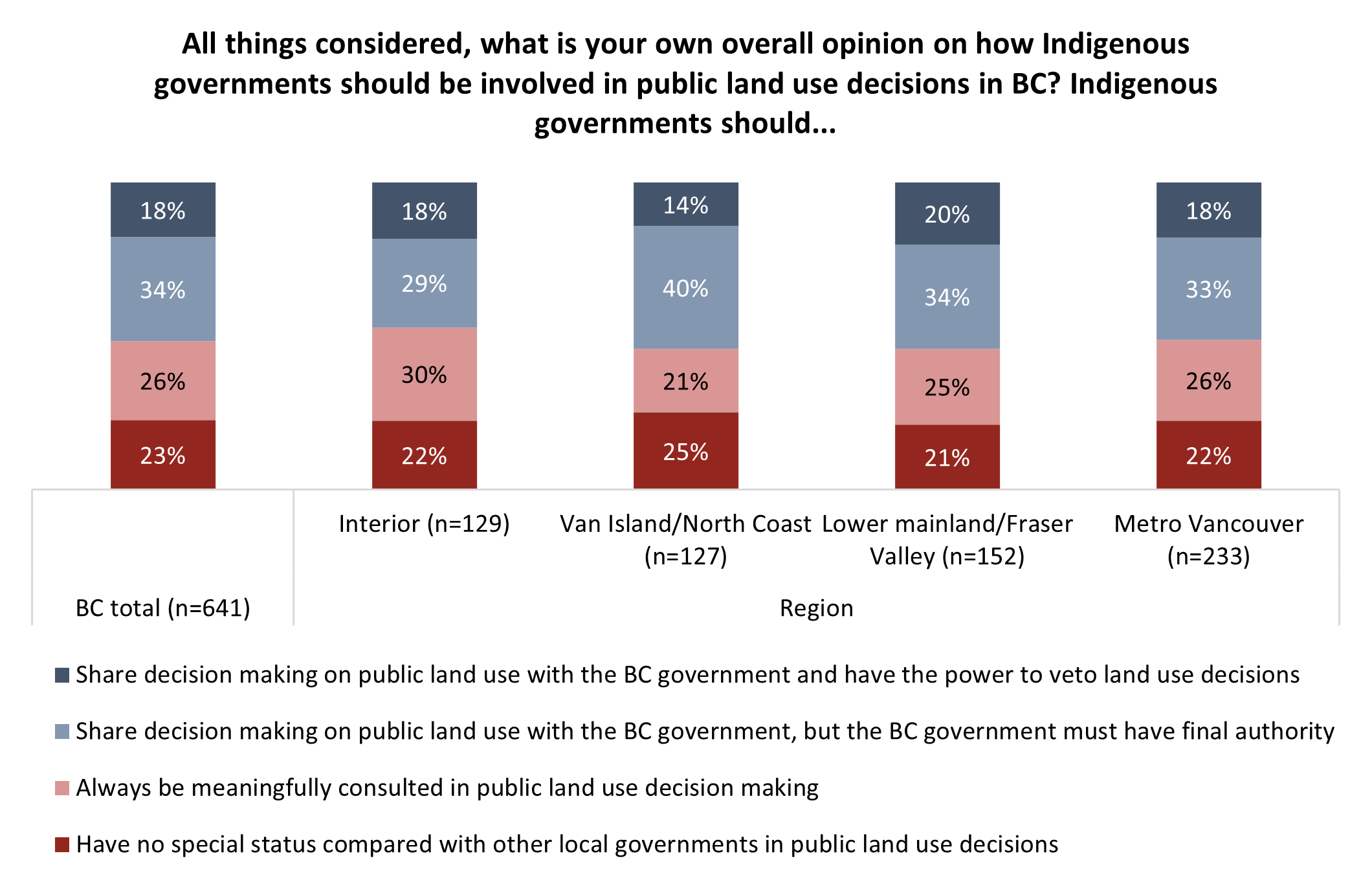
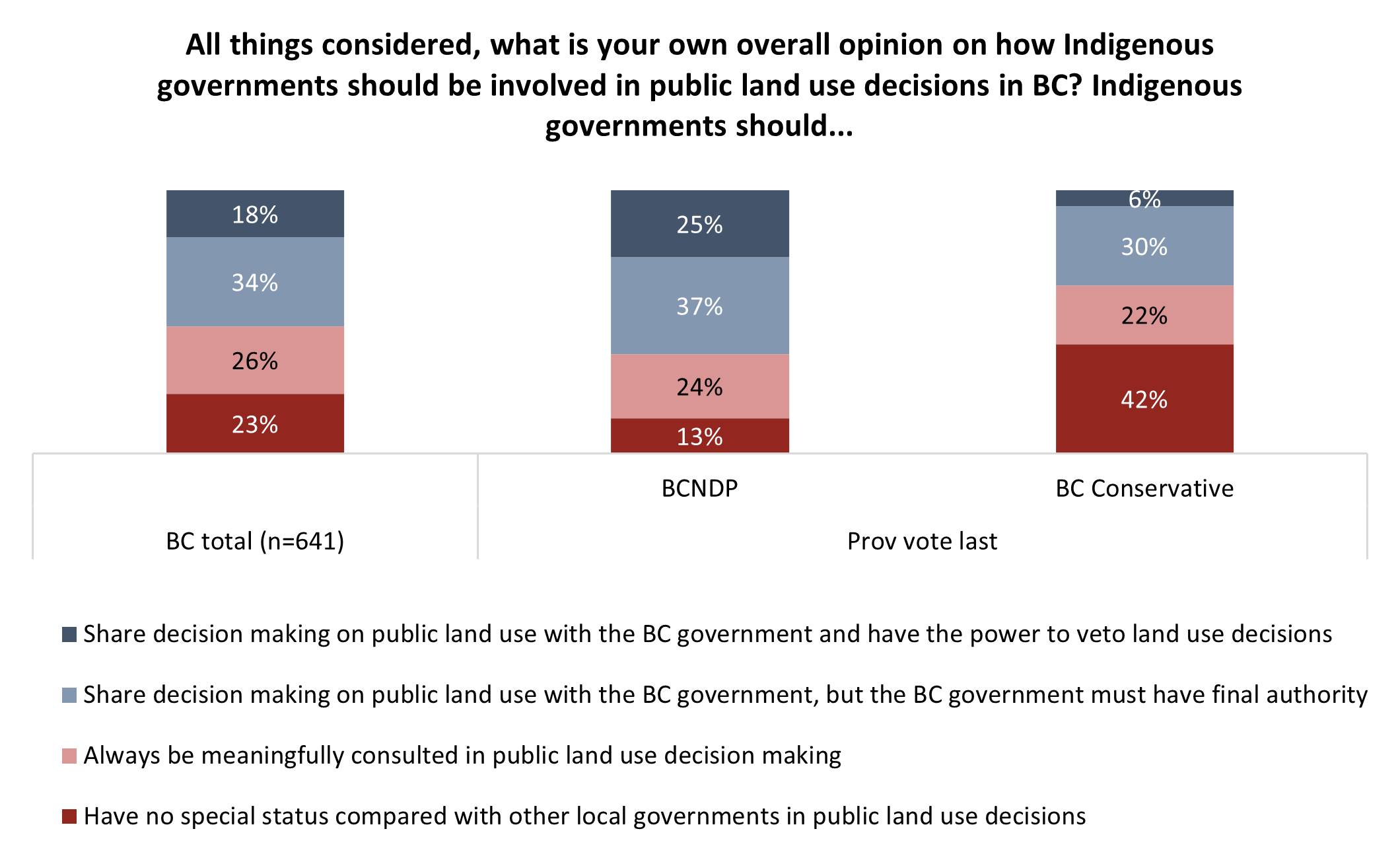
On the question of what role Indigenous groups should have in public land use decisions, views are similarly complex. Just one-in-five (18%) say Indigenous governments should be involved in shared decision-making and have a veto, but 34 per cent say they should share in decision-making and leave final authority to the provincial government. A further one-quarter (26%) support meaningful consultation but no role in decision-making, and one-quarter (23%) say Indigenous groups should be treated the same as others in the province.
More Key Findings:
- The BC NDP has the support of most of its voters, with 54 per cent saying following UNDRIP is necessary, but a significant minority of these voters (29%) disagree, and nearly all Conservative Party of BC supporters are opposed (76%).
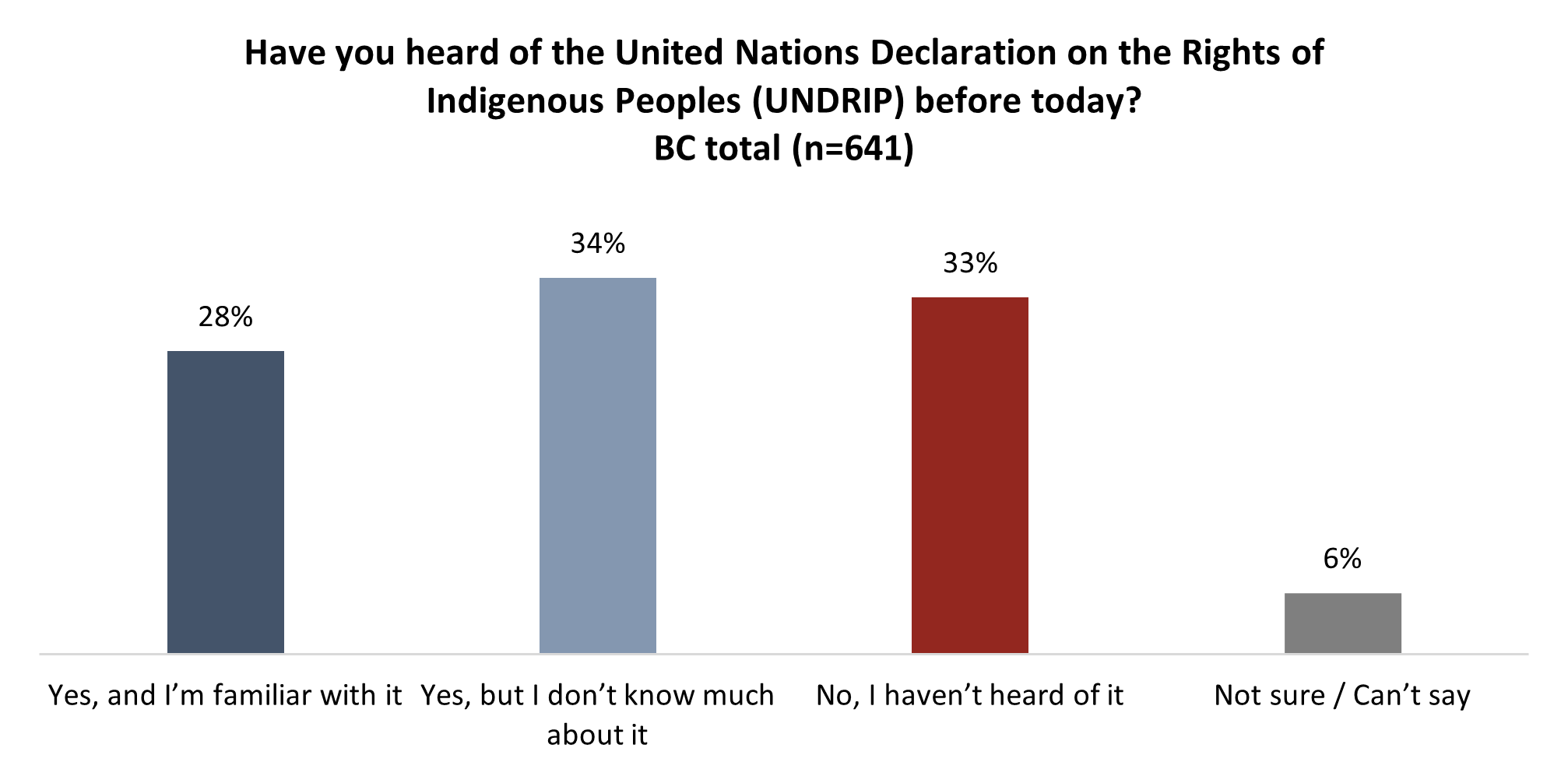
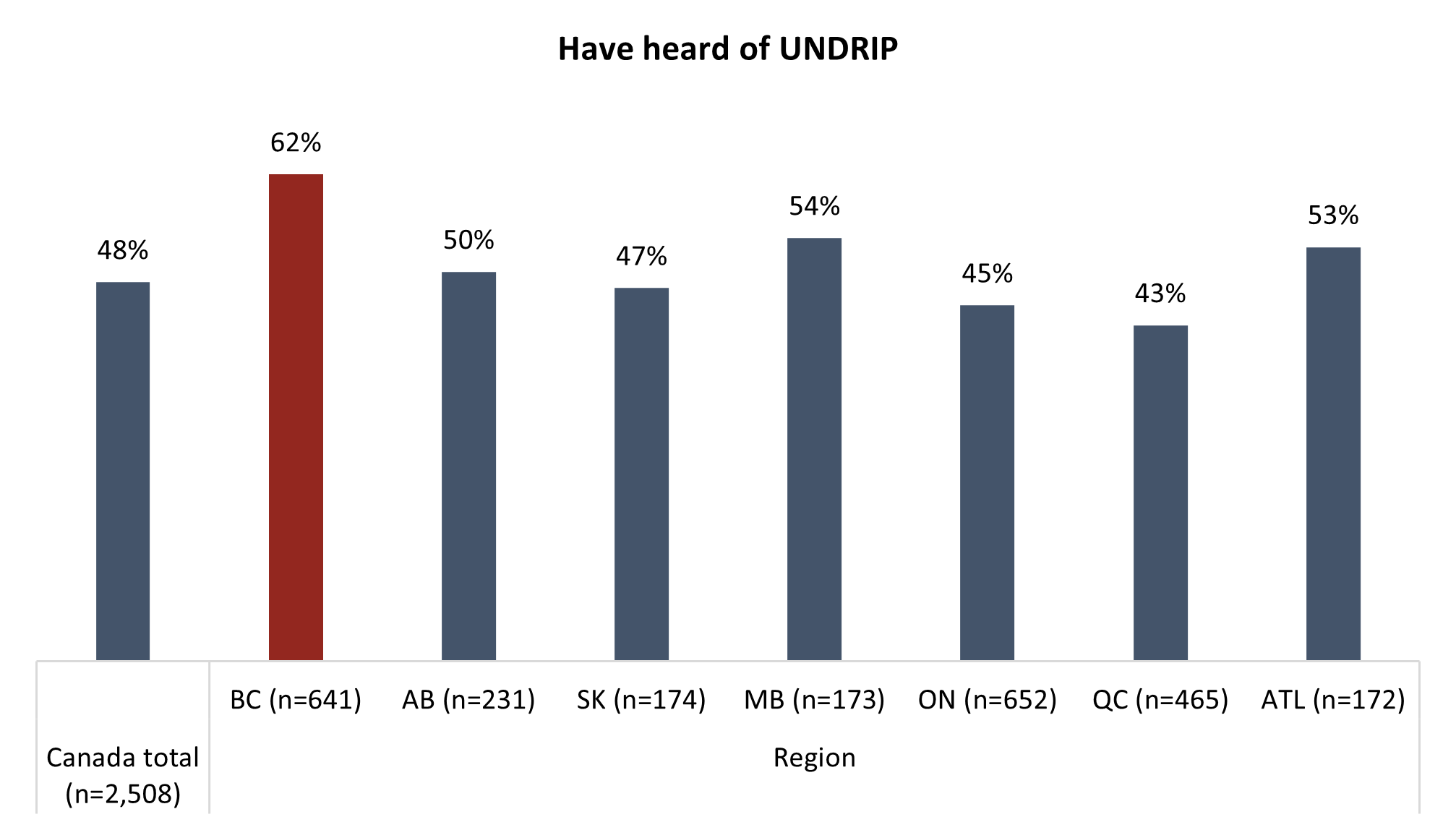
- British Columbians are more aware of UNDRIP than the rest of the country. Three-in-five (62%) profess knowing of it, eight-points ahead of those in Manitoba (54%) and nine ahead of those in Atlantic Canada (53%).
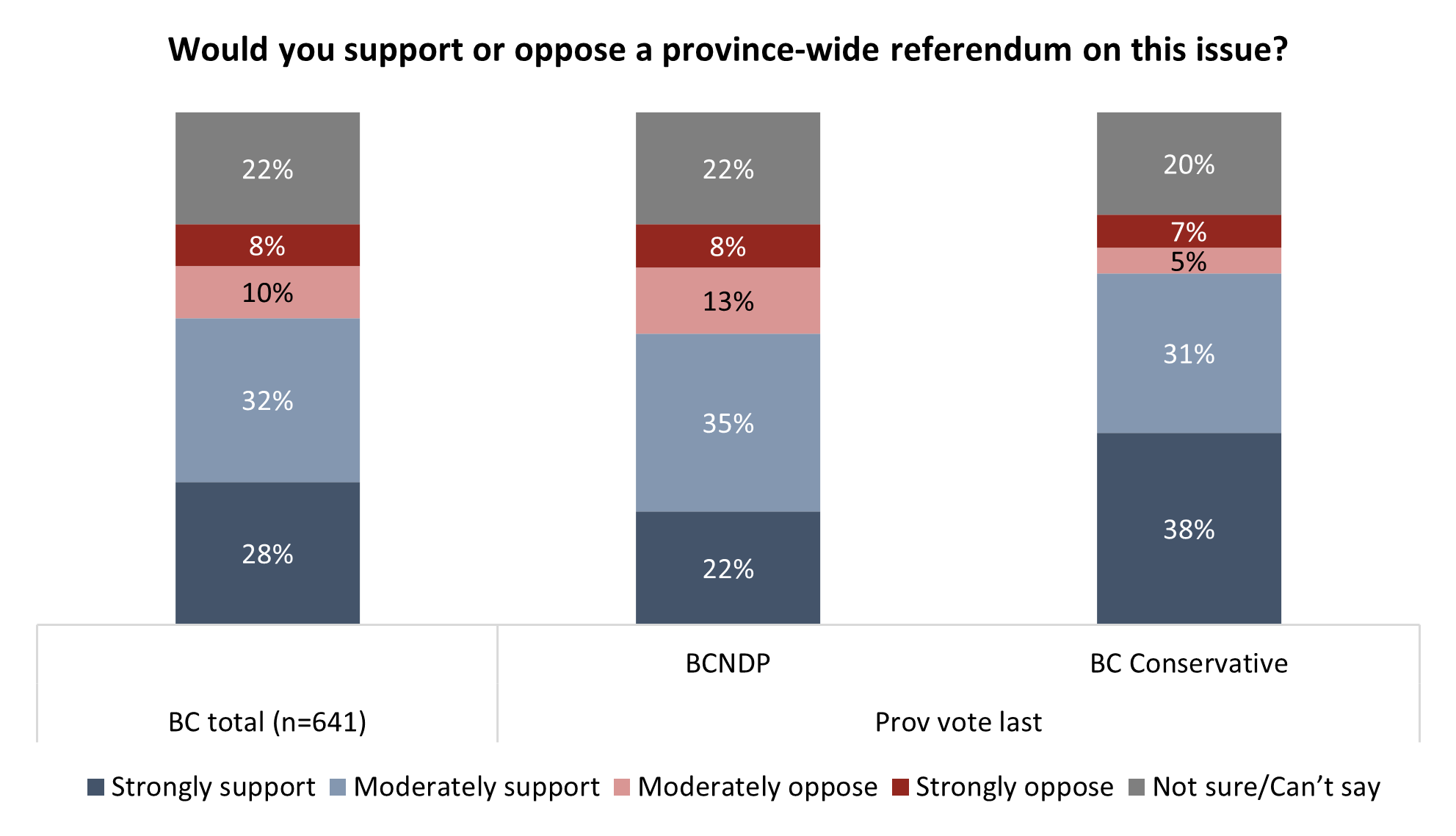
- A majority of B.C. residents would support holding a referendum on maintaining UNDRIP. This includes 57 per cent of BC NDP voters and 69 per cent of BC Conservatives.
INDEX
- BC leads the nation in UNDRIP awareness
-
But they’re divided about its principles
-
NDP voters largely say it’s a necessary step toward reconciliation, BC Conservatives disagree
-
Who has authority in land use decisions?
-
Referendum has majority support
BC leads the nation in UNDRIP awareness
In 2019, British Columbia became the first jurisdiction in Canada to formally enshrine the United Nations Declaration on the Rights of Indigenous Peoples (UNDRIP) into law. That landmark step has evidently kept the issue front-of-mind for many residents. Asked if they have heard of UNDRIP, three-in-10 (28%) say they’re familiar with it, while one-in-three (34%) say they’re aware of it but not necessarily the principles. One-in-three (33%) have never heard of it.
This relatively heightened awareness is evident when comparing with other regions. For example, awareness in B.C. is 17 points higher than in Ontario and 19 higher than Quebec:
But they’re divided about its principles
With many parts of the province lacking historic treaties, land rights and title claims (like those previously noted of the Haida and Cowichan) are central to how UNDRIP plays out here. British Columbians were asked how they feel about signing this into law, in the following question:
Full Question Text: “British Columbia is the only province in Canada that has passed legislation to align its laws with UNDRIP. This includes a commitment to recognize and uphold Indigenous rights and title, and to involve First Nations in decisions about land and development.
Based on what you’ve seen, read, or heard, how would you describe your view of this approach?”
Overall, division is largely the story. Across the province, large portions take each side, with close to two-in-five supporting each position, that this is a necessary step toward reconciliation, or that it is too limiting for the province in land and resource development decisions:
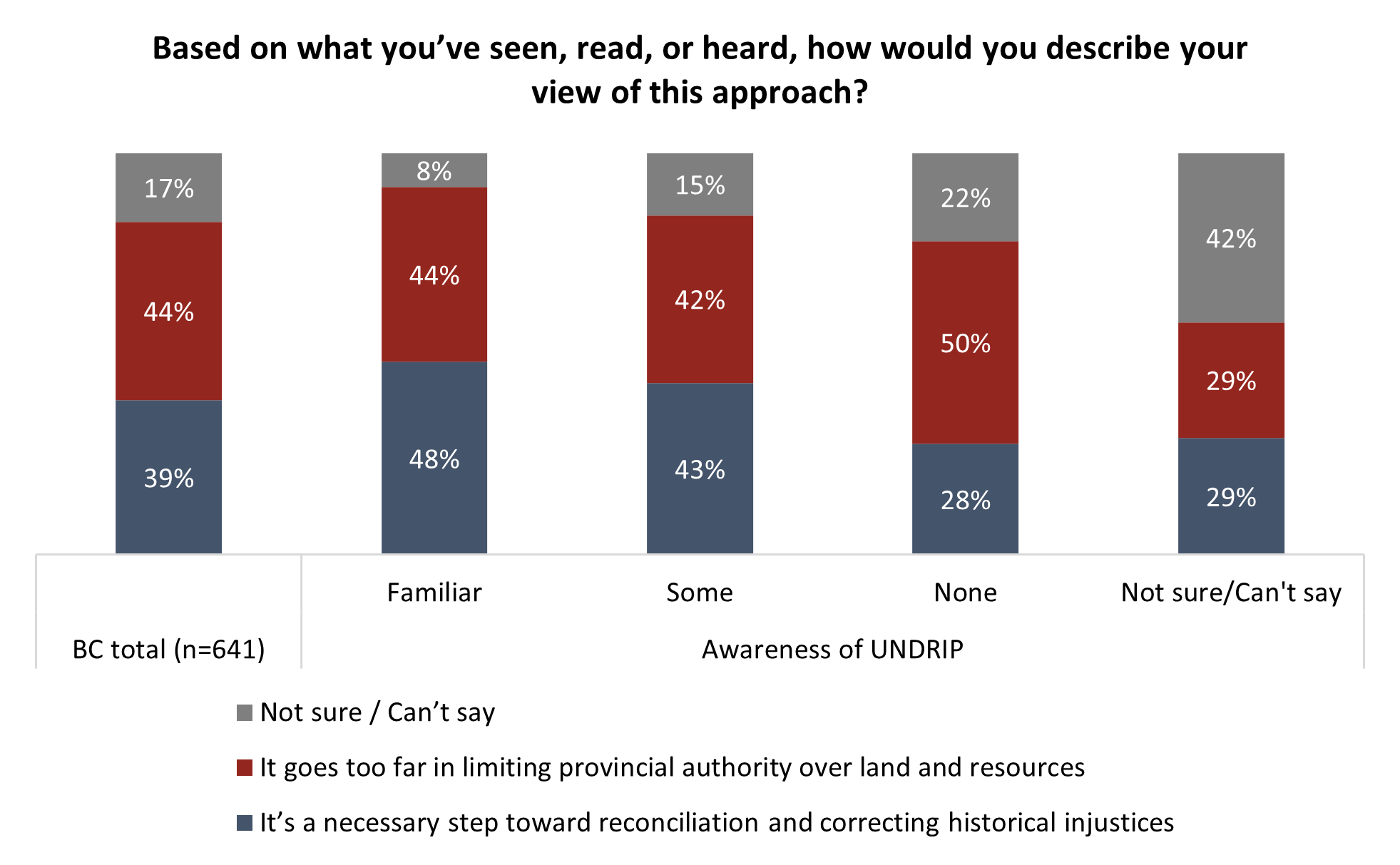
 Those with higher levels of awareness are slightly more favourable to the necessity of UNDRIP. Those with no awareness are against it at a two-to-one rate:
 NDP voters largely say it’s a necessary step toward reconciliation, BC Conservatives disagree
Those who supported the government in the 2024 October election are largely on side with UNDRIP, with half (54%) saying it is necessary – twice the number who disagree. That said, opposition among the BC Conservative Party’s voters is more intense, with 76 per cent saying it goes too far:
Who has authority in land use decisions?
On the broader question of what role Indigenous groups play in public land use decisions – an issue playing out in negotiations and court rooms across the province – British Columbians offer no clear perspective on what they expect. One-quarter (23%) say Indigenous groups have no special status in these conversations, while the same number say meaningful consultation is a must. The other half (52%) say that shared decision making is needed, though they disagree on whose authority supersedes:
Views, again, diverge heavily across political lines. BC Conservatives believe there should be less of a role for Indigenous groups in land use decisions, while a majority of BC NDP voters say they should share decision making:
 Referendum has majority support
Evidently, views of UNDRIP are mixed. The codification of these principles was introduced by former Premier John Horgan’s government in 2019 and remains the only such legislation in Canada at the provincial level. Whether they support it or not, British Columbians are more likely to support than oppose a referendum on going forward with UNDRIP into the future:
METHODOLOGY
The Angus Reid Institute conducted an online survey from July 24 – 29, 2025, among a randomized sample of 2,508 Canadian adults who are members of Angus Reid Forum. Among these, 641 were in British Columbia. The sample was weighted to be representative of adults nationwide according to region, gender, age, household income, and education, based on the Canadian census. For comparison purposes only, a probability sample of this size would carry a margin of error of +/- 1.5 percentage points nationally and 4.0 points in B.C., 19 times out of 20. Discrepancies in or between totals are due to rounding. The survey was self-commissioned and paid for by ARI. Detailed tables are found at the end of this release.
For detailed results by age, gender, region, education, and other demographics, click here.
For PDF of full release, click here.
For questionnaire, click here.
MEDIA CONTACT:
Shachi Kurl, President: 604.908.1693 shachi.kurl@angusreid.org @shachikurl
Dave Korzinski, Research Director: 250.899.0821 dave.korzinski@angusreid.org