


Most CPC voters believe party is in ‘right place’ politically, but others believe it’s ‘too far to the right’
December 11, 2025 – Like snow blanketing the country, a quieting has settled upon caucus rumblings over the leadership of Conservative leader Pierre Poilievre. But as the days count down until the January Conservative convention, and his leadership review, is Poilievre standing on solid ground or skating on thin ice?
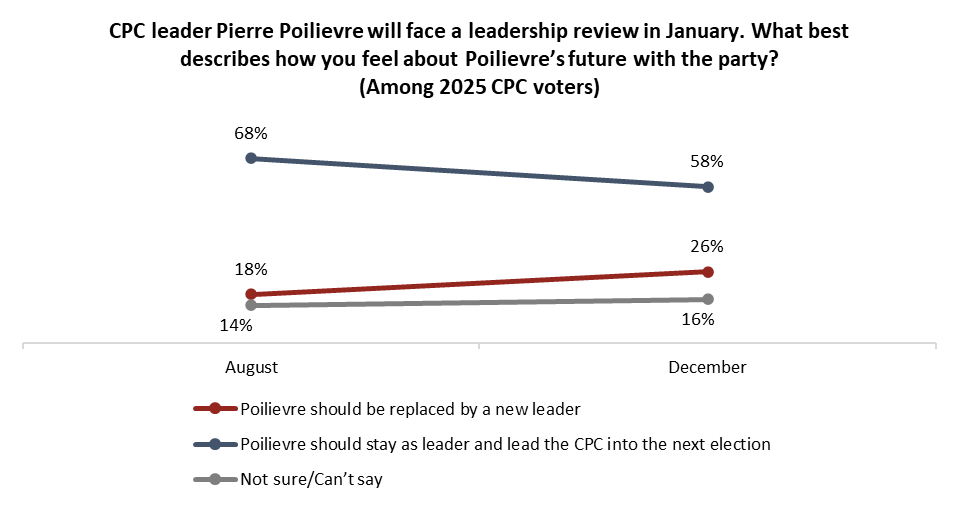
New data from the non-profit Angus Reid Institute finds a majority (58%) of recent Conservative voters want Poilievre to lead the CPC into the next election, but that majority has shrunk from the last time ARI asked this question in August (68%).
While Poilievre has solidly captured the right-side of the political spectrum, successfully minimizing the People’s Party of Canada support in the last election, it was not enough to secure enough seats to form government.
In the post-vote post-mortem, conservative pundits have discussed how the party needs to find “one million more votes” on top of the eight million-plus which earned the CPC 41 per cent of the popular vote.
The issue in finding those additional votes may lay in the current size and scope of the CPC “vote universe”. ARI asked Canadians whether they would consider supporting Conservative in the next election and found 21 per cent would “definitely” support the party, 14 per cent would “certainly consider” it and 22 per cent would “maybe consider” voting CPC. That million boost will likely need to come from the “maybe” crowd.
Poilievre remains a popular figure among the “definites”: 92 per cent have a favourable view and 75 per cent want him to stay on as leader. But those who are wavering in their support of the party have more doubts about his leadership as well. The “certainly consider” crowd are divided as to whether they want Poilievre to be the leader after January (40% stay, 38% leave), while the “maybes” want him to go (61% leave).

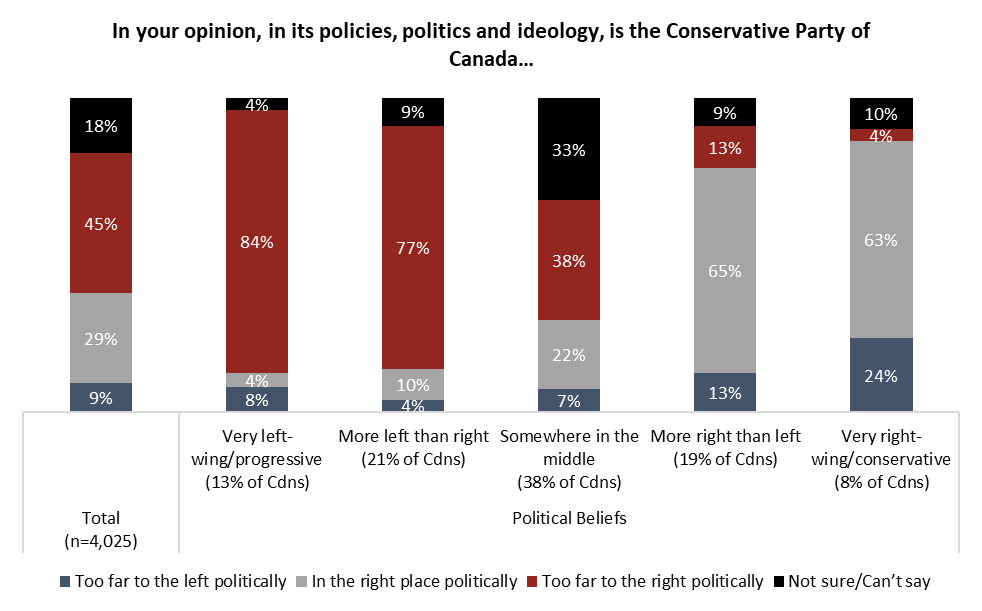
The issue for the Conservatives is that the pool of right-aligned voters in Canada is smaller than the left or centre of the political spectrum. One-quarter (27%) of Canadians describe themselves as “more right-wing” or “very right-wing”, 34 per cent say they are “more left-wing” or “very left-wing” and the largest group of 38 per cent place themselves “somewhere in the middle”. Two-thirds (64%) of that plurality of Canadian centrists have an unfavourable view of Poilievre. Most (63%) believe he should be replaced as leader. And they are more likely to believe that the CPC is “too far to the right politically” (38%) than in the right place on the political spectrum (22%).
INDEX
The Conservative Party and Pierre Poilievre’s future
-
Poilievre favourability
-
Do Canadians want Poilievre to stay or go as leader?
-
Is the party too far to the right or the right place politically?
The Conservative Party and Pierre Poilievre’s future
While he began the year as the prohibitive favourite to become Canada’s next Prime Minister, Conservative Party and opposition leader Pierre Polievre’s hopes crashed down quickly under a wave of national pride, borne of threats from U.S. President Donald Trump, that clearly benefited the then-freshly anointed Liberal leader, Mark Carney. Poilievre lost his Ottawa-based seat in parliament in the April election, and though he recovered his place in parliament in a by-election later in the year, he has been unable to stem the tide of challenges and reverse course from a public opinion standpoint.
Poilievre favourability
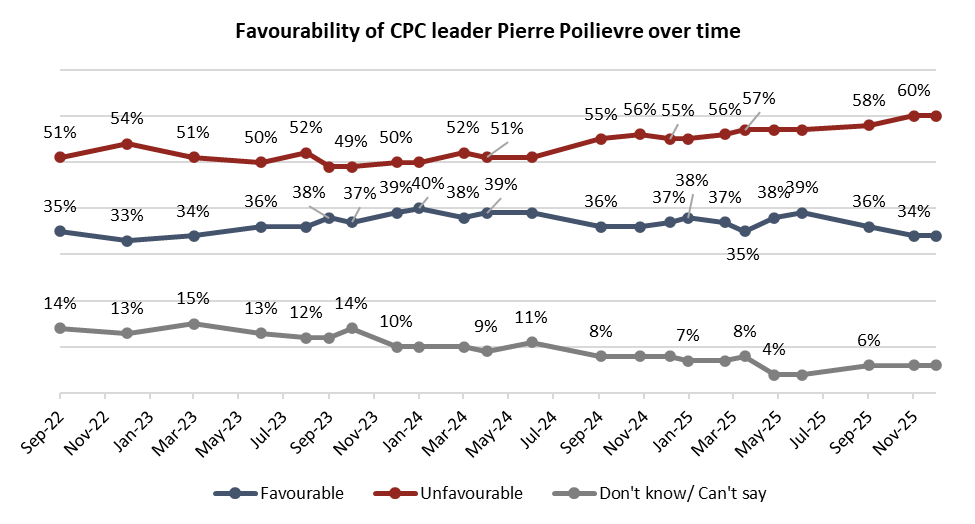
Poilievre’s high-water mark in terms of favourability has been two-in-five, an apparent ceiling he first encountered at the beginning of 2024. With former Prime Minister Justin Trudeau now out of the picture, Poilievre has been criticized for not adapting to the new political reality. In November, the CPC lost a member to Liberals in a floor-crossing, and another to a resignation. Poilievre said in November he has not reflected on his leadership style. As the pages of the 2025 calendar have flipped, Poilievre’s favourability has fallen incrementally and his unfavourability has risen. Now, 26 points separate the two: 60 per cent of Canadians hold an unfavourable view of Poilievre and 34 per cent favourable:
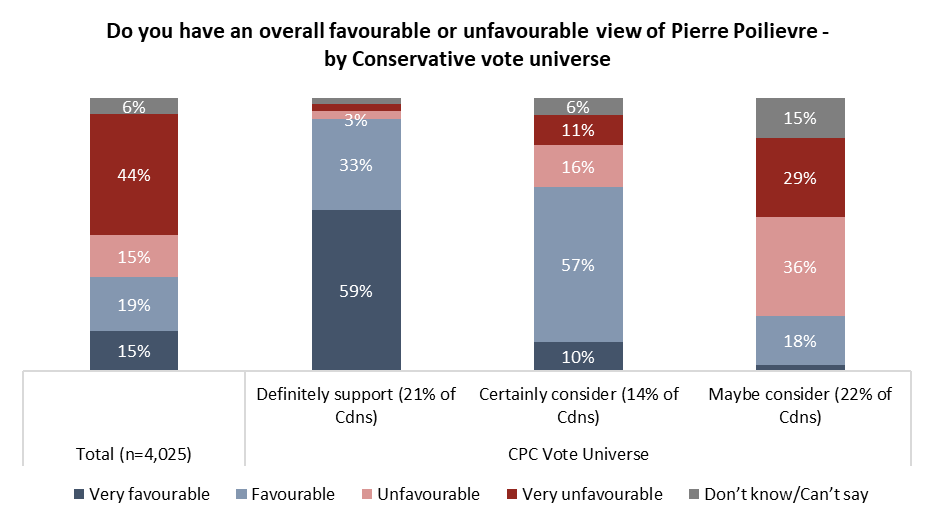
As he faces a leadership review shortly after the holidays, some in Poilievre’s party will be looking to the future and the key question of “electability”. Beyond those who would definitely support them or certainly consider them – a group that adds to about 35 per cent of the electorate – the key to any CPC majority election win will be a group of about one-in-five Canadians who say they “might” consider the party.
Among this “maybe” group, three-in-10 (29%) view Poilievre “very unfavourably” and more than one-in-three view him unfavourably (36%). Positive sentiment peaks at one-in-five (20%) among this segment. So, while the Conservative leader fares well among those most inclined to support the party, his efforts to open up to a broader base remain wanting:
Do Canadians want Poilievre to stay or go as leader?
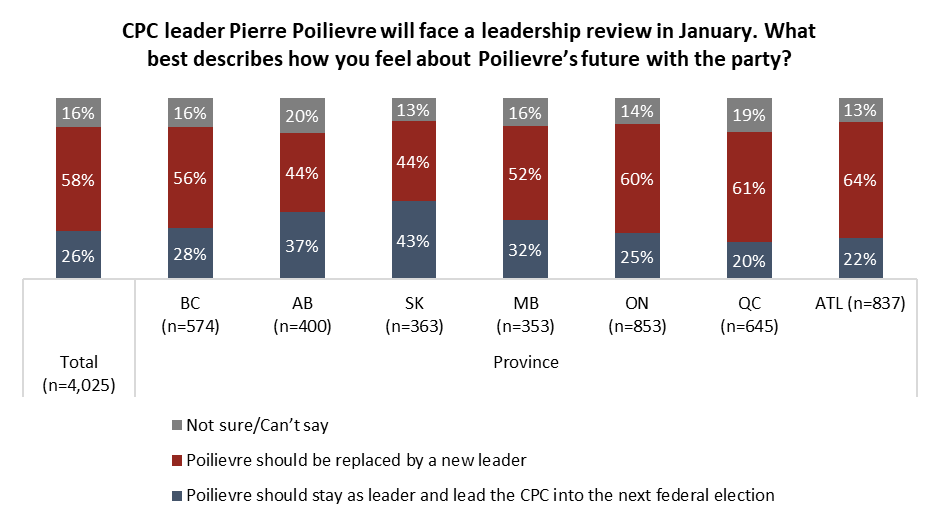
If it were up to most Canadians, the Conservatives would exit their January convention with an opening at the top of the party. Approaching three-in-five (58%) believe Poilievre should be replaced as leader, outnumbering the one-quarter (26%) who believe he should stay on until the next election.
Poilievre fares better among the crowd he needs to win at the convention: dyed-in-the-wool Conservative supporters. Three-quarters (75%) of those who say they will definitely support the CPC in the next election believe Poilievre should stay on to contest it. The support fades the further from the centre of the CPC vote universe. Those who would “certainly” consider the CPC are split as to whether they believe Poilievre should stay on and those who would “maybe” consider the party are most likely to want him to go (61%):
In the April election, Poilievre led the Conservatives to the highest percentage of popular vote the party (in its various iterations) had won since 1988. The CPC also increased its seat count by 24. Indeed, the campaign was successful by many metrics except the most important one: securing enough seats in Parliament to form government.
In the post-Harper era, past Conservative leaders who have come close to defeating the Liberals but weren’t able to get over the hump were not afforded a second chance to guide the party into an election. The broad expectation is that Poilievre isn’t likely to face trouble at the January convention, especially considering there are no publicly declared alternative leadership bids organizing to dethrone him.
But evidently there are many who supported the party in April who have their doubts. One-quarter (26%) of recent CPC voters believe Poilievre should be replaced as leader. Although a minority opinion compared to the majority (58%) who want him to lead the party into the next election, the minority is growing compared to August, when 68 per cent wanted him to stay and 18 per cent wanted him to go.
Regardless of whether Poilievre stays or goes, the challenge for the Conservatives will be finding enough votes to outpace the Liberals in the next election. Those votes may need to come from the tents of the other major political parties. The challenge for Poilievre if he remains as leader is he’ll need to overcome those groups’ overwhelmingly negative views of him. Nearly all of those who voted Liberal (93%) and NDP (90%) in April say they have an unfavourable view of Poilievre; he fares only slightly better among those who voted for the Bloc Québécois (78%, see detailed tables).

The Conservative stronghold is the two prairie provinces, Alberta and Saskatchewan, where the party received nearly two-thirds of the popular vote and 47 of the 51 parliamentary seats in those two provinces. Despite those overwhelmingly electoral results, Poilievre does not receive significantly more support for him staying as leader in those provinces. Elsewhere, notably in provinces where the Conservatives will need to gain seats to surpass the Liberals, most residents would prefer the CPC enter the next election with a new leader:
Is the party too far to the right or the right place politically?
The political dynamic in Canada has shifted significantly after the resignation of former Prime Minister Justin Trudeau and his replacement by Mark Carney at the helm of the Liberal party. Carney immediately signalled a new direction from his predecessor by cancelling the unpopular consumer carbon tax. He also has thrown the support of Ottawa behind a new pipeline between Alberta and B.C., much to the consternation of some on the party’s left.
Related:
- Pipeline Push: Majority of Canadians, including B.C. residents support the idea of a pipeline to the north coast
- Pipeline Politics: Post MOU announcement, Carney’s approval unchanged in B.C., picks up in Alberta
In many other ways, Carney has intentionally shifted the politics of the Liberals away from Trudeau’s, including on identity and gender.
Overall, Carney’s Liberals are occupying the centre of the political spectrum compared to the more left-ward lean of the Trudeau Liberals.
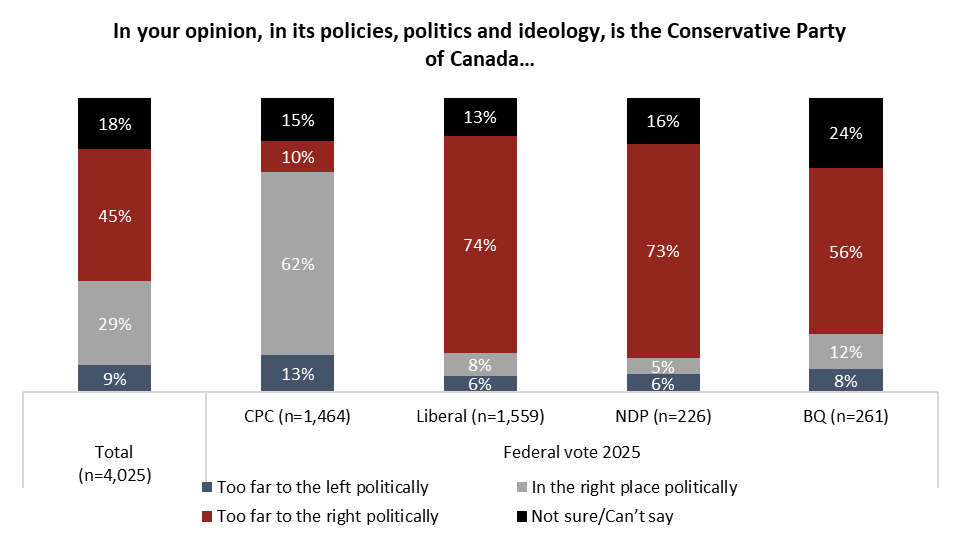
Where does that leave Poilievre and the Conservatives? Since taking over in 2022, Poilievre has pulled the party to the right with a populist bend. A plurality of Canadians (45%) describe the party as “too far to the right politically”. Three-in-ten (29%) believe it is in the right place politically.
Among those who voted for the party in 2025, most (62%) believe it is in the right place politically. Overwhelmingly, those who supported the other three major political parties believe the party is too far to the right:
The country’s current political spectrum is such that there are fewer right-aligned voters (27% of Canadians) than left-aligned ones (34%) and both are outnumbered by those who describe themselves as “somewhere in the middle” (38%).
The Conservatives under Poilievre have been very successful at capturing the right-side of the political spectrum. In 2025, the far-right People’s Party of Canada received just 0.7 per cent of the popular vote, a steep decline from the five per cent it received in 2021. But that has perhaps led to the party’s support hitting a ceiling and led to many Canadians believing the party has moved too far to the fringes (45% said so in August).
Whether it is Poilievre or another leader who is at the helm of the Conservative party, the CPC’s challenge is to differentiate the party from the Liberals while also winning over enough of the plurality of Canadians (38%) who describe themselves as “somewhere in the middle” on the political spectrum. For now, two-in-five (38%) in that group believe the party is “too far to the right politically”. A majority of those on the right believe the party is in the right place on the political spectrum:
Survey Methodology
The Angus Reid Institute conducted an online survey from Nov. 26 to Dec. 1, 2025, among a randomized sample of 4,025 Canadian adults who are members of Angus Reid Forum. The sample was weighted to be representative of adults nationwide according to region, gender, age, household income, and education, based on the Canadian census. For comparison purposes only, a probability sample of this size would carry a margin of error of +/- 1.5 percentage points, 19 times out of 20. Discrepancies in or between totals are due to rounding. The survey was self-commissioned and paid for by ARI.
For detailed results by age, gender, region, education, and other demographics, click here.
For detailed results by self-placement on the political spectrum and whether respondents would support the CPC in a future election, click here.
For PDF of full release, click here.
For questionnaire, click here.
MEDIA CONTACT:
Shachi Kurl, President: 604.908.1693 shachi.kurl@angusreid.org @shachikurl
Dave Korzinski, Research Director: 250.899.0821 dave.korzinski@angusreid.org
Jon Roe, Research Associate: 825.437.1147 jon.roe@angusreid.org