

Half of Canadians say they would be ‘ashamed to call him PM’, a 10-point increase from 2023
August 21, 2025 – Conservative leader Pierre Poilievre has easily slain the 200-headed hydra he faced in his Battle River-Crowfoot byelection, securing his return to parliament, but it remains to be seen what awaits him in the arena of January’s national convention in Calgary.
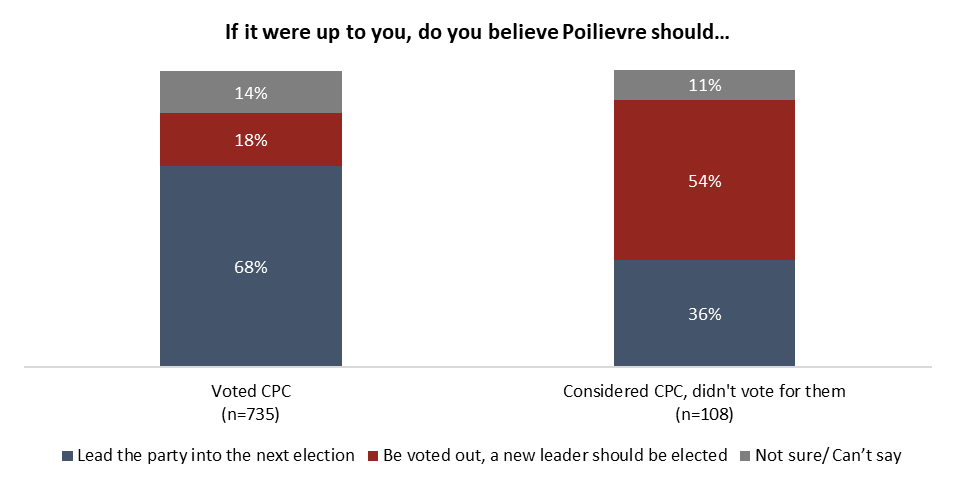
New data from the non-profit Angus Reid Institute suggests that Poilievre still holds the support of most Conservative voters (68%) but the group of voters who could have made the difference between defeat and governing the country want a new leader. A majority (54%) of Canadians who considered voting Conservative during the campaign but ultimately decided against it want Poilievre to be voted out in January.
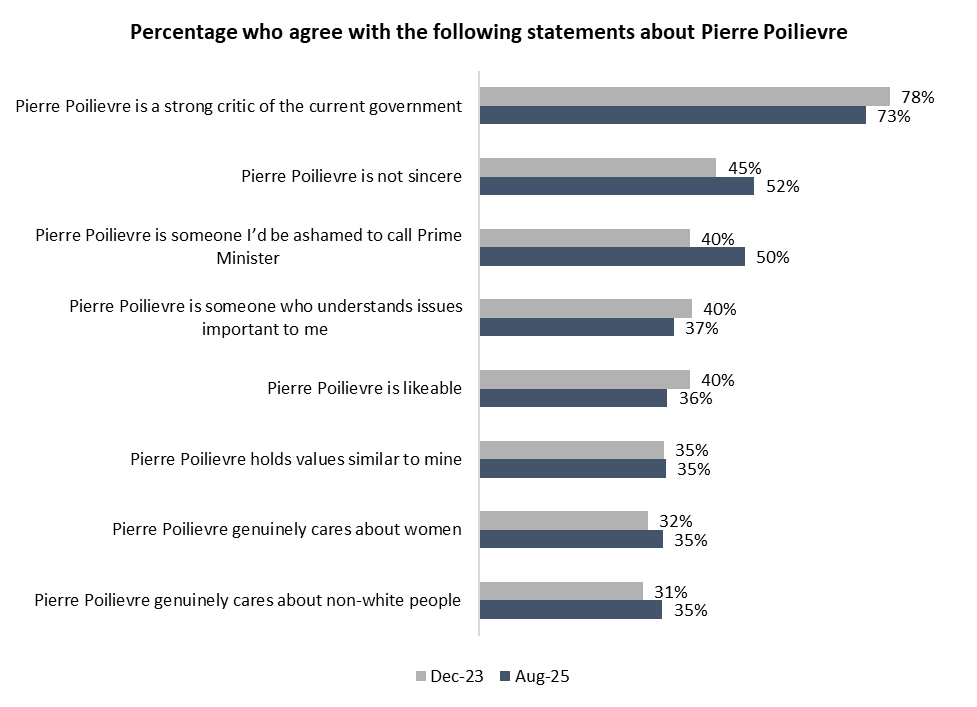
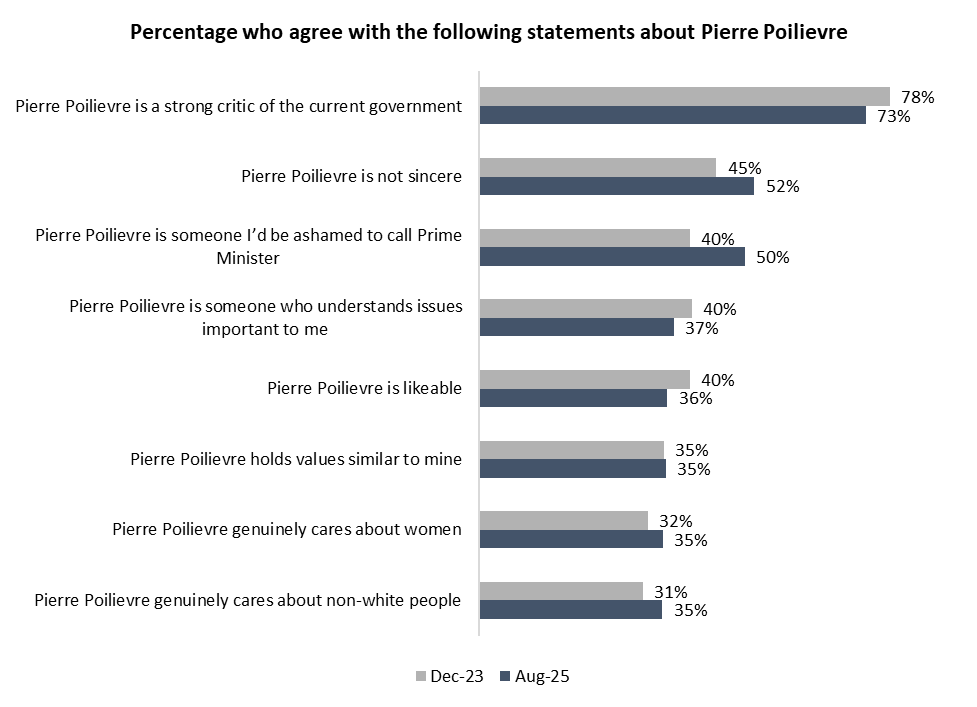
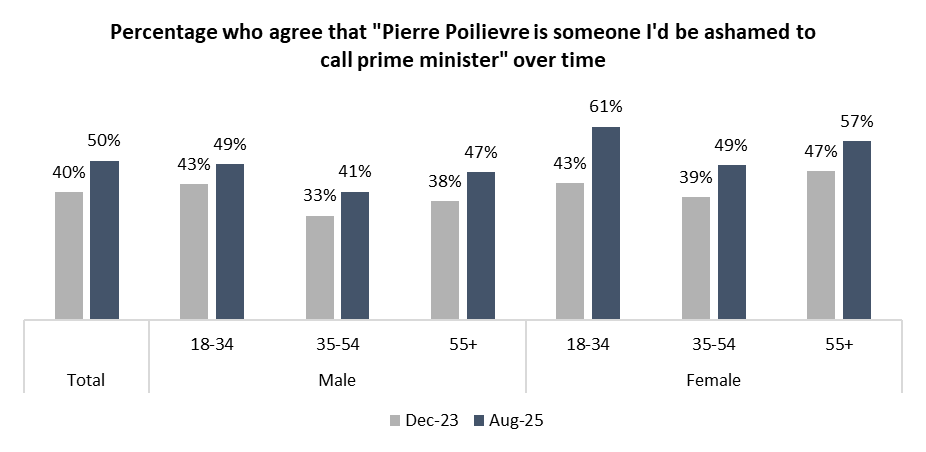
Poilievre led the party to its strongest electoral showing in more than four decades in April but did so while being viewed negatively by most Canadians (a fact perhaps acknowledged by the party when it dropped him from campaign ads aired during the final week of the election). While he is viewed by Canadians as a strong critic of the current government (73% say this), half believe him to be insincere (52%) and say they would be ashamed to call him the prime minister (50%). Both of those latter measures have increased compared to data taken by ARI in December 2023 (45%, 40% respectively).
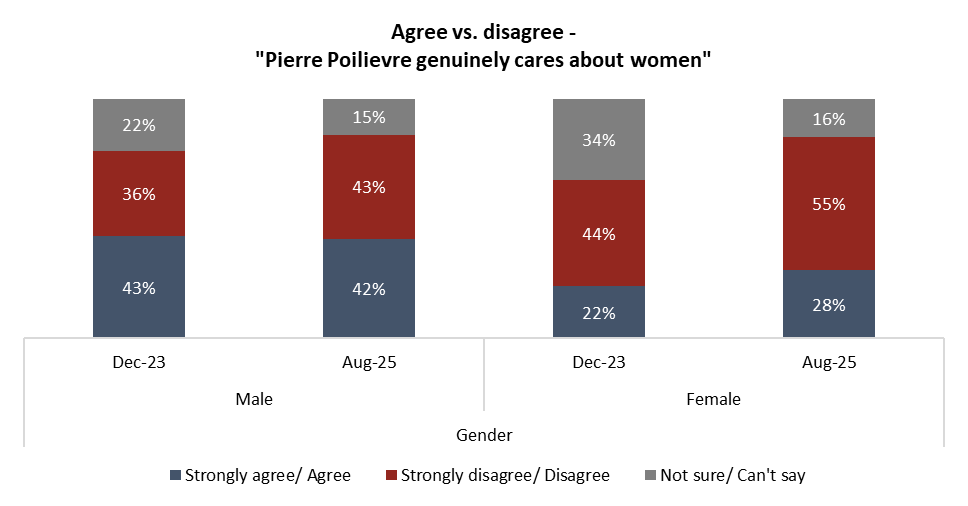
Doubts remain among Canadians that Poilievre shares their views (35%), understands the issues that are important to them (37%), and genuinely cares about women (35%), the latter being a consistent bugaboo for the Conservative leader as he has struggled to generate positivity among women throughout his time as leader.
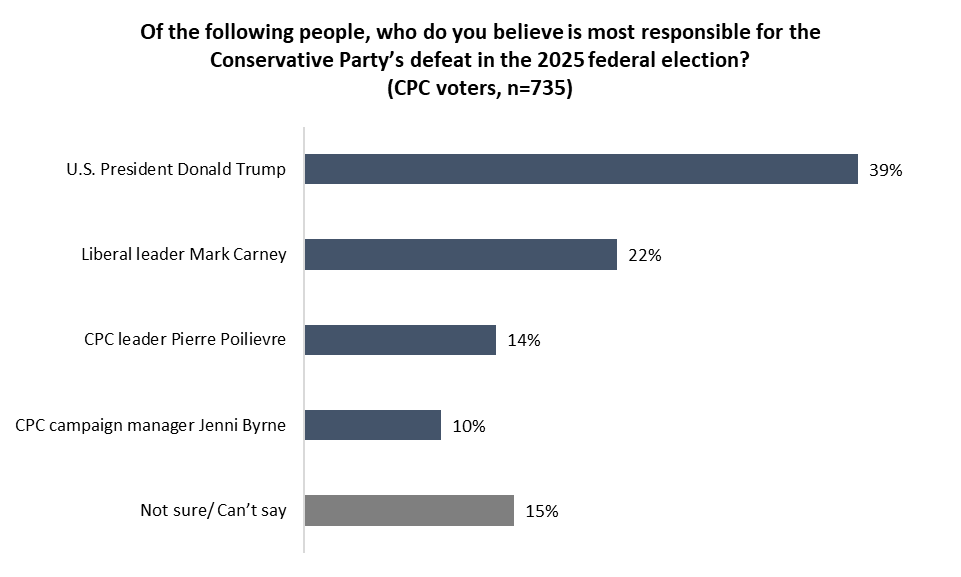
For now, Poilievre faces only a vote from other party members, not the electorate. Conservative voters are more likely to blame U.S. President Donald Trump (39%) and Liberal leader Mark Carney (22%) than Poilievre for the election loss (14%), which may help him come January.

More Key Findings:
- Among criticisms of the CPC campaign presented to respondents, Conservative voters are most likely to believe that the party should have pivoted once the carbon tax was off the table (61% agree). Other criticisms resonate more with those who considered voting Conservative but didn’t end up doing so on election day, including that Poilievre sounded too much like Trump (59%), the campaign was too negative (59%) and the Conservatives didn’t articulate a clear plan for the country (70%).
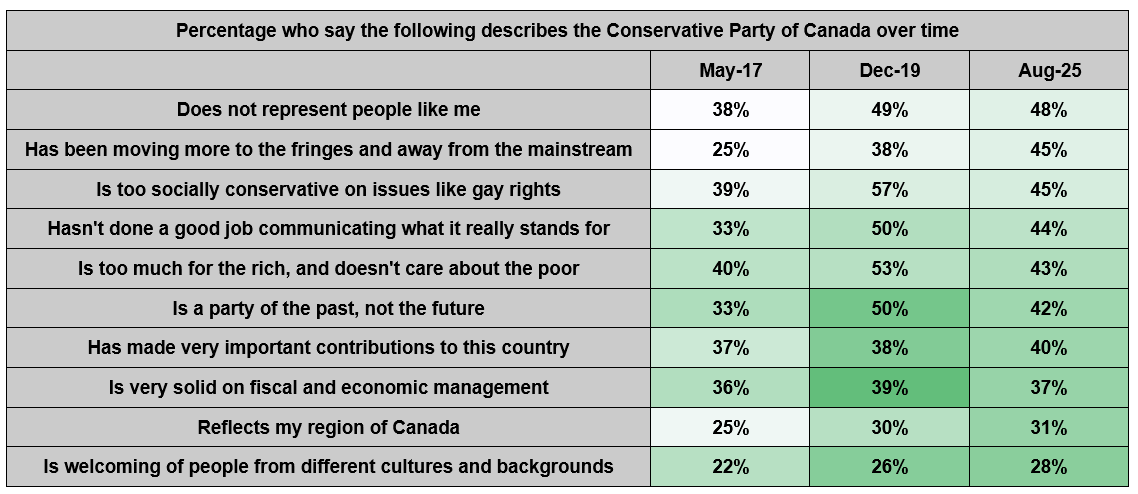
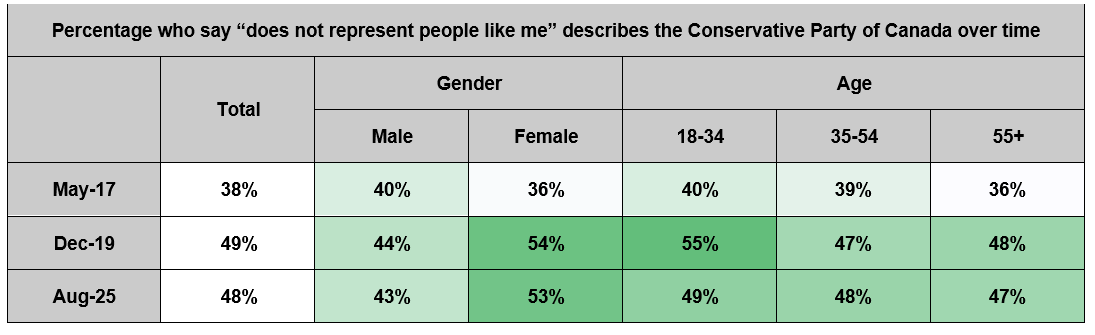
- Half of Canadians (48%), including a majority of women (53%) say that the Conservative party “does not represent people like them”. In 2017, two years after Harper’s defeat by Justin Trudeau, two-in-five (38%) Canadians said the same.
- Approaching half (45%) of Canadians say the Conservative party has moved more towards the fringes (despite earning its highest vote share since the 1980s). In 2017, 25 per cent said the same.
INDEX
Part One: Election post-mortem
-
CPC voters say Trump and Carney, not Poilievre, are responsible for election loss
-
Conservatives wanted post-carbon tax pivot, others say ‘Poilievre sounded too much like Trump’
-
Should the party stay the course, move further to the right, or move to the left?
Part Two: Views of Pierre Poilievre
-
Canadians more likely to view Poilievre as insincere than two years ago
-
A Team Canada approach to Trump?
-
Majority of women don’t believe CPC leader ‘genuinely cares’ about them
-
CPC voters want him to stay, but those who considered the party want him to go
Part Three: The Conservative brand and the Poilievre effect
-
Less likely to be viewed as ‘for the rich’ than 2019, but worries over move to ‘fringe’
-
Representative of the Prairies but not elsewhere?
-
Challenges among women?
Part One: Election post-mortem
After the votes of the 2025 federal election were counted, the Conservative Party of Canada found themselves in a familiar position in the party’s post-Stephen Harper era: second to the Liberals in seats and in opposition rather than in government. While there were plenty of positives of the campaign – they held the Liberals to a minority government and received the highest share of the popular vote a conservative party had received since Brian Mulroney’s majority win in 1988 – most accused the party of squandering what was a huge polling advantage earlier in the year.
CPC voters say Trump and Carney, not Poilievre, are responsible for election loss
But the early months of 2025 prior to the start of the election campaign saw plenty of political upheaval. U.S. President Donald Trump returned to the White House and upended years of Canada-U.S. relations with threats and implementations of tariffs, and musings about annexation. The deeply unpopular Prime Minister and Liberal party leader Justin Trudeau resigned and was replaced by former Bank of Canada governor Mark Carney, who immediately came into office and axed the carbon tax, taking away the club Conservative leader Pierre Poilievre had been battering the Liberals with.
In retrospect, Conservative voters are more likely to blame Trump (39%) and Carney (22%) for the Conservative party defeat in the election than those on the CPC side – either Poilievre (14%) or CPC campaign manager Jenni Byrne (10%). The latter has taken plenty of heat for the party’s performance.
Conservatives wanted post-carbon tax pivot, others say ‘Poilievre sounded too much like Trump’
In the aftermath of the election night loss, there have been plenty of criticisms of the Conservative campaign. Some believed the party needed to – but didn’t – pivot when Carney axed the carbon tax. Others have criticized the messaging of the campaign for not outlining a clear plan for the country or being too negative. But perhaps given the way the political grounds shifted in 2025, others say it was Poilievre’s tendency to emulate Trump that cost him key votes in April.
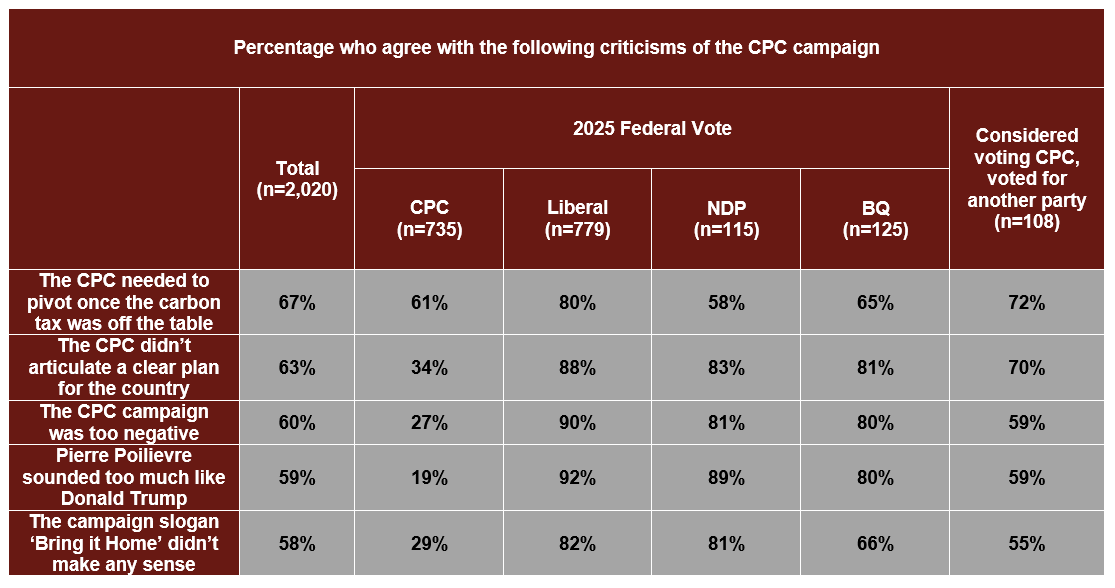
A majority (61%) of those who voted Conservative believe the party needed to change its messaging after Carney dropped the carbon tax. But they are less likely to agree that the CPC didn’t have a clear plan for Canada (34%), the campaign was too negative (27%) or that Poilievre sounded too much like Trump (19%).
However, those criticisms do appear to resonate among those who considered voting for the Conservatives but didn’t in the end. In that group, seven-in-ten (70%) believe the CPC did not “articulate a clear plan for the country”, and three-in-five (59%) call the campaign “too negative” or that Poilievre sounded too much like Trump (59%):
Should the party stay the course, move further to the right, or move to the left?
Post-election, Carney has moved the Liberals farther into the political centre than they were under his predecessor Trudeau. He’s even earned the support of the Conservatives on key pieces of his legislative agenda. While some believe this has opened up opportunities to the left of the spectrum for other parties, others say Carney has eaten Poilievre’s lunch, making the Conservatives look like “waterboys”.
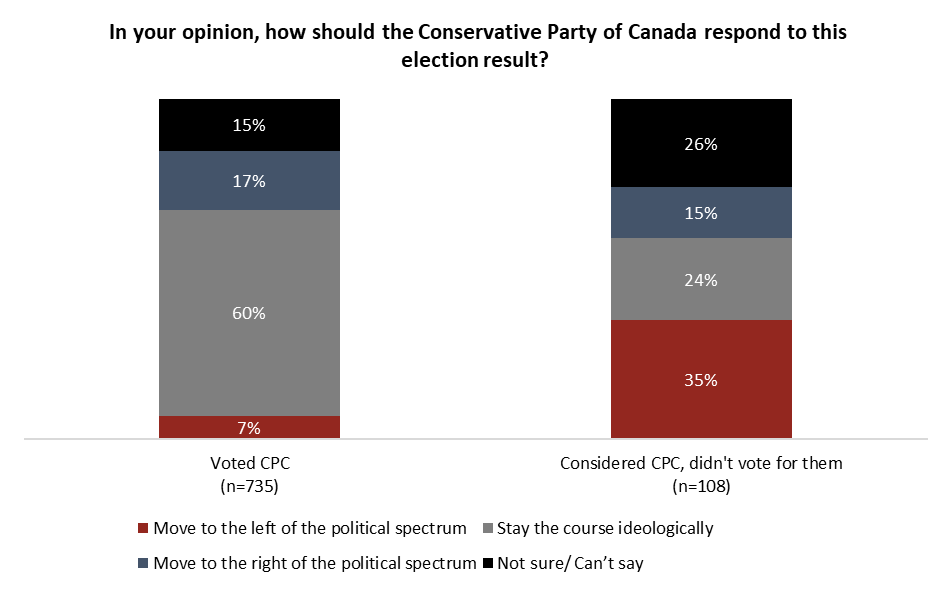
Most Conservative voters want the party to stay where it is on the political spectrum (60%), while one-in-six (17%) believe the party should shift further to the right. There is little consensus among those who considered voting for the CPC in April but didn’t on election day as to where the party should position itself after the election loss:
Part Two: Views of Pierre Poilievre
Poilievre secured his return to parliament with an overwhelming win in the Battle River-Crowfoot byelection. Although it was one of, if not the, safest Conservative riding in the country, Poilievre had to survive an army of 200 candidates to do so.
The byelection win secures him his place as leader of the opposition but does not guarantee his future at the helm of the party he has led since 2022. That will happen in January, when he faces party members still looking for answers for the party’s election loss in a leadership vote.
Canadians more likely to view Poilievre as insincere than two years ago
In the 2025 election, Poilievre earned a larger proportion of the popular vote than past leaders Erin O’Toole, Andrew Scheer, or even Stephen Harper, who won a majority government. But he still remains unpopular among the majority of Canadians.
In fact, he has made little headway across a number of evaluations that the Angus Reid Institute first asked two years ago. While he’s still viewed as a strong critic of the government (73% agree), those who believe he understands issues important to them (37% agree) and holds values similar to theirs (35% agree) number fewer than two-in-five. Both of those have changed little from December 2023.
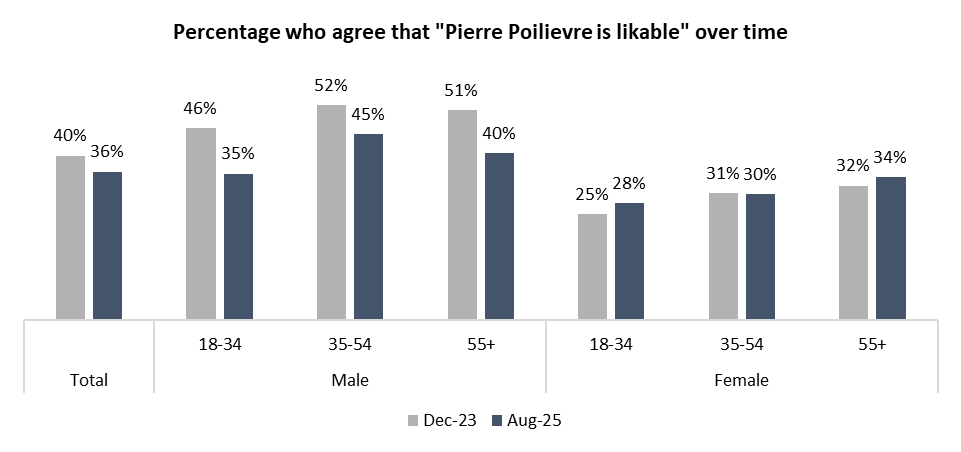
And some key assessments have trended negatively. Whether or not people agree that Poilievre is likeable has dropped from 2023 (40% to 36%). And the biggest changes are seen on two statements that are also referendums on his likability. The proportion of Canadians who believe he is not sincere has risen seven points (45% to 52%), while half (50%) now say they’d be ashamed to have Poilievre as prime minister, an increase of 10 points from 2023:
A Team Canada approach to Trump?
Poilievre’s history as a strong critic of the government is one of his defining traits. But even among Conservative voters, there appears to be a sense that there are times and places where it should be cast aside.
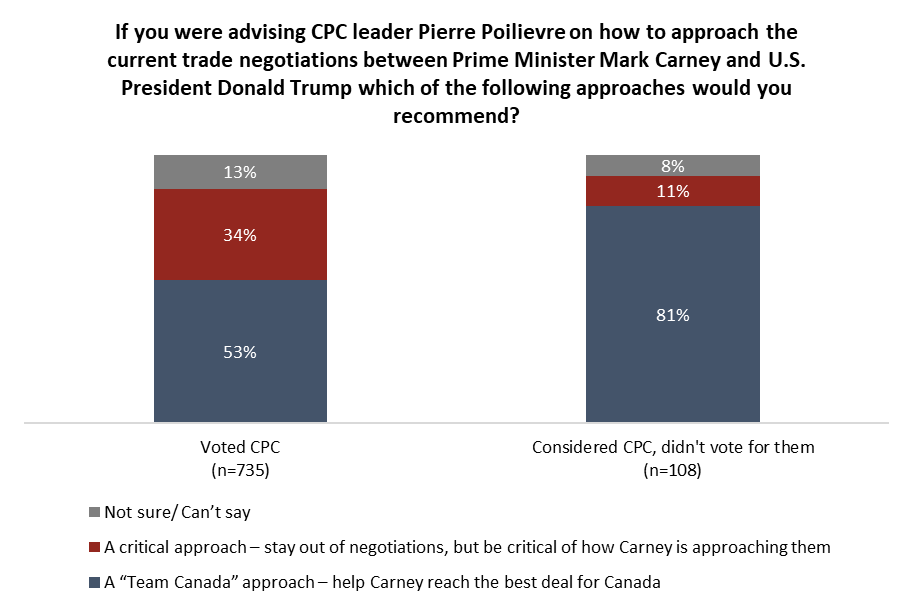
Those who voted Conservative in April, and those who were considering it but ended up not doing so on election night, were asked how Poilievre should approach the ongoing trade negotiations between Carney and the United States. Half (53%) of recent CPC voters believe Poilievre should take a “Team Canada” approach and help Carney reach the best deal for Canada, while one-third (34%) believe instead Poilievre should stay out of negotiations and lean into his critical side. Those who considered the party during the campaign choose the former path by an eight-to-one margin:
Majority of women don’t believe CPC leader ‘genuinely cares’ about them
Poilievre and his party’s struggle to gain favourability and support among women has been well documented by the Angus Reid Institute in his time as leader. There has been a consistent gender gap in favourability of the Conservative leader, which likely played a role in the polling gap between his party and the Liberals among women during the campaign.
Related:
- Federal leadership: Trudeau enjoys end of year approval bump; Poilievre remains deeply unpopular with women
- Election 2025: Incumbent lead holds as CPC edge among men dwarfed by Liberal advantage among women
In December 2023, one-third of women (34%) were unsure whether they agreed or disagreed with the statement “Poilievre genuinely cares about women”. The uncertainty has halved (16%), and not in Poilievre’s favour, with a majority (55%) of women now believing he does not care about issues for their gender:
Further, it appears Poilievre’s downward trend in likability is evidence that his favourability among men is waning. The percentage of men who agree that Poilievre is likable has declined by at least seven points among all age groups while his unlikability among women has persisted:
The decline in likability coincides with an increase in those who would be embarrassed if Poilievre was leading Canada. The latter sentiment has become much more common among women, but also increased among men of all ages:
CPC voters want him to stay, but those who considered the party want him to go
The January 2026 Conservative convention now awaits Poilievre as party members decide whether to give him another shot at securing the first Conservative government since Harper was defeated by Trudeau. More than two-thirds (68%) of those who voted Conservative in April want Poilievre to stay, but there are three-in-ten either with doubts (14% unsure) or who want a new leader (18%).
What Conservative members will likely also weigh is Poilievre’s appeal not just among the 41 per cent of the electorate who voted for the party, but those who didn’t and who could make the difference whenever the next election comes. A majority (54%) of Canadians who mulled voting for the Conservatives during the campaign but didn’t on election day want a new Conservative leader when they consider their next vote:

Part Three: The Conservative brand and the Poilievre effect
Less likely to be viewed as ‘for the rich’ than 2019, but worries over move to ‘fringe’
The Conservative Party has had nearly three years with Poilievre at the helm. To evaluate how perceptions of the party has changed, the Angus Reid Institute presented Canadians with a series of statements about the party. Respondents were asked to say whether the statement described the party or not using a slider on a five point scale (see the questionnaire here).
These statements were previously asked to Canadians at two other critical junctures for party: when Scheer took over the party in 2017 as permanent leader in the wake of Harper’s loss to Trudeau and in 2019 after Scheer resigned.
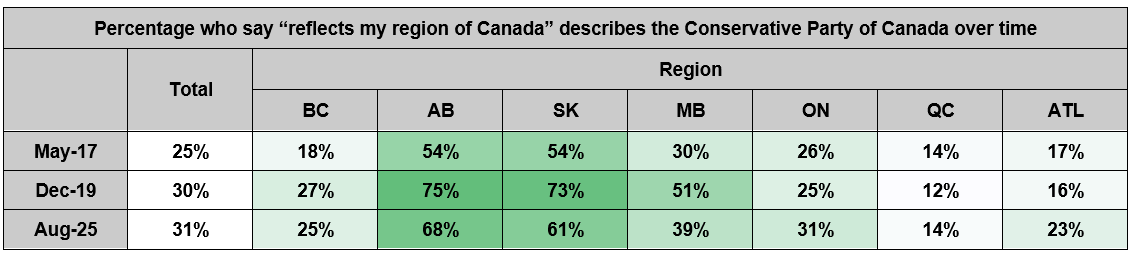
There are perceptions of the party that have been consistent over the past eight years. Over time, approaching two-in-five have viewed the party as making important contributions to the country and a strong manager of the economy. But fewer than three-in-ten believe it is a party that “is welcoming of people from different cultures and backgrounds”. As well, the party continues to struggle to be viewed as representative of all regions of Canada.
There are also perceptions of the party that have become more common over time. Half (48%) currently say the party does not represent people like themselves, an increase from the two-in-five (38%) who said the same two years after the end of Harper’s tenure. As well, since 2017, the percentage of people who believe the party is moving more to the fringes has increased by 20 points. Canadians also were more likely to view the party as a modern one, than one of the past, in 2017 than they are now.
There is also evidence of the difference between the effects of the Scheer era and the Poilievre era. Canadians are less likely to view the party as too socially conservative currently than they were post-Scheer. And evidently Poilievre has made some headway to increasing his party’s appeal to the working class (43% describe it as “too much for the rich”), compared to Scheer (53%):
It’s important to note that the share of people who have voted Conservative has increased since the 2015 election (2015: 5.6 million votes, 32% of the popular vote; 2019: 6.2 million votes, 34%; 2021: 5.7 million votes, 34%; 2025: 8.1 million votes, 41%).
However, the perception among those who are not Conservative voters that the party has moved more to the fringes has increased significantly. Few among Conservatives – again, a growing portion of the population – would agree:

Representative of the Prairies but not elsewhere?
The Conservatives have dominated in Alberta and Saskatchewan in their four election losses to the Liberals since 2015. Poilievre successfully made some headway in B.C. and Ontario in 2025, but the party still struggled to gain seats in the seat-rich city of Vancouver, and failed to generate much support in Quebec.
In all provinces outside of Alberta and Saskatchewan, the view that the Conservative Party represents their region continues to be a minority one:
Challenges among women?
Poilievre’s personal favourability struggles among women was noted above. The perception of the party is perhaps strongly tied to its leader. Post-Scheer and in the Poilievre era, a majority of women believe the party does not represent them. That was not the case in the wake of Harper’s departure:
Survey Methodology
The Angus Reid Institute conducted an online survey from Aug. 15-18 2025, among a randomized sample of 2,020 Canadian adults who are members of Angus Reid Forum. The sample was weighted to be representative of adults nationwide according to region, gender, age, household income, and education, based on the Canadian census. For comparison purposes only, a probability sample of this size would carry a margin of error of +/- 1.5 percentage points, 19 times out of 20. Discrepancies in or between totals are due to rounding. The survey was self-commissioned and paid for by ARI.
For more information on our polling methods, click here.
For detailed results by age, gender, region, education, and other demographics, click here.
For PDF of full release, click here.
For questionnaire, click here.
Image – Pierre Poilievre/ Facebook
CONTACT:
Shachi Kurl, President: 604.908.1693 shachi.kurl@angusreid.org @shachikurl
Dave Korzinski, Research Director: 250.899.0821 dave.korzinski@angusreid.org
Jon Roe, Research Associate: 825.437.1147 jon.roe@angusreid.org