

Generation, politics, and gender shape views on funding, culture, and status of Indigenous Peoples
August 20, 2025 – While issues of land rights, lawsuits, and the legacy of Indian Residential Schools have taken much of the attention in Canada in recent years, there are deep, fundamental questions about Indigenous rights and traditions that underpin many of the views Canadians hold.
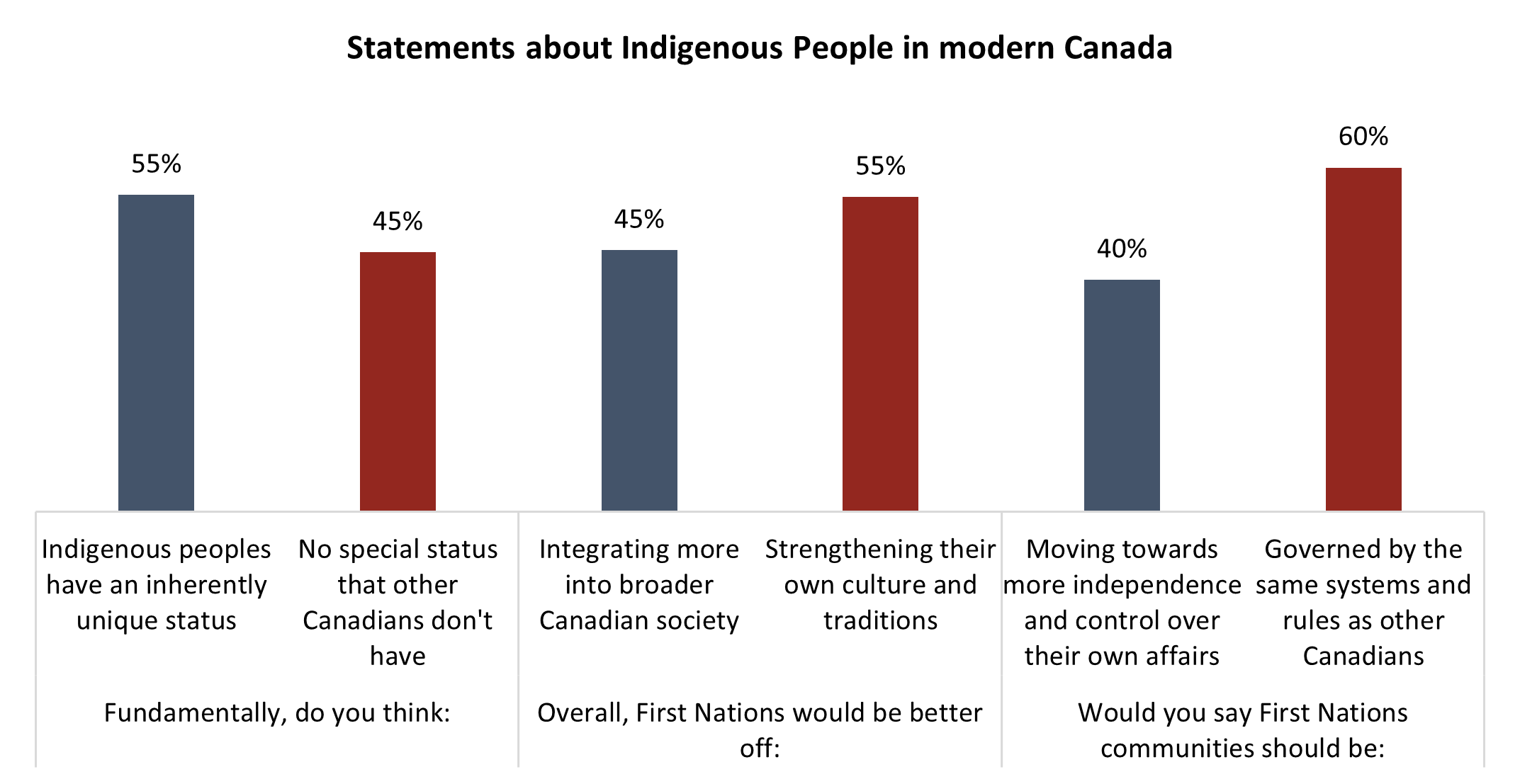
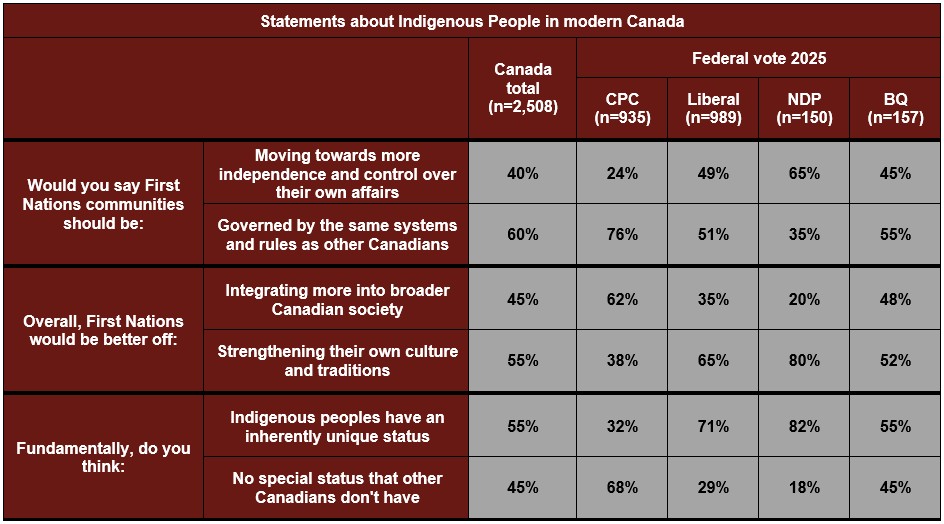
New data from the non-profit Angus Reid Institute finds Canadians divided along generational, political, and racial lines. For example, while a slight majority of Canadians feel that Indigenous People have a unique status in Canada (55%), and the vast majority of Indigenous identifying individuals agree (68%), a large number push back (45%), saying Indigenous Peoples should have the same status as others living in modern Canada, including two-in-three Conservative Party voters (68%).
Men are largely divided about whether or not it would be better for Indigenous People to integrate more into “modern Canadian” culture, whereas women tend to support these groups maintaining their traditional cultural if that’s what they prefer.
Broad agreement on most issues is difficult to find. For example, three-in-10 Canadians say that the federal government is offering too much funding to First Nations’ communities, but the same number feel the current allocation is too little (27%). One-in-five (21%) say that based on what they know, the funding level is about right.

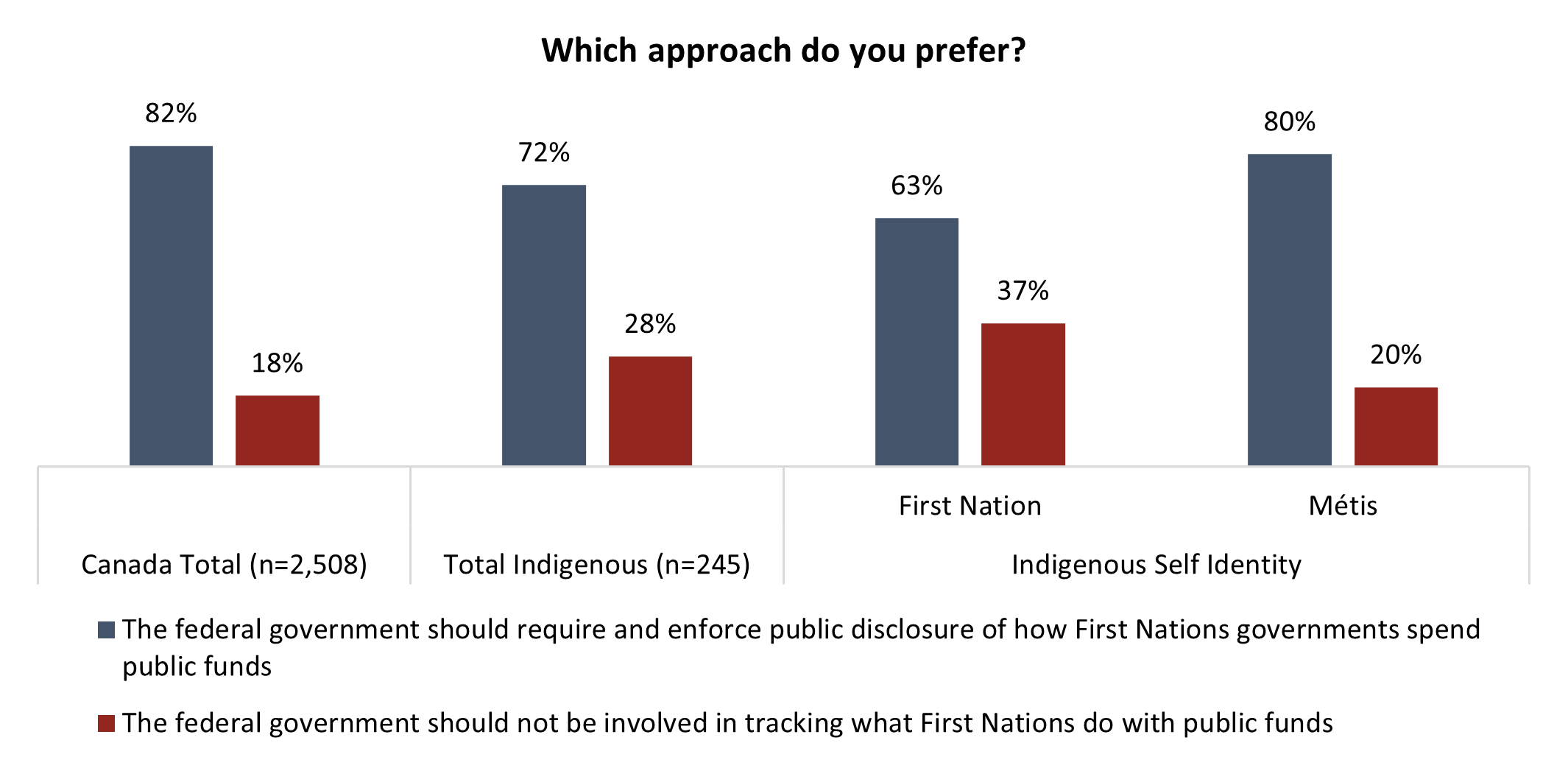
One thing that most, including Indigenous respondents, agree on is that the federal audit requirements under the First Nations Financial Transparency Act that were in effect until 2015 should be re-instated. The federal government stopped enforcing the requirement for First Nations to publish audited financial statements in 2015. Four-in-five (82%) including 63 per cent who identify as First Nation, say this should be brought back.
*A note on sample. The Angus Reid Institute collected responses from those who self-identify as Indigenous in this survey. This is not representative of all Indigenous experiences and perspectives. The total number of responses from Indigenous individuals (245 responses) was weighted within the total sample to be statistically representative at five per cent. Please consider these views as informative but not authoritative.
Part One: Difference of opinion on Indigenous status in modern Canada
-
Indigenous vs non-Indigenous views
-
Gender and generation
-
Regional
-
Political
Part Two: Government Attention and Funding
-
Are conditions improving or worsening for Indigenous?
-
The east-west division on attention paid by provinces
-
Views of federal government funding
-
Four-in-five say more auditing necessary
-
Part Three: History
Part One: Difference of opinion on Indigenous status in modern Canada
The “special constitutional relationship” between Indigenous peoples and the government of Canada is codified in Section 35 of the Constitution Act, 1982, which recognizes and affirms Indigenous rights that predate the constitution. They include “a range of cultural, social, political, and economic rights including the right to land, as well as to fish, to hunt, to practice one’s own culture, and to establish treaties”.
The establishment of Section 35 of the Constitution was not the end of the legal evolution of Indigenous rights, which have been further augmented by the Supreme Court in cases such as R. v. Calder, R. v. Sparrow and R. v. Gladue, the latter of which established rights applied during criminal sentencing to all Indigenous people, whether status or non-status.
Indigenous self-government is recognized as part of section 35 of the Constitution. Some believe this has been infringed upon in recent months with the passing of Bill C-5 federally and Bill 5 in Ontario. Both the federal and provincial legislation look to fast-track development, but at the expense of Indigenous consultation and self-determination, according to Indigenous groups.
Related:
Bill C-5: Canadians support fast-tracking projects, but conflicted over individual elements of the legislation
Bills, Treaties, and UNDRIP: Canadian views of contemporary Indigenous land issues
With all this in the background, on the issue of Indigenous rights and special status, Canada is a nation divided.
For example, on three separate statements about the status, traditions, culture and independence of Indigenous Peoples living in Canada, Canadians show significant disagreement as to which side of the debate they fall. There are considerable variations in these views, across a number of demographics that we will explore in the following section:
Indigenous vs non-Indigenous views
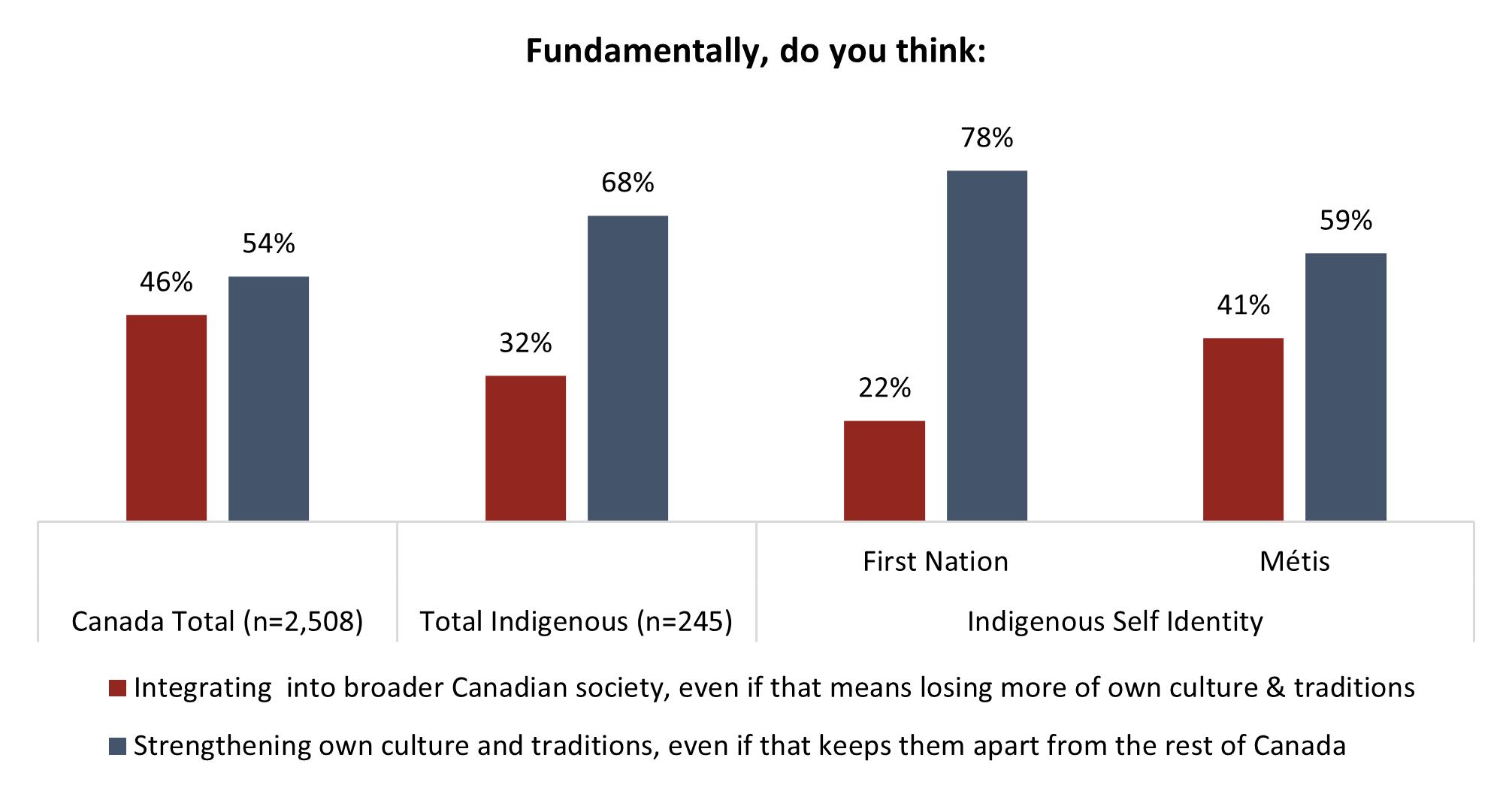
Among the most pronounced splits in these data are the views of those who identify as Indigenous in Canada. These individuals are far more likely to feel that strengthening one’s own culture and traditions is more important than integrating into “broader Canadian society” which may mean abandoning some of those ideas and practices. Those who identify as First Nation are most likely to support this cultural strengthening, as well as moving toward more independence and control, and recognizing special status for Indigenous Peoples (see detailed tables). Among the general population, views are divided close to evenly.
Gender and generation
Across all three of these statement faceoff questions, women are more likely to lean toward recognizing the unique status, culture and tradition of Indigenous People living in Canada, compared to men. Among men, these views are not necessarily strongly in the other direction, but more divided on each side (see detailed tables):

Regional
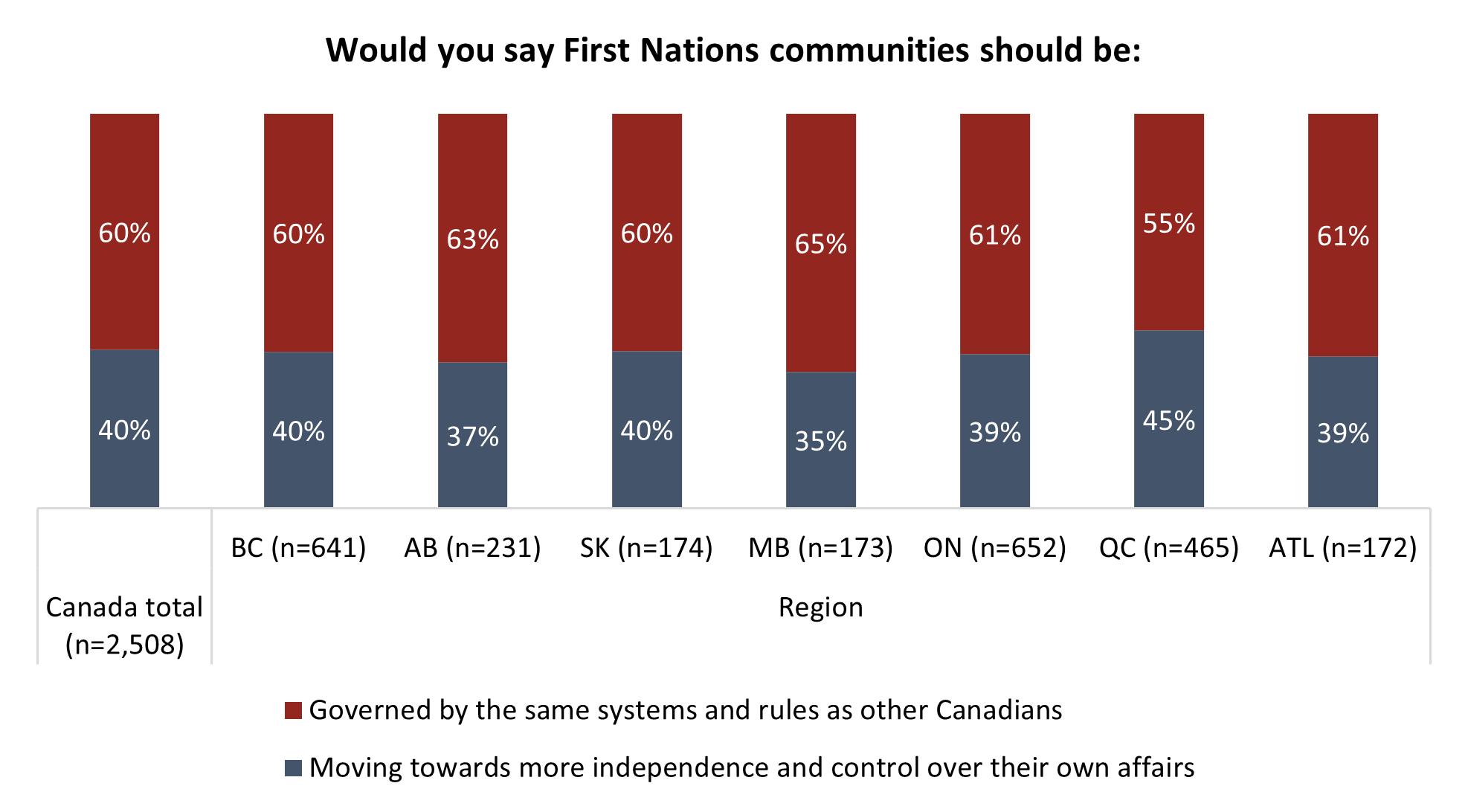
Across the country – as will be seen in subsequent sections of this report – western Canadians tend to be more critical of the funding and attention given to Indigenous Peoples. On the issue of governance, however, these views align with Ontario and Atlantic Canada. Only in Quebec do fewer than three-in-five Canadians say that Indigenous groups should be governed by the same systems and rules as others. For detailed regional results, click here.
 Political
Another factor that drives discord on views of Indigenous status and rights is political perspective. New Democratic Party voters, though far fewer in number now than before April 2025, are most aligned with the predominant Indigenous perspective, whereas Conservatives push back to the highest degree. Liberal Party voters tend to walk a line between these two groups, though it is worth noting that seven-in-10 (71%) say Indigenous People have an inherently unique status:
Part Two: Government Attention and Funding
Under the Trudeau government, significant investment and political attention was given to Indigenous issues. The government claimed reconciliation as a guiding principle and signed the United Nations Declaration on the Rights of Indigenous Peoples (UNDRIP) into federal law.
Bills, Treaties, and UNDRIP: Canadian views of contemporary Indigenous land issues
At the same time, critics argue that despite these commitments, progress on many fronts has been slower than promised — with persistent gaps in clean drinking water access, housing, and economic opportunity — leading some to question whether the attention and funding have translated into meaningful, measurable outcomes.
Are conditions improving or worsening for Indigenous?
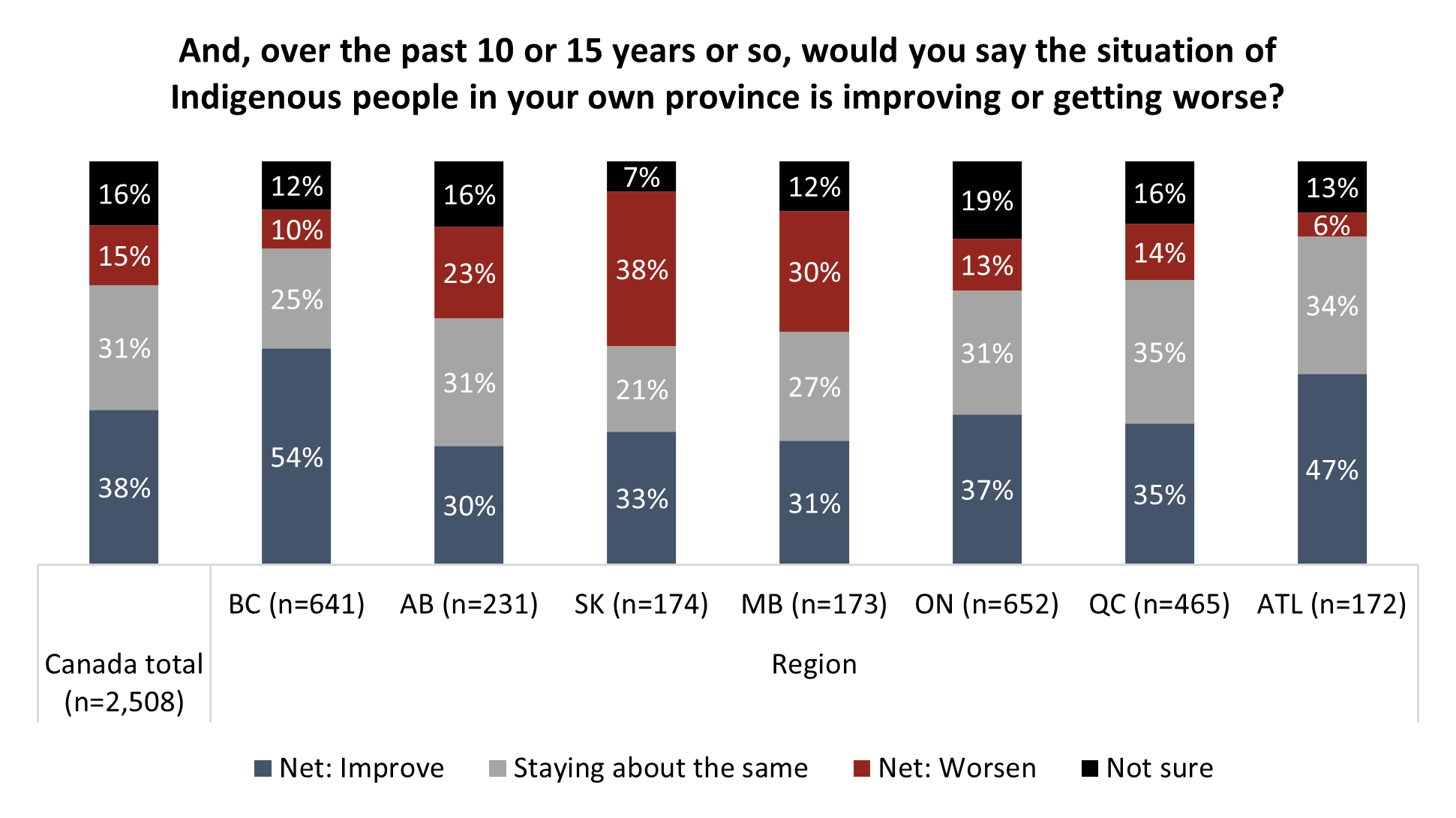
The perception in Canada is generally one of improvement for Indigenous Peoples lives, at least the largest group (38%) feel this way. This is more than twice as many who perceive a worsening in their home province (15%):
 The east-west division on attention paid by provinces
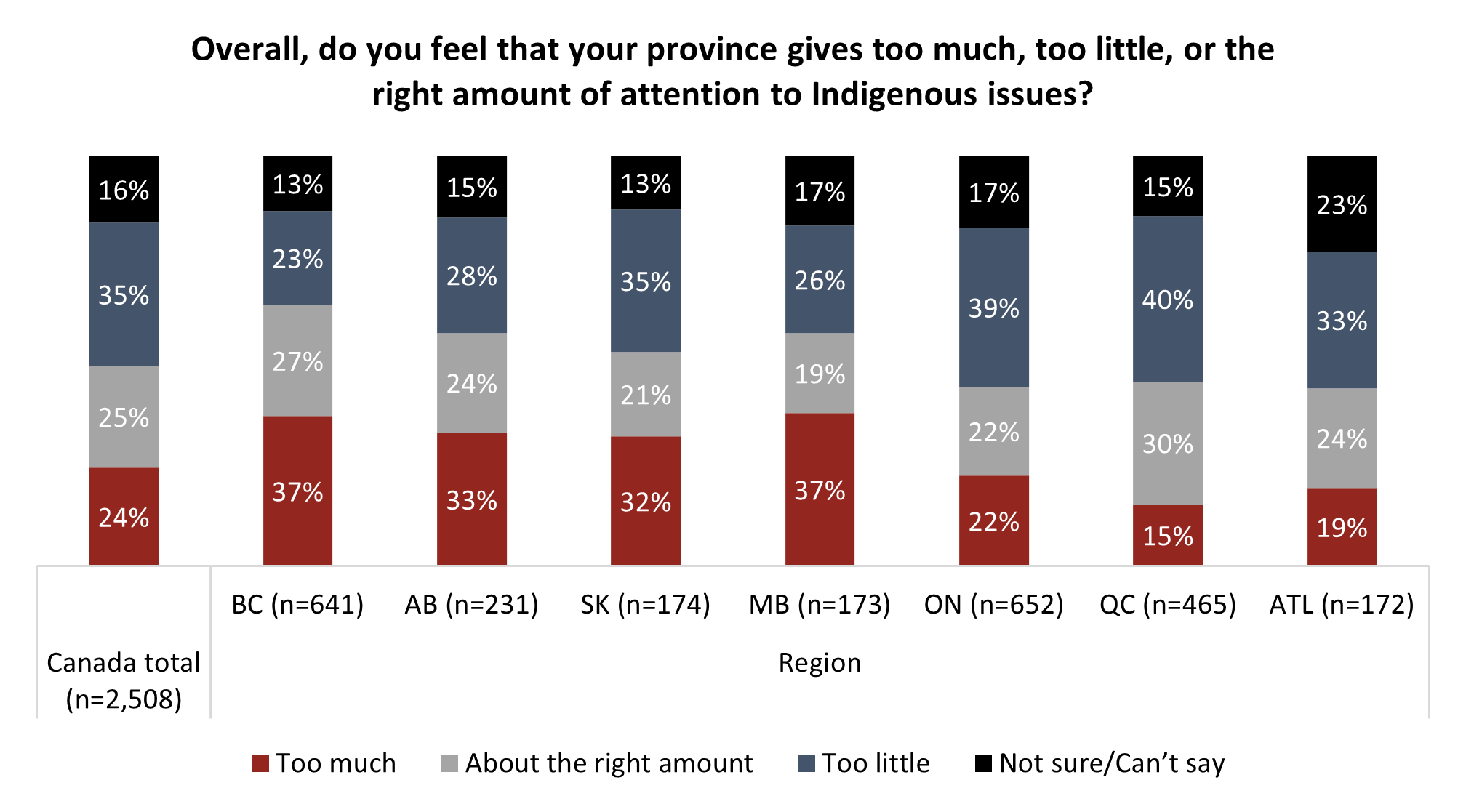
The issue of attention paid to Indigenous issues is one that is discussed at the provincial level as well. Canadians living in the west of the country appear to have a much different perception of attention paid to Indigenous issues than those living in the east. Two-in-five in Ontario and Quebec believe their provincial governments give “too little” attention to Indigenous issues, while B.C. and Manitoba have the highest proportion of people who believe their governments give “too much”.
 Views of federal government funding
The Crown-Indigenous Relations and Northern Affairs Canada department spent approximately $10.9 billion in the 2024-25 fiscal year, the bulk of this money is in transfer payments to Indigenous communities and organizations which is “used advancing reconciliation by settling specific claims and to support self-government agreements to address section 35 rights”, according to the department. The federal Indigenous Services Canada department, with a budget of $24.5 billion in 2024-25, also provides health, child services, education, infrastructure and social programs.
Four-in-five say more auditing necessary
The finances of First Nations is governed by the First Nations Financial Transparency Act, but in 2015, under Prime Minster Justin Trudeau, the federal government stopped enforcing the requirement for First Nations to publish audited financial statements. This has been criticized by members of the First Nations, who have found it difficult to access financial information from their bands.
Four-in-five (82%) Canadians believe the federal government should enforce public disclosure of how First Nations spend public funds, while one-in-five disagree. Those who identify as First Nation are more likely to be in the latter group (37%) but still believe financial accountability for public funds should be a requirement enforced by the federal government (63%):
Part Three: How removing historical figures from public life impacts national conversation
Over the past few years several of Canada’s former political leaders including John A. Macdonald, Egerton Ryerson, and Hector‑Louis Langevin have had their names removed from buildings and other public places because of their roles in the early days of Indian Residential Schools. While some have applauded deplatforming these individuals because of the harm of their legacy, others believe it weakens Canadians’ knowledge of their country’s past.
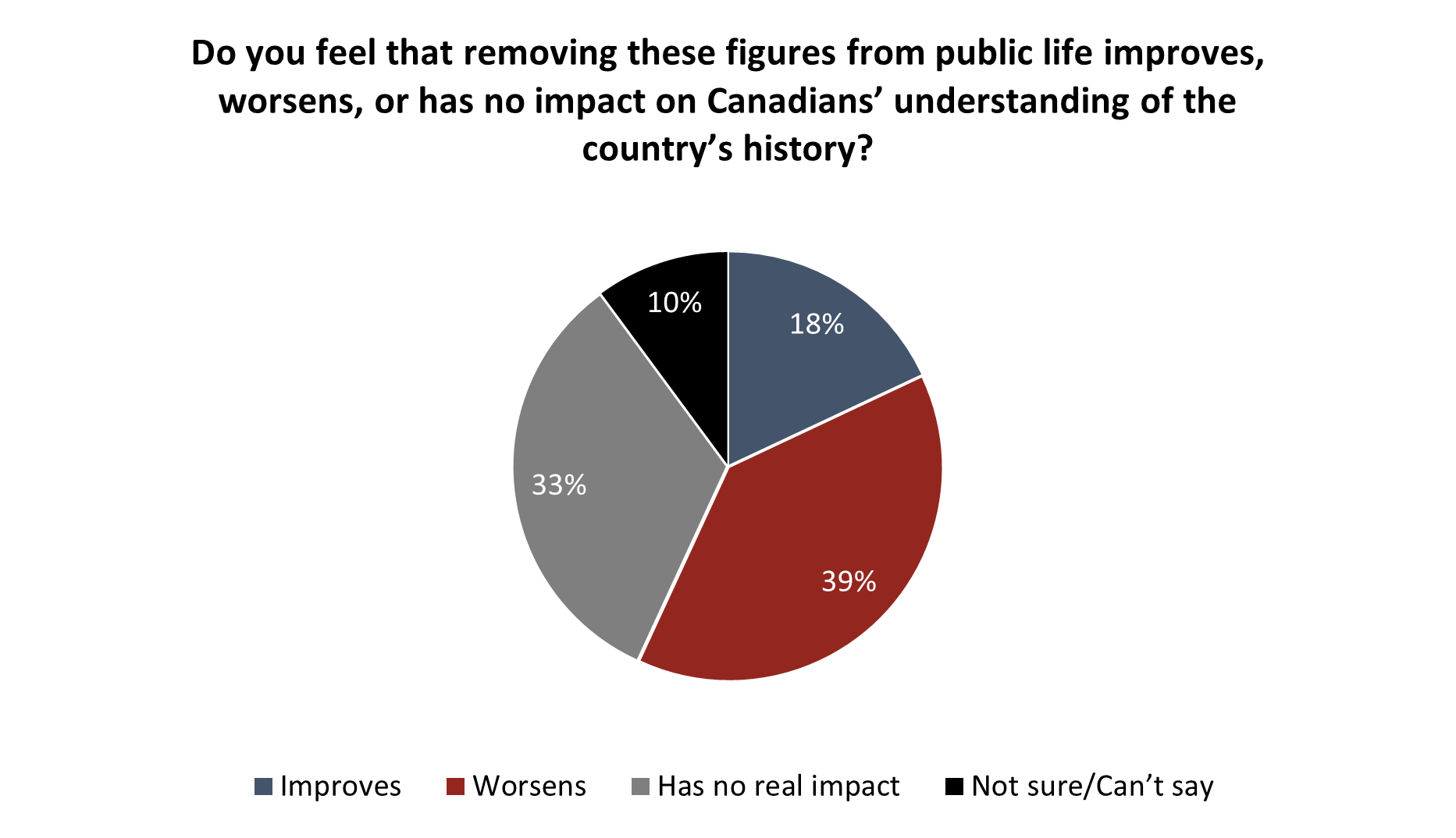
Two-in-five (39%) Canadians believe removing these figures from prominence in public life “worsens” Canadians’ understanding of history, while one-in-five (18%) argue it instead “improves” it. One-third (33%) say changing the names of public institutions and buildings and removing statues doesn’t effect Canadians’ understanding of history at all:
The political divide on this question is evident, as recent Conservative voters are the only group who believes renaming institutions named after Ryerson, Macdonald and their ilk “worsens” Canadians’ appreciation of history. Liberal voters are more divided, with approaching two-in-five (37%) believing it makes no difference:

METHODOLOGY:
The Angus Reid Institute conducted an online survey from July 24 – 29, 2025, among a randomized sample of 2,508 Canadian adults who are members of Angus Reid Forum. The sample was weighted to be representative of adults nationwide according to region, gender, age, household income, and education, based on the Canadian census. For comparison purposes only, a probability sample of this size would carry a margin of error of +/- 1.5 percentage points, 19 times out of 20. Discrepancies in or between totals are due to rounding. The survey was self-commissioned and paid for by ARI. Detailed tables are found at the end of this release.
For detailed results by age, gender, region, education, and other demographics, click here.
For detailed results by those who identify as Indigenous, click here.
For PDF of full release, click here.
For questionnaire, click here.
MEDIA CONTACT:
Shachi Kurl, President: 604.908.1693 shachi.kurl@angusreid.org @shachikurl
Dave Korzinski, Research Director: 250.899.0821 dave.korzinski@angusreid.org