

53 per cent of British Columbians could support a pipeline, but tanker anxiety remains significant hurdle
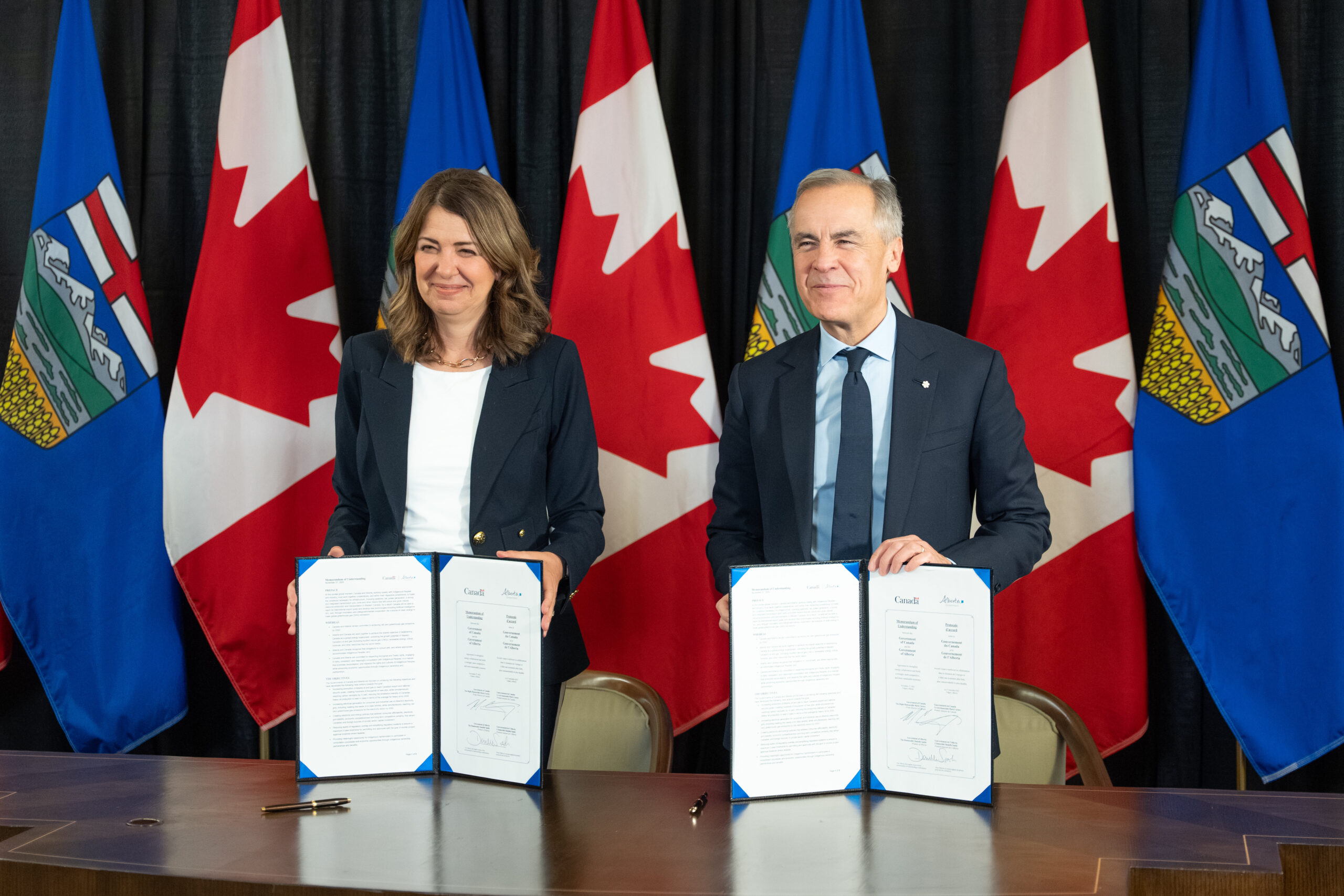
November 27, 2025 – Prime Minister Mark Carney and Alberta Premier Danielle Smith were all smiles as they put their signatures to an energy co-operation agreement that specifies the conditions that must be met for a new bitumen pipeline to the Pacific to be approved under the federal major projects law.
But new public opinion polling data collected November 26th and 27th from the non-profit Angus Reid Institute shows the path from paper to pipeline completion far more complex.
Nationally, there is majority support (60%) for a hypothetical pipeline project from Alberta to the northern coast of British Columbia. One-quarter oppose the idea (25%), while 15 per cent are unsure or have no opinion. Support outweighs opposition in B.C. (53% to 37%), representing a significant increase in amenability compared to the prior decade. These data are also similar to results from seven weeks ago. Current support is unsurprisingly highest in Alberta and Saskatchewan at an identical 74 per cent.
The project itself needs a proponent, something these conditions and clarifications from the federal government are designed to encourage. As Prime Minister Carney stated on Thursday morning in so many words, no private sector proponent, no pipeline.
While Ottawa and Alberta may be aligned, the support and sign off of First Nations, to say nothing of the broader British Columbian population, will require making the case for the pipeline to a population voicing anxiety around lifting a more than 50-year-old moratorium on tanker traffic along BC’s north-west coast.
The agreement includes a carveout for federal environmental laws including an “adjustment” to the tanker ban. Nearly half (47%) either say a carveout is the right policy (26%) or that the tanker ban needs to go entirely (21%). Two-in-five British Columbians (38%) say they would leave the tanker ban in place. Among this group, opposition to the pipeline is near unanimous (88%). A key segment of 15 per cent are unsure and hold the sway of the majority either way.
Indigenous buy-in and co-ownership were a big focus of the memorandum announcement from Smith and Carney and is likely to have a positive impact on how this issue is viewed by some. Three-in-five nationally and a slight majority in B.C. say that these need to be a part of any potential pipeline project.
INDEX
-
Majority support pipeline nationally
-
BC, Quebec most concerned about lifting tanker moratorium
-
Canadians split as to whether provinces should have veto power over pipelines
-
A deep dive into BC opinion
-
Support for pipeline outstrips opposition and uncertainty
-
Regional Picture
-
Political considerations for Carney, Eby
-
Tanker Ban troubles
-
Many see environmental conditions, Indigenous ownership seen as key
-
Majority support pipeline nationally
After months of build up, Prime Minister Mark Carney and Alberta Premier Danielle Smith signed a long-awaited memorandum of understanding on energy in Calgary today. The deal had been discussed for months as Smith angled to have a pipeline from Alberta to northern B.C., similar to the previously cancelled Northern Gateway project, included among developments fast-tracked by Carney’s Major Projects Office. Smith’s government committed $14 million to get the ball rolling and now appears to have secured the federal government’s support – with some conditions.
That includes negotiating with neighbouring province British Columbia, whose Premier David Eby has complained of being left on the sideline of discussions between Carney and Smith. Notably, no route has been announced for the possible pipeline, and no company has signed on to support it.
The concept of a new Alberta to northern B.C. pipeline remains popular among Canadians with a majority (60%) saying they support the project and one-quarter (25%) opposed.
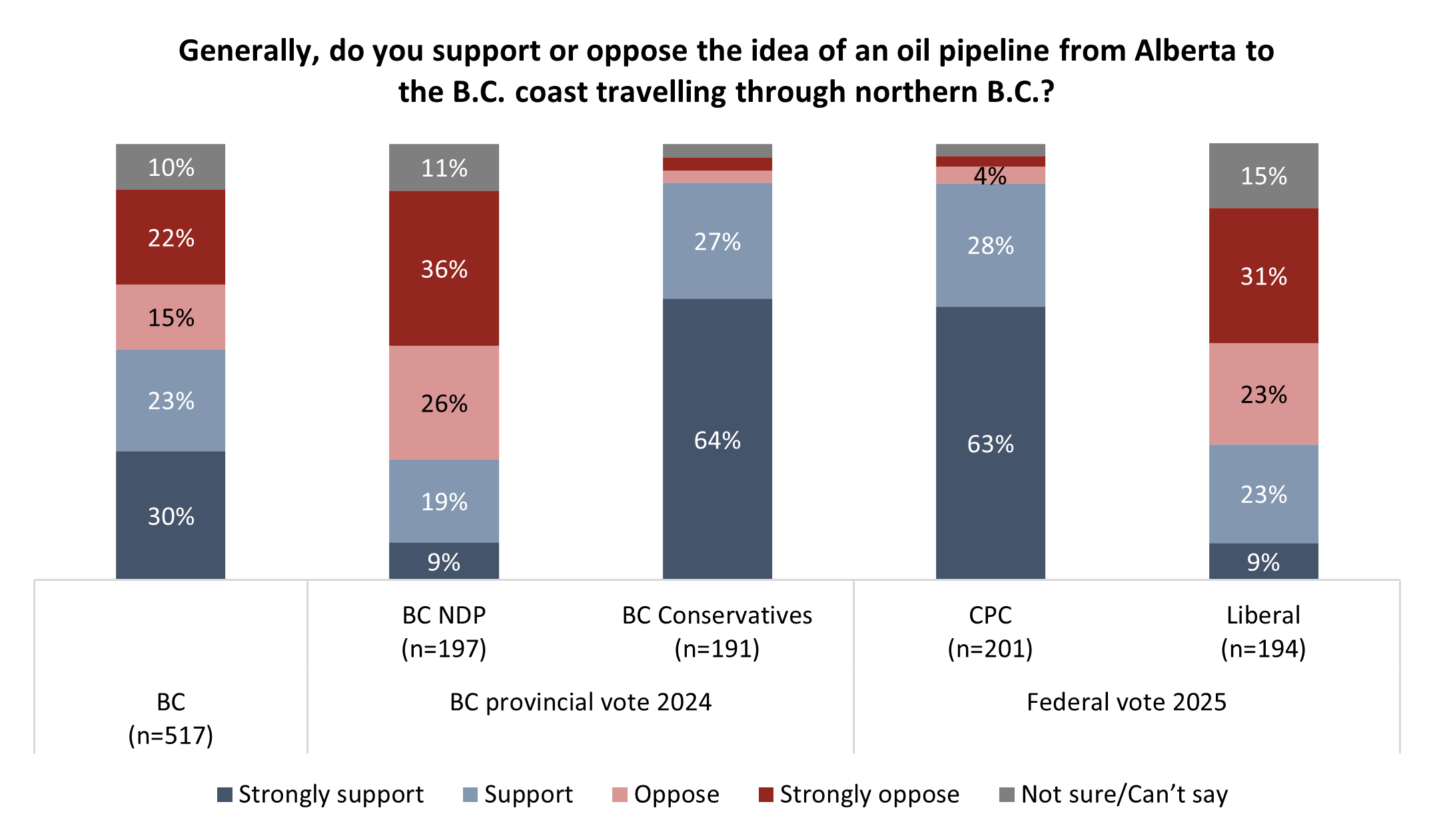
A slight majority in B.C. (53%) say they would support such a project, with nearly two-in-five opposed (37%), including one-in-five strongly so (22%). In Alberta, support rises to three-quarters (74%):

The federal Liberal government does face internal challenges selling this concept to a chunk of its base and some of its caucus. More than one-third who voted for the Liberals in April are either strongly opposed (17%) or opposed (18%), though most support it. This announcement will be viewed as a victory by Conservative voters, with nine-in-10 (89%) supportive of a pipeline their party has long pushed for:

BC, Quebec most concerned about lifting tanker moratorium
The so-called “tanker ban” on B.C.’s northern coast, formalized by Bill C-48 in 2019 but voluntarily in place since 1972, remains an impediment to any northern B.C. pipeline terminating in Prince Rupert. The MOU signed today between the Alberta and federal governments says if the pipeline gets federal approval, Ottawa will “adjust” the tanker ban. Some have speculated that Bill C-5 will be invoked to accomplish this.
In June, when Bill C-5 was passed, Canadians were supportive of its aim to fast-track projects in the national interest, but worried about side-stepping environmental reviews and regulations.
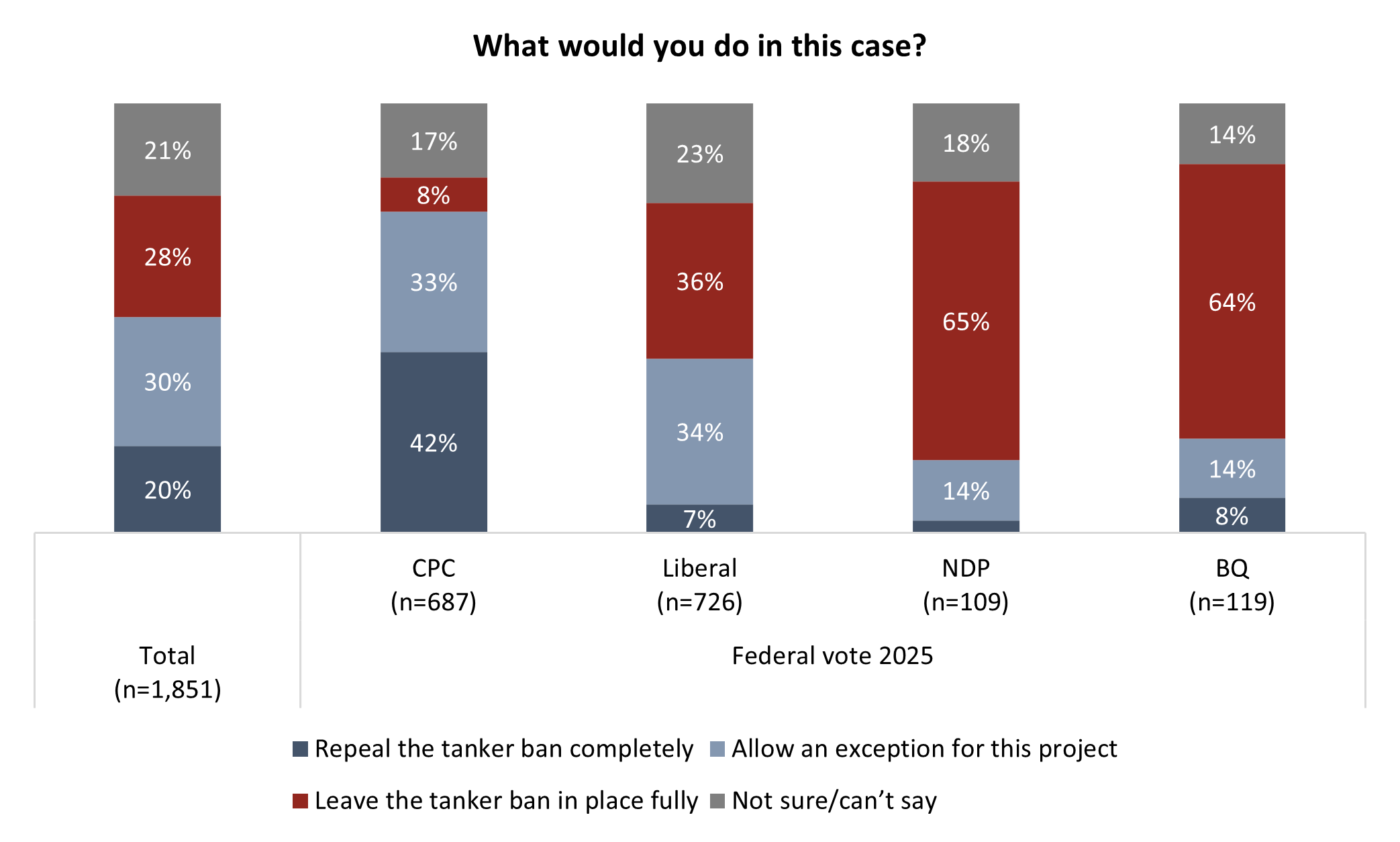
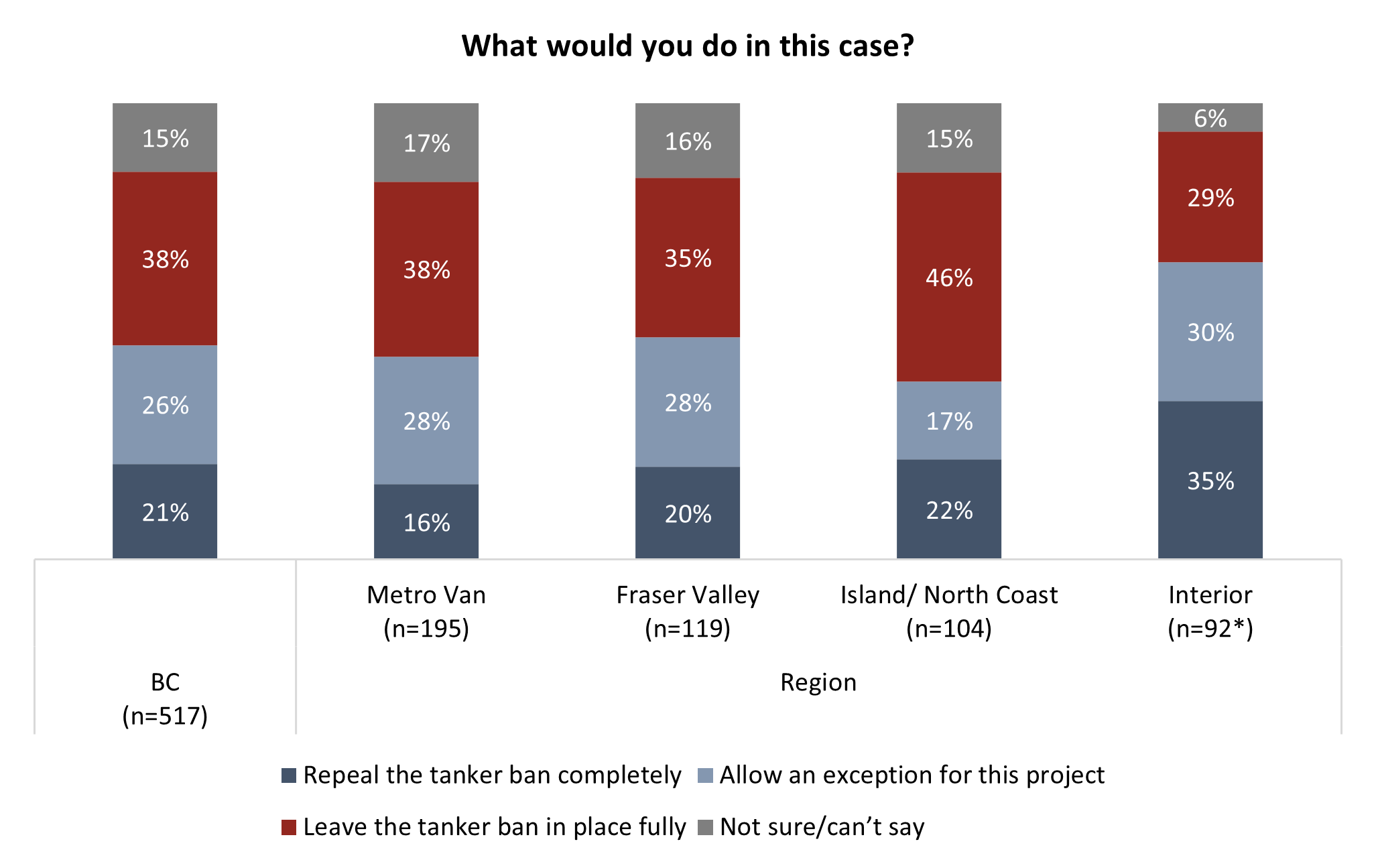
Now, half say the moratorium should not be an impediment: 30 per cent would allow an exception for this particular project while 20 per cent would repeal the ban altogether. Three-in-10 (28%) would leave the ban in place while a considerable portion (21%) aren’t sure. Opposition to touching the ban at all is highest in B.C. (38%) and Quebec (35%):

Conservative and Liberal voters from this year’s federal election are at odds over this aspect of the pipeline debate as well. Conservatives are six-times more likely to want to repeal the ban entirely (42% to 7%) while Liberals are more than four-times as likely to want to keep it in place with no adjustments (8% to 36%):
Views of the tanker ban appear to heavily influence support of the pipeline. Most (74%) who want the tanker ban to stay in place say they oppose the pipeline, while nearly all who would repeal the ban or allow an exception for this pipeline project are in support of the pipeline:

Canadians split as to whether provinces should have veto power over pipelines
Prime Minister Carney said this week in the House of Commons that the agreement signed between Alberta and the federal government “creates necessary conditions, but not sufficient conditions”, adding that “the government of British Columbia has to agree” as well as First Nations along the route. B.C. Premier Eby said the pipeline jeopardizes other major projects in the province and has called it “a communications exercise” by Alberta Premier Smith with no private sector backing. Smith has said her government doesn’t plan to spend its money to build the pipeline but will seek out private investment and then bring the project forward to Carney’s Major Projects Office.
After the agreement was announced, Smith noted that it “did not contain a veto” but she recognized the need for consultation with B.C. and First Nations in the province. In August, one-quarter (25%) believed that national interest projects should only proceed if First Nations agree to them, while two-in-five (40%) said only that First Nations should be meaningfully consulted and accommodated. Prior to today’s announcement, a group of coastal First Nations said they would use “every tool in their toolbox to keep oil tankers and the risk of a catastrophic oil spill out of B.C.’s northern coastal waters”.
Related: Bills, Treaties, and UNDRIP: Canadian views of contemporary Indigenous land issues
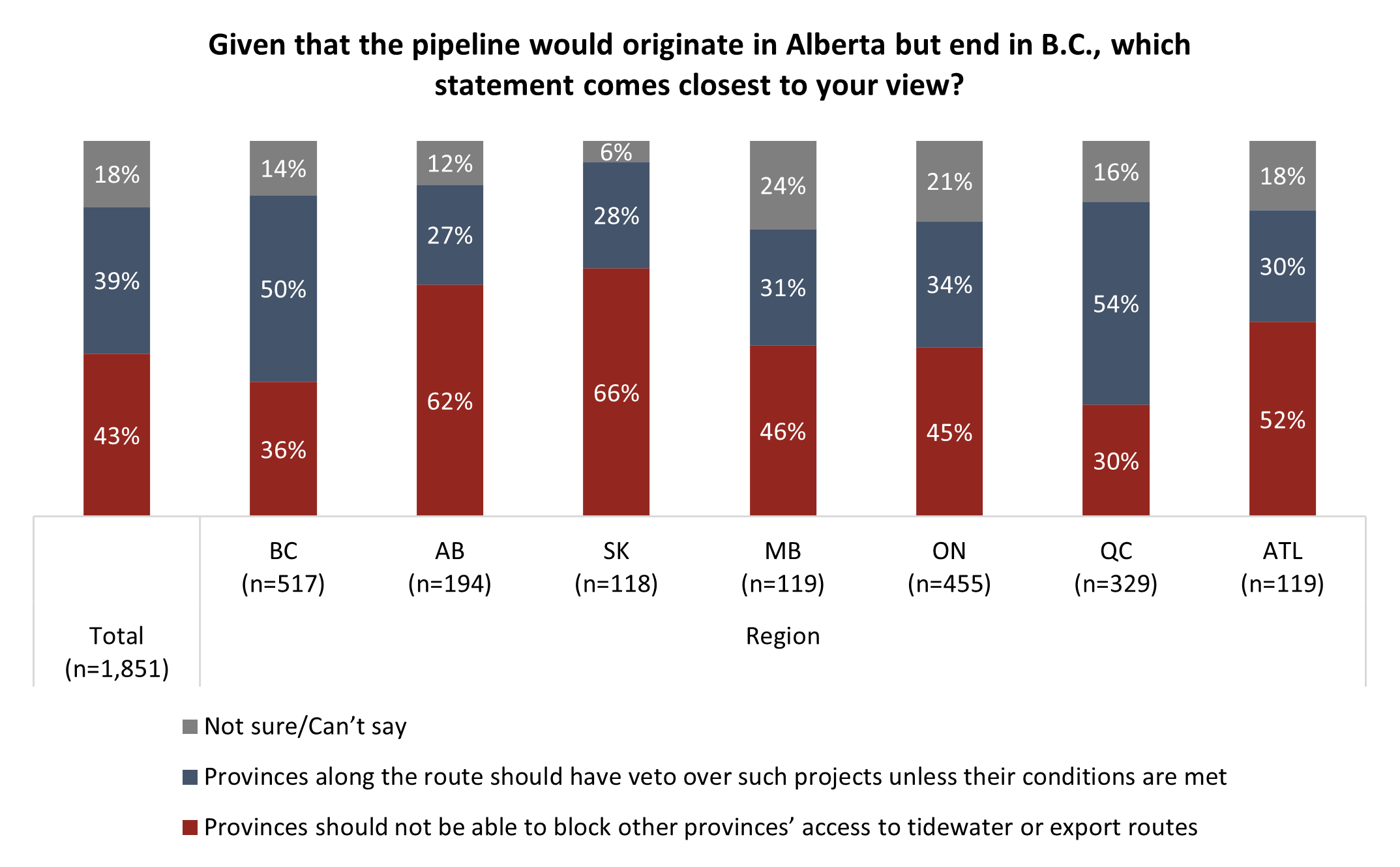
As the B.C. government stands opposed to the project so far, Canadians are divided as to whether projects that cross provincial boundaries, such as pipelines, should require the assent of all jurisdictions. Nearly as many believe provinces should “not be able to block other provinces’ access to export routes” (43%) as say provinces “should have veto unless their conditions are met” (39%).
Those in B.C. (50% veto) and Alberta (62% no veto) have vastly differing views on the matter:
A deep dive into BC opinion
The resurgence of pipeline politics in Canada’s western-most province comes during a turbulent time in B.C.’s political scene. After a narrow victory in last year’s provincial election, Eby and the BC NDP hold a slim edge in the legislature over the opposition Conservative Party of B.C. led by John Rustad. The two parties were tied in vote intention the last time Angus Reid Institute surveyed residents, despite heavy criticism of Eby’s government and questions over Rustad’s leadership.
Related: Rustad’s rocky road: Half of the BC Conservative Party’s 2024 voters say they want him to go
Regional Picture
Pipeline opposition is highest on Vancouver Island and the North Coast, where it reaches 44 per cent. This is outstripped, however by 48 per cent support. In Metro Vancouver, support (47%) outweighs opposition (38%):

*Smaller sample size, interpret with caution
Political considerations for Carney, Eby
Eby’s hardline stance against the concept of an Alberta pipeline to the northern B.C. coast is evidently backed by his party’s supporters. A majority (62%) of those who voted BC NDP in the 2024 provincial election say they oppose Alberta’s proposed pipeline concept. Nearly all (91%) of those who voted for the rival BC Conservatives support it. The parties are currently tied in B.C. vote intention.
Related research: Despite leadership questions, BC Conservatives tie BC NDP in vote intention
The problem for Mark Carney among his own voters in B.C. is more acute. Those who voted for the Conservative Party of Canada in the federal election earlier this year are nearly all (91%) in favour of the concept of the pipeline. However, most recent Liberal voters in B.C. (54%) – a group that included many traditional federal NDP and Green voters – are opposed.
*Note that due to a small sample size, those who voted NDP federally in B.C. cannot be reported.
Tanker Ban troubles
The other core component of this discussion is the tanker ban that would need to be partially repealed in order to allow sufficient traffic to make a pipeline financially functional. It speaks to the caution that the path to achieving a pipeline to a northern B.C. terminal may be long and winding. An exception or full repeal is only supported at a majority level in the Interior. On Vancouver Island and along the north coast, nearly half say not to touch it:
*Smaller sample size, interpret with caution
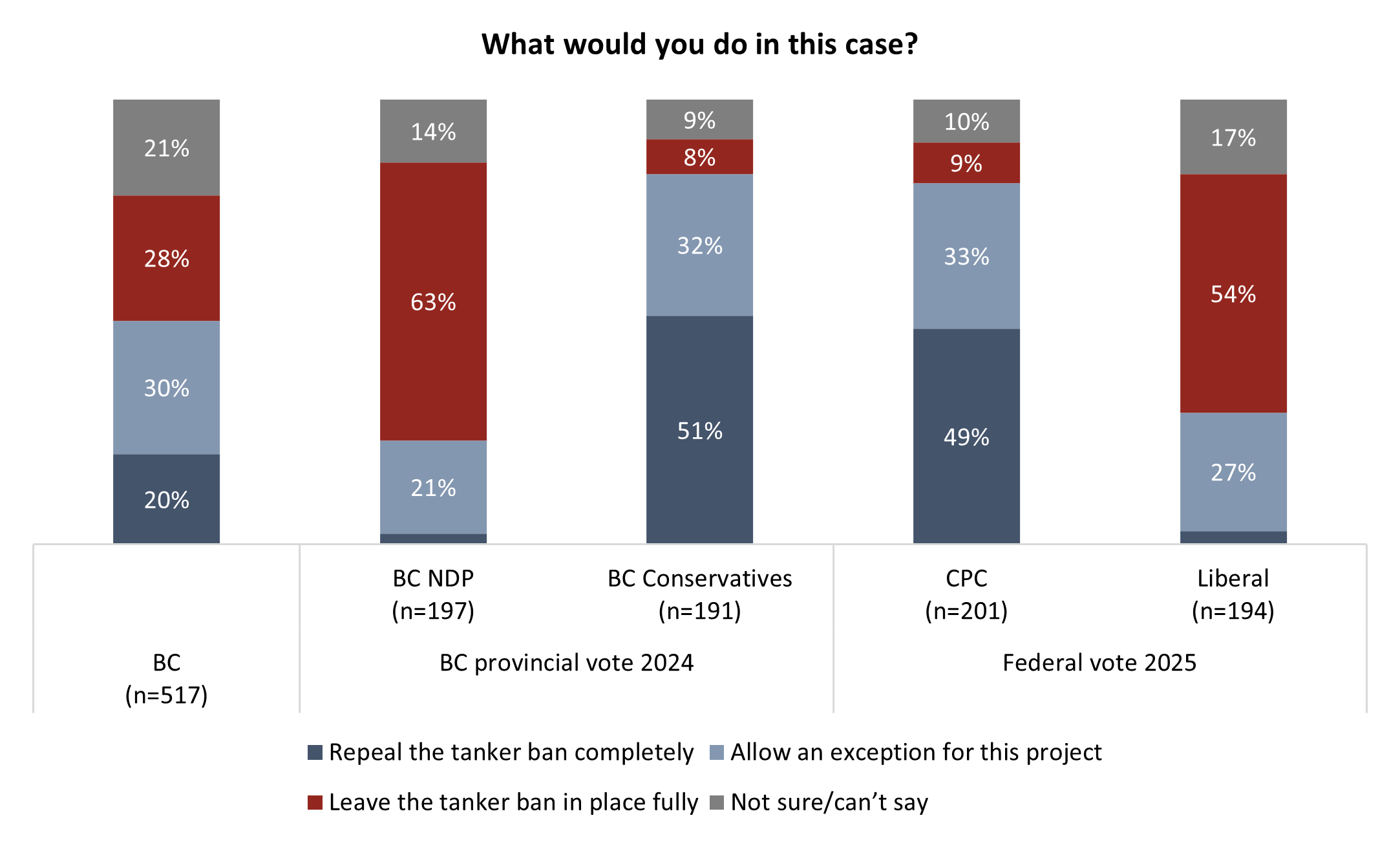
The tanker ban is a major sticking point for BC NDP supporters. Approaching two-thirds (63%) say they want the tanker ban to fully stay in place, while one-in-five (21%) would allow an exception for this pipeline. Half (51%) of BC Conservative supporters say they want to repeal the tanker ban entirely.
Comparing federal party supporters in B.C., a majority (53%) who voted Liberal in the spring election say they want the tanker ban to stay in place. Half (49%) of CPC voters say they want it repealed.
Many see environmental conditions, Indigenous ownership seen as key
The MOU signed by Alberta and Ottawa details that the pipeline will have “Indigenous Peoples’ ownership and benefits”. Half in B.C. (51%) say that would’ve been a condition for them to get the pipeline built. Approval of the First Nations along the path (55%) is selected by more, while environmental and financial concerns around the liability for spills are a higher priority to British Columbians. Nine-in-ten (89%) in the province believe Alberta or the federal government must fund cleanup for pipeline spills and four-in-five (83%) believe Edmonton or Ottawa should fund increased monitoring along the coast if the pipeline is built.
Eby said that any federal subsidy to the pipeline should be matched with one to a B.C. project and two-thirds (68%) in B.C. agree. However, the MOU signed today does not include any mention of federal funding.
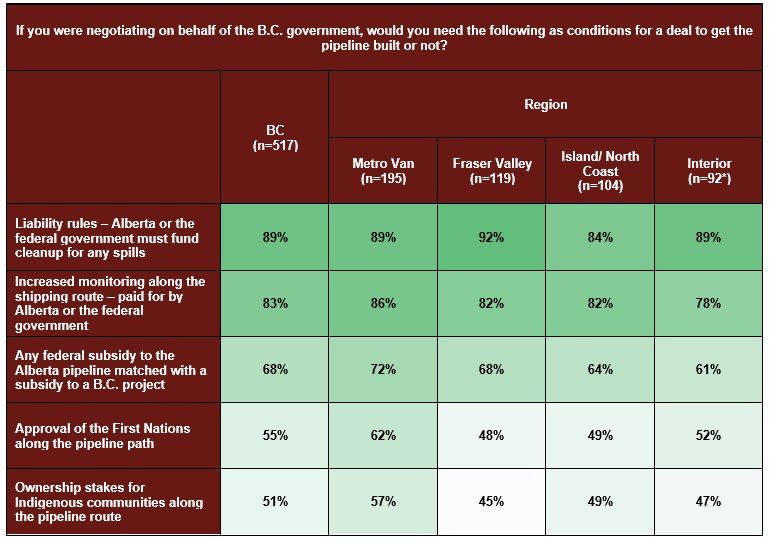
British Columbians are split as to what should be in the deal along political lines. Across party lines, most say that Alberta or Ottawa should be liable for spills, and should be footing the bill for increased monitoring along the shipping route, BC Conservative and federal CPC voters are less likely to believe than BC NDP and federal Liberal voters that there should be matching subsidies for a B.C. project. Most of those who voted BC Conservative in the provincial election, and those who voted federally for the CPC, say that First Nations approval and equity do not need to be part of the deal to get the pipeline built:

METHODOLOGY
The Angus Reid Institute conducted an online survey from Nov. 26-27, 2025, among a randomized sample of 1,851 Canadian adults who are members of Angus Reid Forum. The sample was weighted to be representative of adults nationwide according to region, gender, age, household income, and education, based on the Canadian census. For comparison purposes only, a probability sample of this size would carry a margin of error of +/- 1.5 percentage points, 19 times out of 20. Discrepancies in or between totals are due to rounding. The survey was self-commissioned and paid for by ARI. Detailed tables are found at the end of this release.
For detailed results by age, gender, region, education, and other demographics, click here.
For detailed results in British Columbia, click here.
For PDF of full release, click here.
For full questionnaire, click here.