

Despite leadership questions, BC Conservatives tie BC NDP in vote intention
October 26, 2025 – As the British Columbia Legislature gears up for this week’s sitting, Conservative Party of B.C. leader John Rustad may well be fervently hoping he can re-position the spotlight from his own troubled leadership back onto the governing BC NDP.
But with yet another defection from his caucus last week, plus a letter from the party’s management committee demanding his resignation, it remains to be seen whether this is a wish made in vain.
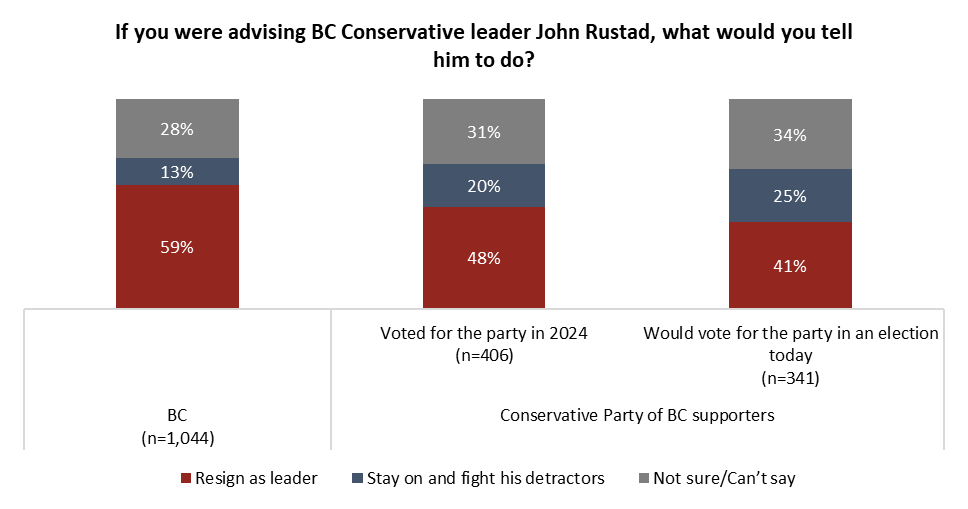
New public opinion data from the non-profit Angus Reid Institute collected between Oct. 23 and 25 show half of the party’s 2024 voters want Rustad gone, with two-in-five current voters – a now smaller slice of the vote intent pie – sharing the sentiment.
Therein lies a conundrum for the provincial Conservatives: its fortunes have declined since last year, bleeding away voters now disaffected with the leader and the party. And while a smaller number are sticking with the party today, this group is slightly more resolute in its backing of Rustad, with more holding favourable views of him than the whole of the 2024 vote base.
The drama bedevilling the right-hand side of B.C.’s political spectrum unfolds as an electorate is not exactly enamoured of its current government.
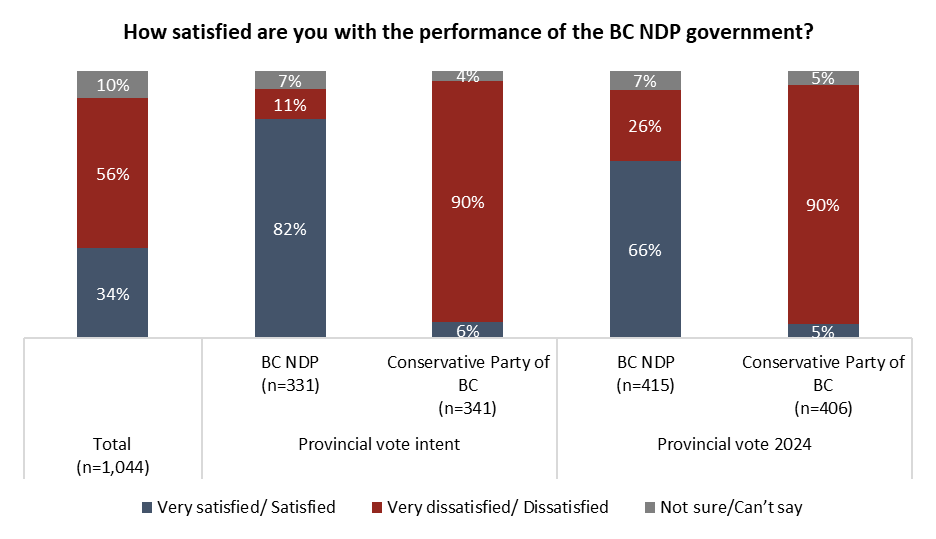
Just over half (53%) say British Columbia is on the “wrong track” under the Eby government, while slightly more – 56 per cent – say they are “dissatisfied” with this government’s performance.
Despite the turmoil on the right and the discontented malaise aimed at the left, the vote picture remains largely unchanged from last year. Just over a single percentage point separated the BC NDP and BC Conservative vote then, the same situation exists now, albeit with the BC Conservatives holding a statistically insignificant one-point lead (41%) over the New Democrats (40%).

About ARI
The Angus Reid Institute (ARI) was founded in October 2014 by pollster and sociologist, Dr. Angus Reid. ARI is a national, not-for-profit, non-partisan public opinion research foundation established to advance education by commissioning, conducting and disseminating to the public accessible and impartial statistical data, research and policy analysis on economics, political science, philanthropy, public administration, domestic and international affairs and other socio-economic issues of importance to Canada and its world.
INDEX
Part One: The Conservative Party of B.C.’s leadership question
-
Majority of current BC Conservative voters have favourable view of Rustad
-
Favourability of Rustad has declined among right-leaning voters since election
-
Half of 2024 BC Conservative voters want a new leader
Part Two: The right of B.C. un-united?
-
Most BC Conservatives believe party is in the right place on the political spectrum
-
Leaders of third-party options largely unknown to B.C. populace
Part Three: A competitive vote intent picture
-
Majority dissatisfied with BC NDP government, believe province is on the wrong track
-
Conservatives, BC NDP tied in vote intent
Part One: The Conservative Party of B.C.’s leadership question
The Conservative Party of British Columbia has spent much of 2025 in turmoil. Leader John Rustad ejected MLA Dallas Brodie in March after Brodie’s appearance on a podcast where Rustad said she “mocked” residential school testimony. MLAs Jordan Kealy and Tara Armstrong left the Conservative caucus in protest. Brodie and Armstrong subsequently launched OneBC.
In September, Rustad removed another MLA from caucus, Elenore Sturko, prompting MLA Amelia Boultbee also to leave the party this past week. In total, the Conservatives are down five MLAs since the party nearly won the 2024 election last fall.
The management committee of the BC Conservative Party has responded to the upheaval by writing a letter asking Rustad to step down, who has refused.
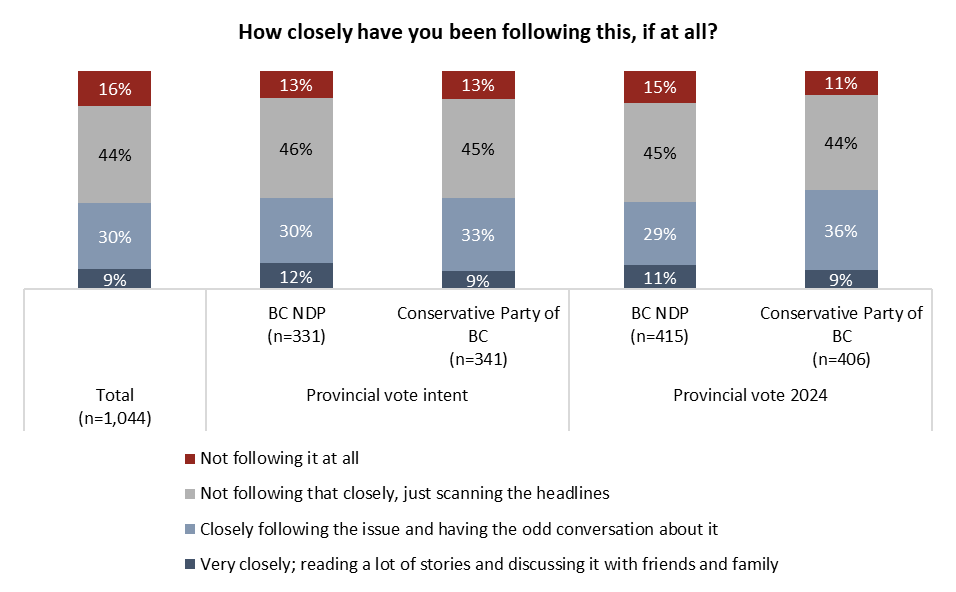
Two-in-five in the province (39%) say they have been following the recent request for Rustad’s resignation by the management committee either closely (30%) or very closely (9%):
Majority of current BC Conservative voters have favourable view of Rustad
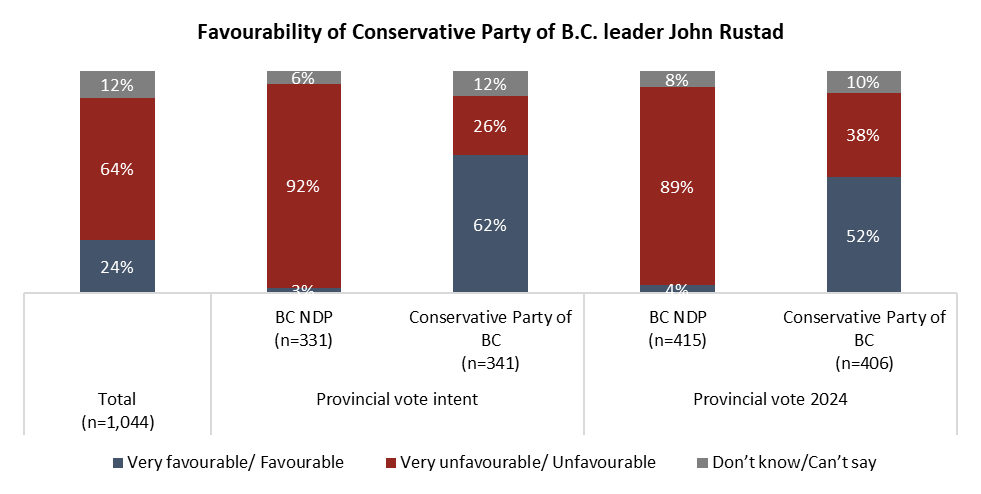
More in the province have a negative view of Rustad (62%) than a positive one (24%). However, he does still earn a net favourable score (favourability minus unfavourability) from both current (+36) and past (+14) party supporters:
Favourability of Rustad has declined among right-leaning voters since election
But views of Rustad have declined significantly among Conservative voters since last fall’s election. During the campaign, more than four-in-five party supporters said they had a favourable view of Rustad; that has since dropped to 52 per cent.
Among the general B.C. populace, Rustad’s popularity has never climbed above one-third:
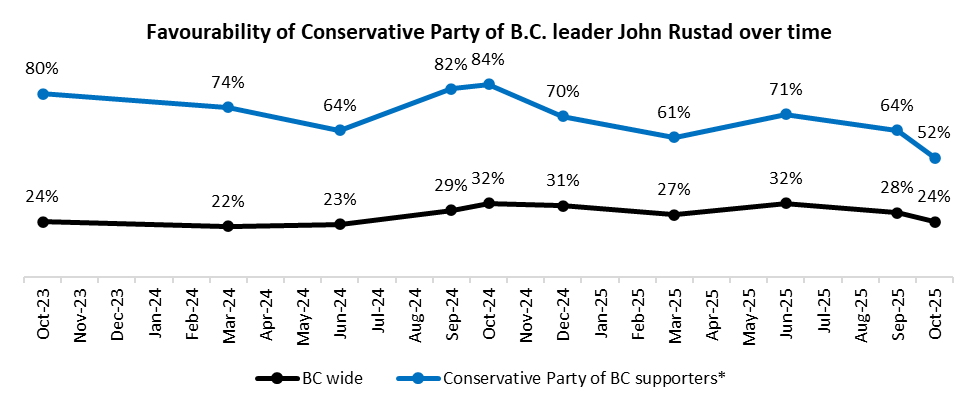
*Those who intended to vote Conservative from Oct. 2023 to Oct. 2024, those who voted Conservative in the 2024 B.C. election afterwards
Half of 2024 BC Conservative voters want a new leader
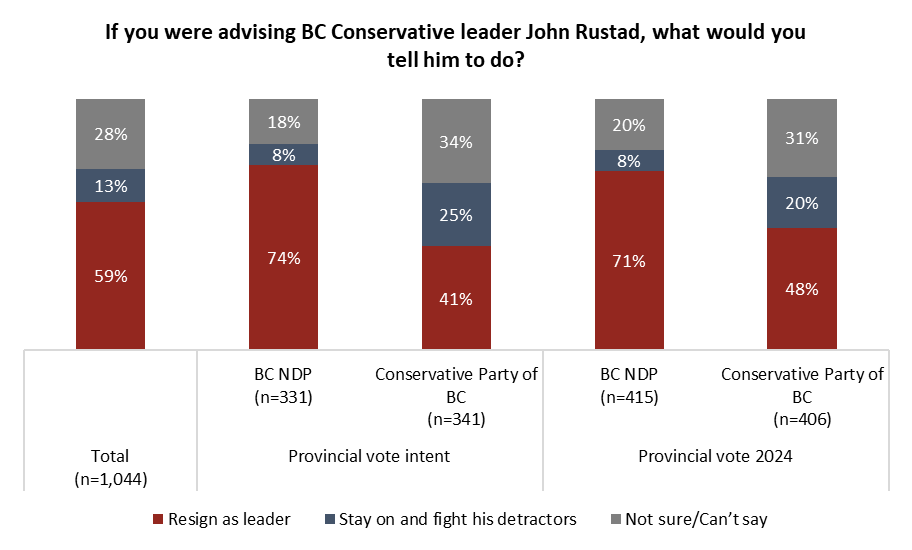
As Rustad faces calls from within his party to step aside, half (48%) of those who voted for the party last year say he should go, while only one-in-five (20%) among this group are of the view Rustad should try to fight to keep the leadership role. However, there is also much uncertainty among past Conservative voters, with three-in-ten (31%) not sure whether they prefer Rustad to stay or go.
Those who currently say they would vote Conservative if a provincial election were held today are also more likely to believe Rustad should go (41%) than stay (25%), with even more uncertainty defining this group. More than one-in-three are on the fence about him:
Part Two: The right of B.C. un-united?
Most BC Conservatives believe party is in the right place on the political spectrum
The 2024 B.C. election took an unexpected turn when B.C. United, formerly known as the B.C. Liberals, withdrew from the race to leave voters with a singular right-of-centre option on the ballot.
A fractious period for the Conservatives post-election has created several new alternative parties in OneBC, which includes the two sitting former Conservative MLAs Brodie and Armstrong, and CentreBC, which bills itself as a “pragmatic, moderate political option” spearheaded by former BC United MLA Karin Kirkpatrick.
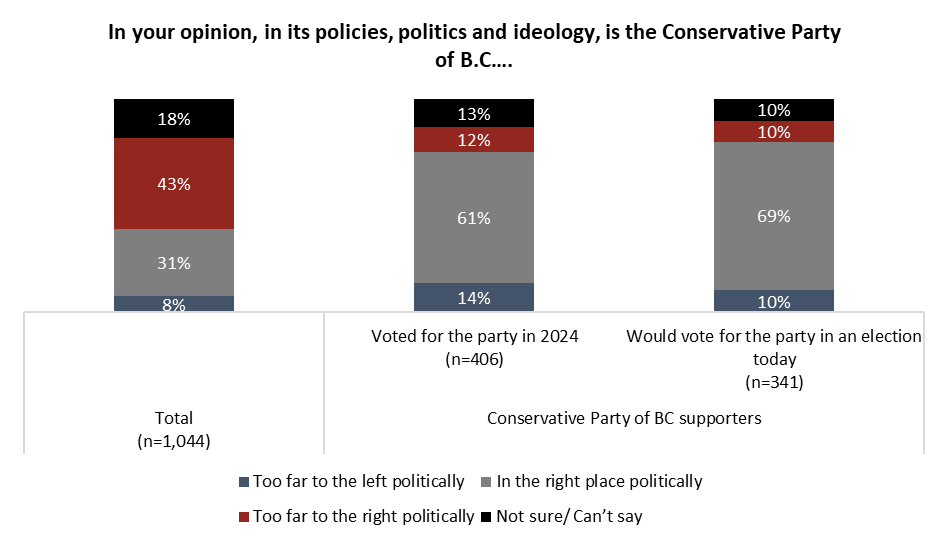
Despite the fracture, most current (69%) and past (61%) Conservative party supporters believe the party is in the right space on the political spectrum. Those who disagree are as likely to believe the party’s current position is too to the left and too far to the right.
Leaders of third-party options largely unknown to B.C. voters
Rustad’s Conservatives perhaps caught lightning in a bottle when they ascended from relative unknowns to the main challenger to the BC NDP. The party also perhaps benefitted from the branding power of being associated in name, but not officially, with the ascendant federal Conservative party under Pierre Poillievre, who at the time held a massive polling lead nationally.
Related: B.C. Politics Deep Dive: How does current federal vote intention impact this fall’s provincial vote?
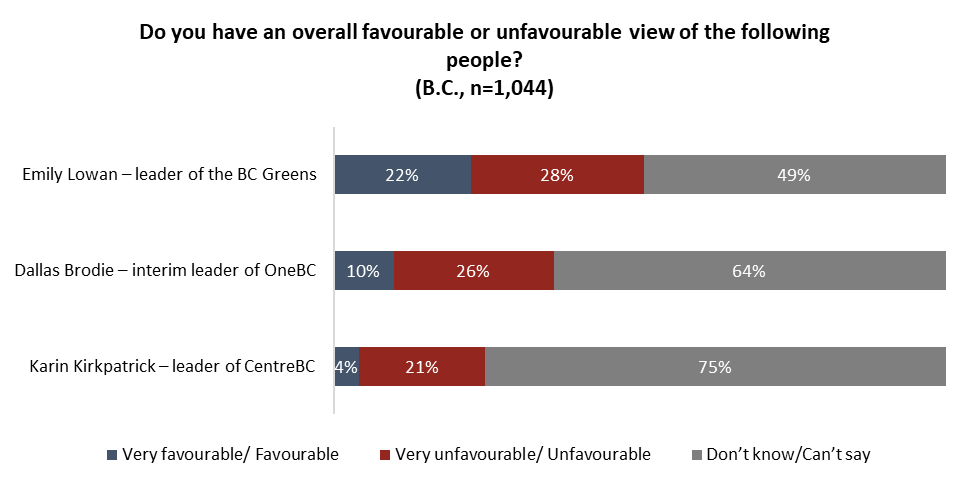
The new third-party options do not have the advantage of sharing a name with a popular federal party. Nor are their leaders currently very well-known. A majority in the province say they don’t know enough to have a positive or negative opinion about either Brodie (64%) or Kirkpatrick (75%). In both cases, those who do hold an assessment are more likely to report an unfavourable one than a favourable one:
Part Three: A competitive vote intent picture
Majority dissatisfied with BC NDP government, believe province is on the wrong track
As the BC Conservatives sort out their post-election malaise, the governing BC NDP have struggled with a number of the most pressing issues the province faces in the eyes of constituents. In September, the B.C. government was ranked among the lowest provinces on the Angus Reid Institute’s Weighted Provincial Government Performance Index.
Related: Cross-Canada Outlook – Provincial Issues, Politics, and Government Performance: British Columbia
More than half (56%) in the province say they are dissatisfied with the BC NDP’s performance in government, outnumbering those who are satisfied (34%). The latter are mostly those who voted for the party in 2024 or would support the party if an election were held today. It is notable that one-quarter (26%) who voted for Eby and the BC NDP last year aren’t pleased with the government’s performance so far:
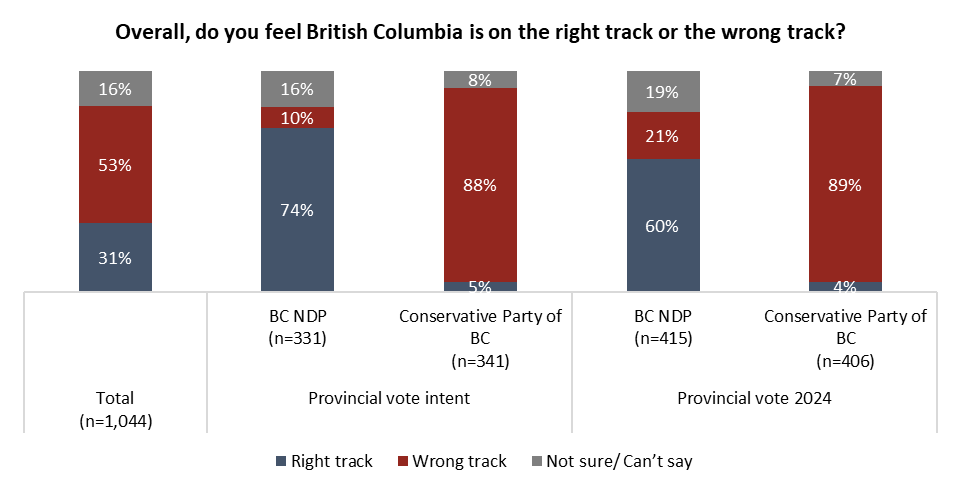
It follows, then, that British Columbians are more likely to believe the province is on the wrong track (53%) than the right one (31%). Again, BC NDP voters comprise most of the latter camp. And, again, those who voted for the party last year express more reservations (21%) than those who would vote for the party if a provincial election were held today (10%):
Conservatives, BC NDP tied in vote intent
Despite the uncertainty surrounding Rustad’s leadership, and perhaps because of all the criticisms British Columbians have for the current BC NDP government, the BC Conservatives still hold a strong position in vote intention. The BC NDP (40%) and Conservatives (41%) are in a statistical tie, with the BC Greens, under new leader Emily Lowan, holding the third position (11%). The two upstart parties OneBC (5%) and CentreBC (1%) are currently polling in single digits:
Survey Methodology
The Angus Reid Institute conducted an online survey from Oct. 23-25, 2025, among a randomized sample of 1,044 Canadian adults who live in B.C. and are members of Angus Reid Forum. The sample was weighted to be representative of adults nationwide according to region, gender, age, household income, and education, based on the Canadian census. For comparison purposes only, a probability sample of this size would carry a margin of error of +/- 3 percentage points, 19 times out of 20. Discrepancies in or between totals are due to rounding. The survey was self-commissioned and paid for by ARI.
For more information on our polling methods, click here.
For detailed results by age, gender, region, education, and other demographics, click here.
For PDF of full release, click here.
For questionnaire, click here.
MEDIA CONTACTS:
Shachi Kurl, President: 604.908.1693 shachi.kurl@angusreid.org @shachikurl
Dave Korzinski, Research Director: 250.899.0821 dave.korzinski@angusreid.org
Jon Roe, Research Associate: 825.437.1147 jon.roe@angusreid.org