


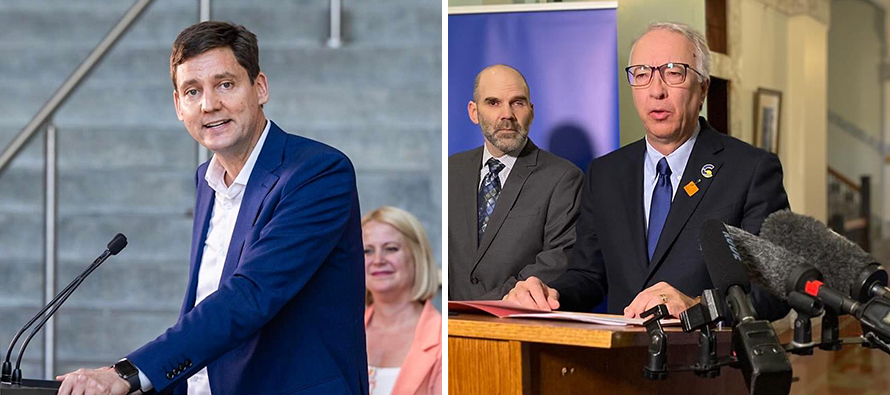
Eby most likely seen as ‘best premier’, but majorities say B.C. on ‘wrong track’ on housing, opioids crises
August 30, 2024 – An unprecedented withdrawal by the official opposition B.C. United mere weeks before the start of a general election campaign has levelled the playing field between the two remaining main competitors.
New data from the non-profit Angus Reid Institute measured after Kevin Falcon announced B.C. United’s exit finds a statistically tied race as voters survey the new election landscape.
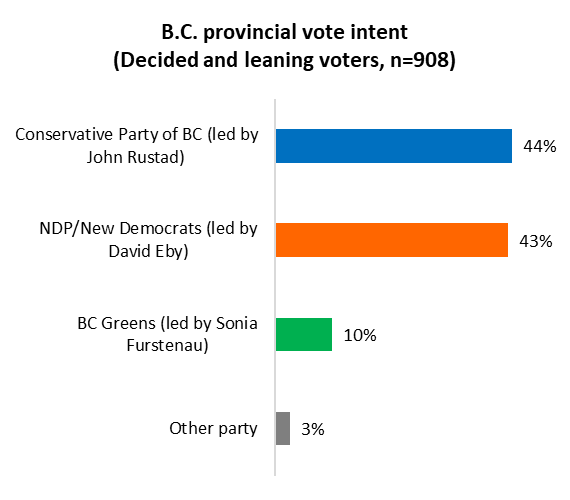
Both the Conservative Party of BC (44%) and the BC NDP (43%) currently have the support of more than two-in-five decided and leaning voters. The BC Greens gather vote intent from one-in-ten (10%).
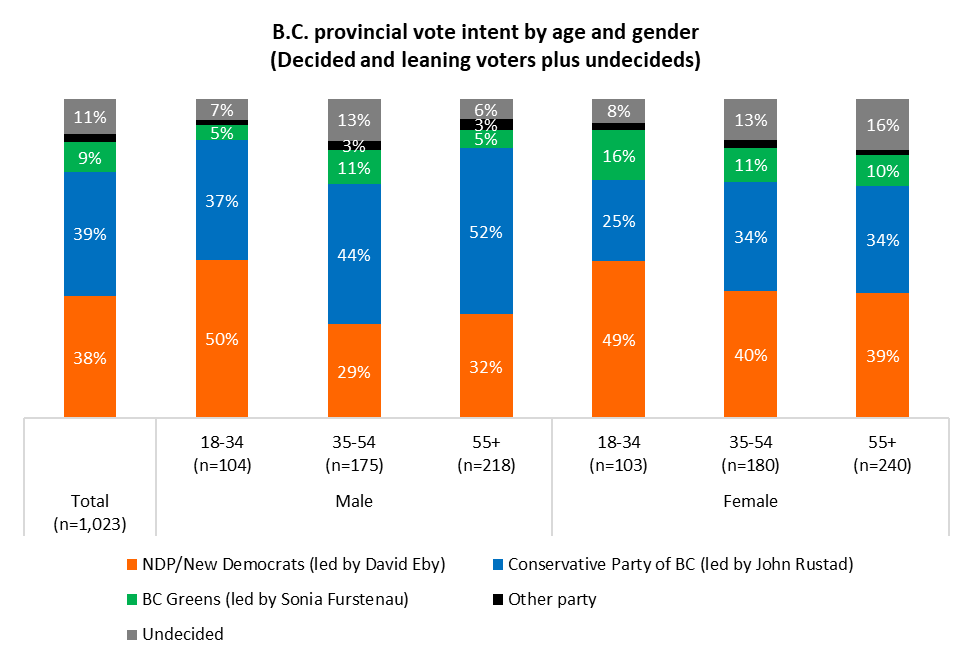
The aftershocks of B.C. United’s departure from the election are still being felt – many candidates in both the United and BC Conservative camps face uncertain electoral futures – and many British Columbians are still evaluating the options left on the table. Among the general population, one-in-ten (11%) say they are currently undecided with no lean to any particular party. This includes one-in-six (16%) women older than 54, one of the more reliable groups of ballot casters in Canadian elections.
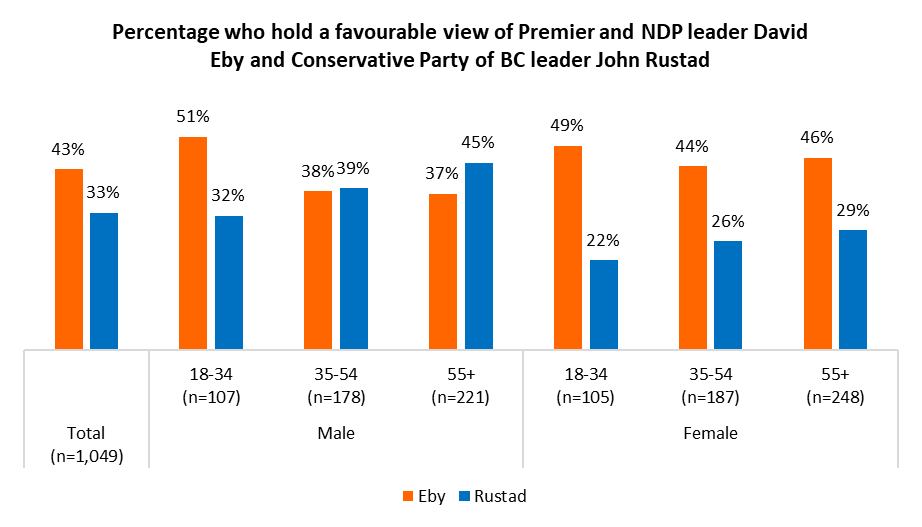
Voters will have several factors to consider, but perhaps the two that will play the biggest role in this election will be leadership and dueling crises of housing affordability and opioids addiction. Incumbent Premier and NDP leader David Eby is viewed more favourably (43%) than his primary opponent, Conservative Party of BC leader John Rustad (33%). However, criticism of Eby has been growing since he first assumed the role of premier in November 2022, while many say they do not know enough to form an opinion of Rustad. The BC Conservatives leader does enjoy better “momentum”; that is, British Columbians are twice as likely to say their opinion of him has improved over recent weeks (18%) than to say the same of Eby (9%).
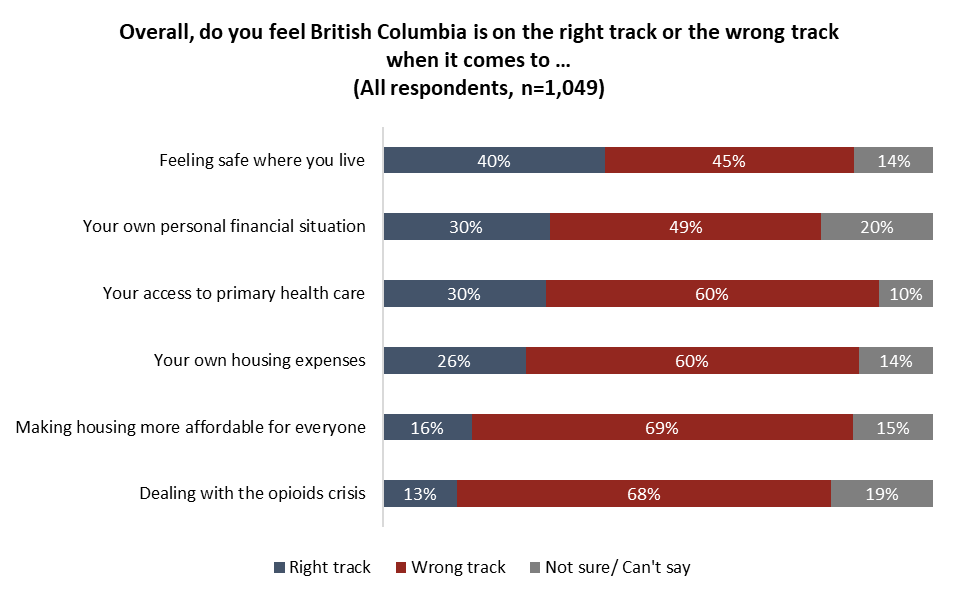
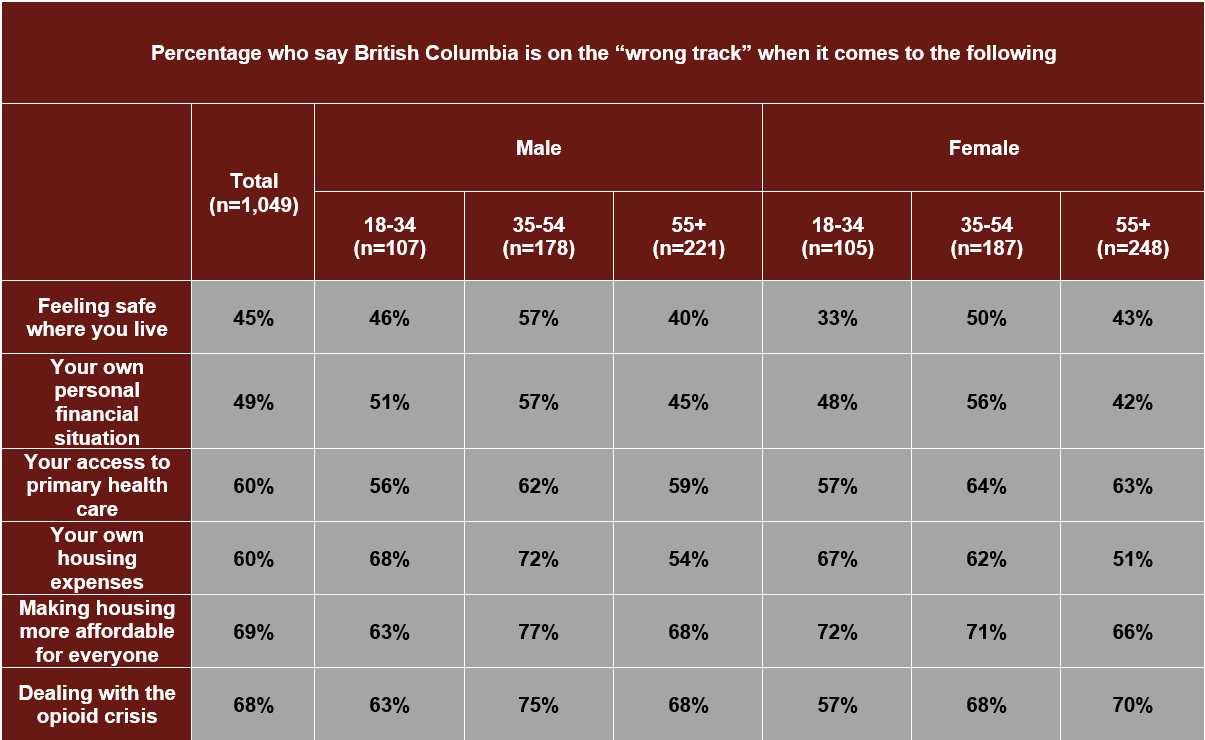
Also perhaps in Rustad’s favour is widespread criticism of the path the province is currently on when it comes to what will likely be the defining issues of the campaign in housing and drug policy. A majority of British Columbians say the province is on the “wrong track” when it comes to dealing with the opioids crisis (68%) and making housing affordable for everyone (69%).
Click below to see Key Takeaways from the data
In new data taken in the days since BC United’s exit from the 2024 provincial election, the BC Conservatives and BC NDP are statistically tied in vote intent, each garnering the support of more than two-in-five. One-in-ten say they will vote for the BC Greens.
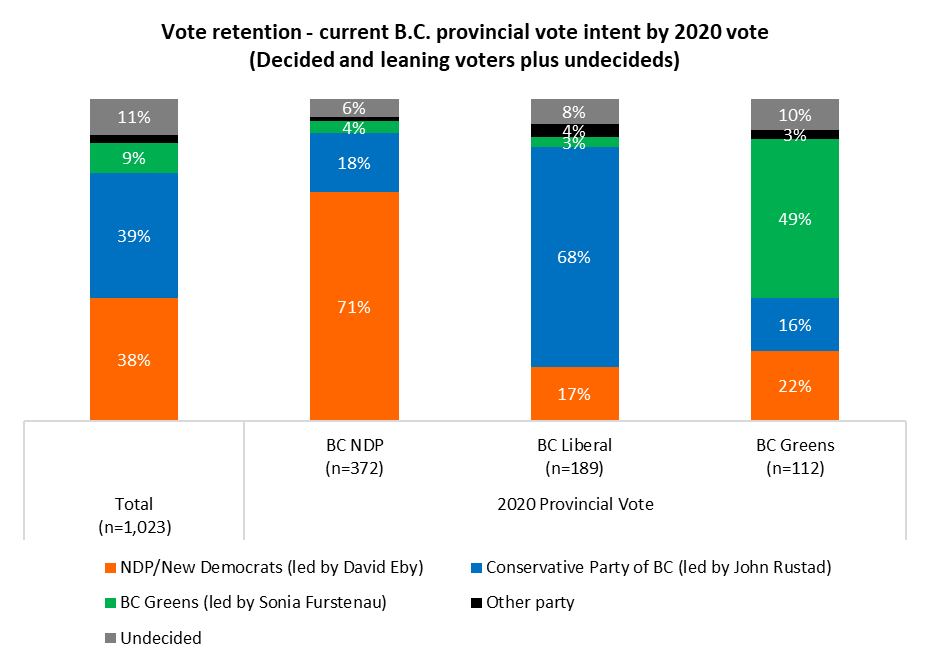
Now that BC United (formerly the BC Liberals) is out of the race, where will the party’s supporters go? Two-thirds (68%) of those who voted for the BC Liberals in the 2020 election say they plan to vote for the BC Conservatives now. One-in-six (17%) currently intend to vote for the NDP and eight per cent are undecided.
Two-in-five (40%) British Columbians say the province is on the “right track” when it comes to feeling safe where they live. However, on this and other measures – respondents’ personal financial situation, housing expenses and access to health care, and the opioids crisis and making housing affordable for everyone – more are likely to say instead the province is heading in the wrong direction.
The Full Story
INDEX
Part One: Vote intent
By age and gender
By region
Part Two: The undecideds
BC Conservatives hold advantage in vote certainty
Women older than 54 most likely to be undecided
Where will United voters land?
Part Three: Leadership and the state of the province
Mounting criticism of Eby
One-in-five have not formed opinion on Rustad
On ‘best premier’, Eby holds slight edge
BC’ers say province is on the ‘wrong tracks’ on several fronts
Part One: Vote intent
With the dust still settling after the controlled demolition of B.C. United set off by leader Kevin Falcon withdrawing the nominations of the parties’ candidates this week, some of his candidates have already found a home under the Conservative Party of B.C., while others are musing about running as independents, or joining forces with since jettisoned Conservative candidates.
What is certain is that the terms of the election have changed with B.C. United exiting the race. The Conservative Party of BC’s share of vote intent has grown from one-in-five (21%) in September to more than two-in-five (44%) today, putting them in a statistical tie with the BC NDP (43%). One-in-ten (10%) say they would vote for the BC Greens, the lowest support for the party seen since the 2020 election:
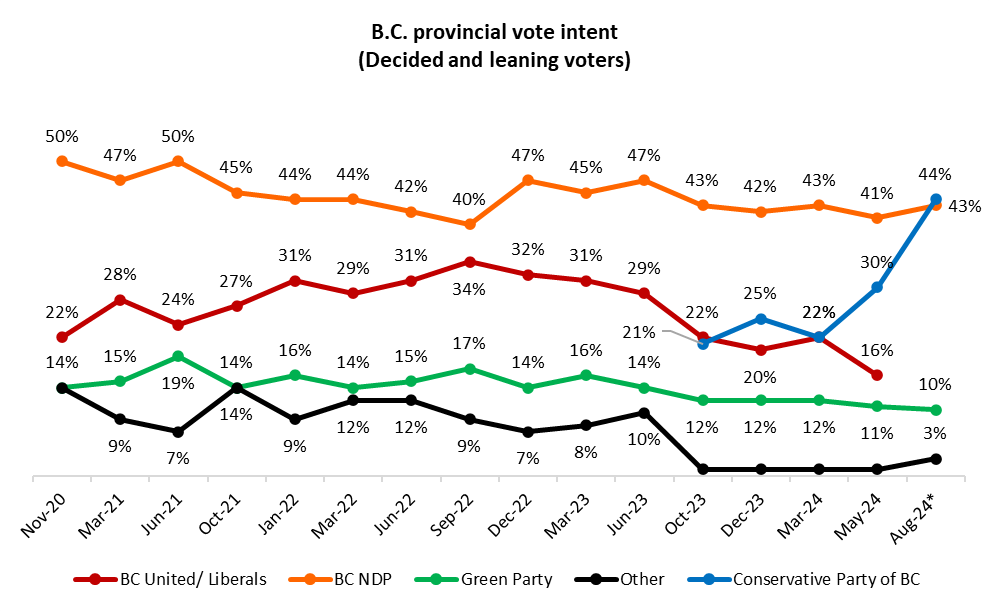
*Note, August 2024 data is taken after BC United exited the election
By age and gender
The NDP performs best among younger voters (+19 among 18- to 34-year-olds) and women (+11, see detailed tables), while the Conservatives’ base appears to be men older than 34:
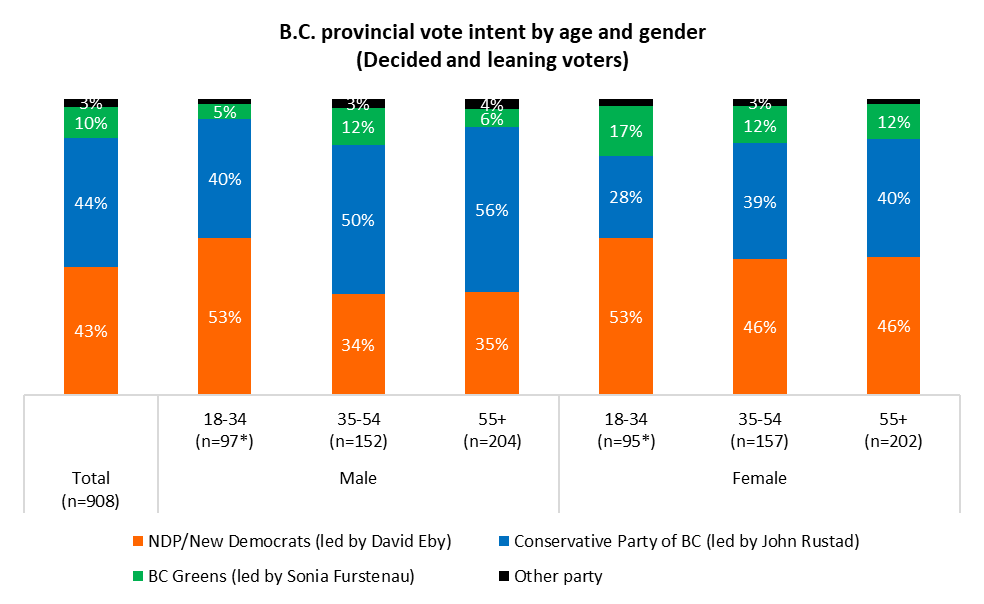
*Smaller sample size, interpret with caution
By region
The two parties contending to form government have regional strongholds. The BC NDP enjoy the most support in the city of Vancouver and Burnaby, where the NDP currently hold all but two seats. The BC Conservatives perform best in the Interior of the province, where it has a two-to-one vote intent advantage over the NDP, but also hold a slight edge in key suburbs such as Richmond, Surrey, Delta and North Vancouver.
Those cities, and the Island/North Coast region, will be ones to watch as the election goes along. The latter also is where the BC Greens generate the most support, and it remains to be seen what effect the third party will have on the race:

*Smaller sample size, interpret with caution
Part Two: The undecideds
BC Conservatives hold advantage in vote certainty
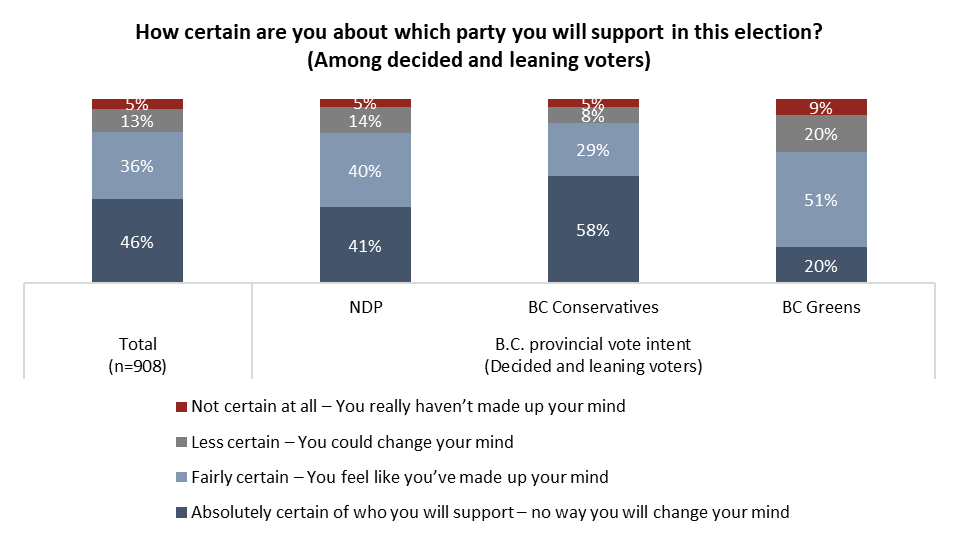
At the moment, the BC Conservatives hold the advantage in voter certainty. A majority (58%) of those who say they will support the Conservative Party of BC say they are “absolutely certain” and there is “no way they will change their mind”. There is less certainty among likely BC NDP voters, one-in-five (19%) who describe themselves as “less certain” (14%) or “not certain at all” (5%). Supporters of the BC Greens are even more likely to be open to changing their mind before October. It’s worth noting that two-thirds (66%) of current BC Greens voters say their second choice is the BC NDP (see detailed tables).
Women older than 54 most likely to be undecided
It is also worth baring in mind that there is a sizable group whose first choice is “undecided”. Half of whom say they are leaning one way or another when asked a follow-up question, but the initial choice of “undecided” suggests that they are weighing the choices on offer from the remaining parties. Women older than 54, historically a group that tends to consistently vote in Canadian elections, are the most likely to be currently undecided (16%). There could still be further shifts in what has become an unstable political picture as voters assess BC United’s exit.
Where will United voters land?
The BC Liberals’ failed rebrand as BC United marks the end of a political legacy of a party which won 77 of 79 possible seats at the turn of the century. It also forces the supporters of the former centre/centre-right party to move one way or the other on the political spectrum. At the moment, more have chosen to shift right than left: seven-in-ten (68%) of those who voted BC Liberal in 2020 say they intend to vote Conservative and one-in-six (17%) say NDP.
Notably, as recently as April, when United still had the support of one-in-five likely voters, half of United supporters said they intended to vote for Pierre Poilievre and the federal Conservatives, while two-in-five (37%) said they would support Prime Minister Justin Trudeau and the federal Liberal party. This suggests that while BC United exiting the race will likely boost support of the BC Conservatives, BC United voters are by no means a bloc that will move in unison to the Conservatives’ side.
Related: B.C. Politics Deep Dive: How does current federal vote intention impact this fall’s provincial vote?
Meanwhile, seven-in-ten (71%) of those who voted NDP in 2020 say they will repeat their vote, with one-in-five (18%) moving to the Conservatives at the moment. Just half (49%) of 2020 BC Green supporters say they will vote again for the party, with one-in-five (22%) instead supporting the BC NDP and one-in-six (16%) intending to vote for the BC Conservatives. Similar numbers of 2020 BC Liberal (8%) and BC Green (10%) voters are undecided:
Part Three: Leadership and the state of the province
Mounting criticism of Eby
Election day is scheduled to fall near the two-year anniversary of Premier and NDP leader David Eby winning the NDP leadership race called after then Premier John Horgan announced his intention to step down. Eby would go on to take the mantle of premier in November 2022, and since then, criticism of his performance has been growing.
In the past six months, there have been as many British Columbians who say they have a positive impression of the premier as a negative one:
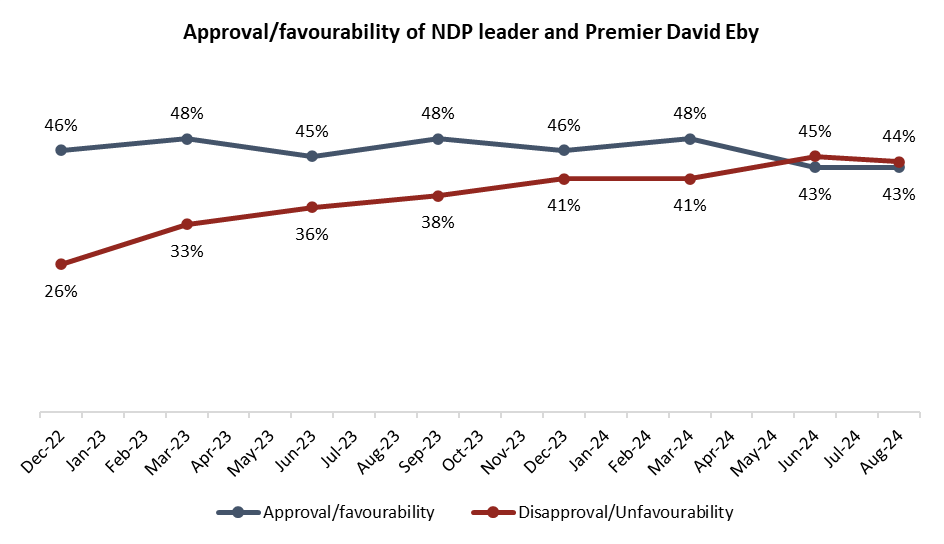
However, Eby is still viewed more favourably than his rival party leaders. In fact, there are as many who say they view Eby unfavourably (44%) as say they have a negative impression of Conservative Party of BC leader John Rustad (46%).
But there are many whose opinions on both Rustad (21%) and BC Greens leader Sonia Furstenau (35%) have yet to be formed:
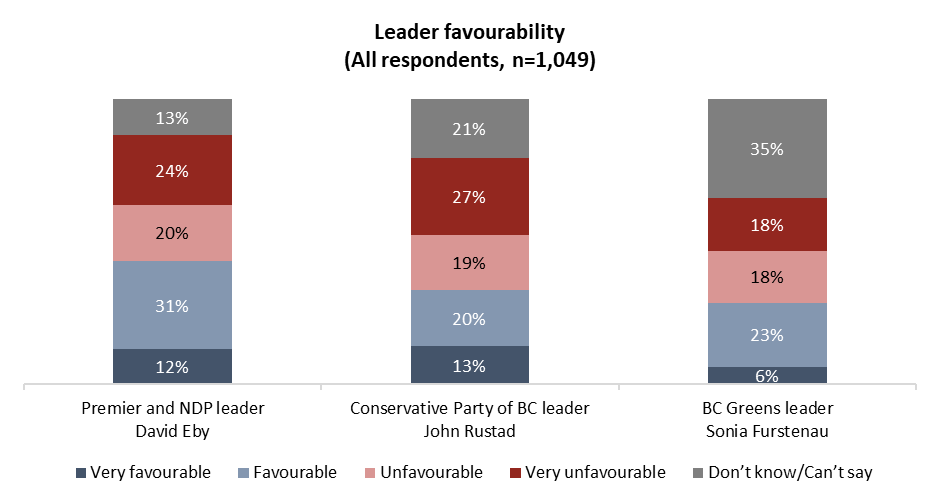
One-in-five have not formed opinion on Rustad
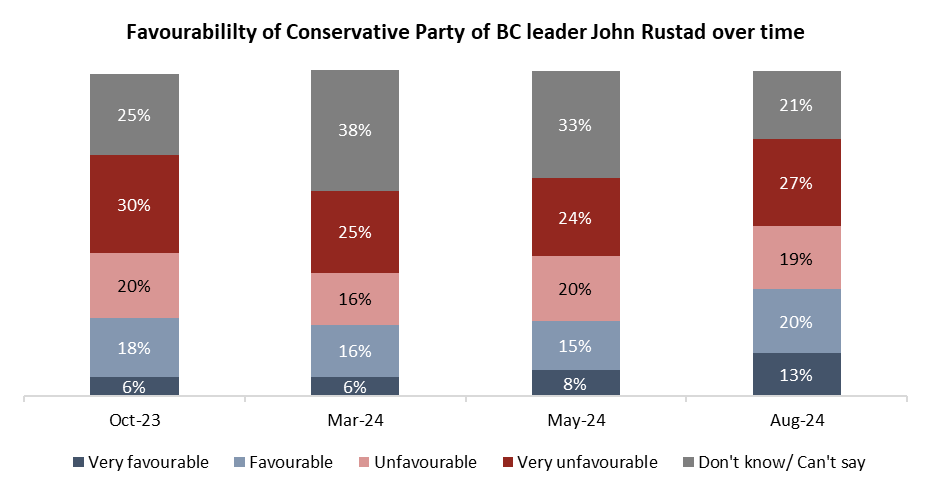
Rustad has become a more recognized name for British Columbians. Even as recently as May, fewer than half (46%) of British Columbians could recognize a picture of Rustad.
Over time, British Columbians have become more positive in their assessments of Rustad. In March, 22 per cent said they had a favourable view of Rustad, with 41 per cent saying they had an unfavourable one. Now those figures are 33 per cent and 46 per cent respectively, suggesting some positive momentum as Rustad becomes voters’ primary right-of-centre option on the ballot:
Indeed, while most British Columbians say their opinion of both Eby (62%) and Rustad (56%) has “stayed about the same” in recent weeks, they are twice as likely to say their opinion of Rustad (18%) has improved than to say the same of Eby (9%). Fewer also say their opinion of Rustad has worsened (25% vs. 29% for Eby, see detailed tables).
Eby appears to be losing ground among men older than 34 – as noted above, the group most likely to be supporting the BC Conservatives – but also perhaps concerningly for the BC NDP as they try to hold on as incumbents, also among women older than 34. Opinions of Rustad are trending negatively among younger British Columbians, a majority of whom say they will vote for the NDP:
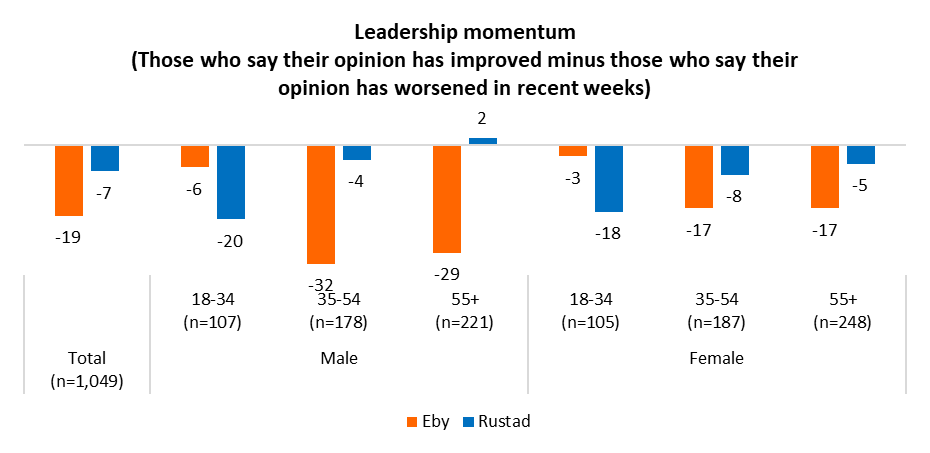
Eby is viewed favourably by more than two-in-five women older than 34. A similar number say they have an unfavourable view of Rustad, but a sizable portion of that group say they don’t know enough to form an opinion (35-54 women, 29%; 55+ women, 28%, see detailed tables).
On ‘best premier’, Eby holds slight edge
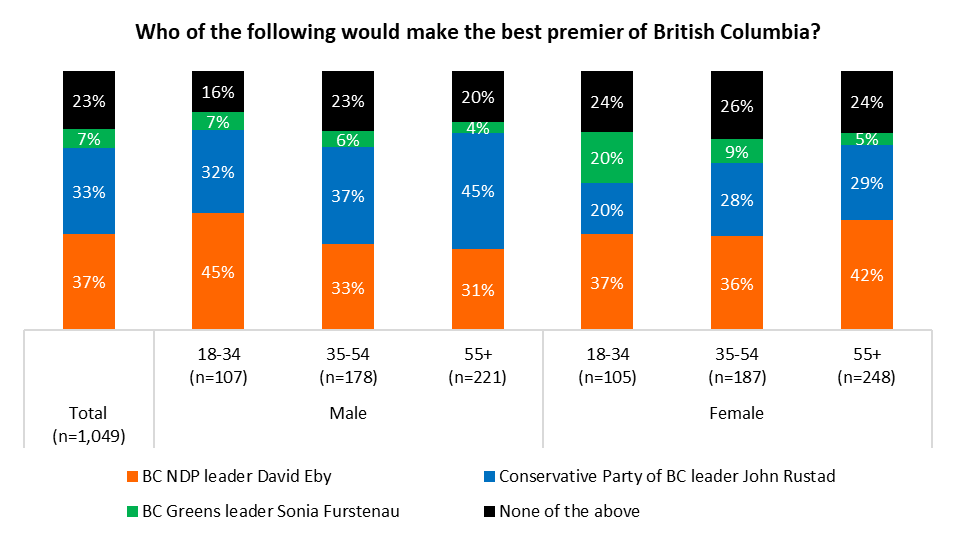
Overall, Eby is still the most likely to be viewed as the best premier for the province, but Rustad isn’t too far behind. Approaching two-in-five (37%) say Eby is the best choice to lead B.C.; one-third (33%) choose Rustad.
Eby leads by this metric among all demographics except for men older than 34:
BC’ers say province is on the ‘wrong tracks’ on several fronts
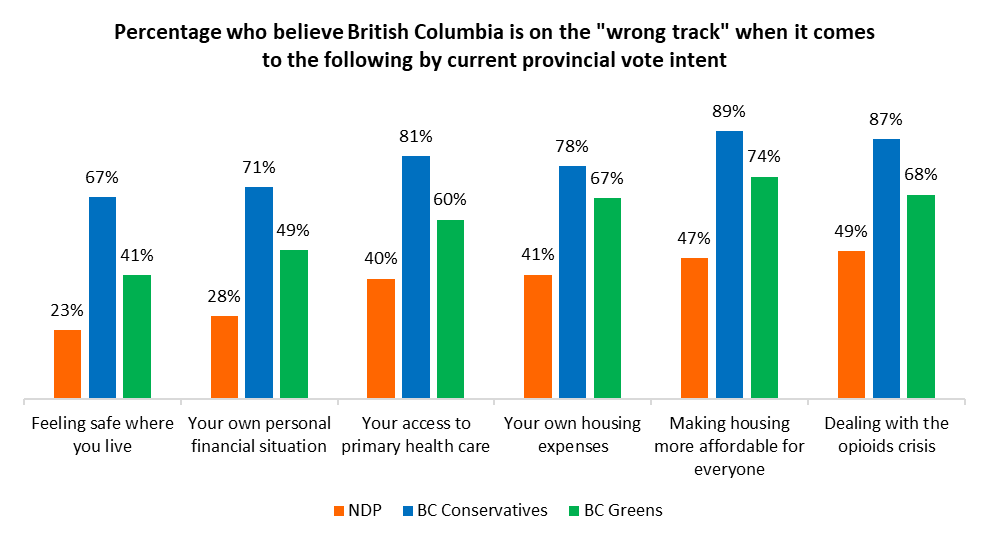
However, British Columbians express strong misgivings about the direction of the province currently under the leadership of Eby. More say that British Columbia is on the “wrong track” than the right one when it comes to feeling safe where they live, their personal finances, their access to health care, their housing expenses and dealing with crises in housing affordability and opioids addiction. The latter two have been policy foci of Eby and the BC NDP government, who have made sweeping changes to zoning rules to encourage further building of housing and have come under severe criticism for its handling of a drug decriminalization pilot program.
While likely BC Conservative voters are near universal in their criticism on these files, there are sizable groups of BC NDP and BC Greens who say the province is moving in the wrong direction when it comes to the opioids and housing crises:
In fact, across all demographics, a majority say British Columbia is on the “wrong track” when it comes to making housing affordable for everyone and dealing with the opioids crisis. Presenting a clear plan and vision on these issues will no doubt play a significant role in the coming election as the campaign period officially kicks off next month.
Survey Methodology
The Angus Reid Institute conducted an online survey from Aug. 28 to Aug. 30, 2024 among a representative randomized sample of 1,049 Canadian adults living in British Columbia who are members of Angus Reid Forum. For comparison purposes only, a probability sample of this size would carry a margin of error of +/- 3 percentage points, 19 times out of 20. Discrepancies in or between totals are due to rounding. The survey was self-commissioned and paid for by ARI.
For detailed results by age, gender, region, education, and other demographics, click here.
For the full release including methodology, click here.
For the questionnaire, click here.
Shachi Kurl, President: 604.908.1693 shachi.kurl@angusreid.org @shachikurl
Jon Roe, Research Associate: 825.437.1147 jon.roe@angusreid.org @thejonroe