

Three-quarters say government performing poorly on cost of living and housing affordability
Sept. 12, 2025 – New data from the non-profit Angus Reid Institute finds the BC NDP facing significant challenges as it approaches the one-year mark of its latest mandate.
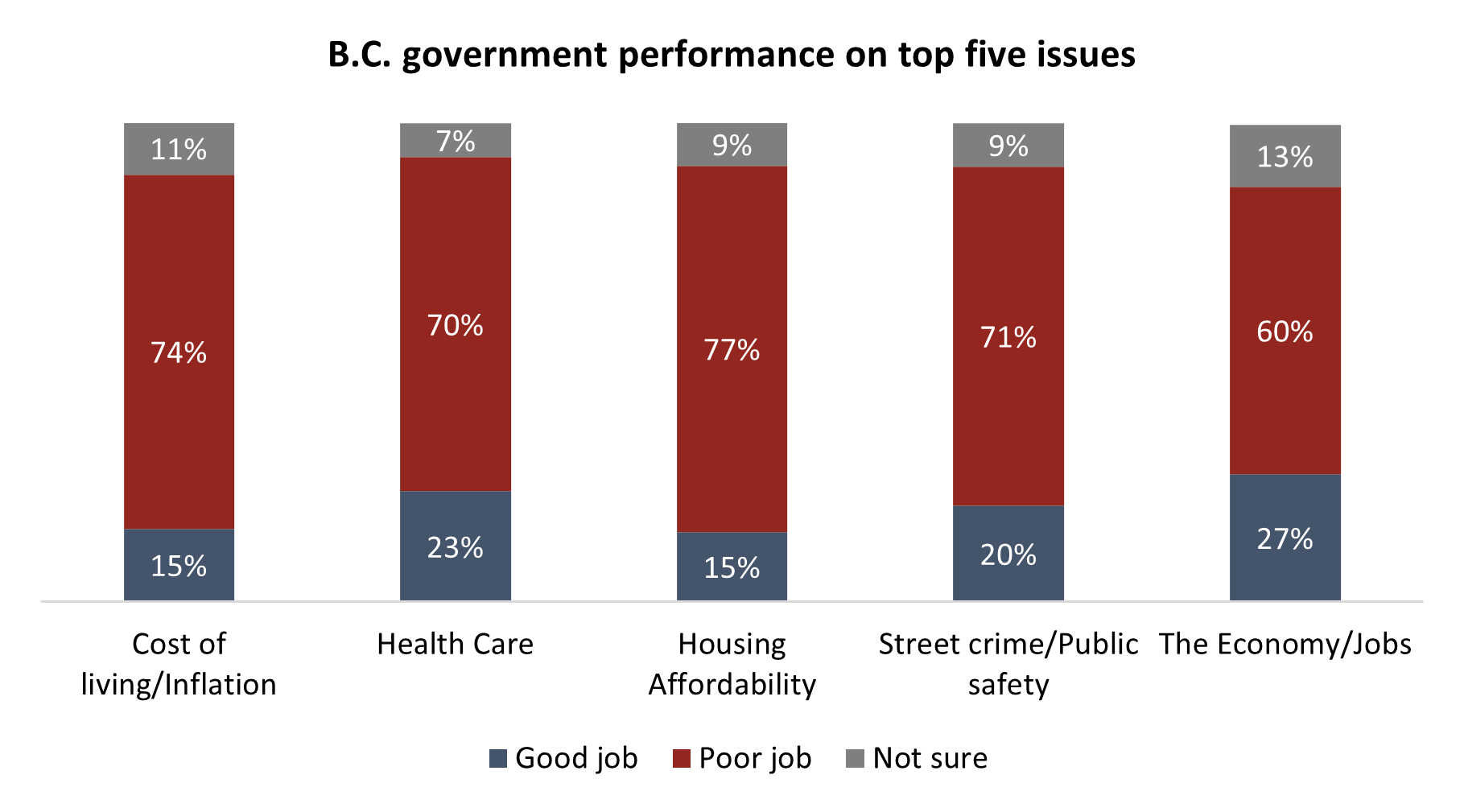
Asked about the government’s performance on the top five issues in the province (as selected by British Columbians) at least three-in-five say the government is performing poorly on all five. On the top issue – the cost of living – 74 per cent take this negative view.
This, as a strike of the B.C. General Employees Union grows, and some predict a record deficit for the 2025-26 fiscal year.
Premier David Eby has seen his own personal approval fall over the last six months, from 53 to 41 per cent, while some of the province’s economic challenges have become more apparent. His main rival, BC Conservative leader John Rustad, however, garners just 28 per cent favourability, against a 56 per cent unfavourable rate.
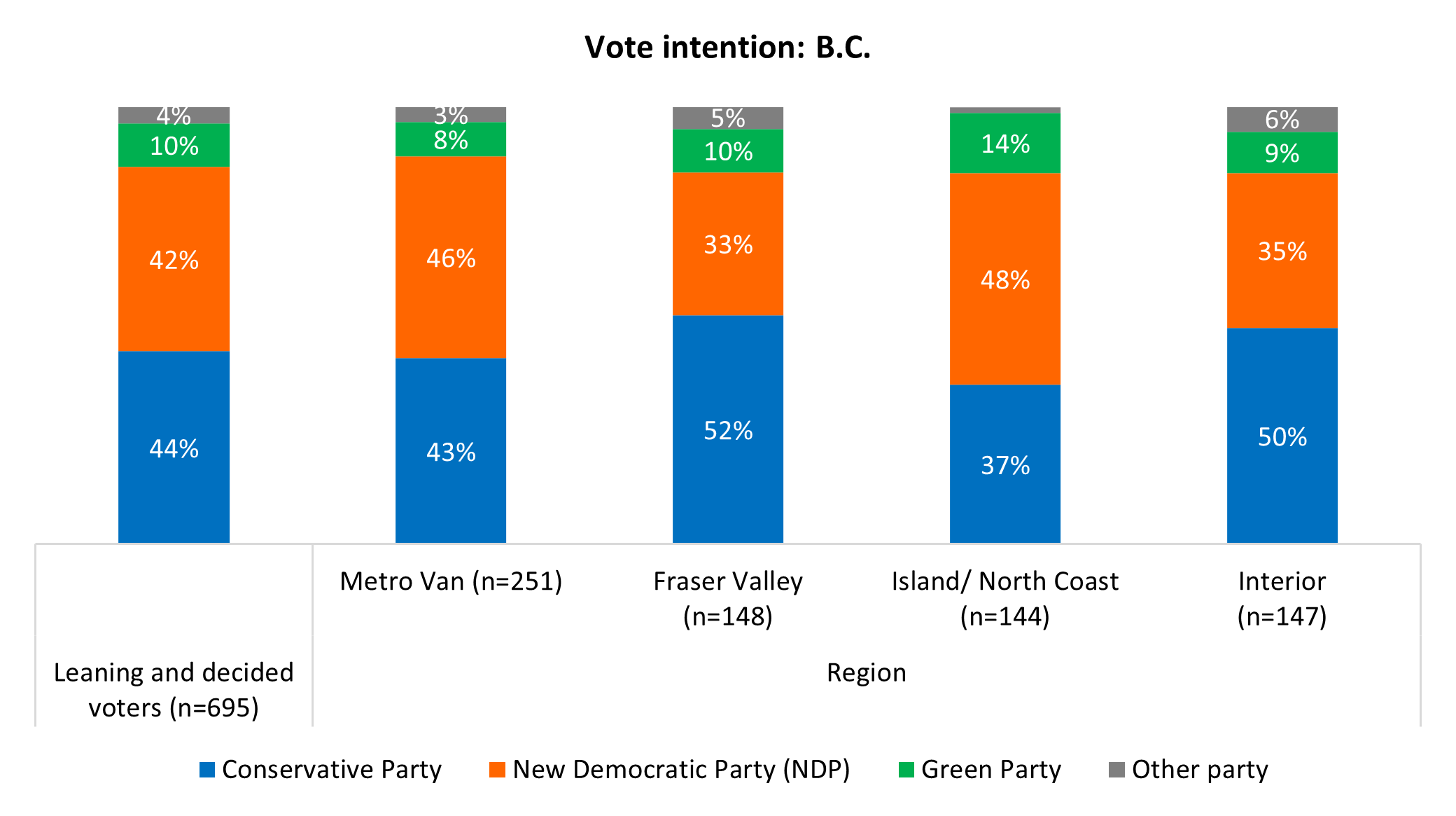
Politically, the picture looks similar now to the one that led Eby and his counterparts to form government last October. If an election were held today, 44 per cent say they would support the BC Conservatives (+1 from election result) while 42 per cent would vote for the incumbents (-3).
INDEX
-
Views of premier and opposition leader
-
Government Performance Index
-
Government performance trend
-
Right track or wrong track?
-
Top issues
-
Performance on top issues
-
Vote intention update
Views of premier and opposition leader
B.C.’s legislature will not return to sitting until Oct. 6, but that hasn’t meant a quiet summer for Premier David Eby or opposition leader John Rustad. Eby made news recently after criticizing Canada’s temporary foreign worker program and has been trying to navigate a strike among the B.C. General Employees Union, as well as the ongoing tariff challenges in the United States. Throw in a controversial decision recognizing Aboriginal title for the Cowichan Tribe in Cowichan, which Eby has stated the government will appeal, and Eby and the BC NDP have had no shortage of issues to address.
Eby’s approval has taken a hit over the past six months, dropping from 53 to 41 per cent. For Rustad, an ongoing leadership review will decide his future. This as the BC Conservatives have lost multiple members since the election due to expulsion and resignation. Rustad’s favourability among British Columbians is 28 per cent, half the level of those who view him unfavourably:

Government Performance Index
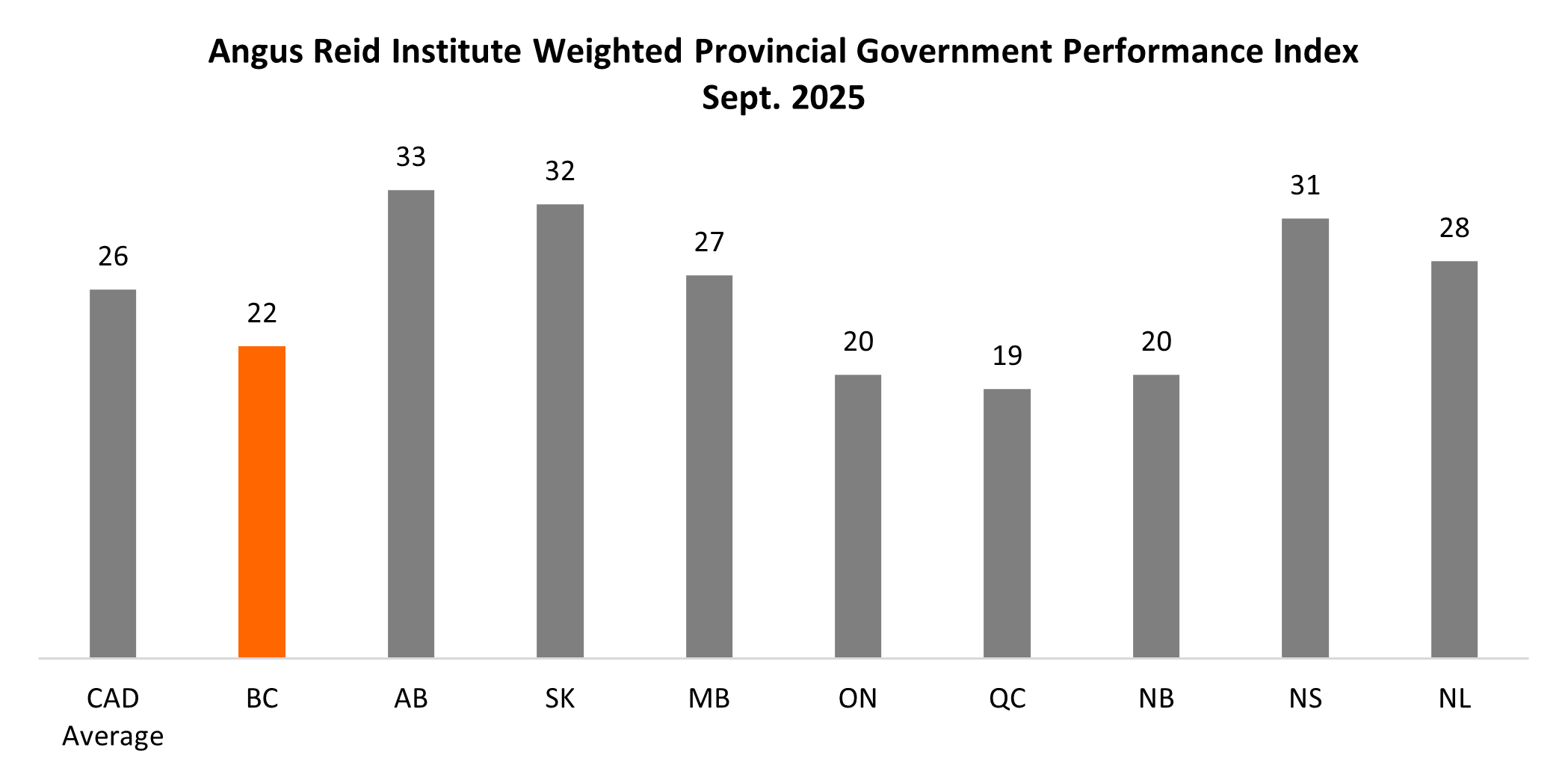
The Angus Reid Institute’s Government Performance Index is a weighted average of the positive responses across all of the issues discussed in the survey. That is, more important issues are weighted more heavily than less important ones. For the full list of issues, see detailed tables. Using this weighted average, none of the provinces are performing particularly well. Consider that in March 2025 the Canadian average was eight points higher. In British Columbia, the BC NDP rates poorly on this measure, scoring a 22. This is lower than the national average and well below Alberta and Saskatchewan:
Government performance trend
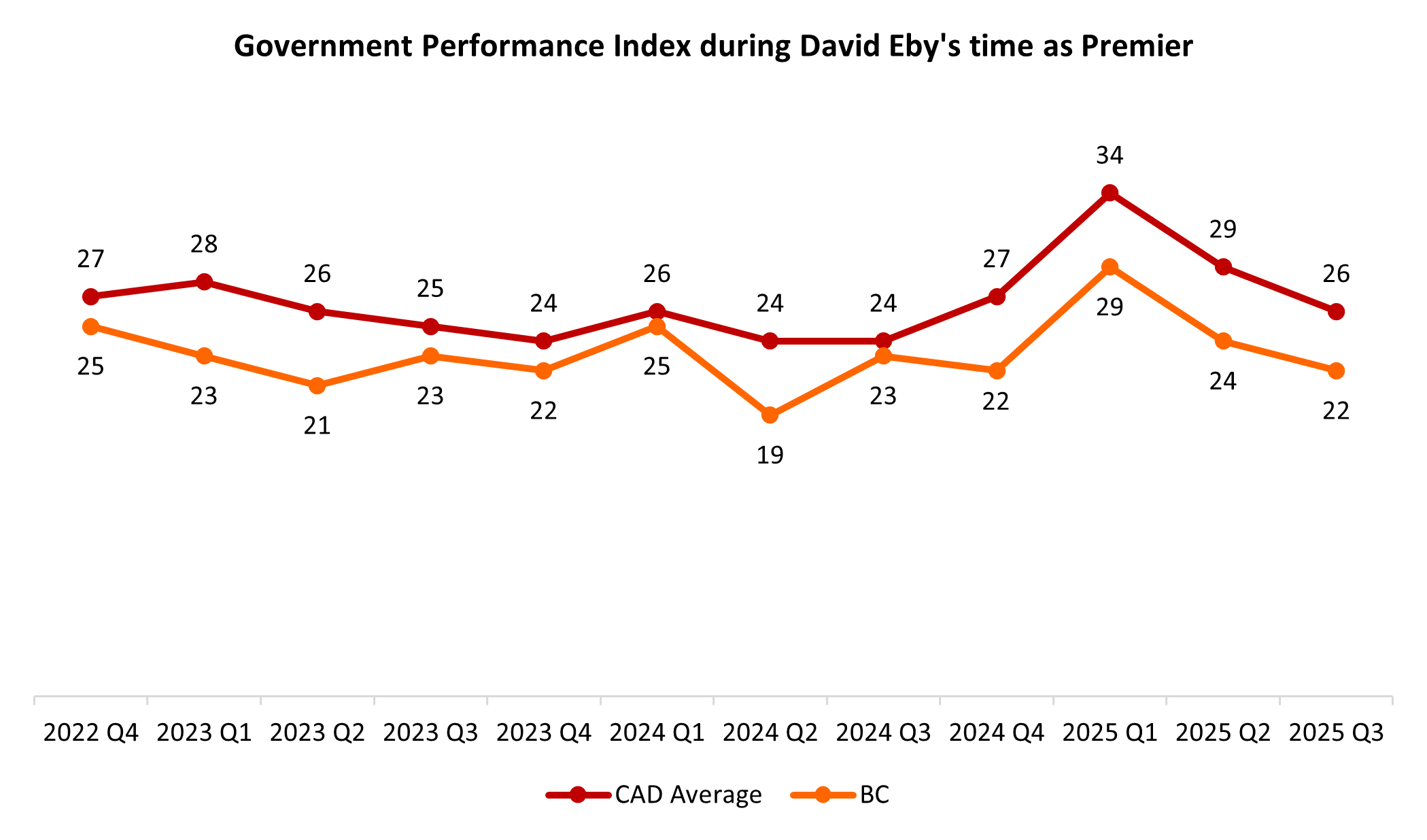
While Eby has remained relatively popular since taking over the leadership in late 2022, his government has never surpassed the national average in terms of its perceived performance. After receiving a boost in acclaim from residents in the wake of the Trump-tariff saga, criticism has grown:
 Right track or wrong track?
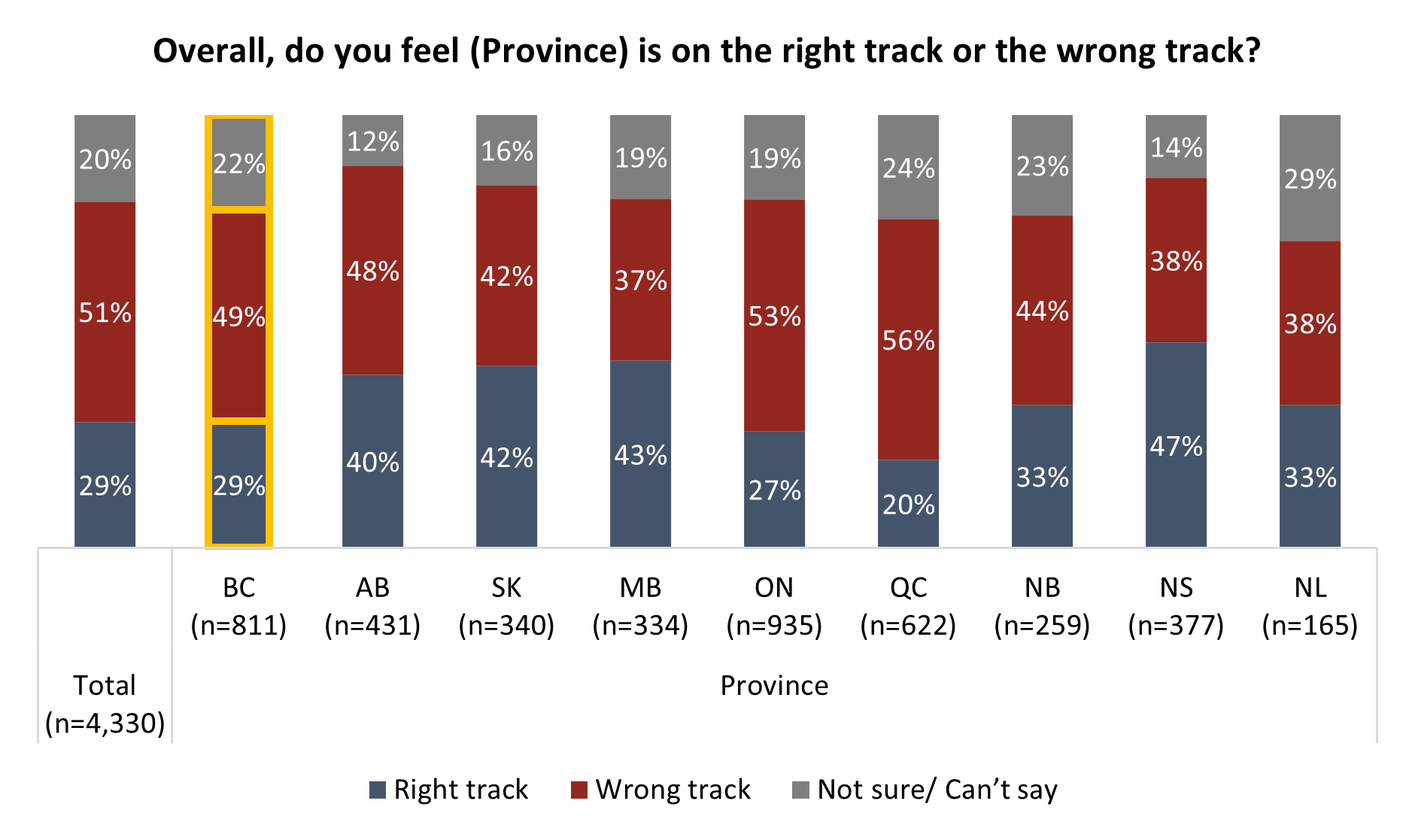
Half of British Columbians say their province is on the wrong track, overall. While this is hardly unique, as Albertans, Ontarians and Quebec residents are as likely or more likely to say this of their province, it is not a ringing endorsement of provincial governance. Three-in-10 (29%) disagree and say the province is on the right track. This is a much more common view among those who voted for the BC NDP in the last election (54%) than those who voted Conservative (20%).
Top issues
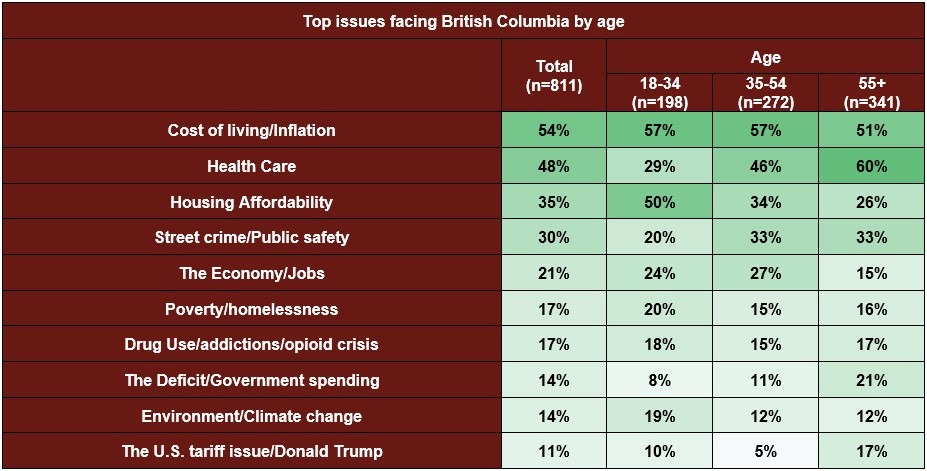
British Columbians were asked what their top priorities are for the government, with two elevating ahead of others. The cost of living (54%) and health care (48%) are clearly the top priorities. B.C. has consistently rated among the most expensive provinces in Canada to live, with many considering leaving.
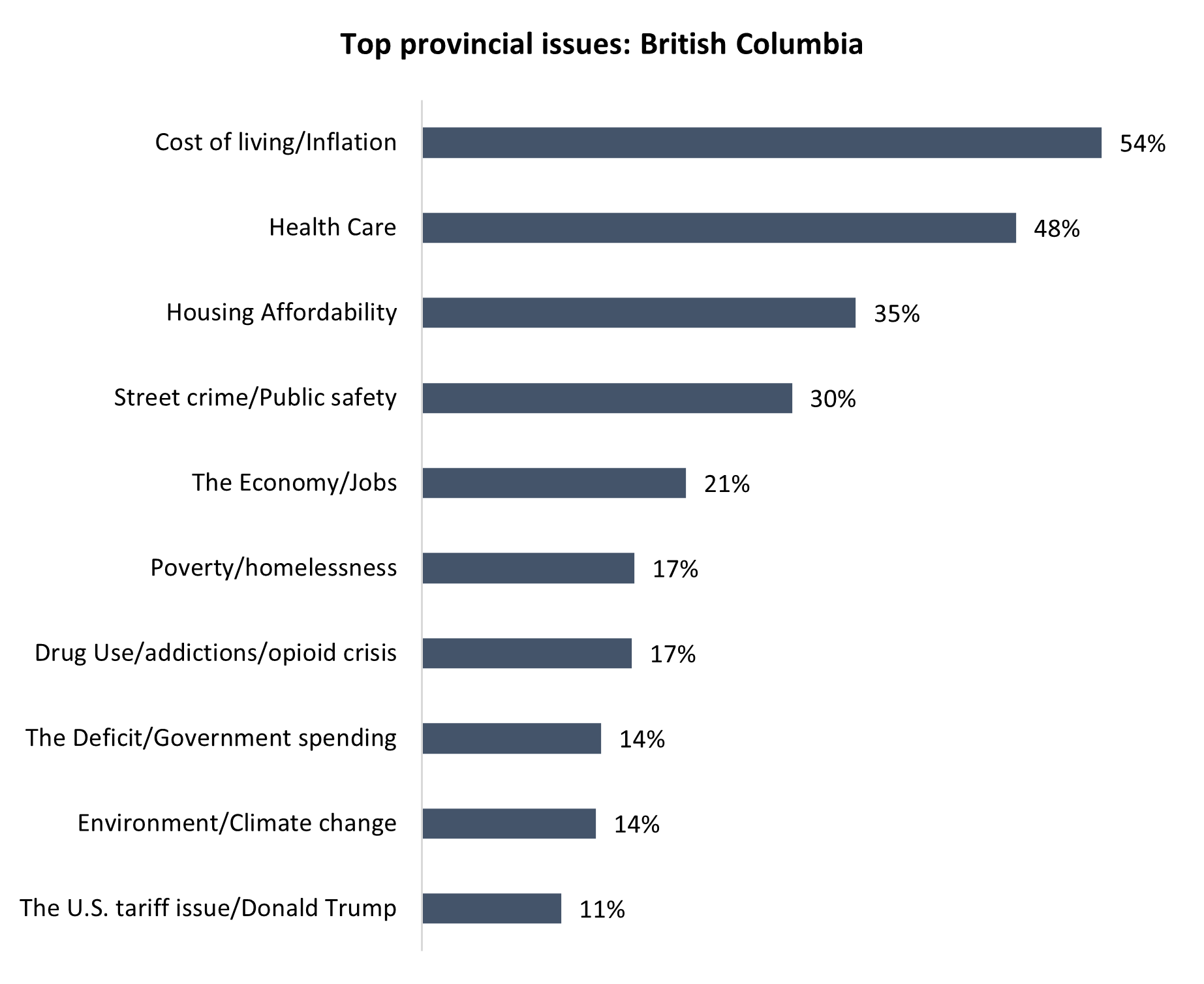 There are significant disparities across age when it comes to the top issues in B.C. While most agree that the cost of living is a key priority, older British Columbians are twice as likely to prioritize health care and half as likely to prioritize housing affordability compared to those under 35. As the labour market continues to struggle, one-quarter of younger residents also choose the economy and jobs a top issue:
 Performance on top issues
The BC NDP appears to have myriad challenges to overcome. Asked how the government is performing on the top five issues of the day, at least three-in-five say “poorly” across each one.
 Vote intention update
The relatively widespread discontent on top issues may be having a political impact as well. The vote picture remains close to the result produced last October (BC NDP 45%, BC Conservative 43%), though the parties have swapped which has the two-point advantage:
Survey Methodology:
The Angus Reid Institute conducted an online survey from Aug. 28 to Sept. 5, 2025, among a randomized sample of 4,330 Canadian adults who are members of Angus Reid Forum. The sample was weighted to be representative of adults nationwide according to region, gender, age, household income, and education, based on the Canadian census. Discrepancies in or between totals are due to rounding. The survey was self-commissioned and paid for by ARI.

For more information on our polling methods, click here.
For detailed results by age, gender, region, education, and other demographics, click here.
For PDF of full release, click here.
For questionnaire, click here.
MEDIA CONTACTS:
Shachi Kurl, President: 604.908.1693 shachi.kurl@angusreid.org @shachikurl
Dave Korzinski, Research Director: 250.899.0821 dave.korzinski@angusreid.org
Jon Roe, Research Associate: 825.437.1147 jon.roe@angusreid.org