

CPC voters at odds with others over consultation and accommodation of First Nations in development
August 13, 2025 – As Canada moves ahead with major nation-building legislation in the face of U.S. economic threats, the public remains deeply divided over how these projects intersect with Indigenous rights, and indeed, many are unaware of what those rights even entail.
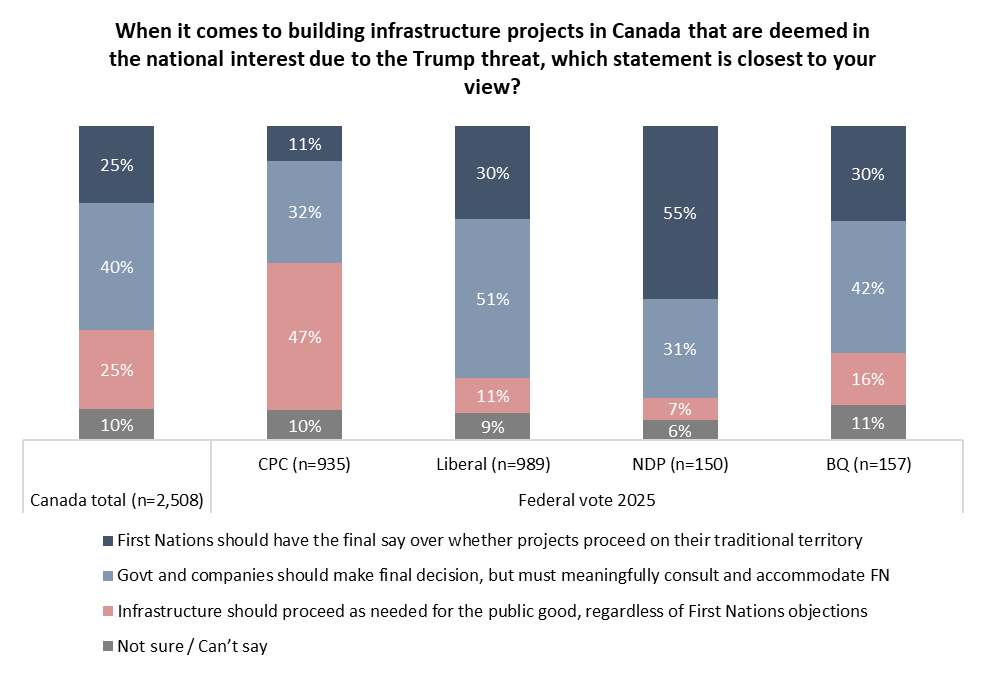
New data from the non-profit Angus Reid Institute finds many Canadians in favour of meaningful consultation and accommodation of First Nations for projects deemed in the national interest. Two-in-five believe that this is needed, but that the government and companies building the projects should retain final say (40%). One-quarter say First Nations should have a veto if projects infringe on their traditional territory, and the same number say infrastructure in the national interest should proceed regardless of objections.
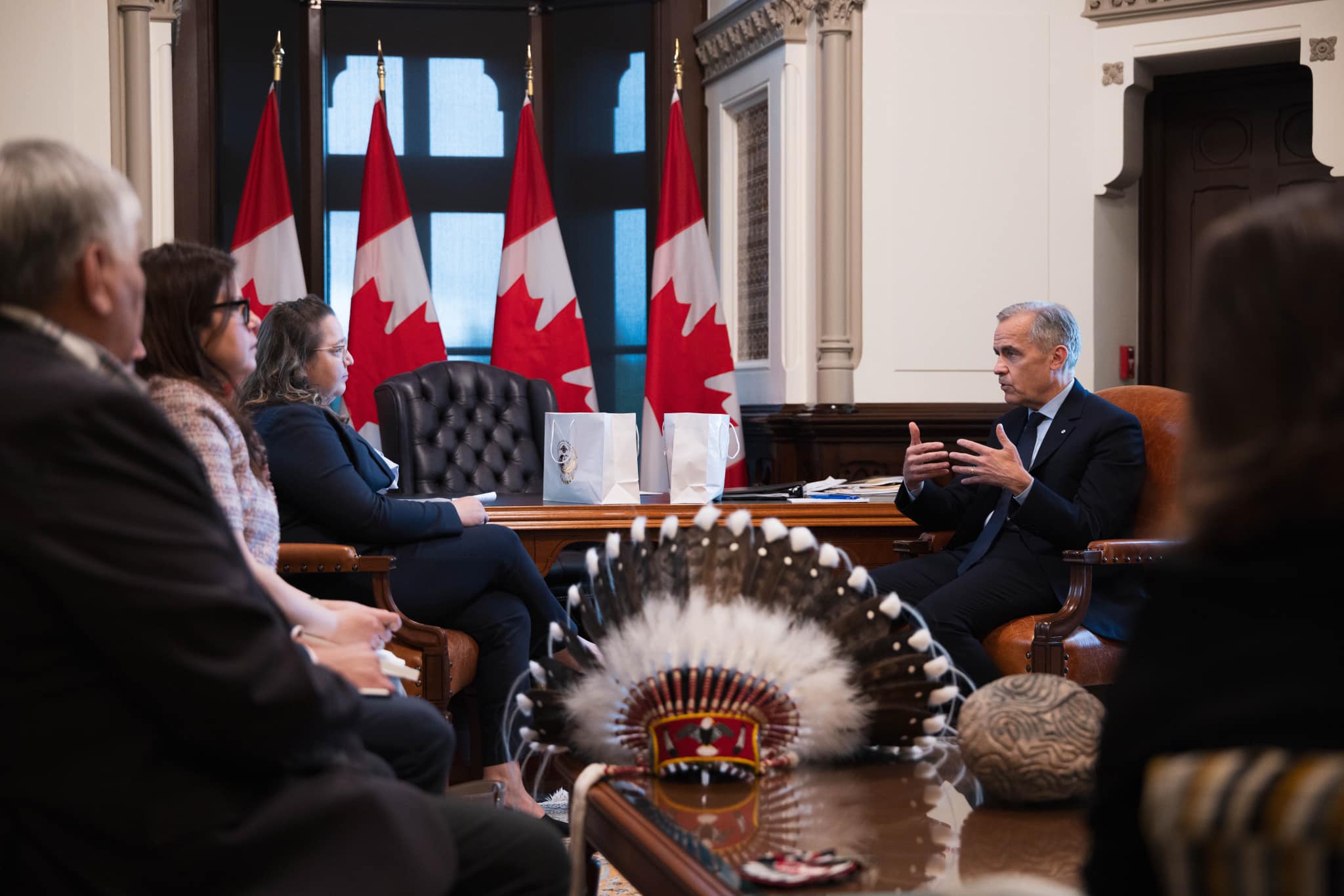
Prime Minister Mark Carney has convened summits in recent months with Indigenous leaders to emphasize consultation as central to his government’s Bill C-5, the One Canadian Economy Act. Carney has repeated that development will recognize and affirm Section 35 of the Constitution Act, 1982, and the rights set out in the United Nations Declaration on the Rights of Indigenous Peoples (UNDRIP), including the principle of free, prior, and informed consent.
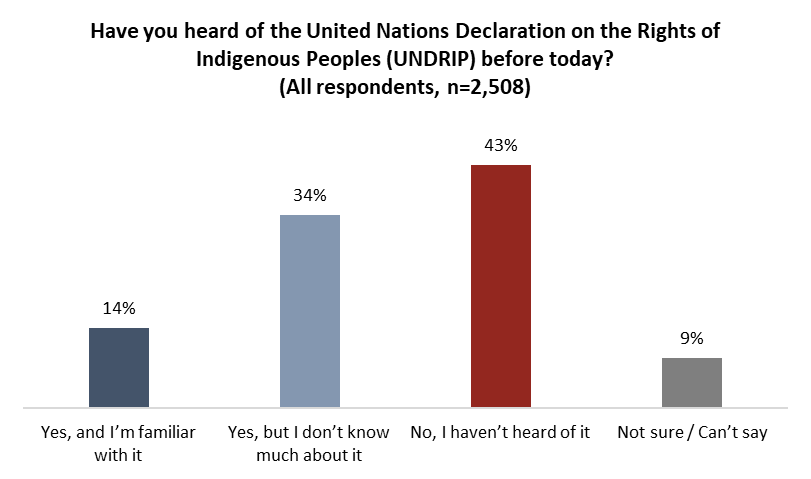
Despite Parliament enshrining UNDRIP into law in 2021, many Canadians have never heard of it. Two-in-five (43%) are unaware of UNDRIP, while 34 per cent have heard of it but say they don’t know much. One-in-seven (14%) profess knowledge of the declaration.
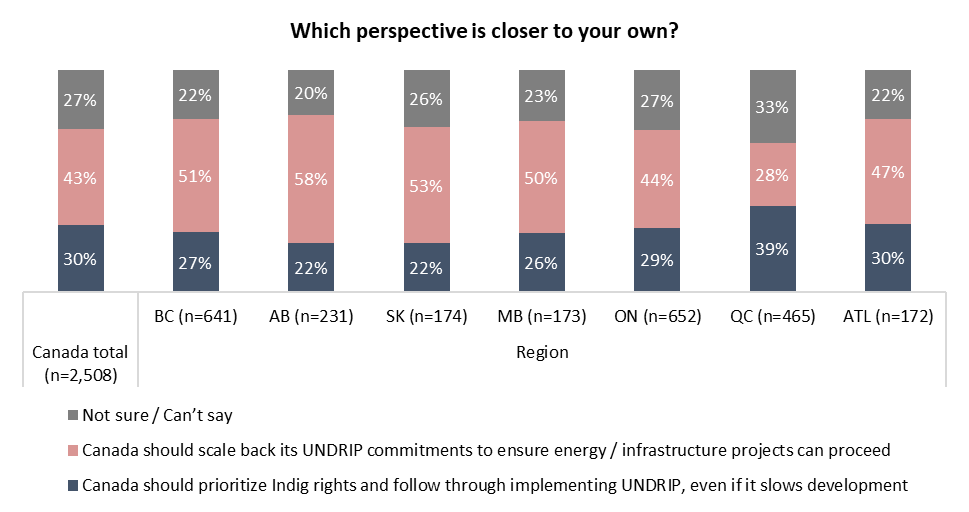
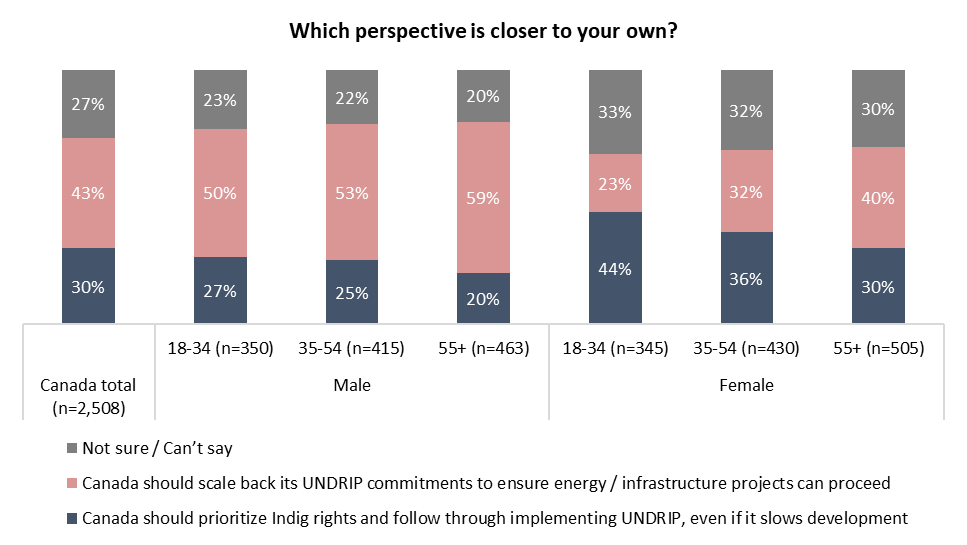
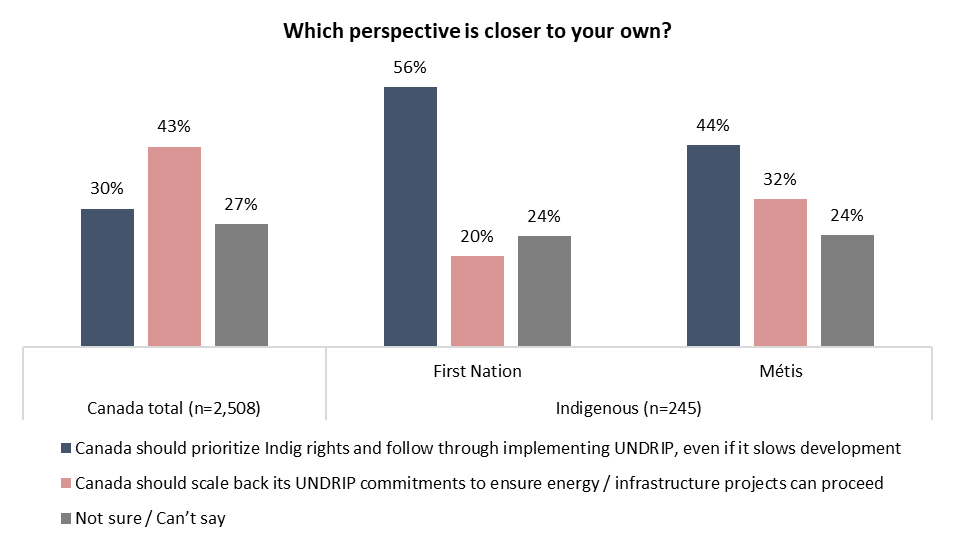
When informed of the obligations and principles, Canadians lean toward scaling back UNDRIP commitment in favour of development projects (43%), rather than ensuring that it is protected, even if that means projects are slowed (30%). Many remain unsure of how Canada should handle its commitment (27%).
INDEX
Part One: Bill C-5 and Bill 5
Part Two: Most say treaties have not been appropriately respected
Part Three: Many unaware of UNDRIP, lean toward reducing obligations for national projects
Part Four: Indigenous focus
Part One: Bill C-5 and Bill 5
Prime Minister Mark Carney’s signature campaign promise to the country centred on building the nation from coast to coast in response to the threat posed by United States President Donald Trump. Shortly after Carney’s election victory the government introduced Bill C-5, the One Canadian Economy act, which introduces legislative elements to streamline regulatory reviews and overcome provincial trade barriers, among other aspects.
Related: Bill C-5: Canadians support fast-tracking projects, conflicted over individual elements
In Ontario, a similar law, Bill 5, has also sought to streamline regulatory processes, leading some First Nations to question whether their right to consultation would be upheld. Several Nations launched lawsuits in response to these laws calling them unconstitutional. Carney has persistently communicated that consultation with Indigenous Peoples living in Canada is fundamental to moving forward projects deemed in the national interest, though many who attended a summit with the federal government recently have been unmoved.
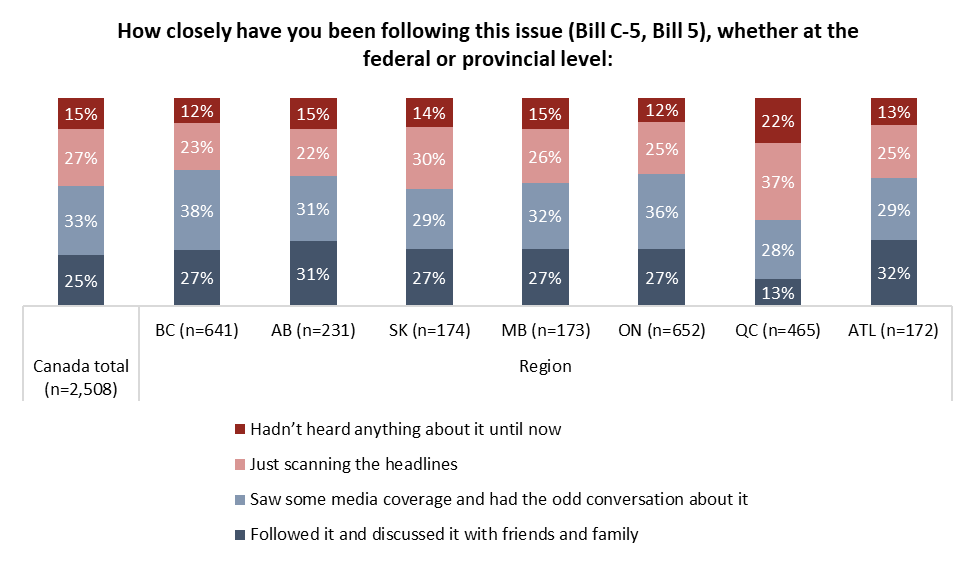
The majority of the country has been following along with these events in recent months, with three-in-five (58%) have at least seen media coverage and had the odd conversation about it. Regionally, awareness is lowest in Quebec and highest in B.C. and Ontario:
Full question: “The federal and Ontario governments have passed new laws (Bill C‑5 and Bill 5 respectively) that fast-track major projects in response to ongoing threats from U.S. President Donald Trump by potentially bypassing environmental and regulatory reviews. How closely have you been following this issue, whether at the federal or provincial level:”
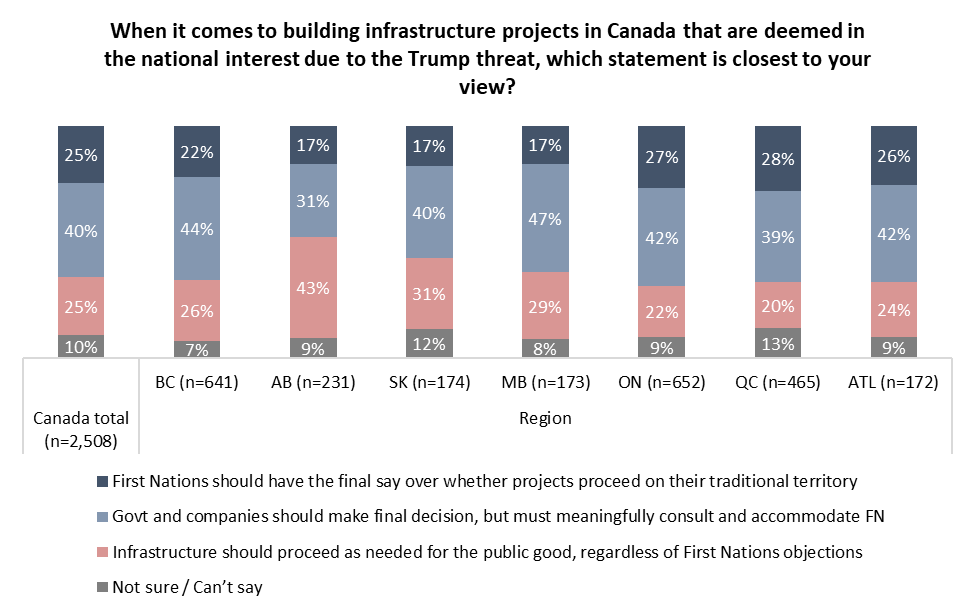
The clear desire of the Canadian public to address the threat posed by American tariffs and unreliability is evidently balanced with the long-held view that proper review and consultation benefits those potentially affected by the projects. Consider that one-quarter of Canadians (25%) say that First Nations should have final say on these proposals, while two-in-five (40%) support meaningful consultation and accommodation before development. One-quarter – rising to a plurality of 43 per cent in Alberta – say that infrastructure deemed in the national interest should proceed as needed, even if First Nations object:
Full question: “Governments say they will consult Indigenous communities, but they also maintain that this doesn’t give First Nations a veto. Nine Ontario First Nations have sued, arguing this violates their legal rights to free, prior, and informed consent and self-determination.
When it comes to building infrastructure projects in Canada that are deemed in the national interest due to the Trump threat (such as pipelines, highways, or energy developments), which statement is closest to your view?”
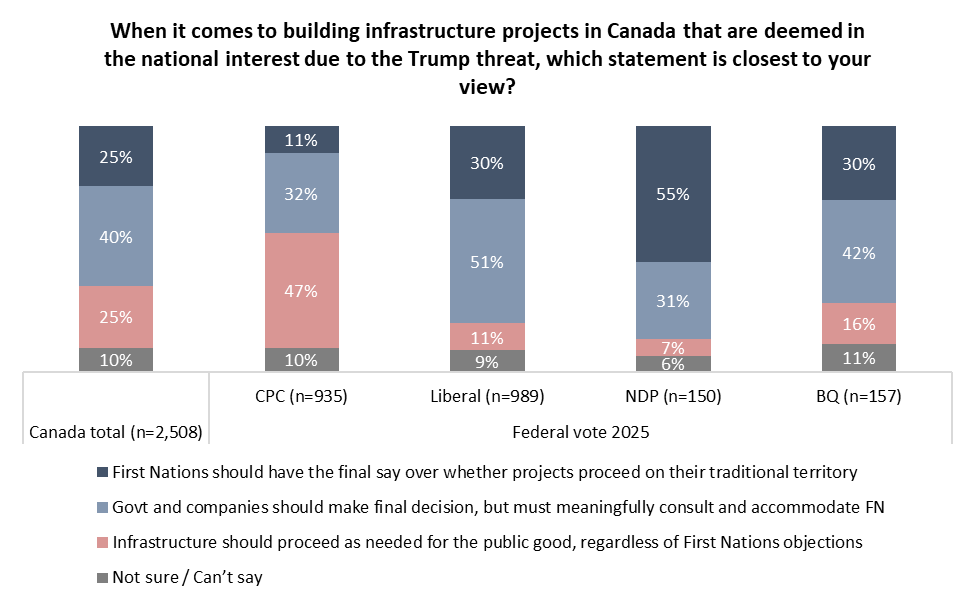
Bill C-5 was passed with rare Liberal-Conservative cooperation, but this is an issue that recent voters of these two parties view distinctly. Half of 2025 Conservative Party voters would ignore First Nations objections for national interest projects, compared to just 11 per cent among Liberals. New Democratic Party voters are the only group politically wherein a majority would give veto rights to First Nations:
Part Two: Most say treaties have not been appropriately respected
Much of this conversation echoes past and ongoing treaty rights negotiations. Numbered treaties were first negotiated in the period between 1871 and 1921, with other treaty negotiations preceding these. Aboriginal title was legally recognized in 1973 and engendered a new series of modern treaties. In recent years, treaties have continued to be the subject of debate, after the Supreme Court ruled that the federal and Ontario governments had acted “dishonourably” by capping payments to Indigenous People in a treaty signed 175 years ago at four dollars per person. Twelve First Nations may reportedly be eligible for billions in compensation.
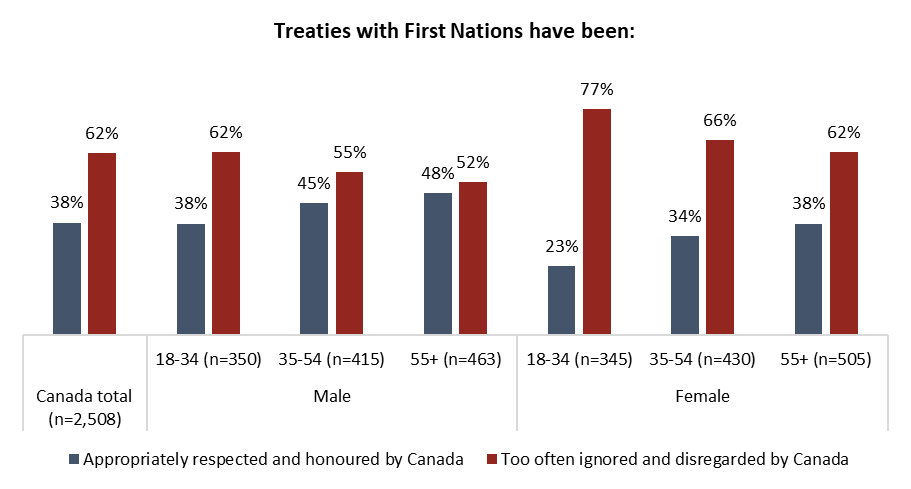
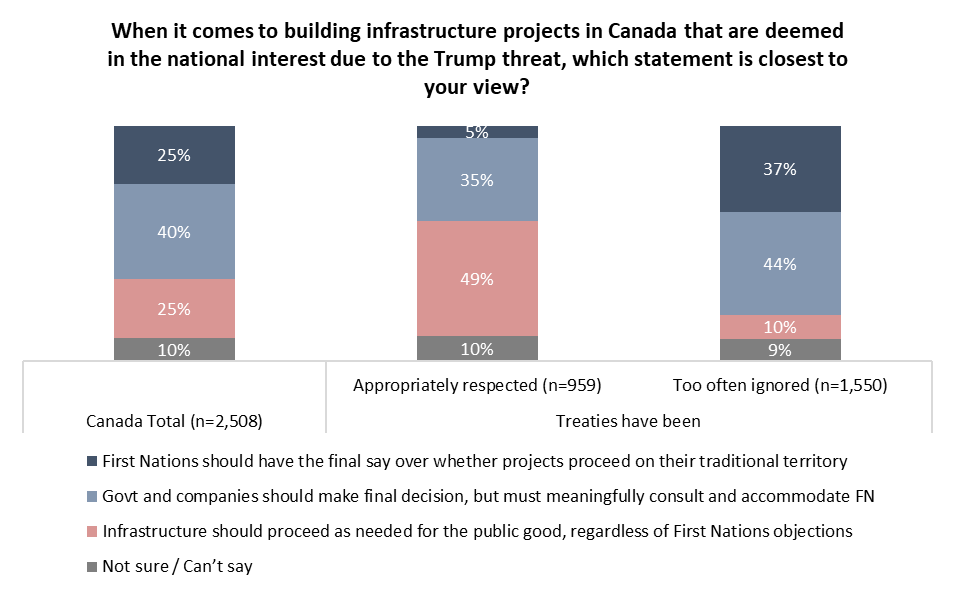
The sentiment among most Canadians is that treaties have not been appropriately respected and honoured by Canada, with all age and gender groups leaning toward this view.
This perspective largely informs views of contemporary debates. Indeed, those who believe that treaties have been ignored are overwhelmingly in favour of either meaningful consultation and accommodation (44%) or an outright veto (37%) for First Nations in developing major national projects. Those who say treaties have been appropriately respected are five-times more likely to say that infrastructure should move forward as needed, regardless of objection:
Part Three: Many unaware of UNDRIP, lean toward reducing obligations for national projects
The United Nations Declaration on the Rights of Indigenous Peoples (UNDRIP) was adopted by the UN General Assembly on Sept. 13, 2007, affirming rights to self-determination, culture, language, land, and free, prior, and informed consent on matters affecting these groups. While 144 countries voted in favour, Canada — along with Australia, New Zealand, and the United States — initially opposed the declaration, citing concerns about provisions on land rights and resource control. Canada shifted its stance in 2010, issuing a statement of support, and in 2016 formally removed its objector status. In 2021, Parliament passed the UNDRIP Act, committing the federal government to align Canadian laws with the principles of UNDRIP.
Angus Reid Institute asked Canadians how much they have heard about this, finding approximately one-in-seven (14%) who profess some knowledge. The largest group – 43 per cent – say they have never heard of it:
Respondents were given the following information to ensure a baseline understanding.
Full question: “The United Nations Declaration on the Rights of Indigenous Peoples (UNDRIP) outlines the rights of Indigenous peoples around the world, including cultural preservation, land use, and the principle of “free, prior, and informed consent” before development projects proceed on traditional lands.
Canada has passed legislation to align its laws with UNDRIP. However, almost all other countries that endorsed the declaration — including the U.S., U.K., and Australia — have not enacted it into law.
Based on what you’ve read, seen, or heard, do you support or oppose Canada making UNDRIP legally binding through national legislation?”
Many are unsure about the implications of national legislation to confirm UNDRIP. Indeed, three-in-10 (30%) say they have no real opinion. Among the rest of the population, two-in-five (39%) are in support and three-in-10 (30%) are in opposition. Notably, equal numbers on each side offer strong support or opposition (14%):

Concerning the current realities on the ground, that is, the development discussions that have defined much of 2025, Canadians lean toward skepticism of UNDRIP commitments, but with significant minorities unsure or in disagreement with that position. Two-in-five overall (43%) say UNDRIP should be scaled back in order to move these key national projects forward. This proportion rises to a majority in B.C., Alberta, Saskatchewan, and Ontario, and drops far lower in Quebec (28%). Three-in-10 would prioritize UNDRIP principles even if it slows development, rising to 39 per cent in Quebec. Many across the country are unsure:
Full question: “Some say enacting UNDRIP into law strengthens reconciliation and Indigenous rights. Others say it can create legal uncertainty and make it harder to build major infrastructure. Which perspective is closer to your own?”
Gender and generation play a large role in views on this issue. Young women say UNDRIP should receive priority by a two-to-one margin, while all male groups disagree by the same margin or more. Women are also more likely to abstain from offering a view:
Part Four: Indigenous focus
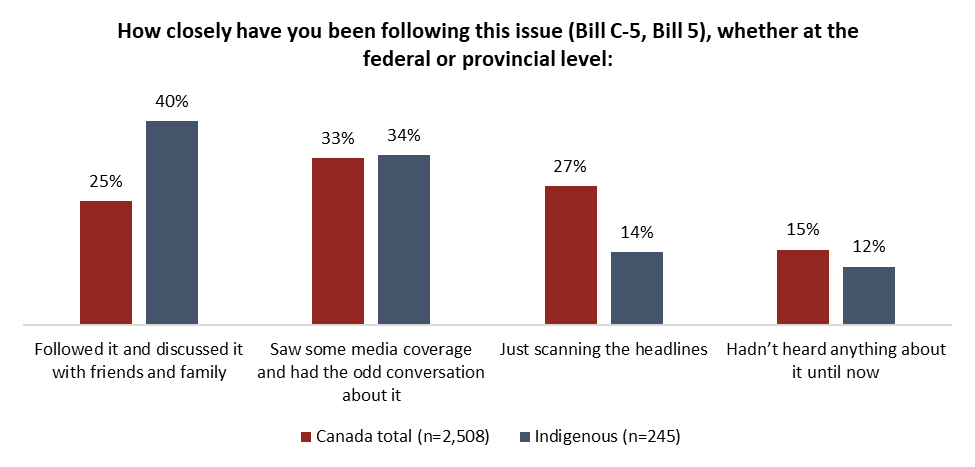
Angus Reid Institute included a sample of self-identifying Indigenous individuals in this survey. As one might expect, views among this group – which includes First Nations, Metis, and Inuit – are more informed than among the general population. Three-quarters of Indigenous individuals have been following the story around Bill’s 5 and C-5, for example:
Opinions are not unanimous on the issue of consultation or veto. First Nation individuals are by far the least likely to feel that infrastructure must move forward regardless of objections:
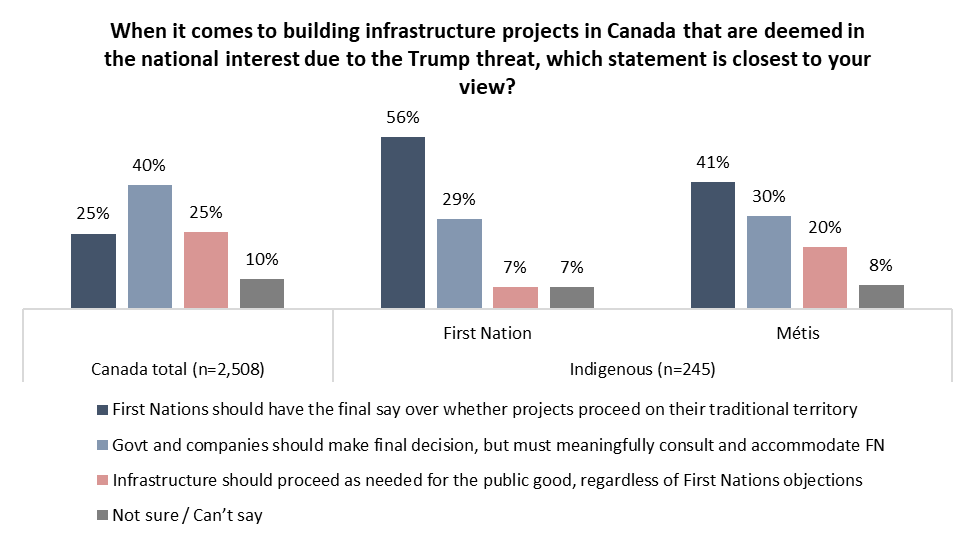
More than half of those who identify as First Nations and 44 per cent of Metis say that Canada should prioritize UNDRIP, while one-quarter of each group are unsure, and others disagree:
Survey Methodology
The Angus Reid Institute conducted an online survey from July 24 – 29, 2025, among a randomized sample of 2,508 Canadian adults who are members of Angus Reid Forum. The sample was weighted to be representative of adults nationwide according to region, gender, age, household income, and education, based on the Canadian census. For comparison purposes only, a probability sample of this size would carry a margin of error of +/- 1.5 percentage points, 19 times out of 20. Discrepancies in or between totals are due to rounding. The survey was self-commissioned and paid for by ARI.
A note on sample: The Angus Reid Institute collected responses from those who self-identify as Indigenous in this survey. This is not representative of all Indigenous experiences and perspectives. The total number of responses from Indigenous individuals (245 responses) was weighted within the total sample to be statistically representative at five per cent. Indigenous responses in Part Four are unweighted. Please consider these views as informative but not authoritative.
For more information on our polling methods, click here.
For detailed results by age, gender, region, education, and other demographics, click here.
For PDF of full release, click here.
For questionnaire, click here.
Image – Mark Carney/ Facebook
CONTACT:
Shachi Kurl, President: 604.908.1693 shachi.kurl@angusreid.org @shachikurl
Dave Korzinski, Research Director: 250.899.0821 dave.korzinski@angusreid.org
Jon Roe, Research Associate: 825.437.1147 jon.roe@angusreid.org