


Liberals lose ground on vote intention in B.C., however, with Green Party and CPC picking up defectors
December 1, 2025 – New public opinion polling data from the non-profit Angus Reid Institute – the first comprehensive, regional and national dive into political dynamics since last week’s announcement of a memorandum of understanding regarding a potential pipeline from Alberta to northwest British Columbia – shows that while Prime Minister Mark Carney lost a cabinet minister who disapproved of the MOU deeply, the PM’s approval level among the Canadian population remains stable.
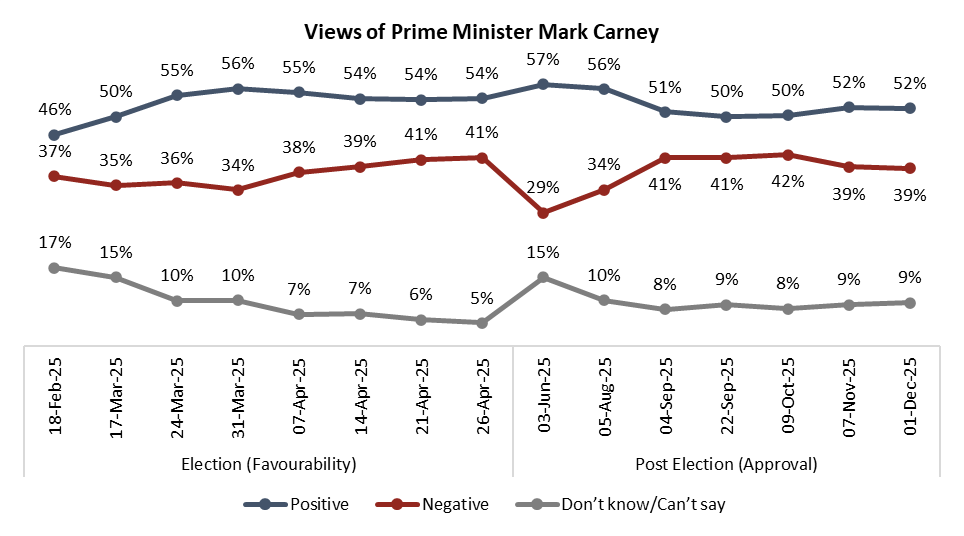
Indeed, both nationally, and in B.C., the epicentre of forthcoming negotiations and most certainly protests over the potential pipeline, Carney’s approval stands at 52 per cent. In Alberta, the PM gains three points in approval, up to 45 per cent.

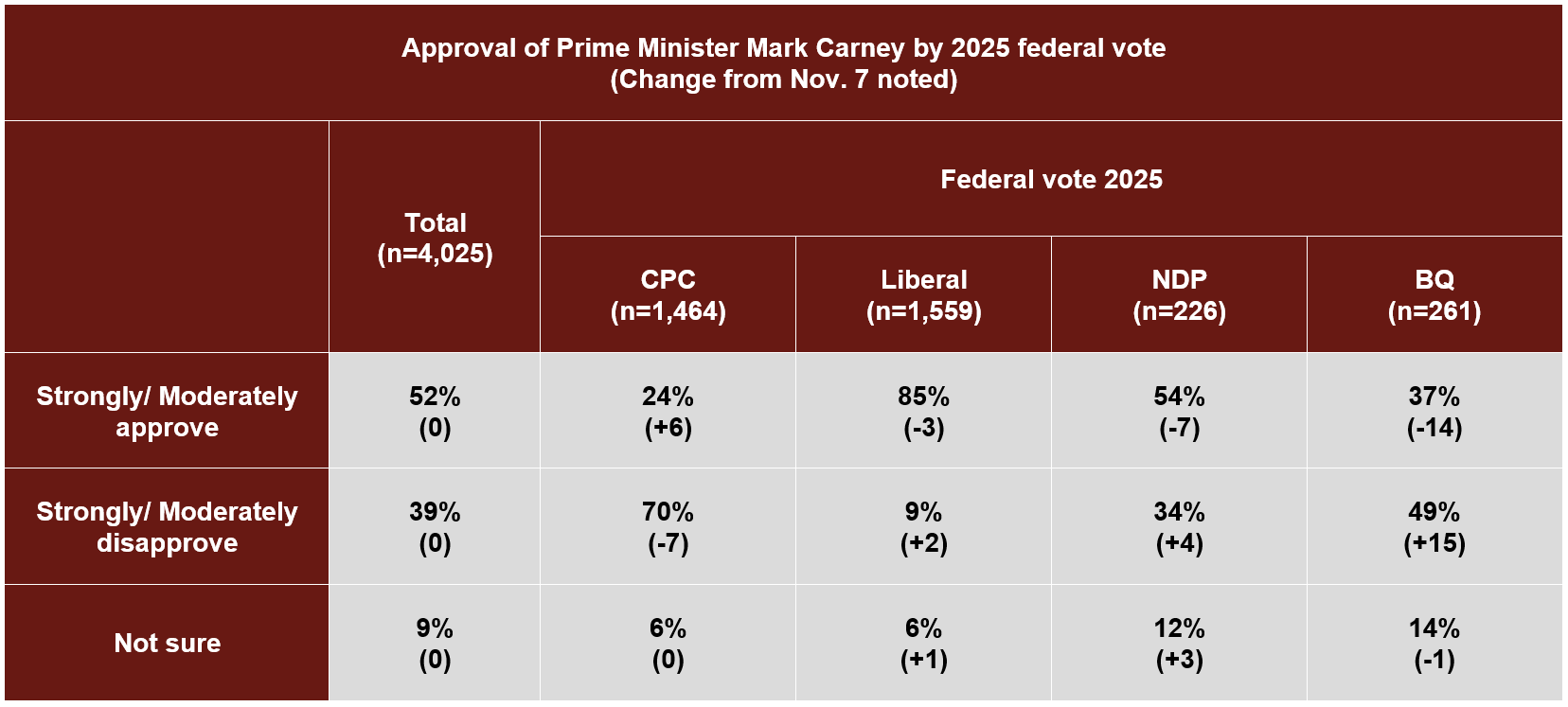
At the federal political level Conservative support has increased for Carney. One-quarter (24%) of those who voted for Pierre Poilievre’s party in April say they approve of the PM, an increase of six points from early November. His approval loss among those who voted for the other major federal parties offsets this gain (Liberal -3 to 85%, NDP -7 to 54% and BQ -14 to 37%).
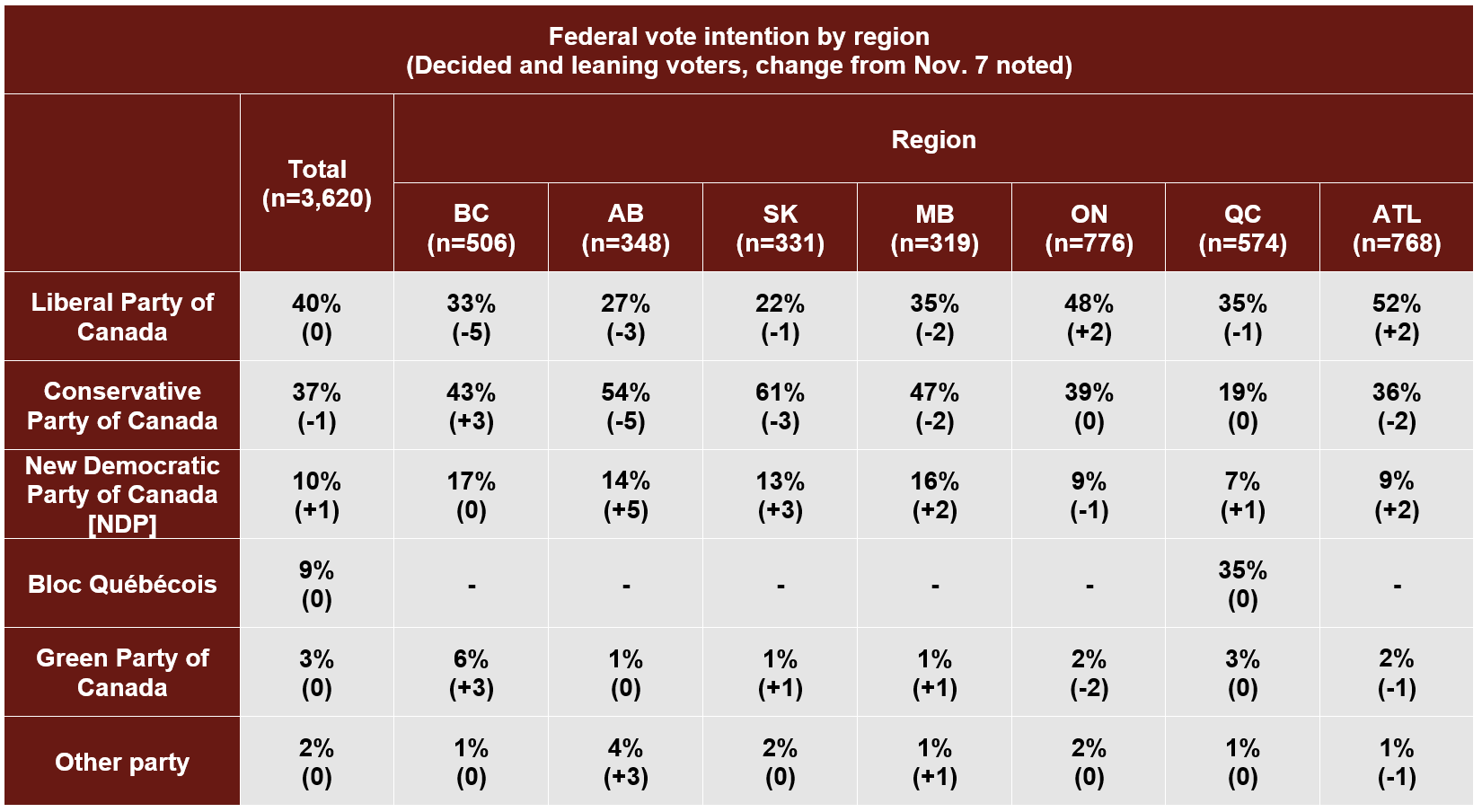
Overall, 40 per cent say they would support the Liberals in a federal election, while 37 per cent would support the CPC. The NDP and BQ, both likely to seek to benefit from some of the unrest among progressives in the country are chosen by 10 per cent and nine per cent respectively.

Under the surface, however, are regional undercurrents pulling in more worrying directions. In B.C., the Liberals have dropped five points in vote intention, with those voters moving to the right and left. The CPC is up three points to 43 per cent and the Green Party has moved from three to six per cent.
Higher approval for Carney among Albertans isn’t translating into a bump in vote intention. The CPC leads the Liberals in that province 54 per cent to 27 per cent.
More Key Findings:
- Voters in Metro Vancouver have shifted considerably after the pipeline project announcement. Compared to early November, support for the Liberals has dropped by 15 points. Vote intention has moved to the CPC (+6), the Greens (+4), and the NDP (+2). The proportion of undecided voters has also grown in Metro Vancouver (+3).
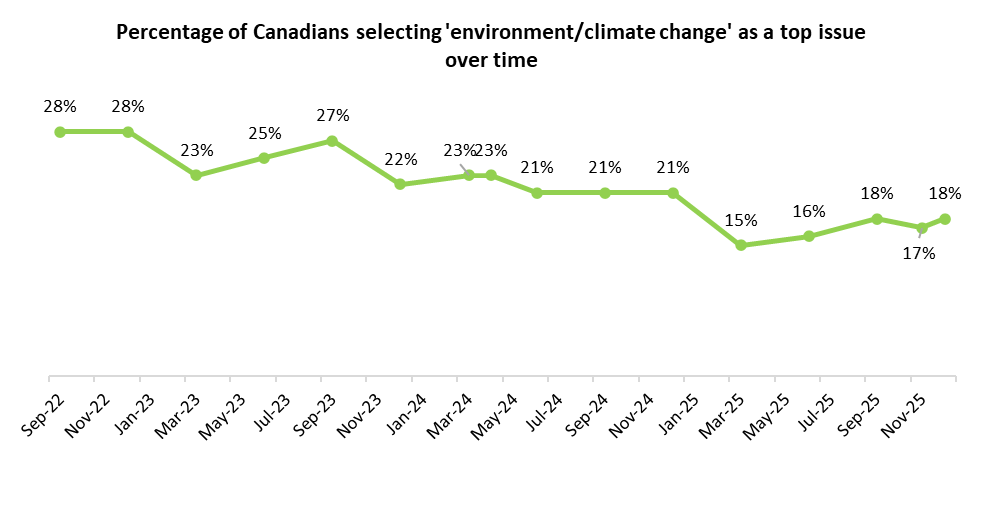
- 18 per cent of Canadians say that the climate and environment is among their top issues. This is a three-point increase compared to March, but well below the 28 per cent who chose this issue in both September and November of 2022.
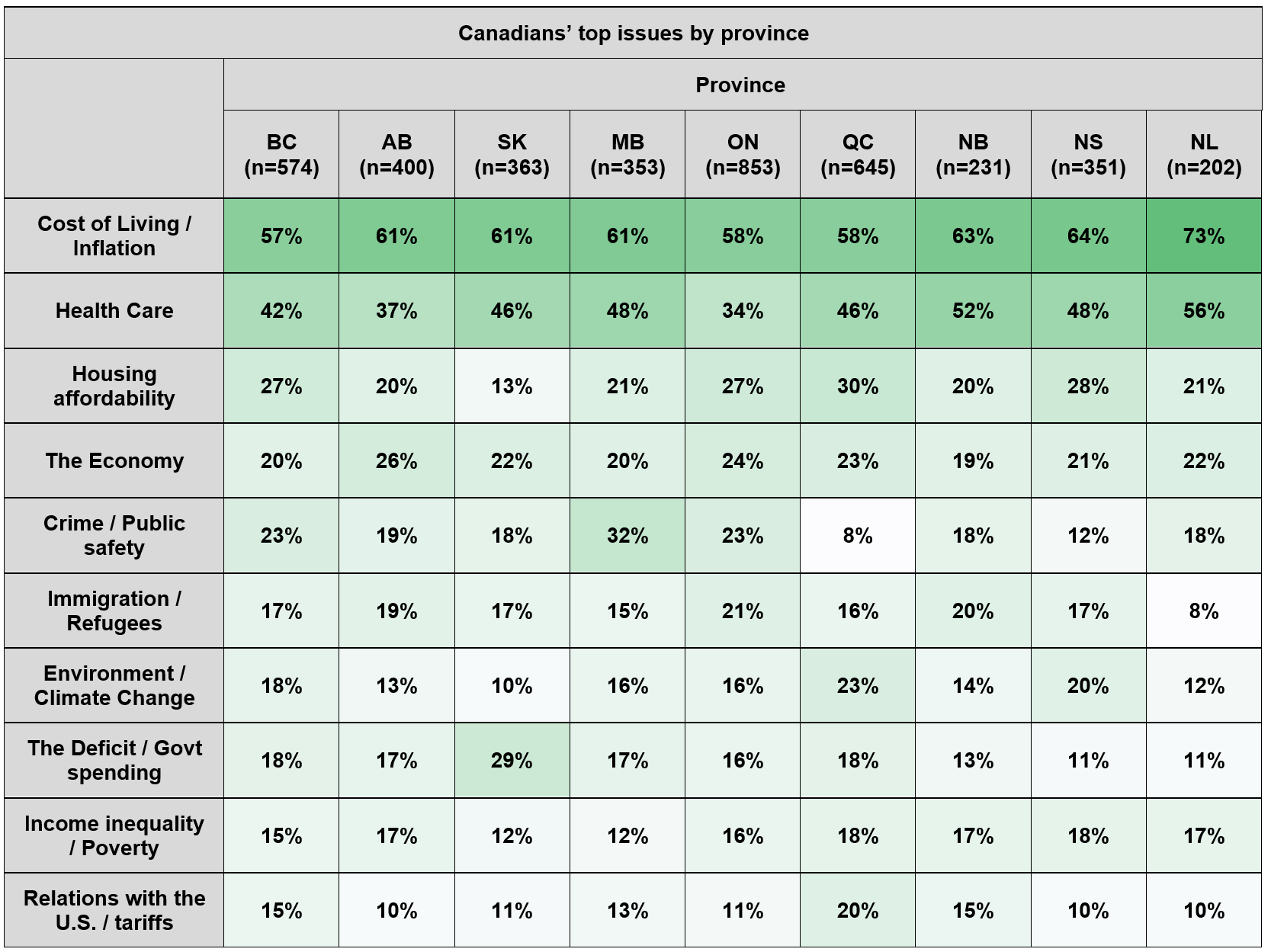
- The cost of living continues to dominate Canadians’ list of concerns, chosen by 59 per cent and placing as the top issue in every region of the country.
Note: Because its small population precludes drawing discrete samples over multiple waves, data on Prince Edward Island is not released.
INDEX
- Approval of Carney
- Top issues
- Vote intention
- What’s the story in B.C.?
Approval of Carney
A memorandum of understanding between the federal Liberal government and the Alberta provincial government got just about every major politician in the country talking last week. Terms and conditions have been set (more here) to pursue a pipeline from Alberta to the northwest coast of B.C., which has B.C. Premier David Eby and many coastal First Nations saying “no” and Premier Danielle Smith saying the MOU does not contain a veto.
In the middle of this provincial expression of cooperative (or combative) federalism, is Prime Minister Mark Carney. Carney has said that the pipeline is not a guarantee, but that this discussion sets up the “necessary conditions” for progress on this front. Swirling amid all of this are changing views of the PM, that notably, come out identically from a public opinion perspective as a national figure. Just as they did early in November, 52 per cent of Canadians approve of Carney and 39 per cent disapprove:
In British Columbia, Prime Minister Carney’s approval is also unchanged overall at 52 per cent. Forthcoming negotiations with an oppositional provincial government and many First Nations will be key to public opinion in that province, which delivered the Liberals 20 seats in April to the Conservatives 19. In Alberta, Carney’s approval rises three points but remains three points below his disapproval (45% to 48%). The biggest gain for Carney is in Saskatchewan, which is where he struggles the most politically. He also drops in Quebec:
Carney receives a six-point bump in approval from 2025 Conservative Party voters which balances out losses of among other major federal party supporters. Internal tensions have yet to make a significant impact on 2025 Liberal voters, however, with their approval of the PM strong at 85 per cent. Gone, however, are majority approval levels from Bloc Québécois voters. Carney’s approval among this group drops from 51 to 37 per cent:
Top issues
The issues Canadians prioritize provide important context. Earlier this year, in February, the Angus Reid Institute found that economic growth was becoming a higher priority to Canadians when it comes to crafting energy policy than environmental concerns. That shift comes among the economic uncertainty brought to Canada’s door by U.S. President Donald Trump and his tariff campaign.
Related: Energy Policy: Canadians’ priorities shift from environment to economic growth and domestic capacity
Canadians’ top personal concern remains the high cost of living (59%), as it has been since the inflation shock of three years ago. Below that ranks health care (41%), housing affordability (26%) and the economy (23%). The environment and climate change (18%) is tied with crime and public safety (18%) and immigration and refugees (18%) among Canadians’ top concerns:

Over time, concern over the environment has fallen behind other issues. In September 2022, it ranked third (28%) behind health care (45%) and inflation (60%). Since then, the proportion of Canadians who select it as top issue facing the country has fallen by 10 points.
As Carney lays the groundwork for the potential federal approval of a new pipeline, there are few (5%) who view energy and natural resources issues as one of the country’s top concerns (see detailed tables).
Regionally, climate change and the environment is selected by more in B.C. (18%), Quebec (23%) and Nova Scotia (20%):
Vote intention
The MOU between Alberta and Ottawa has done little to affect the national vote picture in its immediate aftermath. The gap between the Liberals (40%) and Conservatives (37%) has grown to three points, but statistically speaking, vote intention remains identical to data recorded by ARI last month:
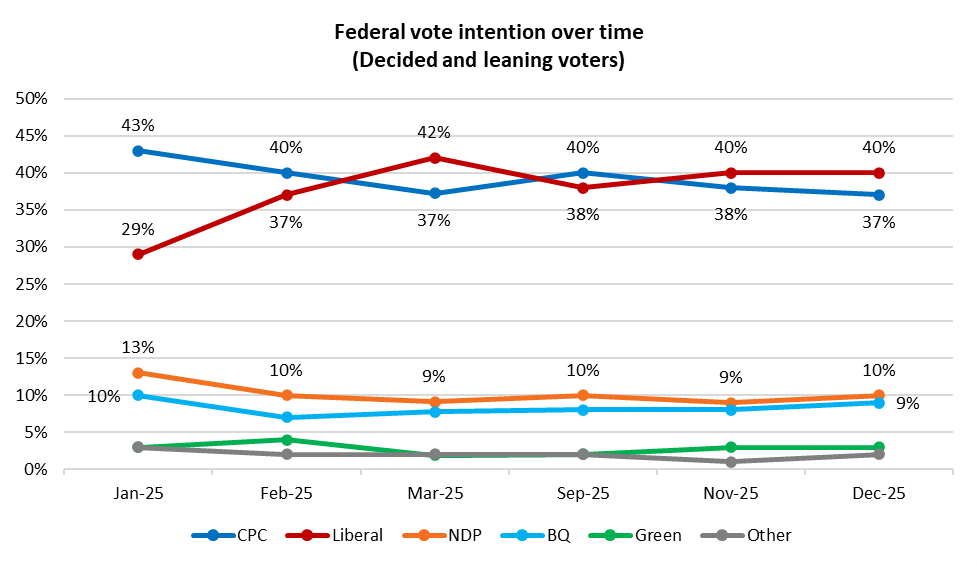
Under the surface, however, is a worrying regional trend for the Liberals. In B.C., a statistically tied federal vote intention picture a month ago (40% CPC, 38% Liberal) has changed to become a 10-point advantage for the CPC (43%, 33% Liberal). This been a boon to the federal Green Party in B.C., which doubles its support compared to November data – though it should be noted the party remains in the single digits. In Alberta, both the Liberal and Conservative Parties lose marginal support this wave, with the NDP and “other” blocks both picking up some support.
Elsewhere, although there have been shifts, the results remain within the provincial margin of error compared to last month:
What’s the story in B.C.?
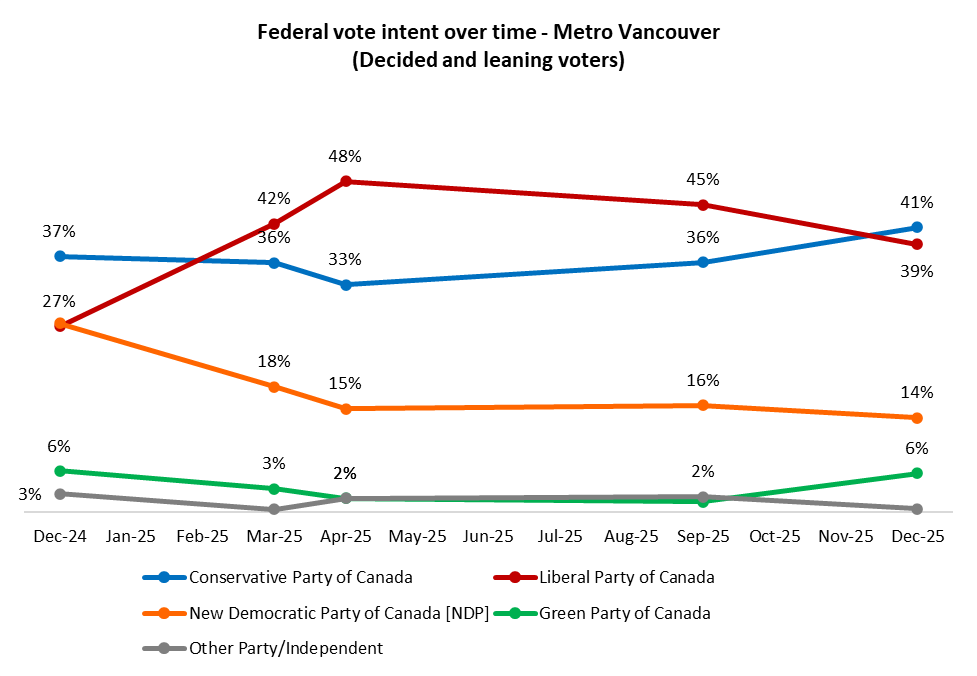
The Liberals have been slowly ceding ground to the Conservatives since the election, and appear to have dropped significant support from the level that helped them secure a minority government in April:

The decline is most notable in the Metro Vancouver region, where the Liberal party has fallen from the half (48%) support it received during the federal election to 39 per cent now. If the election were today, equal numbers in Metro Vancouver say they would vote CPC (41%) as Liberal (39%):
The B.C. story is nuanced. Comparing these data to Nov. 7 including undecided voters, illuminates the net effect on the Liberals’ support since the MOU was announced. The party’s support has dropped six points among the entire provincial population; at the same time, the proportion of undecided B.C. residents has grown by four points. The Greens (+2) and the CPC (+1) benefit slightly from the Liberals’ drop.
The trend is more dramatic in Metro Vancouver, where support for the Liberals has dropped by 15 points, to the benefit of the CPC (+6), the Greens (+4), and the NDP (+2). The proportion of undecided voters has also grown in Metro Vancouver (+3):

Survey Methodology
The Angus Reid Institute conducted an online survey from November 26 – December 1, 2025, among a randomized sample of 4,025 Canadian adults who are members of Angus Reid Forum. The sample was weighted to be representative of adults nationwide according to region, gender, age, household income, and education, based on the Canadian census. For comparison purposes only, a probability sample of this size would carry a margin of error of +/- 1.5 percentage points, 19 times out of 20. Discrepancies in or between totals are due to rounding. The survey was self-commissioned and paid for by ARI.

Note: Because its small population precludes drawing discrete samples over multiple waves, data on Prince Edward Island is not released.
For detailed results by age, gender, region, education, and other demographics, click here.
For PDF of full release, click here.
For full questionnaire, click here.
MEDIA CONTACT:
Shachi Kurl, President: 604.908.1693 shachi.kurl@angusreid.org @shachikurl
Dave Korzinski, Research Director: 250.899.0821 dave.korzinski@angusreid.org
Jon Roe, Research Associate: 825.437.1147 jon.roe@angusreid.org