

Canadians divided over wisdom of Trans Mountain purchase but ultimately feel it will pay off
February 10, 2025 – Conversations about trade wars with Canada’s historically most trusted ally have forced Canadians to take a long, hard look at the domestic capacity of their economy, from agriculture, to manufacturing, to oil and gas. With respect to the latter, new debates have dredged up old projects as Canadians and their leaders consider how to transport energy across the country.
New data from the non-profit Angus Reid Institute finds Canadians largely showing support for increasing pipeline capacity through two dismissed developments – Energy East and Northern Gateway. Each has significant economic and jurisdictional hurdles to overcome, but the public opinion landscape is evidently favourable.
Half (49%) say the federal government is not doing enough to build pipeline capacity, the same number who said so in 2019. Three-in-10 (29%) say the Liberals have taken the right approach, while 22 per cent say Trudeau has pushed pipelines too hard.

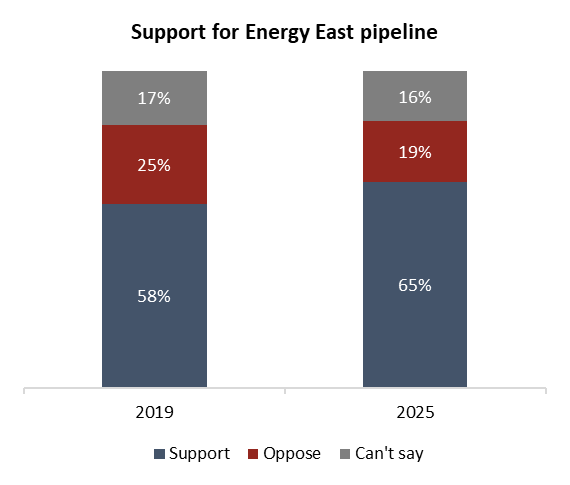
Two-thirds say they would support the renewal of Energy East – a project terminated in 2017 – that would have carried oil from the west to New Brunswick and Quebec. This pipeline, speculated upon recently by many leaders including by Natural Resources Minister Jonathan Wilkinson, has long been controversial in Quebec. That said, Premier Francois Legault recently stated that his government would consider the project if it became appealing to Quebecers. Support for Energy East in Quebec has risen from 33 to 47 per cent since 2019. Nationally support has risen from 58 to 65 per cent.
Another project that frustrated both supporters and opponents on the other coast of the country is the Northern Gateway pipeline. This, too, was terminated several years ago, after the Liberal federal government imposed a moratorium on oil tanker traffic on British Columbia’s northern coastline near its terminus. A slight majority of Canadians say they would support this project as well, while one-quarter oppose it. Northern Gateway generates 55 per cent support in B.C., with 32 per cent opposition.
More Key Findings:
- Asked about another project – the Trans Mountain expansion – Canadians are divided whether the government made the right decision (34%) or wrong decision (32%) in purchasing it. Cost overruns and delays beset the operation, ballooning the cost to $34 billion. More than half (56%) say that ultimately it will be good for Canada.
- Two-thirds of Canadians (66%) say that federal regulations make pipeline projects more expensive than they should be. One-in-five (19%) are unsure, and 16 per cent disagree.
About ARI
The Angus Reid Institute (ARI) was founded in October 2014 by pollster and sociologist, Dr. Angus Reid. ARI is a national, not-for-profit, non-partisan public opinion research foundation established to advance education by commissioning, conducting and disseminating to the public accessible and impartial statistical data, research and policy analysis on economics, political science, philanthropy, public administration, domestic and international affairs and other socio-economic issues of importance to Canada and its world.
INDEX
Part One: Resurrecting old projects
-
Half say government should do more to get capacity built
-
Majority support for Energy East, Northern Gateway
Part Two: Trans Mountain focus
-
A good investment, but did the government need to buy it?
Part One: Resurrecting old projects
The threat of tariffs from Donald Trump has illuminated the extent to which the Canadian and American economies are intertwined. Case in point – oil and gas. Canada is a net exporter of crude oil, with almost all of it going south of the border to the United States. But Canada also is a net importer of gasoline, most of it coming from the United States. This situation gets sticky in the event of tariffs on either side of the border, which could damage Canada’s oil and gas producers, such as Alberta, and potentially harm consumers of American gasoline throughout the country.
Canada’s current pipeline network was built to facilitate this flow. There is no east-west pipeline that carries crude oil across Canada without first going to the United States. One such project – Energy East, which would have carried oil from Alberta through Canada to a terminal in Saint John, New Brunswick – died in 2017 in the planning stages after facing opposition from political and First Nations leaders in Quebec, regulatory hurdles from the National Energy Board, and questions over its environmental impact.
Half say government should do more to get capacity built
Canadians’ assessments of successive Liberal governments approach to pipelines has remained consistent. In the wake of the federal government’s purchase of the Trans Mountain pipeline from Alberta to B.C. to facilitate its expansion, half (50%) of Canadians told the Angus Reid Institute in 2019 that they believed the government was doing too little to build new pipeline capacity. One-quarter (27%) believed it was instead doing too much.
Fast forward six years and with the country staring at the cliff of a potential trade war with the United States – and uncertain if it will be pushed off – Canadians express similar sentiment. Half (49%) believe the government is doing too little to build pipelines, while a smaller proportion (22%) believe it is doing too much:
For Canadians, the driving factor for support of pipelines is perhaps economics. A majority (63%) believe the economy would greatly benefit from the expansion of oil and gas pipeline capacity. Men are more likely to hold this view than women:

Majority support for Energy East, Northern Gateway
This sentiment that the federal government has not pushed hard enough to build pipeline capacity is matched with support for projects since discarded. As mentioned above, Energy East would have filled the gap in pipeline capacity in shipping crude oil across Canada without first travelling through the United States. Two-thirds (65%) of Canadians support the revival of this project, which many believe is unlikely.
Northern Gateway was another proposed pipeline project which would have carried oil from Alberta to the North Coast of B.C. The Liberal government revoked the project’s approvals after it banned oil tankers from B.C’s northern coast and a federal court of appeal ruled that Indigenous Peoples weren’t adequately consulted on the pipeline’s construction.
Support for Northern Gateway is lower than support for Energy East, but still at a majority level (54%):

Across the country, support for Energy East has risen compared to 2019 – except in Alberta, where near unanimous support has declined. Notably, support in Quebec has risen by 14 points. Energy East would have utilized existing TC Energy (formerly known as TransCanada) natural gas pipeline from Alberta to Montreal but would have required new pipeline in Quebec to complete the full line to New Brunswick. At the time, the City of Montreal, and then Mayor Denis Coderre, opposed the pipeline on environmental grounds.

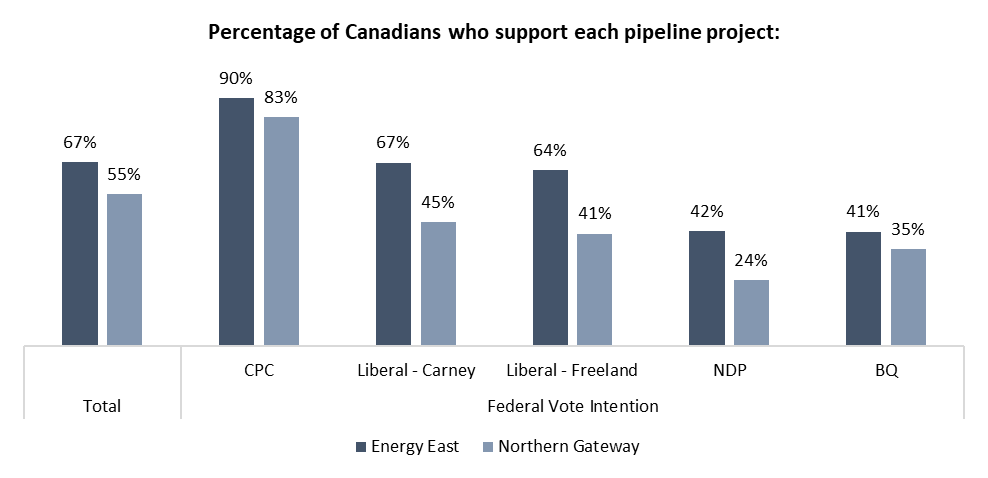
While a majority of likely Conservative voters, and Liberal voters who would support the party under the hypothetical scenarios with Mark Carney or Chrystia Freeland as the leader, support Energy East, there is less support across party lines for Northern Gateway. Meanwhile, NDP and BQ supporters are more likely to oppose both projects:
Part Two: Trans Mountain focus
Trans Mountain was a major pipeline project completed because of the federal government. The pipeline’s former owner, Kinder Morgan, had said it was willing to walk away from its planned twinning of its existing pipeline from Edmonton to Burnaby because of opposition it faced from the B.C. government, First Nations along the route and at the pipeline’s terminus in Burnaby. The federal government paid $4.5 billion to buy the pipeline from Kinder Morgan to complete the project. The expansion project was finally completed last year, with the cost ballooning to $34 billion.
Canadians are divided on the merits of the federal government’s purchase of Trans Mountain. One-third (34%) say it was the right call, but equal numbers disagree (32%) or are uncertain (34%):
The purchase of Trans Mountain is most supported in Alberta, where half (50%) believe it was the right choice. According to a report by Calgary-based economist Charles St-Arnaud, the expansion of Trans Mountain has narrowed the gap between the Canadian price of oil and the U.S. benchmark price, a boon for Alberta’s economy.
Elsewhere in the country, reviews are more mixed:

A good investment, but did the government need to buy it?
In some ways it is perhaps too early to argue about the benefits of Trans Mountain as the federal government has said it plans to recoup some of its investment by selling the expanded pipeline down the road. A majority (56%) believe the project will be viewed as a successful investment for the country with hindsight. However, there is uncertainty that the federal government needed to buy the pipeline at all to ensure its completion.
There is much more agreement that regulations are putting financial hurdles in front of projects like the Trans Mountain pipeline expansion. Two-thirds (64%) of Canadians believe projects like Trans Mountain are more expensive because of government red tape:

Survey Methodology
The Angus Reid Institute conducted an online survey from Jan. 24-27, 2025 among a representative randomized sample of 2,012 Canadian adults who are members of Angus Reid Forum. For comparison purposes only, a probability sample of this size would carry a margin of error of +/- 1.5 percentage points, 19 times out of 20. Discrepancies in or between totals are due to rounding. The survey was self-commissioned and paid for by ARI.
For detailed results by age, gender, region, education, and other demographics, click here.
For full release including methodology, click here.
For the questionnaire, click here.
MEDIA CONTACT:
Shachi Kurl, President: 604.908.1693 shachi.kurl@angusreid.org @shachikurl
Dave Korzinski, Research Director: 250.899.0821 dave.korzinski@angusreid.org
Jon Roe, Research Associate: 825.437.1147 jon.roe@angusreid.org