


CPC support remains at pre-Trudeau-resignation levels, more than two-in-five still prefer that party
January 27, 2025 – The Liberal leadership race is still in its early days, but it is renewing interest in the party among voters, especially with the prospect of Mark Carney as leader.
The former Bank of Canada Governor Mark Carney appears to have an advantage among prospective voters over his main rival in the contest, former Minister of Finance Chrystia Freeland. That said, both still have to contend with Liberal Party members and make their case to be the next leader, and both still trail the opposition Conservative Party by a double-digit margin.
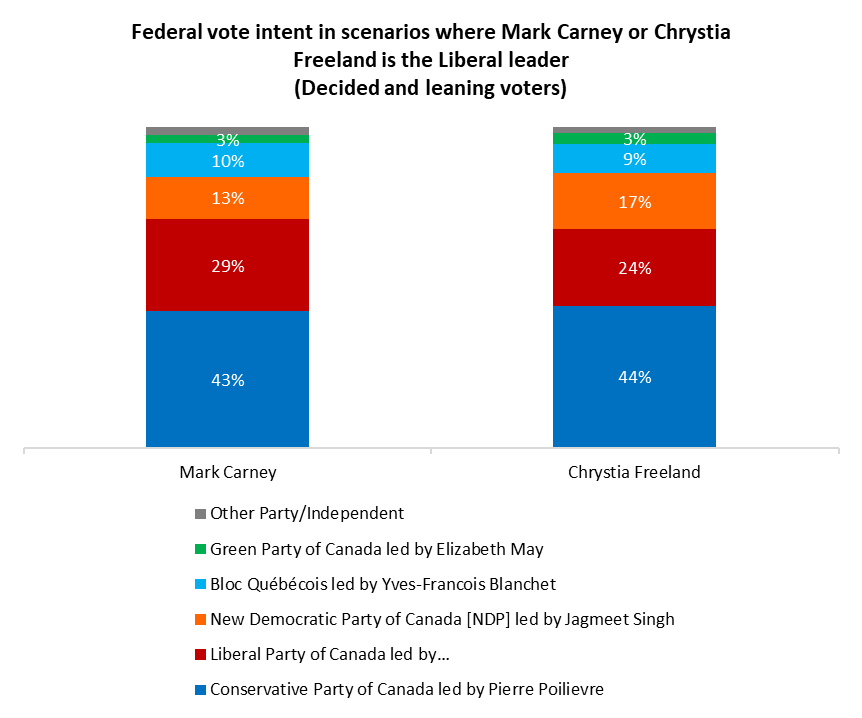
New data from the non-profit Angus Reid Institute finds vote intention more favourable to the Liberals with Carney as leader than Freeland by about six points. With Carney at the helm, 43 per cent say they would vote for the CPC, while 29 per cent would support the Liberals. With Freeland the CPC lead grows to 20 points (44% to 24%). Before his resignation, Prime Minister Justin Trudeau and the Liberals had fallen to 16 per cent.

More Key Findings:
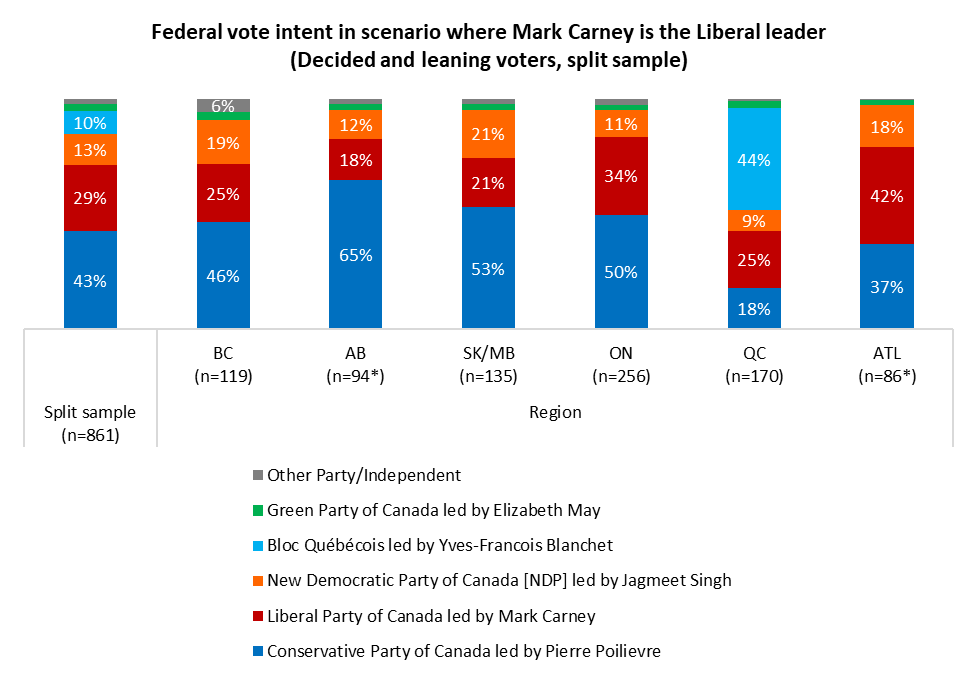
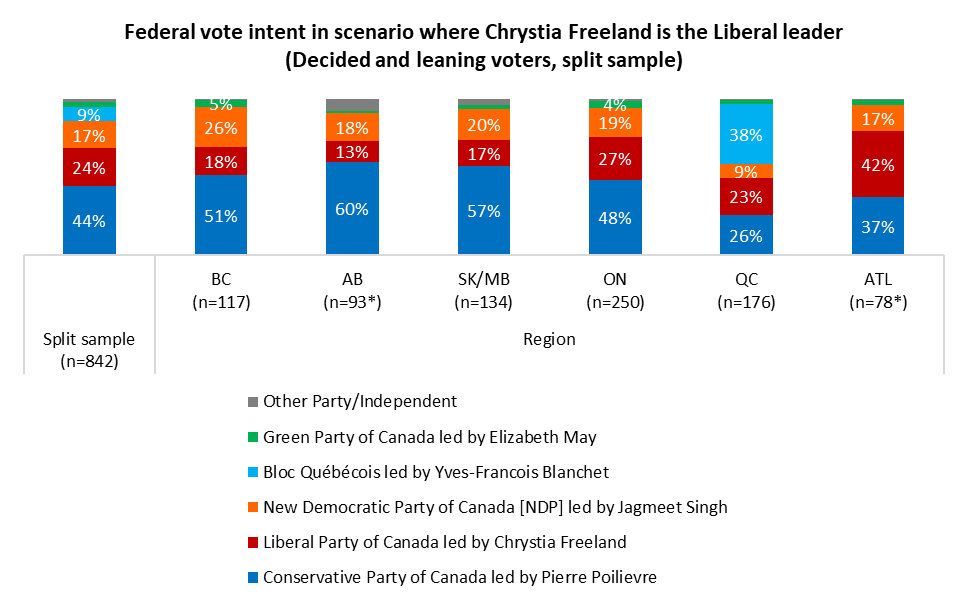
- Carney has regional strengths compared to Freeland. He holds an advantage in proportion of vote generated for the Liberals in British Columbia (+8) and Ontario (+7). Neither is competitive in the Prairies, and each garner close to equal vote totals in Quebec and Atlantic Canada.
- Looking at six age and gender combinations, Carney generates higher vote levels for the Liberals among five. Only among women ages 35 to 54 does Freeland bring the Liberals more votes (+7).
- Notably, the Conservative Party leads in every region other than Quebec and Atlantic Canada by double-digits, regardless of which Liberal leader respondents are assessing.
About ARI
The Angus Reid Institute (ARI) was founded in October 2014 by pollster and sociologist, Dr. Angus Reid. ARI is a national, not-for-profit, non-partisan public opinion research foundation established to advance education by commissioning, conducting and disseminating to the public accessible and impartial statistical data, research and policy analysis on economics, political science, philanthropy, public administration, domestic and international affairs and other socio-economic issues of importance to Canada and its world.
Carney draws more voters than Freeland in early days of leadership race
The field of candidates to replace Prime Minister and Liberal leader Justin Trudeau has become clear. It includes former Bank of Canada and Bank of England Governor Mark Carney, former Deputy Prime Minister and Finance Minister Chrystia Freeland, Government House leader Karina Gould, MP Jaime Battiste, and former MPs Ruby Dhalla and Frank Baylis, with Freeland and Carney viewed as the frontrunners. Carney so far has the overwhelming edge in endorsements from current ministers over his competitors including Freeland. Meanwhile, Freeland is the only other candidate so far to have secured the endorsement of any cabinet members.
To assess the state of the current federal vote intention picture, the Angus Reid Institute split respondents into two groups and asked if how they would vote in hypothetical situations where either of the two frontrunners based on current caucus support, Carney or Freeland, were in charge of the Liberals.
The Liberals with Carney at the helm perform better than the party under Freeland in these theoretical situations. Carney appears to be siphoning off more NDP support (which drops to 13%), while Freeland does elevate the party higher than it was under Trudeau (16%) prior to his resignation. However, neither have done much to blunt the proportion of likely CPC voters, which was 45 per cent at the end of 2024.
Note that the polling was conducted prior to the Green Party announcement that Jonathan Pedneault would return as co-leader of the party alongside Elizabeth May.
Carney by region
Carney lifts the Liberals into second place in B.C. and picks up one-third (34%) of vote intention in Ontario. In previous data taken by ARI prior to Trudeau’s resignation, the Liberals had fallen to third place behind the NDP in both provinces. The party also has more support under Carney in the hypothetical situation that he wins the leadership race than it did under Trudeau in Quebec. However, the former Bank of Canada governor does little to improve the Liberal’s dismal support in the prairie provinces which continue to be dominated by the Conservatives under leader Pierre Poilievre:
*Smaller sample size, interpret with caution
Freeland by region
In the scenario Freeland wins the forthcoming leadership race, it appears she does generate more support in Ontario and Quebec than Trudeau, but does not raise the Liberals’ support above the NDP’s in B.C. While both potential leaders struggle to generate much support in the Prairies, a potential Freeland-led Liberal party performs worse than the NDP in Alberta, Saskatchewan and Manitoba:
*Smaller sample size, interpret with caution
The GTA picture
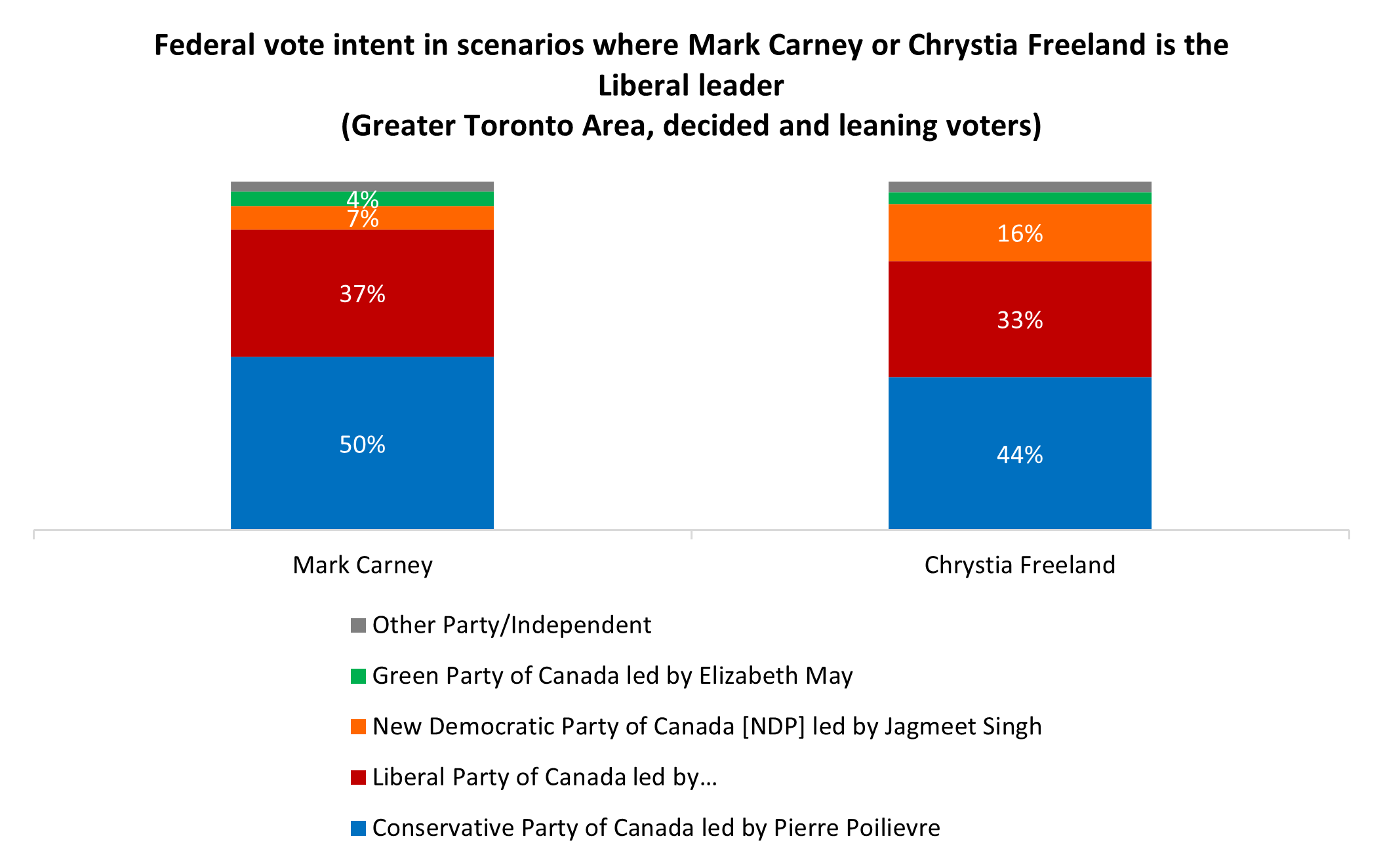
The Liberals summer loss of the Toronto-St. Paul’s byelection brought renewed questions about the future of Trudeau six months prior to his resignation. The seat had stayed Liberal even through the 2011 federal election, a previous low point for the party, and a Conservative candidate had not been competitive in the central Toronto riding since the 1980s. The Greater Toronto Area, and its seats, remain an area of key interest for the Liberals, given their history of success in the city. The hypothetical Carney Liberals receive higher support, but so do the rival Conservatives. The Liberals in a scenario where Freeland wins the leadership race receive lower support as more in the GTA region would back the NDP:
Carney by age and gender
The gender divide of support between the Liberals and the CPC evident when the projected contest was between Poilievre and Trudeau is still there. Majorities of men say they would support the CPC if the Liberals were led by Carney. However, at least one-quarter of men aged 35- to 54-years-old (26%) and older than 54 (23%) say they would support the Carney Liberals. Women under 55 show more of an inclination to vote NDP, while those older than 54 are the most likely to say they would vote for the Liberals under Carney:

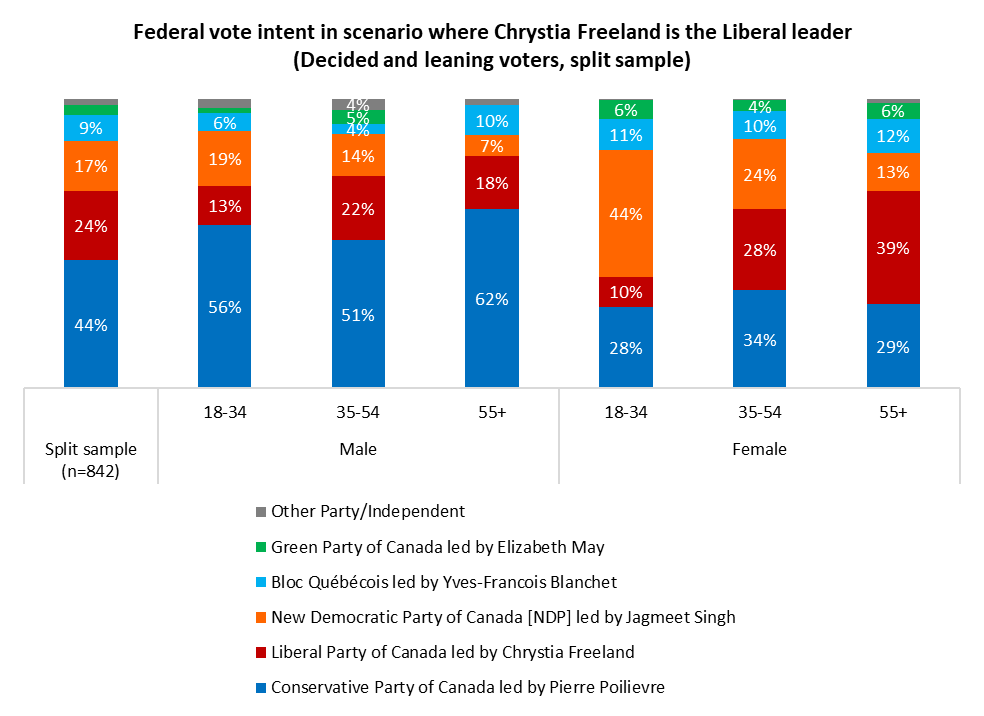
Freeland by age and gender
The Liberals under Freeland receive less support than under Carney by all demographic groups with one exception – women aged 35- to 54-years-old. Three-in-ten (28%) say they would vote for the Freeland Liberals in that scenario, which still places them behind the CPC (34%) among that demographic. The other major swing for the Liberals in comparing the two leadership candidates appears to be among men under 35, who are more likely to say they would vote CPC if Freeland were to win the leadership race (56%) than Carney (36%):
Top issues by voters
The top issues for voters continue to centre around affordability – the rising cost of living (58% choose it as a top issue) and housing (29%). Health care (40%) also remains in the top three. The economy (23%) and climate change (19%) round out the top five issues facing the country according to Canadians.
Analyzing the split samples of Liberal voters under the scenarios where Carney or Freeland win the leadership race paints a picture of slightly divergent priorities. Carney Liberal supporters are more likely to say inflation is a top concern (59%) than Freeland Liberal supporters (49%). Both groups place a higher importance on health care (56% Carney Liberals, 53% Freeland Liberals) than those who say they would vote CPC (27%) if an election were held today. The economy in general is narrowly chosen more often by Carney Liberals while climate change is a slightly higher priority among Freeland Liberals:

Survey Methodology:
The Angus Reid Institute conducted an online survey from Jan. 24-27, 2025 among a representative randomized sample of 1,960 Canadian adults who are members of Angus Reid Forum. For comparison purposes only, a probability sample of this size would carry a margin of error of +/- 1.5 percentage points, 19 times out of 20. Discrepancies in or between totals are due to rounding. The survey was self-commissioned and paid for by ARI.
For detailed results by age, gender, region, education, and other demographics, click here.
For full release, click here.
MEDIA CONTACT:
Shachi Kurl, President: 604.908.1693 shachi.kurl@angusreid.org @shachikurl
Dave Korzinski, Research Director: 250.899.0821 dave.korzinski@angusreid.org
Jon Roe, Research Associate: 825.437.1147 jon.roe@angusreid.org