

Three-in-five would recognize Palestinian state; the same number say Hamas must be deposed
August 7, 2025 – Canada’s move to recognize a Palestinian state has been welcomed by some and rejected by others – U.S. President Donald Trump being one of those occupying the latter view.
The Canadian government’s decision to change its position on this issue, regardless of its motivations, are aligned with the shifting of opinion among the Canadian population.
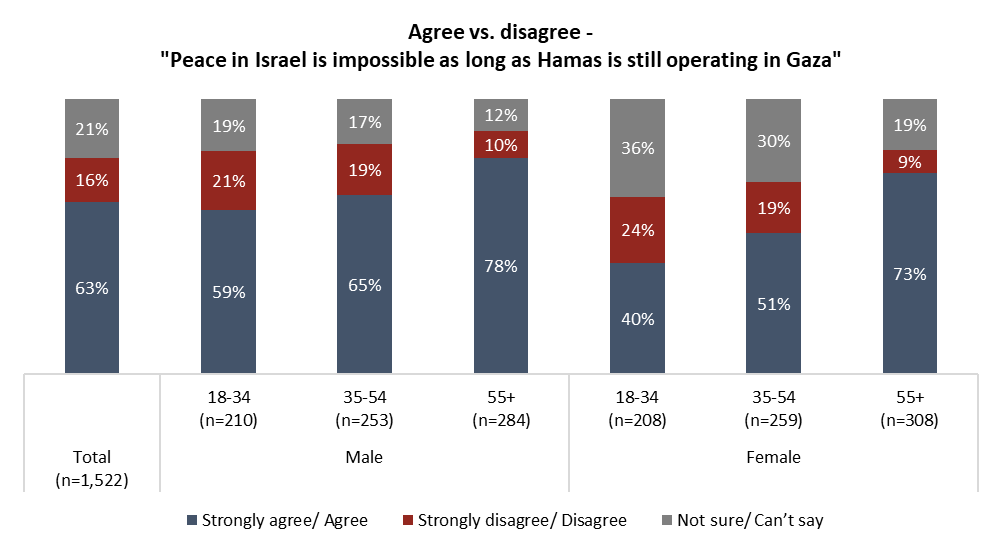
New data from the non-profit Angus Reid Institute finds three-in-five say that Canada should recognize a Palestinian state (61%), with the same number agreeing that Hamas must be removed for this to be a realistic path forward (63%).
This follows nearly two years of shifting sentiment which has found the Canadian public becoming more concerned about the plight of the Palestinian people in Gaza than the initial devastation faced by Israelis.
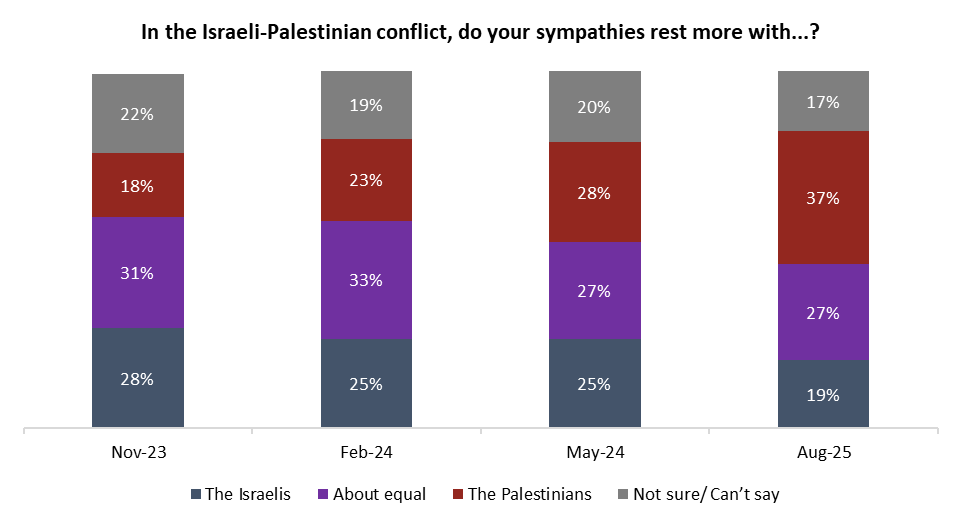
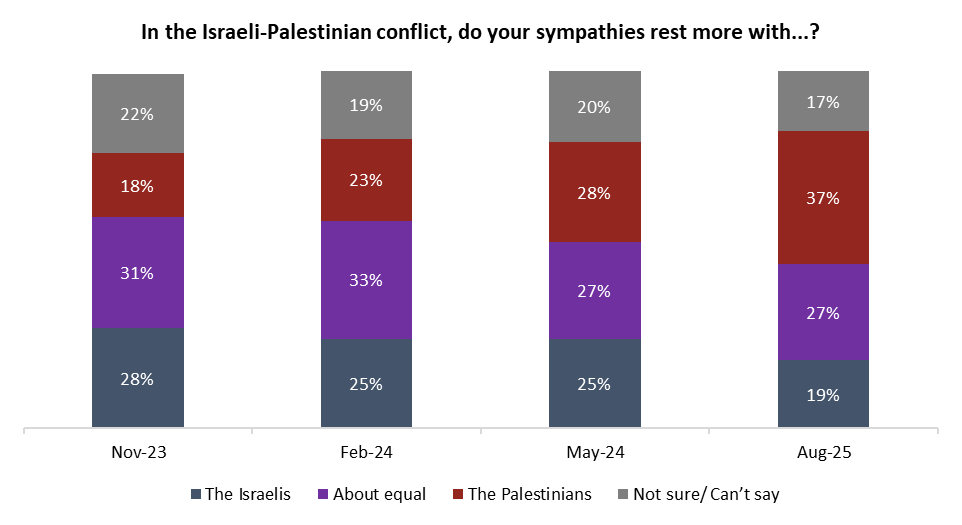
When the conflict began, Israel (28%) and “both sides equally” (31%) were chosen as the primary focus of Canadian sympathy, with 18 per cent choosing the Palestinians. That latter option has now doubled to 37 per cent, with 27 per cent saying both sides and one-in-five saying Israel (19%).
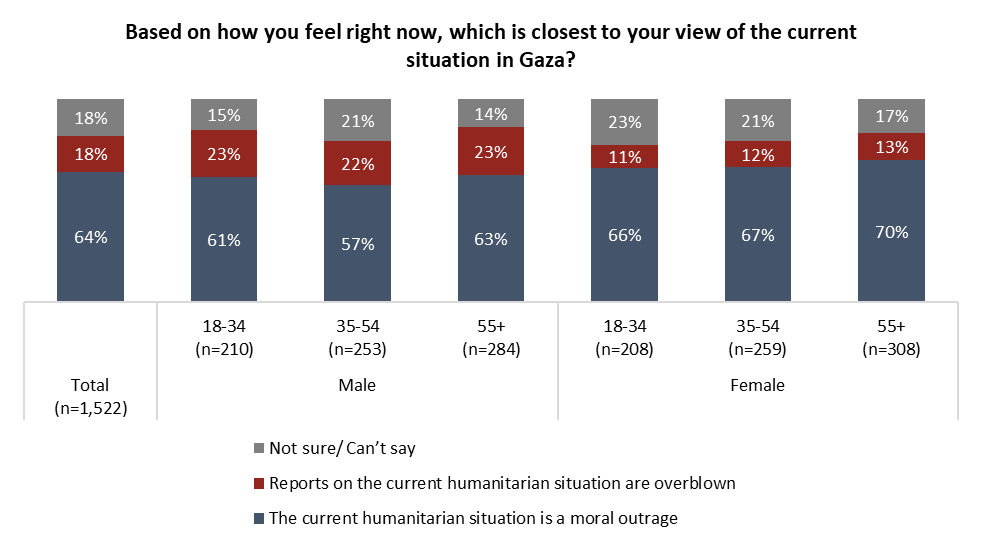
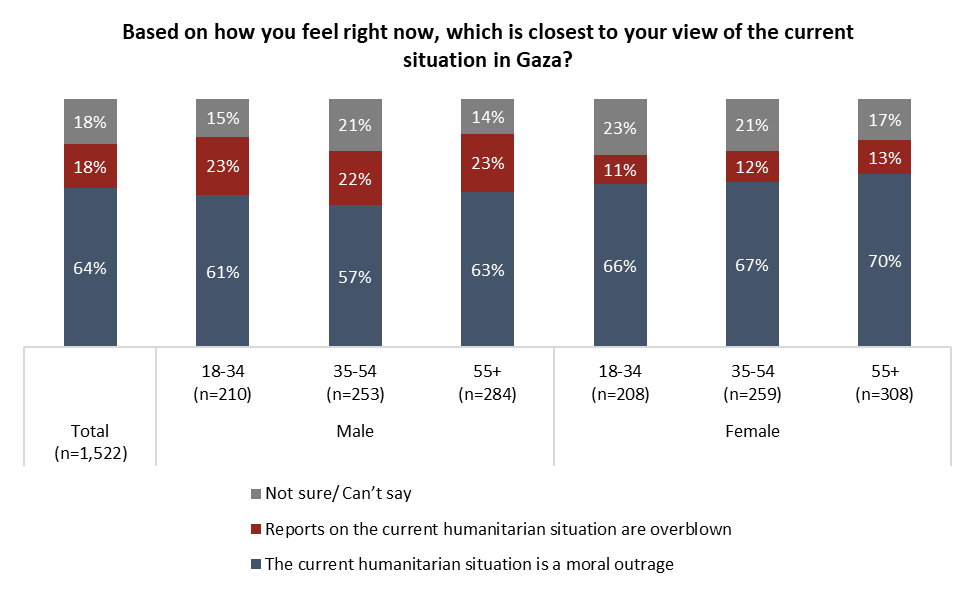
Much of this is driven by what Canadians see as a moral outrage – the humanitarian crisis that has been created. Amid widespread reports of starvation and hunger-related deaths, two-thirds (64%) now say that what they see is a moral outrage, rather than overblown (18%) or something they’re unsure about (18%).
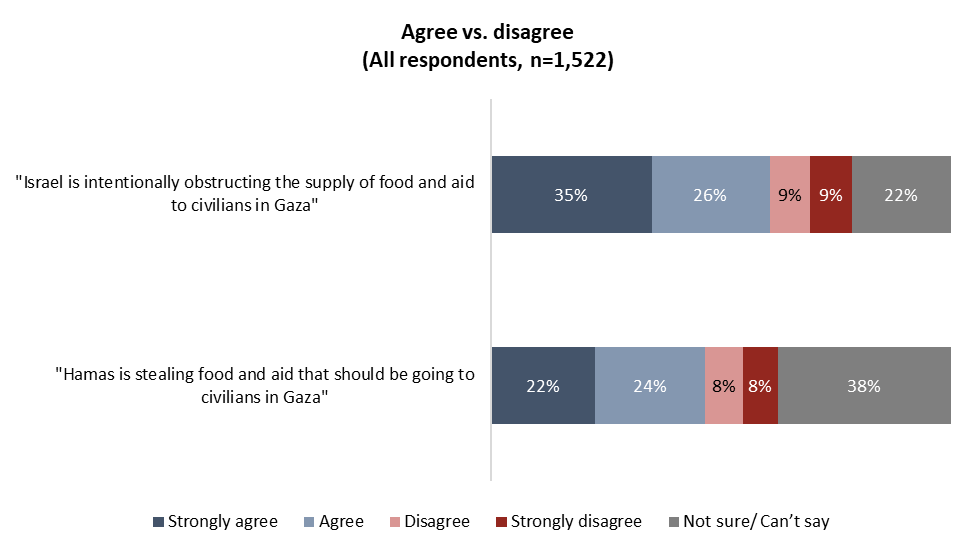
Reportedly, 22,000 loaded aid trucks are awaiting passage into Gaza, leading some to accuse Israel of deliberately obstructing aid. Three-in-five Canadians (61%) agree with this characterization.
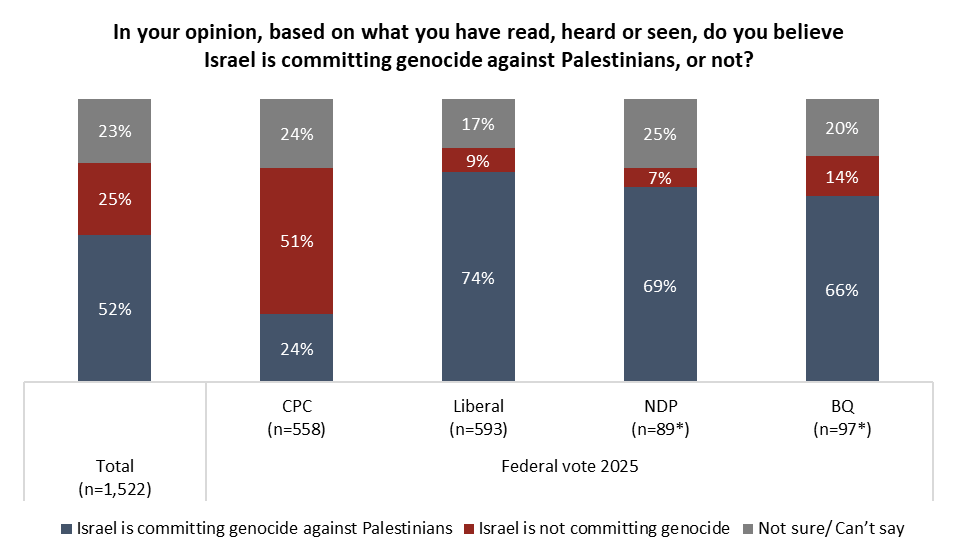
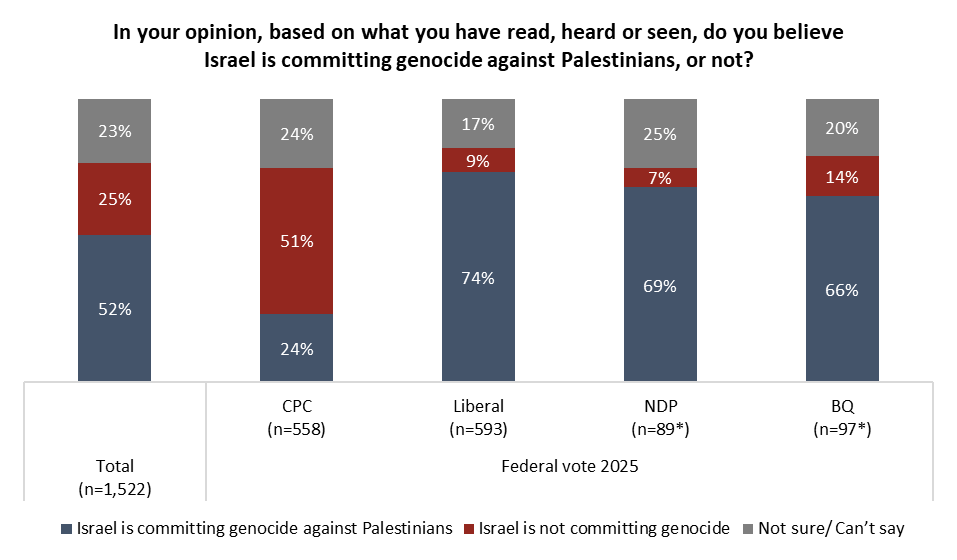
Just over half (52%) say that they believe Israel is committing genocide. This represents an 11-point increase compared to when Angus Reid Institute asked the question in February 2024.
More Key Findings:
- Many Canadians also believe that Hamas is stealing aid, as Israel has accused. Nearly half (46%) agree that this is happening, though recent reports from the U.N. and Israeli military officials say this is not the case.
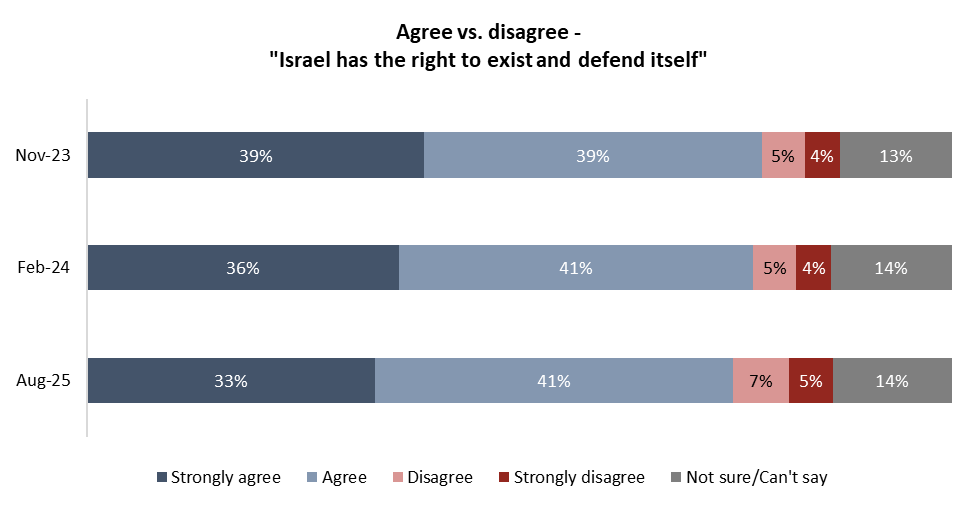
- Despite growing criticism, three-quarters of Canadians (74%) still say Israel has the right to exist and to defend itself. This has changed little from November 2023 (78%).
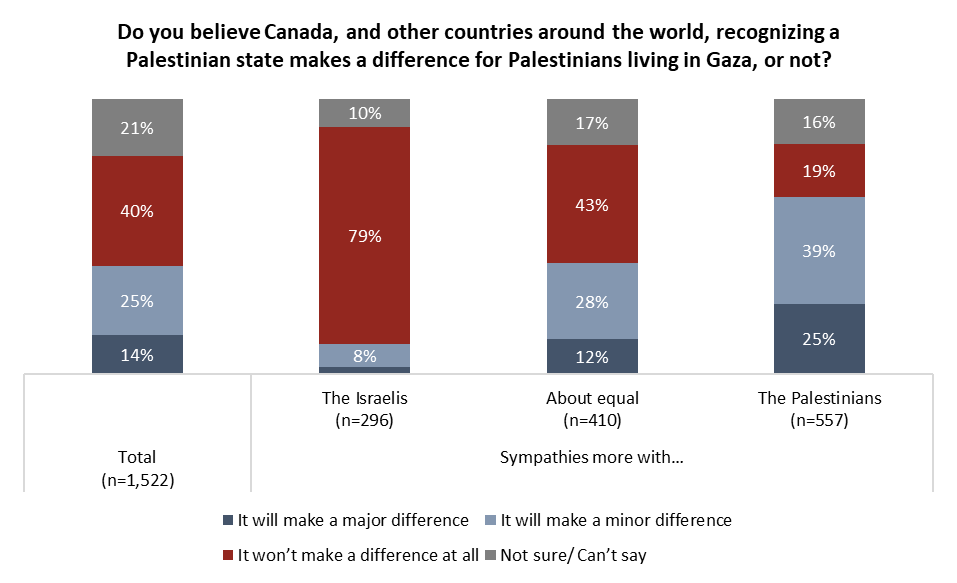
- Many are pessimistic about what Palestinian statehood recognition would mean in a practical sense. Two-in-five (40%) say it will make no difference to the civilians of Gaza, while others say it will make a minor (25%) or major one (14%).
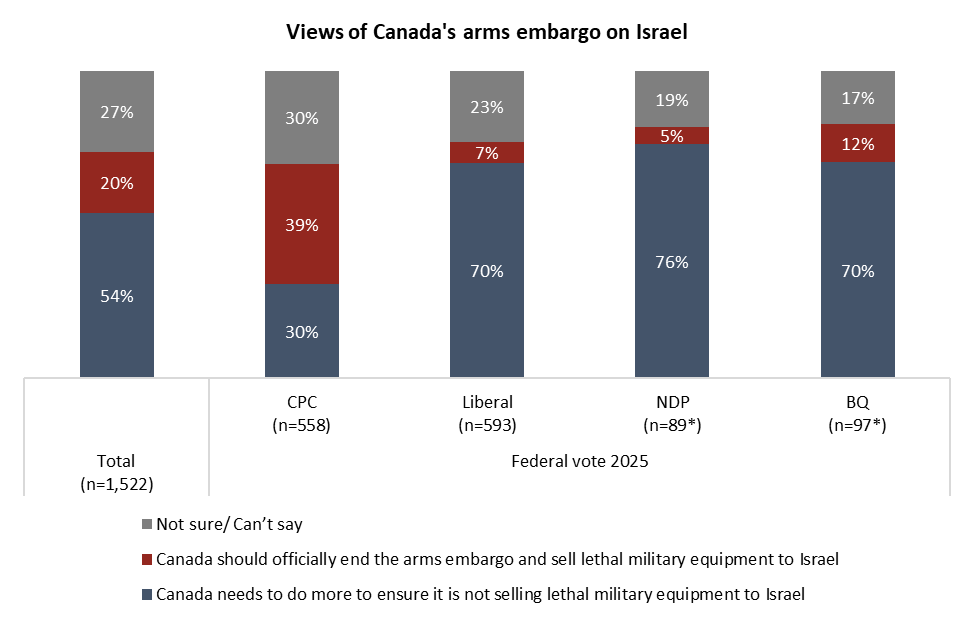
- Amid scrutiny of its embargo on military goods to Israel in recent weeks, a majority of Canadians say Canada must ensure the embargo is upheld (54%). One-in-five (20%) would end the embargo, while others don’t know enough to weigh on in the debate (27%).
Part One: “Outraged” Canadians; increased sympathy for those in Gaza
-
Sympathies continue to move further toward Palestinians
-
Two-thirds see humanitarian situation as moral outrage, one-in-five disagree
-
Half now say this is a genocide
-
Is Israel purposefully obstructing aid?
-
-
Canadians want to ensure no lethal equipment sent
Part Two: A Palestinian state?
-
Majority support decision to recognize Palestinian state
-
Most say Hamas must go, echoing Carney statement
-
Division over how much of an impact recognition would make
-
-
Trump objection sways few
Part Three: Israel criticized
-
Israel actions viewed as excessive over justified by three-to-one
-
Support for right to defence remains strong
-
-
Half say Israel’s strategy to recover hostages has failed
-
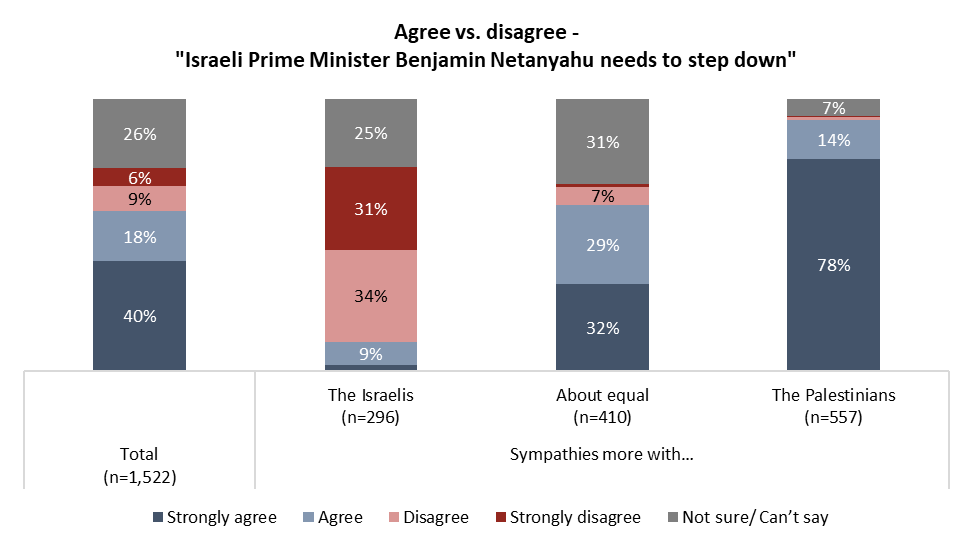
Three-in-five say Netanyahu also needs to go
Part One: “Outraged” Canadians; increased sympathy for those in Gaza
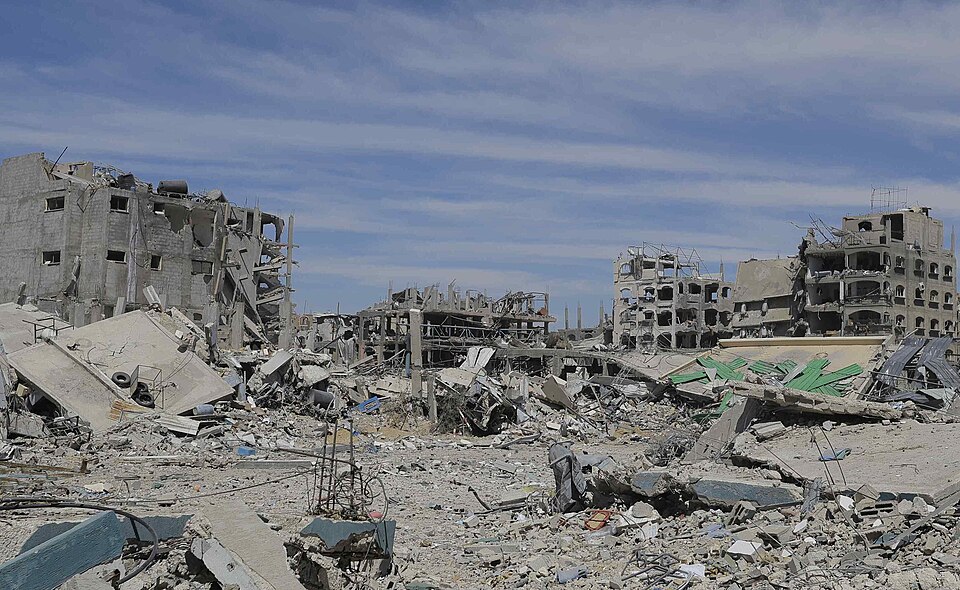
As deaths continue to mount, both due to military strikes and starvation, and aid deliveries are dropped on a desperate population, conversations around the conflict in Gaza continue to shift. This, as the push to recognize a Palestinian state gains momentum, and calls for a ceasefire persist. In Canada, the largest group now says it feels sympathy primarily for the Palestinians, rather than for Israel, or equally on both sides, as was the case in previous years.
Related: Concern over genocide allegations drives increase in calls for a full ceasefire
Sympathies continue to move further toward Palestinians
Shortly after the Oct. 7 terrorist attacks by Hamas, and the counteroffensive by Israel in Gaza, Canadians were asked to weigh in on these events. In November 2023, Canadians were equally divided between offering sympathies to Israel primarily (28%) or both sides (31%). In May of the next year, all three options were chosen equally. Now, as the two-year anniversary of the first attacks inches closer, opinions have shifted further:
Two-thirds see humanitarian situation as moral outrage, one-in-five disagree
Driving this shift is evidently the view that the conditions created represent a humanitarian crisis. Images of starvation have spread virally across social media. Since the war began, 93 children have died from malnutrition, according to Al Jazeera. The United Nations reports that more than 20,000 children have been treated at Gaza hospitals for malnutrition since April.
Two-thirds of Canadians, including a majority of all demographics, say the current humanitarian situation in Gaza is a “moral outrage”.
Half now say this is a genocide
The term genocide has been debated vehemently as the conflict has continued. Some have pointed to comments from Israeli officials in the earlier days after the outbreak of violence as indicating that the annihilation of Gaza is the purpose of persistent operations in the region. South Africa filed a case in the International Court of Justice against Israel alleging genocide at the end of 2023 and has been supported by a handful of other nations, most recently Brazil. The perception in Canada that genocide is taking place has increased significantly from 41 per cent in February 2024 to 52 per cent now.
*Smaller sample size, interpret with caution
Is Israel purposefully obstructing aid?
As international organizations raise alarm over starvation and famine in Gaza, some have raised concern over the lack of food and aid making it across the border as Israel’s military operation continues. Prior to October 2023, there were 500 aid trucks entering Gaza daily, a figure that has not been reached since the conflict began according to Al Jazeera, who also report that Israel allowed only 36 aid trucks across the border on Saturday. There are some 22,000 loaded trucks waiting to enter, according to the Government Media Office in Gaza.
A majority of Canadians (61%) believe Israel is intentionally obstructing the distribution of aid and food to civilians in Gaza. However, there is also concern that once aid enters Gaza it is not getting to the civilians it needs to. More than two-in-five (46%) Canadians blame Hamas for stealing food and aid that should be going to civilians, a claim that has been disputed, including by Israeli military officials.

Canadians want to ensure no lethal equipment sent
Since January 2024, the Canadian government said it has stopped issuing new permits for exports of military goods to Israel. However, Canada’s arms embargo of Israel has been under scrutiny in recent weeks, after a report by Canadian advocates for Palestinians found there have been shipments of weapons from Canada to Israel since last year. Foreign Affairs Minister Anita Anand called the report “flawed” and said that the suspension of permits for military exports has held.
A majority (54%) of Canadians want the federal government to ensure that Canada is not selling lethal military equipment to Israel. One-in-five (20%) would like to see Canada restart arms sales to Israel. A plurality of recent Conservative voters (39%) is in the latter group, while other past voters are much more likely to want Canada to enforce an arms embargo on Israel:
*Smaller sample size, interpret with caution
Part Two: A Palestinian state?
Majority support decision to recognize Palestinian state
Canada followed in the steps of the United Kingdom and France by announcing in July it would officially recognize a Palestinian state in September. Prime Minister Mark Carney reversed a long-standing policy that Canada would recognize a Palestinian state only after Israel and Palestinian leadership came to a negotiated peace agreement because of “the ongoing failure by the Israeli government to prevent the rapidly deteriorating humanitarian disaster in Gaza”.
In May 2024, a majority of Canadians (57%) supported Canada recognizing a Palestinian state, while two-in-five (43%) were opposed.
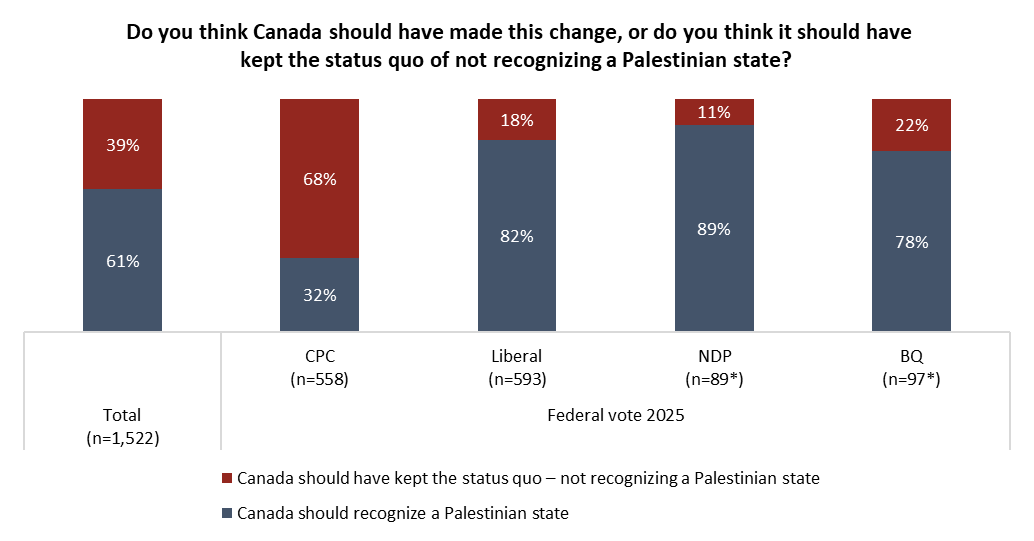
A similar proportion now believe it was the right move (61%) to recognize a Palestinian state, while two-in-five (39%) would have preferred Canada to maintain the status quo. Past Conservative voters are more likely than others to be in the latter group (68%):
*Smaller sample size, interpret with caution
Most say Hamas must go, echoing Carney statement
Canada’s recognition of a Palestinian state comes with some conditions, according to Carney. He said that Hamas cannot participate in a future election, and that the organization which Canada recognizes as a terrorist entity must release the remaining Israeli hostages.
Three-in-five (63%) Canadians agree, and believe peace in Israel is impossible while Hamas is still in operation:
Division over how much of an impact recognition would make
Although the potential recognition of a Palestinian state by Canada, France and the U.K. represents a significant policy shift from major countries around the world, there is doubt that it will make a difference for the civilians suffering on the ground in Gaza.
Canadians are split between believing it will make a difference (39%), whether major (14%) or minor (25%), and believing it won’t (40%). Canadians who say their sympathies lie more with Palestinians are more likely than others to believe that state recognition can drive change for Palestinian citizens:
Trump objection sways few
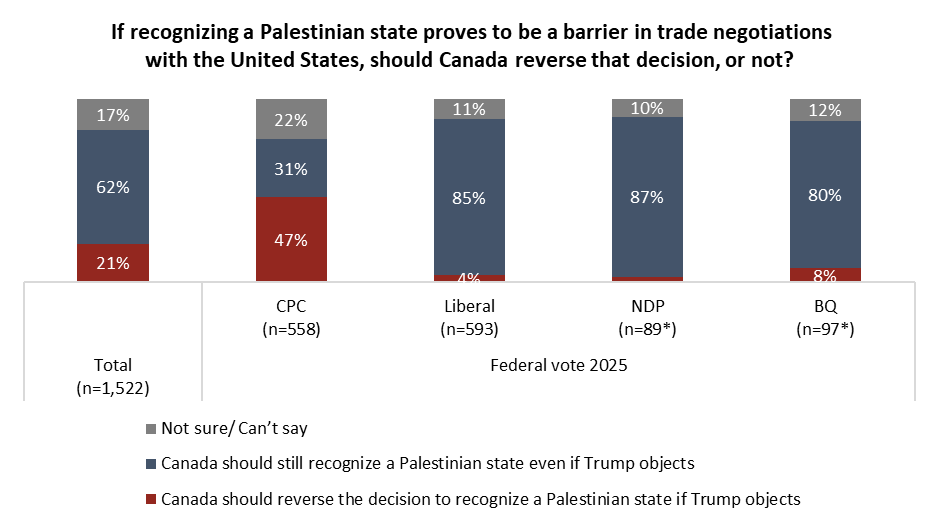
The timing of Canada’s announcement of Palestinian state recognition was questioned after U.S. President Donald Trump voiced objections, saying the change in stance could hinder Canada’s ongoing trade negotiations with its southern neighbour.
Still, most Canadians (62%) believe Canada should push ahead with the recognition of a Palestinian state despite the potential issues it may cause as Canada sorts out its future trade relationship with the United States. Past CPC voters (47%) are more likely to believe Canada should reverse course to avoid further complicating trade negotiations:
*Smaller sample size, interpret with caution
Part Three: Israel criticized
As months have turned into years, and deaths have continued to mount, criticism of Israel appears to be rising. The protracted conflict is one for which Canadians have long hoped to see a ceasefire. While going after Hamas has been accepted by most as a justification for earlier actions, the sense that Israel has used too heavy a hand was evident even in the first months.
Israel actions viewed as excessive over justified by three-to-one
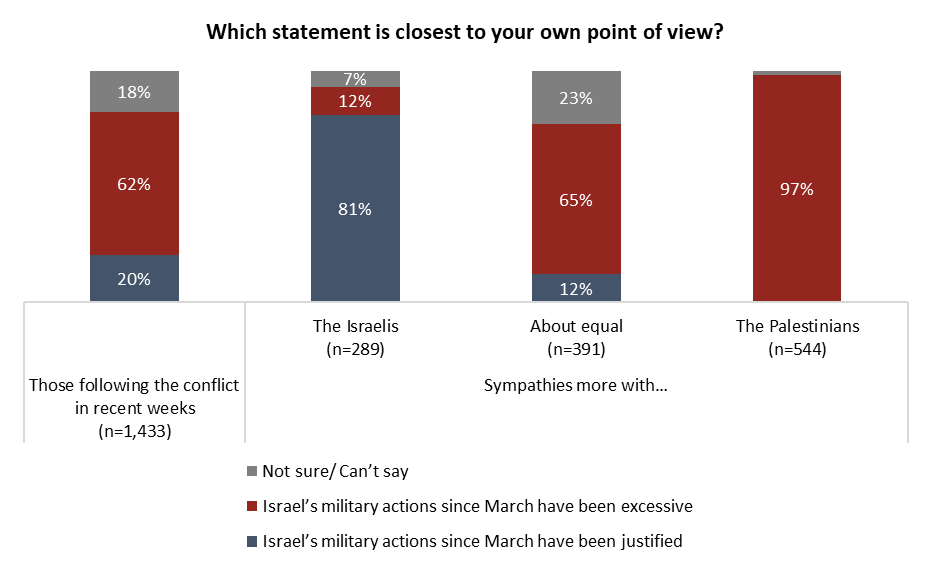
The proportion of those finding Israel’s action excessive, or “too heavy-handed” rose from 45 per cent in November 2023, to 50 per cent in February 2024, now that view is the dominant one, held 62 per cent of Canadians. Notably, those who say that their sympathies are shared equally by each side are vastly more likely to feel Israel has been excessive:
Support for right to defence remains strong
While some perspectives have shifted throughout this conflict, views of Israel’s commonly professed right to defend itself has notably not changed. One month after Israel launched a response in Gaza, 78 per cent of Canadians agreed with the statement “Israel has a right to exist and defend itself”. In February 2024, the same number felt this way. Now, 74 per cent agree with this sentiment, suggesting that the scale of the response is being criticized, not necessarily the initial response itself:
Half say Israel’s strategy to recover hostages has failed
Israel’s goal of the war has been to eliminate Hamas and free the hostages taken on Oct. 7. Israel broke a temporary ceasefire in March after negotiations between the country and Hamas broke down. Israel said it needed to resume its military offensive to free the remaining hostages. Of the 250 hostages taken on Oct. 7, 50 are believed to be still in Gaza, of those only 20 are believed to be alive.
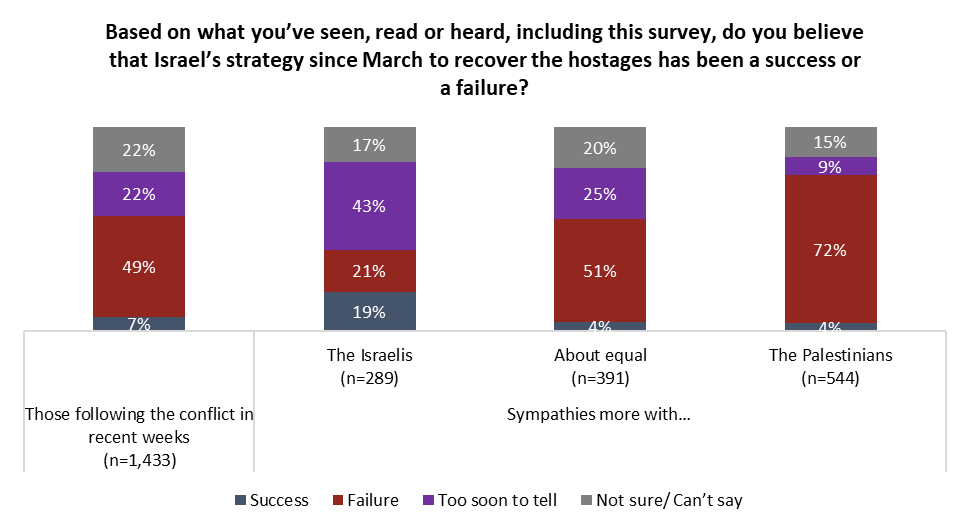
Asked whether they believe the Israeli strategy to resume military operations to free the hostages has been a success or a failure since March, most choose the latter (49%) while 22 per cent say it’s still too early to tell:
Three-in-five say Netanyahu also needs to go
While much of the talk in Canada has hinged on Hamas being removed in order for Canada to recognize a Palestinian state, Canadians also feel that Israeli Prime Minister Benjamin Netanyahu must step down to move peace forward. Most (58%) say this needs to happen, while 15 per cent disagree. Others are unsure (26%). Three-in-five of those who say their sympathies are with both sides do not see a path forward with Netanyahu in place:
Survey Methodology
The Angus Reid Institute conducted an online survey from July 31 – Aug. 5, 2025, among a randomized sample of 1,522 Canadian adults who are members of Angus Reid Forum. The sample was weighted to be representative of adults nationwide according to region, gender, age, household income, and education, based on the Canadian census. For comparison purposes only, a probability sample of this size would carry a margin of error of +/- 1.5 percentage points, 19 times out of 20. Discrepancies in or between totals are due to rounding. The survey was self-commissioned and paid for by ARI.
For more information on our polling methods, click here.
For detailed results by age, gender, region, education, and other demographics, click here.
For PDF of full release, click here.
For questionnaire, click here.
CONTACT:
Shachi Kurl, President: 604.908.1693 shachi.kurl@angusreid.org @shachikurl
Dave Korzinski, Research Director: 250.899.0821 dave.korzinski@angusreid.org
Jon Roe, Research Associate; 825.437.1147 jon.roe@angusreid.org