

Two-thirds say Canada should take “hard” line in trade talks, rebuff Trump’s rebuke on Palestine stance
August 1, 2025 – Canadian resolve in the face of what are now 35 per cent tariffs on non-USMCA protected goods (notwithstanding items already subject to a Trump-imposed 50 per cent) is holding firm, at least for now, according to new data from the non-profit Angus Reid Institute.
As Prime Minister Mark Carney voices disappointment but preaches patience, he finds a country largely looking to hold the line, even if it means taking on more financial pain.
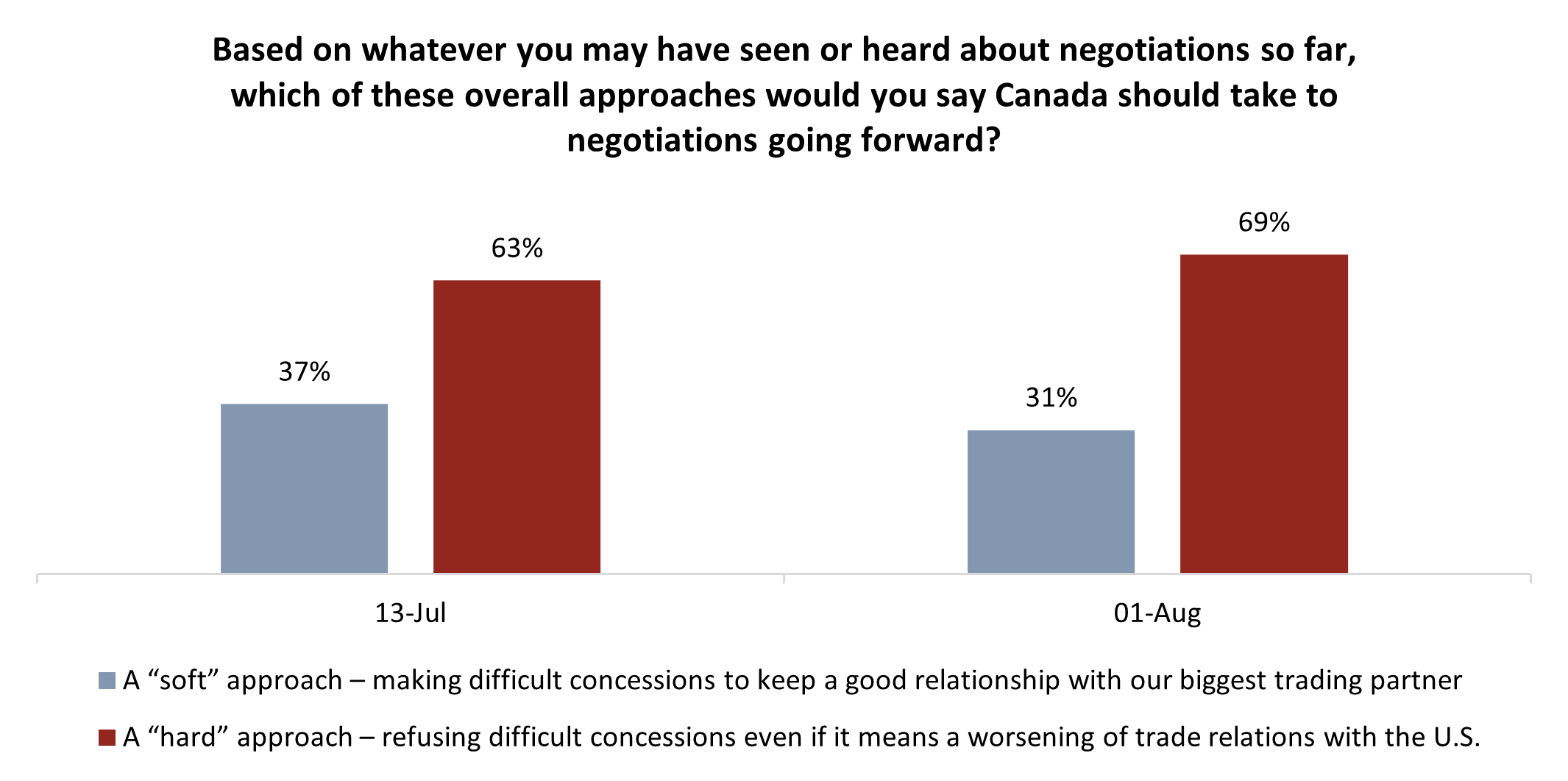
Results from an overnight poll suggest the proportion of those advising the PM and his team to “play hardball” has increased, from 63 to 69 per cent of the population compared to mid-July.
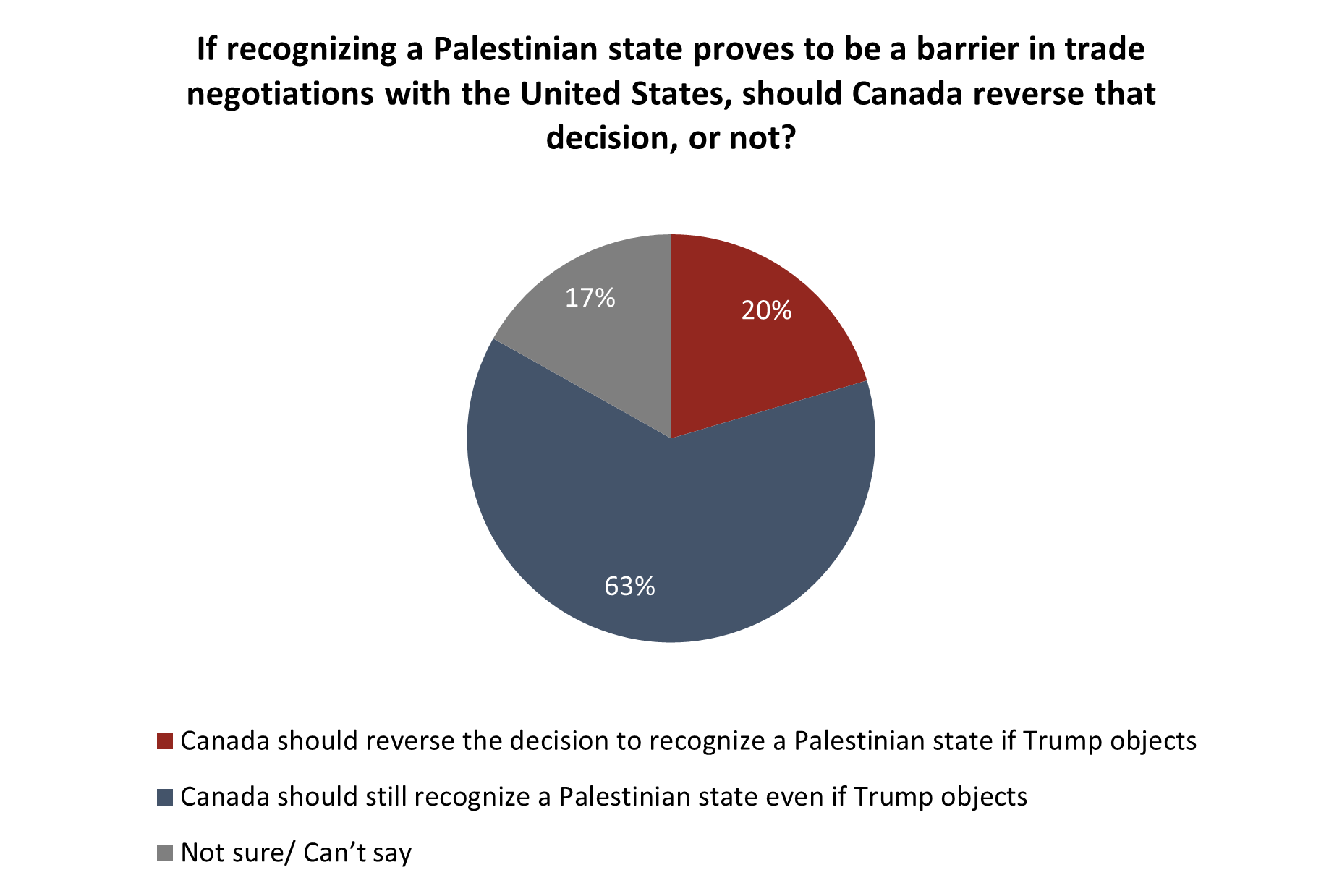
The latest irritant for President Trump, who some suggest has become interminably irritated with trade talks, is Canada’s decision to recognize Palestinian statehood in September. Trump has stated that this will make it “very hard” to make a deal, though it is “not a deal-breaker”. Canadians are three-times as likely to say that Canada should go forth with recognition, even if it irks the president (63%) rather than reversing course to win his favour (20%).
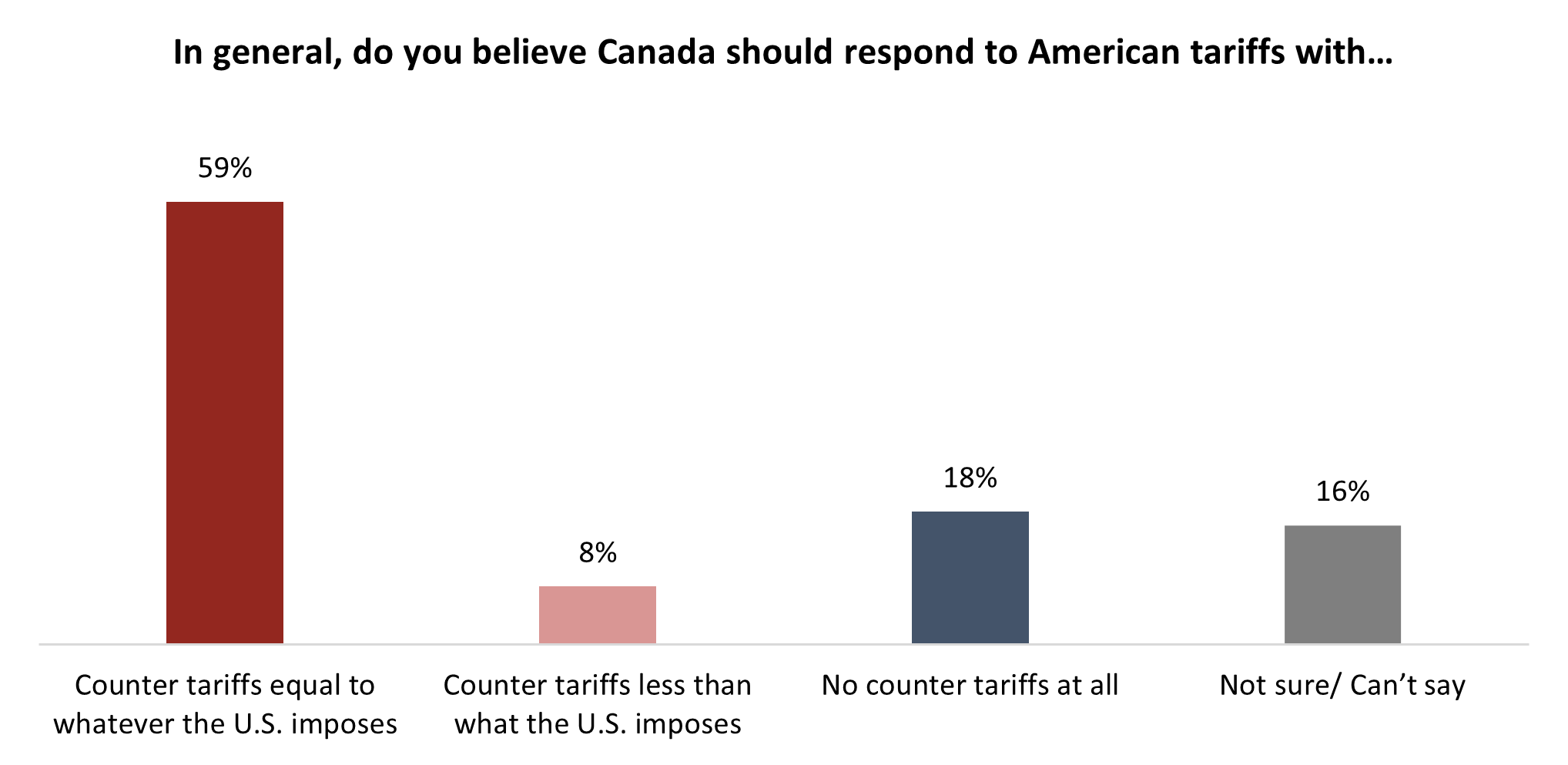
Also on the table – after Trump’s latest executive order increased the current tariff rate on some Canadian goods – are counter-tariffs. Ontario Premier Doug Ford has suggested responding with a 50 per cent rate on U.S. steel and aluminum. Canadians are largely in favour of a tariff-based response from their country. Three-in-five (58%) would match whatever the U.S. value of tariffs is, while another eight per cent would respond, but at a lower level. One-in-five (18%) say Canada should stand pat and not risk inflaming the relationship further.
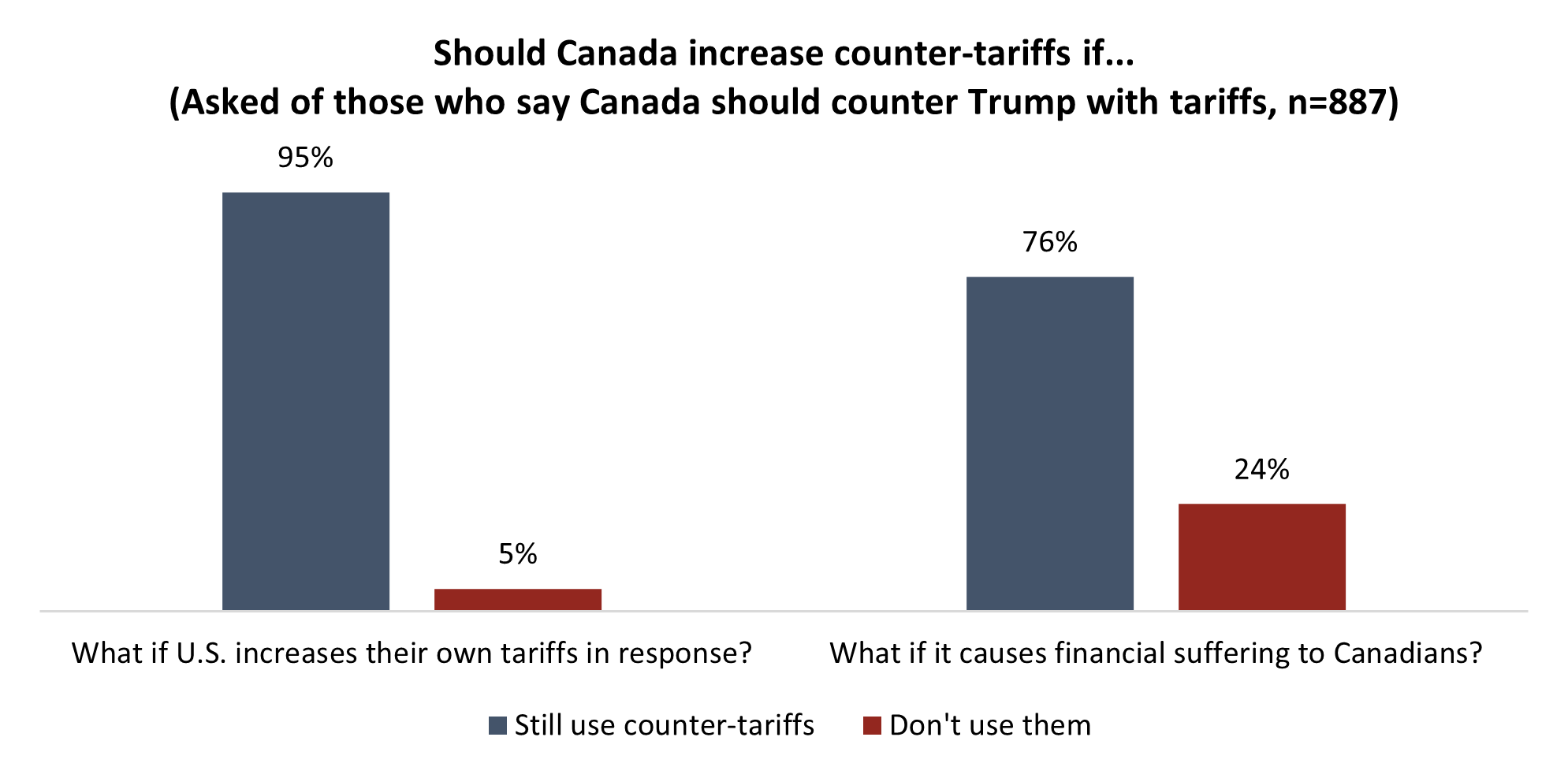
For those who would increase tariffs (58 per cent of the population) little dissuades them from this view. Nearly all (95%) say Canada should do this, even if the United States responds with another round of their own tariffs. Three-quarters (74%) within this group say Canada should counter-tariff even if it causes more financial harm at home.
More Key Findings:
- Confidence in Prime Minister Carney and the Canadian negotiating team is faltering as the saga continues. More Canadians are now unconfident (49%) than confident (43%). (July 13 – 46 per cent confident, 45 per cent not confident).
- Despite this dip in confidence, Mark Carney continues to garner a similar approval rate. Over the past three months his personal marker has not changed – June 57%, July 55%, August 57%.
INDEX
Part One: Resolve among Canadians to play hardball increases
-
Three-in-five say ignore Trump, recognize Palestine
-
Vast majority say Trump trying to make Canada suffer
-
Canadians want counter-tariff response, even if it hurts
-
Seven-in-10 want “best deal possible”, whether that means tariffs or not
Part Two: Confidence in Carney to deliver a deal drops, approval holds
Part One: Resolve among Canadians to play hardball increases
American President Donald Trump was quick to comment after Prime Minister Mark Carney announced that Canada would recognize Palestinian statehood in September – assuming certain conditions are met. Trump posted on social media that Canada’s decision would make a trade deal “very hard”. That latter description is likely how Canadian negotiators are already feeling, after months of unpredictable deadlines and tariff announcements from the U.S. President, who announced later that evening on July 31 that he would be increasing the tariff on non-USMCA goods to 35 per cent. Carney responded that this latest volley in the trade war was disappointing but the work would continue.
For Canadians, Trump’s behaviour appears to be only increasing their resolve. Asked earlier in July, 63 per cent said Canada should take a hard line on negotiations going forward, even if it risks worsening the U.S. relationship. That number has increased six points to 69 per cent now, as the August 1 deadline for a deal passes.
Three-in-five say ignore Trump, recognize Palestine
President Trump, after initially voicing his disagreement with Canada’s announcement regarding Palestine, said that it was “not a deal breaker”. Most Canadians, for their part, don’t seem to feel Trump’s opinion on the issue matters. More than three-in-five (63%) say that even if this proves to be a barrier in trade negotiations, Canada should recognize Palestine regardless. This is three-times the number (20%) who say Canada should reverse course if Trump truly objects to the stance:
Views on this issue are politically divided between the two parties comprising most of parliament. Those who voted Conservative in the April general election are more likely to say Canada should reverse course in the face of Trump’s criticism, while past Liberal voters are nearly unanimous in their view that Palestinian statehood is not on the table: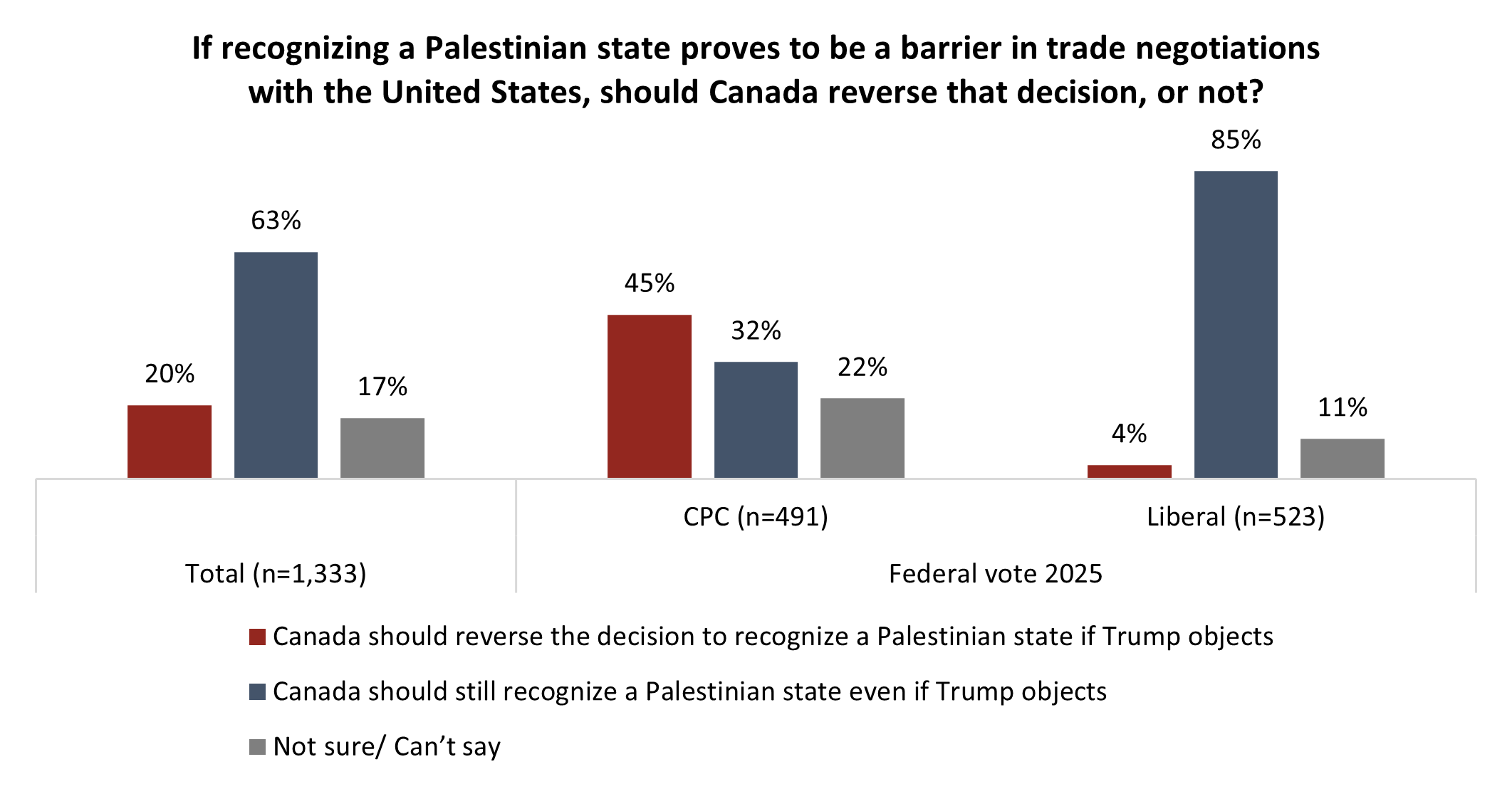
Vast majority say Trump trying to make Canada suffer
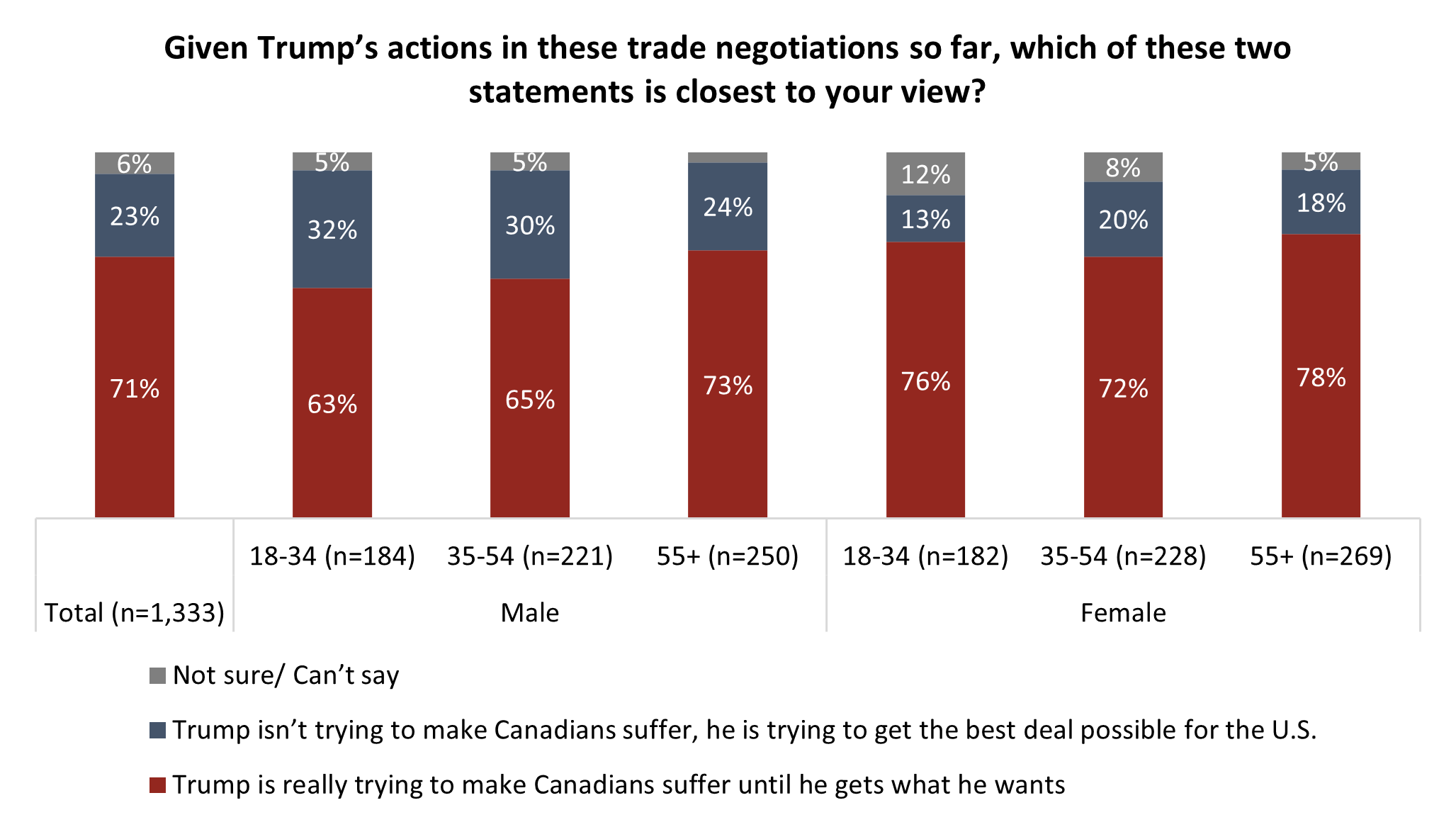
Recent ARI data found Canadians unlikely to believe that Trump would negotiate a new deal in good faith. Now, seven-in-10 (71%) feel he is attempting to inflict suffering on Canadians in order to gain leverage. This is a view held by most across all age and gender groups, though three-in-10 men younger than 55 say Trump isn’t trying to harm Canadians, he’s trying to get a good deal for his own country:
Canadians want counter-tariff response, even if it hurts
Ontario Premier Doug Ford has called for retaliation from Canada, specifically in the form of 50 per cent tariffs on U.S. steel and aluminum. Ottawa has imposed billions in counter-tariffs thus far, with announcement in March and April, but has not responded to the latest increase from Trump. Canadians have an appetite for more, with just one-in-five saying Canada should not respond (18%). Three-in-five (59%) would counter with tariffs equal to the value of U.S. policies:
Angus Reid Institute followed up this initial question with two considerations: what if the U.S. responds with counter tariffs and what if this causes more financial suffering in Canada? Those who want to respond with counter-tariffs are not swayed. Three-quarters say Canada should respond in this way even if it increases the financial harm to Canadians, and 95 per cent say that increasing U.S. tariffs do not dissuade them.
Seven-in-10 want “best deal possible”, whether that means tariffs or not
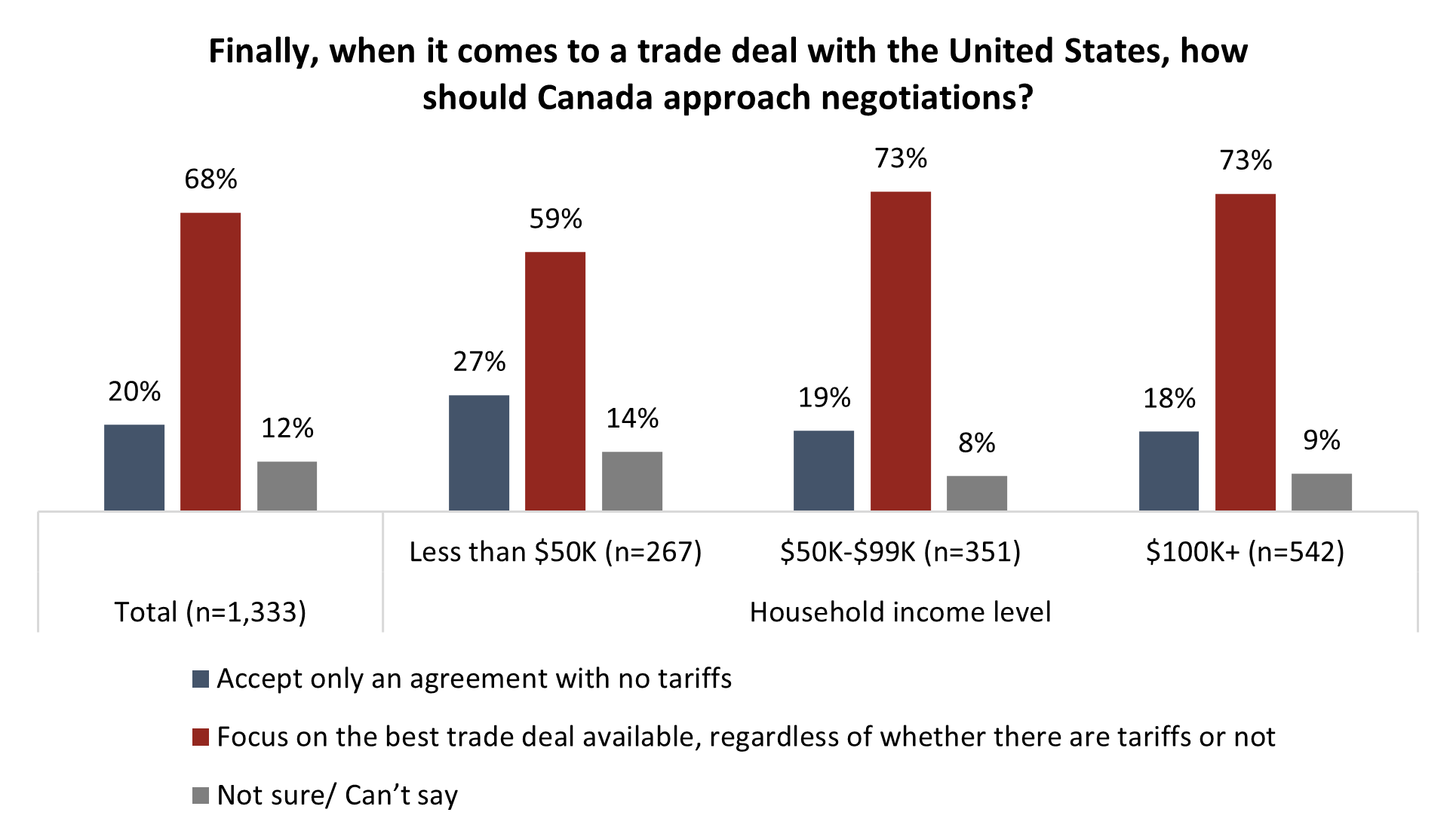
Some, including Conservative Party leader Pierre Poilievre, have stated that Canada should accept nothing short of a zero-tariff deal. With trade talks set to “continue over the coming weeks”, many Canadians aren’t certain that a deal with no tariffs is necessarily the target. Two-thirds (68%) say that Canada should focus on the best trade deal available, regardless of whether this means tariffs or not. One-in-five, including one-quarter of lower-income households, say that only a tariff free agreement should be accepted:
Part Two: Confidence in Carney to deliver a deal drops, approval holds
As talks drag on, the impact on Prime Minister Mark Carney thus far appears negligible. His approval rating has remained nearly unchanged in each of the last three months, as Canadians watch and wait for a trade deal. Carney has been busy domestically in recent weeks. In addition to announcing that he and his government would recognize a Palestinian state, he has been meeting with provincial, territorial and Indigenous leaders in order to move forward development projects across the country.
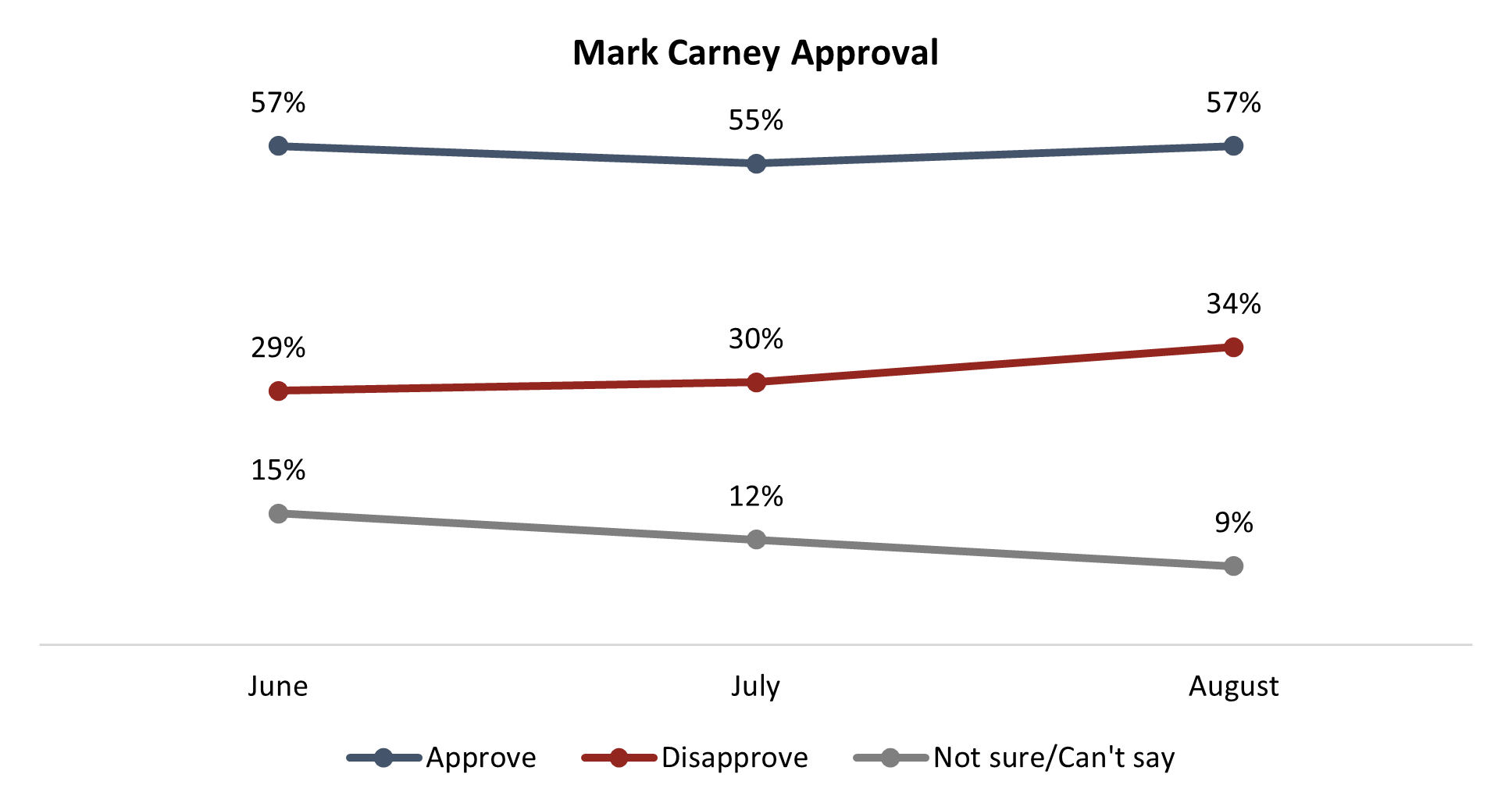
While approval has remained firm, confidence in Carney and his team to deliver a good deal for Canada has slipped. Compared to mid-July, confidence is down three points, and skepticism is up four points (see detailed tables).
METHODOLOGY:
The Angus Reid Institute conducted an online survey from July 31 – August 1, 2025, among a randomized sample of 1,333 Canadian adults who are members of Angus Reid Forum. The sample was weighted to be representative of adults nationwide according to region, gender, age, household income, and education, based on the Canadian census. For comparison purposes only, a probability sample of this size would carry a margin of error of +/- 2 percentage points, 19 times out of 20. Discrepancies in or between totals are due to rounding. The survey was self-commissioned and paid for by ARI. Detailed tables are found at the end of this release.
For detailed results by age, gender, region, education, and other demographics, click here.
For PDF of full release, click here.
For questionnaire, click here.
MEDIA CONTACT:
Angus Reid, Chairman: 604.505.2229 angus@angusreid.com
Shachi Kurl, President: 604.908.1693 shachi.kurl@angusreid.org @shachikurl
Feature image credit: Mark Carney Facebook