

More say Canada is on wrong track (42%) than right one (34%)
April 27, 2026 – First anniversaries are a significant milestone in most aspects of life. That it has been one year since Prime Minister Mark Carney and the federal Liberals completed a stunning reversal of electoral fortunes and secured a minority government in the House of Commons is no less remarkable. The election campaign may have focused on elbows, but it is concerns from Canadians over pocketbooks that linger.
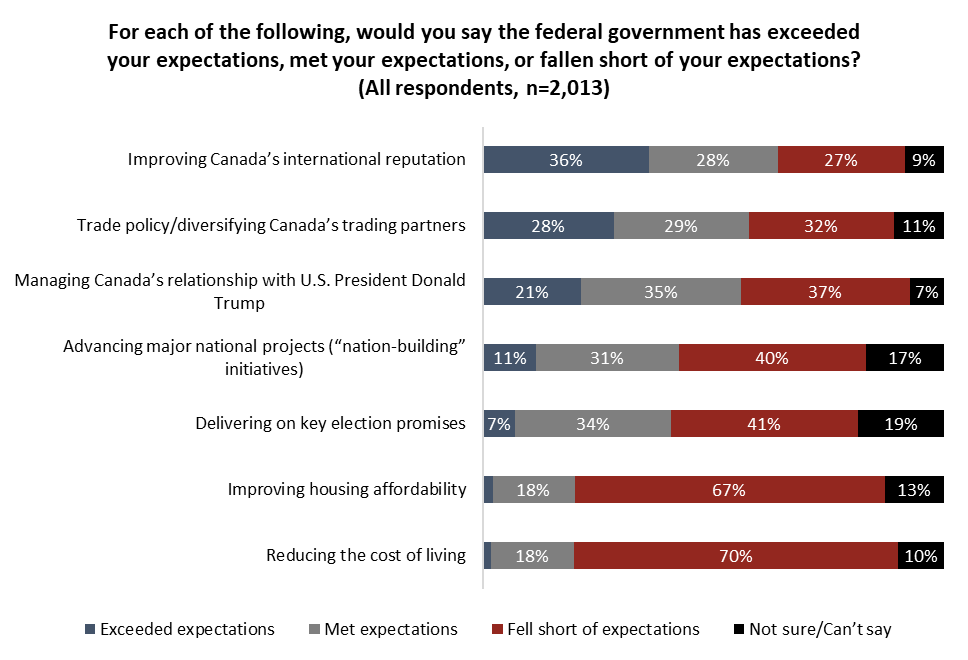
New data from the non-profit Angus Reid Institute finds a majority of Canadians say the Carney government has met or exceeded expectations on improving Canada’s international reputation (64%), diversifying Canada’s trade partners (57%) and managing this country’s relationship with the U.S. (56%) but has fallen short when it comes to improving housing affordability (67%) and addressing the high cost of living (70%).
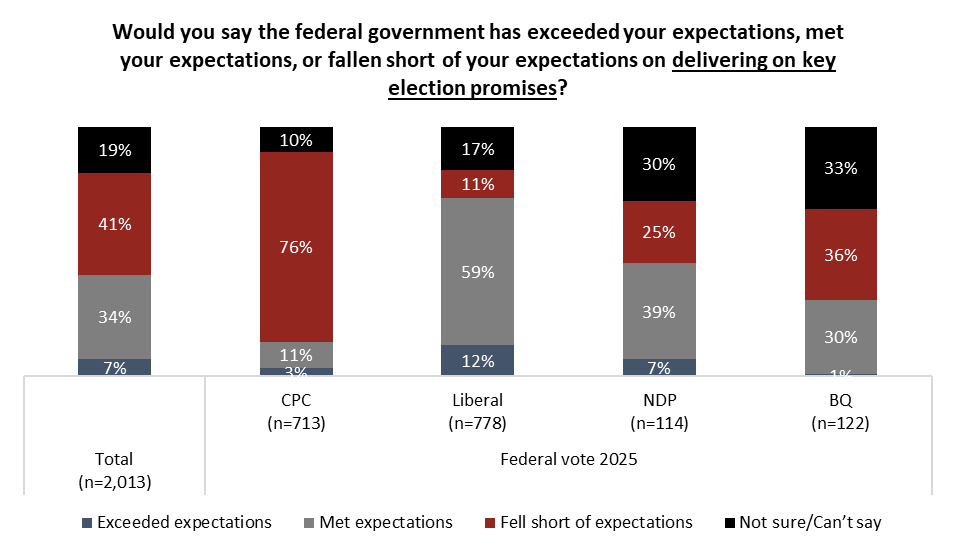
Overall, Canadians are evenly divided as to whether the one-year-old government has at least met their own bar on key election promises (41%) as say it hasn’t lived up to its goals (41%).
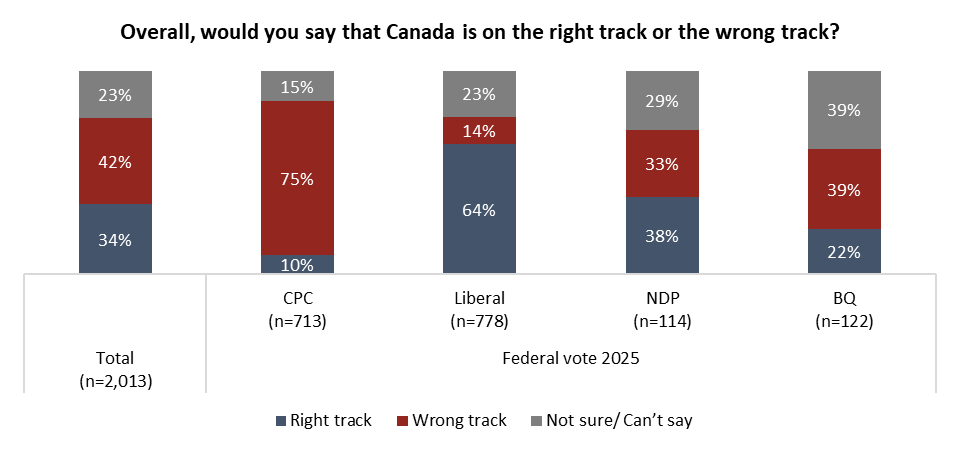
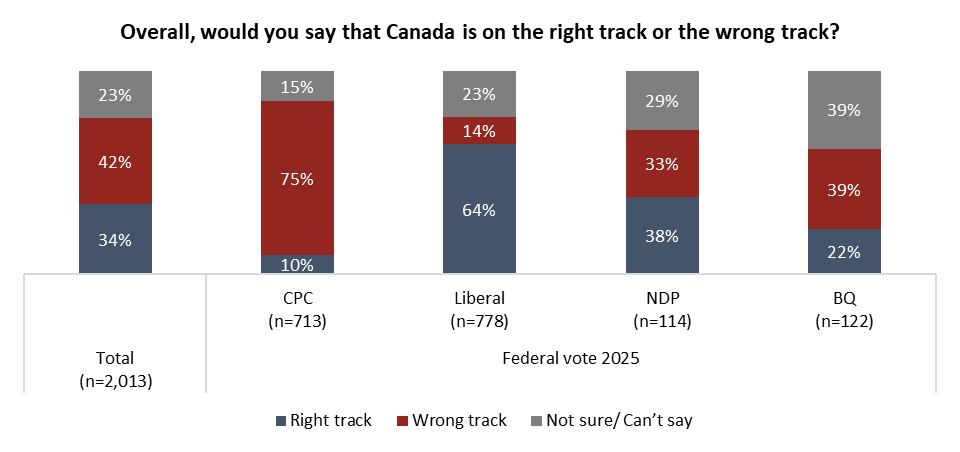
That is perhaps why Canadians are more likely to believe their country is on the wrong track (42%) than the right one (34%). Although that assessment is sharply divided along political lines: three-quarters (75%) of past CPC voters believe the country is on the wrong track; two-thirds (64%) of those who voted Liberal last year disagree.
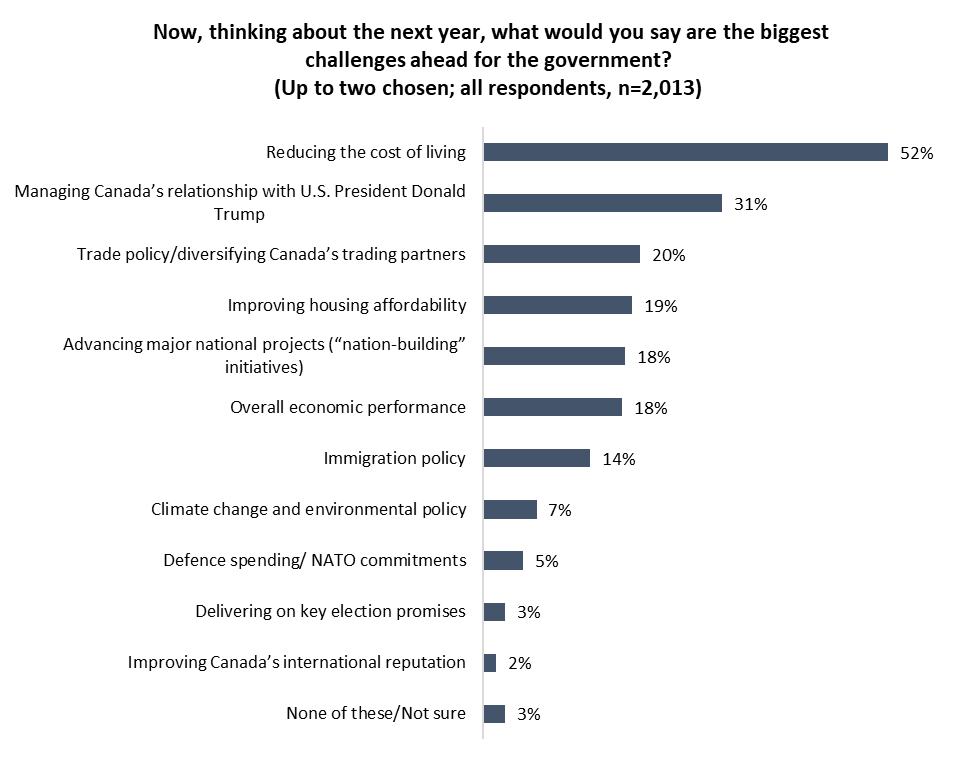
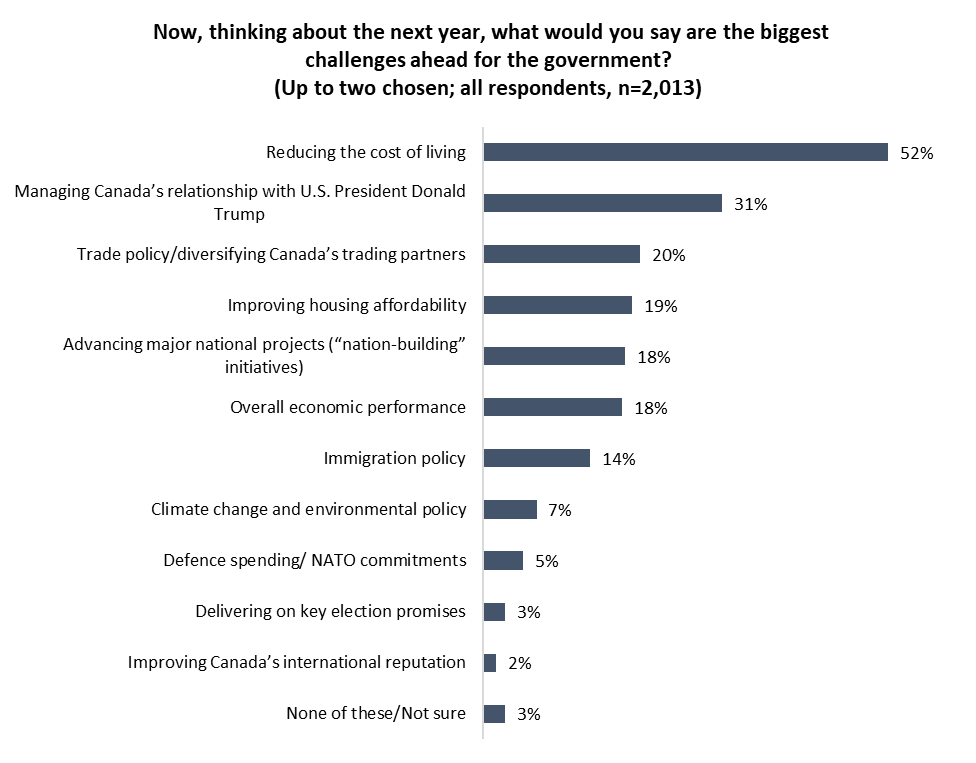
Looking ahead, there are two key issues on Canadians’ minds for the federal government to address. Half (52%) of Canadians say that reducing the cost of living will be the biggest challenge for Carney and the Liberals over the next 12 months; three-in-ten (31%) say it is managing the relationship with U.S. President Donald Trump. So far, Canadians are more likely to say Carney has met that latter challenge (56%) than not (37%).
More Key Findings:
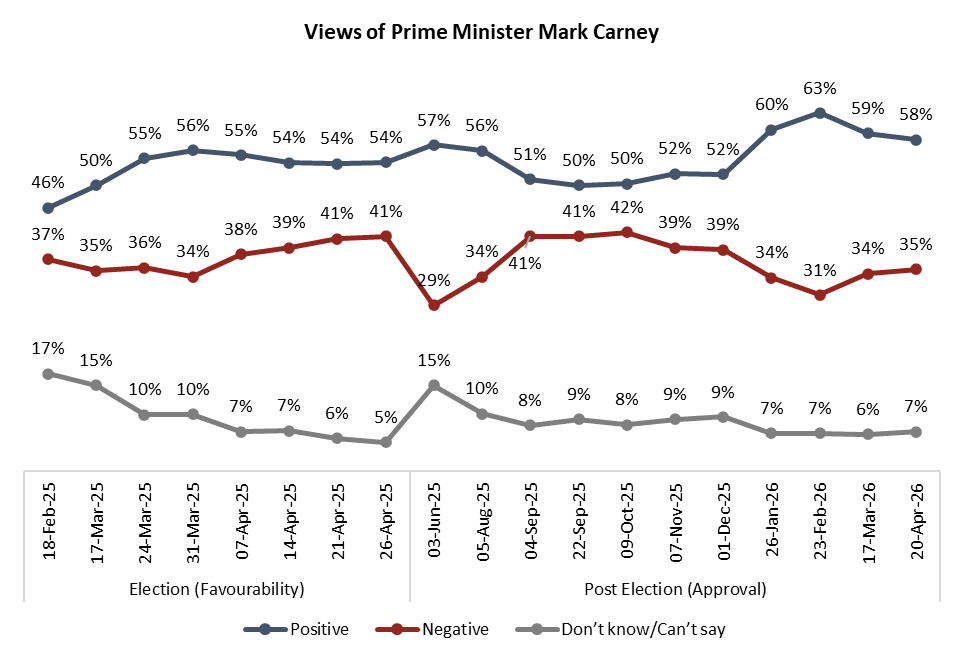
- Three-in-five (58%) say they approve of Carney’s performance as prime minister. Compared to past prime ministers, a level higher than the approval of Stephen Harper (55%), Paul Martin (51%) and Brian Mulroney (43%) after approximately 12 months, but lower than that of Jean Chrétien (66%) and Justin Trudeau (65%) at around the same time period.
- A majority of past CPC (86%), NDP (64%) and Bloc Québécois voters say the Carney government has fallen short of expectations on addressing the high cost of living. Half (50%) of past Liberal voters agree.
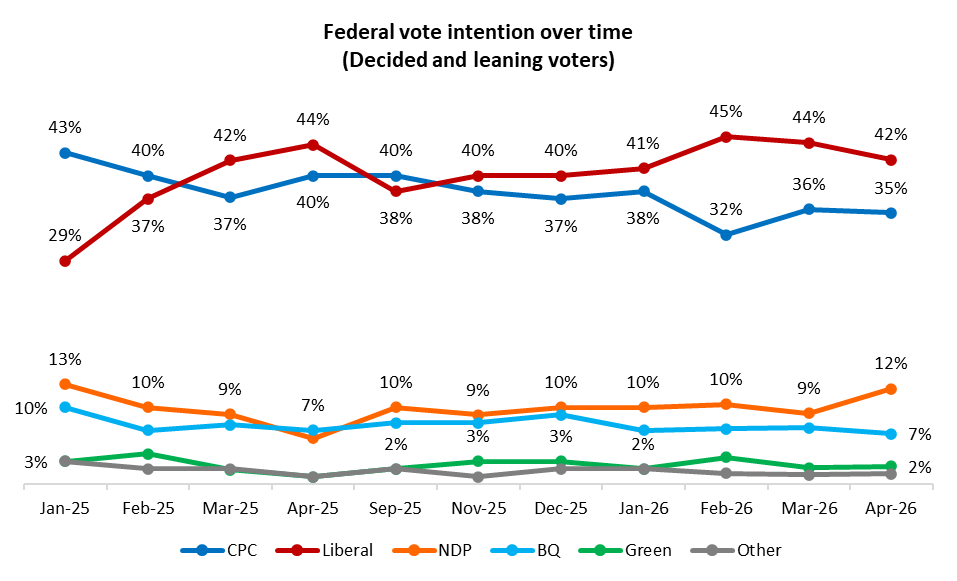
- The Liberals lead in vote intention by seven points over the Conservatives. Two-in-five (42%) Canadians say they would vote for the Liberals if there were an election day; one-third (35%) say they would vote for the CPC.
INDEX
Part One: The Post Election Report Card
-
More say Canada is on wrong track than right one
-
The issues during the campaign vs. the issues now
-
Has Carney’s government exceeded, met, or fallen short of expectations?
-
Looking ahead: Cost of living remains the big concern
Part Two: Carney approval
-
Three-in-five approve of PM’s performance
-
Comparing Carney to other PMs
-
Vote intent gap between Liberals and CPC narrows
Part One: The Post Election Report Card
Mark Carney and the Liberals election win last April capped off a seismic four months in Canadian politics. The year began with the resignation of Prime Minister Justin Trudeau as his party sank to new lows in vote intention. The Liberals began a search for Trudeau’s replacement as U.S. President Donald Trump upended years of North American co-operation with tariffs and threats of annexation. With Trudeau out of the picture, the Liberals’ electoral fortunes improved. Then, Carney secured the leadership of the party in March, setting up an election campaign centred on Canada’s response to the new American paradigm.
This remarkable run of events concluded with a Liberal minority electoral victory, a few seats away from the majority threshold. Carney eventually parlayed a series of floor crossings and a trio of byelection wins into a majority government almost 12 months out from the election.
Related:
- The Federal Liberals’ New Year’s Eve Nightmare: Party vote intent sinks to 16%, Trudeau approval at all-time low
- Canada as 51st State? Four-in-five Americans say a merger should be up to Canadians; 90% of us say ‘no’
- Conservatives Crumble: Liberals surge past CPC into majority territory, but Grits’ vote commitment is softer
Carney capped off election night last year with a speech acknowledging the shift in Canada-U.S. relations brought about by Trump and declaring that Canada “will need to think big and act bigger. We will need to do things previously thought impossible at speeds we haven’t seen in generations.” This framing promised big changes and big infrastructure projects for a country searching for a response to the deterioration of its relationship with its biggest trading partner.
More say Canada is on wrong track than right one
Evidently there is more work for Carney to do. More Canadians believe their country is on the wrong track (42%) than the right one (34%). As with so many things, political preference drives perception. CPC (75% wrong) and Liberal (64% right) voters from last year are more likely to find themselves in disagreement than not as to which direction the country is heading. NDP voters are split (38% right, 33% wrong); BQ voters are almost twice as likely to believe the country is on the wrong track (39%) than right one (22%):
The issues during the campaign vs. the issues now
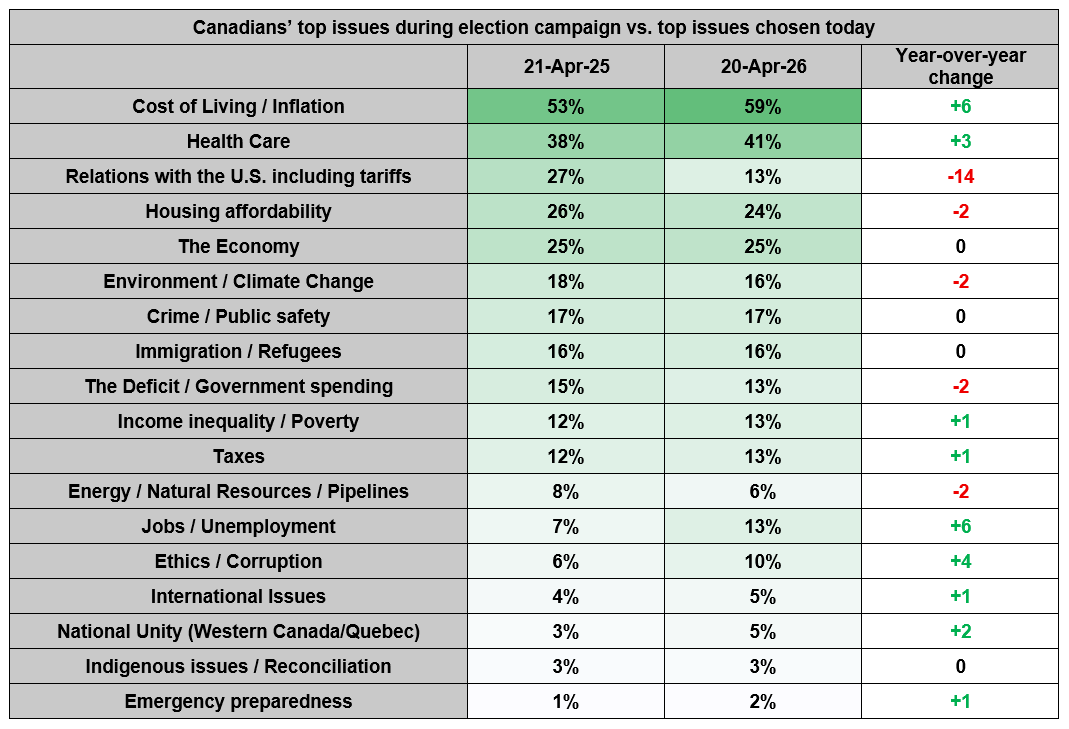
Although Trump loomed large over the Canadian federal election, there were plenty of other issues on the minds of voters. One year ago, half (53%) of Canadians said the high cost of living was the top issue facing the country. Health care (38%) came in second, ahead of relations with the U.S. (27%), housing affordability (26%) and the economy more broadly (25%). One year later, U.S. relations are a less pressing concern, with half as many people (13%) selecting it as a top issue. Meanwhile, worries over the cost of living (59%) and health care (41%) have grown.
Two other issues have risen in prominence in the past year: jobs and unemployment (+6 year over year) and ethics/ corruption (+4).
Unemployment remains a top concern for Canadians under the age of 25 (33% select it as a top issue). Although overall unemployment is lower than it was in April 2025, the unemployment rate for those under 24 is nearly twice the national average. And there are plenty of reports of young Canadians applying for hundreds of jobs with little response.
Related: Economic Focus: Concern over jobs and unemployment skyrockets among young people

Ethics/ corruption is also selected by Canadians as a top issue at a higher rate than it was a year ago, largely driven by past Conservative voters, among whom one-in-five (18%, see detailed tables) say it is an issue of concern. The post-election flow of floor crossers from the Conservatives to the Liberals may be driving perceptions. Conservative leader Pierre Poilievre has described the floor-crossings from his party as “dirty backroom deals”; two-thirds of past CPC voters told ARI in recent data that floor crossers should have to step down and re-contest their seat in a byelection.
Has Carney’s government exceeded, met, or fallen short of expectations?
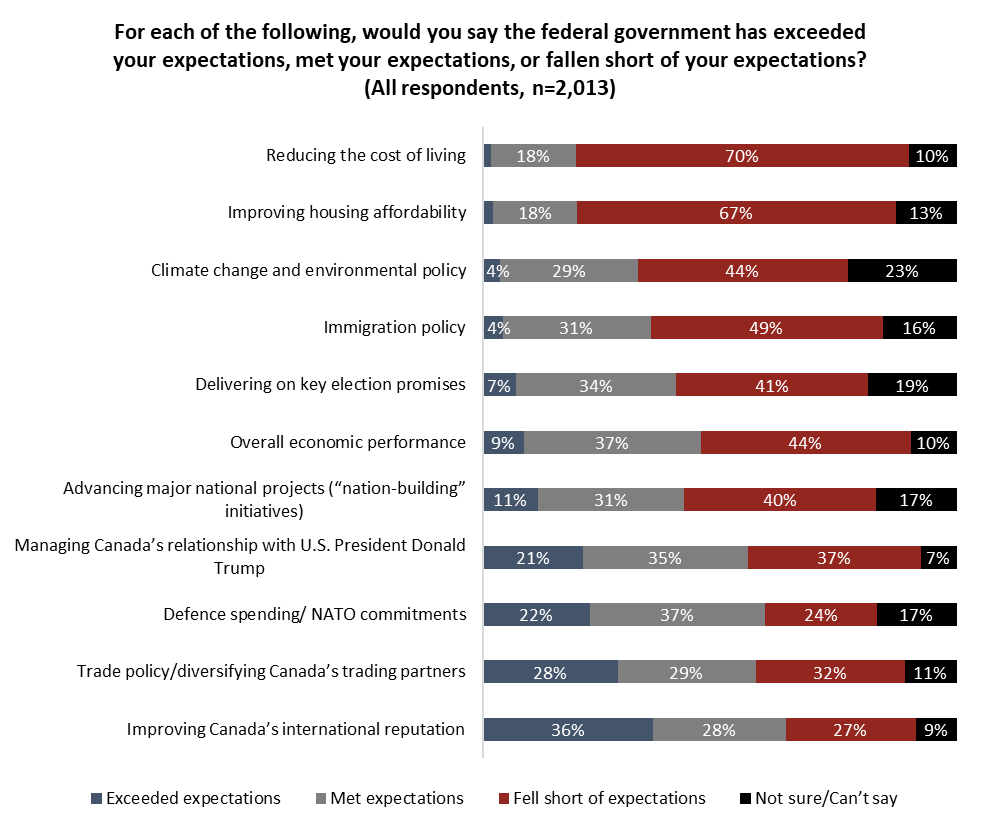
Canadians now have a year’s worth of evidence to assess how Carney’s government has tackled the issues that defined the campaign, and the progress the Liberals have made on its election promises. Carney’s international legwork – he’s made trips to Europe, Mexico, the U.K., Egypt, Southeast Asia, Australia, China and India so far – is where he’s received the most praise from Canadians. A majority say the federal government has met or exceeded expectations when it comes to improving Canada’s international reputation (64%) and diversifying Canada’s trade partners (57%).
Last month, the federal government announced it had achieved the target of two per cent of GDP spent on national defence Canada had agreed to as part of its obligations to the North Atlantic Treaty Organization (NATO) for the first time in its membership. That is just one step on the ladder to eventually reaching spending five per cent of GDP on defence by 2035. Three-in-five (59%) say Carney has met or exceeded expectations on the defence file, while one-quarter (24%) want more.
Carney and his one-year-old government also has met or passed a majority (56%) of Canadians’ expectations for its performance on managing Canada’s relationship with Trump, despite a lack of a trade deal as the USCMA renegotiation deadline looms. Notably however, two-in-five (37%) say they expected more from Carney on that front.
There is division as to whether Carney has made enough progress on advancing major projects (42% met or exceeded expectations, 40% fell short) and improving Canada’s economy (46%, 44%). There are also more who believe the Liberals under Carney have failed to live up to expectations on the files of immigration (49% fell short) and climate change (44%).
Canadians evidently are waiting for much more from the federal government when it comes to affordability. More than two-thirds say Carney’s government has fell short on addressing housing affordability (67%) and the high cost of living (70%).
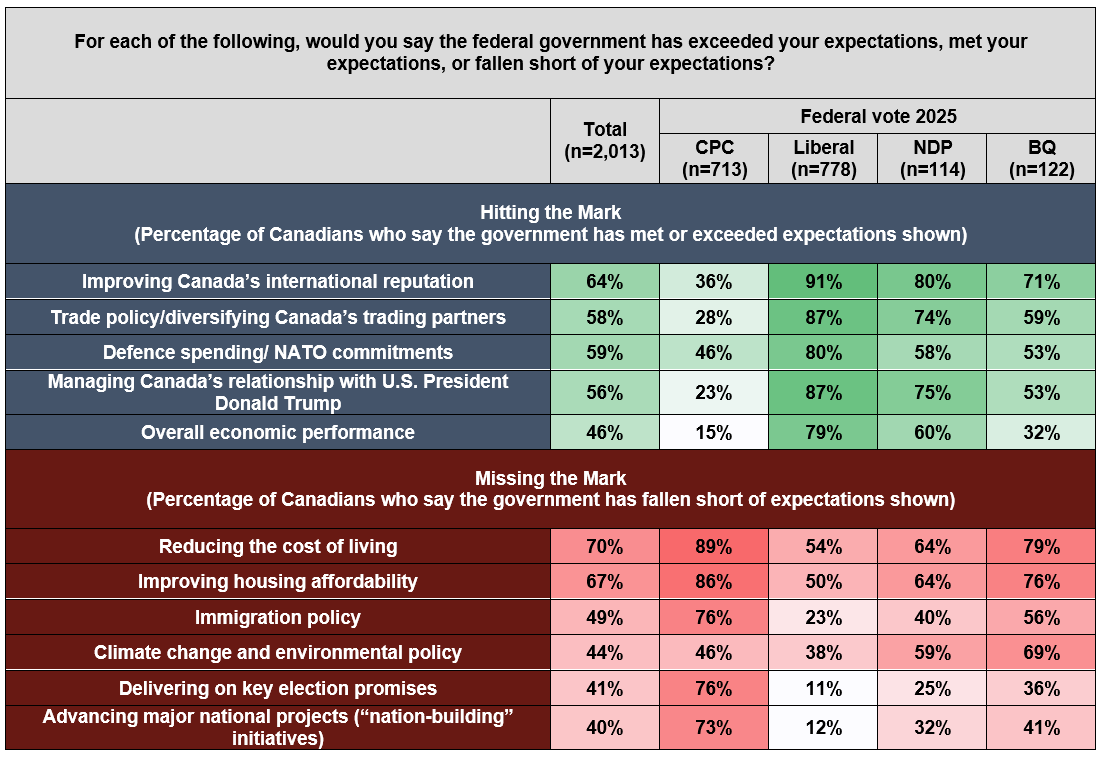
The Liberals needed plenty of NDP switchers to boost its popular vote total in the 2025 federal election. Among those who stuck with the NDP, the environment remains an elevated concern (34% top issue, see detailed tables), and an area where there is criticism of Carney’s Liberals from both past NDP and past Liberal voters. Perhaps that could provide an opening for new leader Avi Lewis to begin rebuilding a larger NDP coalition.
Those who voted CPC are most likely to say that Carney has met or exceeded expectations on defence spending but are much more likely to say that the new government has fallen short on many files.
Past Liberal voters are more or less satisfied on most fronts when it comes to Carney’s performance after a year in addressing key campaign promises. But half (50%) say the Carney’s government has fallen short on housing and a majority (54%) say the government has failed to deliver on the high cost of living.
Overall, Canadians are split as to whether Carney’s federal government has succeeded or failed to deliver on its election promises. Two-in-five (41%) believe the PM has fallen short; two-in-five (41%) say the Liberals have delivered. Notably, three-in-five (59%) past Liberal voters say Carney has only met expectations, just a handful of one-in-eight (12%) say he has exceeded them:
Looking ahead: Cost of living remains the big concern
The issue of affordability is where Canadians want more attention paid by their federal government. Half (52%) say the biggest challenge for the next year for the federal government is to reduce the cost of living, an issue that has been compounded by the war in Iran’s impact on the price of gasoline.
Related:
- Three-in-five say increasing gas prices have already led to personal behavioural change
- Federal Politics: Liberals lead, but continued cost of living challenges could open door for Conservatives
Continuing to navigate the U.S.-Canada relationship vis-à-vis Trump is chosen by three-in-ten (31%) as a major challenge for Carney’s government. There are also equal sized groups of one-in-five who say the top challenge is diversifying Canada’s trade partners (20%), improving housing affordability (19%), advancing major projects (18%), and the economy more broadly (18%):
Part Two: Carney approval
Three-in-five approve of PM’s performance
Carney’s approval received a bump up in 2026 after a well-received speech at the World Economic Forum in Davos.
Currently, approval is below the peak seen in February (63%), but at a three-in-five (58%) level consistent with other data points in 2026. One-third (35%) of Canadians say they disapprove of Carney’s performance as prime minister:
Comparing Carney to other PMs
Carney has stiff competition when it comes to approval among past Liberal prime ministers in their first year in office. Former Prime Ministers Jean Chrétien (66%) and Justin Trudeau (65%) held the approval of two-thirds of Canadians approximately one year into their first terms. Carney (58%) does fare better than Prime Ministers Stephen Harper (55%) and Paul Martin (51%), and well outpaces Prime Ministers Brian Mulroney (43%) and Pierre Elliott Trudeau (34%):

Vote intent gap between Liberals and CPC narrows
The Liberals dip in ARI’s latest vote intention data but still lead the CPC by seven points. More than two-in-five (42%) Canadians say they would vote Liberal if the federal election were today. The Liberals fall as the NDP rise to 12 per cent, the highest they’ve polled in ARI tracking data post Trudeau. The CPC are statistically unchanged from last month, with the support of one-third (35%) of Canadians:
METHODOLOGY:
The Angus Reid Institute conducted an online survey from April 15-20, 2026, among a randomized sample of 2,013 Canadian adults. Respondents are drawn from the Angus Reid Forum, a large-scale online panel developed to include Canadian residents in each of the 343 federal ridings in Canada and representative of the Canadian population by age, gender, family income, ethnic status and education. The sample was weighted to be representative of adults nationwide according to region, gender, age, household income, and education, based on the Canadian census. For comparison purposes only, a probability sample of this size would carry a margin of error of +/- 2 percentage points, 19 times out of 20. Discrepancies in or between totals are due to rounding. The survey was self-commissioned and paid for by ARI.
For detailed results by age, gender, region, education, and other demographics, click here.
For PDF of full release, click here.
For questionnaire, click here.
Image – Daniel Pereira/ Office of the Prime Minister of Canada
MEDIA CONTACT:
Shachi Kurl, President: 604.908.1693 shachi.kurl@angusreid.org @shachikurl
Dave Korzinski, Research Director: 250.899.0821 dave.korzinski@angusreid.org
Jon Roe, Senior Research Associate: 825.437.1147 jon.roe@angusreid.org