


Two-in-five worried that they or someone in their household may lose a job due to economic conditions
September 17, 2025 – The Bank of Canada is expected to cut interest rates this morning, as a sluggish economy overshadows inflation concerns. While the job market has continued to weaken throughout 2025, young workers have borne a significant share of the unemployment trend.
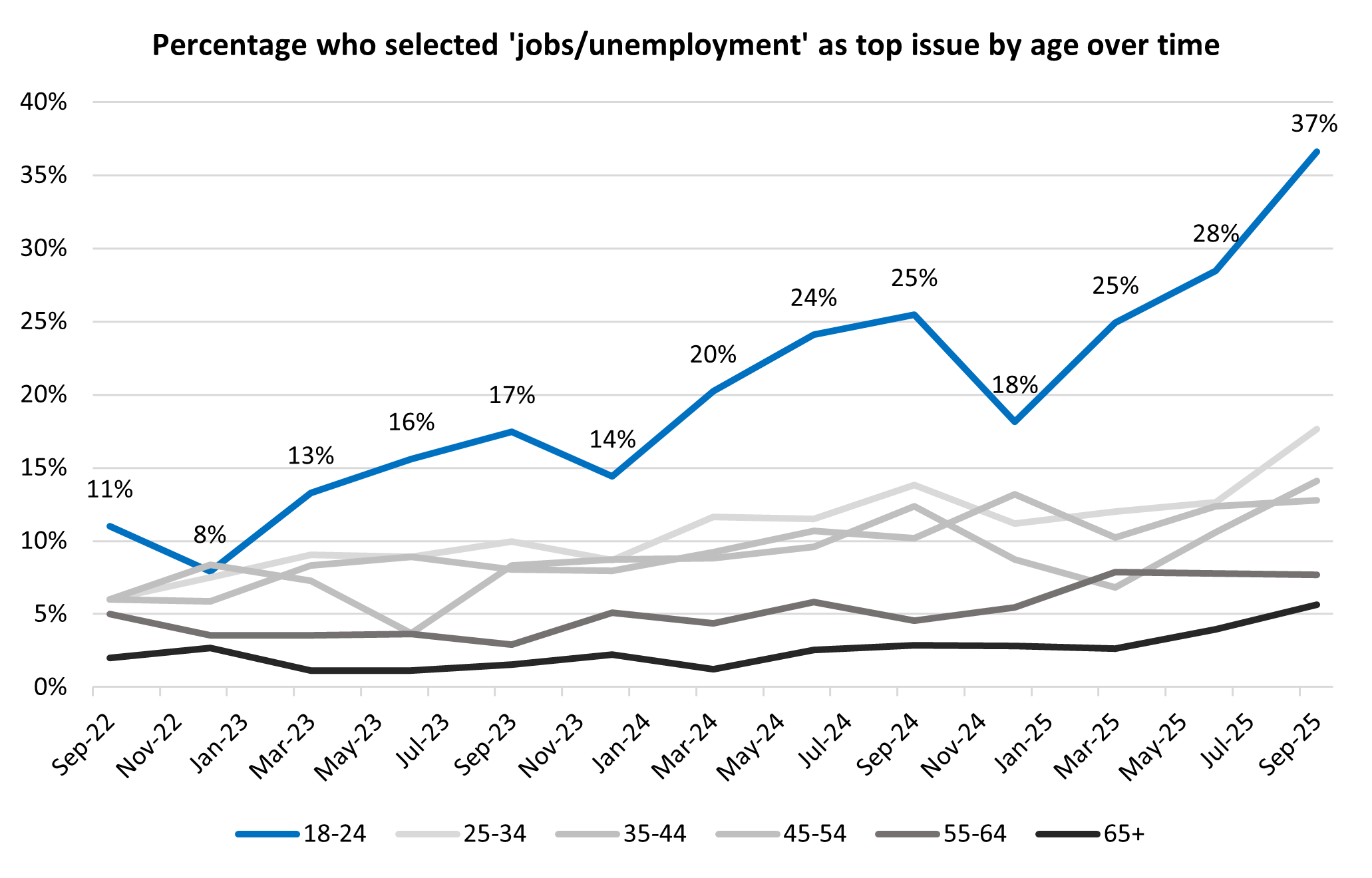
New data from the non-profit Angus Reid Institute finds concern over jobs among young Canadians climbing sharply as the unemployment rate remains elevated. Approaching two-in-five (37%) 18- to 24-year-olds choose jobs and unemployment as a top issue facing the country. That’s double the proportion who said the same last December (18%) and up nine points since June (28%).
Young adults endured one of the weakest summer job markets since 2010, excluding the pandemic years. And while youth unemployment was the key concern in June and July, August job losses centered on the 25-to-54 age group. At present, two-in-five Canadians (40%) say they are concerned they or someone in their household may lose their job due to the economy. This view is consistent across income levels but highest among 18- to 24-year-olds (52%).
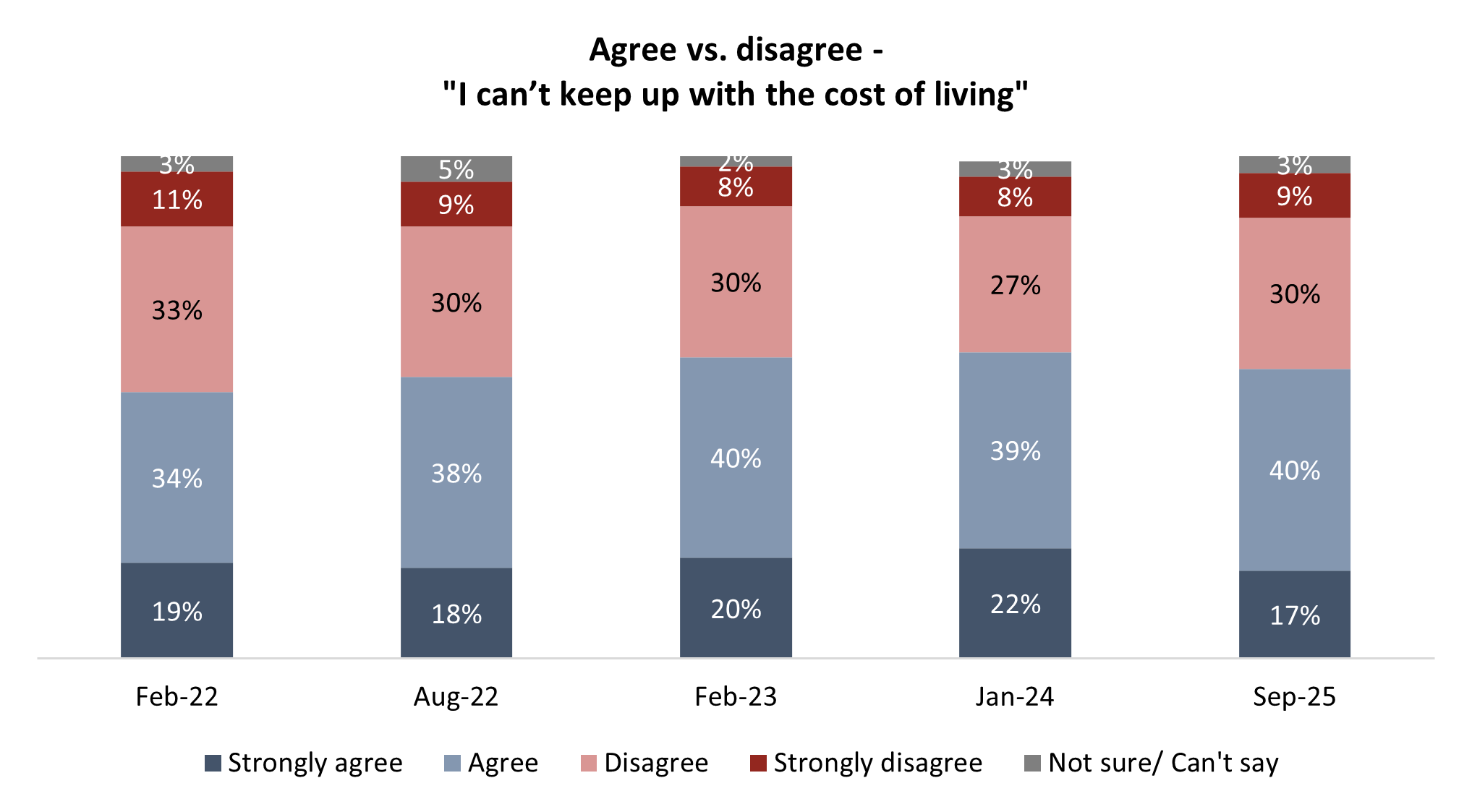
The latest data show both positive and negative economic signals heading into the fall. On the brighter side, housing costs are causing slightly less concern than they did last September, for renters and mortgage holders alike. On the other hand, nearly three-in-five (57%) Canadians continue to say they can’t keep up with the cost of living — a trend that has persisted since 2022.
More Key Findings:
- One quarter of Canadians say they could not manage an unexpected expense of more than $250. Half (50%) say they could absorb $1000 or more.
- On the positive side of economic trends, three-in-five say their housing costs are currently manageable – a six-point increase from last September. There has been a corresponding seven-point decrease in the proportion who say this is difficult.
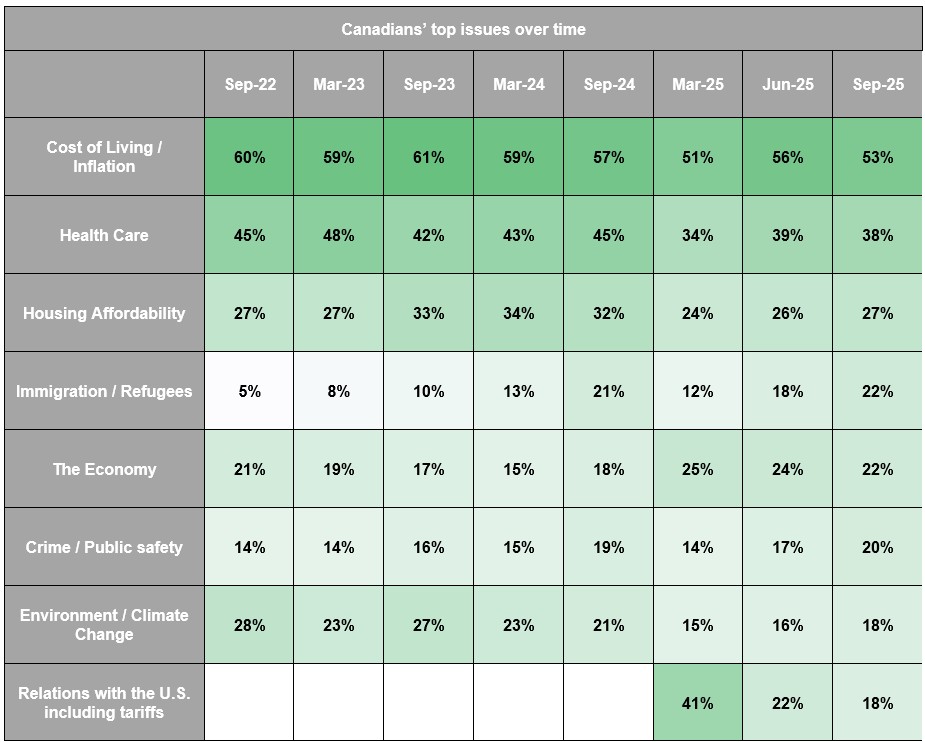
- The proportion of those choosing tariffs and U.S. relations as a top issue facing the country has dropped from 41 per cent in March to 18 per cent now.
INDEX
Part One: Top issues and employment
-
Concern about jobs and unemployment doubles among the under 25 crowd
-
Household job loss remains a concern for two-in-five
-
Job security
-
Economic Well-Being Index
-
Many of the worst off also deal with job precarity
Part Two: Expenses – housing, groceries and more
-
Debt levels a major concern for one-quarter
-
Housing costs improving
-
Renters less pressed than they were last September
-
Mortgage stress also drops
-
Grocery challenges continue to fluctuate
-
Majority “can’t keep up”
Part One: Top issues and employment
The country has undergone a massive reorganization of priorities in 2025. An unforeseen trade war shocked Canadians in the first quarter, leading them to rally around their leaders and a Canada First, Elbows Up, sentiment. That surge has largely diminished as Canada’s trade negotiations have worn on. President Trump’s early threats have settled on targeted tariffs, which, while harmful to large industries in the country, have not been applied to USMCA compliant goods, which represent 90+% of products crossing the border.
The proportion of those choosing U.S. relations and tariffs as a top issue has fallen from 41 per cent in March to 18 per cent, while the issues of immigration and crime have correspondingly re-risen to their previous levels of urgency. Notably, as the priorities have re-balanced, criticism of provincial leaders and Prime Minister Mark Carney have begun to increase:
Concern about jobs and unemployment doubles among the under 25 crowd
Employment trends over the summer have been largely negative, as the economy lost 66,000 jobs in August and Canada’s unemployment rate rose from 6.9 to 7.1 per cent. Foremost among these employment challenges, evidently, are those faced by young people. The youth unemployment rate for 15-to-24-year-olds has risen to what some call “recession levels”. Concern over this is evident in ARI’s tracking of top issues over the last few years. The proportion of 18-to-24-year-olds concerned about jobs and unemployment was just eight per cent at the end of 2022. This rose to 14 and 18 per cent at the end of 2023 and 2024. That incremental climb, however, has been overshadowed by precipitous movement in 2025. Now, 37 per cent of this group say jobs and unemployment is a top issue for the country – a doubling in the past nine months.
Household job loss remains a concern for two-in-five
Broader concerns about household job loss are consistent, though lower than COVID-19 era worries. Two-in-five (40%) say they’re concerned that they or someone in their household may lose a job because of the current state of the economy, an increase compared to 2022 and 2023 data, but 13 points below the proportion who said this in March of 2021.
Job loss anxiety is elevated among those who are worse off financially. That said, these concerns are held at significant levels across all income groups:
 Job security
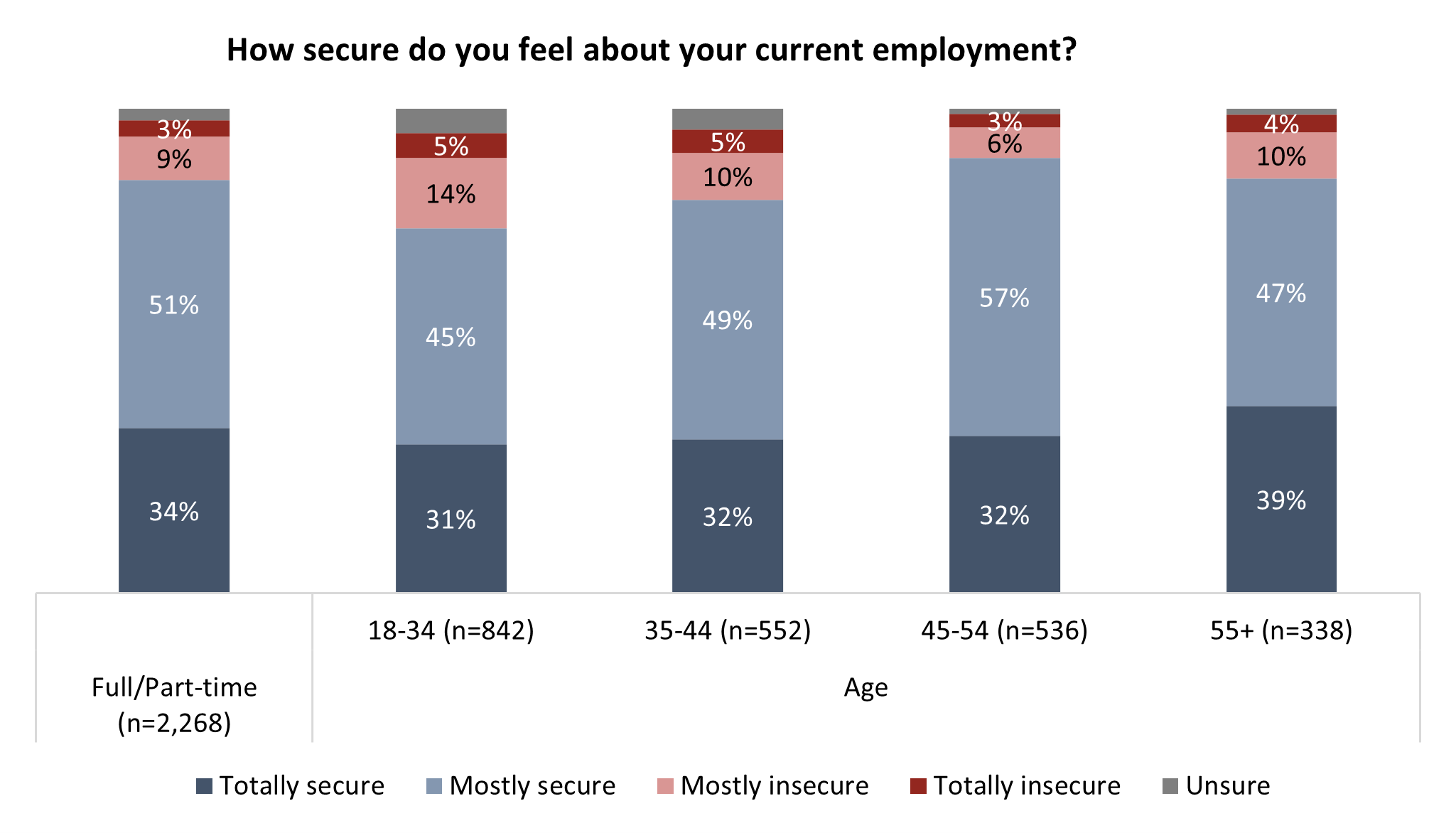
While concern is high within many households, job security overall is relatively solid among full and part-time workers. One-in-three in Canada say they feel their job is totally secure, while half (51%) say it is mostly secure. As such, much of the worry at the household level may reflect a more general economic concern, as well as the fact that that question operates at the household level with the potential of more than one worker to a home. Canadians under 30 are the least likely to report feeling their job is “totally secure” (30%) than other age groups:
Economic Well-Being Index
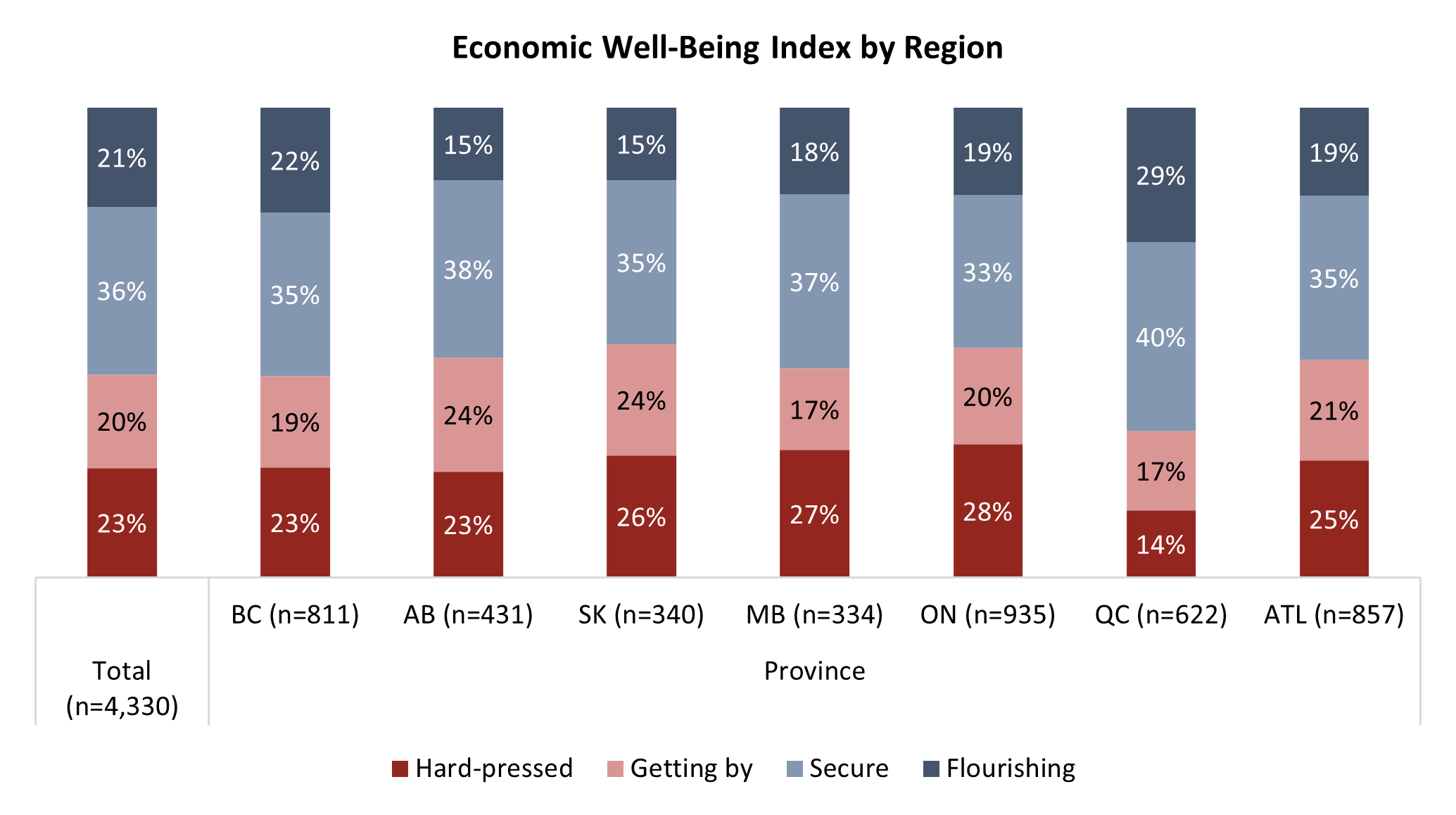
The Economic Well-Being Index combines responses about household finances, employment, food, housing, and debt into a single score. Raw totals range from –13 (lowest well-being) to +14 (highest well-being). To make results easier to interpret, we re-index these totals to a 0–100 scale, where 0 represents the lowest level of well-being and 100 the highest. This allows us to group Canadians into four categories, from those facing the Hard-pressed to those who are Flourishing.
Overall, the scale leans positive, with one-in-five Flourishing, and one-in-three Secure. That said, significant challenges are evident, with 20 per cent Getting by and 23 per cent Hard-pressed.
Three-in-10 (29%) in Quebec fall into the Flourishing category, the most in any region of the country, while the province also has the fewest who could be described as Hard-pressed (14%). Quebecers are more likely than others to describe the cost of putting food on the table as “very easy” or “easy (65%, see detailed tables); as well, they report less challenges with covering their monthly cost of housing (70% describe mortgage/rent as easy/manageable, see detailed tables). Debt is less of a stress as well, with half in the province saying they either have none, or the amount they have is not a concern for them.
According to Equifax, Quebec has the second lowest average household consumer debt and the lowest delinquency rate in the country. Housing affordability has become a growing issue in the province but rent in the province’s major markets still trail many smaller cities in B.C. and Ontario. The province also enjoys a relatively low cost of commonly purchased grocery items compared to other provinces.
As one might expect, a massive indicator of placement on the Index is household income level. While each of the four groups is represented in all income categories, the Hard-pressed are far more likely to be found in lower-income households.
 The group most well-off in terms of age are older Canadians of retirement age. That said, one-in-five among the 65 and older group are Hard-pressed. Half of 35-to-44-year-olds, those most likely to have school-aged children, are on the negative side of the spectrum:

Many of the worst off also deal with job precarity
The importance of the Economic Well-Being Index is perhaps most evident here, in showing the compounding of economic challenges for those worst off. Consider that among those who are already financially Hard-pressed, job insecurity affects two-in-five. This is nearly four-times the average across the population.

Part Two: Expenses – housing, groceries and more
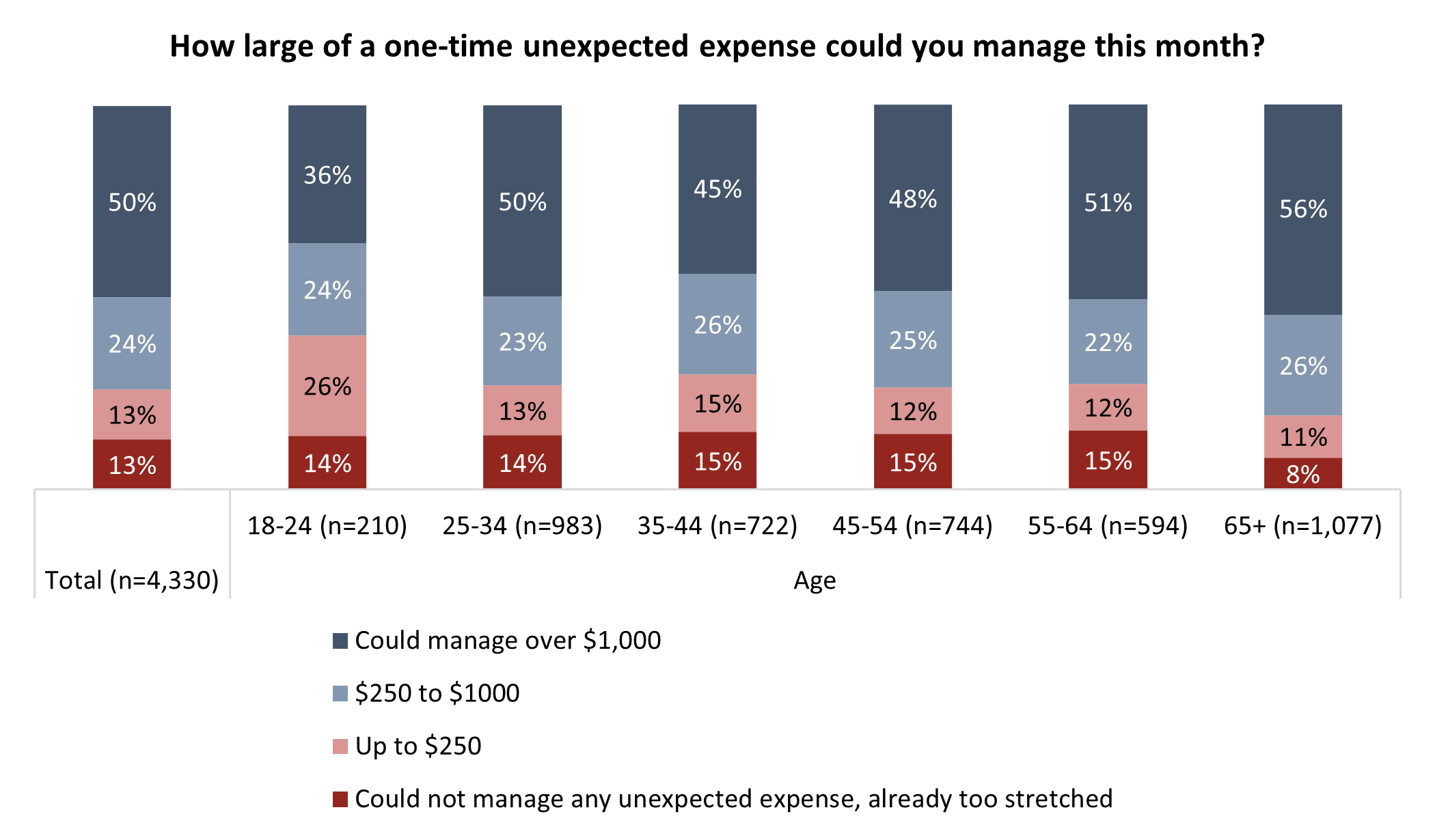
Employment in the economy is one aspect of the picture, while the demand that those wages are used to satisfy is another. A small but significant proportion of Canadians (13%) say that their finances are stretched as far as they can go at this point, while another group of the same size say that they could handle a bill of as much as $250 this month. Just half of the country say that they would be able to accommodate a one-time expense of $1,000:
 Young people face much higher levels of economic instability as they seek to establish fruitful careers. For the rest of the population, the proportion who could not manage any extra expense is relatively stable:
Debt levels a major concern for one-quarter
A majority of Canadians (62%) report finding the debt level of their household a major (23%) or minor (39%) source of stress. Fewer than one-quarter (22%) say they have debt but it’s not an issue they worry about, while one-in-six (17%) say they don’t have any debt at all. These figures have been consistent since January 2022.
Canadians have one of the highest levels of household debt in the world, mostly due to high housing costs.

Housing costs improving
However, Canadians are less likely to report difficulties paying their mortgage or rent than they were over the previous two years. Three-in-five (60%) say their monthly housing costs are “easy” or “manageable”, while one-third (36%) describe it as “tough” or “very difficult”. Two years ago, there were more Canadians saying the latter (43%) and fewer the former (53%):

Renters less pressed than they were last September
The average rent in Canada has declined month over month for nearly a year. This follows a period where rents grew significantly year over year from 2021 to 2024. Last fall, a majority (56%) of renters described their rent as “tough” or “very difficult” to pay. Since then, a growing proportion of Canadians report their rent as manageable:

Mortgage stress also drops
Interest rates have been on the steady decline since last year as the Bank of Canada has cut its policy rate from five per cent to 2.75 per cent since April 2024. This has led to more favourable terms for mortgage holders. In June 2024, one-in-six (16%) Canadians with a mortgage said their monthly payment was “very difficult” to cover; this proportion has declined by seven points and sits at nine per cent currently:
 Grocery challenges continue to fluctuate
Canadians are more likely to report feeding their household is “easy” or “very easy” than at any point in the last four years. More than half (55%) of Canadians say this, while two-in-five (42%) say they find their household food budget “difficult” or “very difficult” to cover.
Food inflation outpaced the headline inflation rate in recent data and has been higher than figures seen last year, despite a brief dip in January. However, compared to the high inflation period of 2022 to 2023, food inflation has cooled. Grocers blamed tariffs for the increase in prices this year, but expect the impact to lessen after Canada lifted most retaliatory tariffs last month.

Majority “can’t keep up”
Despite an overall cooling of inflation, the sense among a majority of Canadians is that they are falling behind. Approaching three-in-five (57%) say they “can’t keep up with the cost of living”. This proportion has remained relatively consistent in the past three years, suggesting that Canadians are still feeling the shock of the post-pandemic inflation.
The level of anxiety about falling behind is pronounced among those who are Hard-pressed. Half (49%) strongly agree that they can’t keep up, with 44 per cent agreeing. Four-in-five among the “Getting by” and nearly half of the Secure (45%) join them in this sentiment, suggesting that only one group is really free of this weight: METHODOLOGY:
The Angus Reid Institute conducted an online survey from Aug. 28 to Sept. 5, 2025, among a randomized sample of 4,330 Canadian adults who are members of Angus Reid Forum. The sample was weighted to be representative of adults nationwide according to region, gender, age, household income, and education, based on the Canadian census. For comparison purposes only, a probability sample of this size would carry a margin of error of +/- 1.5 percentage points, 19 times out of 20. Discrepancies in or between totals are due to rounding. The survey was self-commissioned and paid for by ARI. Detailed tables are found at the end of this release.
For detailed results by age, gender, region, education, and other demographics, click here.
For detailed results by Economic Well-Being Index, click here.
For PDF of full release, click here.
For questionnaire, click here.
MEDIA CONTACTS:
Shachi Kurl, President: 604.908.1693 shachi.kurl@angusreid.org @shachikurl
Dave Korzinski, Research Director: 250.899.0821 dave.korzinski@angusreid.org