

Legault reaches new low of 22 per cent approval, while B.C. Premier down 12 points in six months
Sept. 9, 2025 – Once the most popular premier in the country, Quebec’s François Legault is now far and away the most unpopular.
New data from the non-profit Angus Reid Institute finds one-in-five (22%) in Quebec approve of Legault, while more than three times as many (72%) do not. This marks the lowest approval of Legault since he first took office in 2018, and a remarkable reversal of fortunes for a leader who secured back-to-back majorities in 2018 and 2022. He now stares down “disastrous defeat”.
The ongoing public inquiry into the SAAQclic $500-million overspend has evidently not done Legault any favours, as he’s been skewered for admitting ignorance to the project’s ballooning budget.
Legault and his Coalition Avenir Quebec have 13 months to right the ship before the province’s scheduled election.
On the country’s west coast, another significant decline has been unfolding. British Columbia’s David Eby has seen his approval has drop for the second consecutive quarter (41%, down five points from June and 12 from March) to the lowest rating he’s received since he’s been in office. This, as his government reckons with a strike of the BC General Employees union, a growing government deficit, and the fallout from recent court decisions on Indigenous land rights. Unlike Legault, however, Eby’s BC NDP won re-election less than one year ago.
The country’s next provincial election will feature one of its most recent additions to the ranks of premier, Newfoundland and Labrador’ John Hogan. After being sworn into the job in May, Hogan and his governing Liberal Party face an election in October. Half (51%) approve of his performance so far, a 12-point increase from last quarter when many were reserving judgement.

About ARI
The Angus Reid Institute (ARI) was founded in October 2014 by pollster and sociologist, Dr. Angus Reid. ARI is a national, not-for-profit, non-partisan public opinion research foundation established to advance education by commissioning, conducting and disseminating to the public accessible and impartial statistical data, research and policy analysis on economics, political science, philanthropy, public administration, domestic and international affairs and other socio-economic issues of importance to Canada and its world.
Note: Because its small population precludes drawing discrete samples over multiple waves, data on Prince Edward Island is not released.
INDEX
- Kinew’s approval declines, but he remains on top
- Atlantic trio – Houston, Holt and Hogan
- The Prairie middle – Smith and Moe
- Fallers and riser in the three most populous provinces – Eby, Legault and Ford
Kinew’s approval falls, but he remains on top
Manitoba appears to be poised to be a big winner of Prime Minister Mark Carney’s nation-building push. Carney has said his government plans to invest in infrastructure for the Port of Churchill as a potential outlet to export Canadian grain, minerals, potash, LNG and crude oil to the European Union. While there remains questions around the viability of the railroad leading to the port to accommodate heavier trains, and sea ice blocking access to the port for most of the year, Manitoba Premier Wab Kinew has touted the project’s economic potential both for the province and Indigenous nations invested in the port.
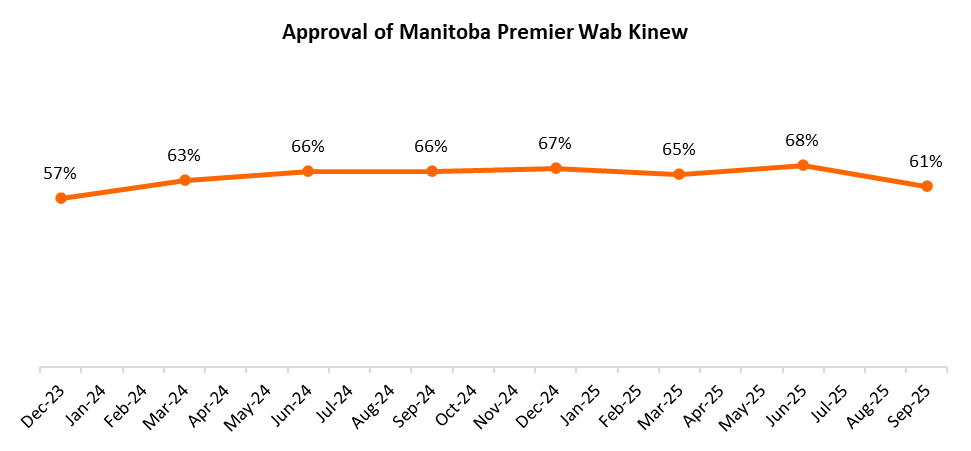
Still, despite the potential economic boost, Kinew has seen his popularity significantly drop for the first time since becoming premier almost two years ago. Three-in-five (61%) in Manitoba approve of Kinew’s performance, a seven-point fall from last quarter. He’s also seen a 12-point decline in the proportion of Manitobans who strongly approve of his performance compared to June (34% to 22%). Kinew has been criticized for delaying the Spruce Wood byelection – and questioned over the timing of more than $300 million worth of spending in the region prior to the byelection being held. There are also those who view Kinew as abandoning the climate crisis in his push to develop infrastructure.
Atlantic trio – Houston, Holt and Hogan
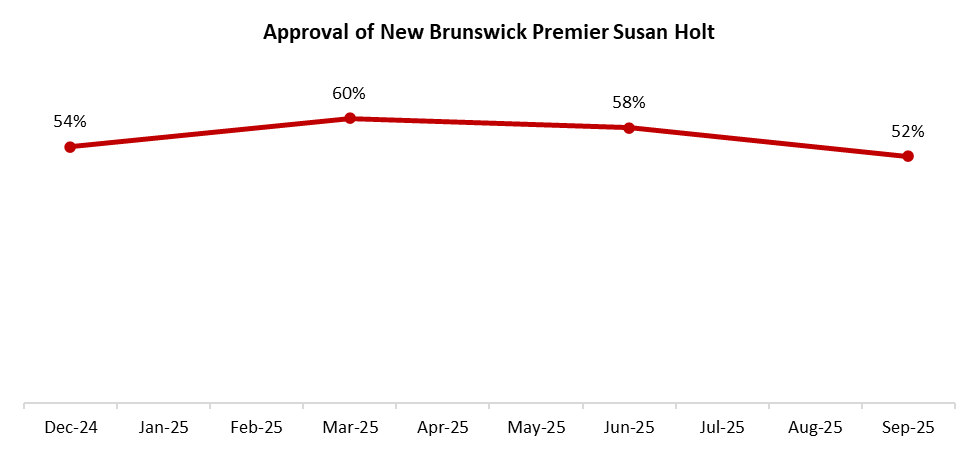
Not every premier gets to experience a multi-year Kinew-style honeymoon from constituents. The realities of governing are perhaps already weighing on assessments of New Brunswick Premier Susan Holt, who has approval of half (52%) in the province, eight points below the level (60%) seen in March and the lowest of her short tenure so far.
Holt has seen criticism from multiple axes. The Liberals promised during the election campaign to balance the budget but retreated from that pledge almost immediately. The government is now projecting a fiscal year deficit that is $120 million more than forecasted in March.
Meanwhile a gasoline surcharge Holt and the Liberals promised to eliminate has instead doubled in the past year, as some question why there has been a delay to fulfill that pledge.
Still, Holt enjoys positive net-approval (+14) as her government nears its first anniversary:
Holt, and Premier Tim Houston of neighbouring Nova Scotia, were both criticized for restrictions imposed on activities in forests while the provinces dealt with out-of-control wildfires. It is perhaps not a coincidence that both saw their popularity drop, but both remain among the top approved-of provinces in the country. Houston is approved of by 53 per cent in Nova Scotia with a net approval of plus-nine.
The province’s wildfires were the central but not the only issue the provincial government was occupied with over the summer. Houston followed in Conservative colleague Doug Ford’s footsteps by wading into his province’s largest city’s traffic issues, warning the Halifax regional council that he would step in if it did not reverse a decision to put a bike lane on a downtown street. The plan was eventually scrapped, but not before Houston mulled strong mayor powers similar to those granted by Ford’s Progressive Conservative government in Ontario.

Newfoundland and Labrador Premier John Hogan will get a rapid referendum on his tenure in office since taking over from Andrew Furey in May as the province is set to hold an election this fall. His approval is at least trending in the right direction as more constituents get to know him: Half (51%) say they approve of Hogan’s performance, while three-in-ten (28%) do not:

The Prairie middle – Smith and Moe
Alberta Premier Danielle Smith continues to be the most polarizing premier in the country. One-quarter (24%) strongly approve of her performance – the most in the country and ahead of Manitoba’s Kinew (22%) this term. But two-in-five (40%) strongly disapprove of Smith, the second highest behind Quebec’s François Legault (49%). This month, Smith’s approval returns to familiar territory, with 46 per cent in the province offering her a thumbs’ up.
Smith has not been afraid to institute controversial policies that both play to her party’s right flank and generate loud criticism from elsewhere in the province. A ministerial order banned books with sexually explicit written, illustrated or audio content from Alberta schools right before the school year. The government went back to the drawing board after the Edmonton Public School board released a list of books it was removing that included classics such as Margaret Atwood’s The Handmaid’s Tale. Smith’s government has been criticized for its censorship and for leaning heavily on American sources to guide them on which books to ban.
The province also became the first to charge most of its residents for COVID-19 immunization, which doctors criticized for its potential to create inequalities in coverage between rich and poor residents. The Alberta government argues paying for the vaccines – which were previously funded by the federal government – would require diverting money from other areas of the health-care system and that many free vaccines went to waste last year.

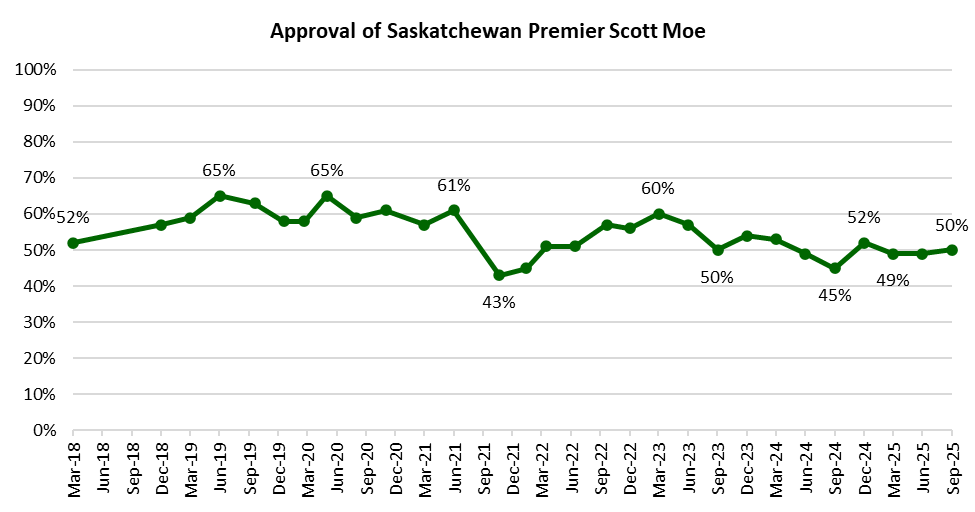
Saskatchewan Premier Scott Moe also finds himself in familiar territory – half (50%) in the province approve of his performance. In the past two years, assessments of Moe have stayed within five points of that proportion, ranging from a low of 45 per cent in Sept. 2024 to a high of 54 per cent in Dec. 2023.
Moe’s province has been dealing with the fallout from the lesser-known trade war: Canada’s dispute with China. Canada followed the U.S. in putting tariffs on Chinese electric vehicles; China responded with punishing tariffs on Canadian canola. Moe is in China this week to persuade the country to lift its tariffs on canola, which have cost Canadian farmers $800 million in losses since March.
Fallers and riser in the three most populous provinces – Eby, Legault and Ford
The downward trend for British Columbia Premier David Eby continues as two-in-five (41%) say they approve of his performance, the lowest rating he’s received since he took office. His approval has now fallen for two straight quarters.
Eby announced that the province was “facing big fiscal headwinds”, including a potential $10-billion deficit, as it works to end a strike by the B.C. General Employees’ Union (BCGEU). Provincial government spending under Eby has severely outpaced that of his predecessor John Horgan; the province’s debt is forecast to nearly double in the next three years.
The government also faced public outrage from a decision by the Expensive Drugs for Rare Disease committee which ruled to stop providing a drug for a terminally-ill 10-year-old B.C. girl suffering from Batten disease. Eby and Health Minister Josie Osborne initially said they wouldn’t overturn the ruling, but reversed course after receiving a letter from experts who study the disease.

The country’s least approved-of premier is in Quebec for another quarter. One-in-five (22%) approve of Premier François Legault, the lowest proportion since he took office. Legault took to the stand this month to answer questions as part of a public inquiry into a $500-million cost overrun at the province’s auto-insurance board. The province’s media found his answers less than convincing.
Some have accused Legault of throwing a policy “hail-mary” to save his government by proposing a bill to ban prayer in public spaces.
Legault’s Coalition Avenir Québec party has suffered, too, as the premier’s popularity has tumbled. The party’s vote share in Arthabaska fell from 52 per cent in the 2022 general election to seven per cent in an August byelection.
And the province’s economy has suffered body blows as well. The North American branch of Northvolt, which had signed a deal with the province to build an electric vehicle battery plant in Quebec, was declared insolvent this month. While the province was able to recover $200 million owed by Northvolt, it also lost a $270-million investment in the venture.

Ontario Premier Doug Ford finds himself once again near the bottom of the quarterly premier approval rankings, but he does so with an approval of 41 per cent, a figure he has been able to match or eclipse only three times since Sept. 2022.
Ford continues to mix things up on the tariff front, issuing sharp words to the owner of a Hamilton steel plant and the makers of Crown Royal, dumping a bottle of the whiskey after the company announced it was relocating jobs from Ontario to the U.S. His fiery responses to revelations on medical tests on dogs in the province – “stop before I catch you” – and a nationally viral story about a man who was charged with assault after he fought with an intruder who broke into his home – “something is broken” – perhaps resonate with some in the province.
Meanwhile, the province’s economy is suffering from the tariffs, losing 38,000 jobs in the second quarter of 2025. Unemployment is also higher than it has been since 2012, excluding the pandemic. Ford’s government has been criticized for slow implementation of the “Protect Ontario Account” designed to help companies hit by tariffs.

Survey Methodology
The Angus Reid Institute conducted an online survey from Aug. 28 to Sept. 5, 2025, among a randomized sample of 4,045 Canadian adults who are members of Angus Reid Forum. The sample was weighted to be representative of adults nationwide according to region, gender, age, household income, and education, based on the Canadian census. Discrepancies in or between totals are due to rounding. The survey was self-commissioned and paid for by ARI.
For more information on our polling methods, click here.
For PDF of full release, click here.
CONTACT:
Shachi Kurl, President: 604.908.1693 shachi.kurl@angusreid.org @shachikurl
Dave Korzinski, Research Director: 250.899.0821 dave.korzinski@angusreid.org
Jon Roe, Research Associate: 825.437.1147 jon.roe@angusreid.org

Note: Because its small population precludes drawing discrete samples over multiple waves, data on Prince Edward Island is not released.
Summary Table
