


Carney’s approval down six points to 51 per cent; CPC (40%), Liberals (38%) close in vote intent
September 5, 2025 – Summer has come and mostly gone, and no trade deal has materialized between Canada and its largest trading partner – the United States. Amid this, Prime Minister Mark Carney’s decision to drop counter tariffs, as well as high expectations on other major issues like housing affordability and “nation building” have contributed to a drop in his personal approval for the first time since assuming the office, and an electoral outlook that is now deadlocked with the Conservatives.
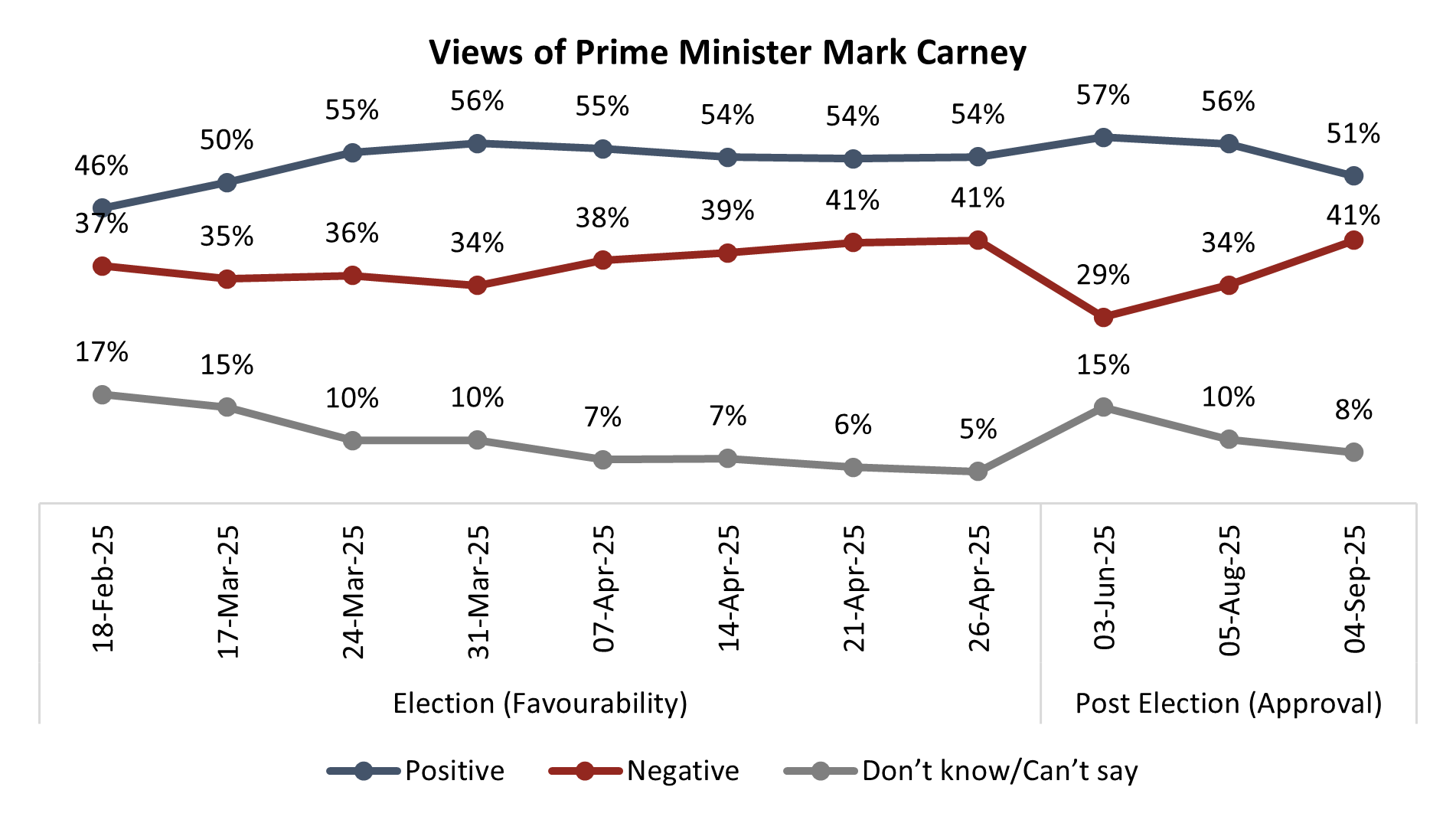
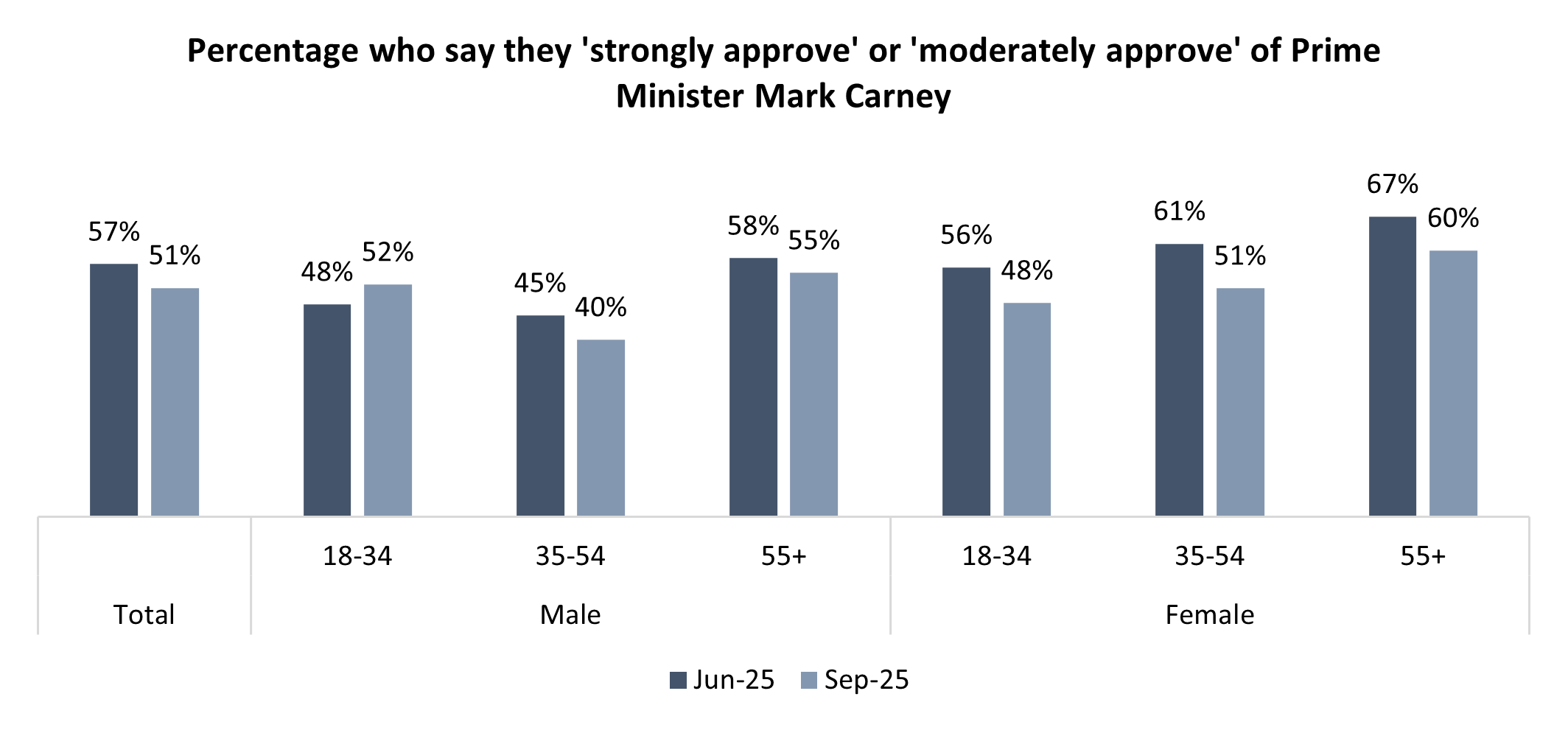
New data from the non-profit Angus Reid Institute finds a six-point drop in approval for Carney and a 12-point increase in disapproval compared to data from June.
This, as many Canadians voice either dissatisfaction (35%) or uncertainty (26%) about his decision to remove tariffs on American goods in August, which had come to define the “Elbows Up” approach Carney was said to be taking against President Donald Trump. Two-in-five (39%) say this was the right choice. While some have noted that Canada enjoys tariff-free trade on 90 per cent of goods, opposition leader Pierre Poilievre was quick to jump on the decision as showing weakness.

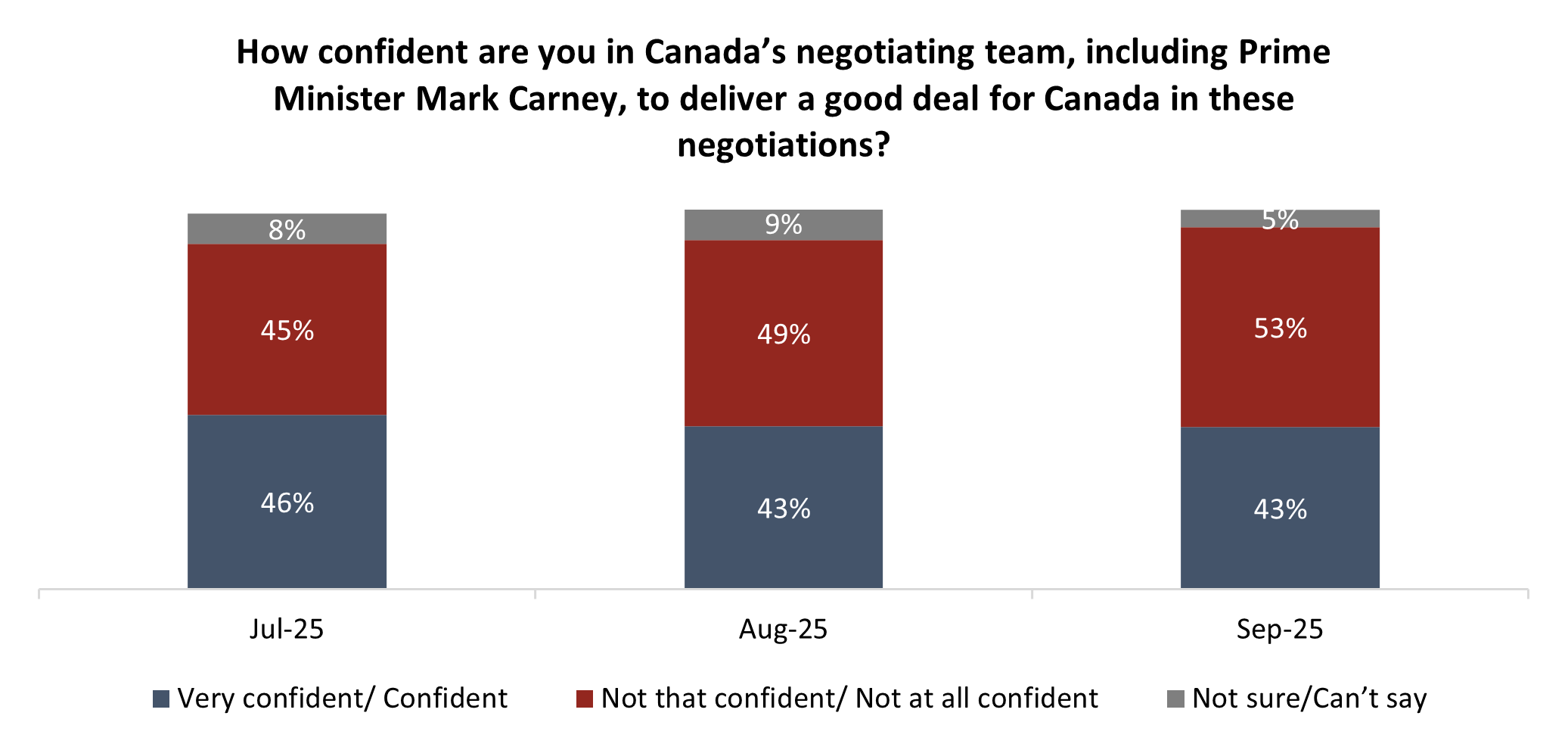
As negotiations continue, well past the Aug. 1 deadline for a deal set by Trump, Canadian confidence in good outcome appears shaken. In July, 46 per cent were confident that Carney and company would deliver a beneficial deal for Canada, while 45 per cent were not confident (+1 confidence). Now, 43 per cent have confidence and 53 per cent lack it (-10 confidence).
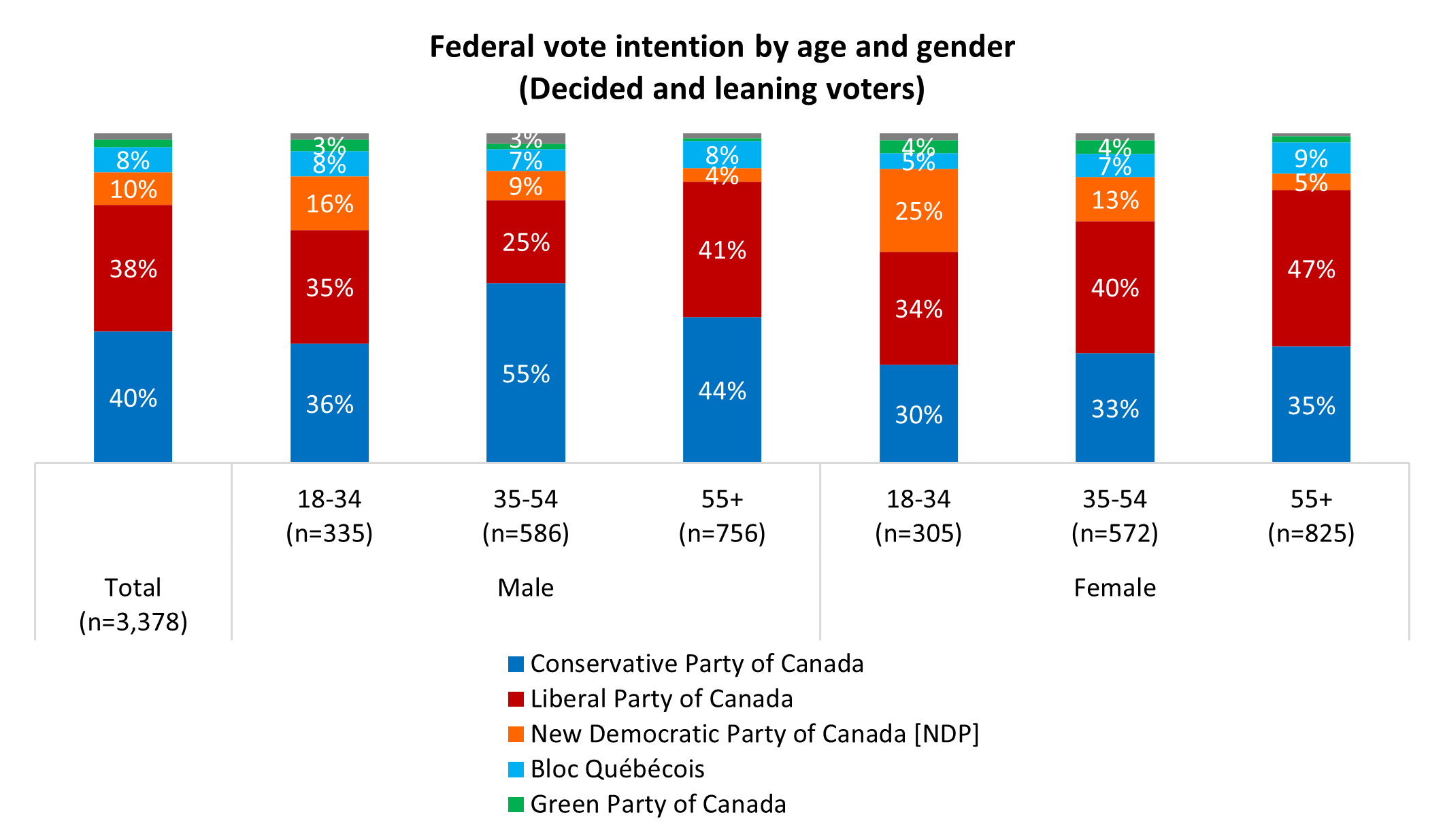
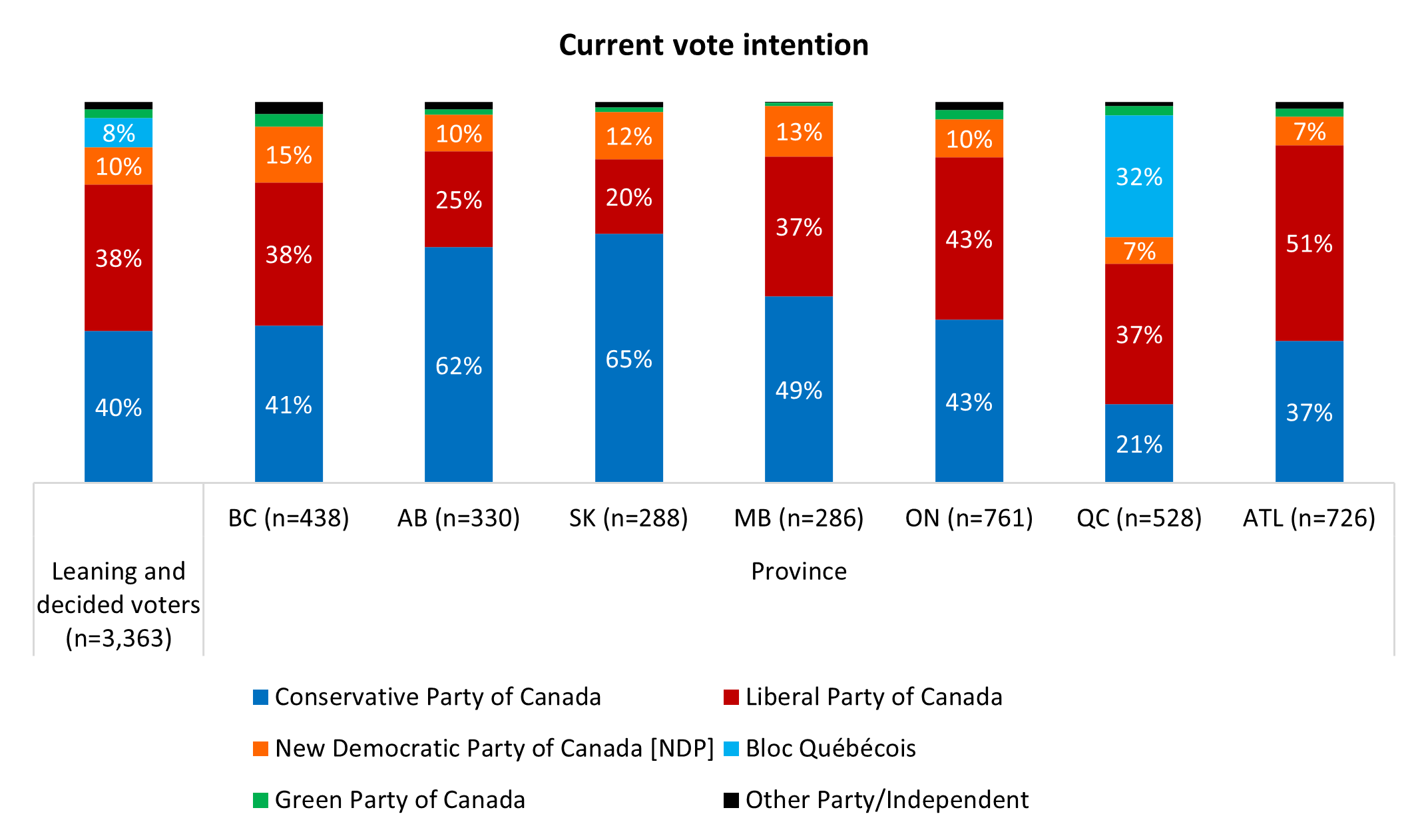
The good news for Poilievre is that his party’s current vote intention outlook has improved compared to the April result that sent it back to opposition status. The CPC hold the slightest of leads as 40 per cent say they would vote for that party in an election, compared to 38 per cent for the Liberals. The NDP are the largest beneficiaries in these new data, with 10 per cent saying they would vote for the party as it searches for a new leader. This four-point increase from the election result of six per cent appears to be driven by one-in-10 (9%) of those who voted Liberal saying they would now support the NDP.
The bad news is that after securing his seat in the House through an Alberta byelection in August, Poilievre’s personal favourability remains poor. Just over one-in-three (36%) say they view Carney’s principal verbal sparring partner favourably, while 58 per cent say the opposite.
Overall, half of Canadians say that based on what they see Canada is on the “wrong track” (50%) overall. Three-in-10 (28%) – including a slight majority of Liberal voters (54%) – say the opposite, that Canada is on the right track.
More Key Findings:
- Canadians continue to voice support for a “hard line” in trade negotiations with the United States. Three-in-five (61%) say this, while 39 per cent would make concessions to get a deal done. The proportion choosing hard line has dropped eight points since early August, before Carney’s decision to remove counter-tariffs.
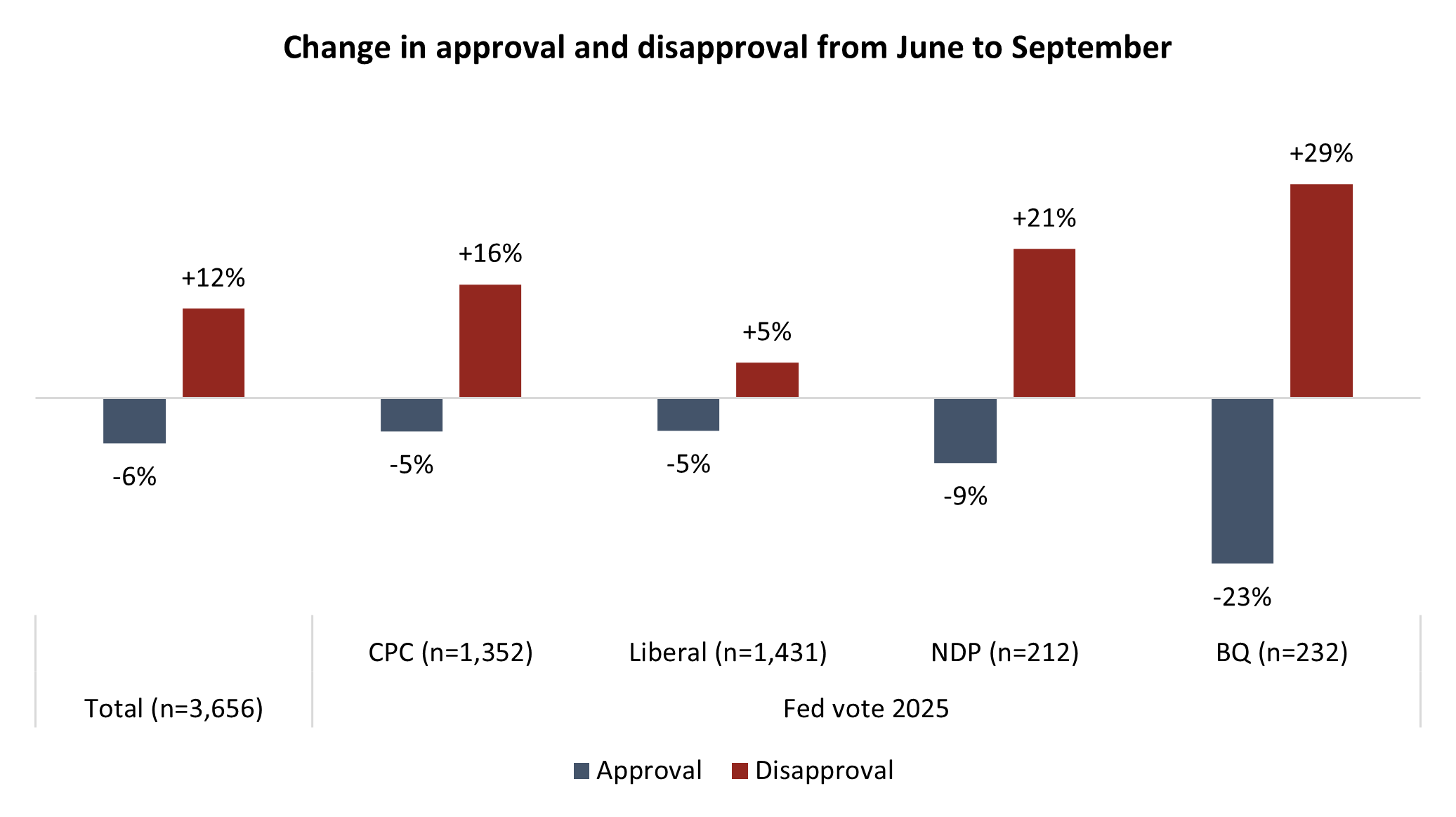
- Disapproval of Carney has rise 16 points among CPC voters, 5 points among Liberals, 21 points among New Democrats, and 29 points among those who voted Bloc Québécois.
INDEX
Part One: Leadership and politics
-
Carney faces first real drop in approval
-
Vote intention divided
-
NDP voters shift (partially) back
-
-
More say Canada on the “wrong track”
-
Poilievre remains unpopular
Part Two: Trade negotiations
-
Division over decision to drop tariffs
-
Confidence in trade deal with U.S. drops
Part One: Leadership and politics
Prime Minister Mark Carney and the Liberal Party won the federal election just over four months ago largely based on a perception that Carney would be the best man to deal with U.S. President Donald Trump and get Canada’s economy moving. While it remains too early to know what fruit early actions will bear, as the government moves forward with major “nation-building” projects, and attempts to complete what appears a laborious trade negotiation with Trump, the first indications have appeared that early goodwill from Canadians towards Carney is slipping.
Carney faces first real drop in approval
For the first time in several waves of data recorded by Angus Reid Institute since the April federal election, there is a reduction in the number of Canadians offering Carney their approval. While hardly cause for alarm, it is a noteworthy indication of Canadians becoming more critical after the early grace period often afforded to newly elected leaders:
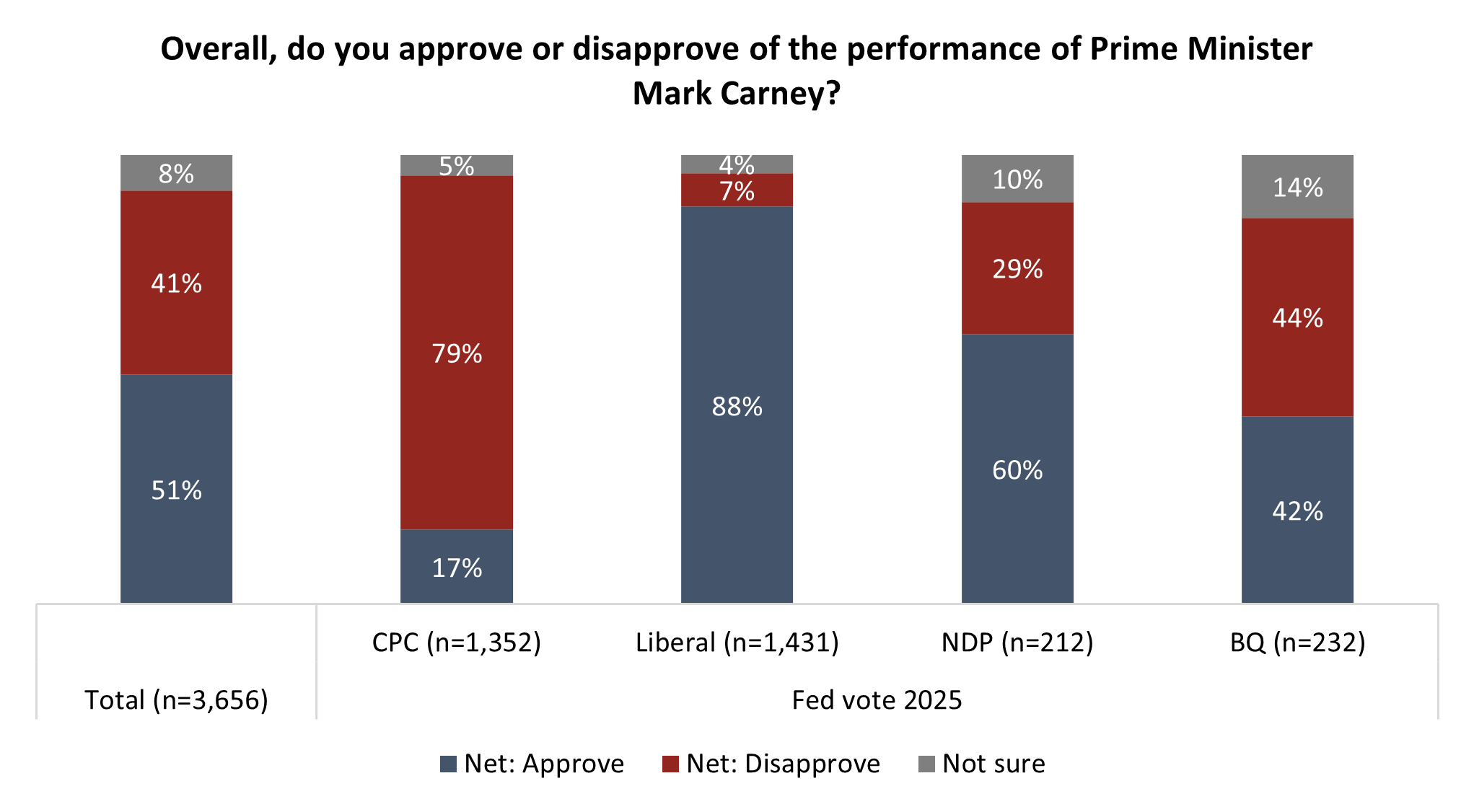
Approval among past Liberal voters approaches nine-in-10 (88%) and remains in majority territory with those who supported the NDP. Four-in-five (78%) CPC voters disapprove, while Bloc Québécois voters are divided:
Disapproval is up across all party supporters, though a smaller amount among those who cast a ballot for Carney’s Liberals in April. Conservative disapproval is up 16 points and NDP disapproval is up 21. Both fall short of the plus 29 disapproval offered by BQ voters:
Carney is still approved of at a majority level among most age groups, but has dropped significantly among women – at least seven points among all three age groups:
Vote intention divided
The April federal election garnered the Liberals a third consecutive minority government, and again a shorter leash than they would have wanted. The situation appears precarious, as the Liberals 169 seats necessitate other-party-support for legislative maneuvers. The 2.4 per cent popular vote victory in April has seemingly evaporated, with the Liberals now in a near-tie, trailing the CPC by two points. The gender imbalance that has defined much of the last decade continues, with women preferring the Liberals and men the Conservatives:
 NDP voters shift (partially) back
The Liberals secured a minority government in April largely on the strength of the erosion of NDP. That party saw its vote share drop from 17.8 per cent to 6.3 per cent. It appears that approximately one-in-10 Liberal voters have shifted back to the NDP, the lion’s share of those who voted Liberal in April but currently say they would not again. While the NDP’s 10-per-cent support pales in comparison to the 2021 result, perhaps it will offer some hope to a party that has freshly launched the search for a new leader:

Regionally, the CPC and Liberals are deadlocked in B.C. and Ontario, while the Liberals hold an advantage in Quebec and Atlantic Canada. The Prairies offer the CPC a comfortable lead:
More say Canada on the “wrong track”
The sense that Canada is on the wrong track is palpable among many. Whether it’s housing affordability and the cost of living, health care access, or other top issues chosen by Canadians, half take a negative opinion on this question – almost twice as many as say they think the country is on the right track (28%). Liberal voters are the only group for whom a majority feels positively in this faceoff: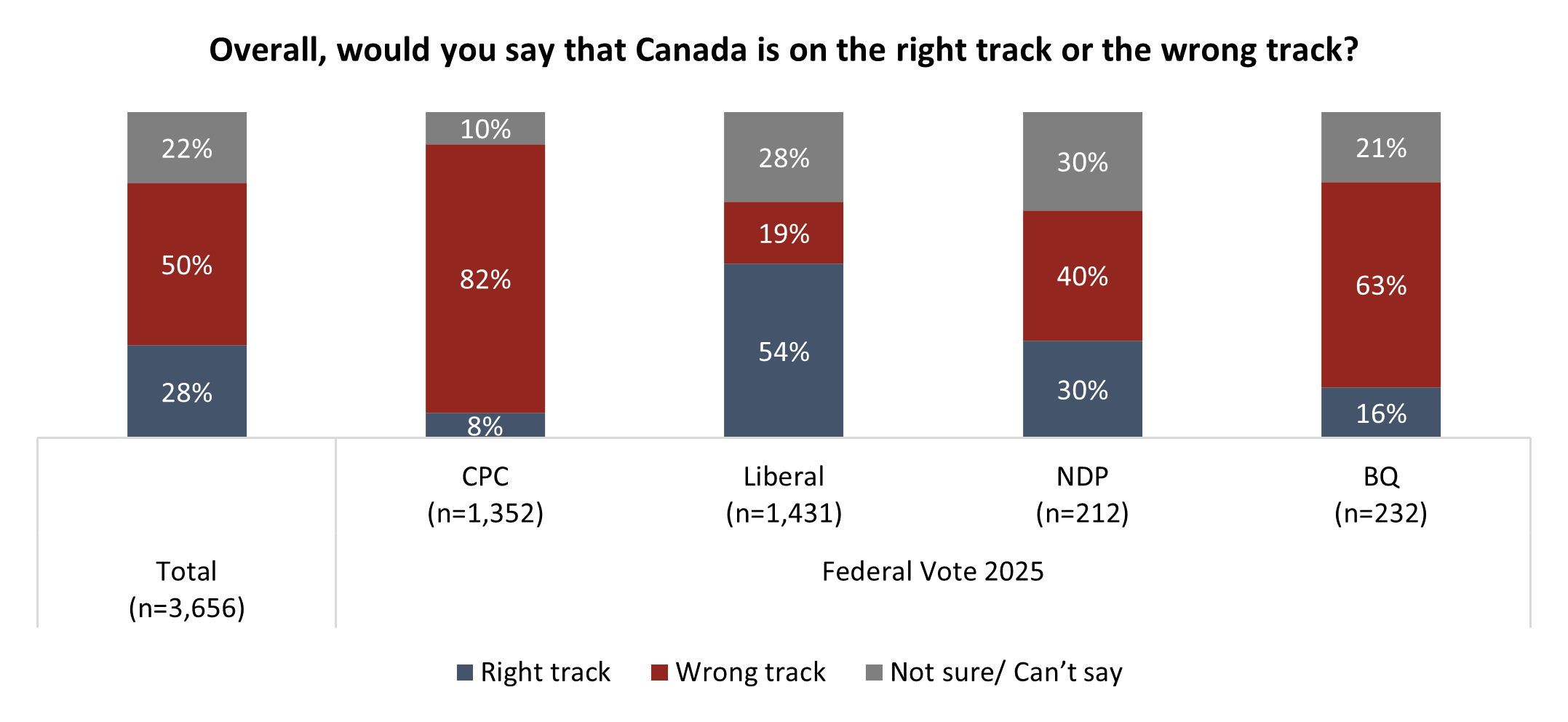 Poilievre remains unpopular
August saw Conservative Party leader Pierre Poilievre re-secure a place in the House of Commons when it opens for the fall session. Poilievre battled the long-ballot initiative and more than 200 other candidates to skate to an easy win in the byelection held in the Battle River—Crowfoot riding in Alberta.
Poilievre was quick to return to his attacking ways, criticizing Carney for early spending commitments, “backing down” against Trump in trade deals, and a lack of action on building infrastructure.
Unfortunately for Poilievre, he continues to struggle to resonate with a larger group of Canadians. His favourability continues to hover in the mid-30s. Poilievre has failed to reach 40 per cent since taking over the CPC leadership in 2022:

Part Two: Trade negotiations
The ongoing and hereto unresolved U.S.-Canada trade negotiations likely loom large over all appraisal of Carney and the Liberal government. The prime minister’s “Elbows Up” slogan has been a source of opposition mockery after Canada removed most counter-tariffs on the U.S. even as Trump raised tariffs on Canada to 35 per cent in July. However, because of the Canada-U.S.-Mexico Agreement (CUSMA), an estimated 90 per cent of Canadian goods enter the U.S. with no tariffs. Carney put the effective tariff rate – or the average rate charged on Canadian goods entering the U.S. – at about 5.5 per cent, “the lowest average tariff of any country in the world.” Some economists have estimated it could be as low as 2.4 per cent.
Division over decision to drop tariffs
Carney defended his decision to drop Canadian tariffs on the U.S. in August, saying it is important that Canada “do everything we can to preserve” the unique advantage of the country’s low effective tariff rate with the U.S.
The strategy to drop tariffs, however, runs counter to most Canadians preferred tact in trade negotiations with the U.S. Three-in-five (61%) say they prefer a “hard approach” even if it means worsening of trade relations, a proportion that has dropped from August (69%) but still remains at a majority level:

This is perhaps why the decision to remove counter-tariffs is divisive: two-in-five (39%) say it was the right move, but one-third (33%) disagree.
While recent Conservative voters express their doubts on Carney’s ability to negotiate a good deal for Canada with the U.S., they are split as to whether they believe removing counter-tariffs was the right decision (40%) or the wrong one (38%). Those who voted Liberal in April are more certain it was the correct play (47%) but express a significant amount of uncertainty (26%). Those who voted NDP (44%) and BQ (49%) are more likely than others to say dropping counter-tariffs was a misstep:
Confidence in trade deal with U.S. drops
Deadlines are maybe immaterial in negotiations with U.S. President Donald Trump – who has not adhered to many self-imposed ones during his tariff odyssey – but it has perhaps not gone unnoticed by the Canadian public that Aug. 1 came and went with no deal between Canada and the U.S. That date was itself a relocated goal post, after Trump and Carney had agreed at the June G7 summit in Alberta to reach a deal by late July.
The percentage of Canadians who are “not confident” that Carney and Canada’s negotiating team will deliver a good deal for Canada has risen from 45 per cent in July to 53 per cent now.
Related:
- Head Down or Elbows Up? Canadians divided whether Carney can deliver a trade deal with Trump
- Canadian resolve on trade negotiations hardens as country faces day one of increased tariffs
The growing doubt that Carney will be able to deliver a favourable trade deal for Canada is coming from those who did not support the Liberals in April. Nine-in-ten (87%) Conservatives say they don’t believe Carney will be able to get it done, but they are increasingly being joined by recent NDP (27% to 41%) and BQ (54% to 67%) voters: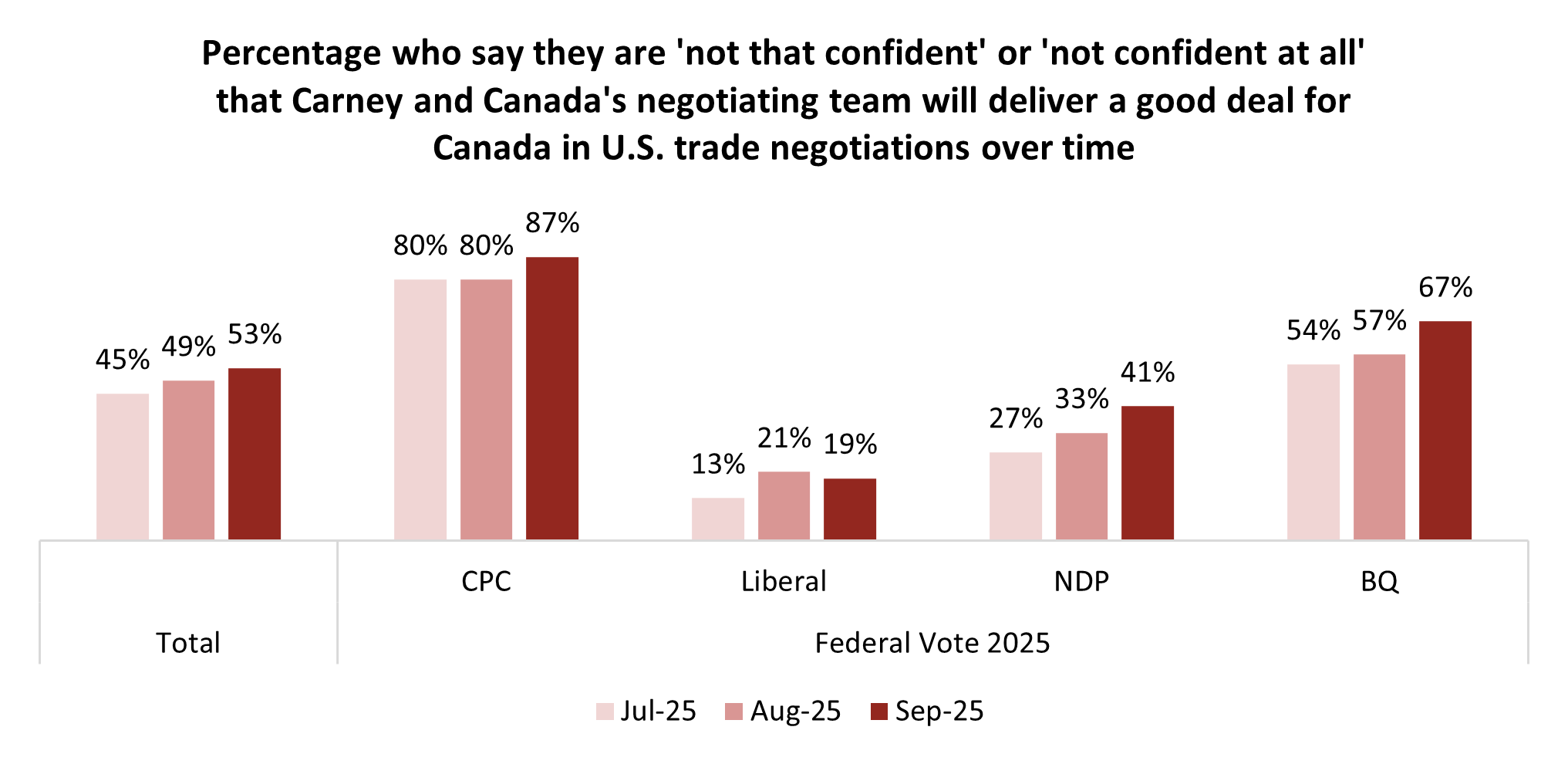
METHODOLOGY:
The Angus Reid Institute conducted an online survey from Aug. 29 – Sept. 4, 2025, among a randomized sample of 3,656 Canadian adults who are members of Angus Reid Forum. The sample was weighted to be representative of adults nationwide according to region, gender, age, household income, and education, based on the Canadian census. For comparison purposes only, a probability sample of this size would carry a margin of error of +/- 1.5 percentage points, 19 times out of 20. Discrepancies in or between totals are due to rounding. The survey was self-commissioned and paid for by ARI. Detailed tables are found at the end of this release.
For detailed results by age, gender, region, education, and other demographics, click here.
For PDF of full release, click here.
For questionnaire, click here.
MEDIA CONTACTS:
Shachi Kurl, President: 604.908.1693 shachi.kurl@angusreid.org @shachikurl
Dave Korzinski, Research Director: 250.899.0821 dave.korzinski@angusreid.org