

Three-in-five say increasing gas prices have already led to personal behavioural change
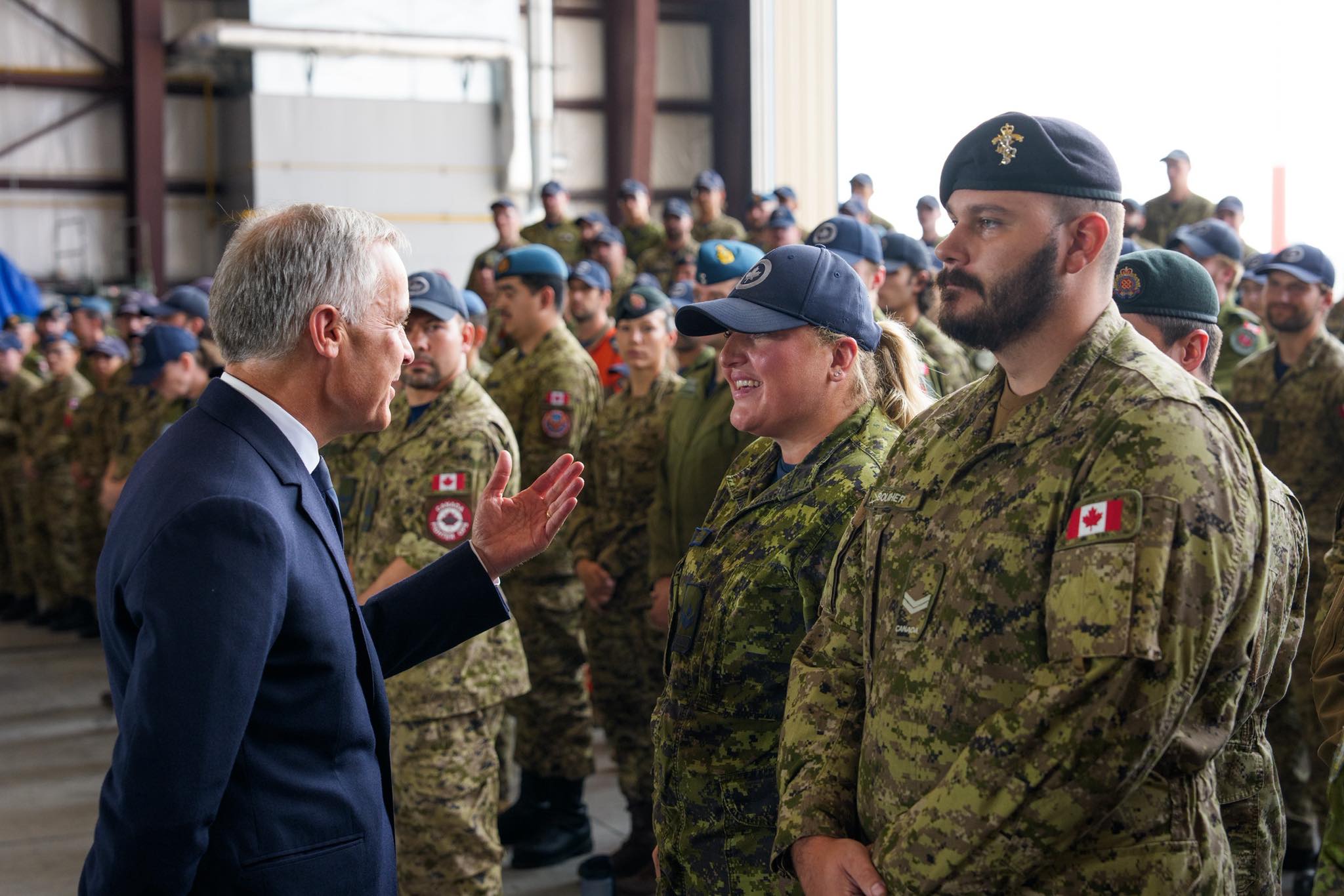
March 17, 2026 – Prime Minister Mark Carney has responded to the U.S.-Israeli bombardment of Iran with a mix of support and hesitation, leading some to wonder if his position is in need of clarification, while others praise his strategic ambiguity. For Canadians, there’s little in the way of guess work.
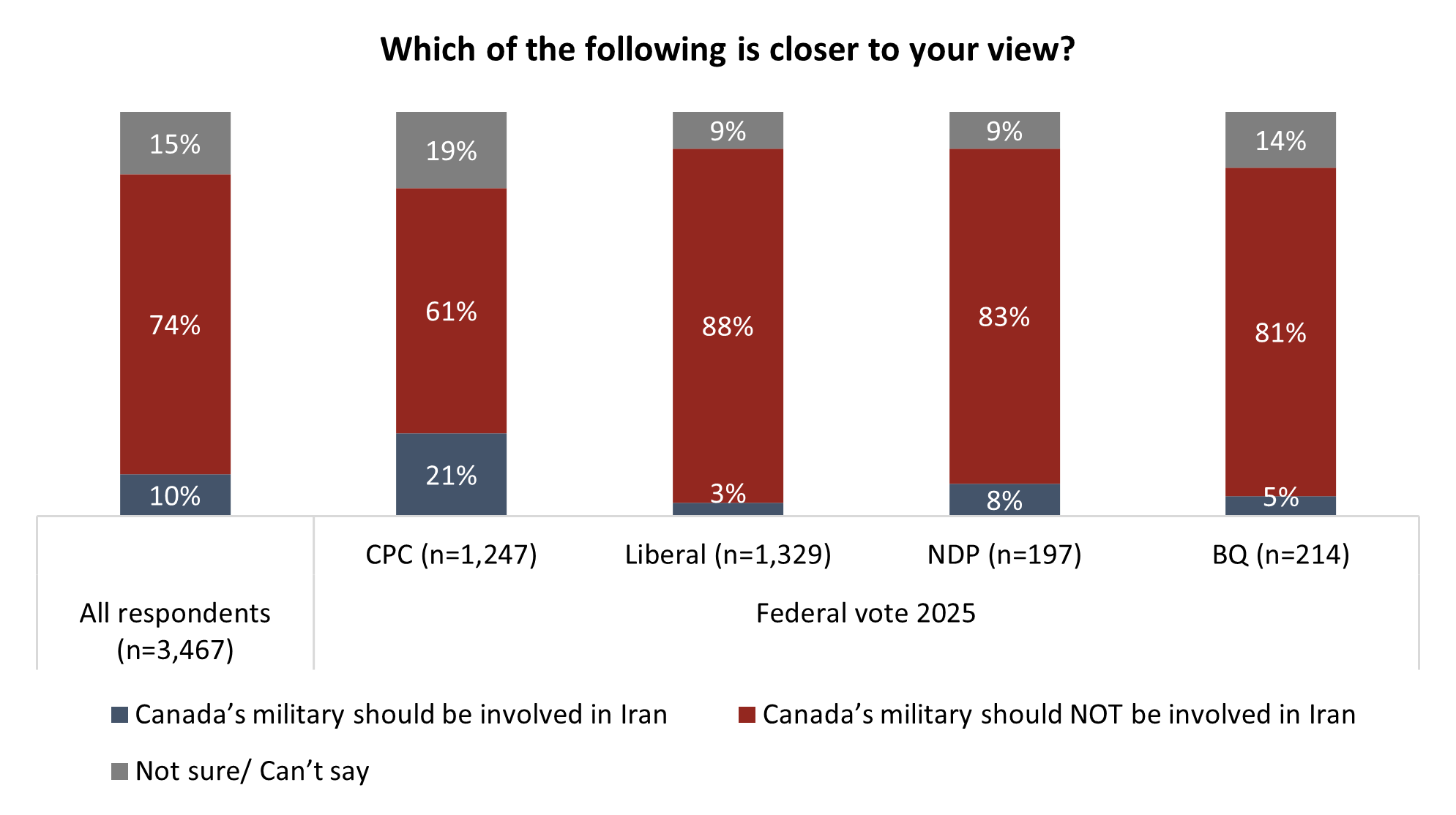
New data from the non-profit Angus Reid Institute finds three-quarters of Canadians (74%) saying Canada’s military should not be involved in this conflict, with one-in-10 (10%) disagreeing. Another 15 per cent take no position.
The lack of interest in getting involved mirrors some of Carney’s statements, as he told parliament that Canada “will never participate”. That said, calls from U.S. President Donald Trump to other nations for additional assistance are growing.
Population level support for Canadian involvement is limited to single digits for a number of different options. Four per cent would offer Canadian aircraft strike assistance and the same number would offer Canadian troops if a ground invasion were to follow. The largest number – six per cent – would offer intelligence and cybersecurity support.
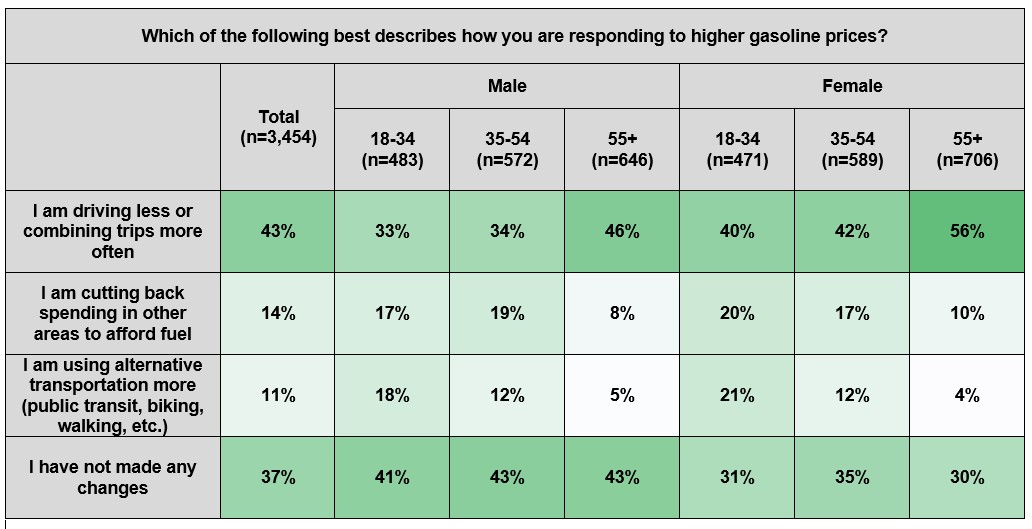
While the war feels far away, and Canadians hope to keep it that way, the impact on gas prices at home has already been felt. With traffic in the Strait of Hormuz still constrained, prices have jumped between 20 to 25 cents per litre in much of the country. One-quarter of Canadians (23%) say this has impacted their household finances a great deal already, while another 44 per cent say they’ve felt the impact more minimally. Overall, three-in-five say they’ve made changes including driving less, combining trips, and using alternative transportation.
More Key Findings:
- While 10 per cent of Canadians support military involvement, this rises to 21 per cent among past CPC voters and drops to three and five per cent for Liberals and New Democrats, respectively.
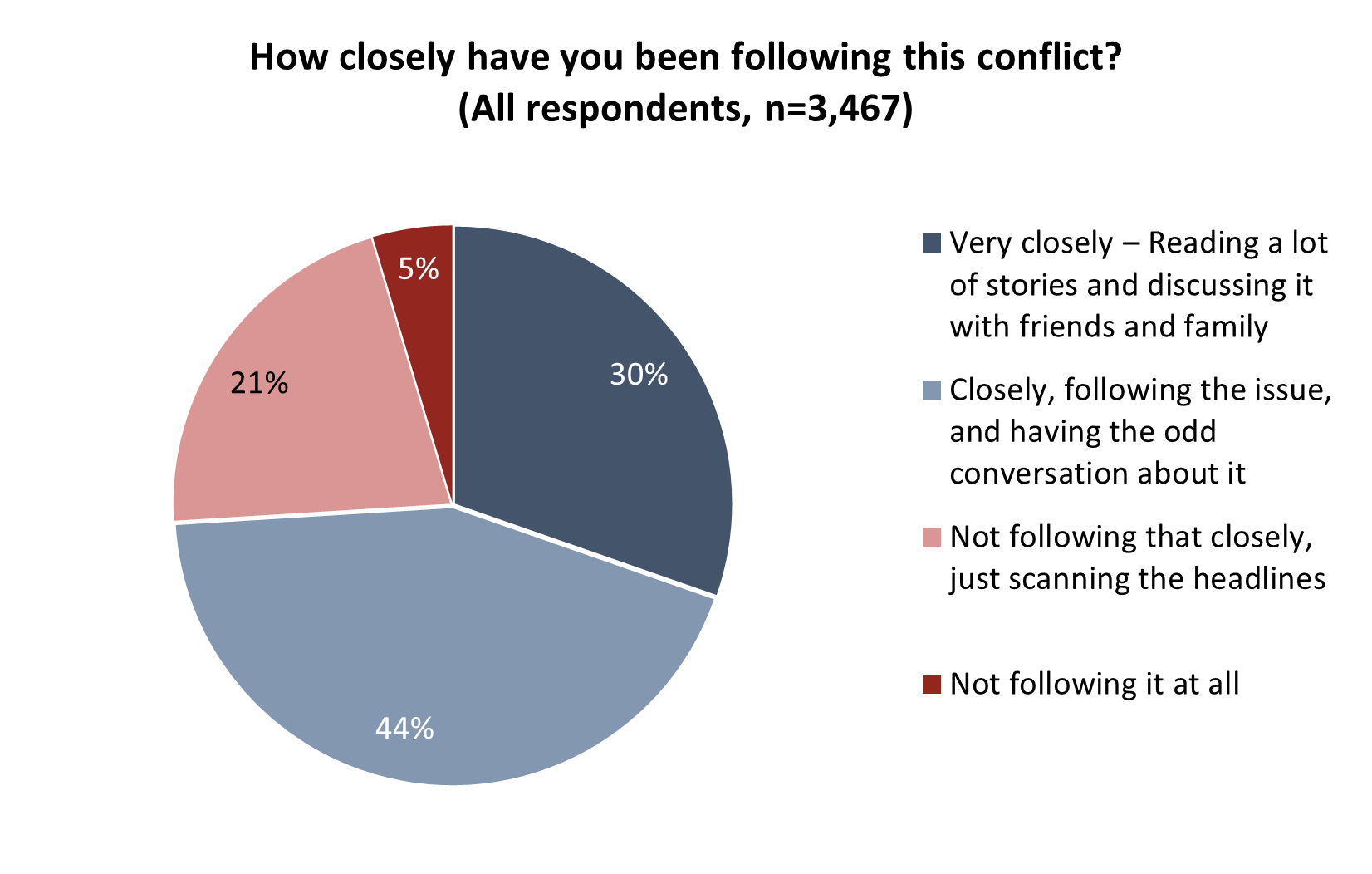
- Three-quarters say they have been following the war closely so far. This rises to 87 per cent among men over the age of 55 and drops to 58 per cent among women younger than 35.
INDEX
Part One: Three-quarters say no role for Canadian military in Iran
- Most are following the conflict closely
- One-in-10 say Canada should be involved in support capacity
Part Two: Gas price gauge
- One-quarter say price surge has impacted finances “a great deal”
- Three-in-five have made changes in response
Part One: Three-quarters say no role for Canadian military in Iran
Most are following the conflict closely
Israel and the United States’ bombing campaign in Iran has dominated headlines since the conflict began on Feb. 28. Three-quarters say they’re either “closely” or “very closely” following the conflict. A further one-in-five (21%) say they have been scanning headlines, while just one-in-20 say they aren’t following it at all:
Engagement with the war is high, but not nearly as high as some other recent news stories. The Angus Reid Institute tracks Canadians’ engagement with news stories using the Engagement Index. Engagement rises from 0 to 100, with 50 being about average. On this, Canadian’s current engagement with the conflict is rated a 62 on the index, above average, but not nearly as high as the beginnings of the conflict between Israel and Hamas in Gaza in November 2023, or Trump’s tariff threats in February 2025:

One-in-10 say Canada should be involved
Prime Minister Mark Carney initially expressed support for the attacks by Israel and the U.S., but softened his stance a few days later, saying that he took that previous position “with regret, because the current conflict is another example of the failure of the international order”.
There are Canadian military personnel deployed in the region near Iran, including some who have come under fire. Carney’s position on Canadian involvement in the conflict has evolved, from initially not ruling it out to unequivocally taking it off the table last week.
Canadians overwhelmingly prefer Canada stay on the sidelines. Three-quarters (74%) say Canada’s military should not be involved in Iran; a handful of one-in-10 (10%) believe Canada should have a role in the conflict. Those who voted Conservative in last year’s federal election are more likely than others to believe Canada’s military should aid the U.S. and Israel, but it is still a minority opinion among those voters:
This smaller portion of Canadians who would like to see Canada play a role in the conflict were asked which areas would be appropriate. The most supported aspect of Canadian assistance would be with intelligence and cyber support, while a handful of Canadians would use Canadian aircraft to assist, either in reconnaissance (5%) or air strikes (4%). The same number (4%) say they would send Canadian ground troops if the war were expanded to this theatre:

Part Two: Gas price gauge
One-quarter say price surge has impacted finances “a great deal”
The war has resulted in economic turmoil felt the world over. One-fifth of global oil consumption is shipped through the Iran-bordering Strait of Hormuz. The price of oil has skyrocketed as tankers have been targeted near the strait, stopping the flow of shipping traffic.
In Canada, gas prices are up more than 16 per cent per litre since the conflict began. One-quarter (23%) of Canadians say this gasoline price spike has had a great effect on their household’s finances; two-in-five (44%) say they’ve noticed a difference but only a little one.
The effect has not been uniform across the country, although all provinces have seen higher gas prices. The spread between the cheapest province for gas and the most expensive province can be 30 or more cents per litre, as there is also a significant discrepancy between taxes and other inputs province to province.
Despite having some of the cheapest gas in Canada, those in Alberta (28%), Saskatchewan (28%) and Manitoba (29%) are the most likely to say the rising cost at the pump have affected their household “a great deal”. Those three provinces are among the highest for the percentage of commuters who drive a car, truck or van, while B.C., Quebec and Ontario – the three provinces where Canadians are most likely to report their household finances are unaffected by the recent gas price spike – have higher average public transit usage, according to Statistics Canada.

Three-in-five have made changes in response
Amidst rising gas prices brought on by the U.S. and Israel bombing campaign of Iran, three-in-five (58%) Canadians have made some sort of change to their behaviour to offset the more expensive cost of fuel. Two-in-five (43%) say they are driving less. Approaching one-in-six (14%) say they’ve had to cut spending elsewhere.
Older Canadians are more likely to report driving less than younger ones, who are more likely to say they are responding to high gas prices by taking the bus or biking or walking.
Those living in households earning more than $100,000 annually are more likely to say they’ve made no changes to their habits (47%) in response to elevated gas prices. Fewer Canadians living in lower income households say the same (29%, see detailed tables).
METHODOLOGY
| The Angus Reid Institute conducted an online survey from March 11-16, 2026, among a randomized sample of 3,467 Canadian adults. Respondents are drawn from the Angus Reid Forum, a large-scale online panel developed to include Canadian residents in each of the 343 federal ridings in Canada and representative of the Canadian population by age, gender, family income, ethnic status and education. The sample was weighted to be representative of adults nationwide according to region, gender, age, household income, and education, based on the Canadian census. For comparison purposes only, a probability sample of this size would carry a margin of error of +/- 1.5 percentage points, 19 times out of 20. Discrepancies in or between totals are due to rounding. The survey was self-commissioned and paid for by ARI. Detailed tables are found at the end of this release.
For more information on our polling methods, click here. |
For detailed results by age, gender, region, education, and other demographics, click here.
For PDF of full release, click here.
For questionnaire, click here.
MEDIA CONTACTS
Shachi Kurl, President: 604.908.1693 shachi.kurl@angusreid.org @shachikurl
Dave Korzinski, Research Director: 250.899.0821 dave.korzinski@angusreid.org