


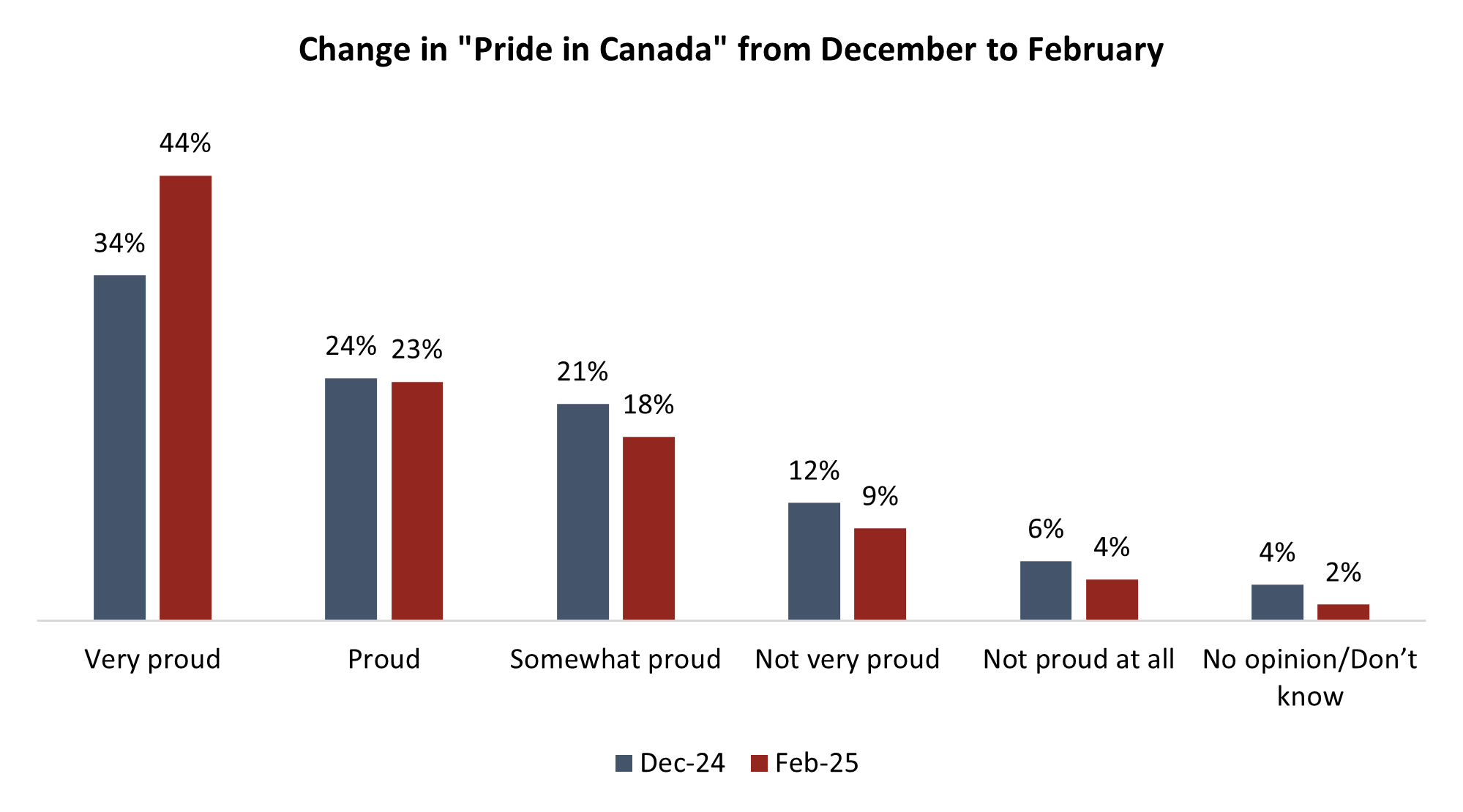
Percentage saying they are ‘very proud’ to be Canadian jumps from 34 to 44 per cent vs. December
February 5, 2025 – It has been a whirlwind past week in Canada-U.S. relations, after announced tariffs on Canadian goods entering America – set to take effect on Tuesday – were delayed 30 days. This, after a call between Prime Minister Justin Trudeau and U.S. President Donald Trump, where Trump claimed victory but by many accounts received little.
The mood in Canada amid this pause is multifold. The population has received a boost in patriotic sentiment but remains concerned about what the future holds.
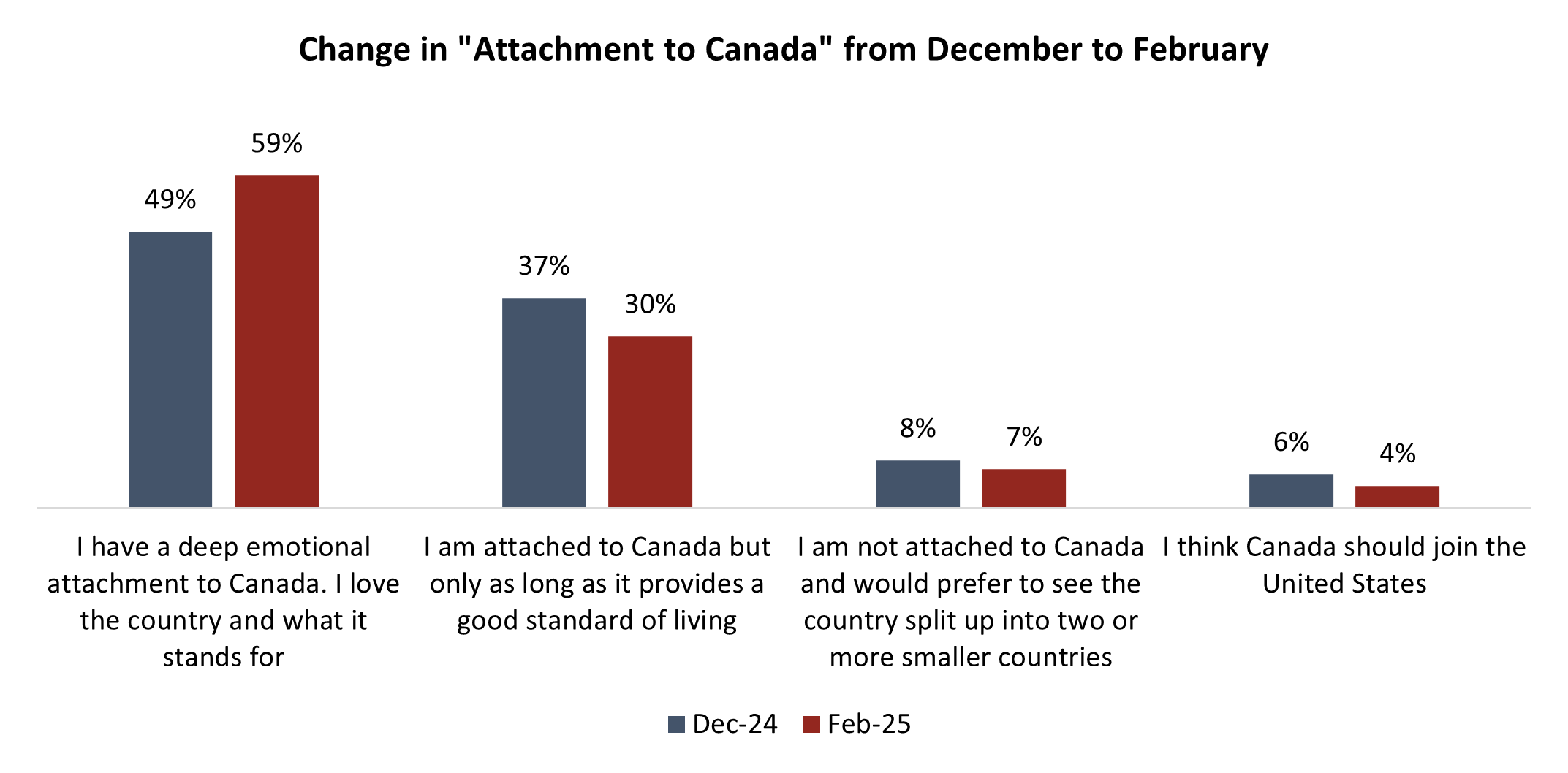
An Angus Reid Institute analysis of data donated by the Angus Reid Group finds a 10-point jump in the number of Canadians who say they are “very proud” of their country compared to just two months ago. The same increase is noted in the number who say they have a “deep emotional attachment to Canada”, which has risen from 49 to 59 per cent. The proportion who say they would like to see Canada join the United States has dropped from six per cent to four per cent over the same period.
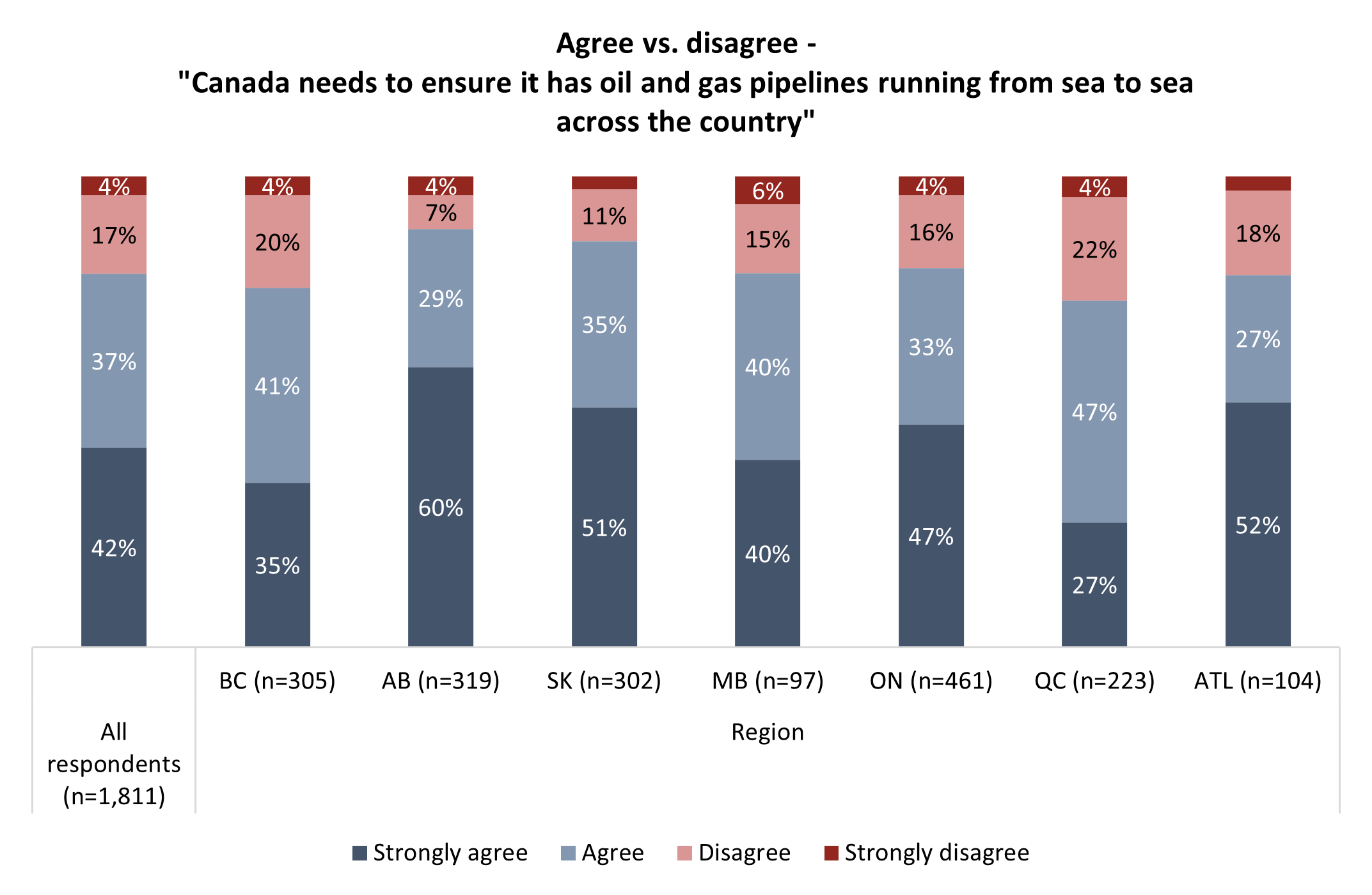
With this newfound national fervour, Canadians are looking at productive ways to fill the 30-day period between one tariff threat and the expected next. Paramount in the public perspective are two items: removing interprovincial trade barriers and increasing the nation’s pipeline capacity. Nearly all Canadians (95%) agree that Canada should immediately begin work to eliminate barriers between the provinces and territories to increase the flow of domestic goods. Four-in-five, meanwhile, say that Canada “needs to ensure it has oil and gas pipelines running from sea to sea across the country”.
More Key Findings:
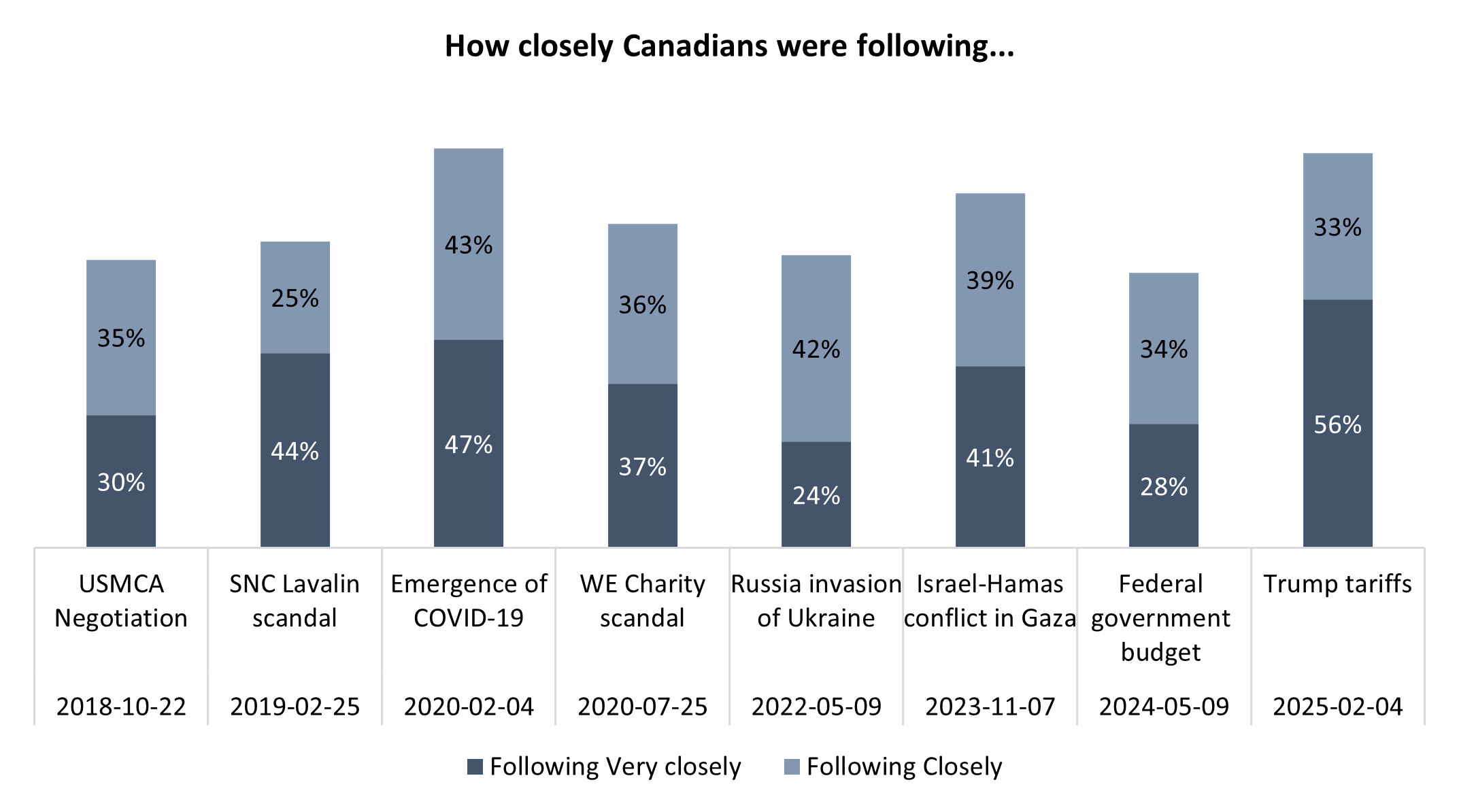
- The amount of attention paid to this issue is matched in recent Angus Reid Institute tracking only by the onset of the COVID-19 pandemic. Nine-in-10 Canadians say they are following this issue closely. This includes the largest portion seen in 10 years saying they are following it “very closely” – 56 per cent.
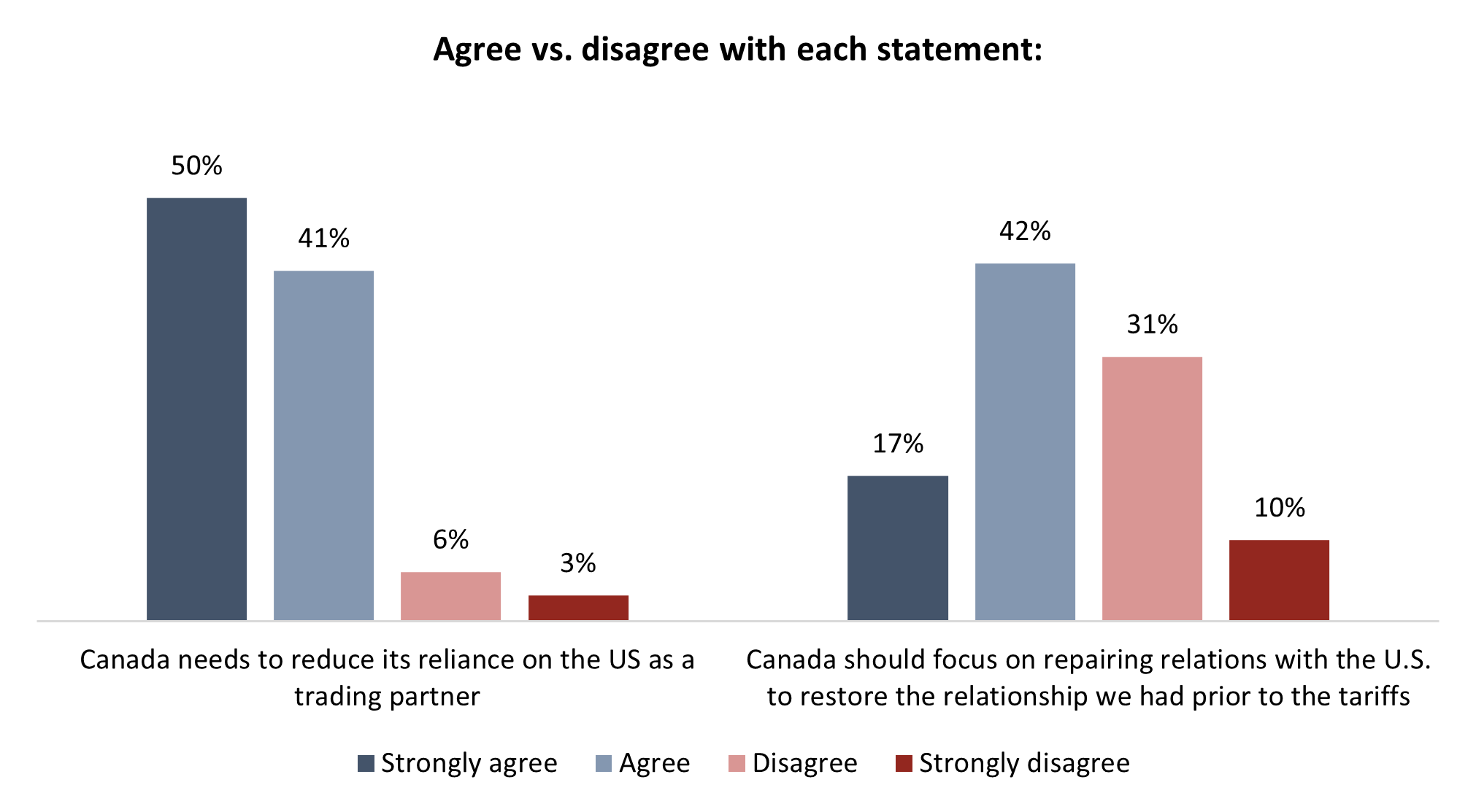
- Canadians are more likely to want a reduction of the country’s reliance on the United States (91%) over repairing the relationship to a place it was before the near trade war (59% agree this should be attempted).
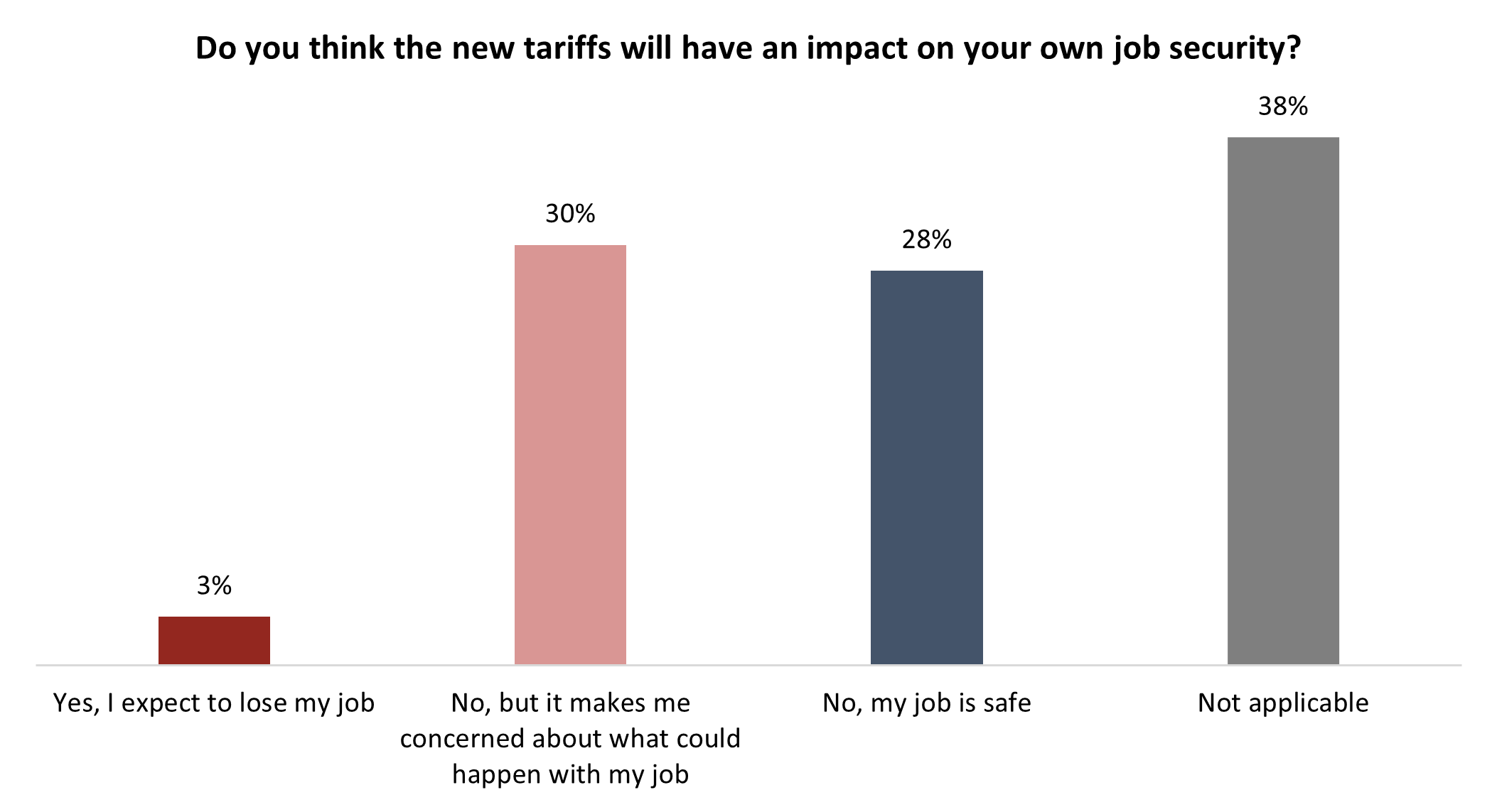
- Three per cent of Canadians say they would lose their job if tariffs were implemented, while three-in-10 (30%) are less certain but worry about what might happen.
INDEX
- Awareness of tariff turmoil extremely high
- Trump threat leads to boost in pride and attachment to Canada
- Three-in-10 say this is a top issue, but cost of living and health care still lead
- What should Canada do now?
- Near-unanimous call to eliminate interprovincial trade barriers
- Four-in-five say oil and gas infrastructure needed
- Canadians feel need to reduce reliance on U.S. trade
Awareness of tariff turmoil extremely high
The news of U.S. President Donald Trump’s tariffs threats has dominated headlines in Canada in recent weeks as Canadians anxiously awaited whether they were coming – on inauguration day, Feb. 1, or Tuesday – or not. Eventually, it was ‘not’ – for now. Canadian Prime Minister Justin Trudeau managed to secure a 30-day reprieve from the implementation of the tariffs after highlighting for Trump a series of previously committed-to border security measures.
The international trade high-wire act has captured Canadians’ attention like few recent events. A majority (56%) say they have been following the story “very closely” while a further one-third (33%) say they have keeping track “closely’. Compared to other major news of recent years – the emergence of COVID-19 in February 2020 (47% very closely, 43% closely), the war in Gaza in the aftermath of Hamas’ attack on Israel in October 2023 (41% very closely, 39% closely) – Trump’s tariffs have drawn more attention:
Trump threat leads to boost in pride and attachment to Canada
In December, the Angus Reid Institute highlighted the significant declines in pride and attachment to Canada. Compared to data taken in 1985 (78%) and 1994 (71%), the proportion of Canadians who described themselves as “very proud” to be Canadian had halved (34%). Meanwhile, there was a 16-point drop in those who said they had a “deep emotional attachment to Canada” from 1991 (65% to 49%).
Related: From ‘eh’ to ‘meh’? Pride and attachment to country in Canada endure significant declines
Trump bringing the U.S. to the brink of a trade war with Canada appears to have reversed some of the losses in pride seen over the past 30 years. More than two-in-five (44%) say they are “very proud” to be Canadian, a 10-point increase from December, but still lower than levels seen in 2016 (52%).
The proportion of Canadians expressing “deep emotional attachment” to their country has also risen (59%) by 10 points from December (49%), putting it closer to data taken in 2016 (62%).
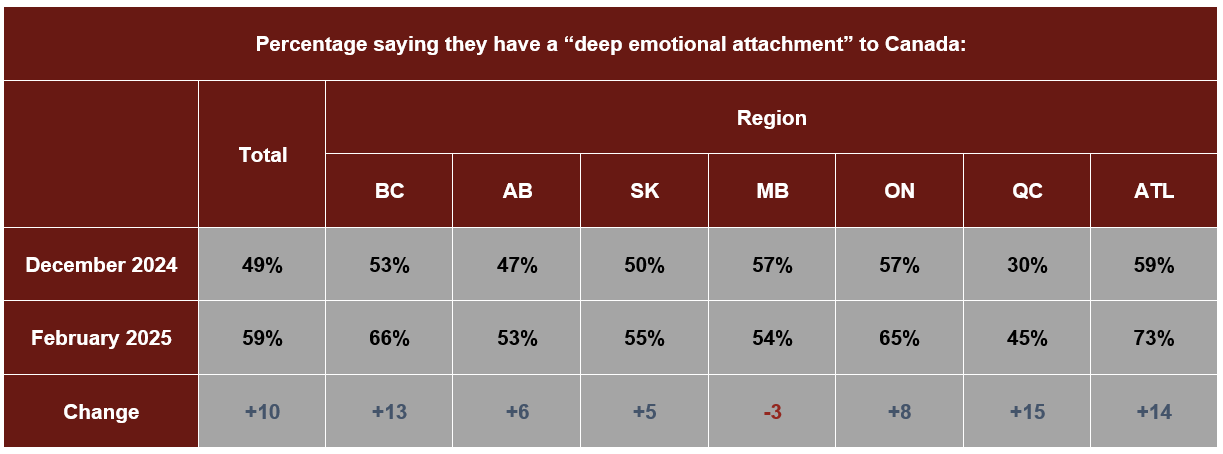
This rallying of emotion is not evenly spread across the country. The largest gains are seen in Quebec (+15), Atlantic Canada (+14) and B.C. (+13). The 45 per cent in Quebec who express a “deep emotional attachment” is especially notable since it outpaces the 37 per cent measured in 2016.
Sentiment has moved less in Alberta (+6) and Saskatchewan, and statistically not at all in Manitoba (-3):
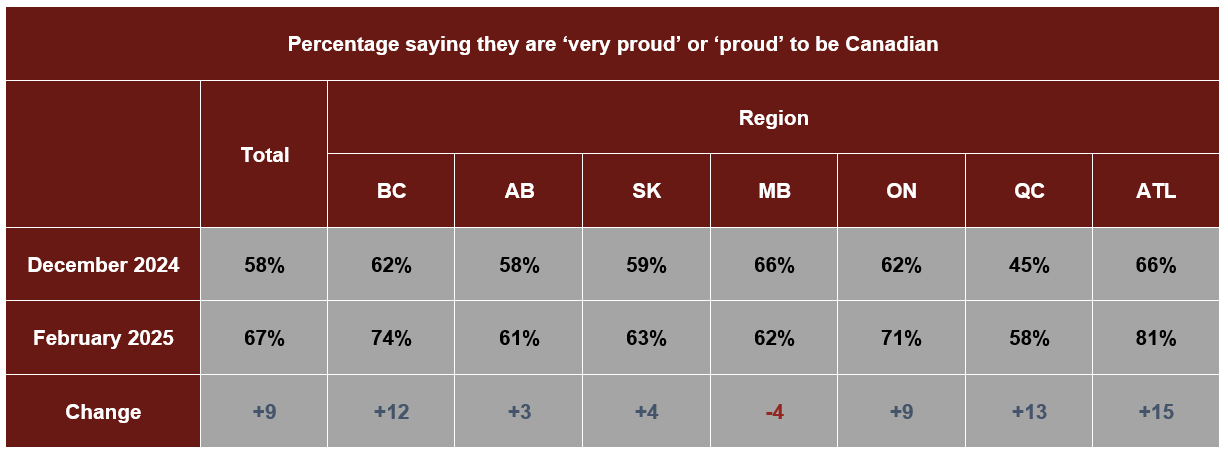
A similar trend is seen in the regional numbers of those who say they are “very proud” or “proud” to be Canadian. Those in Atlantic Canada (+15), Quebec (+13) and B.C. (+12) again lead the way. On the Prairies, there has been little statistical shift:
Three-in-10 say this is a top issue, but cost of living and health care still lead
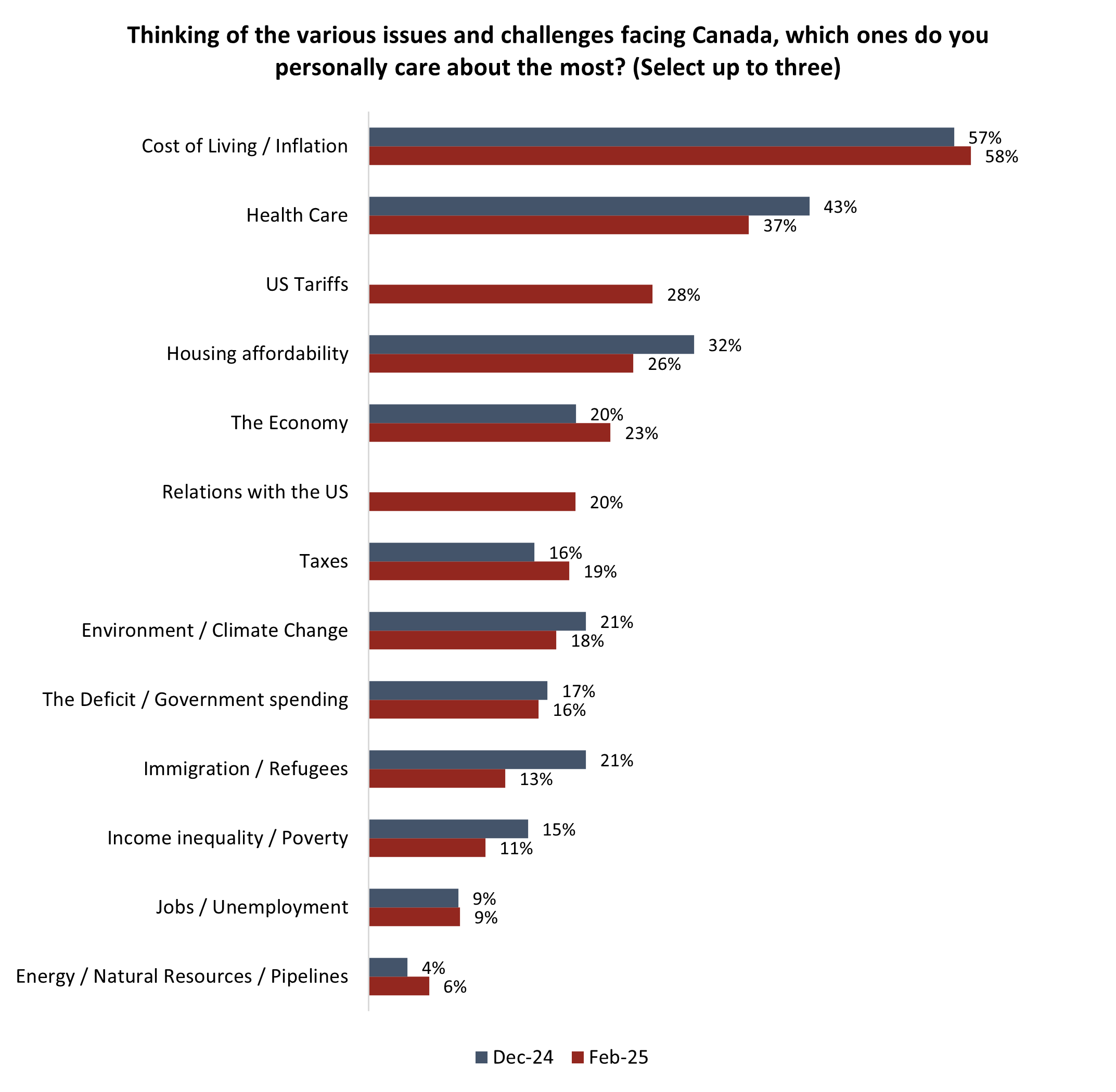
For more than two years, the top issue has been the rising cost of living. Any tariff war with the United States would cause price increases of many staples that Canada primarily sources from the United States – including gasoline, and fresh fruit and vegetables. Concern over the high cost of living has not gone anywhere – three-in-five (58%) say that is a top issue facing the country – but has been supplemented by specific worry over the tariffs (28%), and U.S. relations (20%). Other top issues – health care (43% to 37%), housing affordability (32% to 26%), climate change (21% to 18%) and immigration (21% to 13%) – have seen some decline in priority since December as Trump’s tariffs have come closer to reality:
For working Canadians, there is the added worry of personal financial effect of any trade war between Canada and the U.S. Three-per-cent say they expect to lose their job if Trump’s tariffs are put in place. A further three-in-10 express less, but some, concern that the tariffs could affect their employment. A similar number (28%) are certain they are safe from the ripple effects of this sort of seismic shift in Canada-U.S. trade policy:
What should Canada do now?
Near-unanimous call to eliminate interprovincial trade barriers
The potential economic damage of decreased trade internationally with the United States has brought renewed attention to the internal barriers between Canadian provinces that limits trade domestically. These include the restriction of cross-border alcohol sales, differing regulations on the trucking industry province-by-province, disparate rules on the licensing of professionals, and more.
The International Monetary Fund estimated in 2019 that the internal barriers between provinces add up to a tariff equivalent of 21 per cent and the Canadian Federation of Independent Business estimated in 2024 removing them could boost Canada’s economy by $200 billion annually.
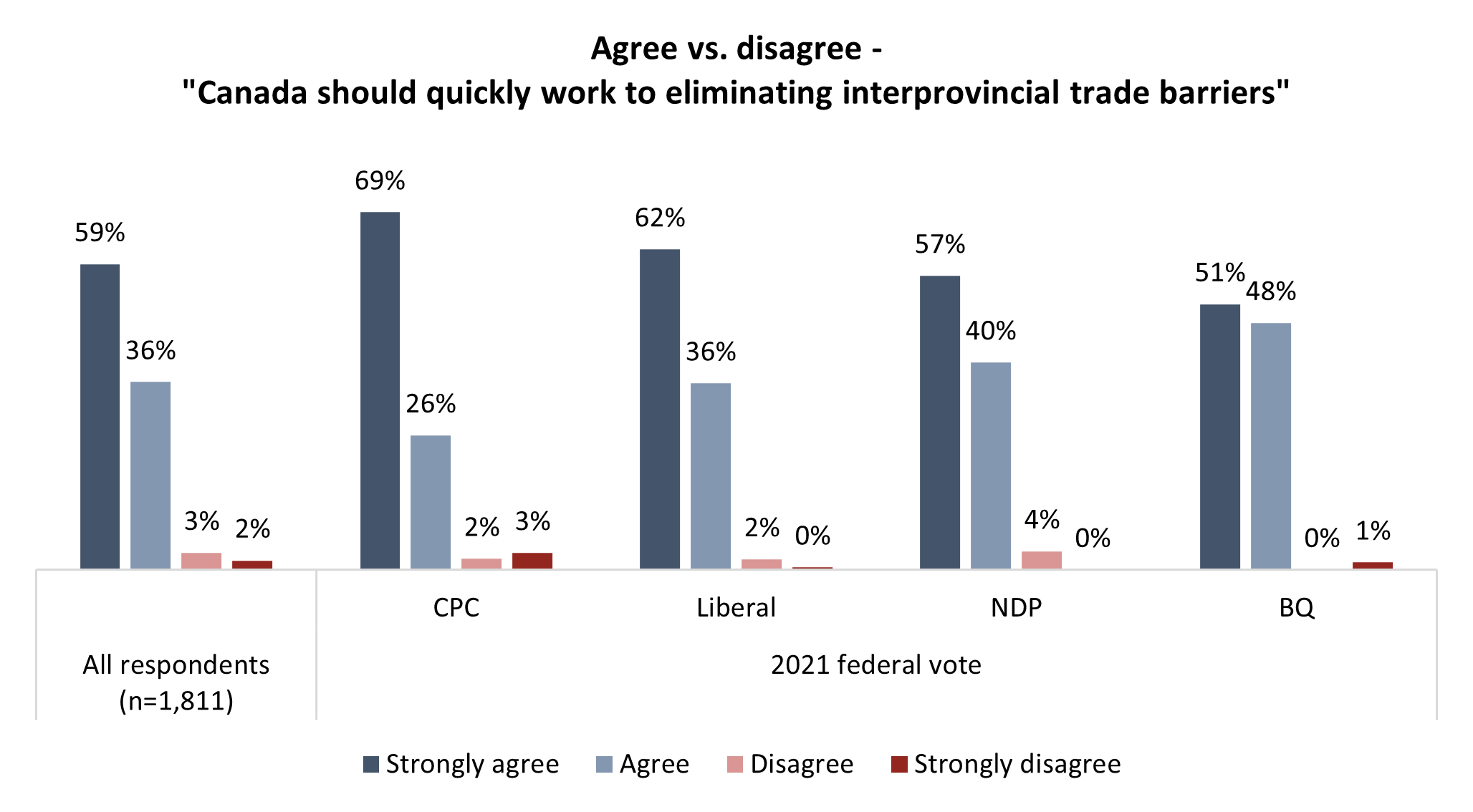
Nearly all Canadians (95%) believe their country should work quickly to eliminate interprovincial trade barriers. While there is variation in how strongly people agree with that sentiment across political boundaries, there is little disagreement that Canada should move towards freeing trade between provinces:
Four-in-five say oil and gas infrastructure needed
Trump’s tariff threats have also put the spotlight on Canada’s oil and gas industry and infrastructure. As of 2023, nearly all – 97 per cent – of Canada’s exports of oil and gas went to the United States. This figure has trended downward with the completion of the expansion of the Trans Mountain pipeline in 2024, allowing the shipment of more oil to countries overseas. An Alberta Central report estimated that, because of the expansion of Trans Mountain, non-U.S. oil exports doubled in the second half of 2024.
That still leaves Canada’s oil and gas industry extremely reliant on the U.S. as its biggest customer. While Canada is also dependent on the U.S. for refinement of oil into products such as gasoline, which is in turn sold in Canada. In 2022, Canada imported $19.8 billion of refined petroleum, more than $15 billion of which came from the United States. As well, there is currently no east-west pipeline to carry crude oil within Canada without first crossing the border in the United States.

Four-in-five (79%) Canadians believe their country “needs to ensure it has oil and gas pipelines running from sea to sea across the country.” A majority in all provinces agree, although those in Quebec are the least likely to do so strongly (27%):
Canadians feel need to reduce reliance on U.S. trade
Canadians have received a reprieve on the threat of tariffs, but there appears to be appetite to address the issues the tariffs have brought attention to. The United States buys nearly 75 per cent of Canada’s exports. Nine-in-ten (91%) Canadians believe Canada should reduce their country’s reliance on the U.S. as a trading partner in the wake of these tariff threats. A smaller majority (59%) want their country to repair Canada’s relationship with their southern neighbour, but a sizable portion of two-in-five (41%) disagree:
METHODOLOGY:
The Angus Reid Institute conducted an online survey from Feb. 2 – 3, 2025 among a representative randomized sample of 1,811 Canadian adults who are members of Angus Reid Forum. These survey data were donated by Angus Reid Group. For comparison purposes only, a probability sample of this size would carry a margin of error of +/- 2 percentage points, 19 times out of 20. Discrepancies in or between totals are due to rounding. The survey was self-commissioned and paid for by ARI. Detailed tables are found at the end of this release.
For detailed results by age, gender, region, education, and other demographics, click here.
For full release including methodology, click here.
MEDIA CONTACT:
Shachi Kurl, President: 604.908.1693 shachi.kurl@angusreid.org @shachikurl
Jennifer Birch, EVP & Managing Director, Angus Reid Group: 613.668.5237 jennifer.birch@angusreid.com