


Canadians split as to whether Carney achieving a majority through floor crossing would be good or bad
March 11, 2026 – NDP MP Lori Idlout became the fourth MP to cross the floor to the governing Liberals during the 45th Parliament, adding more fuel to the debate about the politically controversial practice.
NDP interim leader Don Davies said his party believes floor crossers like Idlout should have to “put that decision to the voters”, and most Canadians appear to agree.
New data from the non-profit Angus Reid Institute finds that only one-in-four (26%) Canadians say if their MP crossed the floor, they should be allowed to serve out their term under their new party colours. More (41%) prefer that if an MP wanted to cross the floor, they should have to step down and re-contest their seat in a byelection. One-in-five (22%) say they should have to serve as an independent until the next election and one-in-ten (11%) believe they should have to vacate their seat.

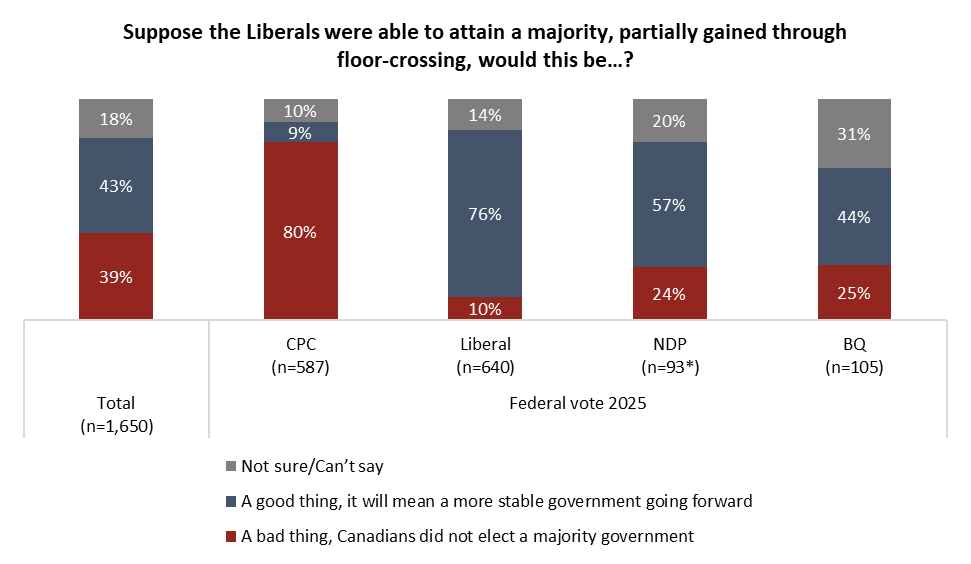
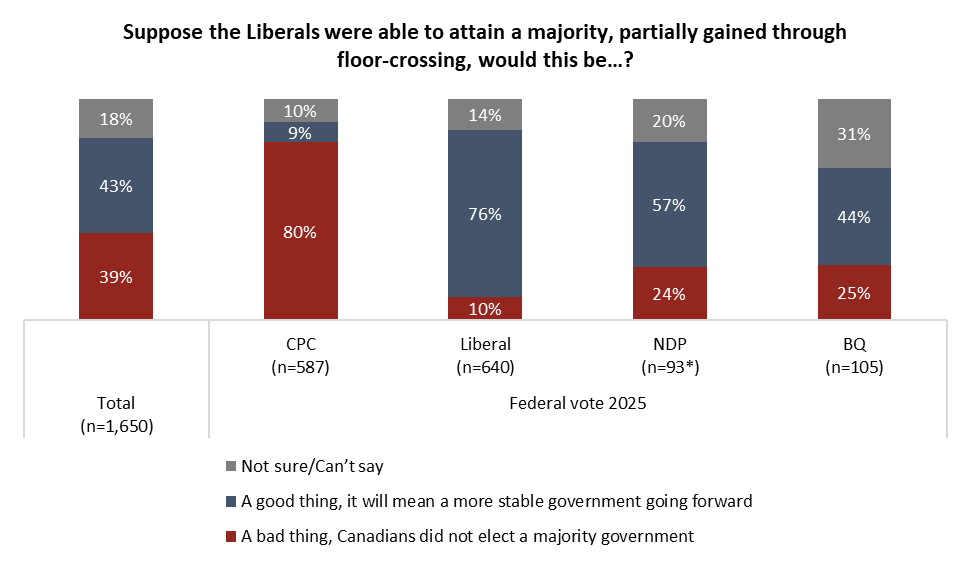
Conservative leader Pierre Poilievre has criticized the three floor crossers who have left his party, arguing that Prime Minister Mark Carney and the Liberals should use an election to get a majority not “backroom deals”. Canadians are split as to whether or not it would be a good (43%) or bad (39%) thing if Carney successfully creates a majority through floor crossing, largely split along political affiliation.
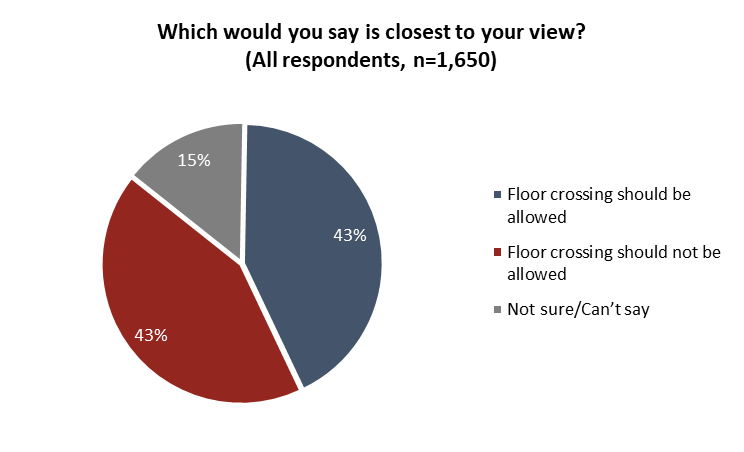
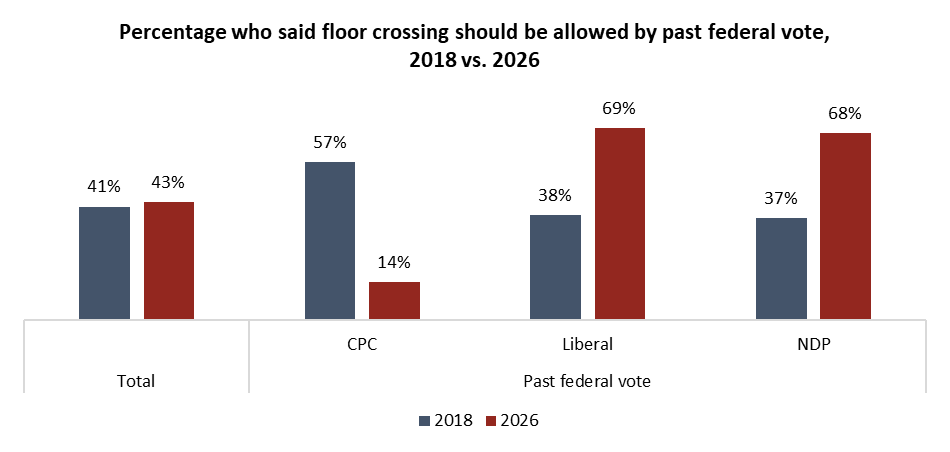
Canadians are also split on the practice of floor crossing in general. Equal sized groups of two-in-five believe it should be allowed (43%) and it should be forbidden (43%). This was also the case when ARI previously asked about floor crossing in 2018. But notably, given the current flow of floor crossers to the Liberals, who makes up those groups has changed over time. In 2018, a majority (57%) of previous CPC voters believed floor crossing should be allowed, now most believe it should be banned (78%).

About ARI
The Angus Reid Institute (ARI) was founded in October 2014 by pollster and sociologist, Dr. Angus Reid. ARI is a national, not-for-profit, non-partisan public opinion research foundation established to advance education by commissioning, conducting and disseminating to the public accessible and impartial statistical data, research and policy analysis on economics, political science, philanthropy, public administration, domestic and international affairs and other socio-economic issues of importance to Canada and its world.
INDEX
-
A majority achieved by floor crossing?
-
Canadians evenly split as to whether floor crossing should be allowed or not
-
CPC voters flip on crossing the floor
-
Plurality say floor-crossing MPs should re-contest seat in byelection
A majority achieved by floor crossing?
After Idlout became the latest MP to change parties, Prime Minister Mark Carney is on the cusp of a majority government, pending the result of a trio of vacated seats that need to be filled by byelections. Two are in favourable territory, which would give the Liberals an on-paper majority, but that is complicated by the Speaker of the House role. The seat up in the third byelection was won by the Liberals by only one vote before the election results was overturned by the Supreme Court. Another Liberal MP, on top of two byelection wins, would realistically be needed for Carney to govern as a true majority.
Nonetheless, the possibility exists that the tides could turn through byelections or further floor crossing to push the Carney Liberals into majority territory. Canadians are split as to whether this would be a good thing for governmental stability (43%) or a bad thing because it was not the will of the people expressed during last year’s election (39%).
Recent Conservative voters (80%) make up the bulk of the latter camp. All other political groups are more likely to believe a floor-crossing majority would be a good thing than not, although opinions are more mixed among recent NDP and Bloc voters than those who voted Liberal:
*Smaller sample size, interpret with caution
Canadians evenly split as to whether floor crossing should be allowed or not
Since November, four Canadian Members of Parliament crossed the floor, joining a long list of federal and provincial politicians who have done so in Canadian political history. The practice has proven controversial, especially in recent times. Prior to Idlout leaving the NDP, three floor crossers left the opposition Conservatives to join the governing Liberals, bringing an elected minority government closer to majority rule. Conservative leader Pierre Poilievre has been critical of the Liberals for trying to “manipulate” their way to a majority government against the will of the populace who only elected a minority in last year’s election.
Canadians are evenly split as to whether floor crossing should be permitted or banned. Similar groups of two-in-five (43%) place themselves on either side of the debate:
CPC voters flip on crossing the floor
The current political environment appears to be heavily influencing the debate. When the Angus Reid Institute first asked about floor crossing in 2018, a similar proportion believed it should be allowed. But who made up that two-in-five has changed over time. In December 2018, when ARI’s floor crossing report was published, the most recent MP to cross the floor was Leona Alleslev, who left the Liberals to join the Conservatives. That year also saw the development of nascent political movements which saw MPs leave established parties to try to form new political entities, some, such as Maxime Bernier’s People’s Party of Canada, have lasted longer than others.
In that 2018 environment, a majority (57%) of past CPC voters believe floor crossing should be allowed, while past Liberal (38%) and NDP voters (37%) were less certain. Now fewer than one-in-six (14%) CPC voters would permit floor crossing were it up to them, while the practice is more heavily supported by those who voted Liberal (69%) and NDP (69%) last year. This survey was done prior to Idlout crossing the floor.
And note that data from 2018 of Bloc Québécois voters is unavailable due to a small sample size.
Plurality say floor-crossing MPs should re-contest seat in byelection
The basic question of whether or not it should be allowed lacks the nuance of other potential paths for the political system to address floor crossing. Canadians were presented with four options as to how to approach floor crossing and just one-quarter (26%) say they prefer the current system. More (41%) would have the MP step down and be forced to re-earn their seat in a byelection. One-in-five (22%) believe if an MP wants to cross the floor, they should first have to sit as an independent until the next election. One-in-ten (11%) say the MP should have to leave their seat until the next election.
Even among current Liberal and NDP voters who support allowing floor crossing broadly at a majority level, there is not majority support for the current system. Half (48%) of Liberals say they prefer how floor crossing currently works, but the other half split themselves into the variety of other options. One-third (33%) of past NDP voters say the current system is fine, while nearly as many (32%) believe floor crossers should have to serve as an independent and change affiliations at the next election:

*Smaller sample size, interpret with caution
| METHODOLOGY:
The Angus Reid Institute conducted an online survey from Feb. 19-22, 2026, among a randomized sample of 1,650 Canadian adults. Respondents are drawn from the Angus Reid Forum, a large-scale online panel developed to include Canadian residents in each of the 343 federal ridings in Canada and representative of the Canadian population by age, gender, family income, ethnic status and education. The sample was weighted to be representative of adults nationwide according to region, gender, age, household income, and education, based on the Canadian census. For comparison purposes only, a probability sample of this size would carry a margin of error of +/- 2 percentage points, 19 times out of 20. Discrepancies in or between totals are due to rounding. The survey was self-commissioned and paid for by ARI. |
For detailed results by age, gender, region, education, and other demographics, click here.
For PDF of full release, click here.
For the questionnaire, click here.
MEDIA CONTACTS:
Shachi Kurl, President: 604.908.1693 shachi.kurl@angusreid.org @shachikurl
Dave Korzinski, Research Director: 250.899.0821 dave.korzinski@angusreid.org
Jon Roe, Senior Research Associate: 825.437.1147 jon.roe@angusreid.org