


Concern over cost of living reaches three-year high in lower-income households amid gas price spike
March 20, 2026 – The war in Iran has wiped out positive momentum on inflation in Canada, driving up the price of gas more than 20 per cent in less than a month. Whether this is a price spike or plateau depends on the resolution of the international conflict that may have domestic ramifications for Canadian politics.
New data from the non-profit Angus Reid Institute finds the Liberals maintain a significant lead over the rival Conservatives in vote intention, 44 per cent to 36 per cent. But, with financial pressure ramping up on Canadians at the pump, those in poor economic circumstances are more likely to consider the Conservatives than the incumbent Liberals.
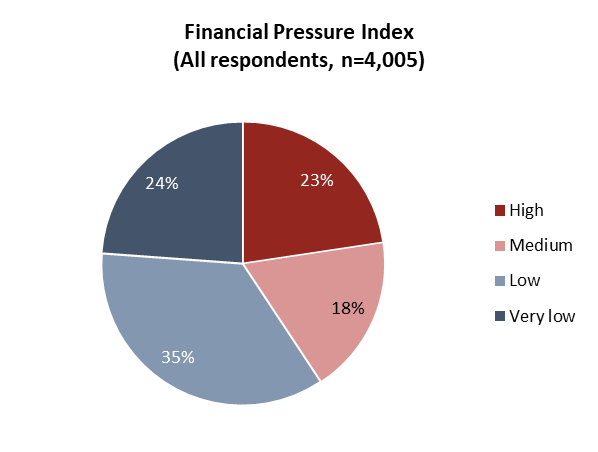
ARI’s Financial Pressure Index measures a variety of factors – grocery prices, levels of debt, financial optimism or pessimism for the coming year, concerns over employment stability – to assess Canadians’ economic standing. It finds one-quarter (23%) facing High financial pressure, 18 per cent Medium, 35 per cent Low, and 24 per cent Very Low.
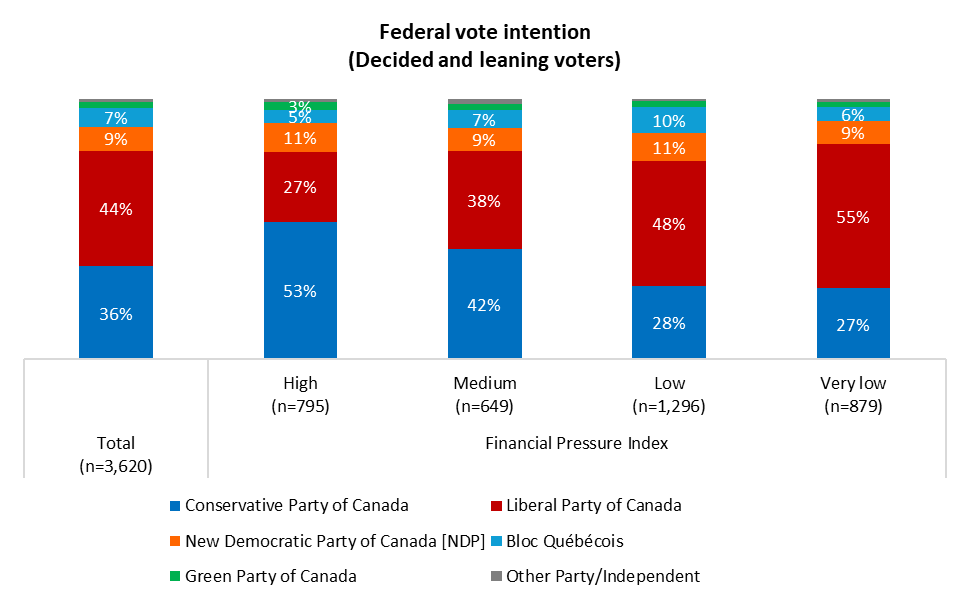
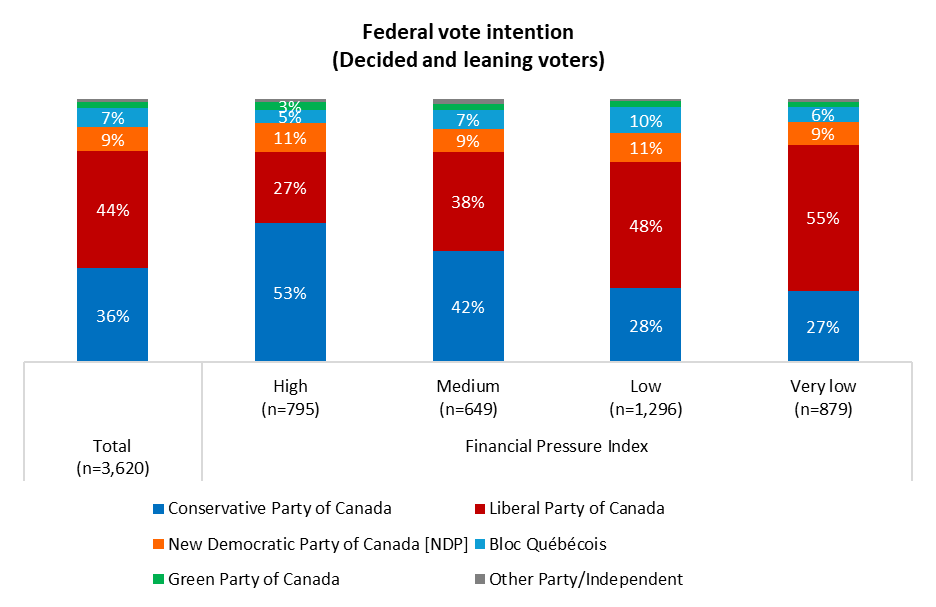
There is a political divide depending on Canadians’ financial pressure. Those facing High pressure are twice as likely to say they would vote Conservative (53%) in an election today than Liberal (27%). The inverse is true among those facing Very Low financial pressure (55% Liberal, 27% Conservative).
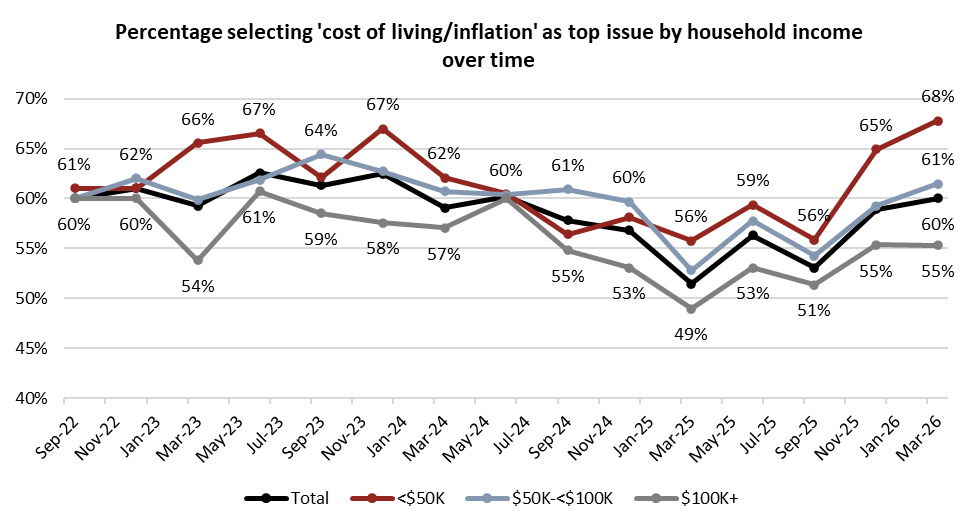
Meanwhile, concerns over the high cost of living are higher than they have been in recent memory for lower-income Canadians. Dating back to the beginning of the post-pandemic inflation of 2022, Canadians in lower income households have always expressed higher concern than others about the rising cost of living. But they have never selected it at as high a rate as they do currently. Approaching seven-in-10 (68%) in households earning less than $50,000 annually say it is the top issue facing the country, the highest rate in three-and-a-half years.
More Key Findings:
- Three-in-five (59%) approve of Prime Minister Mark Carney’s performance. This is a four-point dip from the level seen last month (63%).
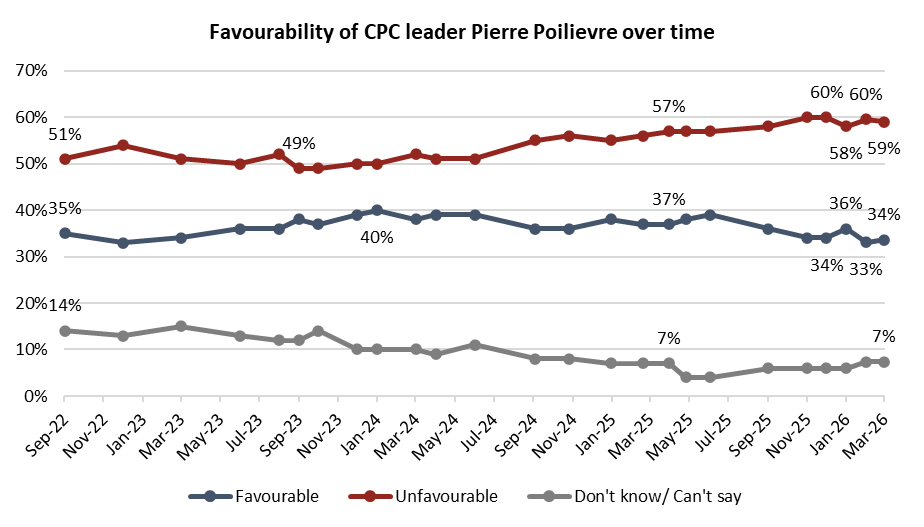
- Views of Conservative leader Pierre Poilievre are statistically unchanged from last month: three-in-five (59%) have an unfavourable view; one-third (34%) favourable.
- The Liberals lead in vote intention in B.C. (+6 over the CPC), Ontario (+11 over the CPC), Quebec (+13 over the BQ) and in the Atlantic provinces of New Brunswick (+17 over the CPC), Nova Scotia (+30 over the CPC) and Newfoundland and Labrador (+28 over the CPC). The Conservatives have a two-to-one advantage over the Liberals in Alberta (58% to 29%) and Saskatchewan (58% to 30%) and a narrow lead in Manitoba (+6).
Note: Because its small population precludes drawing discrete samples over multiple waves, data on Prince Edward Island is not released.
INDEX
Part One: Vote intent
-
By province
-
By age and gender
Part Two: The effect of a persistent cost of living crisis
-
Top issues
-
Cost-of-living concerns in low-income households at three-year high point
-
Financial pressure a major political factor
Part Three: Leadership
-
Approval of Carney dips
-
Three-in-five have unfavourable view of Poilievre
Part One: Vote intent
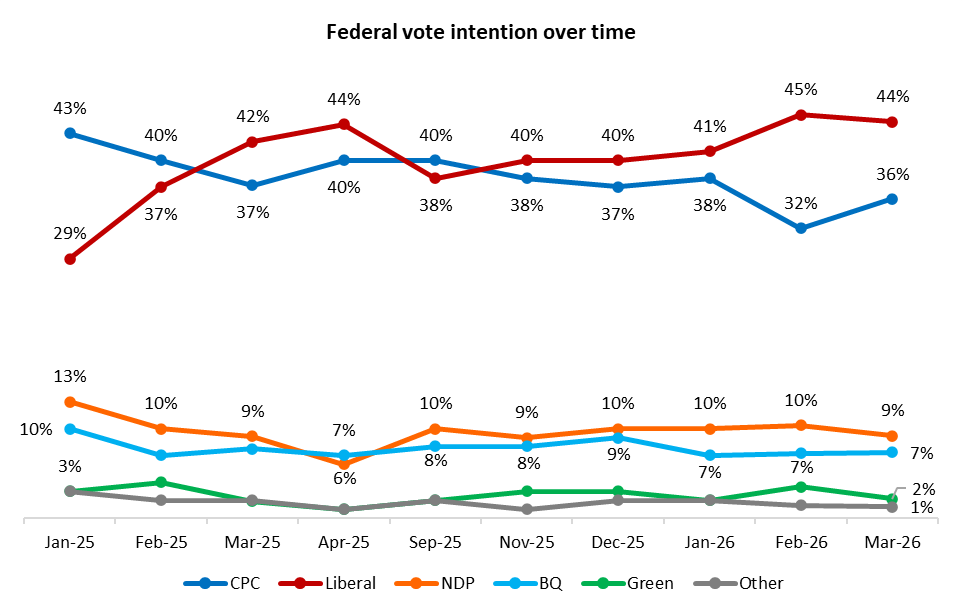
The Conservatives have closed the gap in vote intention but still trail the Liberals by eight points. More than two-in-five (44%) Canadians would vote Liberal if the election were today; 36 per cent say they would vote for the Conservatives. Support for the NDP (9%) and Bloc Québécois (7%) is in single digits.
By province
The Liberals’ lead is built on strong positions in the vote- and seat-rich provinces of B.C. (+6 over the CPC), Ontario (+11 over the CPC) and Quebec (+13 over the Bloc Québécois). The Liberals also hold a massive lead in vote intention in the three Atlantic provinces of New Brunswick (+17), Nova Scotia (+30) and Newfoundland and Labrador (+28).
The Conservatives fare best in the Prairies, where they earn two-to-one margins over the Liberals in Alberta (58% to 29%) and Saskatchewan (58% to 30%), and narrowly edge the Liberals in Manitoba (+6).

By age and gender
Men are more likely to say they would vote Conservative than women, who are more likely to support the Liberals. But the Liberals do hold a lead among four of the six demographic groups, including men older than 54, a consistent voting demographic. Men aged 35 to 54 are the most likely to say they would support the Conservatives:

Part Two: The effect of a persistent cost of living crisis
Top issues
Inflation had been cooling. In February, year-over-year inflation was 1.8 per cent, below the Bank of Canada’s target for annual inflation that guides its monetary policy. And the news was positive across a number of important household items, including grocery prices and gas prices. The latter, of course, was measured prior to the U.S. and Israel attacked Iran, which has sent gas prices more than 20 per cent higher compared to prior the war. Previously released research by ARI showed one-quarter (23%) of Canadians said their household finances had been affected “a great deal” by the gas price spike, while a further two-in-five (44%) say it has had an impact albeit a smaller one.
Related: Three-in-five say increasing gas prices have already led to personal behavioural change
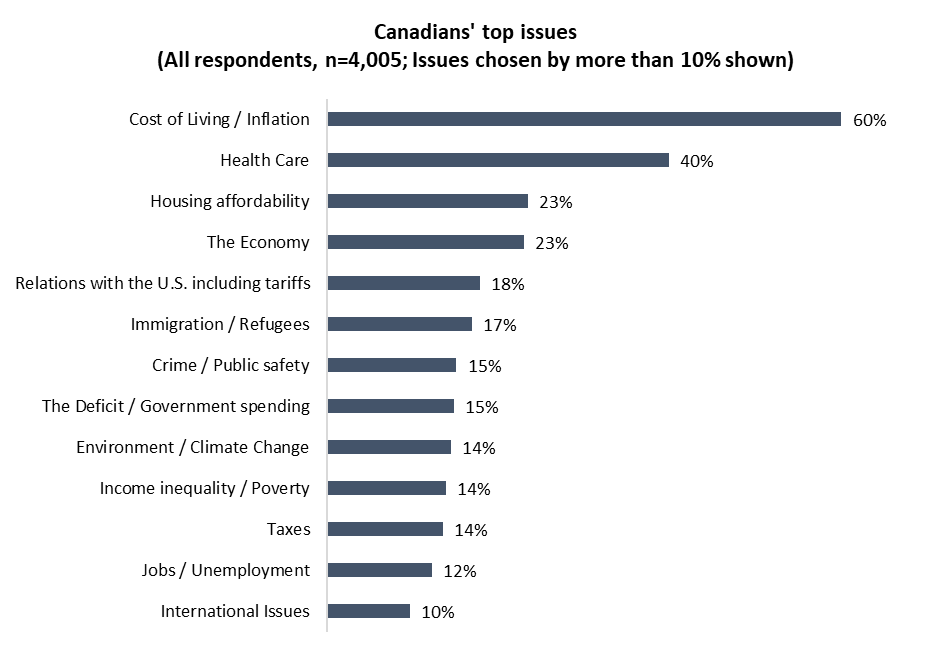
Overall, three-in-five (60%) Canadians say the high cost of living is the top issue facing the country. Health care is chosen by two-in-five (40%) at a distant second, but still far above issues around housing affordability (23%), the economy (23%), U.S. relations (18%) and immigration (17%):
Cost-of-living concerns in low-income households at three-year high point
The cost-of-living crisis dates back to the high inflationary period of 2022. Although all household income brackets have selected inflation as a top issue at high rates since that time, it has typically been a higher concern among those living in Canada’s lowest income households. The recent surge in gas prices has clearly had an outsized effect on lower-income households, who now choose inflation as a top issue at the highest rate (68%) in ARI’s tracking dating back to 2022.
Notably, those living in households earning less than $50,000 annually are the least likely to say they have not made a behavioural change in response to the high gas prices brought on by war in Iran (<$50K, 28%; $50K-$100K, 32%, $100K+, 46%; see detailed tables).

Financial pressure a major political factor
The economic circumstances of Canadians are affected by a wide array of variables, including job security, housing affordability, levels of debt and personal outlooks on financial health. To better assess these varying situations, the Angus Reid Institute created a Financial Pressure Index, which scores respondents on eight questions and sorts them into one of four groups based on the financial pressures they face.
Approaching one-quarter of Canadians (23%) are currently under high financial pressure. This group are more likely to report feeling insecure about their current employment, to describe their household finances as ‘poor’, say they are falling behind economically and find challenges with covering their groceries and monthly rent or mortgage. The one-in-five (18%) who say they are facing medium financial pressure face many of these challenges as well, but they are overall less severe. The low (35% of Canadians) and very low (24%) financial pressure groups are much less likely to report these issues, and more likely to say they are coping fine in the current economic circumstances and are optimistic about their financial future. For the full responses to these questions, see the detailed tables.
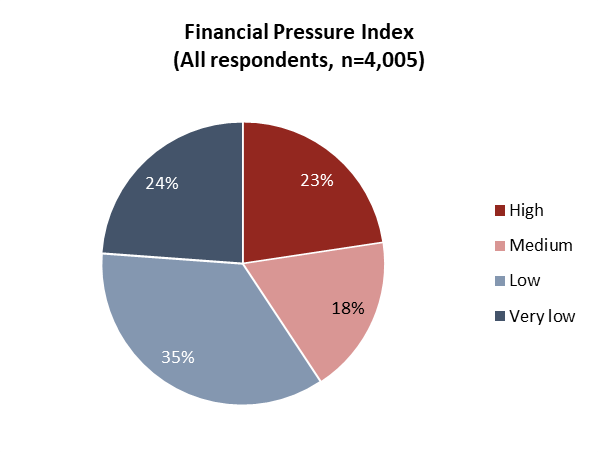
The economic challenges for many Canadians offer a political opportunity for the rival Conservative Party, who fare better among those facing high financial pressure than those whose economic circumstances are rosier.
In December, the Bank of Canada noted that grocery prices had increased by 22 per cent in the past three years. And Canada’s food inflation was the highest among Group of Seven countries. Prime Minister Mark Carney and the Liberals addressed the issue in January by boosting the GST rebate for lower-income Canadians and directing government money towards food suppliers. Last year, one of Carney’s first measures implemented when he became prime minister was to cancel the consumer carbon tax, which lowered gasoline prices across the country.
Still, Canadians under high financial pressure are more likely to look at support the Conservatives (53%) than the incumbent Liberals (27%):
Part Three: Leadership
Approval of Carney dips
Three-in-five (59%) Canadians say they approve of Carney’s performance, a high mark, but a four-point decline from last month (63%). Carney has faced criticism for inconsistency in his response to Israel and the United States’ attacks on Iran. He supported the attacks in the opening days, only to caveat that support later “with regret”. And he first didn’t rule out Canada’s military taking part in the war before saying that Canada “will never participate” in the war in Parliament.

Three-in-five have unfavourable view of Poilievre
His party may be performing slightly better in vote intention, as noted above, but assessments of Conservative leader Pierre Poilievre have settled into a similar range since December. With between 58 per cent and 60 per cent of Canadians saying they have an unfavourable view of the opposition leader and between 33 per cent and 36 per cent saying they have a favourable one.
| METHODOLOGY:
The Angus Reid Institute conducted an online survey from March 11-17, 2026, among a randomized sample of 4,005 Canadian adults. Respondents are drawn from the Angus Reid Forum, a large-scale online panel developed to include Canadian residents in each of the 343 federal ridings in Canada and representative of the Canadian population by age, gender, family income, ethnic status and education. The sample was weighted to be representative of adults nationwide according to region, gender, age, household income, and education, based on the Canadian census. For comparison purposes only, a probability sample of this size would carry a margin of error of +/- 1.5 percentage points, 19 times out of 20. Discrepancies in or between totals are due to rounding. The survey was self-commissioned and paid for by ARI. |
Note: Because its small population precludes drawing discrete samples over multiple waves, data on Prince Edward Island is not released.
For detailed results by age, gender, region, education, and other demographics, click here.
For detailed results by the Financial Pressure Index, click here.
For PDF of full release, click here.
For the questionnaire, click here.
MEDIA CONTACTS:
Dave Korzinski, Research Director: 250.899.0821 dave.korzinski@angusreid.org
Jon Roe, Senior Research Associate: 825.437.1147 jon.roe@angusreid.org