

Concessions on emissions caps, Bill C-69, east-to-west pipelines sway many “leave” voters
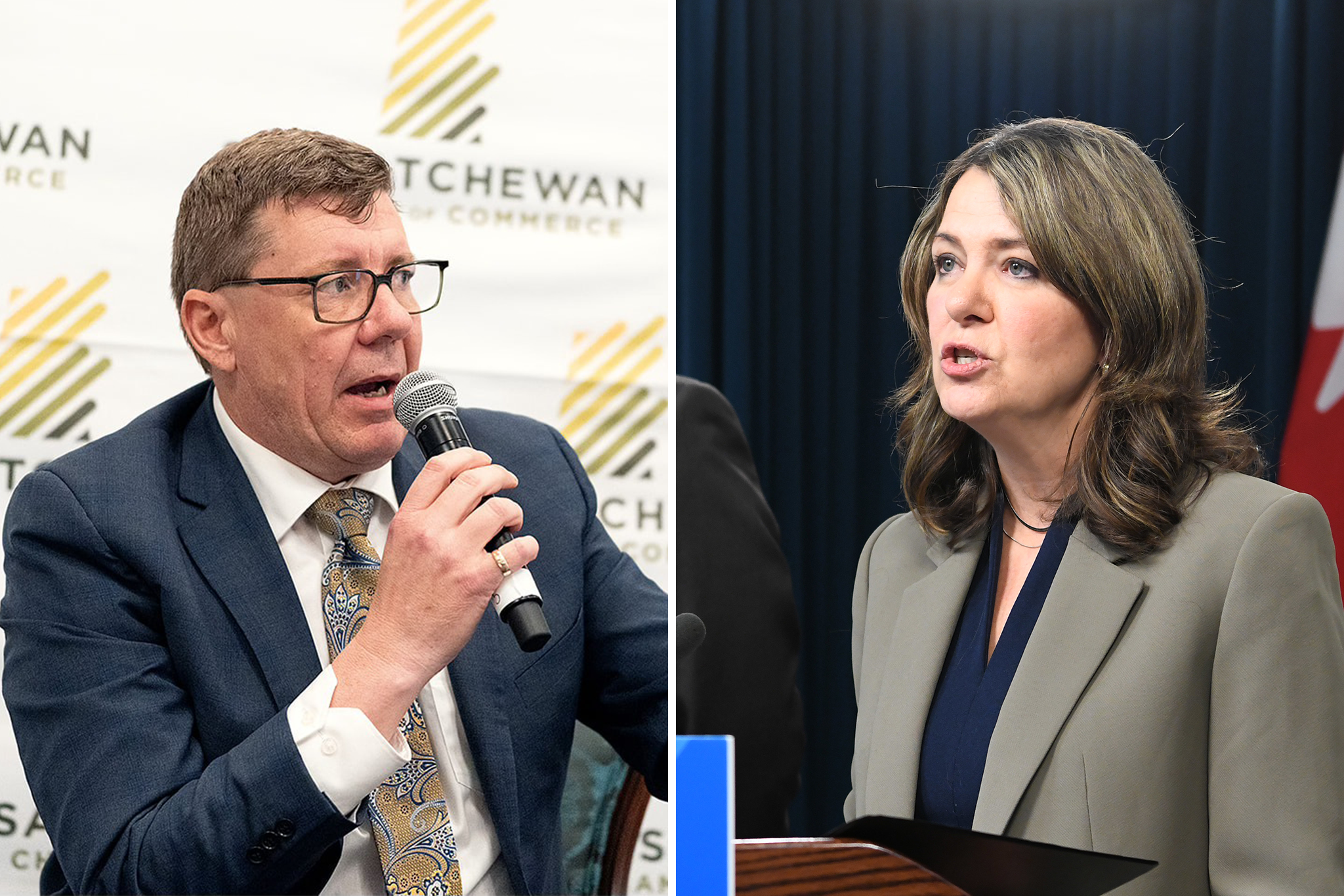
May 8, 2025 – The path for a referendum on separation in Alberta was laid out this week by Premier Danielle Smith, even though she has been adamant that she does not support the movement. In Saskatchewan, Premier Scott Moe has said his government does not support separation, but he wouldn’t stand in the way of a vote.
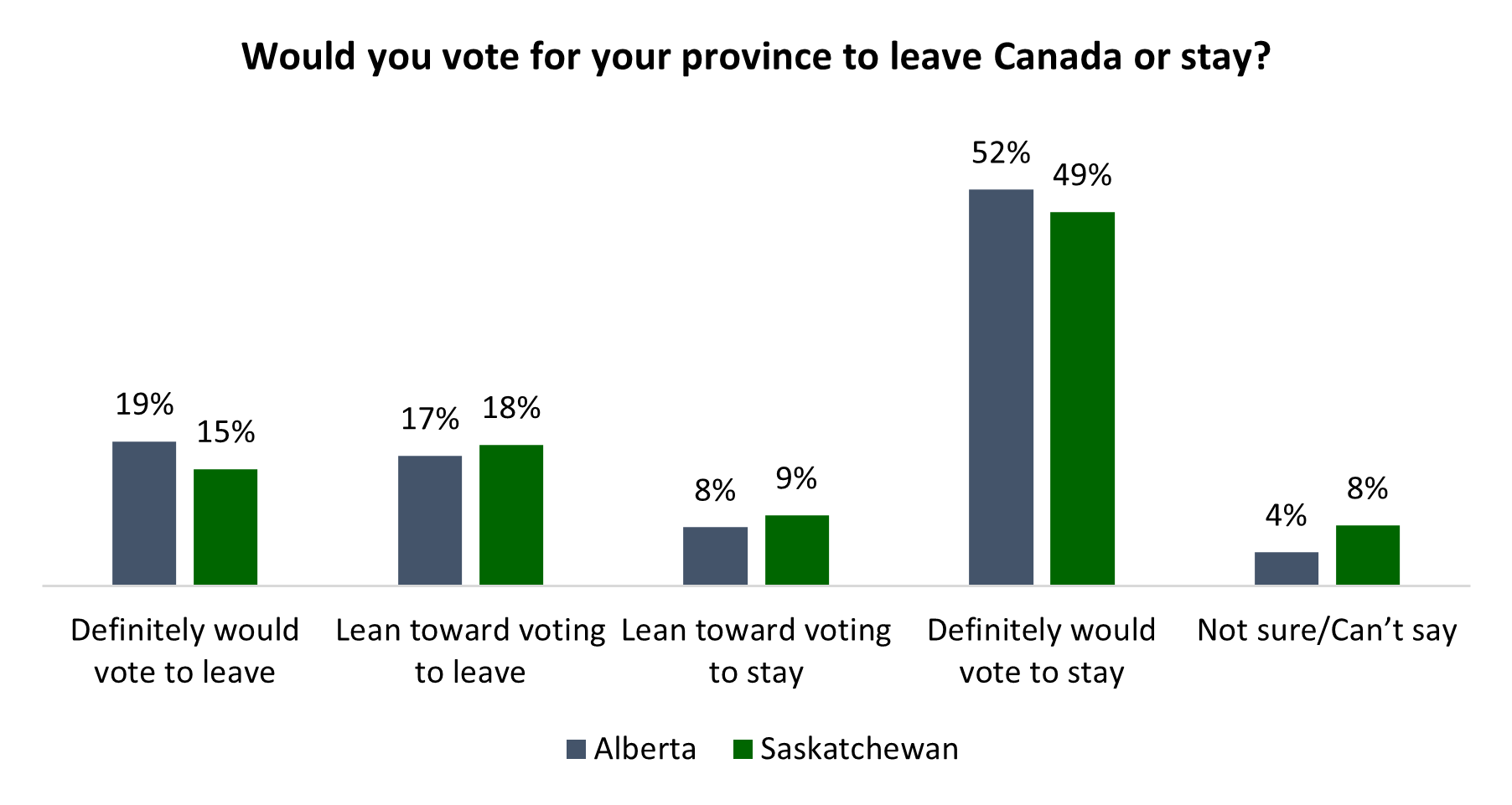
As these dual referendums loom, new data from the non-profit Angus Reid Institute finds that support in Alberta and Saskatchewan for their respective province to leave confederation is still a minority (36% Alberta, 34% Saskatchewan). And those minorities shrink when assessing how serious the support is – few in Alberta (19%) or Saskatchewan (15%) say they would “definitely” vote to leave were a referendum to be held.
These questions of separation come as Smith presents a series of a demands for the incoming Liberal minority government under Prime Minister Mark Carney, including numerous requests on oil and gas infrastructure and policy. These data find that some concessions from the Carney government could do much to quell Alberta and Saskatchewan unrest.
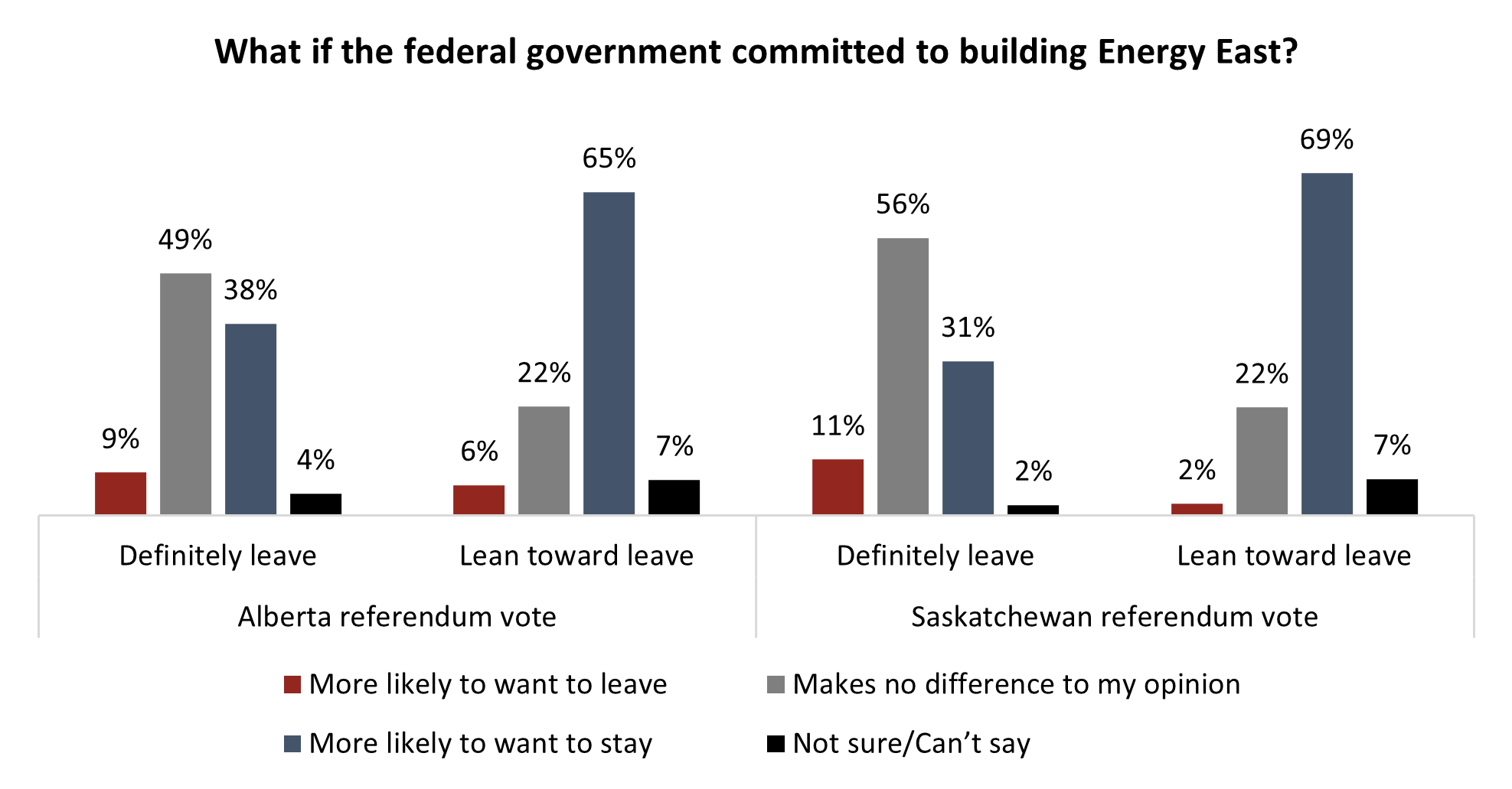
Majorities of those who are leaning to vote leave in a hypothetical referendum say they would be more likely to vote stay if the federal government built an east to west pipeline, removed the emissions cap on oil and gas production, and repealed Bill C-69, which requires resource projects to be assessed for environmental, health, social and economic impacts and ensure they respect Indigenous rights. Smaller, but still significant, portions of those who would “definitely” vote leave in their province’s respective referendum would also be swayed to voting stay by those concessions.
There is also, however, the potential for “leavers” to be galvanized even further. If B.C. said it would stand in the way of tide water access for independent Saskatchewan and Alberta, and if Quebec said it would block all future pipeline development in the province, more people say they would be likely to vote leave in Alberta and Saskatchewan.

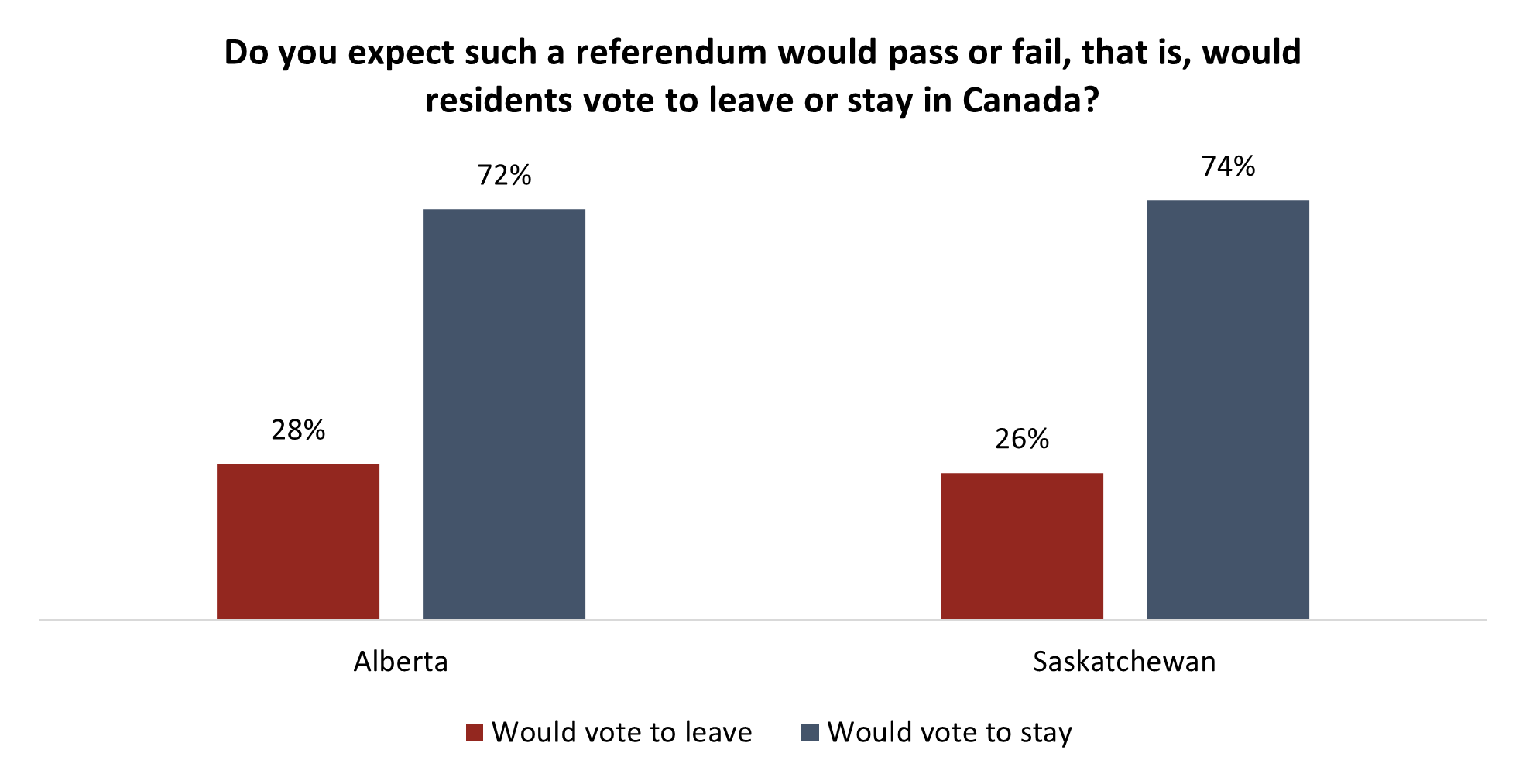
In the end, regardless of their position on a vote, approximately three-quarters in both provinces say they expect a referendum to fail.
More Key Findings:
- Among those in Alberta and Saskatchewan who would vote to leave Canada, more than seven-in-10 say they would change their mind if the CPC formed government
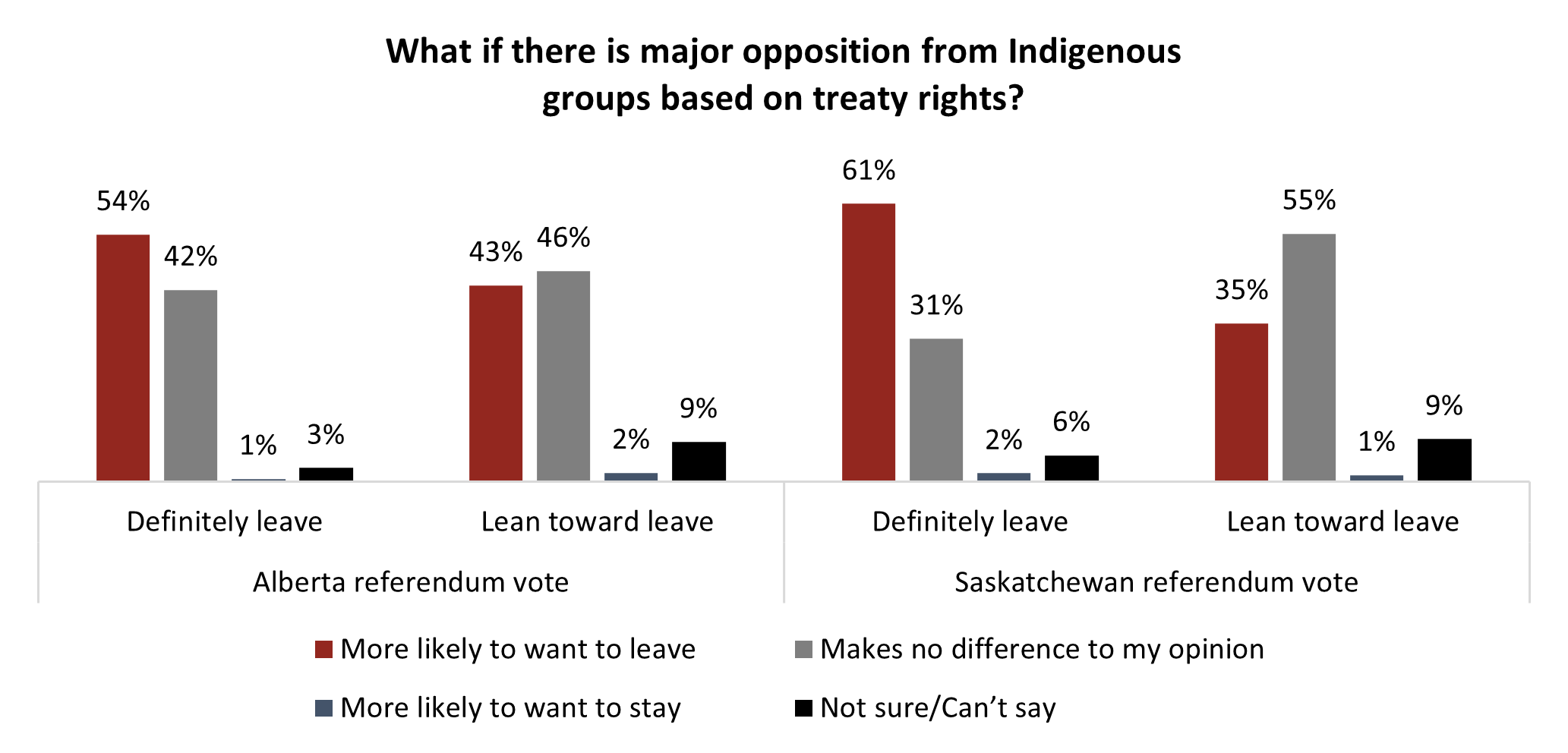
- Indigenous protests based on treaties are unlikely to change the views of those who want to separate. In fact, a majority of those who say they would definitely vote to separate say that major protests from Indigenous groups would make them more likely to want to leave, rather than less
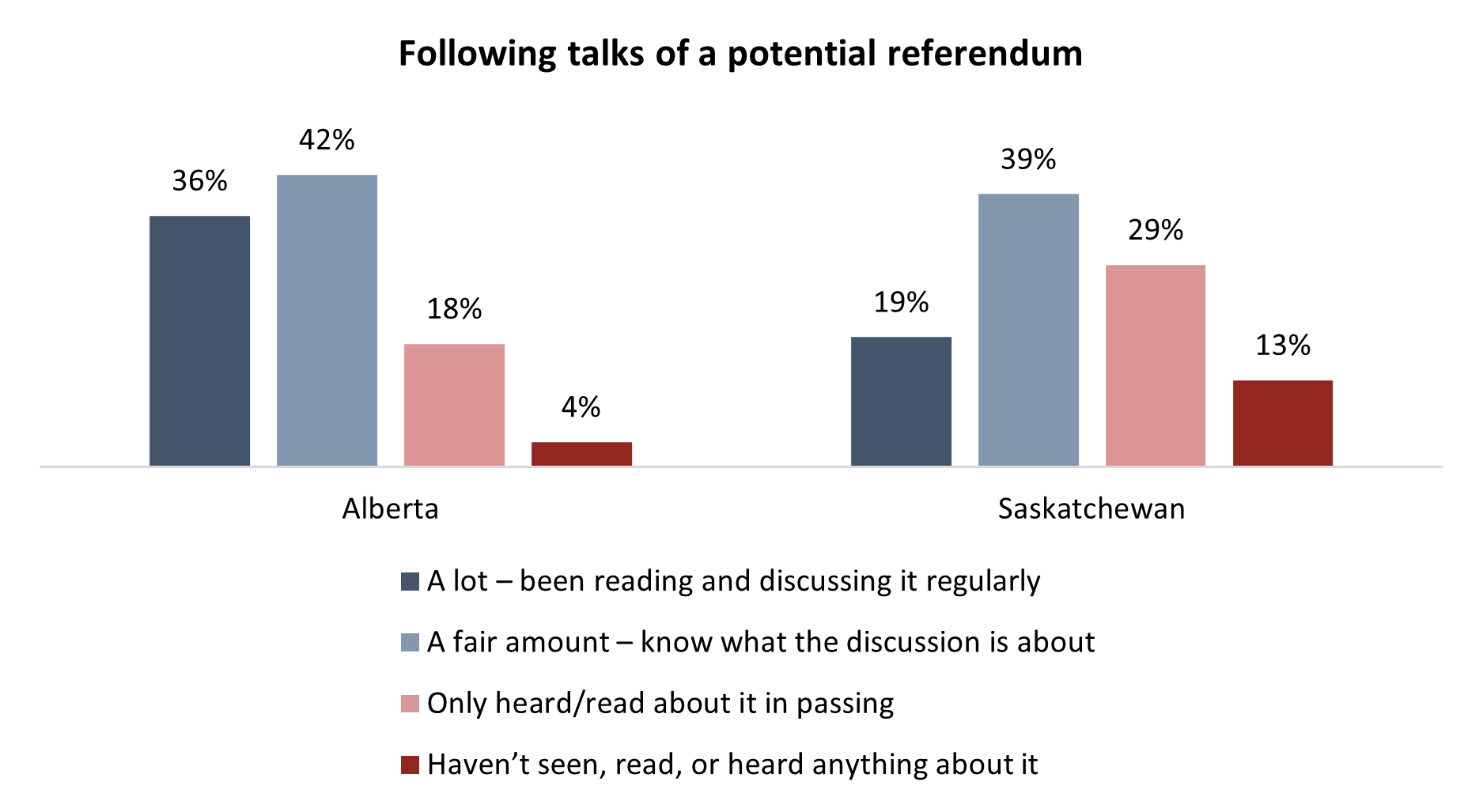
- These conversations are being followed much more closely in Alberta – four-in-five following closely (79%) – than in Saskatchewan, where 58 per cent say the same
INDEX
Part One: Referendum talk
- Attention higher in Alberta than in Saskatchewan
- Holding a referendum more popular among right-of-centre voters in both provinces
- Half in both provinces say they would ‘definitely’ vote to stay
- Liberal election win driving support of leavers
- Expectation in both provinces is that referendum would fail
- What would make leavers more likely to want to stay?
-
- Energy East
- Removal of emissions cap
- Repealing Bill C-69
- Indigenous protests would not sway the leavers
- C. opposition to tidewater access
- Quebec opposition to pipelines
Part Two: Personalities
- Leadership approval
- Who holds sway
- Do people believe Smith just wants leverage?
- Should there be political consequences for failed vote?
Part One: Referendum talk
Attention higher in Alberta than in Saskatchewan
The issue of Alberta and Saskatchewan sovereignty has been simmering for a while. Both provincial governments turned up the temperature in recent years with the passing of legislation to clearly delineate provincial jurisdiction – and provide ammunition against what they believe is federal government overreach. In Alberta, Premier Danielle Smith and the United Conservative Party passed the Alberta Sovereignty within a United Canada Act in November 2022; Saskatchewan Premier Scott Moe and the Saskatchewan Party passed a similar act, the Saskatchewan First Act, in March 2023.
The simmer has progressed to a boil in the wake of the federal election. During the campaign, Smith laid out her province’s demands for the next federal government, including reversing previous Liberal government policies on pipelines, tankers and emissions caps. She then insinuated if those demands aren’t met, the province could hold a referendum on its future in Canada.
Related:
- Fractured federation: Amid competing priorities, which provinces believe they give & get more from Canada?
- What unites & defines the “West”? In a complicated confederation, less than one might think
- Confederational Fairness: As premiers meet, which provinces say they get more, or less, out of federation?
- Three-in-10 in Alberta & Saskatchewan say they’d like to leave if Liberals form next government
Following the election, which saw the Liberals under new leader Mark Carney win enough seats to form a minority government, Smith and the Prime Minister had a “positive” first meeting, but Smith announced that the province would hold a referendum on separation in 2026 if enough Albertans demanded one. Meanwhile, the UCP government passed a bill lowering the threshold for the number of signatures needed to spark a province-wide referendum to 177,000.
In Saskatchewan, Moe said his government is not interested in separation but wouldn’t stand in the way of a referendum in that province. A petition signed by 125,000 voters is enough to launch a non-binding plebiscite vote in Saskatchewan.
A majority in both provinces report discussing a potential referendum at least “a fair amount”, but the issue is evidently dominating the conversation more in Alberta, where more than one-third say they are discussing it regularly, than in Saskatchewan, where one-in-five say the same:
Holding a referendum more popular among right-of-centre voters in both provinces
In Alberta, there are similar sized groups who oppose (49%) and support (51%) holding a referendum, but the intensity of opposition is higher. The issue also apparently politically divisive – four-in-five of those who voted for the Alberta NDP in the past election say they are “strongly” against holding a referendum, while most UCP voters are in favour:
Support for holding a referendum is smaller in Saskatchewan, but a similar political divide is seen. Those who voted for that province’s NDP in the recent provincial election are strongly opposed to even holding a referendum, while three-quarters of Saskatchewan Party supporters would like the issue of separation put to a province-wide vote:

Half in both provinces say they would ‘definitely’ vote to stay
Holding a vote is one matter, actually voting to leave the country appears to be a different consideration entirely in both Alberta and Saskatchewan.
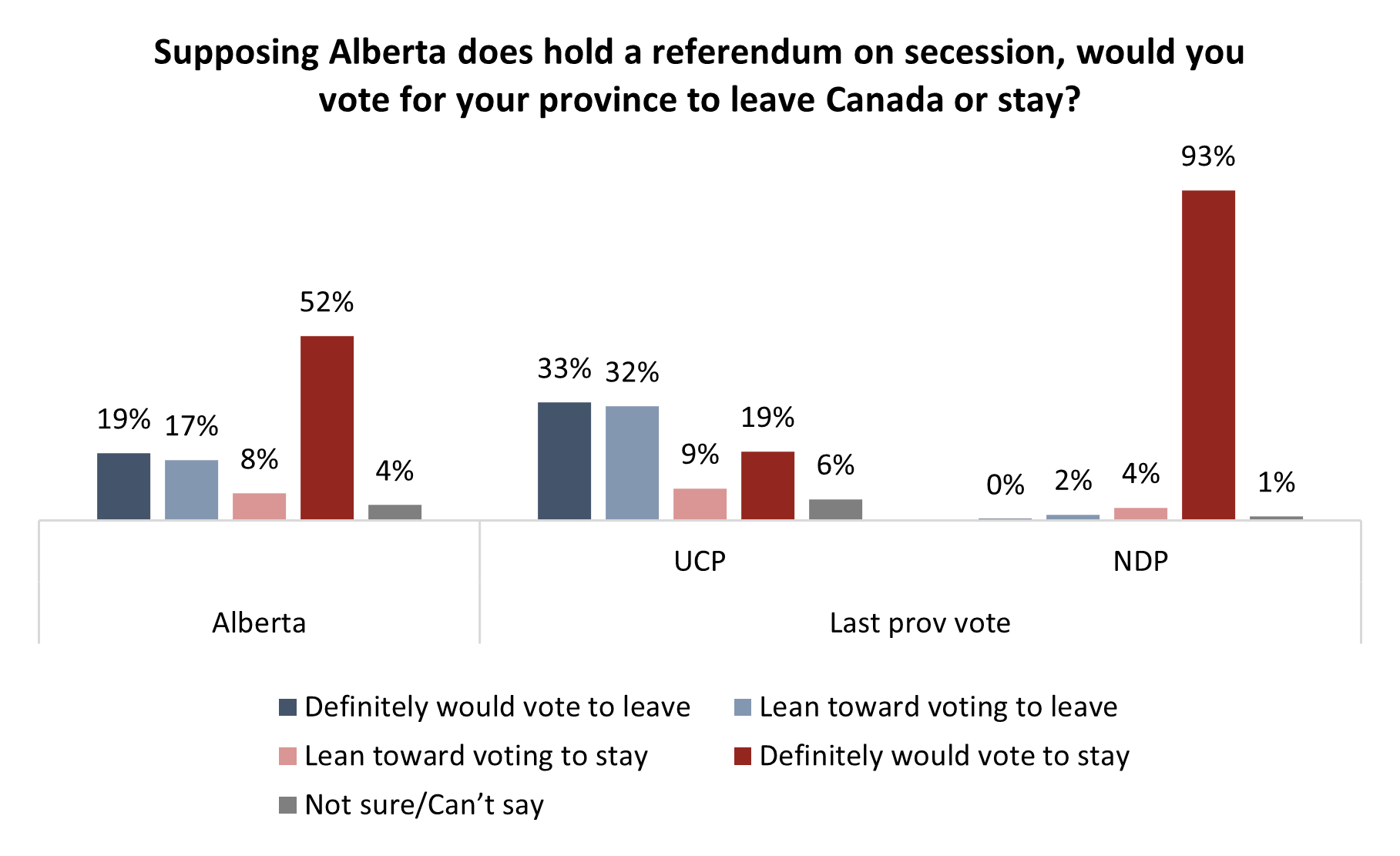
First, Alberta: a smaller group say they would vote to leave than say they would like to hold a referendum. And if a referendum were held, half (52%) say they would “definitely” vote to stay, while a further one-in-12 (8%) say they probably would vote that way. The “definitely” group on the other side of this debate, those who would like to see Alberta leave Canada are approximately one-in-five (19%).
A majority of those who voted for the UCP in Alberta’s last provincial election say they would vote to leave, whether definitely, or leaning that way, while nearly all past Alberta NDP voters say they would vote to stay:
In neighbouring Saskatchewan, the group who would vote to leave Canada is again smaller than the proportion of residents who want a referendum. And half (49%) of those in the province say they would “definitely” vote to stay, and their numbers are bolstered by the nine per cent who say they are leaning to voting that way as well.
The one-third (33%) who would vote for Saskatchewan to leave Canada in a referendum are almost entirely made up of past Saskatchewan Party voters, a majority of whom support their province leaving the country:

Liberal election win driving support of leavers
During the federal election campaign, the Angus Reid Institute found that, if the Liberals formed the next government, support grew among Albertans and Saskatchewanians for their province to leave the country.
Related: Three-in-10 in Alberta & Saskatchewan say they’d like to leave if Liberals form next government
That scenario has come to pass with the Liberals forming the next government under Carney after winning the most seats in the past election. ARI posed the alternative scenario – a Conservative victory in the federal election – to those who say they would vote “leave” if a referendum was held in their provinces. A Conservative victory would evidently do much to neuter this budding separatist movement – three-quarters of “leavers” in both Alberta and Saskatchewan say they would vote to stay had Conservative leader Pierre Poilievre been the next prime minister:
 Expectation in both provinces is that referendum would fail
Most in Alberta and Saskatchewan do not believe separation referendums in their provinces would be successful. Three-quarters in both provinces expect them to fail:
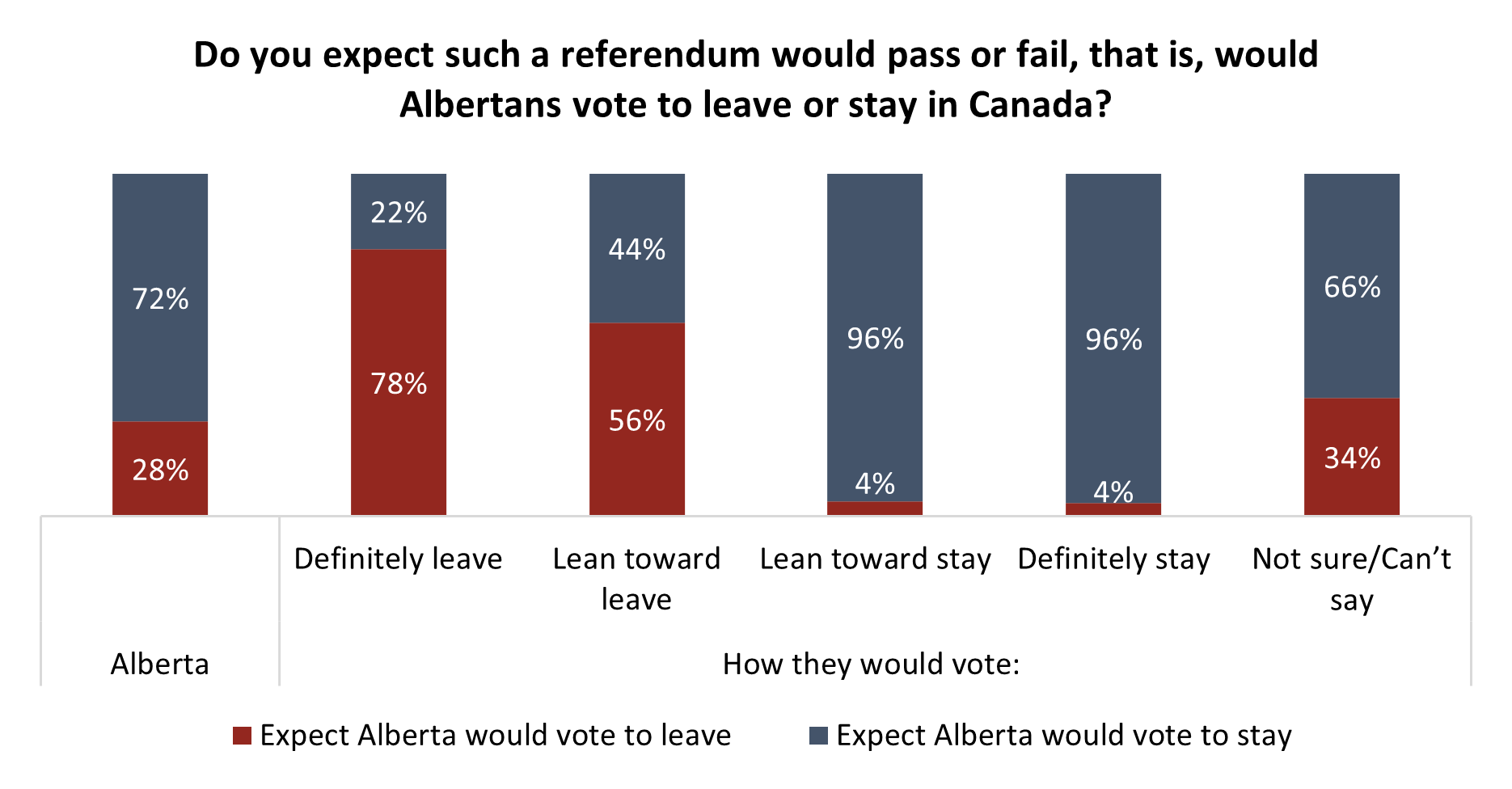
Expectations appear to be coloured by how residents expect to vote. Four-in-five of the definite leave voters in Alberta say they expect their province to separate if a referendum were held, while those who lean to voting leave are split. For all other groups, overwhelming majorities expect the vote to fail:
A similar picture is seen in Saskatchewan: most committed leave voters expect enough of the province to vote with them that Saskatchewan would leave confederation. Most others believe the separation vote will fail:

What would make leavers more likely to want to stay or go?
Energy East
Smith’s demands laid out to Carney (and Poilievre) during the election campaign centred around the expansion of distribution options for Alberta’s oil and gas industry, as well as removing other environmental regulations passed by the Liberal federal government under former Prime Minister Justin Trudeau.
Previous ARI research has found a growing reception among Canadians to building access for oil and gas to markets other than the U.S. in response to the tariff-laden hostility of the regime of U.S. President Donald Trump. In February, four-in-five said Canada needed “to ensure it has oil and gas pipelines running from sea to sea across the country”.
Energy East was one such project which was cancelled in 2017. Though it is viewed as “unlikely” to be revived by those who previously worked on it – a major barrier being that the project required the conversion of TC Canada pipeline from carrying natural gas to oil. TC Canada has since split off its crude oil pipeline business to focus on natural gas.
However, Energy East remains emblematic of the type of east-to-west energy infrastructure the country is currently lacking. Support for it has grown compared to 2019, including importantly in Quebec, the source of key opposition to the project during the planning process.
Related:
- Four-in-five say oil and gas infrastructure needed
- Pipeline Possibilities? In wake of Trump tariff threats, majorities support Energy East, Northern Gateway
If the federal government were to commit to building Energy East, or a project like it, that would convince a significant portion of those who would vote for their province to leave the country to change their mind. One-third of definite leave voters in Alberta, and one-quarter in Saskatchewan, say they would “more likely want to stay” if Energy East was resurrected. That project would also shift seven-in-10 leave leaners in both provinces towards the stay camp.
Removal of emissions cap?
The previous Trudeau government had submitted draft legislation to cap emissions from the oil and gas sector, legislation that Carney said his government would follow through on. Smith has said that a cap on emissions amounts to a cap on production, echoing the comments of oil and gas executives who have said it would be impossible to reduce emissions to the level proposed by the Liberal government without reducing production.
The emissions cap appears also to be a key point of contention for leavers in both provinces. Majorities of those leaning to voting leave in Alberta and Saskatchewan say removing the cap would make them change their mind, while significant portions of the definite leave voters say the same:

Repealing Bill C-69
Bill C-69 passed by the former Trudeau Liberal government requires resource projects to be assessed for environmental, health, social and economic impacts and the rights of Indigenous people before they can be approved. Officially this was known as the Impact Assessment Act, but it was unofficially dubbed the “no more pipelines act” in Alberta as it was seen as a major barrier to future projects.
Repealing it would dampen support for separation in both provinces, causing majorities of leave leaners to reconsider, and also pulling away three-in-ten definite leavers:

Indigenous protests would not sway the leavers
Indigenous leaders in Alberta have said any efforts to separate will be met with “full opposition”. Alberta First Nations chiefs gathered for an emergency meeting after Smith’s announcement this week that the province would hold a referendum on separation, provided the movement got enough signatures. Chief Billy-Joe Tuccaro of the Mikisew Cree First Nation tossed Bill 54, the legislation which lowered the threshold for the number of signatures needed for a province-wide referendum, in the air and called it “garbage”. The tensions between the province and Indigenous leaders have run so high over the potential of a referendum that Alberta’s Indigenous Relations Minister has said that he’d like to “run and hide”.
The response has been similar across the border in Saskatchewan. Bobby Cameron, the chief of the Federation of Sovereign Indigenous Nations, which represents 74 First Nations in Saskatchewan, said “Any process of separation that fails to honour the true spirit and intent of our treaties would violate both constitutional and international law.”
This full-throated opposition to separation from First Nations in both provinces does little to deter leave voters and in fact strengthens many of their resolve:
B.C. opposition to tidewater access
Perceived barriers put in front of the development of oil and gas in Alberta, and lesser so Saskatchewan, appears to be a key issue for those who support the separatist movement. But were either province to leave, they would encounter the geographical problem of being landlocked and requiring cooperation from bordering regions to ensure their resources can reach international markets.
Were B.C. to state that it would block tide water access to independent Alberta or Saskatchewan, it might drive some stay voters to the leave side and push those leaning to voting leave more solidly into the leave camp. However, as noted above, the lean stay groups are the smallest in the province, and the larger definite stay groups are hardly swayed by B.C. instituting standing in the way of tide water access to Alberta and Saskatchewan:
Quebec opposition to eastward pipelines
Similarly, if Quebec were to come out and block pipeline construction in its jurisdiction, it could bolster the separatist movement in both Alberta and Saskatchewan. Four-in-five leaning to leave voters say they would be more likely to want their province to separate were Quebec to institute a pipeline embargo. Majorities of those leaning to voting stay say the same:

Part Two: Personalities
Leadership approval
Throughout the time where they’ve overlapped as premiers, Moe has enjoyed an approval advantage over Smith. Smith has seen relatively steady approval, ranging between 42 and 47 per cent, but has yet to ever be approved of by a majority of Albertans. For Moe, that is usually the case, but he has recently seen dips that take him closer to Smith’s levels.
The top-line approval number does not tell the full story for both premiers, however. In Alberta, Smith has been polarizing, with three-in-ten (28%) strongly approving of her performance, but more than two-in-five (41%) who say they strongly disapprove of what she’s done in the premier’s office (see detailed tables).
Views of Moe are less polarizing overall, but he does have a sizable portion of the province – three-in-ten (30%) – who are strong detractors (see detailed tables).

Who holds sway
Smith has tried to walk a tightrope in these discussions. She has insisted she’s against separation, but she wants to “acknowledge that the feelings have a root, and the root is in the way Alberta has been treated for the last 10 years by the Liberals”. However, Smith has been criticized, including by Ontario Premier Doug Ford, for threatening the unity of the country at a key time in negotiations with the United States around Trump’s tariffs.
Most Albertans (54%) believe Smith has been making an important contribution in these discussions. She is viewed as holding more sway than former Premiers Rachel Notley (33%) and Jason Kenney (27%), or current opposition and NDP leader Naheed Nenshi (32%). Former Reform Party leader Preston Manning, who penned a Globe and Mail op-ed warning that national unity was on the ballot during the federal election campaign, is more likely to be viewed as irrelevant (45%, see detailed tables) to the conversation than having an influential part (20%).

Across the border, Smith’s sway in this conversation is evident. Those in Saskatchewan are as likely to say their own premier is an important voice on separatism as they are to point to Alberta’s premier. Kenney, opposition and NDP leader Carla Beck, and Manning are all more likely to be viewed as irrelevant (see detailed tables).

Half say Smith just wants leverage
Previous ARI data showed that two-in-five (41%) in Alberta and half (48%) in Saskatchewan believed that the only way to be heard by Ottawa is to threaten separation.
Related: Canadians prefer provinces stand up for themselves over avoiding conflict with Ottawa
Stoking the fires of separatist sentiment could be a play by Smith to increase leverage for her province. Indeed, one of the demands she laid out to the new Carney Liberal government was for Alberta to receive the same level of per capita federal transfers and equalization payments as Ontario, Quebec and British Columbia.
Half (47%) of Albertans say they believe Smith only wants leverage, while three-in-ten (28%) believe she actually wants to separate, despite repeatedly saying she is against it.

Should there be political consequences for failed vote?
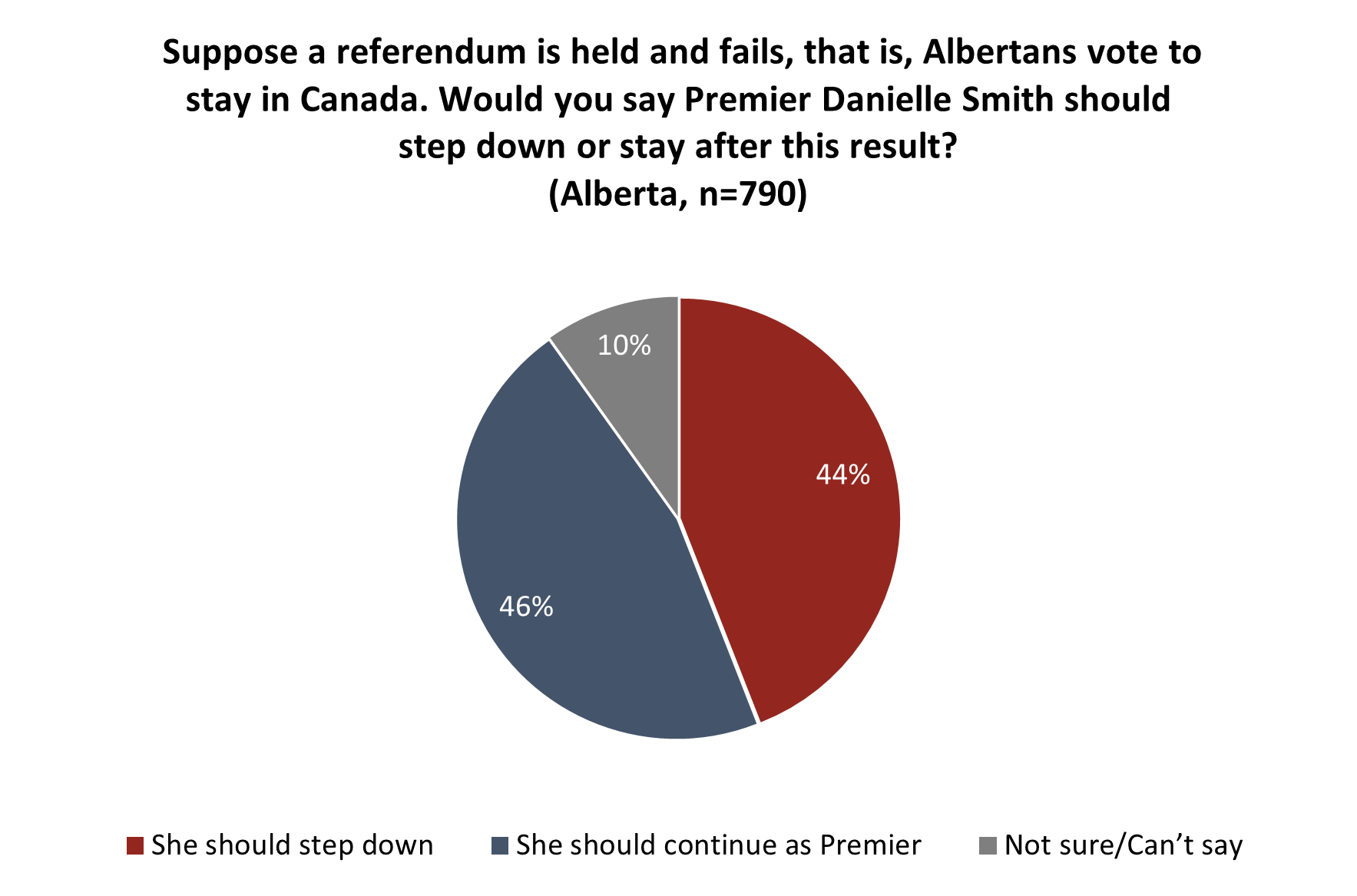
A potential 2026 referendum on Alberta separation would precede the province’s scheduled 2027 election. Were the province to hold a referendum, and it fails, Albertans are split as to whether Smith should step down in response, or not:
METHODOLOGY
The Angus Reid Institute conducted an online survey from May 6 – 8 2025, among a randomized sample of 790 Albertan adults and 577 Saskatchewan adults who are members of Angus Reid Forum. The sample was weighted to be representative of adults nationwide according to region, gender, age, household income, and education, based on the Canadian census. For comparison purposes only, a probability sample of this size would carry a margin of error of 3 percentage points in AB, 4 percentage points in SK, 19 times out of 20. Discrepancies in or between totals are due to rounding. The survey was self-commissioned and paid for by ARI. Detailed tables are found at the end of this release.
For detailed results in Alberta by age, gender, region, education, and other demographics, click here.
For detailed results in Saskatchewan by age, gender, region, education, and other demographics, click here.
For PDF of full release, click here.
For questionnaire, click here.
MEDIA CONTACTS:
Shachi Kurl, President: 604.908.1693 shachi.kurl@angusreid.org @shachikurl
Dave Korzinski, Research Director: 250.899.0821 dave.korzinski@angusreid.org
Jon Roe, Research Associate: 825.437.1147 jon.roe@angusreid.org