


Taking those who believe their province gets an advantage over others in Canada, minus those who say they get a raw deal, we can understand just who feels most aggrieved as a part of confederation. It is Saskatchewan residents who are most likely to feel little benefit and high levels of angst.

A majority in every province except Quebec (46%) say federal government policies have “hurt” their provincial economy in recent years. However, at most one-in-five believe the federal government has “helped”.

Residents of British Columbia are the most likely to say their “province is respected by the rest of the country”; two-thirds (64%) say this. Agreement to this statement elsewhere in the country ranges from 44 per cent in Ontario to 22 per cent in Saskatchewan.

The Full Story
INDEX
Part One: Provincial and national satisfaction levels
- Saskatchewan & Manitoba most satisfied; significant five-year drop in Ontario & Quebec
- Satisfaction levels across the country down when considering the national picture
Part Two: Perceptions: Who benefits and who loses in confederation?
- Quebec seen as garnering the most benefit, few see western provinces as advantaged
- Alberta seen as getting a raw deal, but Saskatchewan residents most peeved
- Net Alienation Score
Part Three: Perceptions from the provinces
- B.C. feels respected by others; Ontario feels fairly-treated by the federal government
- Proportion saying federal government has hurt their provincial economy rises
Part One: Provincial and national satisfaction levels
Saskatchewan & Manitoba most satisfied; significant five-year drop in Ontario & Quebec
Since 2019, Canadians have seen a pandemic, historic inflation, increasing international conflict and instability, and summers of wildfires and smoke. As these events have shaped Canadians’ world, they residents have become more critical of their provincial governments. The persistent issues of rising inflation and declining health care in recent years have more residents viewing their provincial governments negatively. Since 2019, the Angus Reid Institute Government Performance Index, measuring residents’ evaluations of their provincial government, has declined five points.
Related:
- Blast radius: Satisfaction with provincial governments crashes after years of COVID-19, cost of living crisis
- Five-Year Decline: Canadians growing more critical of their provincial governments as unresolved issues linger
Meanwhile, there is also a declining satisfaction with how things are going more generally in most provinces across the country. Since 2019, those saying they are “satisfied” with how life is in their province today has declined significantly in Ontario (-14 points), Quebec (-15) and Saskatchewan (-9), with slight declines seen in B.C. (-4) and Atlantic Canadian provinces on average (-3). Manitoba is the only province which has seen stability by this metric (-1).
Alberta is one province which has bucked this trend – satisfaction with the way things are going in that province has increased significantly by 16 points. When this question was asked in January 2019, the Alberta NDP majority government under Premier Rachel Notley were nearing the end of its term and there was significant discontent with a struggling provincial economy, especially when it came to the oil and gas industry and the lack of movement on new pipelines.

Satisfaction levels across the country down when considering the national picture
There has been an even sharper decline across the country when it comes to satisfaction with the state of things in Canada more broadly. In 2019, a majority (59%) said they were “dissatisfied” with the way things were going in the country; now three-quarters (72%) say the same. Those living in Alberta (75%) and Saskatchewan (72%) were most critical in their assessments five years ago. That is still the case, but now dissatisfaction with the direction of the country has risen to a similar level in B.C. (70%), Ontario (76%) and Atlantic Canada (73%). Those in Quebec (63%) are less dissatisfied than others, but are still critical of the way things are going at a majority level:

Part Two: Perceptions: Who benefits and who loses in confederation?
Quebec seen as garnering the most benefit, few see western provinces as advantaged
Governments in Alberta, Saskatchewan and Quebec have historically been the noisiest when it came to federal policies deemed unfair to their individual provinces. But recent years have seen increasing complaints regarding Ottawa’s approach from typically more circumspect regimes in British Columbia and Atlantic Canada. There is a common thread in many these complaints from government officials. Whether it’s immigration, carbon pricing, or calling for “nation-within-a-nation” status, provincial leaders often mention Quebec.
Among Canadians, two-in-five (42%) believe Quebec gets “an extra advantage” by being part of Canada. This figure rises to a majority in all provinces except Ontario (41%) and Quebec (19%). Meanwhile many outside Ontario – especially in the west – feel that province too is in a privileged position in confederation.
Within Canada’s two largest provinces, there is a larger proportion who “don’t know” if any province or region gets an advantage for being a part of Canada (Ontario 26%, Quebec 32%).

Alberta seen as getting a raw deal, but Saskatchewan residents most peeved
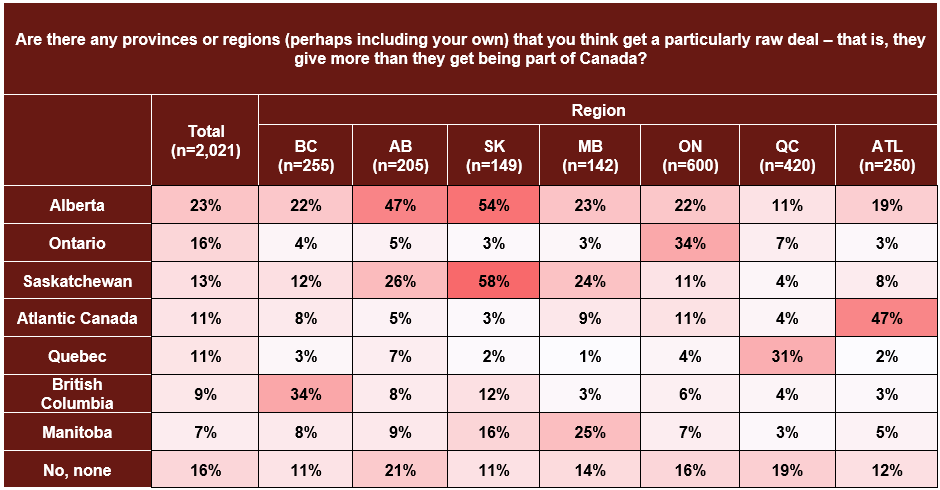
The inverse question offers a more diverse set of views across the country. Alberta (23%) is the most likely to be seen as receiving the short end of the confederation stick, while Ontario (16%) follows behind.
Those in Saskatchewan (58%) are the most likely to see their own provinces as particularly aggrieved; Manitobans (25%), the least likely. In fact, a larger proportion of those living in Saskatchewan believe Alberta (54%) suffers from confederation, than in Alberta (47%).
Albertans (21%) and Quebecers (19%) are the most likely to believe no province gives more than they get for being part of Canada:
Net Alienation Score
Adding these two elements together, those who believe their province gets an advantage over others in Canada, minus those who say they get a raw deal, we can understand just who feels most aggrieved as a part of confederation. It is Saskatchewan residents who are most likely to feel little benefit and high levels of angst.
In the wake of the home heating oil carveout of the carbon tax last fall – a move seen by a majority of Canadians at the time as a political gambit to gain votes in Atlantic Canada by the federal Liberal government – and the Saskatchewan government’s response to stop collecting carbon taxes on natural gas used for home heating in January – now subject to a lawsuit – this is perhaps unsurprising. Atlantic Canadians, on the other side of that particular policy maneuver, are only slightly less negative about what they garner from being a part of Canada:
Part Three: Perceptions from the provinces
B.C. feels respected by others; Ontario feels fairly-treated by the federal government
Interprovincial opinions extend beyond simple cost-benefit analysis and evidently some provinces feel more respected than others in the federal relationship. B.C., for example, stands out among all regions as by far the most likely populous to feel that the rest of the nations respects them. Two-thirds (64%) feel this way, well ahead of Ontario in second place at 44 per cent. While British Columbians feel respected by other Canadians, the federal government is another story. Here, one-in-three (32%) say they feel fairly treated, a similar number as feel this way in Alberta (32%). Ontario is the only province wherein a majority of residents say they feel fairly treated by Ottawa, with Quebec second at 42 per cent:
Proportion saying federal government has hurt their provincial economy rises
COVID-19 is a hinge point for so many aspects of modern society, and it appears that since that period, criticism of the federal government’s economic impact on one’s home province has ratcheted up. In all regions but one – Alberta – the proportion of residents saying that the federal government’s policies have hurt their province has risen. Only in Alberta has this proportion dropped, though that province still has the second largest group of respondents saying that the Liberals under Prime Minister Justin Trudeau have had a negative impact on the provincial economy: