

Albertans critical of government performance on top issues of health care and cost of living
April 8, 2026 – The UCP government under Premier Danielle Smith is relatively well-appraised when it comes to the top issues of the day. But the word relatively is doing significant heavy lifting.
New data from the non-profit Angus Reid Institute finds Alberta outperforming most provincial governments when it comes to how residents view the UCP government’s performance on the top issues of the day. But there are still majority levels of criticism when it comes to how Smith’s government is handling health care (poor job, 67%) and cost of living (66%), the two top issues selected by those in Alberta.
On both those issues, three-in-ten believe the government is handling cost of living (28%) and health care (29%) well, levels higher than most Canadians give their own provincial governments on these issues.
The criticism for the government coalesces into a situation where half in the province (52%) believe Alberta is on the wrong track. Two-in-five (38%) disagree and believe the UCP government has Alberta on the right path. That places Alberta behind only Saskatchewan (45% right track) and Manitoba (45%) in the proportion of residents who say their province is trending in the right direction.
About ARI
The Angus Reid Institute (ARI) was founded in October 2014 by pollster and sociologist, Dr. Angus Reid. ARI is a national, not-for-profit, non-partisan public opinion research foundation established to advance education by commissioning, conducting and disseminating to the public accessible and impartial statistical data, research and policy analysis on economics, political science, philanthropy, public administration, domestic and international affairs and other socio-economic issues of importance to Canada and its world.
INDEX
-
Views of the premier and opposition leader
-
Government Performance Index
-
Government performance trend
-
Top issues
-
Performance on top issues
-
Economic Outlook
-
Right track or wrong track?
Views of the premier and opposition leader
The election of Avi Lewis as leader of the federal NDP pose a challenge for Alberta’s New Democrats, who sit in opposition to Premier Danielle Smith and the UCP. The Alberta NDP face the challenge of distancing themselves from their federal counterparts once again on matters of oil and gas development and pipelines. Lewis said he believes the oil and gas sector doesn’t need to keep expanding, which puts him at odds with Nenshi and his counterpart in Saskatchewan, Carla Beck. Nenshi, in a statement posted after Lewis’ win, said Alberta’s New Democrats “believe in Alberta and we believe in Canadian energy and the good jobs it creates. We believe in more pipelines and in reducing emissions.”
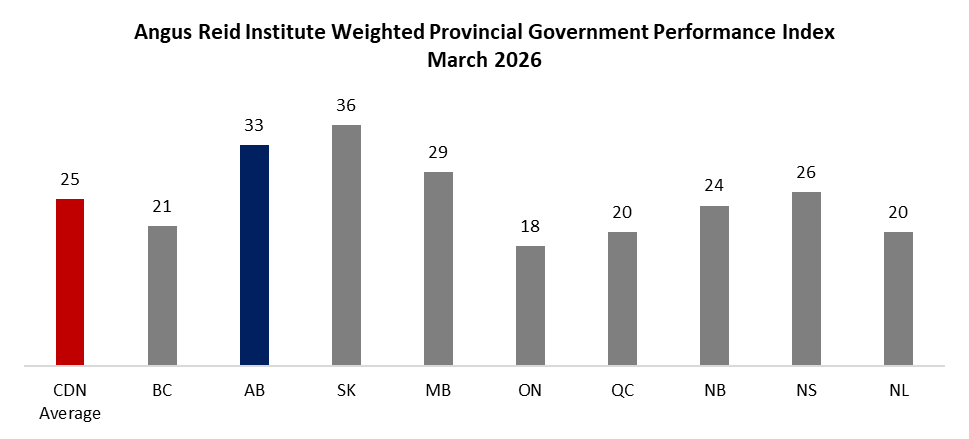
Maintaining that fine line between the provincial party and the federal one under the new leadership of Lewis will be a challenge for Nenshi and the NDP as Alberta nears the next scheduled provincial election date in 2027. For now, Nenshi also faces a struggle to gain personal appeal with Albertans in general. One-third (33%) say they have a favourable view of Nenshi; his political opponent, Smith, currently garners 46 per cent approval. Both, notably, are viewed negatively by a majority (Nenshi, 53% unfavourable; Smith, 52% disapproval):
Government Performance Index
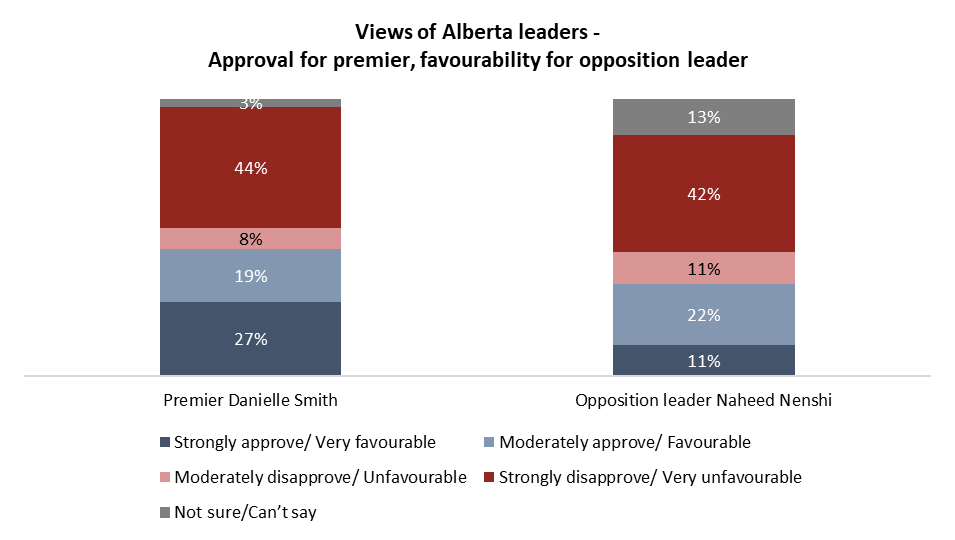
Nenshi and the NDP also line up against an incumbent government that is under significant criticism from residents, but still performs better than provincial governments across the country on a number of key issues. The Angus Reid Institute Weighted Provincial Government Performance Index incorporates not only the percentage of provincial residents who believe their government is performing well on a file, but also how highly that file is selected as a top issue in the province.
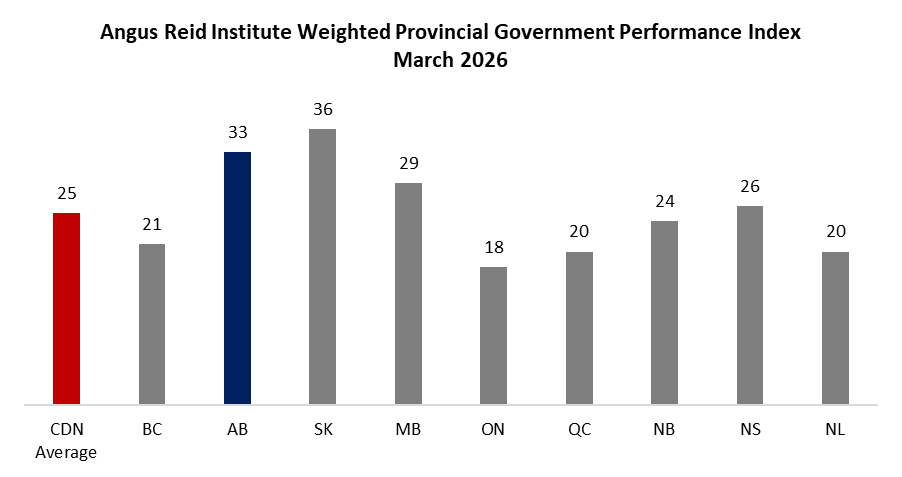
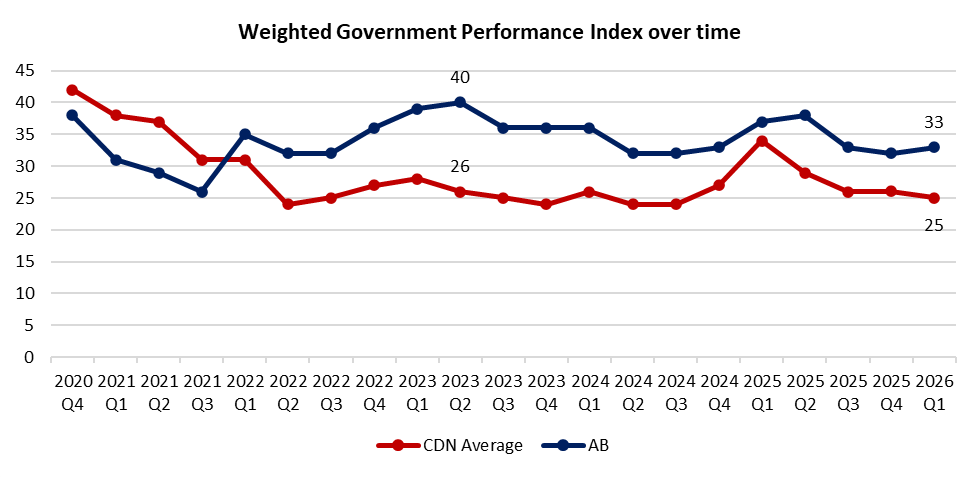
Alberta, with a score of 33, is the second highest scoring province in the country, behind Saskatchewan at 36. It also outperforms the Canadian average score of 25:
Government performance trend
Consistently in Smith’s tenure as premier Alberta has been more praised than other provinces on its performance on the key issues. However, the gap between Alberta and the rest of the country has narrowed, from a high of 14 points in the second quarter of 2023, to eight points this quarter:
Top issues
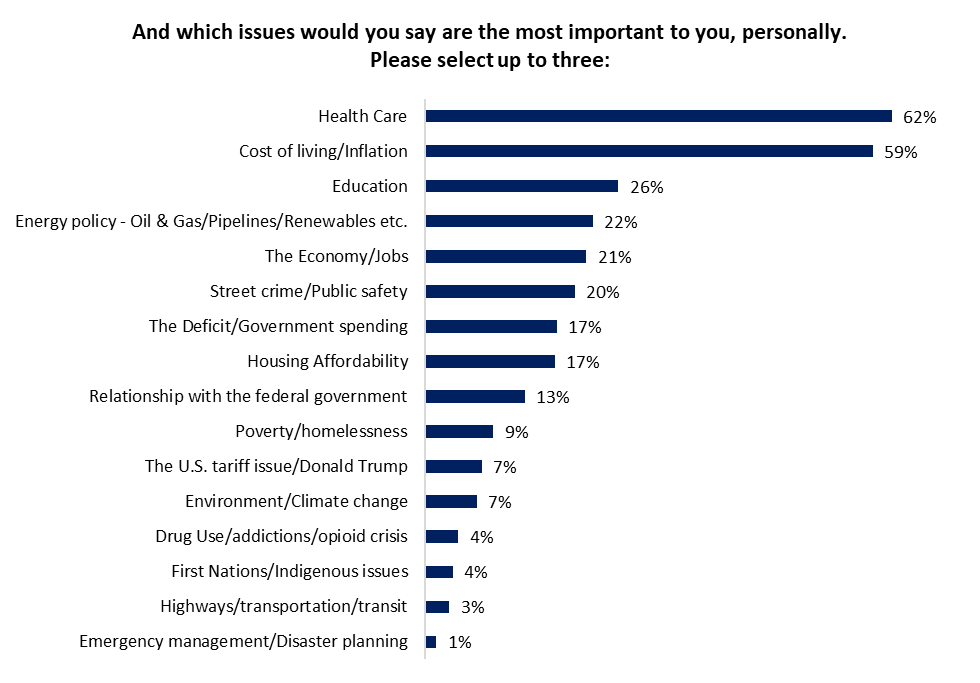
Most Albertans identify two key issues: health care (62%) and the high cost of living (59%). Following behind those are education (26%), a lingering concern since the fall teacher’s strike and as the province further expands financing of private schooling; energy policy (22%), always a key concern for Albertans; and the economy more broadly (20%).
Related:
- Teachers’ Strike: Most Albertans side with teachers as they criticize UCP’s handling of education
- Alberta Schools: Two-thirds say education system is ailing, but there’s no consensus on the cure
Performance on top issues
Taken side by side with the Canadian average assessment of provincial government performance on the varying issues, both Alberta’s relatively better performance and the potential for further improvement is evident. On health care, 29 per cent believe Alberta is doing a good job. That is not a ringing endorsement, but it is nine points better than the Canadian average. On cost of living, comparatively, Alberta’s 28 per cent is better than the 16 per cent Canadians give their provincial government on average.
Smith and the UCP receive the best marks on highways and transportation (48%) and energy policy (47%); for both files, positive appraisal does not reach a majority level:

Economic Outlook
The cost of living issue remains intractable for provincial governments across the country. And the war in Iran is perhaps further exacerbating this stubborn concern.
In Alberta, two-in-five (40%) say they believe they are financially worse now than a year ago, while a similar number (41%) say they are at best treading water:

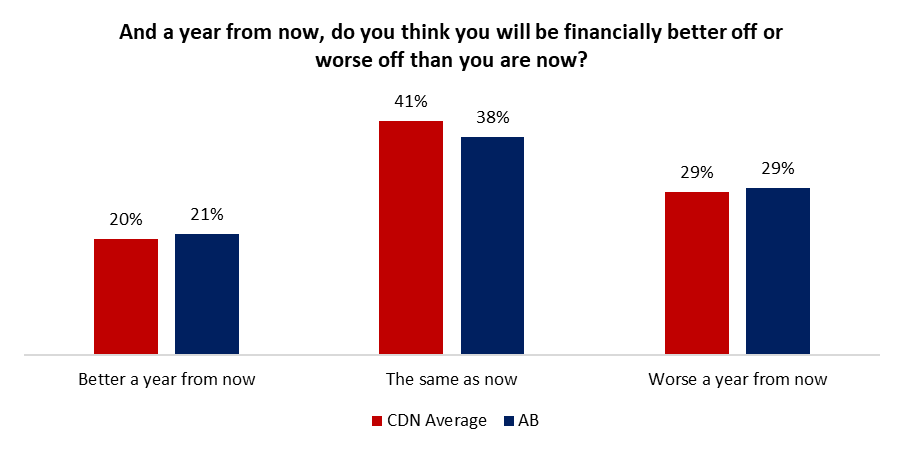
Across the country, pessimism for the financial future is more common than optimism. That is also the case in Alberta, where one-in-five (21%) believe they will be better off next year and three-in-ten (29%) say they expect their financial prospects to worsen:
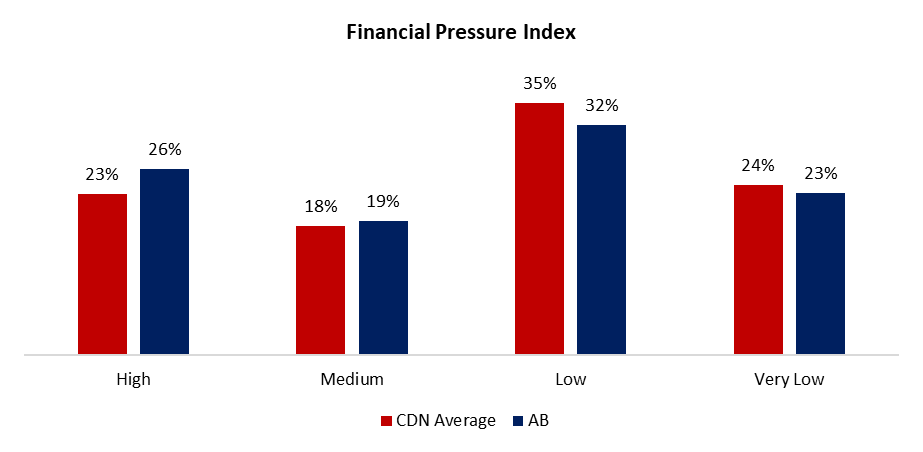
The Angus Reid Institute Financial Pressure Index includes the data from the above questions as well as measuring personal assessments on how Canadians believe their household is handling grocery prices, levels of debt, concerns over employment stability and monthly housing payments like rent or mortgage. Index scoring is available here.
This Index sorts Canadians into four groups: those under high, medium, low and very low financial pressure. There are slightly more Albertans who fall into the high pressure category (26%) than the national average. Albertans, notably, stand out on one measure of the index: concerns over household debt. More than one-quarter (27%) describe their current debt levels as “a major source of stress”. Albertans on average hold more personal non-mortgage debt than the average Canadian, and the highest delinquency rate in the country, according to Equifax.
Right track or wrong track?
More Albertans believe the province is overall on the wrong track (52%) than the right one (38%). But the fact that approaching two-in-five (38%) say their province is on the right path makes Alberta third in the country on that metric, behind Saskatchewan (45%) and Manitoba (45%), the only two provinces in the country where more believe their province is trending in the right direction than not:

METHODOLOGY:
The Angus Reid Institute conducted an online survey from March 11-17, 2026, among a randomized sample of 434 Canadian adults who are residents of Alberta. Respondents are drawn from the Angus Reid Forum, a large-scale online panel developed to include Canadian residents in each of the 343 federal ridings in Canada and representative of the Canadian population by age, gender, family income, ethnic status and education. The sample was weighted to be representative of adults nationwide according to region, gender, age, household income, and education, based on the Canadian census. For comparison purposes only, a probability sample of this size would carry a margin of error of +/- 5 percentage points, 19 times out of 20. Discrepancies in or between totals are due to rounding. The survey was self-commissioned and paid for by ARI.
Note: Because its small population precludes drawing discrete samples over multiple waves, data on Prince Edward Island is not released.
For detailed results by age, gender, region, education, and other demographics, click here.
For PDF of full release, click here.
MEDIA CONTACT:
Shachi Kurl, President: 604.908.1693 shachi.kurl@angusreid.org @shachikurl
Dave Korzinski, Research Director: 250.899.0821 dave.korzinski@angusreid.org
Jon Roe, Senior Research Associate: 825.437.1147 jon.roe@angusreid.org