

Three-in-five say Smith government has done poor job on education
October 14, 2025 – The Alberta Teachers’ Association (ATA) is set to resume negotiations with the government in an effort to resolve a strike which has taken more than 700,000 students out of classrooms in the province.
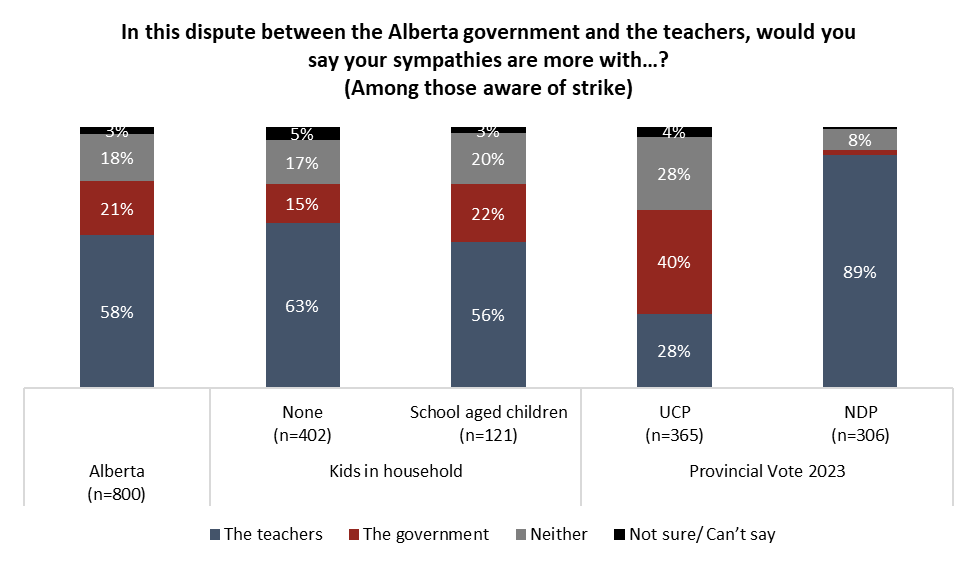
According to new data from the non-profit Angus Reid Institute, the teachers return to the table with the support of a majority of Albertans. Three-in-five (58%) in the province say their sympathies are more with the teachers in this labour dispute, triple the number who say instead they are siding with the government (21%). The former includes a majority (56%) of those with school-aged children.
The sympathy appears to come from agreement on two of the central sticking points in the ongoing negotiations: class sizes and teacher compensation. Four-in-five (84%) believe there are “too many kids” in Alberta public school classes, while most (56%) disagree that teachers are paid enough as it stands. However, where Albertans stand on this matter is apparently heavily influenced by politics: three-in-five (62%) past UCP voters believe teachers are currently making enough money; four-in-five (82%) 2023 NDP voters disagree.
Support for the teachers’ cause comes as there is widespread criticism of the public education system under Premier Danielle Smith and the UCP government. Three-in-five (61%) believe the UCP has done a “poor job” handling public education.

The public school system teacher strike has also brought to the forefront questions around Alberta’s spending on the parallel private system. Seven-in-ten (71%) say that the provincial government should be mainly focused on improving public schools. At the same time, three-in-five (60%) want fewer public funds to go towards private schools in general.
More Key Findings:
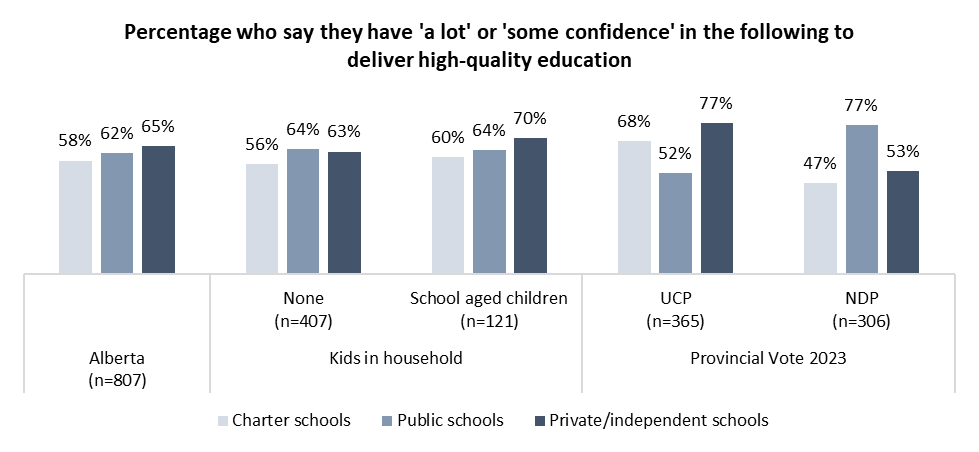
- Past UCP voters are less likely (52%) to say they have confidence in public schools to deliver a high-quality education than those who voted NDP (77%) two years ago.
- Three-in-five (63%) of those with school aged children in their household say the strike has been disruptive to their day-to-day lives.
INDEX
Part One: The strike – disruptions, sympathies and the central disputes
-
Majority with school-aged children say strike has been disruptive to day-to-day life
-
Most say their sympathies are with the teachers rather than the government
-
Four-in-five agree class sizes are too big
-
Most believe teachers are underpaid, but UCP voters disagree
-
Smith government has done a ‘poor job’ on education, majority believe
Part Two: The private school debate
-
Seven-in-ten believe government should ‘mainly focus’ on improving public system
-
Most believe private schools should receive less public funding
-
Albertans more likely to believe charter schools weaken than improve education system
-
Past UCP voters more likely to doubt public system’s quality of education
Part One: The strike – disruptions, sympathies and the central disputes
Majority with school-aged children say strike has been disruptive to day-to-day life
The strike by public school teachers that began Oct. 6 has derailed the beginning of the school year in Alberta. More than 700,000 students across the province have been affected after teachers rejected the government’s most recent offer, sending them off the job.
A majority (63%) of those with school aged children (ages six to 17) in the household say the strike has been either very (40%) or a little (23%) disruptive to their day-to-day routine:

Most say their sympathies are with the teachers rather than the government
The government has used an ad campaign to explain their position on the strike to “correct the false narrative the ATA has created”, according to Finance Minister Nate Horner. The government argues it plans to address the key issue of class sizes by hiring more than 3,000 teachers over three years, as well as offering a 12-per-cent increase to teacher pay over four years. Alberta Premier Danielle Smith has said that because of the $6.5-billion deficit the government is facing, it’s difficult to offer more than that.
The ATA believe 3,000 teachers is not enough to fix overcrowding, asking instead for 5,000. It also argues that the wage increase does little to offset inflation and years of stagnant wages.
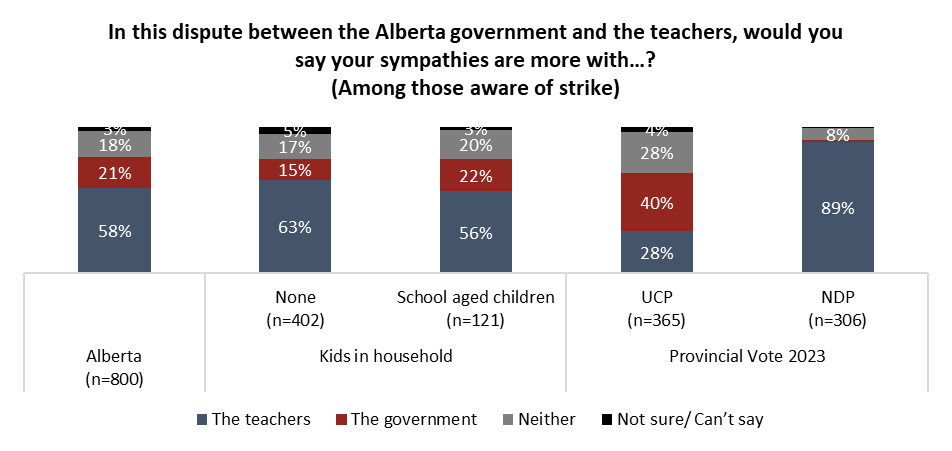
By a three-to-one margin, Albertans side more with the teachers (58%) than the government (21%). Those with children in school in their household also express more sympathy for the teachers (56%) than Smith and the UCP (22%).
Past UCP voters are more likely to take the government’s side (40%) than others, but many (28%) either support the teachers in the strike or take neither side (28%):
Four-in-five agree class sizes are too big
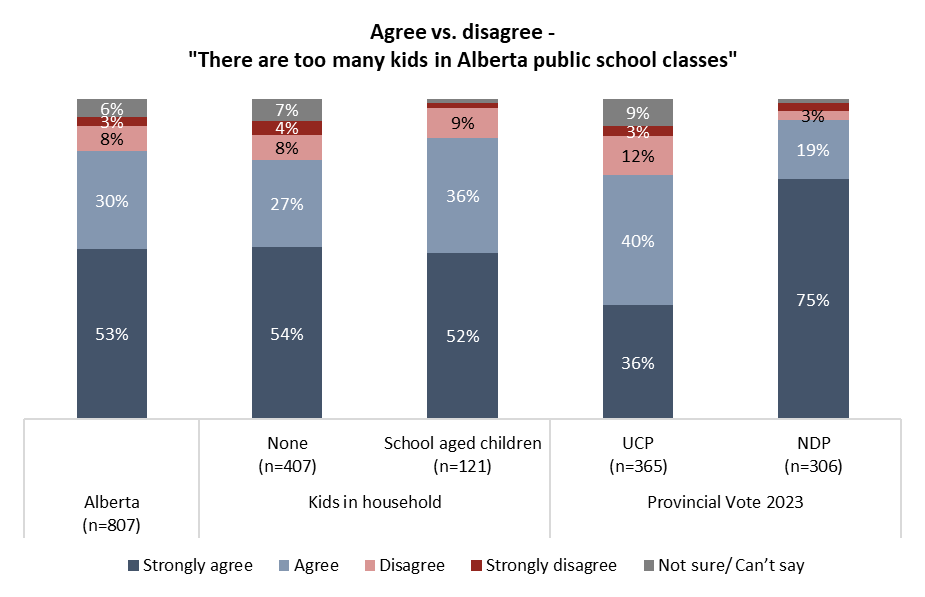
The government and teachers both acknowledge the issue of class sizes, although they differ on how many teachers are needed to help rein them in. There is also a strong belief among Albertans, too, that there are too many kids in public school classes. More than four-in-five (83%), including approaching nine-in-ten (88%) with school aged children in their house, say that is the case:
Most believe teachers are underpaid, but UCP voters disagree
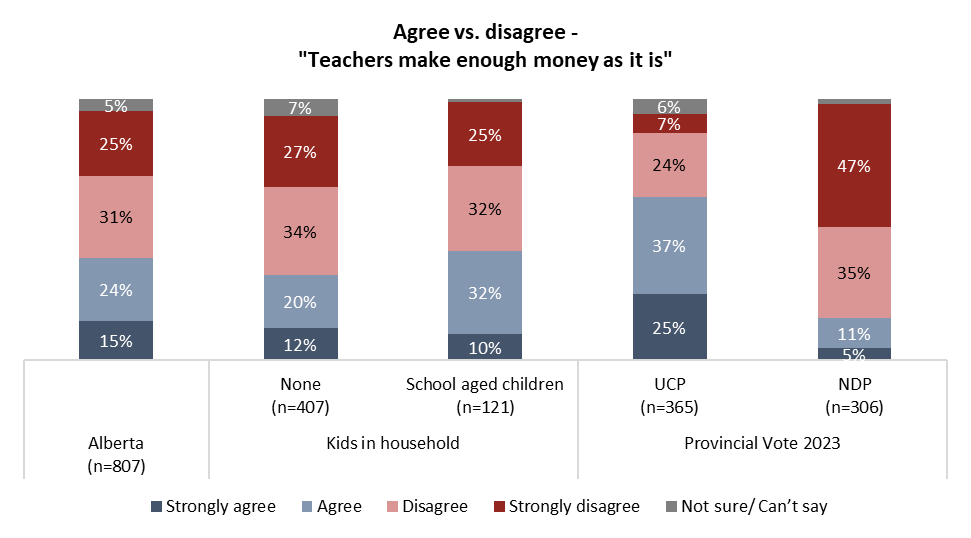
There is more disagreement on another sticking point in negotiations. There are two-in-five (39%) Albertans who believe “teachers make enough money as it is”, while more (56%) disagree. Past UCP voters, by a two-to-one margin (62% to 31%), believe teachers are fairly compensated as it stands, while there is more disagreement from those who voted NDP in 2023:
Smith government has done a ‘poor job’ on education, majority believe
It has been more than three years since Danielle Smith officially stepped into the premier’s office. Albertans are critical of the job she and her government has performed on the education file since Smith took over from Kenney. Half (48%) describe the UCP’s government performance on the issue as “very poor” and another 14 per cent believe it has performed poorly.
Those with school aged children in their household are more likely (40%) than those without (25%) to offer praise to Smith and the UCP for their handling of public education, but still half (54%) in that group are critical.
Those who voted UCP in 2023 are much more positive (62%) than others. This follows as Smith stands as the most polarizing premier in the country, with the highest proportion of strong approval (24%) among the country’s premiers, but also one of the highest strong disapproval ratings (40%). The former group contains mostly UCP voters, while the latter those who voted NDP.
Related:
- Premiers’ Performance: The journey from first to worst for Legault; Eby’s decline continues
- Cross-Canada Outlook – Provincial Issues, Politics, and Performance: Alberta

Part Two: The private school debate
Seven-in-ten believe government should ‘mainly focus’ on improving public system
Although not a central point in the dispute between public school teachers and the government in the strike, some have been critical of Smith and the UCP for their allocation of public funds to private schools as they have been resistant to public teachers’ demands for increased wages.
The kindergarten to Grade 12 education budget, including both spending on private and public schools, is $9.9 billion this year, of which $461 million, or five per cent, is allocated to fund those outside the public system. That grant to private schools grew 10 per cent in the 2025 budget, while the funding for public schools increased by 4.5 per cent. And the private school grant is expected to grow to $544 million by the 2027-28 school year. Private schools receive about 70 per cent of the per-student funding that public schools receive, the highest level of subsidies for private schools in the country.
Private school proponents argue the funding increase is driven by more Albertans choosing private schools for their kids. Education Minister Demetrios Nicolaides said cutting funds to private schools “would create massive pressure on our public system”.
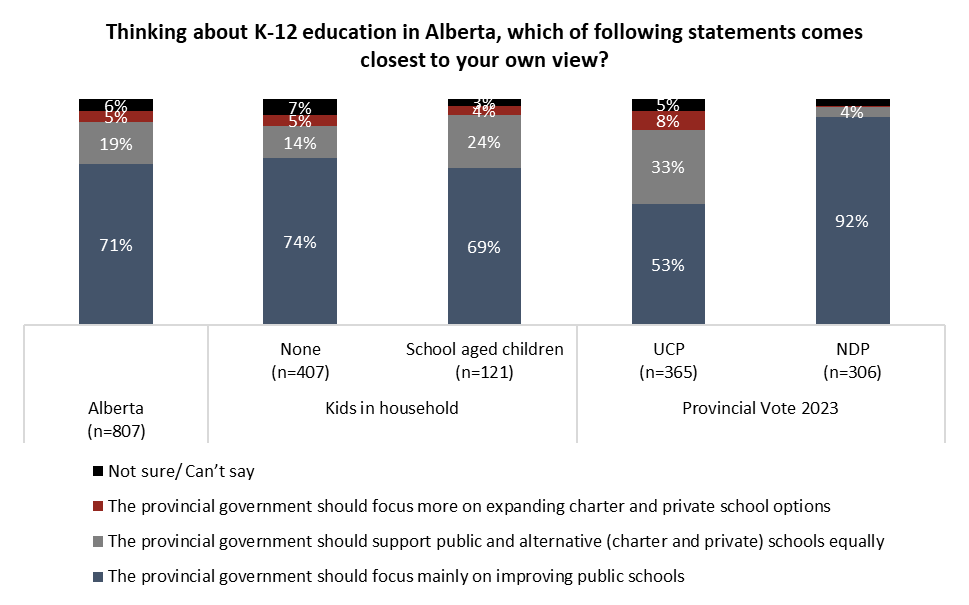
Albertans overwhelmingly prefer their government focus on addressing issues in the public system over expanding alternative choices for students. Seven-in-ten (71%), including half (53%) of UCP voters, say the provincial government should “focus mainly on improving public schools”. A minority (19%) want equal support for public and alternative schools:
Most believe private schools should receive less public funding
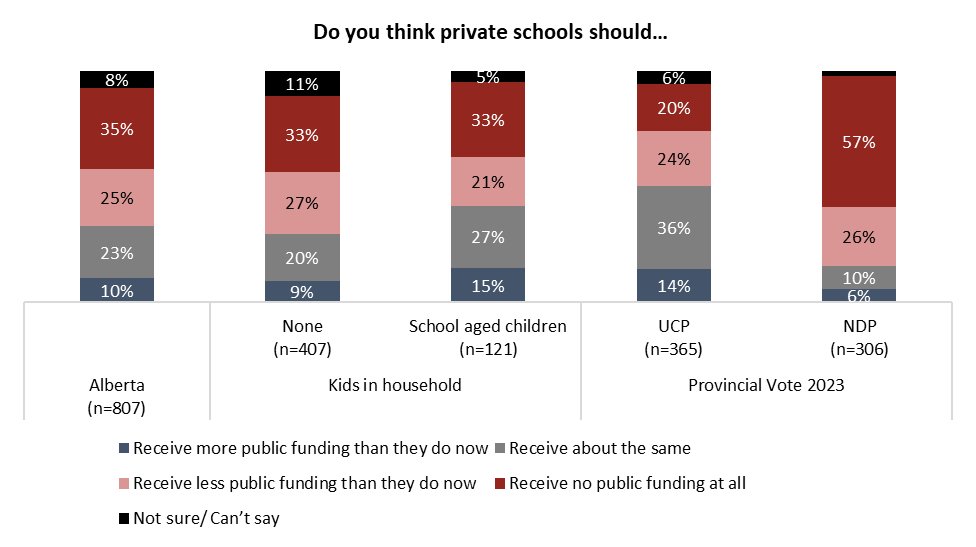
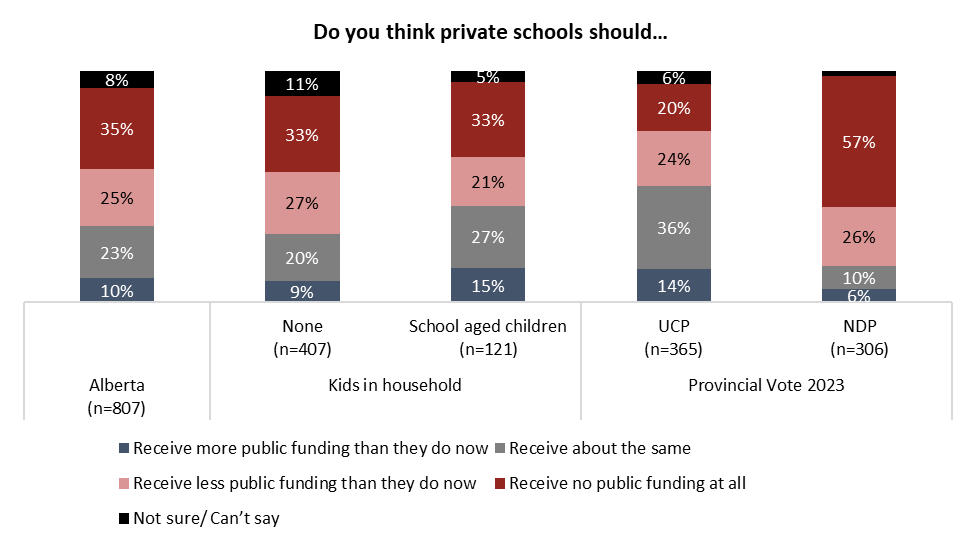
Last week, an Alberta teacher filed a petition to end private school funding. Only one-third (35%) of Albertans would go that far, but including those who want private schools to receive less funds, most (60%) would prefer the provincial government roll back subsidies to schools outside of the public system. One-quarter (23%) support the system as it stands and one-in-ten (10%) would grant more funds to private schools.
A majority (57%) of past NDP voters would end private school subsidies. A minority (20%) of UCP voters agree; more (50%) want private school funding to stay where it is (36%) or increase (14%):
Past UCP voters more likely to doubt public system’s quality of education
For UCP voters, there is evidently less confidence in the quality of education provided by the public system. Seven-in-ten (68%) who voted for Smith in 2023 believe say they have “a lot” or “some” confidence in charter schools to provide a high-quality education; three-quarters (77%) express belief in the education provided by public schools. They reserve the least amount of confidence, 52 per cent, for the public school system.
The inverse trend is noted among those who voted NDP in the most recent provincial election:
Survey Methodology:
The Angus Reid Institute conducted an online survey from Oct. 8-10 2025, among a randomized sample of 807 Canadian adults living in Alberta who are members of Angus Reid Forum. The sample was weighted to be representative of adults nationwide according to region, gender, age, household income, and education, based on the Canadian census. For comparison purposes only, a probability sample of this size would carry a margin of error of +/- 3 percentage points, 19 times out of 20. Discrepancies in or between totals are due to rounding. The survey was self-commissioned and paid for by ARI.
For more information on our polling methods, click here.
For detailed results by age, gender, region, education, and other demographics, click here.
For PDF of full release, click here.
For questionnaire, click here.
CONTACT:
Shachi Kurl, President, Angus Reid Institute: 604.908.1693 shachi.kurl@angusreid.org @shachikurl
Jon Roe, Research Associate, Angus Reid Institute: 825.437.1147 jon.roe@angusreid.org
Paige Waldie, Senior VP Calgary, Research, Angus Reid Group: 825.365.6665, paige.waldie@angusreid.com