

Albertans less critical of their provincial government than others, but half say Alberta is on the wrong track
Sept. 12, 2025 – As part of its ongoing Cross-Canada Outlook series, the non-profit Angus Reid Institute takes a closer look at Alberta, its government and the current issues facing the province with new data.
These data find that while Albertans offer more praise than others on their provincial government’s performance on their top issues, there is plenty of room for improvement at the halfway point of the UCP government’s majority term.
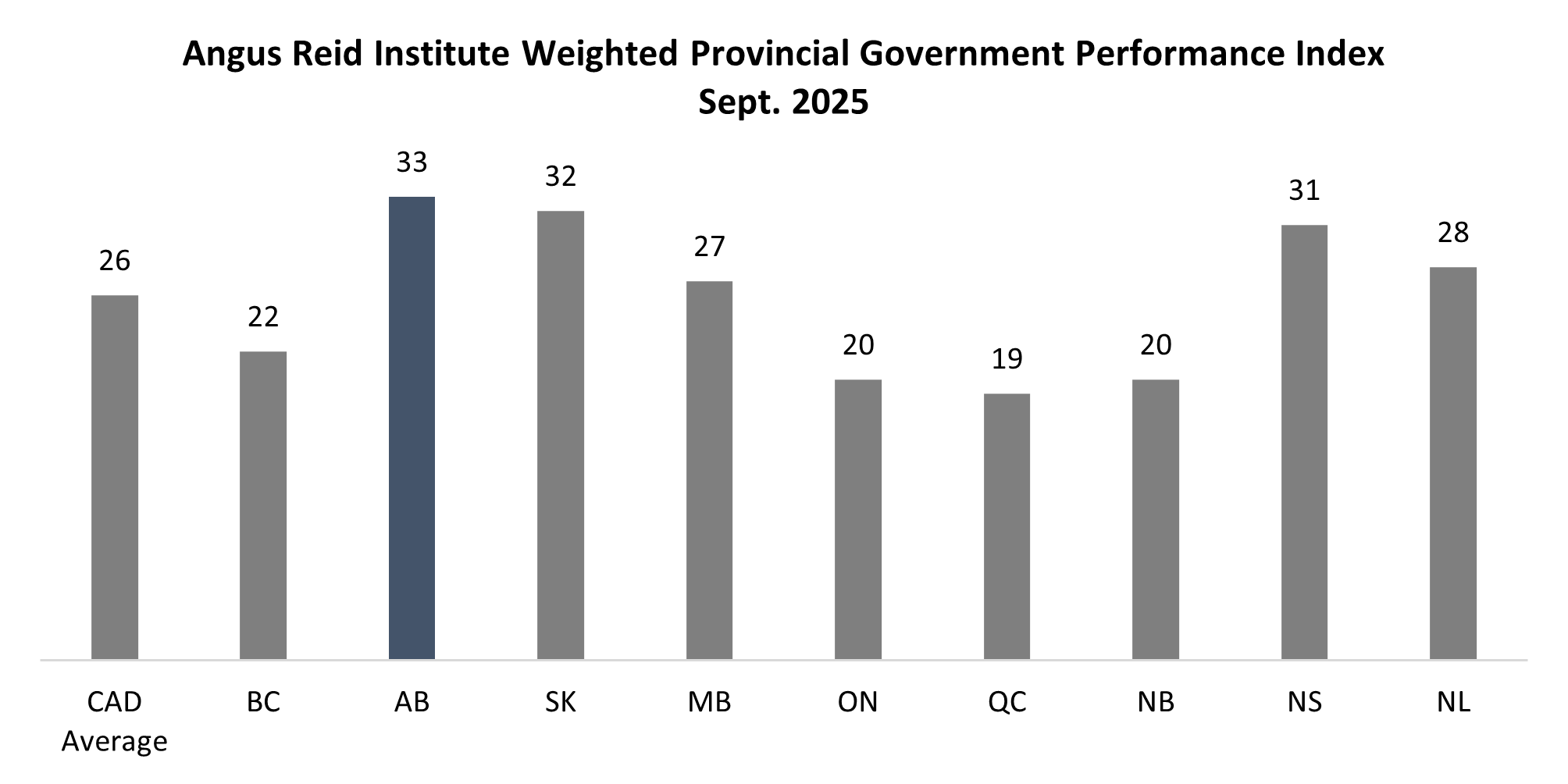
Using ARI’s Weighted Government Performance Index, which includes constituents’ assessments of the top issues as well as their rankings of how important those top issues are, the Alberta government is the best performing provincial government in the country. But this is in an environment of high criticism of provincial governments from Canadians.
Indeed, on the top five issues selected by Albertans – cost of living (61% choose it as a top issue), health care (52%), the economy (28%), public safety (24%), and housing affordability (22%) – a majority in the province believe the UCP government under Premier Danielle Smith is doing a poor job. With those assessments, it is perhaps no surprise then that half (48%) of Albertans say the province is on the wrong track, more than those who say it is heading in the right direction (40%).
INDEX
- Views of the premier and opposition leader
- Government Performance Index
- Government performance trend
- Top issues
- Performance on top issues
- Right track or wrong track?
- Vote intention update
Leadership
Alberta Premier Danielle Smith has a full plate. In recent weeks, her government has advanced controversial policies on charging most in the province for COVID-19 vaccines and banning books with sexually explicit content in schools. The latter is not the only pending issue on the education file; the province’s teachers are poised to strike on Oct. 6 if they aren’t satisfied with the latest offer in contract negotiations.
The labour unrest is complicated by the province’s worsening finances. Low oil prices forced the Alberta government to revise its projected deficit to $6.5 billion this fiscal year. Alberta has yet to find a way to get itself off the resource revenue roller coaster, as the latest budget represents a steep drop from the $8.3-billion surplus of the 2024-25 fiscal year.
As the premier takes a fork and knife to those issues and others, a lawsuit from the former CEO of Alberta Health Services still simmers in the background.
Through it all, Smith’s approval has shown remarkable durability. Since taking office in October 2022, her approval has been between 45 and 47 per cent in all but two quarters of ARI data.
Related: Premiers’ Performance: The journey from first to worst for Legault; Eby’s decline continues
And that’s where it sits now, with 46 per cent in the province approving of Smith’s performance and 49 per cent disapproving. The topline numbers do obscure a key dynamic with Smith’s leadership, however, as she remains the most polarizing premier in the country with one-quarter (24%) strong approval, the highest in the country, and 40 per cent strong disapproval, the second highest in the country.
Those who are critical of Smith’s government now have a key voice in the legislature as NDP leader Naheed Nenshi won his byelection in Edmonton Strathcona this summer, a year after winning the NDP leadership. Smith and the UCP were criticized for delaying the byelection to replace former Premier and NDP leader Rachel Notley, who stepped down as an MLA in December.
Nenshi, a long-time Calgary mayor, enters with a higher profile than is typically seen among opposition provincial leaders. One-in-ten (11%) say they are unfamiliar with Nenshi, the lowest such figure in the country; lower than even that of B.C. Conservative leader John Rustad (16%) and Saskatchewan NDP leader Carla Beck (15%), both of whom led their respective parties in provincial elections last fall.
However, that familiarity does not appear to work in Nenshi’s favour. Half (50%) of Albertans say they have an unfavourable view of Nenshi, while two-in-five (39%) say they have a positive one:
 Government Performance Index
The Smith UCP government policies may be polarizing, but Albertans are less critical of their provincial government than others across the country. The Angus Reid Institute’s Weighted Provincial Government Performance Index incorporates both assessments of government performance and how highly the issue is ranked by provincial residents. To see all issues, view detailed tables here. By this metric, the UCP government is seven points above the Canadian average, and the best in the country:
Government performance trend
Since she took over as premier in 2022, it has consistently been the case that Smith’s government has been better rated than its peers on the top issues that matter to Alberta residents:
 Top issues
The suite of top issues – cost of living, health care, street crime, housing affordability and the economy – are similar to those seen in other provinces. Cost of living and health care are the top two issues in every province in the country; housing affordability, public safety and the economy round out the top five in all but two provinces. In Nova Scotia and Quebec, environment and education, respectively, replace public safety in the top five.
Albertans are more likely than those in other provinces to be concerned about the economy, as well as energy policy and relationship with the federal government:
 Younger Albertans are more concerned with housing affordability than older ones. While not at the same heights as B.C. or Ontario, Alberta house prices grew 10 per cent in 2024 and are predicted to continue to rise according to TD Bank.
Education also is a more pressing concern for those under 55 as a teacher strike looms.
Older Albertans are much more likely to select government spending, energy policy, and the federal government relationship. The latter two will likely come to a head as the federal government sets out its list of projects of national importance, which reportedly does not currently contain an oil pipeline.

Performance on top issues
It’s important to note that the Alberta government is only performing relatively well when compared to assessments of other constituents of their provincial government. Overall, a majority believe the UCP government is doing a bad job on the rising cost of living (66%), health care (64%), the economy (54%), public safety (59%), and housing affordability (63%).
With that noted, Alberta, with 27 per cent saying it is doing a good job, is tied for the highest rating among the provinces on inflation. It also receives the second highest marks in the country on health care (31% good job), the economy (39%), street crime (31%) and housing affordability (26%). It is hard to take a victory lap on these achievements, however, considering so many are critical of the government’s performance on these key issues:

Right track or wrong track?
With all those negative assessments from Albertans in mind, it is perhaps no coincidence that there are more in the province that believe Alberta is on the wrong track (48%) than the right one (40%).
The province is performing better on this evaluation than B.C. (29%), Ontario (27%), Quebec (20%), New Brunswick (33%) and Newfoundland and Labrador (33%), but trails Saskatchewan (42%), Manitoba (43%) and Nova Scotia (47%):
 Men (50% right track) and women (52% wrong track) find themselves with divergent assessments of the path the province is on. There is also a big gap by age: three-in-five (60%) of the youngest Albertan adults believe the province is heading in the wrong direction; half (51%) of those older than 54 say it’s on the right track:

Vote intention update
There has been some speculation that Smith and the UCP might be tempted to call a snap election this fall; if not, the next scheduled one is set to take place in 2027. Nenshi and the NDP find themselves with ground to make up to turn the election, whenever it happens, into a close contest. Currently, the UCP lead by 11 points:

Survey Methodology:
The Angus Reid Institute conducted an online survey from Aug. 28 to Sept. 5, 2025, among a randomized sample of 4,330 Canadian adults who are members of Angus Reid Forum. The sample was weighted to be representative of adults nationwide according to region, gender, age, household income, and education, based on the Canadian census. Discrepancies in or between totals are due to rounding. The survey was self-commissioned and paid for by ARI.

For more information on our polling methods, click here.
For detailed results by age, gender, region, education, and other demographics, click here.
For PDF of full release, click here.
For questionnaire, click here.
MEDIA CONTACTS:
Shachi Kurl, President: 604.908.1693 shachi.kurl@angusreid.org @shachikurl
Dave Korzinski, Research Director: 250.899.0821 dave.korzinski@angusreid.org
Jon Roe, Research Associate: 825.437.1147 jon.roe@angusreid.org