


Two-in-five say diversity ‘strength’ of system, but split over expanding offerings outside of public system
February 17, 2026 – The debate over the distribution of resources in Alberta’s public school system is fierce as the public system still simmers from a contentious fall strike.
New data from the non-profit Angus Reid Institute in partnership with Cardus finds most Albertans (63%) disagree that the public education system is “strong and healthy” but less certainty over the path to fix it.
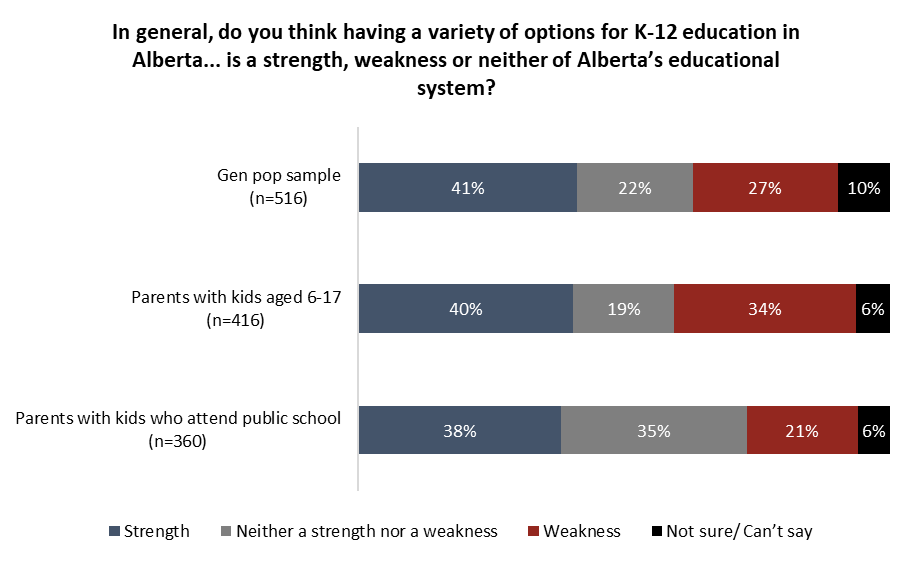
The diversity of school options available to Alberta’s parents – charter, independent, home education, and alternative language and religious programs – is more likely to be viewed as a strength by Albertans (41%) than a weakness (27%).
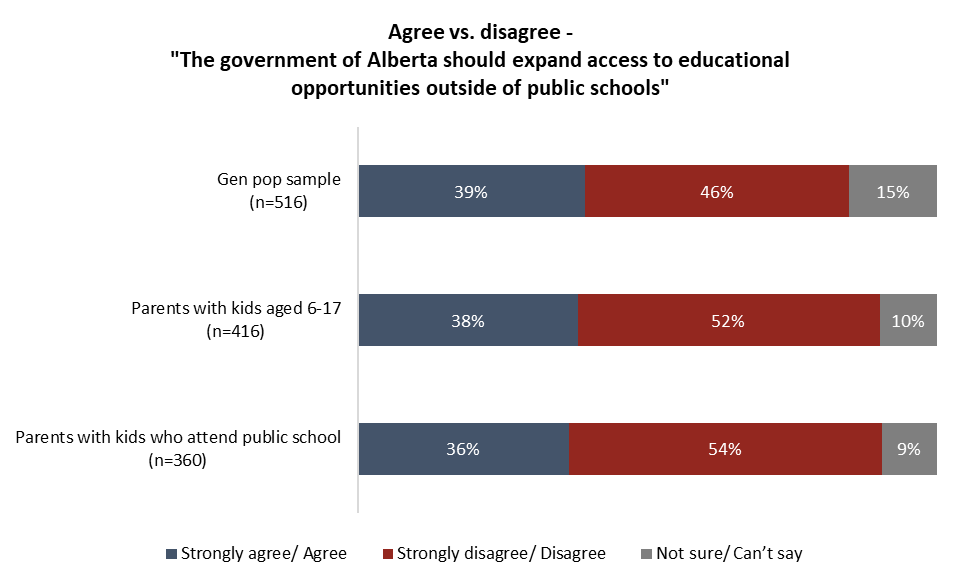
But Albertans are more divided when it comes to whether they believe that the government should be expanding educational opportunities outside of the public realm (39%) or not (46%). There is more agreement that the government should try to diversify the options available under the public banner (77%).
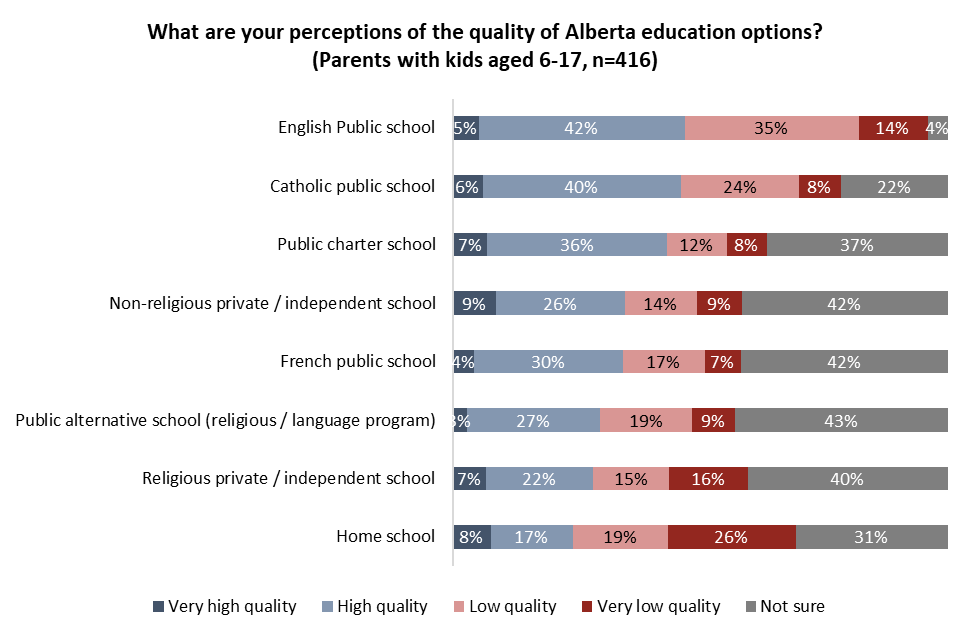
Indeed, public charter schools are more likely to be viewed as high quality (43%) than low quality (20%) by Alberta parents of school-aged children. Those same parents also are more positive than not about the quality of non-religious independent schools (net +11 high quality). But many Alberta parents admit they do not know enough to assess the quality of many of the education options available to K to 12 students, including public alternative schools (43% not sure), public charter schools (37%), religious independent schools (40%), and non-religious independent schools (42%).
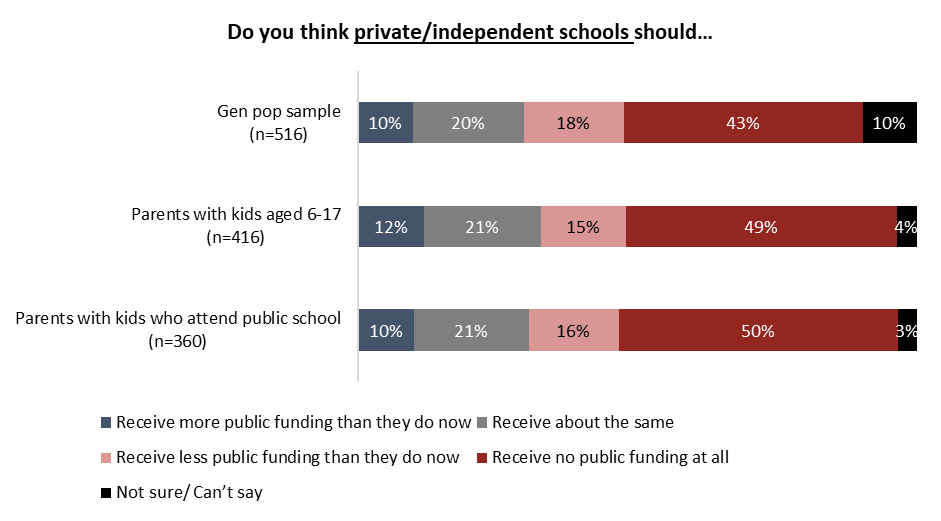
Despite this, there is a resistance to public funding of independent schools. Two-thirds (64%) of parents of school-aged kids believe either independent schools should receive less (15%) or no funding at all (49%) from the government. This is driven by the belief held by two-thirds of parents (65%) that independent schools are taking away resources that should be going to public schools.
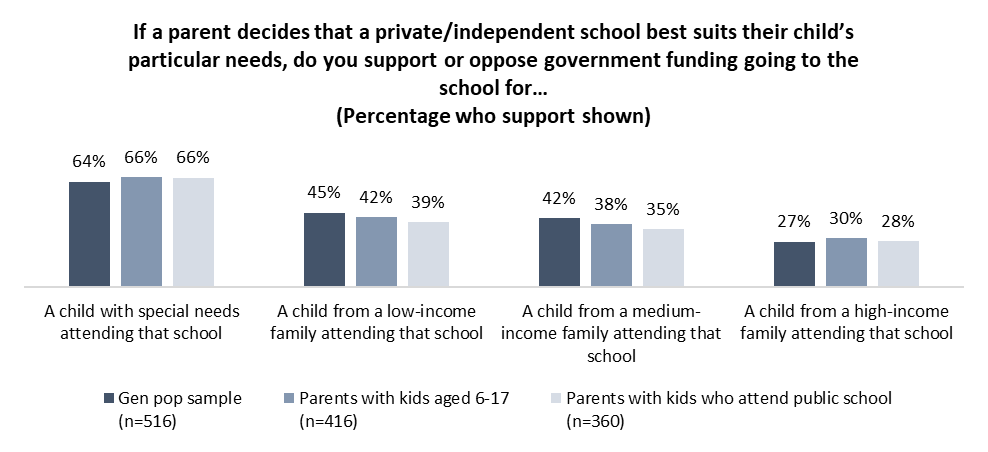
However, there is a contrast between the blanket resistance to public funding of independent schools and scenarios where those schools may best fit a child’s needs. Two-thirds (66%) of parents with school-aged kids say they support government funding going to an independent school for a child with special needs if their parent decides the school best suits their child’s education.
More Key Findings:
- Parents with school-aged kids are split as to the quality of public schools. Half (47%) describe them as providing a high- or very high-quality education; half (49%) believe instead they are providing a low- or very low-quality education.
- Two-thirds (67%) of parents with school-aged children believe “all Alberta students should have government-funded access to the type of education that best suits their individual needs”.
INDEX
Part One: Assessments of Alberta’s public education system
-
Most believe it’s unhealthy
-
Parents split on quality of English public schools
Part Two: The K-12 ecosystem
-
Two-in-five say diversity of school options ‘strength’ of system
-
But more want expansion of options under public umbrella than outside of it
-
Most want independent schools to receive less government funding
Part Three: A role for independent schools?
-
Most support government funding following special needs kids to independent schools
-
Albertans split as to whether independent schools play ‘important’ role in system
Part One: Assessments of Alberta’s public education system
Most believe it’s unhealthy
The fall teachers’ strike cast a spotlight on Alberta’s education system and raised questions on the distribution of resources within the public education ecosystem.
Related: Teachers’ Strike: Most Albertans side with teachers as they criticize UCP’s handling of education
The strike may be over, but the resolution did little to quell concerns about Alberta’s public education system. By a two-to-one margin, Albertans are more likely to believe the public education system is ailing (63%) than it is strong and healthy (29%). And the margin grows among parents with kids who attend public schools (68% to 30%):

This report includes an additional sample of Albertan parents with kids aged six to 17. Within that sample, most (60%) are parents of kids who attend English public school. One-in-five (19%) have a child that attends Catholic public school. More than two-in-five (45%) of parents employ some type of choice option – religious, language, charter, independent, etc. – whether within or outside of public schools. Parents are less likely to be familiar with the other options within the Alberta K-12 education system:

Parents split on quality of English public schools
Although most parents worry about the health of the public school system in Alberta, they are split when asked to assess the quality of public schools. Half (47%) of parents with kids aged six to 17 believe English public schools are high or very high quality, while a similar number (49%) would describe the education they provide as low or very low quality.
Catholic public schools (46% high, 32% low), public charter schools (43% high, 20% low) and French public schools (34% high, 24% low) receive higher net grades. Non-religious independent schools (35% high, 23% low) also receive a net positive grade. Parents are split in their assessments of religious independent schools (29% high, 31% low) and more negative than not of home schooling (25% high, 45% low).
It’s worth noting the lack of familiarity with many of these options. Two-in-five Albertan parents say they do not know enough about public charter schools (37%), non-religious independent schools (42%), French public schools (42%), public alternative schools (43%) and religious independent schools (40%) to assess whether they are high or low quality:

Part Two: The K-12 ecosystem
Two-in-five say diversity of school options ‘strength’ of system
For Albertans, the variety of options in the K-12 system is more likely to be viewed as a strength (41%) than a weakness (27%). Parents with kids who attend public school are less likely to view it as a weakness (21%) than Albertans in general (27%) and instead more likely to say it is neither a strength nor a weakness (35% vs. 22%):

As well, there is a strong belief that Alberta students should have government-funded access to the type of education that best suits their needs. Two-thirds (67%) of parents agree, outnumbering those who disagree (25%) by more than two-to-one:

But more want expansion of options under public umbrella than outside of it
The desire however for most parents is that the education options be expanded within public schools. More than three-quarters (77%) of Albertans, and more than four-in-five (84%) parents of school-aged kids, believe the government of Alberta should expand opportunities within public schools:

Whereas when the same statement is presented to respondents on whether the government should expand educational opportunities outside of the public system, Albertans lean towards disagreeing (39% vs. 46%). Parents of school-aged children are more likely to disagree (52%):

Most want independent schools to receive less government funding
The public funding of independent schools became a focal point during Alberta’s fall teacher strike despite being an issue outside of the scope of the strike itself. Most Albertans would prefer if independent schools received less (18%) or no (43%) public funding, the latter a stronger belief of parents of school-aged kids (49%) and those in public schools (50%):

Underlying this desire for less public funds for independent schools is the belief that those schools take away resources from public schools. Three-in-five (59%) Albertans, and two-thirds of parents with kids (65%) and parents with kids in public schools specifically (67%), say this. Independent school proponents have argued that these schools save the government money because they receive 30 per cent less of the per-student operational funding compared to public schools. One-quarter (27%) of Albertans, and one-quarter of parents, agree:

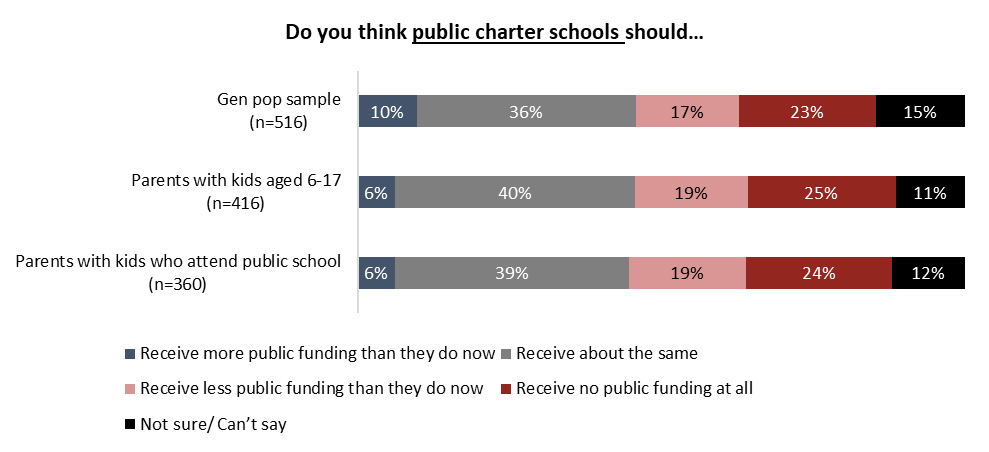
Albertans appear more willing to allocate public funding to public charter schools than independent schools. More than two-in-five (46%) believe public charter schools should receive more or the same amount of money they do currently per student while two-in-five (40%) believe they should receive less or none:
Part Three: A role for independent schools?
Most support government funding following special needs kids to independent schools
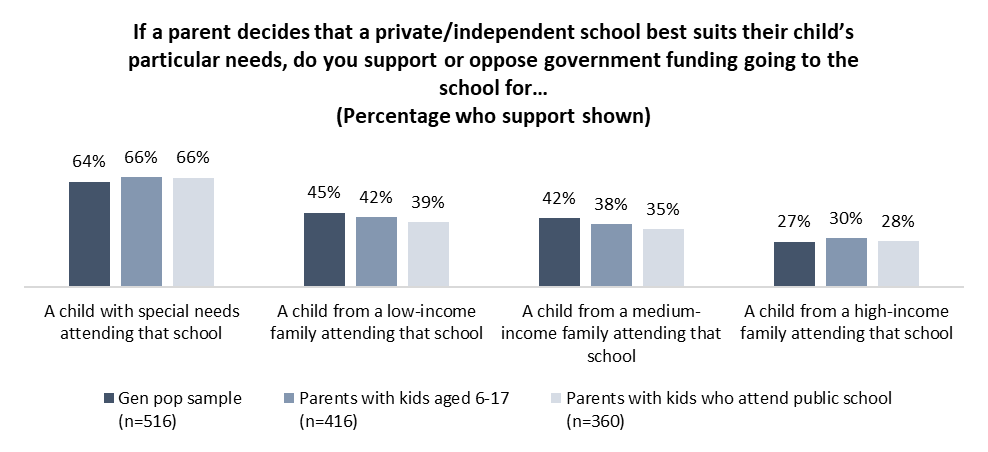
As noted above, two-thirds (64%) of Albertans believe all students should have “government-funded access” to options that best suit their needs. What follows that belief is that a similar number of Albertans (64%) also say that children with special needs should have government-funded access to independent schools.
There is less agreement that government funding should follow children from low-income families (45%), medium-income families (42%) or high-income families (27%) to independent schools even if parents decide those schools best meet their child’s needs:
Albertans split as to whether independent schools play ‘important’ role in system
Although there is little appetite for increased public funding for independent schools, Albertans are split as to whether they play “an important role in meeting Albertan student needs”. Two-in-five (43%) agree they do; a similar number (40%) disagree.
Parents with school-aged kids (49%) and those with kids in public schools (50%) are more likely to disagree:

About ARI
The Angus Reid Institute (ARI) was founded in October 2014 by pollster and sociologist, Dr. Angus Reid. ARI is a national, not-for-profit, non-partisan public opinion research foundation established to advance education by commissioning, conducting and disseminating to the public accessible and impartial statistical data, research and policy analysis on economics, political science, philanthropy, public administration, domestic and international affairs and other socio-economic issues of importance to Canada and its world.
About Cardus
Founded in 1974, Cardus is a non-partisan think tank dedicated to clarifying and strengthening, through research and dialogue, the ways in which society’s institutions can work together for the common good.
Survey Methodology
The Angus Reid Institute in partnership with Cardus conducted an online survey from Jan. 27-30, 2026, among a randomized sample of 516 Canadian adults living in Alberta who are members of Angus Reid Forum. The sample was weighted to be representative of adults nationwide according to region, gender, age, household income, and education, based on the Canadian census. For comparison purposes only, a probability sample of this size would carry a margin of error of +/- 4 percentage points, 19 times out of 20.
This survey also included an additional sample of 416 Canadian adults living in Alberta who are parents of kids aged 6 to 17.
Discrepancies in or between totals are due to rounding. The survey was self-commissioned and jointly paid for by ARI and Cardus.
For detailed results by age, gender, region, education, and other demographics, click here.
For detailed results of the additional sample of parents with school-aged kids, click here.
For PDF of full release, click here.
For the questionnaire, click here.
MEDIA CONTACT:
Daniel Proussalidis, Director of Media and Public Relations, Cardus: 613.899.5174 dproussalidis@cardus.ca
Jon Roe, Senior Research Associate: 825.437.1147 jon.roe@angusreid.org