


Majority believe American consumers, not foreign countries, are paying for Trump’s tariffs
March 11, 2026 – Trade negotiations between Canada and the U.S. have restarted, but there appears to be no end in sight to the American tariffs on Canadian steel, aluminum, cars, lumber, copper and more from the administration of U.S. President Donald Trump.
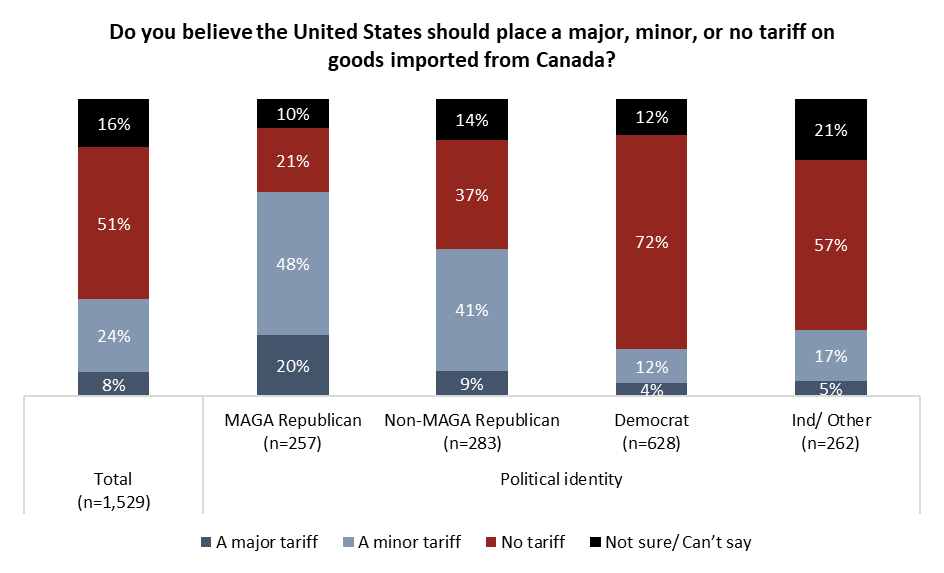
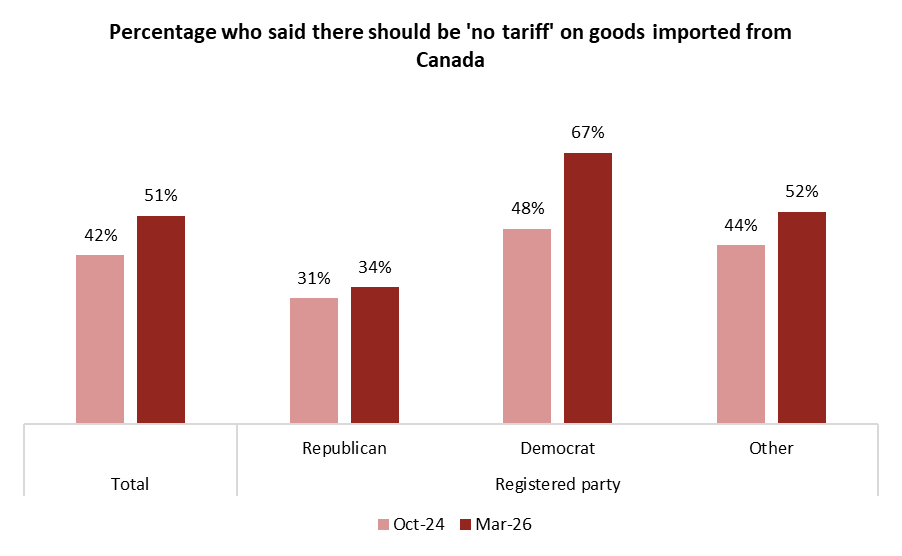
According to new data from the non-profit Angus Reid Institute, if half (51%) of Americans had their way, there would be no tariff on Canadian goods entering their country. This is more than the proportion who said the same in October 2024, during the presidential election campaign, when two-in-five (42%) said there should be no tariffs on Canada. MAGA Republicans are more likely to want a tariff but prefer a minor one (48%) to a major one (20%).
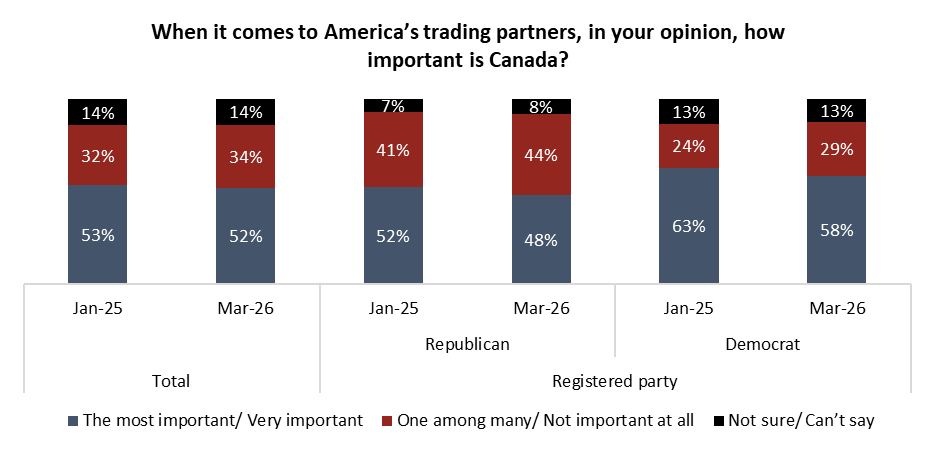
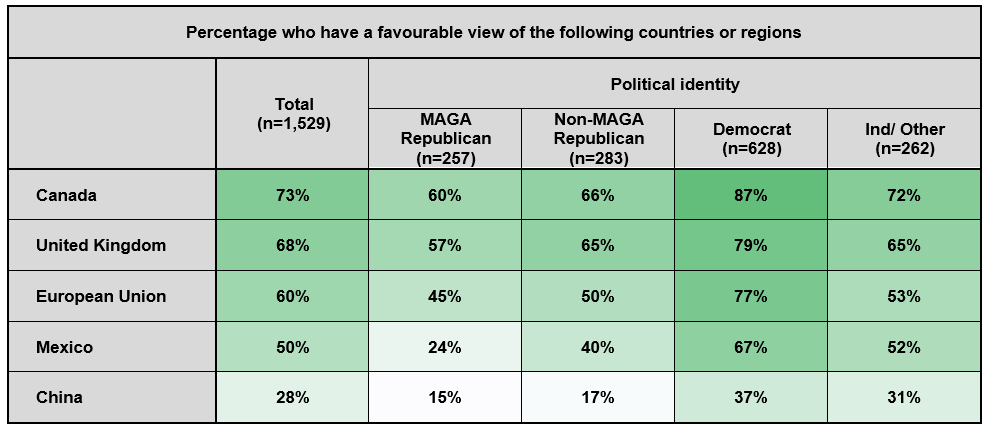
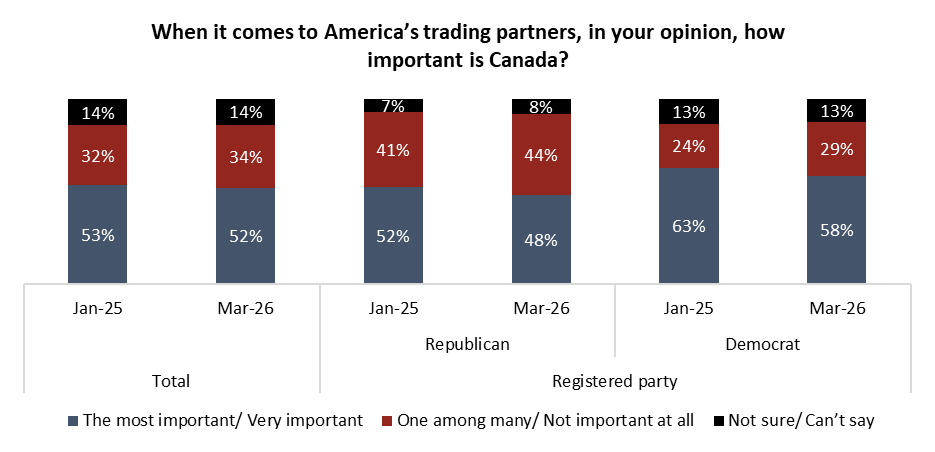
The recent acrimonious U.S.-Canada trade relationship, fueled by the economic hostility of the Trump administration, is not reflected in the general views of Americans. Three-quarters (73%) in the U.S. say they have a favourable view of Canada. There also has been no statistical change in the percentage of Americans (52%) who describe Canada as “the most important” or a “very important” trading partner to the U.S.
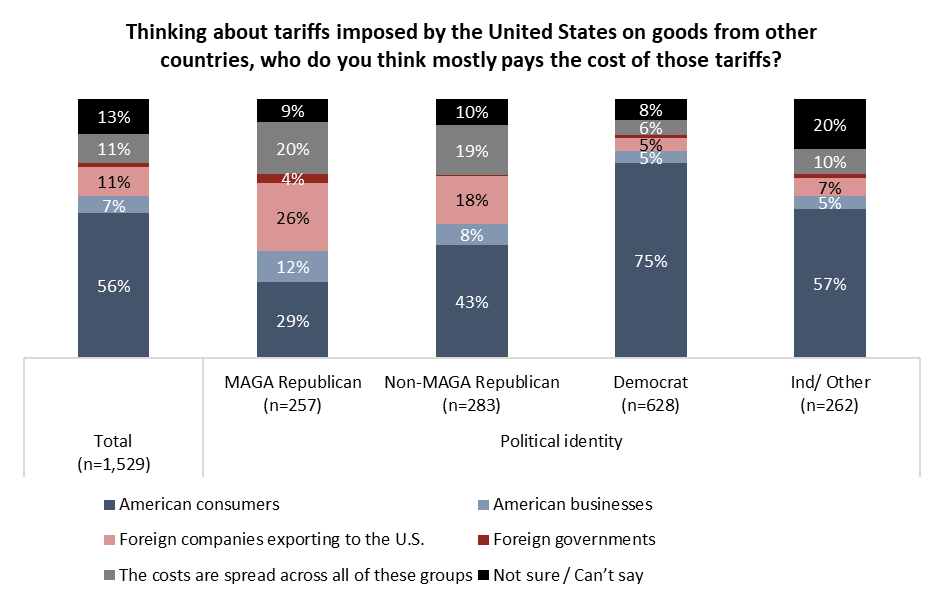
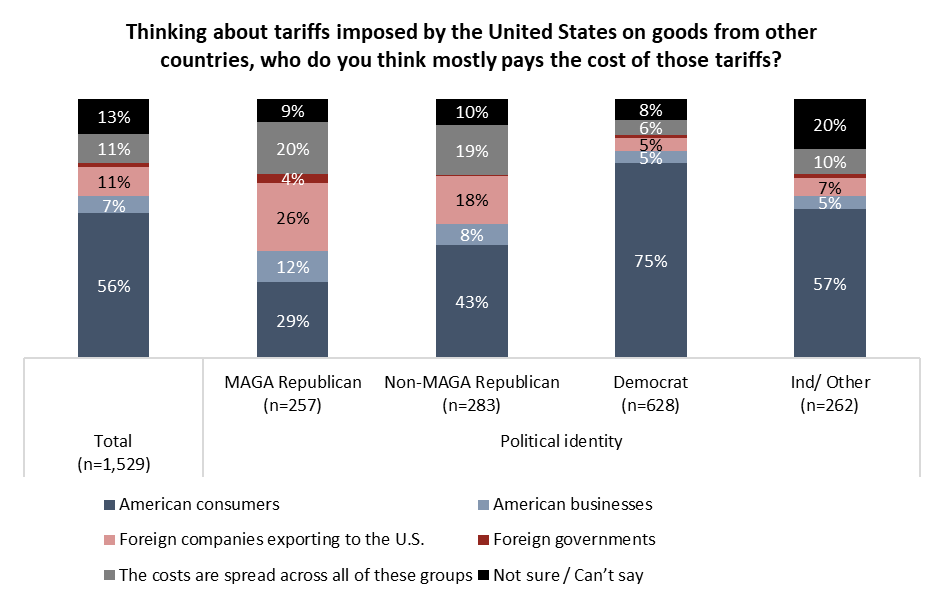
In the U.S., much like in Canada, the high cost of living and inflation is the top issue (46%) according to residents. At the same time, more Americans say Trump’s tariffs are mostly born by Americans (63%), either consumers (56%) or businesses (7%), than believe it is instead foreign companies or governments (13%) bearing the brunt of them.
More Key Findings:
- The backlash against tariffs on Canada is largely driven by registered Democrats. Among that group, there has been a 19-point jump in those who say there shouldn’t be tariffs on Canadian goods (48% in Oct. 2024; 67% now).
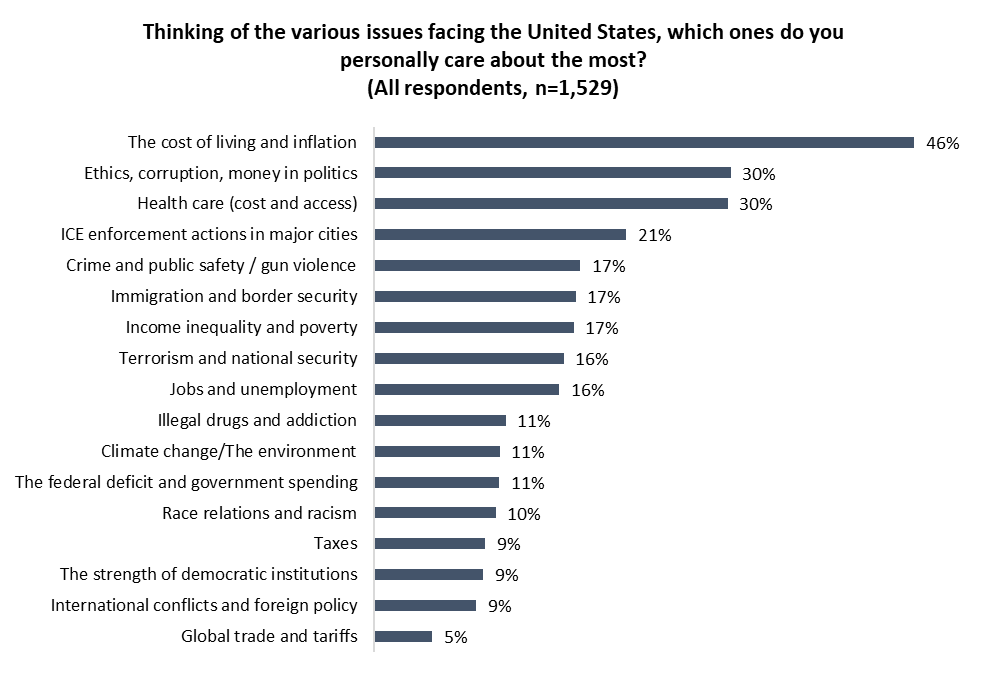
- Americans select the cost of living and inflation as the top issue (46%), above corruption in politics (30%), health care (30%) and the recent ICE enforcement actions (21%).
- Americans are more likely than not to want to keep the trilateral USCMA together by a two-to-one margin (48% to 23%). Trump’s MAGA Republican base are more in favour (50%) of splitting Mexico and Canada and negotiating separate deals than opposed (25%).
INDEX
Part One: Views of Canada and the USCMA
-
Three-quarters view Canada positively
-
Half describe Canada as an ‘important’ trading partner
-
Half want no tariffs on Canada
-
Half say keep USCMA; one-quarter want separate deals
Part Two: Perceptions of Trump’s case for tariffs
-
Most Republicans approve of Trump’s performance on cost of living, tariffs
-
But who bears the costs of tariffs?
Part Three: Americans’ top issues
-
Cost of living, corruption and health care
-
Variations based on political identity
Part One: Views of Canada and the USCMA
The first year of U.S. President Donald Trump’s second term has been a trying one for Canada-U.S. relations. Among Canadians, there has been a great sense of betrayal as the leader of their country’s top trading partner, and once closest international friend and ally, has levied tariffs and mused about annexation. Canadians’ favourable views of the U.S. have plummeted 37 points from February 2023. More prefer their government approach their southern neighbour as “an enemy” or “potential threat” (39%) than on friendly terms or as an ally (22%).
Related:
- Fear Factor: Anxiety over Canada-US relationship has four-in-five Canadians worried about the year ahead
- Liberals ascend to 13-point lead in vote intention as Canadians continue to demand hard line on U.S. trade
Three-quarters view Canada positively
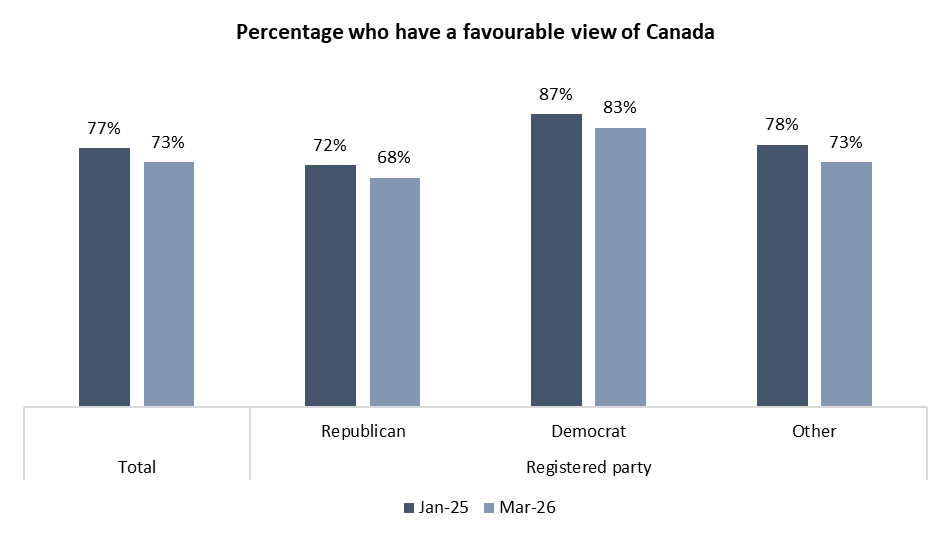
Anger on part of Canadians in response to the White House’s stance appears to be isolated to one side of the 49th parallel. On the other side, Americans continue to view Canada with much positivity. Three-quarters (73%) of Americans have a favourable view of Canada, including a majority of Republicans who personally identify as part of the Make America Great Again (MAGA) movement (60%). Canada is assessed higher on this metric than the United Kingdom (68% favourable) or the European Union (60%):
And Americans’ positive assessments are little changed despite the counter actions taken by the Canadian government in response to the U.S. tariffs. Canadians have changed their travel plans to avoid U.S. destinations and stopped imbibing American liquor as provincial liquor boards have taken U.S. booze off the shelves, both actions labelled as “nasty” by the American ambassador to Canada.
This has not coloured (or, colored) Americans’ views in a significantly more negative light. In January 2025, prior to Trump’s inauguration, three-quarters (77%) of Americans viewed Canada favourably. The four-point drop over the past 14 months is barely outside the statistical margin of error, though it is seen across all political identifiers:
Half describe Canada as an ‘important’ trading partner
Canada and Mexico typically rank first or second among the U.S.’s top trading partner countries. Although the U.S.’s trade diversity means that Canada as a percentage of total U.S. trade is lower than vice versa, Canada is a top source of key goods including potash and oil.
And despite months of claims from Trump that the U.S. doesn’t need Canadian goods, Americans are more likely to describe Canada as an “important” trading partner than not. These views have also shifted little during the first year of Trump’s second term:
Half want no tariffs on Canada
The USCMA agreement, a free trade agreement signed by Trump during his first term to replace the North American Free Trade Agreement (NAFTA), ensures that most trade between Canada and the U.S. crosses the border tariff free. Canadian exports not covered by the USCMA are subject to a 35 per cent tariff rate by the United States, but since most goods are, the effective tariff rate Canada has been paying on exports to the U.S. is estimated to be around five per cent.
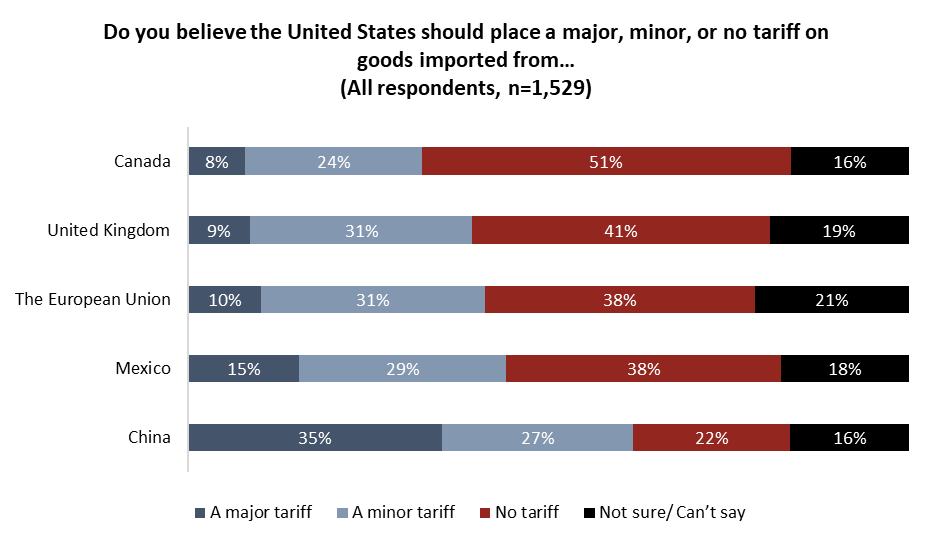
Half (51%) of Americans would prefer there to be no tariff on Canadian goods, and those who want a tariff prefer a minor one (24%) to a major one (8%). Among key American trade partners, Americans are the least likely to want a tariff on Canadian goods:
Trump’s MAGA base are distinctively more pro-tariff than other political groups, but even among MAGA Republicans more prefer a minor tariff on Canada (48%) than a major one (20%). Most Democrats (72%) and Independents (57%) would prefer to see no tariff on Canadian goods at all:
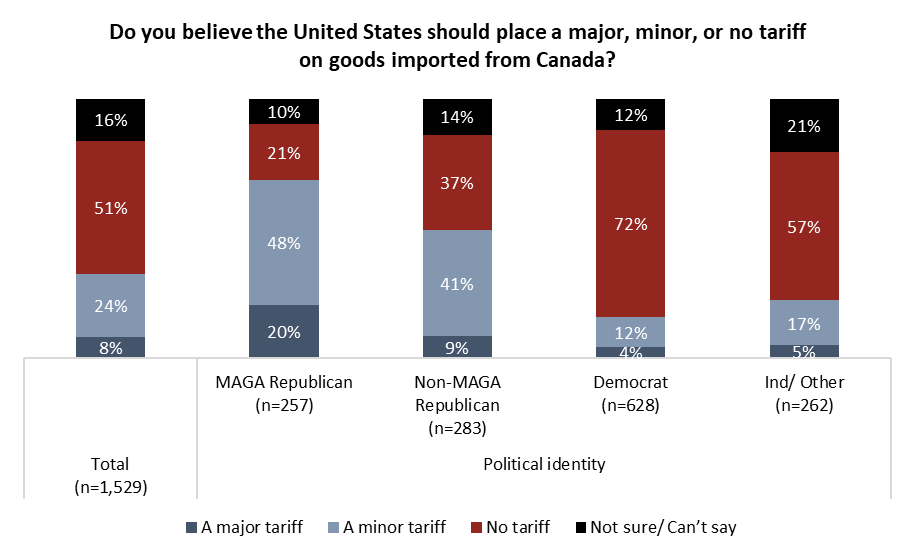
The proportion of Americans who would prefer “no tariff” on Canada has grown from prior to the U.S. election in November 2024. Then, two-in-five (42%) said they wanted no tariff on Canada. The rise has largely been driven by a shift in opinion by registered Democrats, who oppose tariffs on Canada at a rate of two-thirds (67%):
Half say keep USCMA; one-quarter want separate deals
The future of U.S.-Canada trade hangs on what happens during this year’s review of the USCMA trade deal. Trump is considering pulling the U.S. out of the deal and looking for separate agreements with Canada and Mexico. The deal does not expire until 2036.
Americans, by a two-to-one margin, prefer keeping the existing USCMA (48%) over separate deals with Canada and Mexico (23%). But the preferences of Trump’s base are inverted: half of MAGA Republicans prefer individual deals (50%):

Part Two: Perceptions of Trump’s case for tariffs
In February, Trump’s State of the Union address provided an opportunity for the president to tout the accomplishments of his second term. He claimed that “inflation is plummeting” over the past year as he’s instituted a broad swath of policies affecting the U.S. economy. A PBS fact check has found that inflation “has dipped modestly” compared to the previous year under Trump’s predecessor Joe Biden.
Most Republicans approve of Trump’s performance on cost of living, tariffs
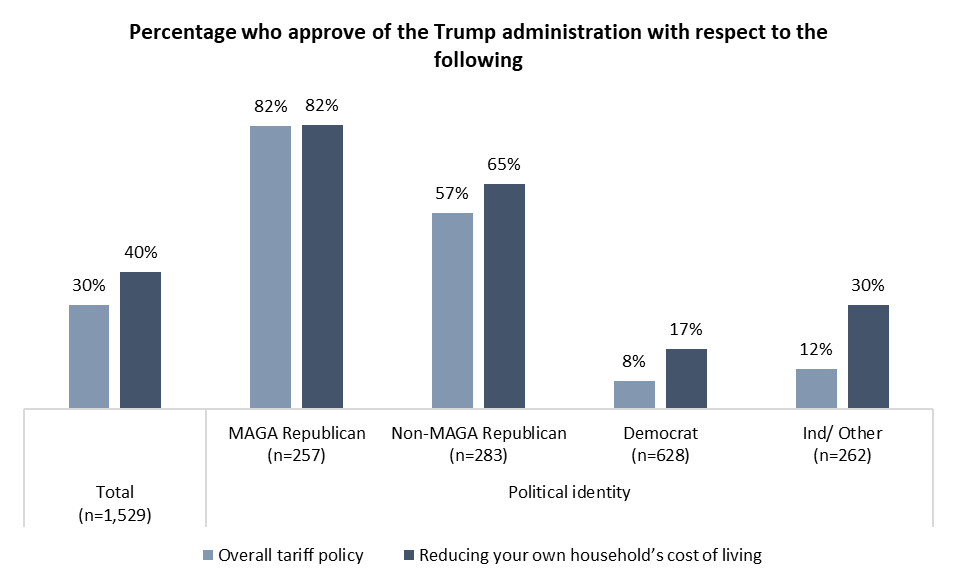
Overall, Americans are split on Trump’s handling of inflation: two-in-five (40%) approve and slightly more disapprove (45%). Approval is highest among MAGA Republicans (82%). Non-MAGA Republicans also offer a thumbs-up at a majority level (65%).
Americans are more critical of Trump’s tariff policies. Approaching three-in-five (57%) say they disapprove, nearly double the rate of approval (30%). Again, Republicans offer the most approval on this file:
But who bears the costs of tariffs?
Although inflation has cooled under Trump, his administration’s tariffs have had an inflationary effect. Research by the Board of Governors of the Federal Reserve system has shown that tariffs gradually raised retail prices in 2025. The New York Federal Reserve President claimed that the tariffs are keeping the Federal Reserve from keeping inflation under its two-per-cent goal. A research paper by the New York Federal Reserve found that 90 per cent of the added cost of tariffs has been passed on to American producers and consumers.
Two-thirds (63%) of Americans believe that tariffs are mostly paid for by American consumers (56%) or businesses (7%). One-in-ten (11%) say that it is more foreign companies who are paying for tariffs, while a similar number (11%) believe the costs are spread evenly among domestic consumers, businesses and foreign companies and governments.
This perception is influenced by politics. A plurality (41%) of MAGA Republicans believe tariffs are born by American consumers and businesses, but a significant minority (30%) believe foreign companies and governments are paying Trump’s tariffs. The belief that Americans are largely the ones paying for the tariffs rises among non-MAGA Republicans (51%) and even more so among Democrats (80%):
Part Three: Americans’ top issues
Cost of living, corruption and health care
Inflation may have eased compared to a few years ago, but it is selected as the top issue by 46 per cent of Americans, followed by corruption and money in politics (30%) and health care (30%).
Notably these domestic concerns are far above international conflicts and foreign policy (9%) and global trade and tariffs (5%).
Variations based on political identity
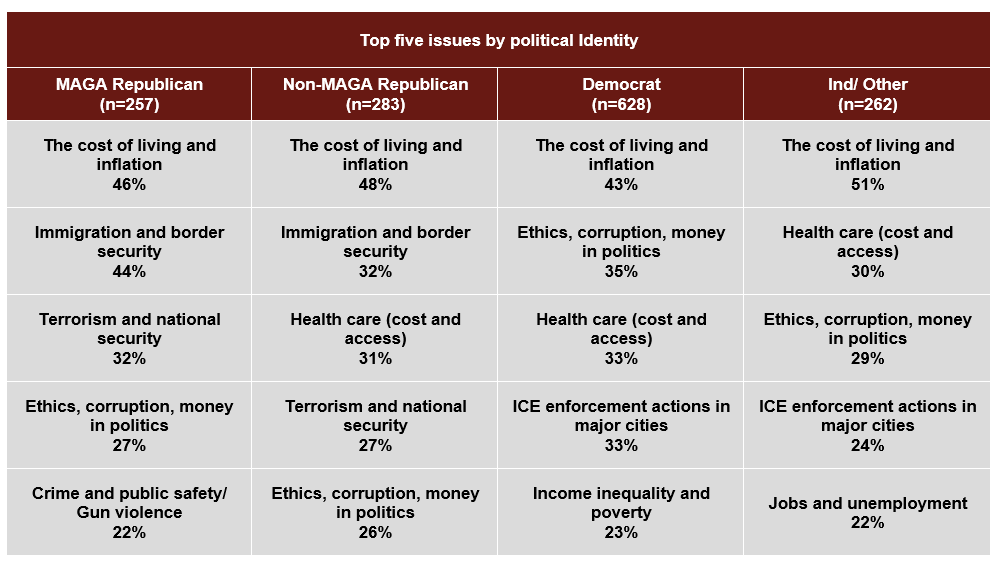
Political identity appears to heavily influence which of these issues are prioritized. The high cost of living ranks high across the political spectrum. Political ethics is also a top issue for both Republicans and Democrats, but there is likely disagreement on whose ethics are under question.
Republicans who align themselves with the MAGA movement are more concerned about border security (44%) and public safety (22%) than others. There is a divide between MAGA and non-MAGA Republicans on the importance of the issue of health care. And Democrats are more concerned with the ICE enforcement and its fallout than Republicans:
| METHODOLOGY:
The Angus Reid Institute conducted an online survey from March 2-5, 2026 among a representative randomized sample of 1,529 American adults who are members of Angus Reid Forum USA. For comparison purposes only, a probability sample of this size would carry a margin of error of +/- 3 percentage points, 19 times out of 20. Discrepancies in or between totals are due to rounding. The survey was self-commissioned and paid for by ARI. Detailed tables are found at the end of this release. |
For detailed results by age, gender, region, education, and other demographics, click here.
For PDF of full release, click here.
For the questionnaire, click here.
MEDIA CONTACTS:
Shachi Kurl, President: 604.908.1693 shachi.kurl@angusreid.org @shachikurl
Dave Korzinski, Research Director: 250.899.0821 dave.korzinski@angusreid.org
Jon Roe, Senior Research Associate: 825.437.1147 jon.roe@angusreid.org