


Just one-quarter say U.S. should be viewed as an ally or friend – a near 50-point drop from 2023
February 24, 2026 – As American President Donald Trump addresses the union this evening, Canadians may have some interest in the chosen topics, which will likely reference the Supreme Court’s recent decision to strike down his tariffs, and even Canada’s heartbreaking losses in the Olympic hockey tournament, both men’s and women’s. If Trump’s speech is anything like his first year, Canadians will likely be upset.
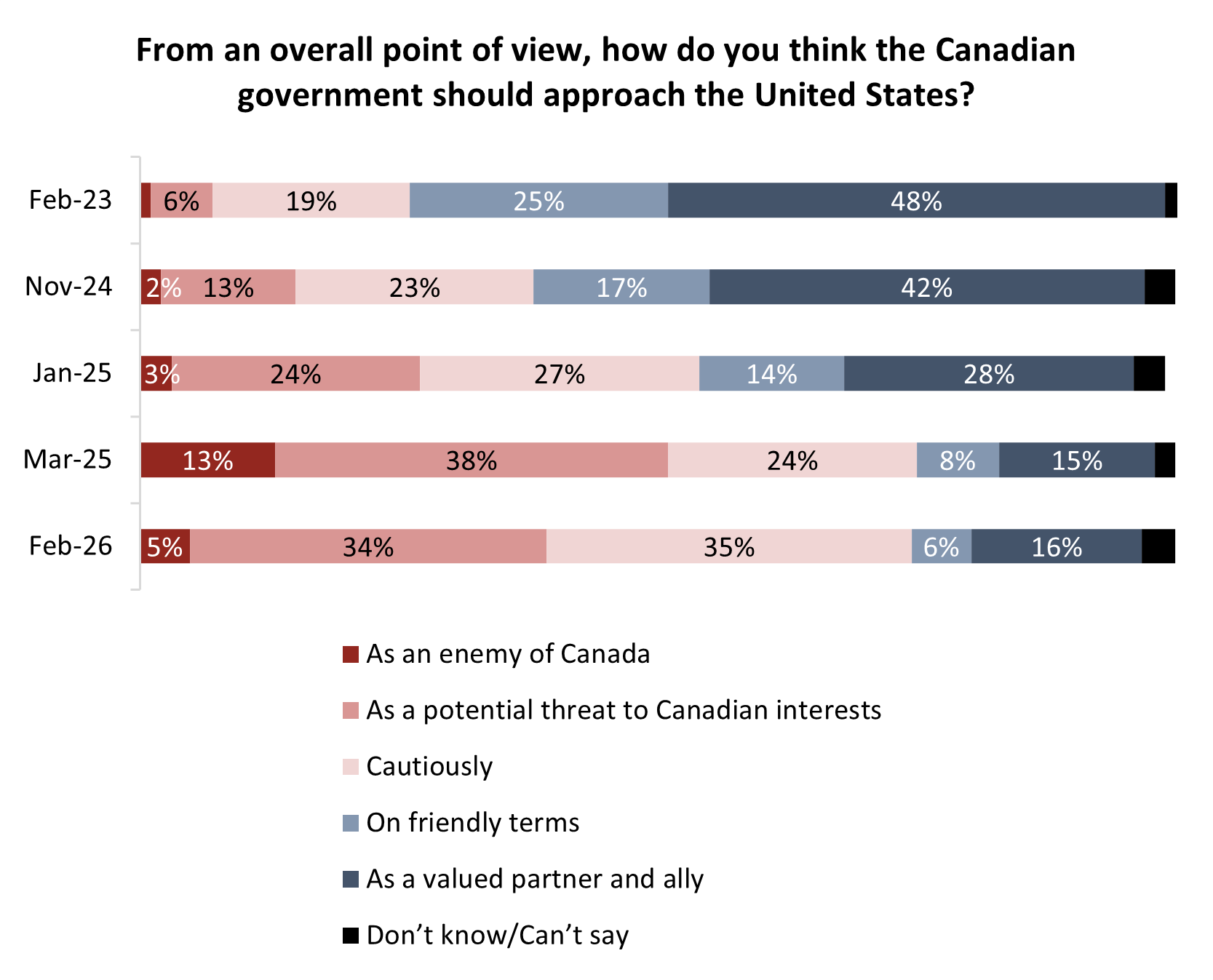
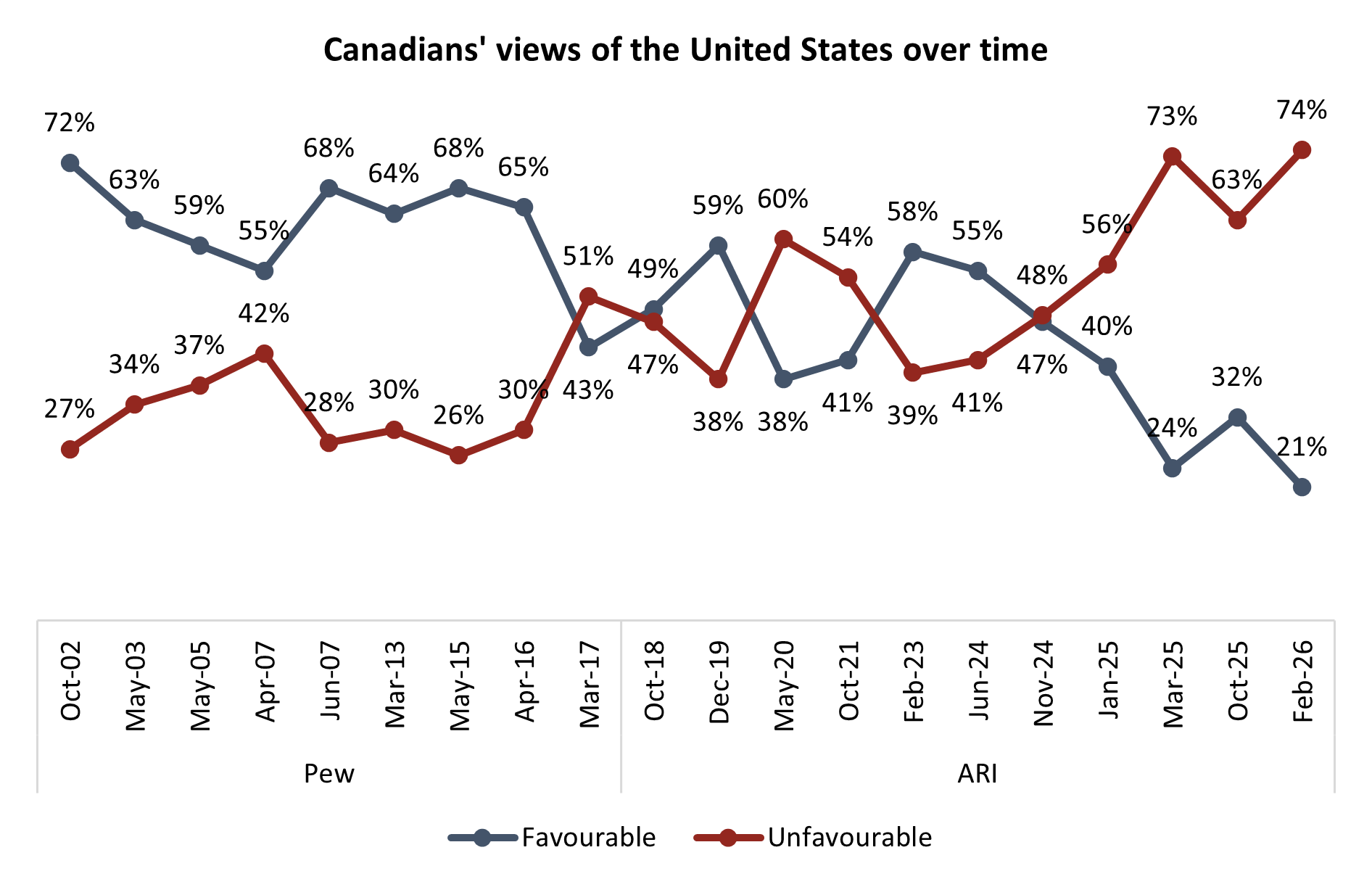
New data from the non-profit Angus Reid Institute finds Canadians’ views of the U.S. under Trump hitting a new low, with just 21 per cent holding a favourable view of the country. Further, residents are now three-times as likely to prefer that Canada approach the U.S. as a potential threat or with caution (69%), than they are to treat their southern neighbour as a friend or ally (22%).
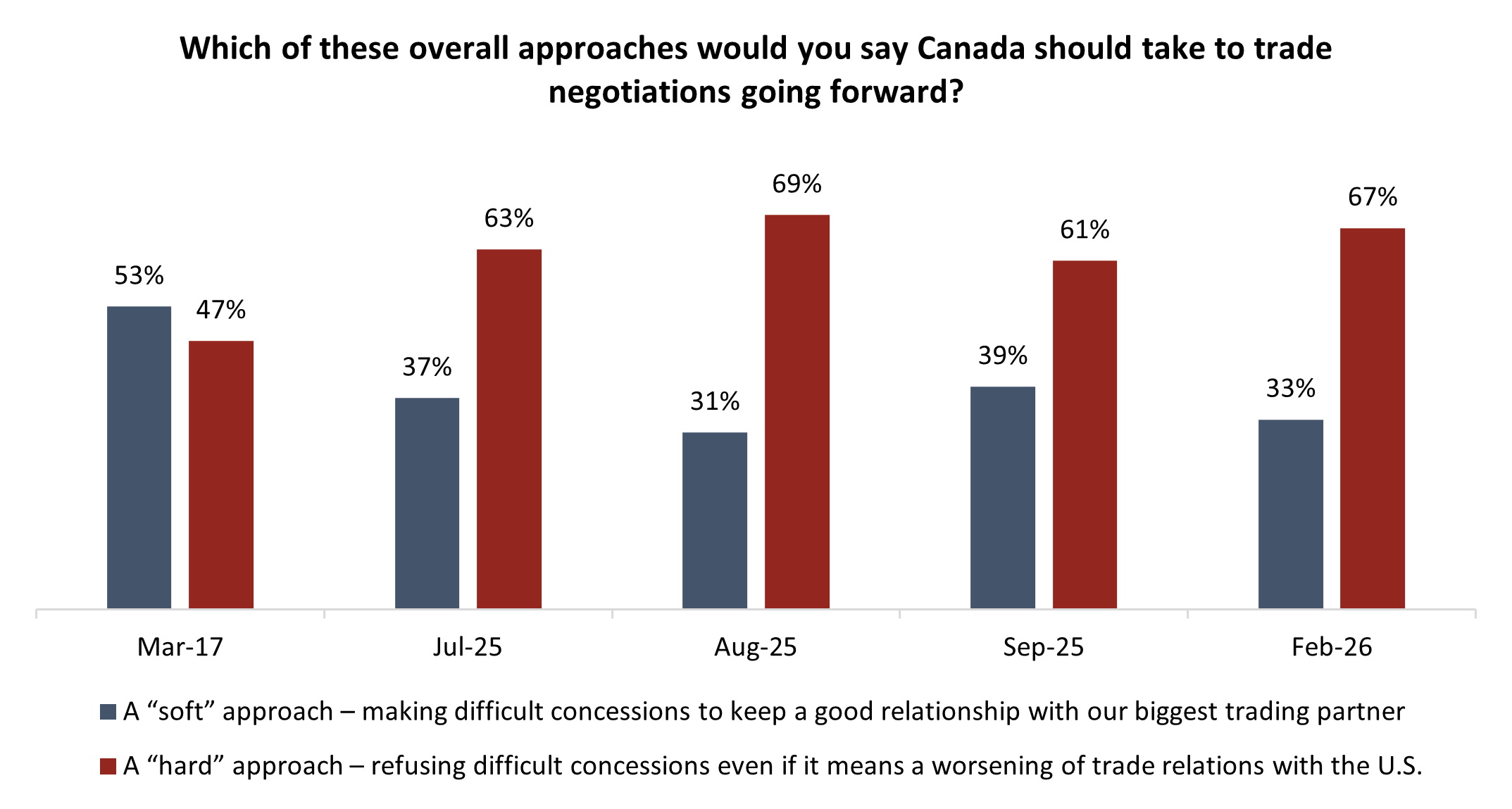
This approach includes, evidently, a preference for taking a hard line in trade negotiations (67%) over a soft one (33%). This is a view that Canadians have consistently voiced since Prime Minister Mark Carney succeeded Justin Trudeau.
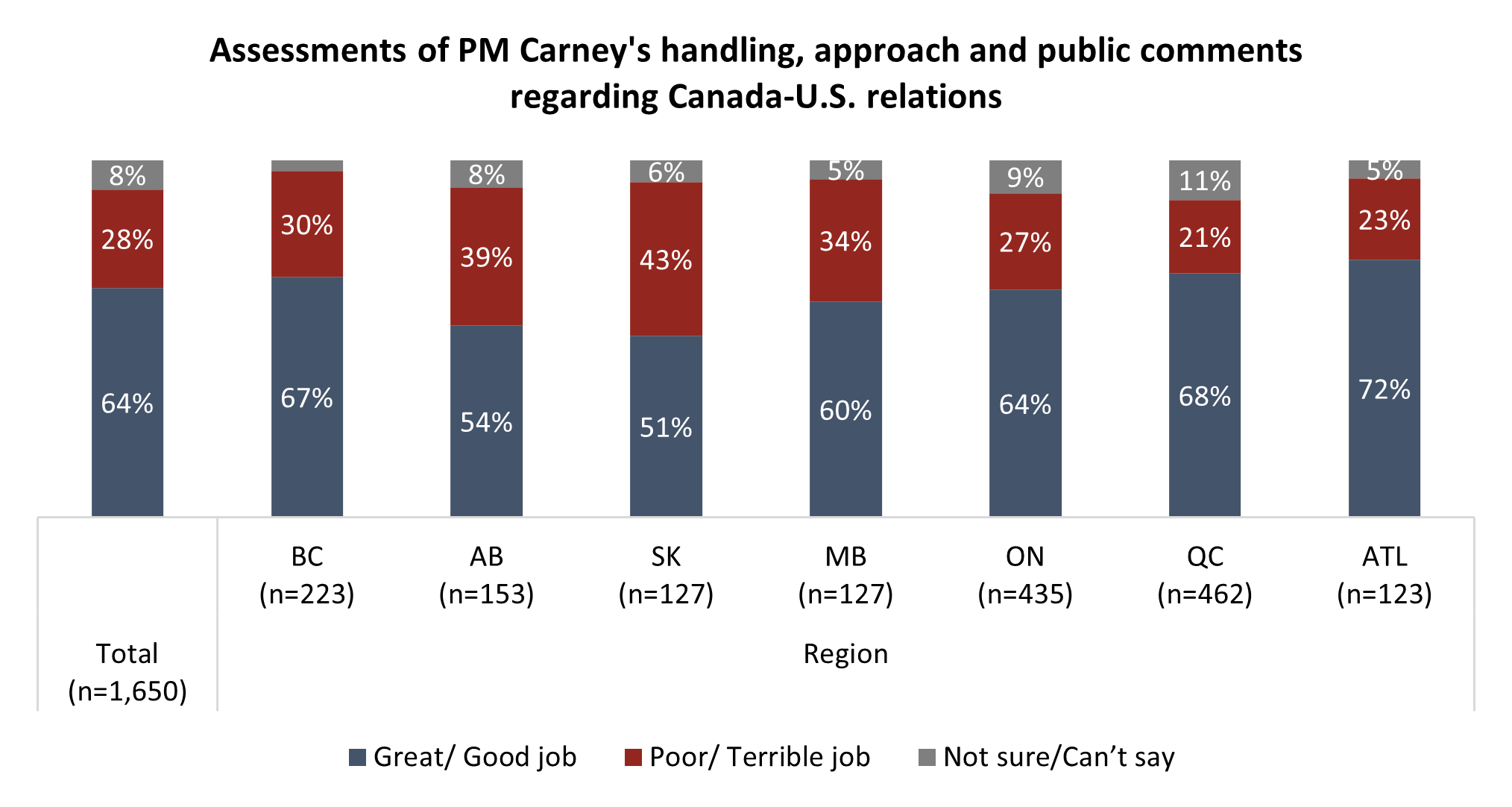
Overall, two-thirds (64%) say Carney has done a good or great job handling the Canada–U.S. relationship so far — nearly identical to the proportion (63%) who approve of his overall performance as prime minister.
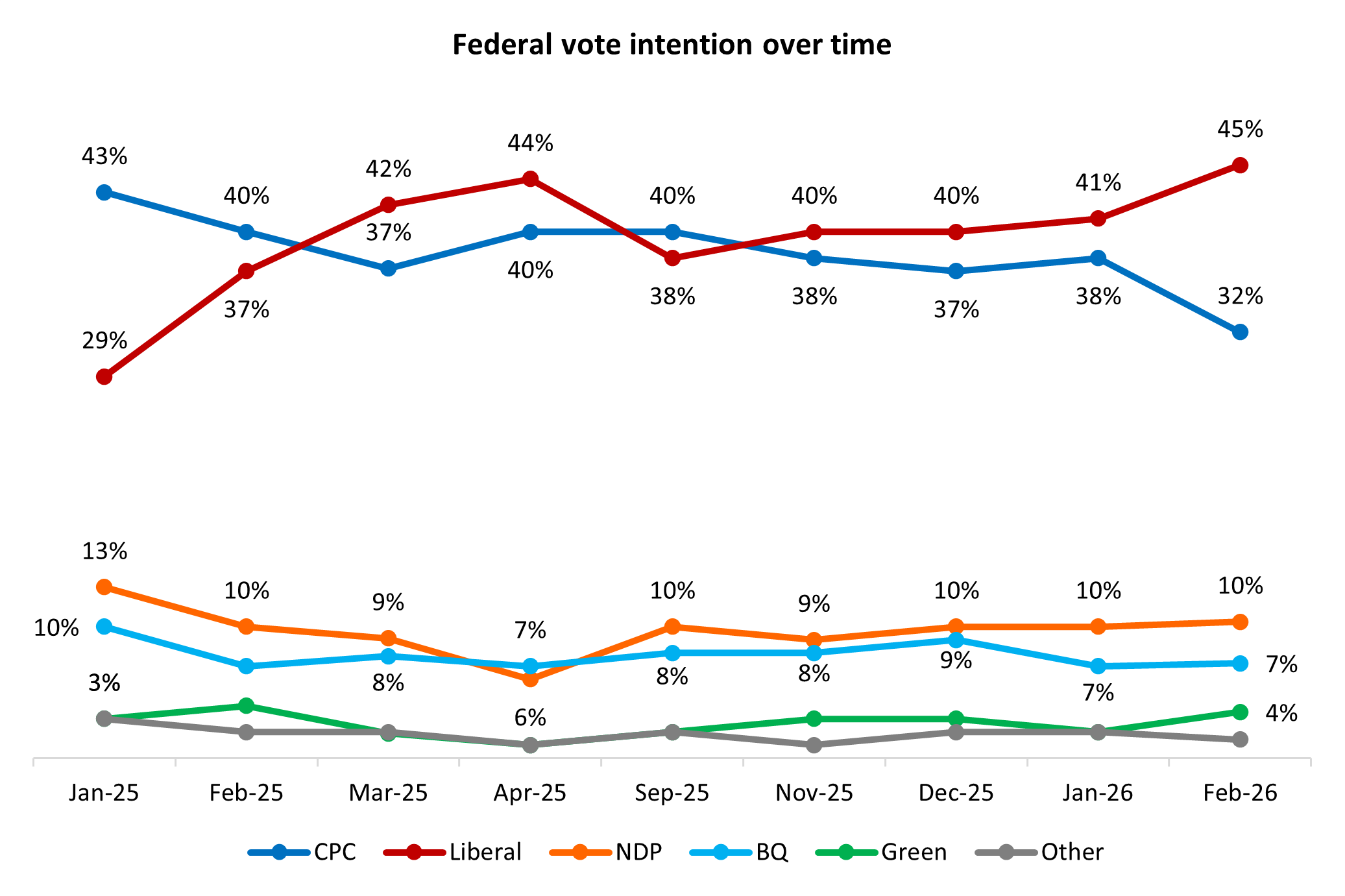
That approval appears to be translating into improved electoral prospects for the Liberals. Currently, 45 per cent say they would vote for the LPC in a future federal election, compared to 32 per cent who prefer the Conservative Party. The resulting 13-point lead marks a 10-point increase in the Liberals’ advantage compared to last month’s tracking.
INDEX
Part One: U.S. relations
- Carney approved of while most provincial premiers panned
- Hard line approach demanded by Canadians
- Favourability of United States reaches new low
- Fewer than one-quarter say U.S. should be approach as a friend or ally
Part Two: The federal landscape
- Carney continues to garner approval
- A Poilievre setback?
- Vote intention gap widens significantly
Part One: U.S. relations
Carney approved of while most provincial premiers panned
Prime Minster Mark Carney has endured a rocky relationship with U.S. President Donald Trump, as positive public appearances have been undermined by consistently critical social media posts for nearly a year. Now, with Trump reportedly considering ending the free trade agreement his administration negotiated in his first term – the USMCA – concerns are shifting to what that will mean and whether negotiations for a bilateral deal with the U.S. is in Canada’s future.
Asked how they feel Carney is handling Canada-U.S. relations so far, as he approaches the one-year mark of taking office, most are positive, with 64 per cent saying he has done a good or great job. This praise includes a majority in more unlikely places, like Alberta and Saskatchewan.
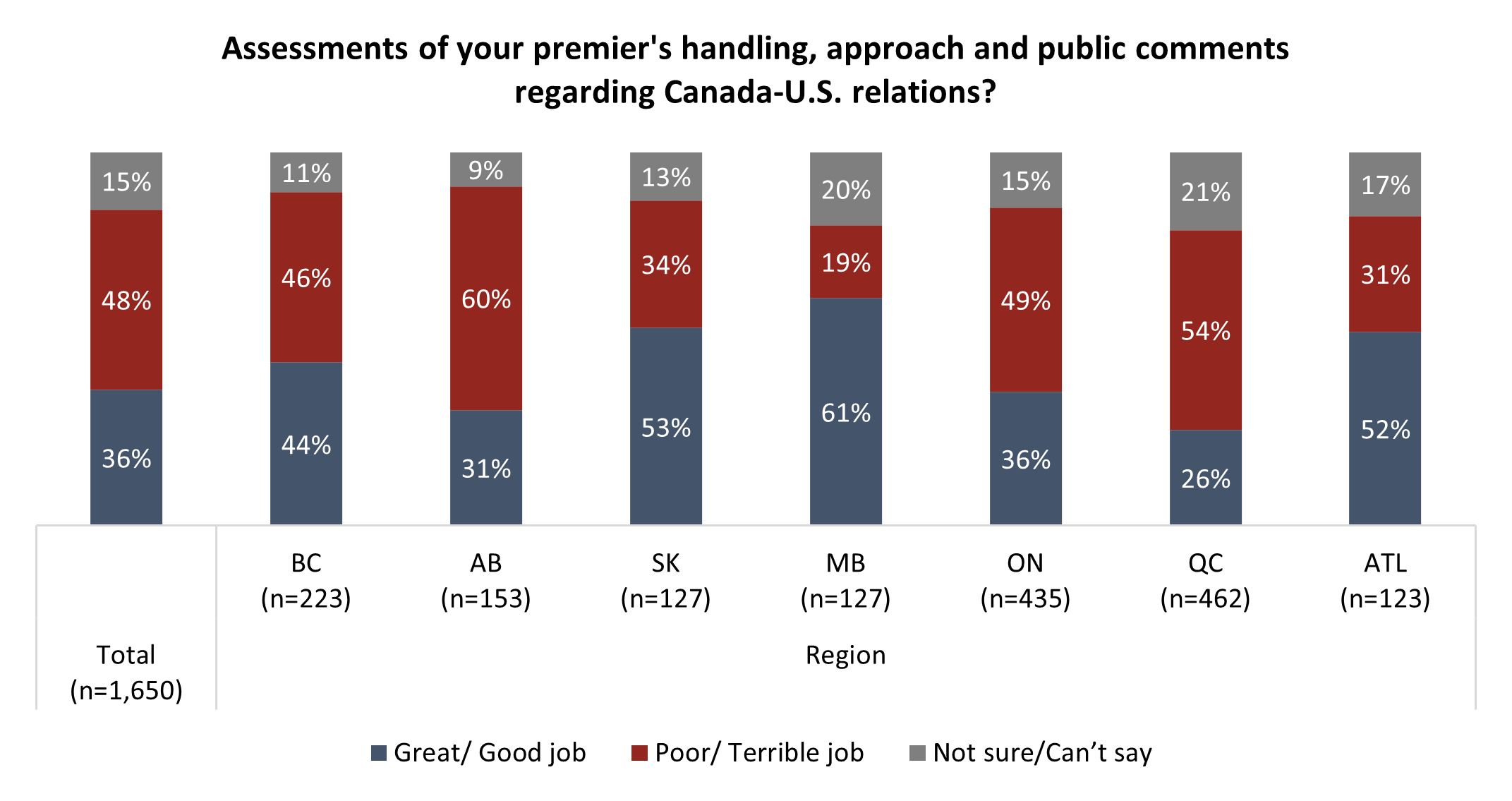
While there is common ground in Alberta and Saskatchewan when it comes to views of Carney, assessments of their own political leadership are divergent. Alberta Premier Danielle Smith receives among the poorest marks from her constituents for her handling of this file, while Saskatchewan Premier Scott Moe is bested only by Manitoba’s Wab Kinew. In the early days of Trump’s threats and tariffs, Smith took a more friendly and optimistic approach to the administration, drawing criticism from other provincial leaders.
Hard line approach demanded by Canadians
Canadians’ appetite for capitulation when it comes to Trump’s threats has long been minimal. Consistently, fewer than two-in-five have said that making concessions to maintain the relationship is the preferred path. Currently, two-thirds say that they would have the Canadian government take a hard approach even if it means drawing the ire of Trump’s team.
As negotiations of a potential, but perhaps unlikely, renewal of the USMCA trade deal near, it’s worth noting how Canadians’ attitudes have changed compared to when that deal was first negotiated during Trump’s first term. Then Canadians were much more likely to say they wanted a soft approach to preserve the relationship between the two countries:
Favourability of United States reaches new low
This lack of desire to appease the administration may be rooted in an overall negative view of the United States that has developed under Trump. Unfavourable views of the U.S. have skyrocketed well past where they were in his first term, amid continual threats of annexation and jabs on social media. Currently, just 21 per cent of Canadians say they have a favourable view of the U.S., a number that has halved in the year since Trump took office again:
There remains a pocket of Canadians who view our southern neighbour positively, and most are past Conservative Party voters. Nearly half (46%) of that party’s supporters retain a positive view of the U.S., while nearly none of the other party’s voters share this opinion. Recently, Conservative MP Jamil Jivani has criticized Canadians for throwing an anti-American “hissy fit”, an argument clearly more likely to resonate with Conservatives, but still likely to rile many:

Fewer than one-quarter say U.S. should be approach as a friend or ally
As recently as 2023, three-quarters of Canadians viewed the United States as a friend or valued ally. That proportion has eroded in the three years that followed and now comprises just one-quarter of the country. Much larger groups say that at best the U.S. should be approached cautiously (35%) while one-in-three say it should be viewed as a threat to Canada’s interests (34%):
Part Two: The federal landscape
Carney continues to garner approval
Canadians’ assessments of their prime minister continue to trend in a positive direction as Carney nears the one-year anniversary of his takeover of the office from predecessor Justin Trudeau. Approaching two-thirds (63%) say they approve of his performance, while three-in-ten (31%) do not. Notably, assessments of Carney’s overall performance are statistically similar to Canadians’ views of his performance on Canada-U.S. relations (64% good job, 28% bad job, noted above) suggesting how important that file is to Canadian appraisal of the prime minister at this moment in time.
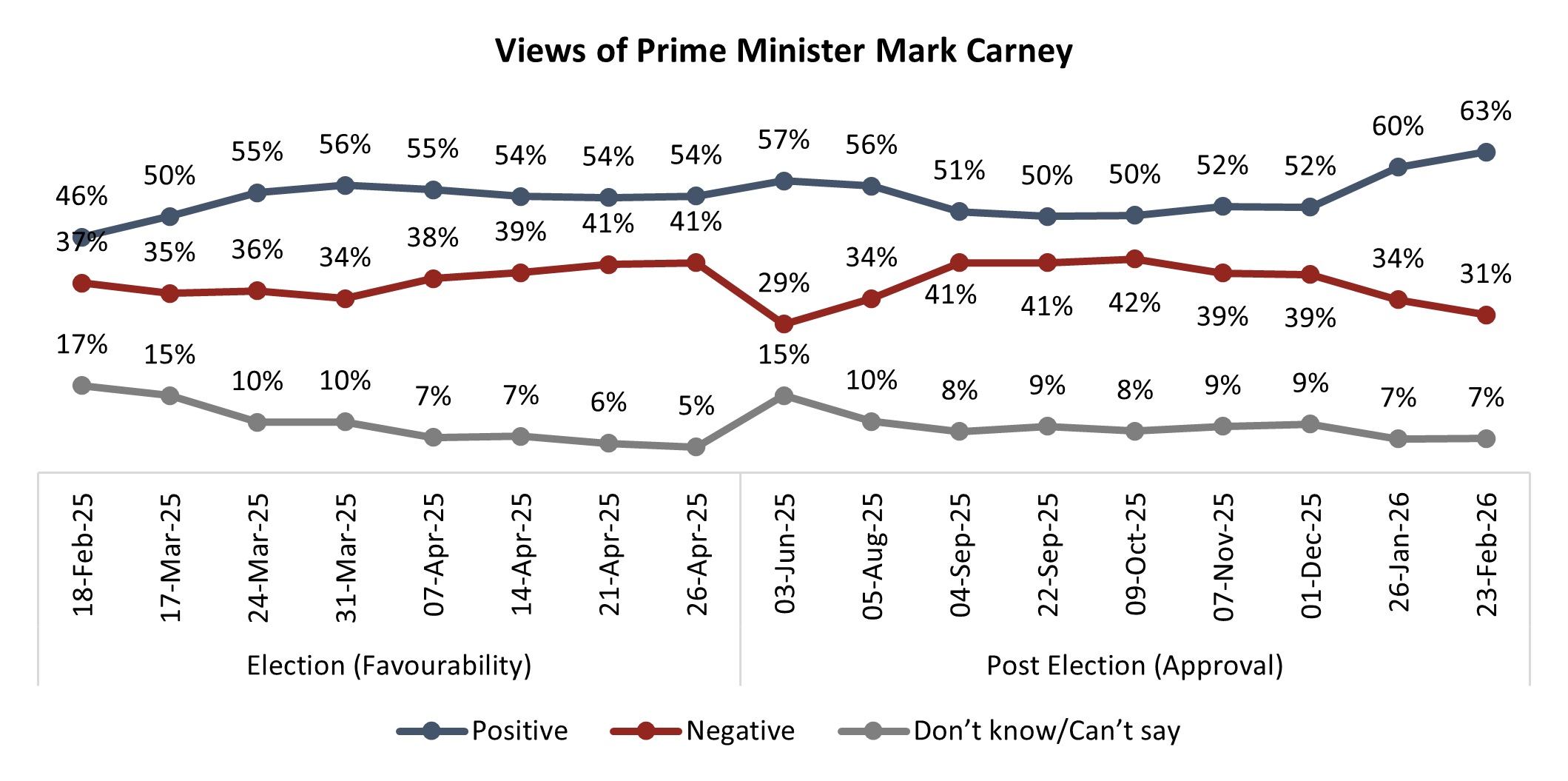
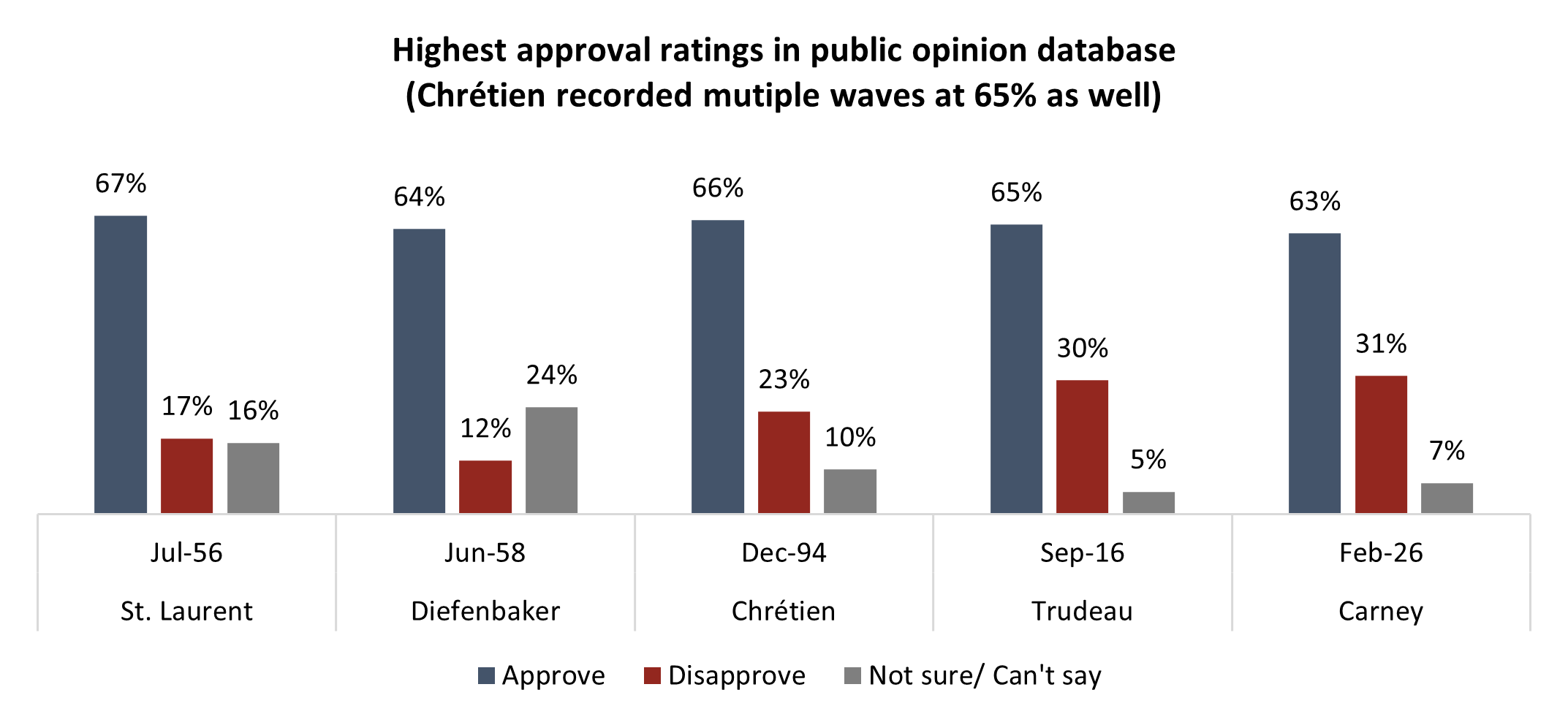
While Carney’s high approval rating is a sharp departure from the latter stages of Trudeau’s time in office, there was a time when the country held Carney’s predecessor in high regard. In September 2016, also about 11 months into his first term, 65 per cent of Canadians approved of Trudeau.
Current high approval of Carney is among the highest recorded in available Canadian public opinion data. Former Liberal Prime Minister Louis St. Laurent recorded a 67 per cent approval, although he ended up out of office following a shock defeat by the Progressive Conservatives under John Diefenbaker in 1957 despite the Liberals winning the popular vote. Diefenbaker also recorded a high approval of 64 per cent during his first term in office.
In the 1990s, former Liberal Prime Minster Jean Chrétien earned 65 per cent or higher approval in multiple waves, including a high-water mark of 66 per cent in December 1994.
A Poilievre setback?
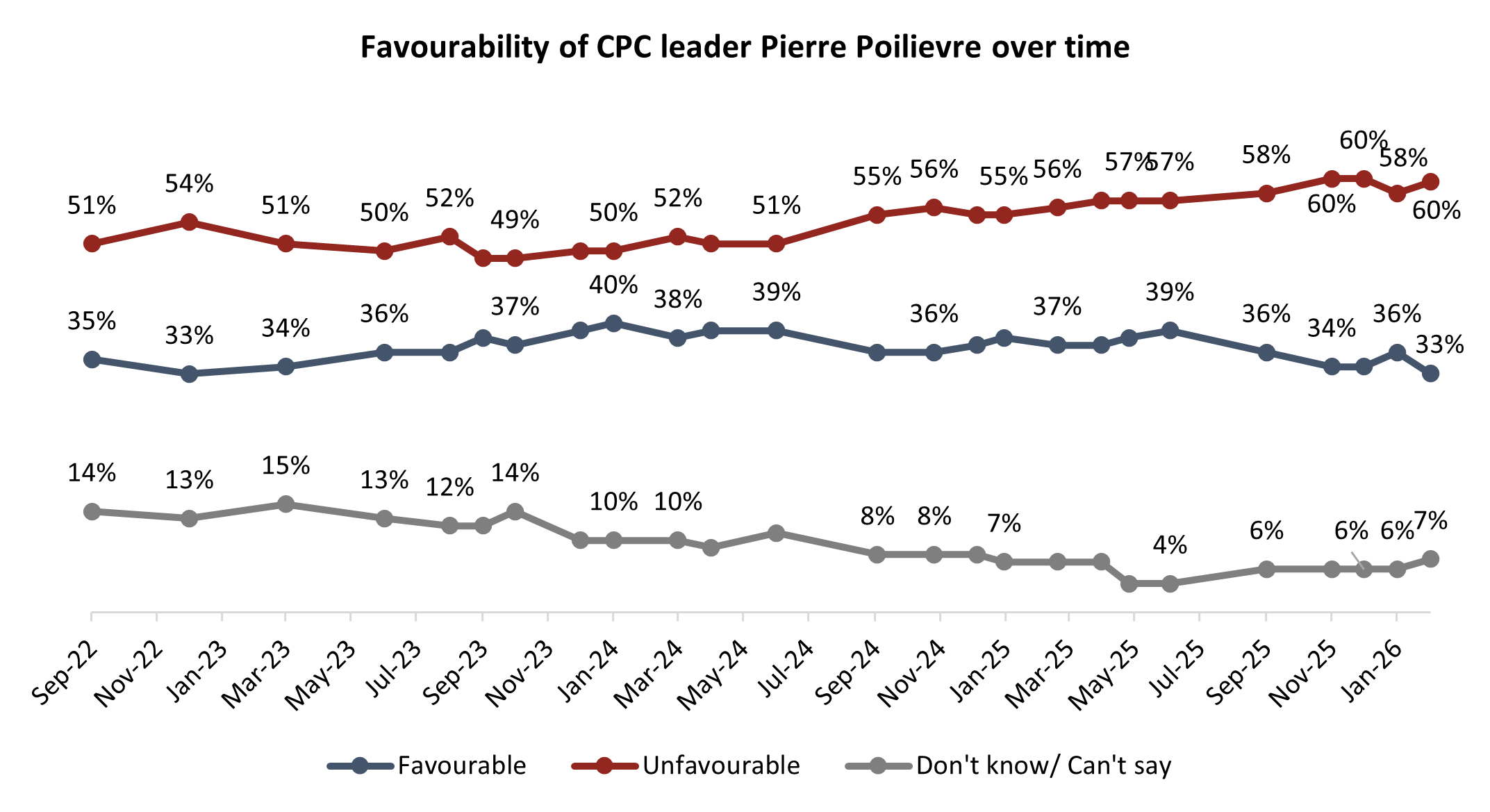
Conservative leader Pierre Poilievre earned a ringing endorsement from delegates at the January Conservative convention in Calgary but still is more likely to be viewed negative than not among the general populace. One-third (33%) of Canadians say they have a favourable view of Poilievre, tying the lowest approval of Poilievre seen in ARI tracking dating back to when he first took over as leader of the Conservatives. The three-in-five (60%) who hold an unfavourable view of Poilievre also ties a high in tracking.
As has been the case consistently in his time as Conservative leader, Poilievre garners more favourable views among men (39%) than women (27%). But a majority of both (56% men, 63% women) view him negatively (see detailed tables).
Vote intention gap widens significantly
The personal popularity gap between the two party leaders corresponds with a wide gap in current vote intention. More than two-in-five (45%) Canadians say they would vote Liberal if there was a federal election today, putting the incumbent party 13 points ahead of the rival Conservatives, supported by one-third (32%). The leaderless NDP (10%), the Bloc Québécois (7%) and Greens (4%) all trail far behind:
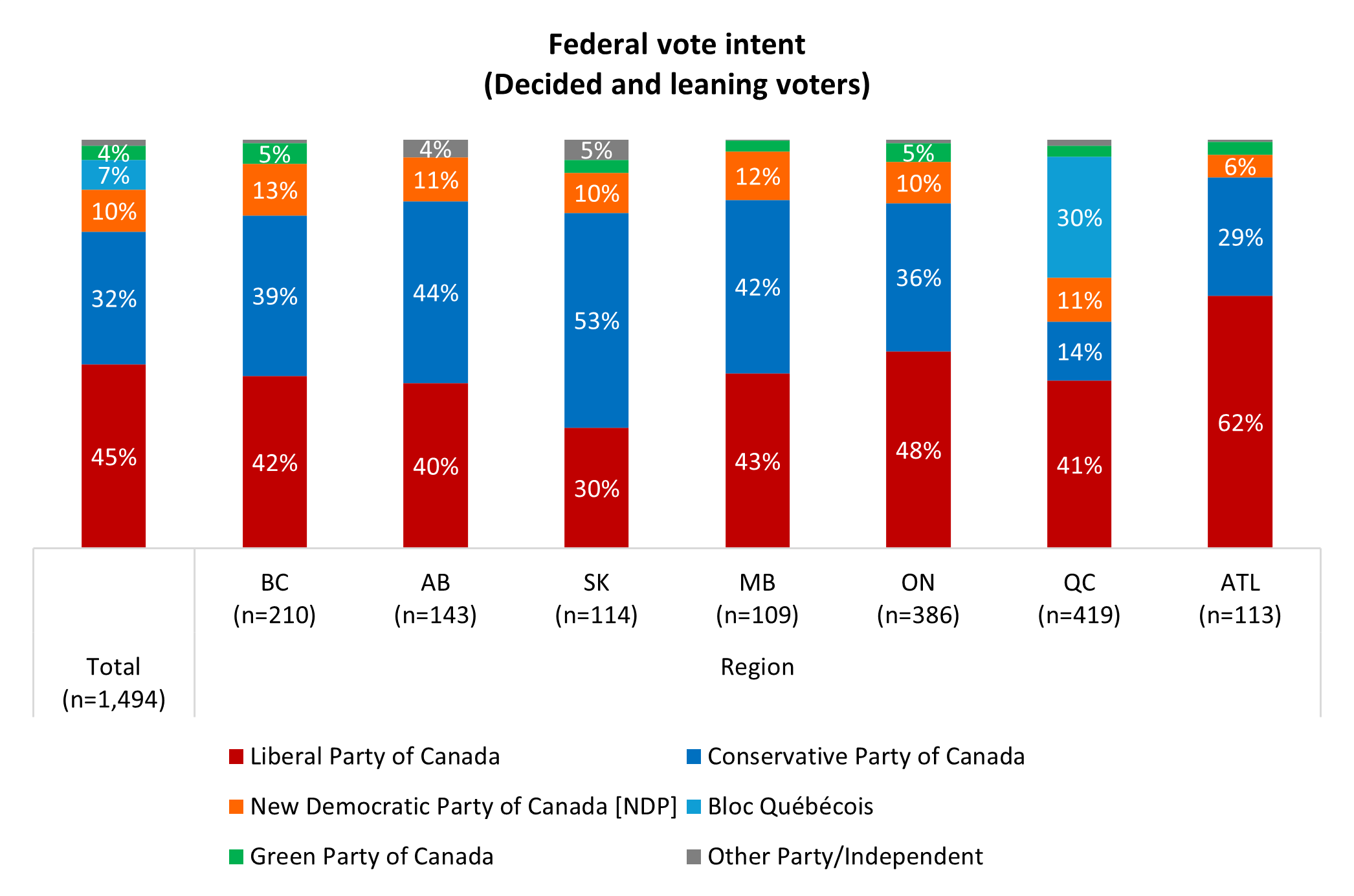
The Liberals find themselves in first place in vote intention in Ontario (+12 over the CPC), Quebec (+11 over the BQ), and Atlantic Canada (+33 over the CPC), while there are close races in B.C., Manitoba and Alberta, the latter a reversal of form from recent history.
Carney’s attempts to placate unrest in Alberta have evidently been well-received. He is viewed more positively (54% approval) than Poilievre (45% favourability) in the province. But despite Carney reaching a memorandum of understanding with Alberta in the fall, there remains a key April 1 deadline for the federal government and Premier Danielle Smith’s United Conservative Party government to settle some outstanding issues on carbon capture and industrial carbon taxes. And despite recent positive talk, Smith’s demanded pipeline is still theoretical. The Liberal renaissance in the province likely rests on those issues settling in the province’s favour.
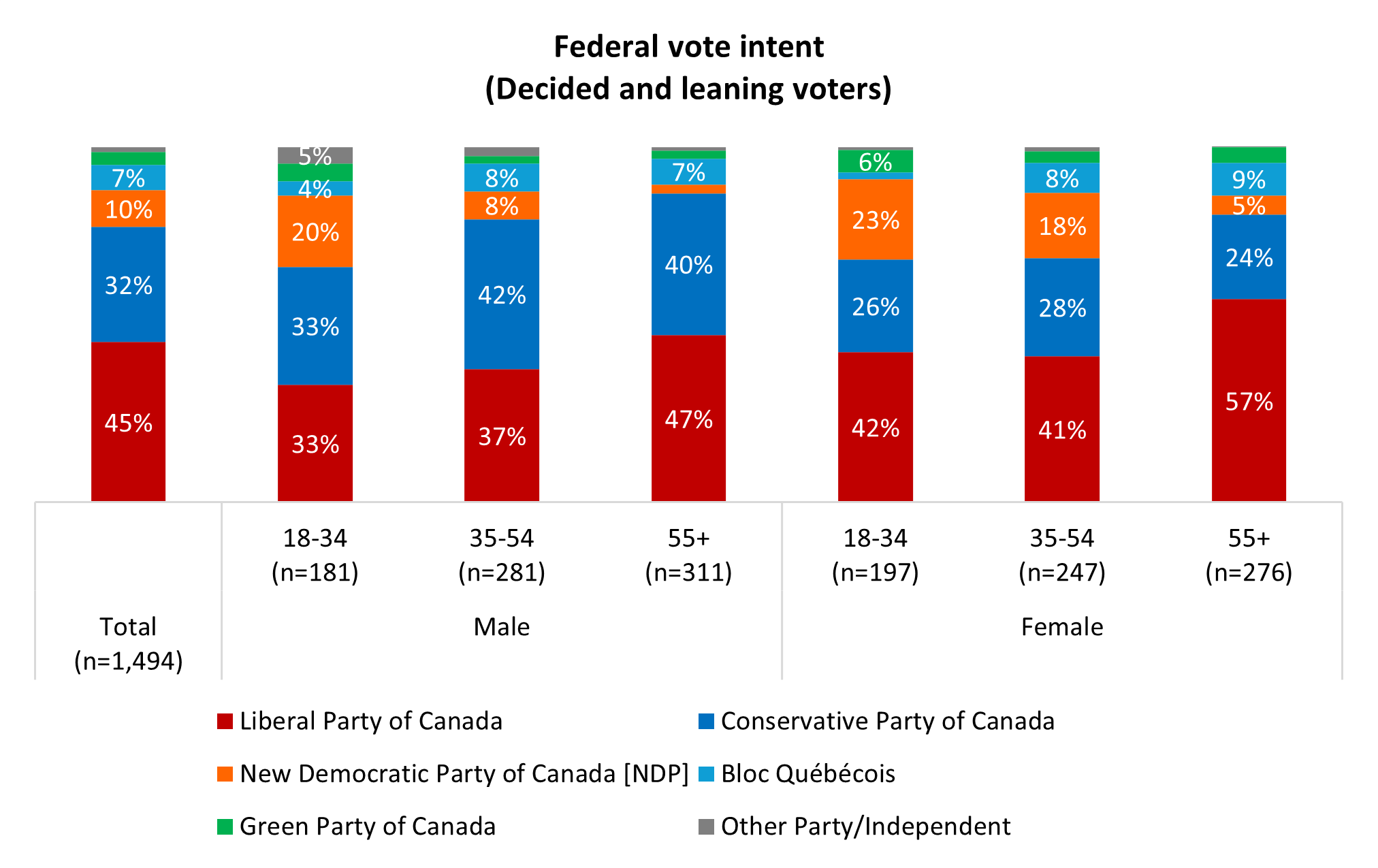
Poilievre and the Conservatives perform best among men aged 35 to 54, a plurality (42%) of whom would vote CPC if the election were today. Carney and the Liberals lead among men older than 54 (+7), and women of all ages:
| METHODOLOGY:
The Angus Reid Institute conducted an online survey from February 20-23, 2026, among a randomized sample of 1,650 Canadian adults. Respondents are drawn from the Angus Reid Forum, a large-scale online panel developed to include Canadian residents in each of the 343 federal ridings in Canada and representative of the Canadian population by age, gender, family income, ethnic status and education. The sample was weighted to be representative of adults nationwide according to region, gender, age, household income, and education, based on the Canadian census. For comparison purposes only, a probability sample of this size would carry a margin of error of +/- 2 percentage points, 19 times out of 20. Discrepancies in or between totals are due to rounding. The survey was self-commissioned and paid for by ARI. Detailed tables are found at the end of this release.
For more information on our polling methods, click here. |
For detailed results by age, gender, region, education, and other demographics, click here.
For PDF of full release, click here.
MEDIA CONTACTS:
Shachi Kurl, President: 604.908.1693 shachi.kurl@angusreid.org @shachikurl
Dave Korzinski, Research Director: 250.899.0821 dave.korzinski@angusreid.org
Jon Roe, Senior Research Associate: 825.437.1147 jon.roe@angusreid.org