

Majority of frequent border crossers are making fewer trips, choosing Canadian destinations instead
November 7, 2025 – The once reliable Canada-U.S. relationship appears to have entered a new phase of elevated enmity. As tariff tensions continue and President Donald Trump does little to reduce the temperature, Americans may be dealing with a snowbird snub this winter.
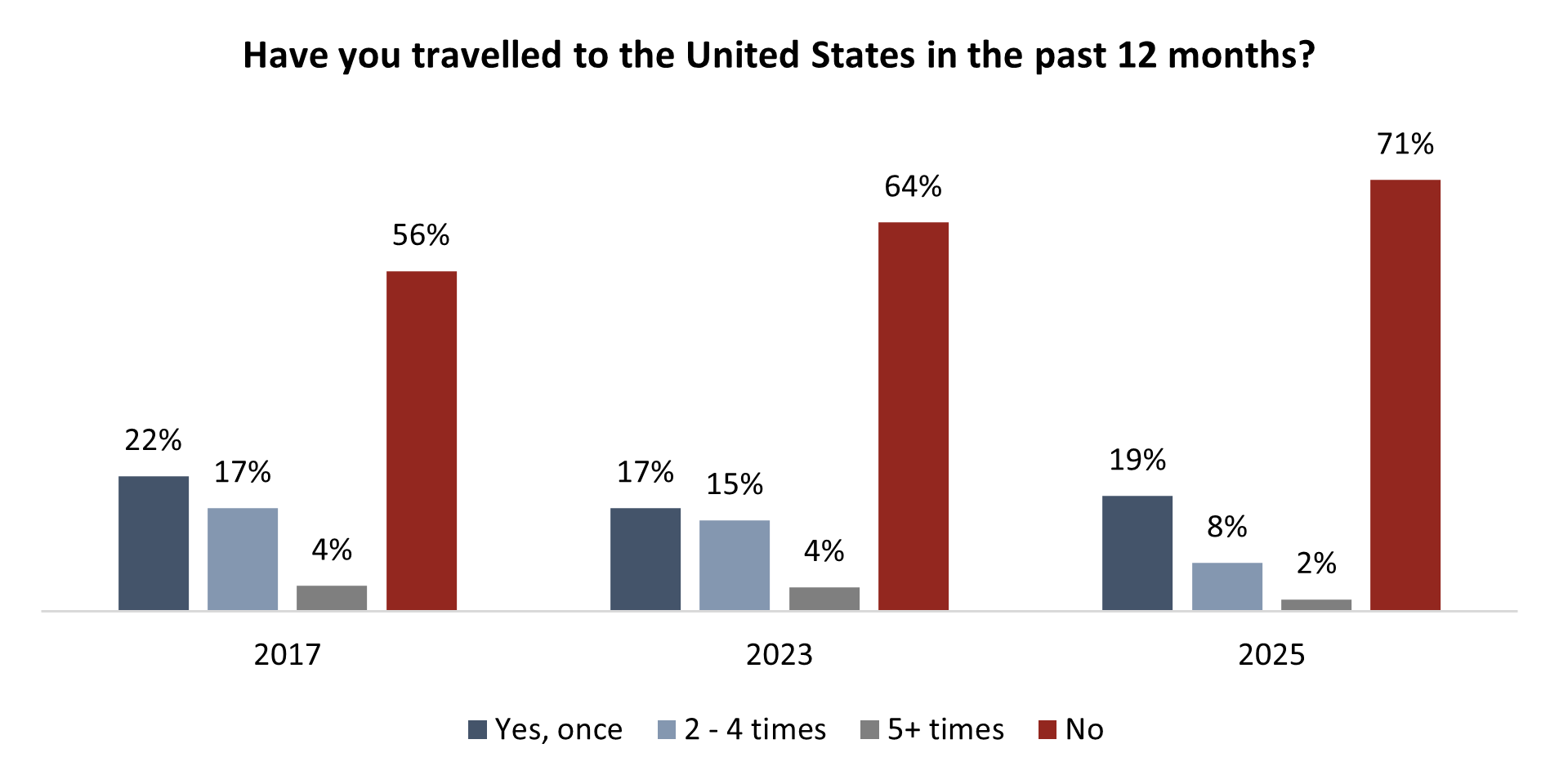
New data from the non-profit Angus Reid Institute finds the proportion of Canadians making multiple trips to the U.S. in the past year has fallen by half compared to data collected in both 2017 and 2023. Approximately one-in-10 Canadians say they have made more than one trip to the States the past 12 months now, while 19 per cent said the same in 2023, and 21 per cent in 2017.
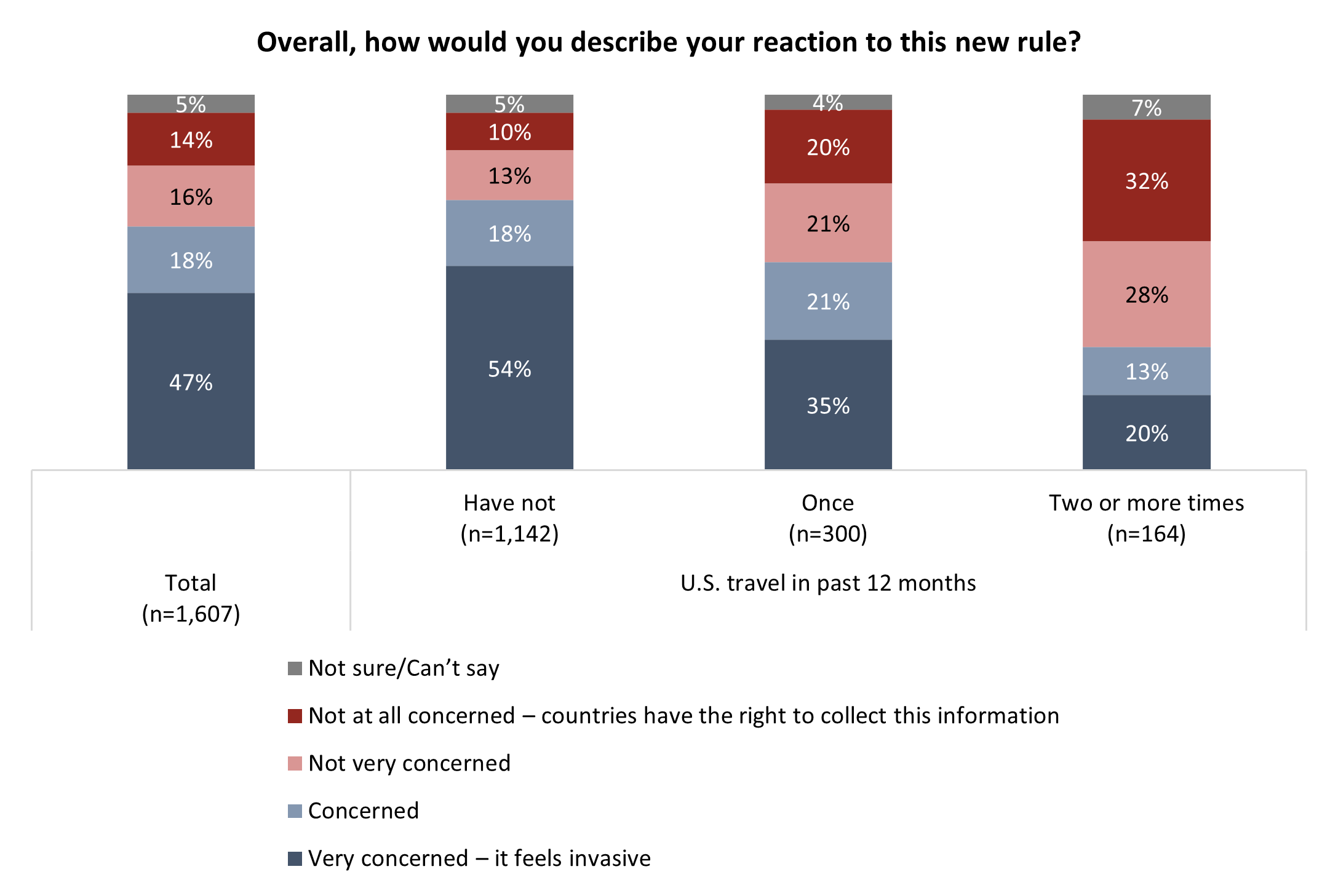
From safety concerns to new fingerprinting rules for longer stays, to a growing antipathy toward the U.S., a winter getaway to Arizona or Florida is no longer the automatic choice it once was. Seven-in-10 (70%) say they would be uncomfortable travelling to the United States this winter, and two-thirds (65%) describe new border requirements for long-term visitors – including fingerprinting and registration fees – as “invasive.”
Concerns about safety, politics, and border treatment now rank ahead of cost or exchange rates as the top reasons Canadians are cutting back on travel. Further, for many who are not travelling to the U.S., this decision is seen as a way “to stand up for Canada”. Seven-in-10 (69%) who have reduced their travel say this.
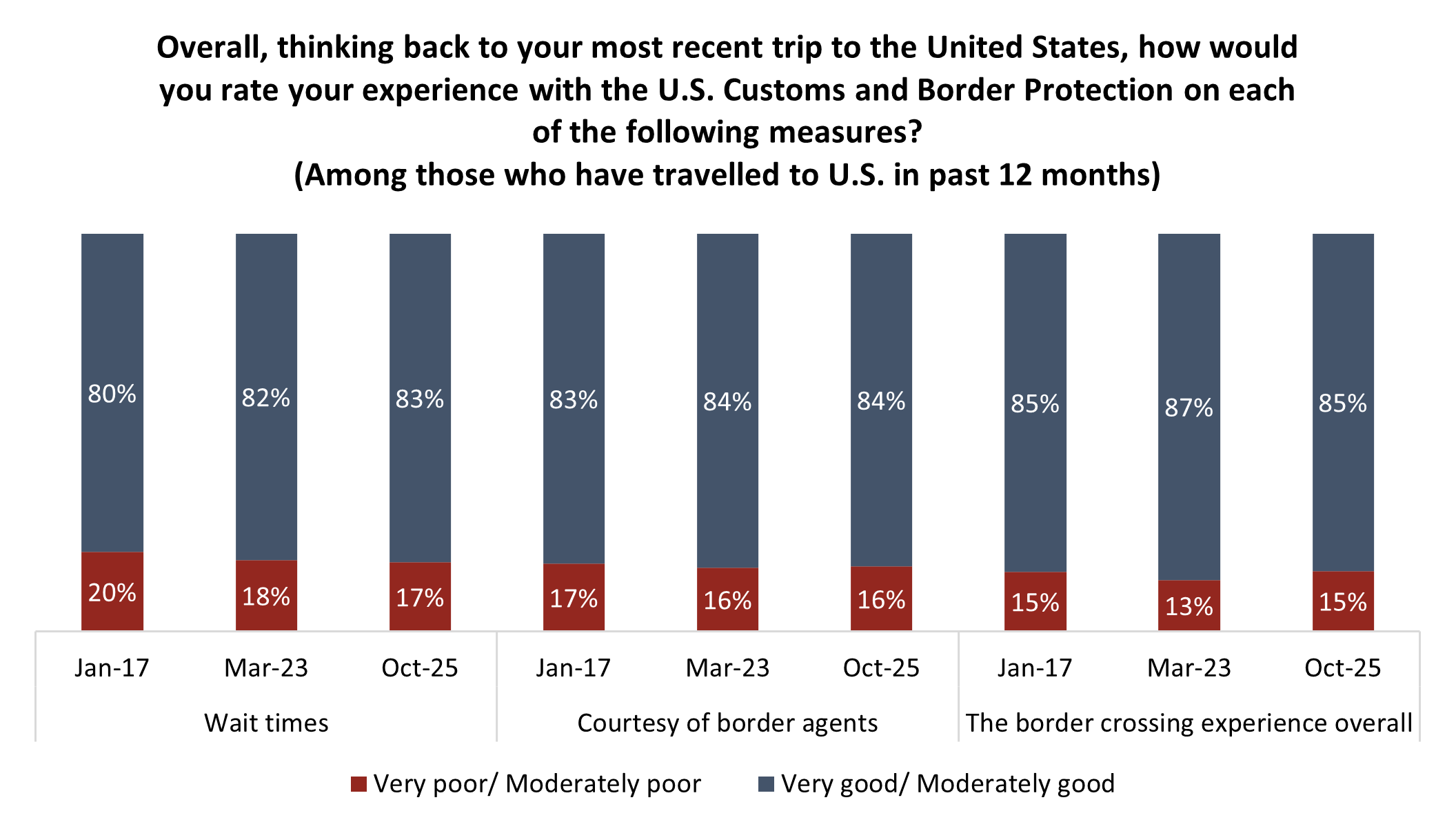
That said, experiences at the border for those who have travelled are no more difficult than they were in previous iterations of this survey. The border crossing experience is described as good by 85 per cent of those who have travelled, the same number as was noted in 2017 and 2023.
More Key Findings:
- Three-quarters of Canadians (77%) say they view the U.S. more negatively as a travel destination this year than in those prior. This view is held by seven-in-10 (71%) who are the most frequent travellers
- Asked whether Canada should reciprocate with similar fingerprinting and registration rules for longer-term travellers from the U.S., Canadians are divided. Two-in-five take each side of the debate, feeling it is appropriate (42%) or unnecessary (39%)
INDEX
Part One: Travel trends
-
Fewer Canadians are making multiple trips to the U.S.
-
Perceptions of U.S. as a destination worsen significantly
-
Frequent travellers say they’re going less
-
Why aren’t Canadians heading south? U.S. political climate and patriotism
-
Where are Canadians going instead?
Part Two: What about the border?
-
Despite fears, border crossing experiences remain relatively positive
-
Non-travellers most worried about crossing
Part Three: Winter is Coming
-
Seven-in-10 uncomfortable with heading south to escape the cold
-
Canadians say U.S. fingerprinting requirement for snowbirds “invasive”
-
Divide on whether Canada should reciprocate for U.S. travelers
Part One: Travel trends
Fewer Canadians are making multiple trips to the U.S.
The United States’ foray into protectionist economic policies – and expansionist musings – led by President Donald Trump has had an adverse effect on its relationship with Canada and its residents. Canadians’ initial response was anger at Trump’s tariffs and overtures to Canada becoming the 51st state. Recently, approaching half said they believe Canada should approach America as an enemy or potential threat.
Related:
- Canadians say they’re ready to fight back after tariffs drive views of U.S. to new low
- Fewer say China should be viewed as a threat than say this of the U.S.
Canadians have also responded with their tourism dollars. The U.S. International Trade Administration reported that Canadian arrivals fell by nearly 18 per cent year over year in the first half of 2025. Trips by car and by air were down by 35 per cent and 27 per cent year over year in September, according to Statistics Canada. In 2024, Canadians visitors represented nearly one-quarter of all foreign travellers who came to the U.S., spending $20.5 billion. Overall, the U.S. is expected to lose as much as $29 billion of international tourism this year due to the political instability in recent months.
Asked about their travel over the past 12 months, Canadians are half as likely to say they have visited the U.S. multiple times (10%) than they were two years ago (19%) or in 2017 (21%). The proportion who say they have not gone to the U.S. at all in the past year has increased by 15 points from 2017 (56% to 71%):
For comparison, in a regular year, more than two-in-five Canadians say they would travel at least once to the United States (43%), while another one-in-three (33%) say they visit every couple of years. This far outpaces the 29 per cent who say they have gone this year and again shows the reduced number of multiple-crossers in the Canadian population currently.

Perceptions of U.S. as a destination worsen significantly
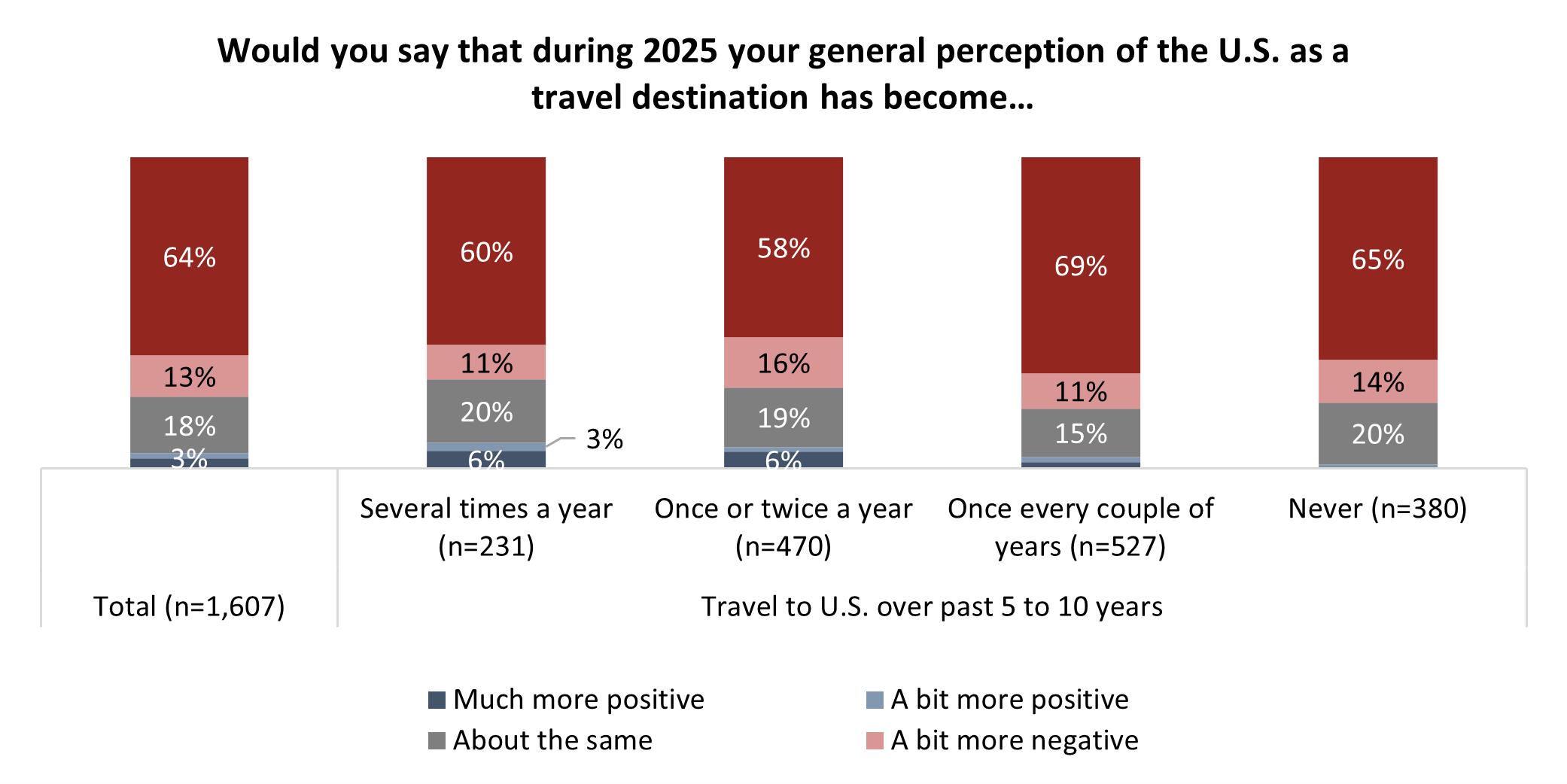
The return of Trump to the Oval Office has not only soured Canadian impressions of the U.S. as a whole; it appears to have also harmed Canadian views of the country as a travel destination. Two-thirds (64%) say they are “much more negative” in their view of the U.S. as a potential destination, while a further one-in-eight (13%) say their view has become “a bit more negative”. Taken together, those whose view has worsened outnumber those whose view is unchanged or has improved by more than three to one (77% vs 23%).
Although they are less likely to say their view has worsened, a majority of those who are frequent travellers to the U.S. say their impression of the country as a potential travel destination has deteriorated:
Frequent travellers say they’re going less
The above data is punctuated by the fact that three-quarters (75%) of Canadians say they are travelling to the U.S. less than they had been over the past five to 10 years. Those who used to take multiple trips to the U.S. annually are also reporting less travel to Canada’s southern neighbour:

Why aren’t Canadians heading south? U.S. political climate and patriotism
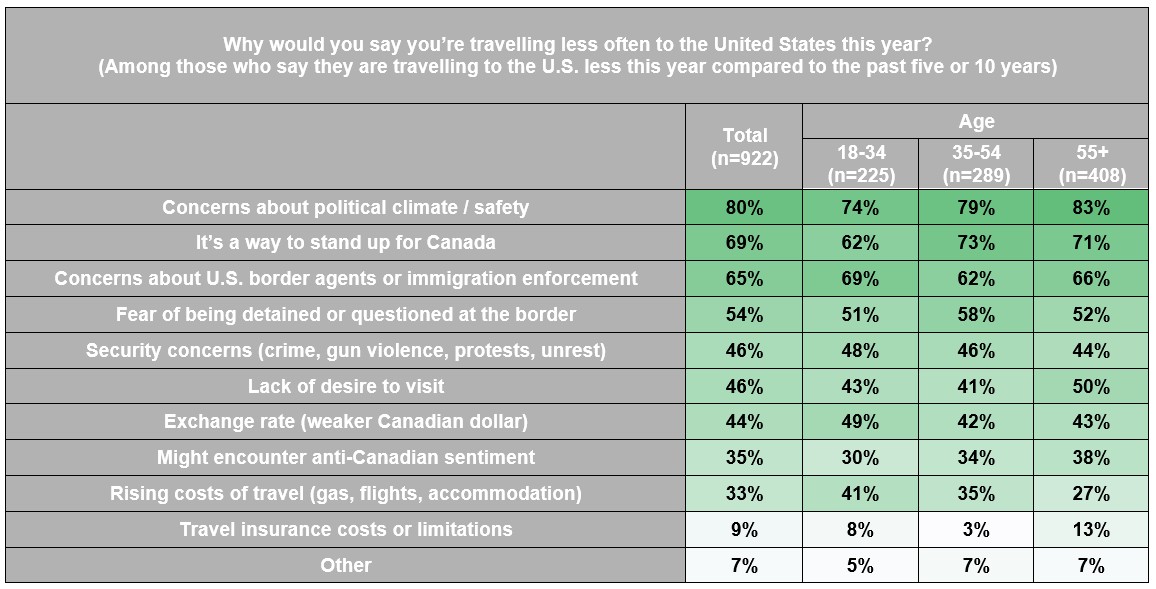
For those who are reporting less travel to the U.S., concerns over the political climate and safety (80%) is the top chosen reason as to why they are venturing to Canada’s southern neighbour less frequently. Seven-in-10 (69%) say they are doing so to “stand up for Canada”. Worries over border agents (65%) or being detained and questioned (54%) are also reported by a majority.
Among the “snowbird” crowd, those older than 54, half (50%) say they just don’t have a desire to visit the U.S., while younger Canadian adults are the most likely to say the exchange rate (49%) or cost are major factors (41%) why they aren’t travelling to the U.S.:
Where are Canadians going instead?
Two-in-five Canadians who are skipping the U.S. say they have, or plan to, travel within Canada (42%) or outside of North America (42%) instead. One-in-five (21%) say they’ve replaced their travel to America with travel to Mexico. Canadians under 35 are the most likely to say they’re skipping travel altogether (16%):

Part Two: What about the border?
Despite fears, border crossing experiences remain relatively positive
For those that have visited the U.S. in the past 12 months, the reported experience is notably similar to past years’ data. More than four-in-five recent U.S. travellers say they had a good experience with wait times (83%) and U.S. border agents (84%), while the crossing experience overall was also viewed as positive by more than four-in-five (85%). Those are in line with similar ratings offered by Canadians in 2017 and 2023:
Non-travellers most worried about crossing
For those who have not visited the U.S. in the past year, concerns that they will encounter issues at the border are elevated – perhaps fueled by recent headlines about travellers being detained or being subject to thorough searches. A majority of those who have not recently visited the U.S. say they worry about their personal information being collected at the border (71%), having their phone inspected (70%), being questioned more thoroughly than usual (69%) or being denied entry (63%).
Comparatively, those who have visited the U.S. more than twice in the past 12 months are much less concerned with these issues:

Part Three: Winter is Coming
Seven-in-10 uncomfortable heading south to escape the cold
Canadians’ concerns over treatment at the U.S. border perhaps lead to a large majority (70%) saying they would be uncomfortable visiting the country this winter, including more than half (52%) who say they would be “very uncomfortable” to do so.
Women, and especially those older than 54, are the most likely to say they would be uncomfortable travelling to the U.S. in the coming months:

However, actual experience crossing the border appears to be connected to more willingness to cross again. A majority (58%) of those who have visited the U.S. at least twice in the past year say they would be comfortable visiting the country this winter. Meanwhile, a majority (61%) who have been once would not:

Canadians say U.S. fingerprinting requirement for snowbirds “invasive”
U.S. Customs and Border Protection recently instituted a policy that those staying in the United States longer than 29 days must now register at the border. The registration process includes border officers taking fingerprints and photographs and a $60 US charge.
Two-thirds (65%) say they are concerned about this new rule with half (47%) believing it to be “invasive”. Frequent travellers are less bothered by the new requirement:
Divide on whether Canada should reciprocate for U.S. travelers
Canadians are divided as to whether their own border should play a game of tit-for-tat. Similar sized groups want Canada to follow suit (42%) as believe their country should not (39%). Approaching half (46%) of those who have been to the U.S. twice in the past 12 months believe Canada should match the rules, while smaller groups disagree (28%) or are uncertain (26%):

METHODOLOGY
The Angus Reid Institute conducted an online survey from October 24 – 27, 2025, among a randomized sample of 1,607 Canadian adults who are members of Angus Reid Forum. The sample was weighted to be representative of adults nationwide according to region, gender, age, household income, and education, based on the Canadian census. For comparison purposes only, a probability sample of this size would carry a margin of error of +/- 1.5 percentage points, 19 times out of 20. Discrepancies in or between totals are due to rounding. The survey was self-commissioned and paid for by ARI. Detailed tables are found at the end of this release.
For detailed results by age, gender, region, education, and other demographics, click here.
For detailed results by recent travel to the United States, click here.
For PDF of full release, click here.
For questionnaire, click here.
MEDIA CONTACTS:
Shachi Kurl, President: 604.908.1693 shachi.kurl@angusreid.org @shachikurl
Dave Korzinski, Research Director: 250.899.0821 dave.korzinski@angusreid.org
Jon Roe, Research Associate: 825.437.1147 jon.roe@angusreid.org