


Half want Canada to focus more on economic relationship with China, even as favourability remains low
October 15, 2025 – After years of deep frost in the Canada-China relationship, a subtle thaw appears to be underway. Canadians are beginning to view China less harshly than before and shifting their priorities toward focusing on potential economic common ground with the Asian powerhouse.
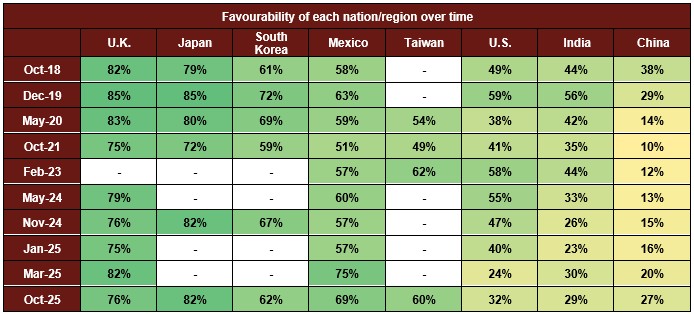
New data from the non-profit Angus Reid Institute, in partnership with the Asia Pacific Foundation of Canada, finds that 27 per cent of Canadians now hold a favourable view of China, up from just 16 per cent earlier this year and nearly triple the all -time low recorded in 2021 (10%). That said, most (59%) still view the country negatively, and China continues to rank significantly lower than other Asian nations for public warmth.
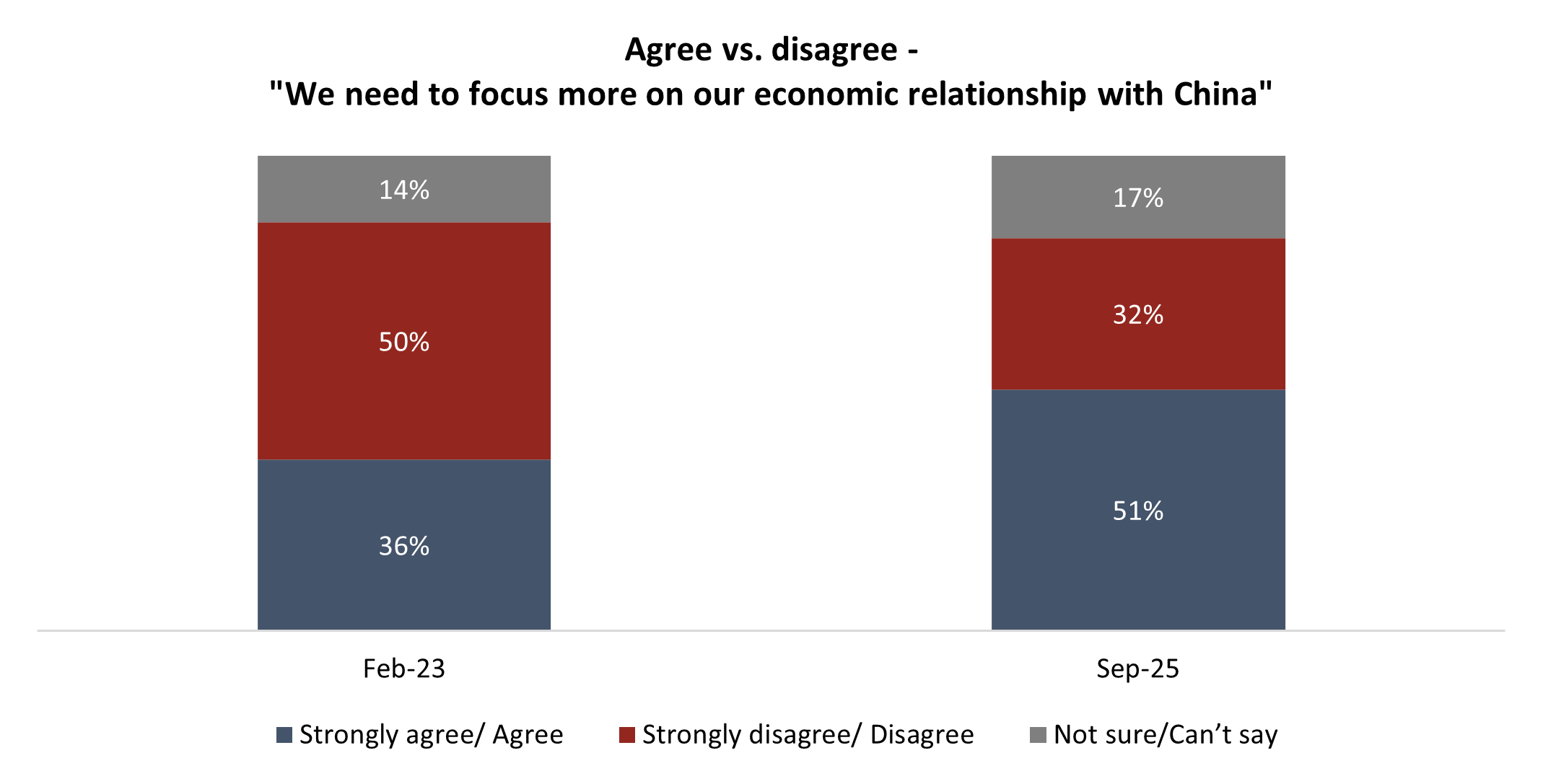
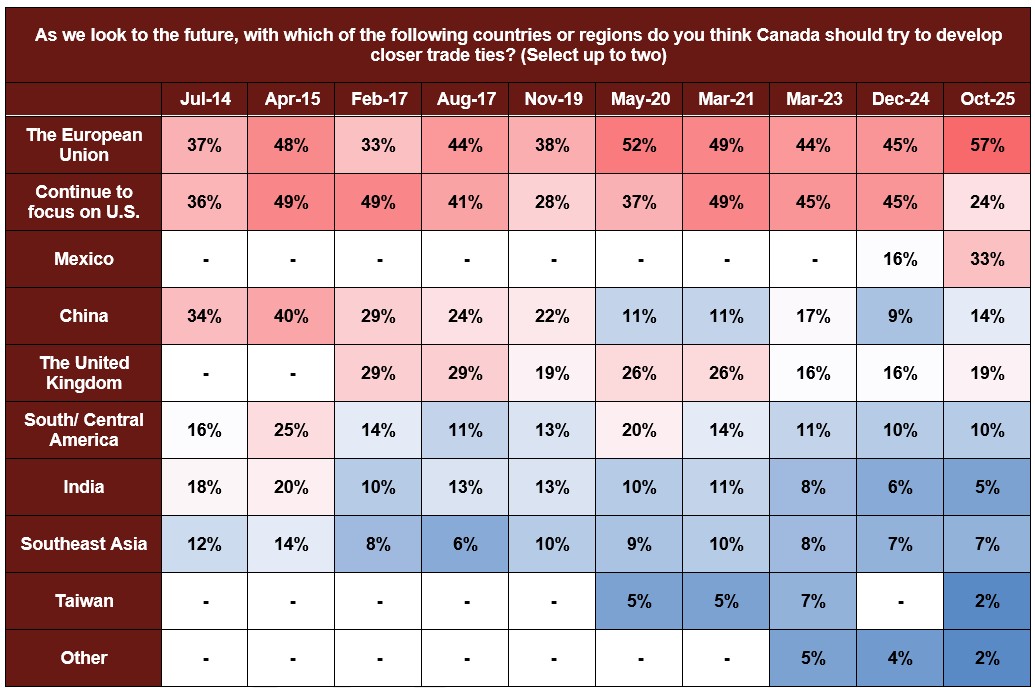
Economic engagement tells a parallel story of restraint with curiosity. When presented with a number of global options, fewer than one-in-six (14%) believe Canada should pursue deeper trade with China — a steep decline from the 40 per cent who said so a decade ago. That said, while China’s priority appears relatively lower than European nations or Mexico, this doesn’t mean that Canadians want to do away with trade efforts entirely. Fully half (51%) say Canada should focus more on its economic relationship with China, up 15 points from 2023.
Much of this may be attributed to the economic anxiety many Canadians are feeling as their once most reliable ally has become a source of frustration and at times, hostility. Consider that Canadians are more likely to say the United States (46%) should be treated as a threat than China (34%). Caution is more appropriate according to Canadians in this relationship with China (37%), while only one-quarter say Canada should approach the Chinese government as a friend or ally (23%).
More Key Findings:
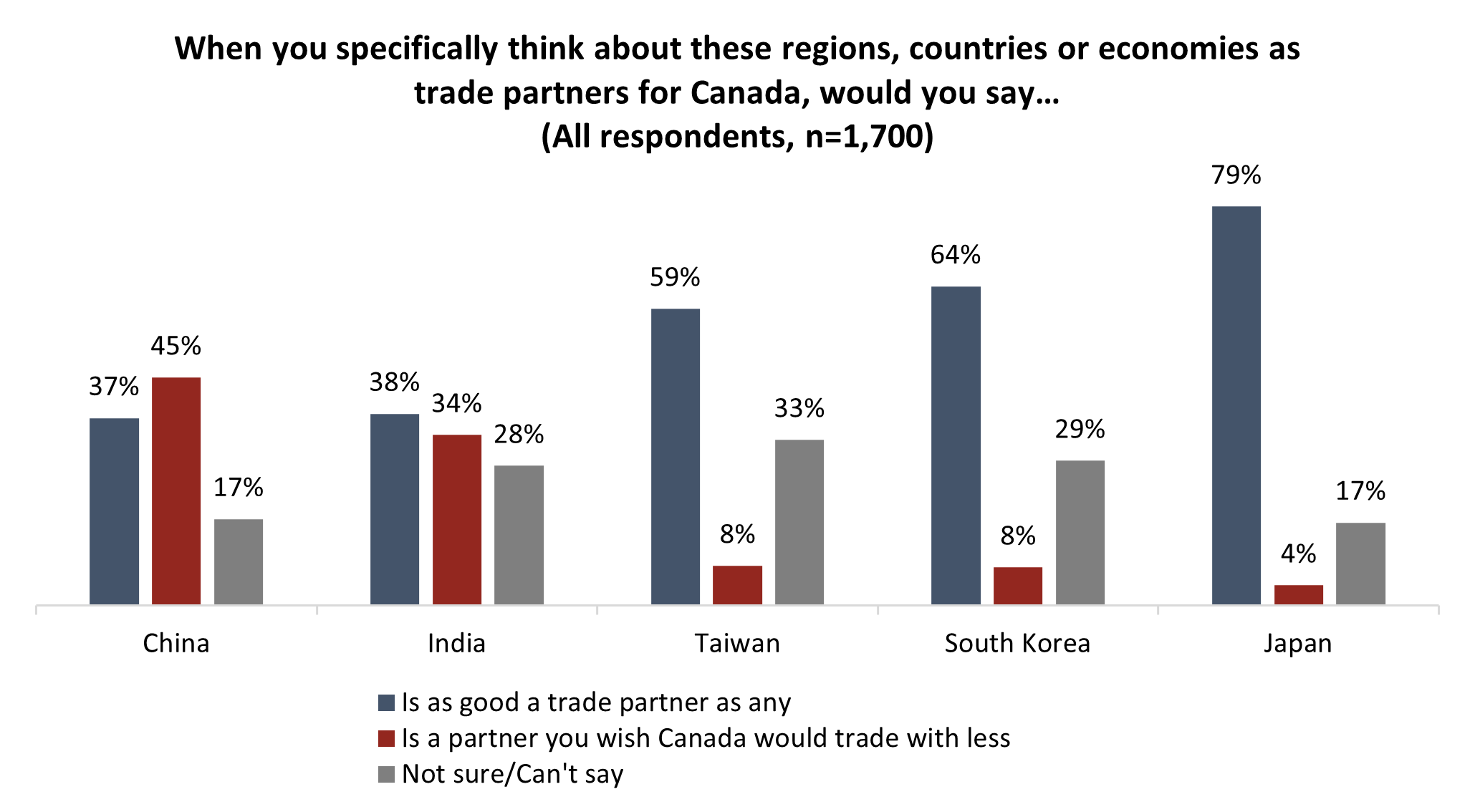
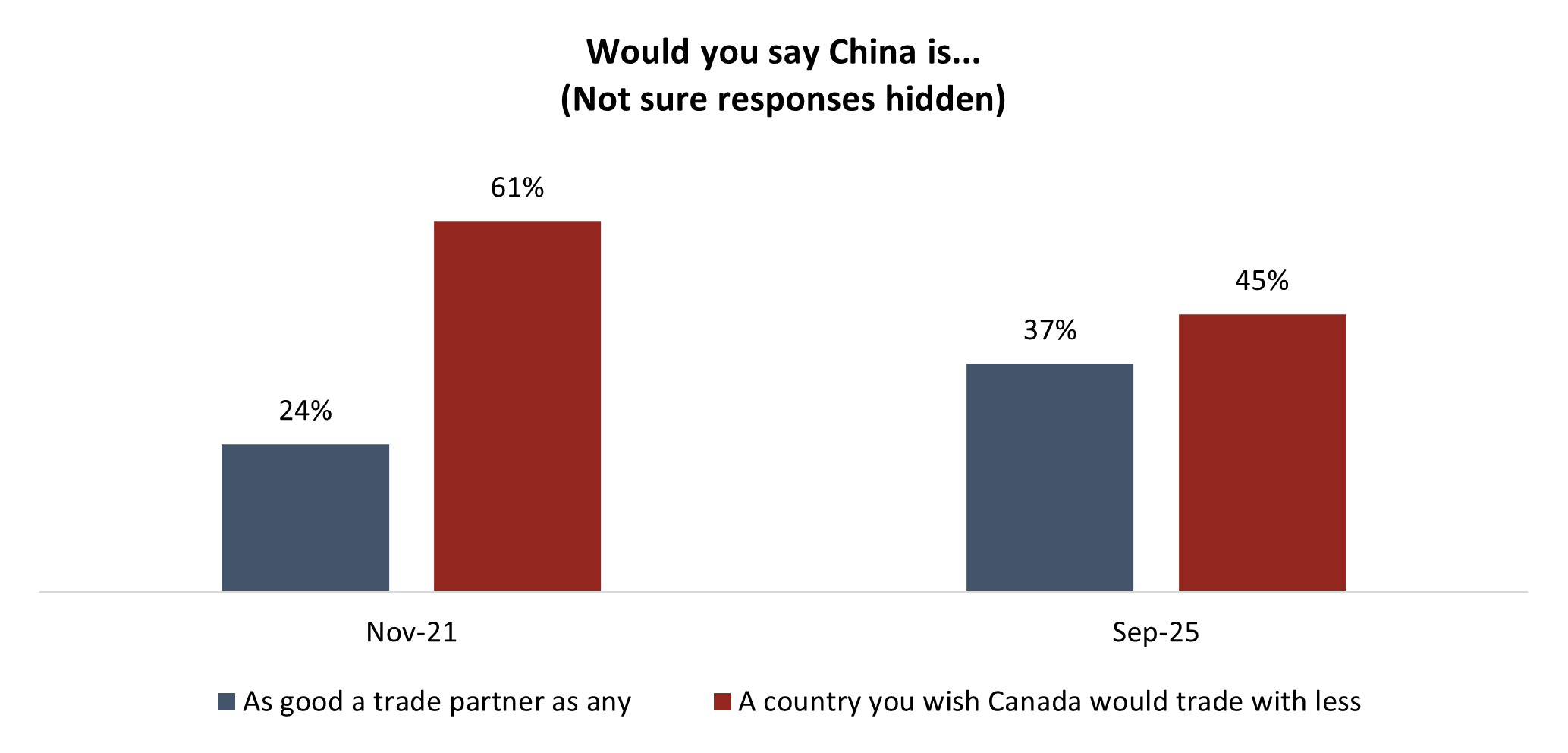
- More Canadians (45%) say they would ideally have Canada do less trade with China than say it’s as a good a trade partner as any (37%). In 2021, this ratio was 24 per cent to 61 per cent, suggesting Canadian views of China as a trade partner have improved, but still causes hesitation. A much higher number of Canadians view Taiwan (59%), South Korea (64%) and Japan (79%) as good trading partners
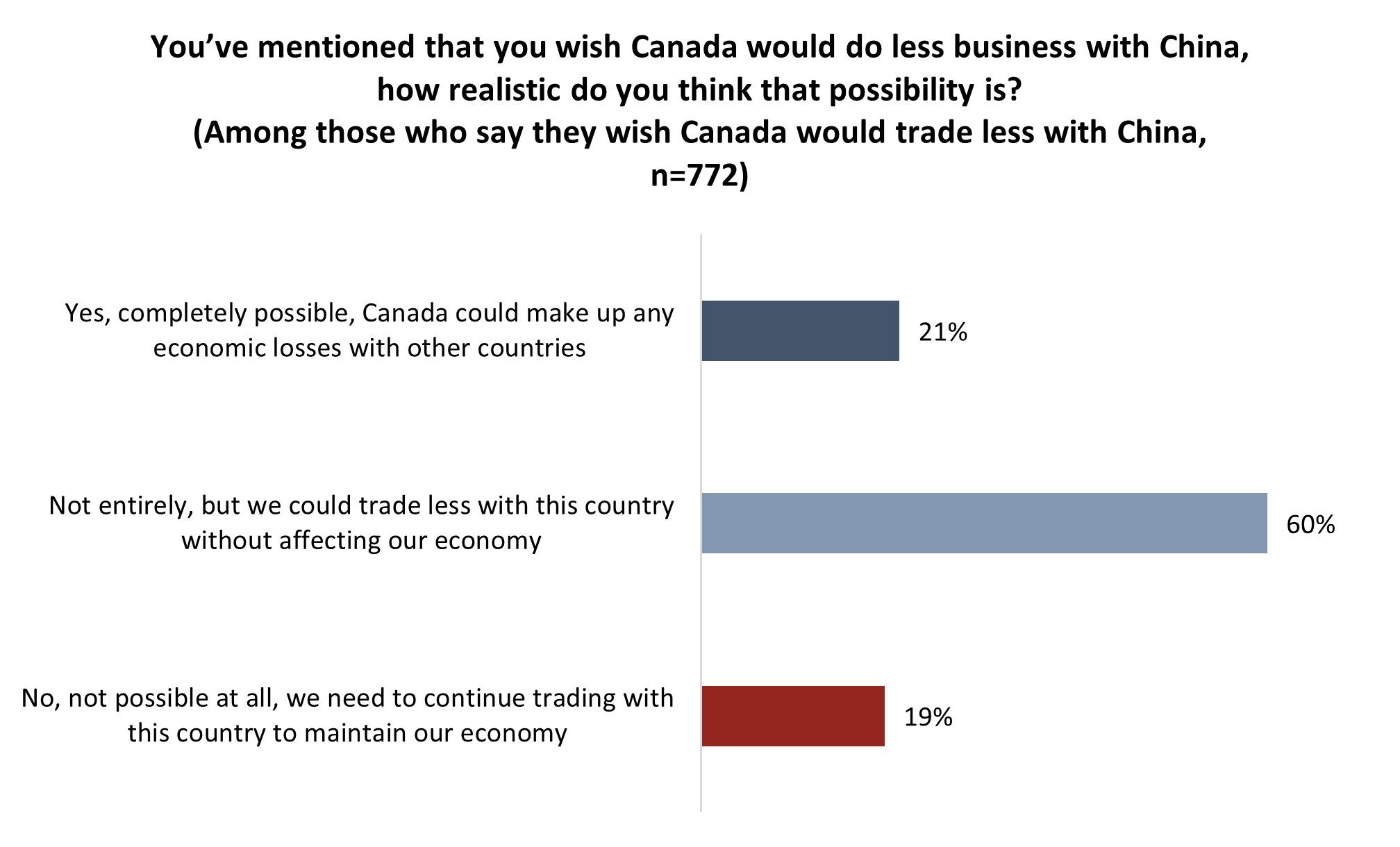
- Among those who would like to trade less with China, one-in-five (21%) say Canada could completely make up economic losses from forgoing this relationship, while three-in-five (60%) believe Canada could trade less with China with minimal economic consequence. Another one-in-five say there’s no way to reduce trade with China without hurting Canada’s economy (19%)
- Three-in-five (61%) describe China’s prominence as an economic power as a “threat to Canadian interests” and a similar number (57%) believe economic retribution is possible if Canada takes too hard of a stand against Beijing’s policies.
- Half of Canadians (53%) say that despite the risk of damage it may do to their country’s relationship with China, they would still pursue a closer relationship with Taiwan. One-in-five (18%) disagree, and many are unsure (29%)
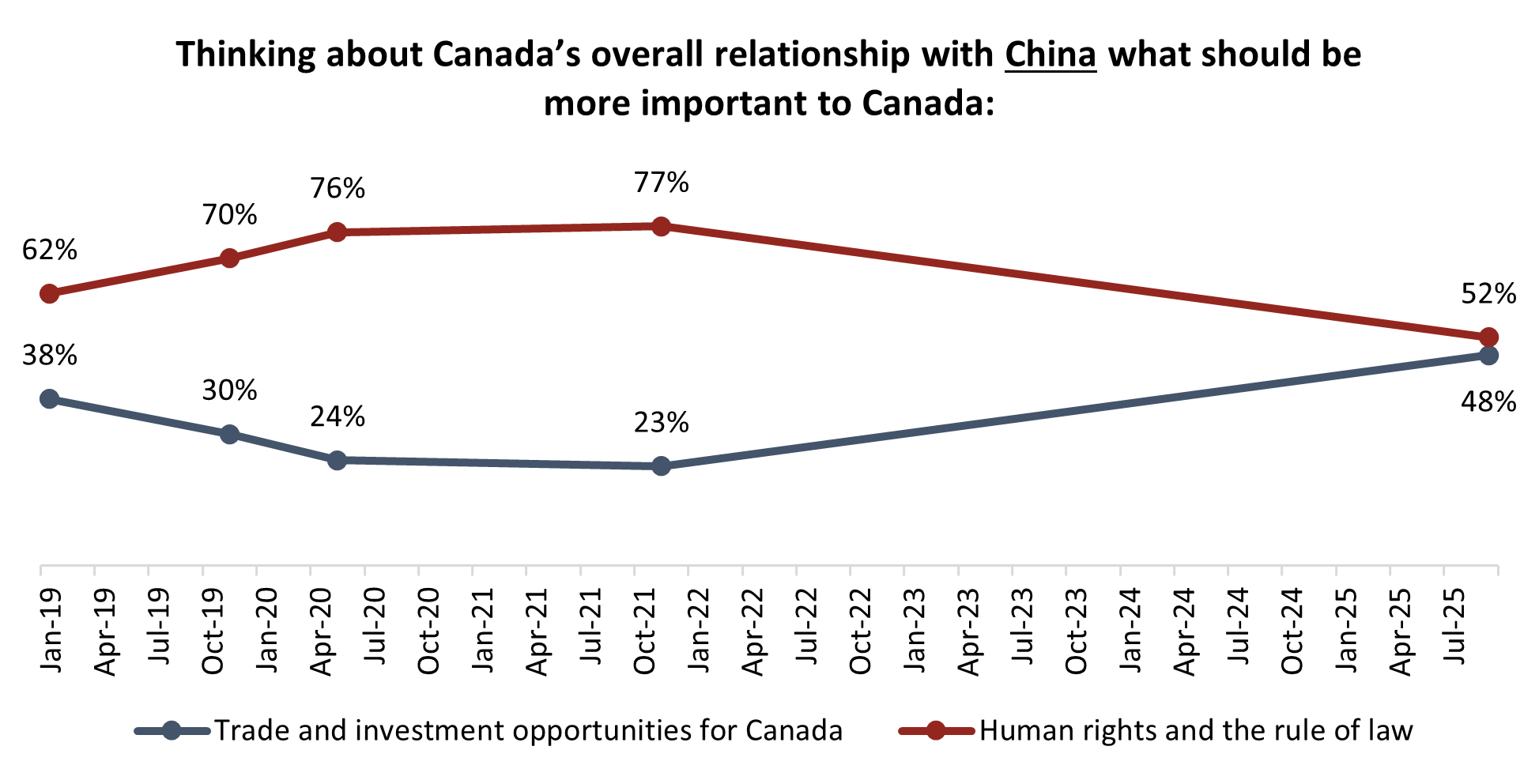
- On a trade-off between human rights and trade opportunity, concern over the former has dwindled. In 2019, 2020, and 2021, more than 70 per cent of Canadians prioritized human rights in dealing with China. That number has fallen to 52 per cent, with 48 per cent now saying trade opportunities are paramount
About ARI
The Angus Reid Institute (ARI) was founded in October 2014 by pollster and sociologist, Dr. Angus Reid. ARI is a national, not-for-profit, non-partisan public opinion research foundation established to advance education by commissioning, conducting and disseminating to the public accessible and impartial statistical data, research and policy analysis on economics, political science, philanthropy, public administration, domestic and international affairs and other socio-economic issues of importance to Canada and its world.
About Asia Pacific Foundation of Canada
The Asia Pacific Foundation of Canada (APF Canada) is an independent, not-for-profit public institution focused on Canada’s relations with Asia. Its mission is to be Canada’s catalyst for engagement with Asia and Asia’s bridge to Canada. APF Canada is dedicated to strengthening ties between Canada and Asia through its research, education, and convening activities. APF Canada’s research provides high-quality, relevant, and timely information, insights, and perspectives on Canada-Asia relations for Canadians and stakeholders across the Asia Pacific. APF Canada also works with business, government, and academic stakeholders to provide Asia Competency training for Canadian organizations and students.
INDEX
Part One: Views of China
-
Canadians know more about China than other Asian nations
-
Favourability improves but remains poor
-
Fewer say China should viewed as a threat than say this of the U.S.
Part Two: Canada – China trade
-
Trade priorities: Western nations preferred, China chosen by one-in-nine
-
More would limit rather than expand trade with China if possible
-
Most who want less trade with China believe Canada can recover economic losses elsewhere
-
Changing priorities? Trade opportunities vs. human rights and the rule of law
-
Desire for closer ties with Taiwan, but worry over economic cost
Part One: Views of China
The volatile nature of Canada’s near-term relationship with the United States has put a greater focus on Canada’s overseas economic relationships. Across the Pacific lies plenty of economic might in countries such as China, India, South Korea, Japan and Taiwan. But Canada’s cross-Pacific relationships have not always been smooth sailing in recent years. Relations between Canada and China, for example have remained frosty in the wake of the Meng Wanzhou, Michael Kovrig and Michael Spavor affair, the COVID-19 pandemic, and as the nations have traded tariffs on electric vehicles and canola crops.
Related: Canadians say U.S. deserves as much credit for Two Michaels’ release as their own country
Canadians know more about China than other Asian nations
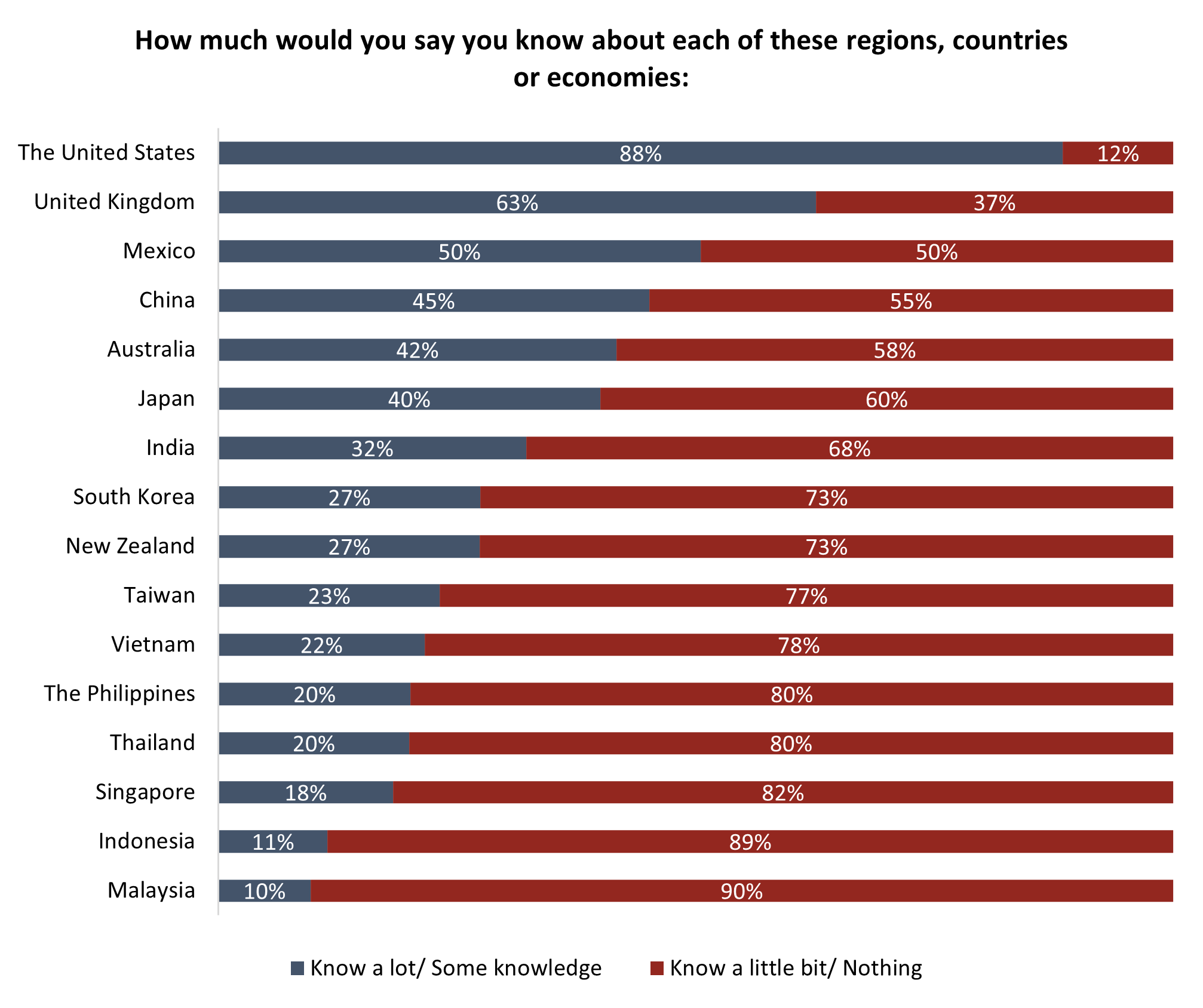
Current tensions and headlines, as well as perhaps its place as a global economic powerhouse and a store of rich history, have Canadians more likely to say that they feel they have some knowledge of China compared to other Asian nations. Slightly fewer than half – 45 per cent – say they feel they have knowledge about that country and/or economy, five points ahead of Japan, 13 points ahead of India, and four times higher than Indonesia, the fourth most populous nation in the world and one with which Canada signed a Comprehensive Economic Partnership Agreement just weeks ago.
Favourability improves but remains poor
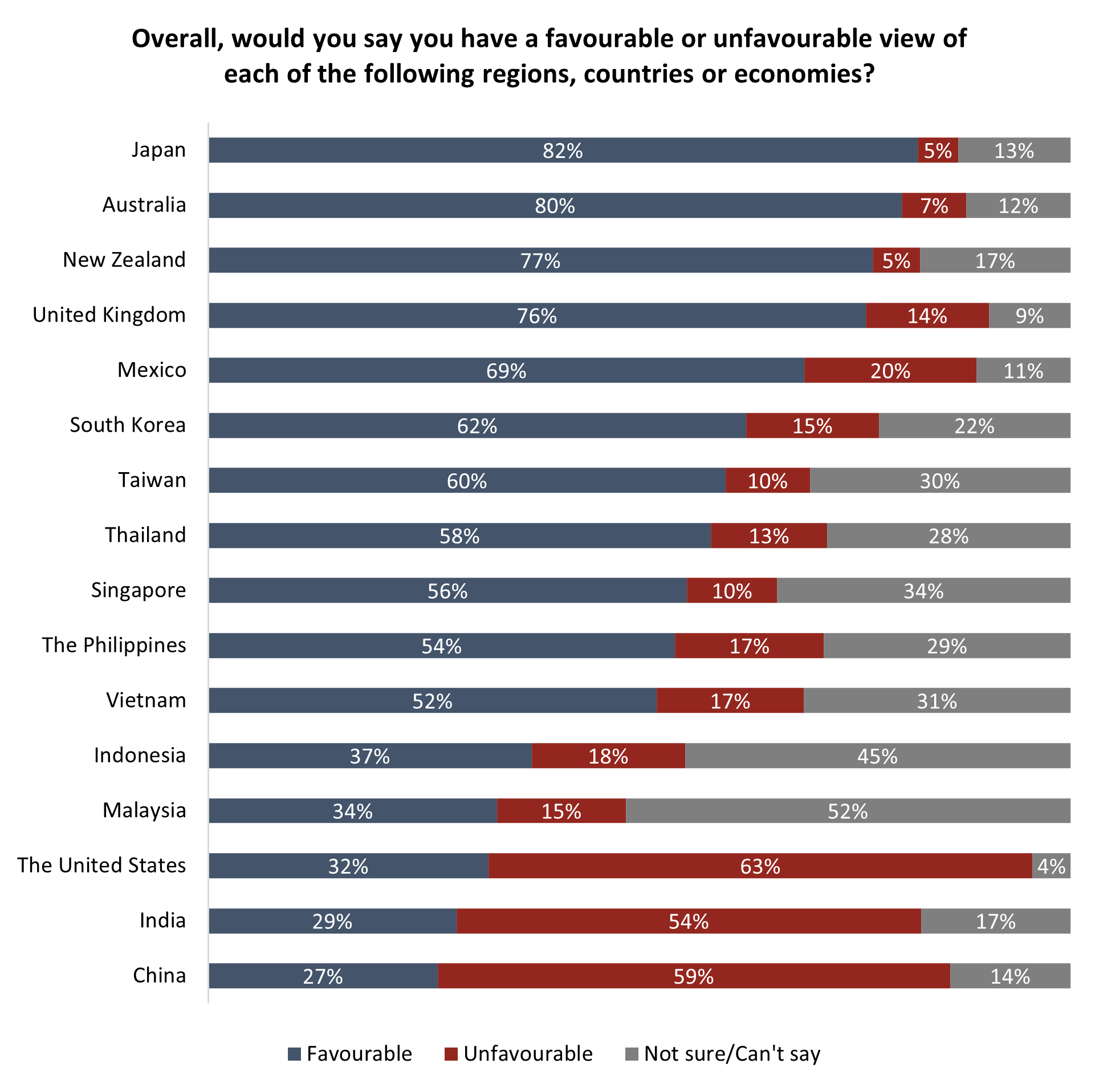
Knowledge about China is relatively higher than other nations, but favourability lags behind considerably. Approaching three-in-10 (27%) say they have a favourable view of China, while more than twice that number (59%) view it unfavourably. Japan leads all nations presented, with 82 per cent favourability, standing in stark contrast. Other Asian nations are also strong in favourability, or subject to significant uncertainty, but few generate negativity:
The public opinion trend for China has been negative in recent years, as its favourability in Canada dropped from 38 per cent in 2018 to a low of 10 per cent in October of 2021. That said, throughout 2025, with the United States playing the primary global villain for many, favourability of China is up 11 points from 16 per cent in January to 27 per cent now:
Fewer say China should be viewed as a threat than say this of the U.S.
Threats from the United States have been numerous this year and emanating from the seat of the U.S. president. In response, an increasing number of Canadians have begun to view their southern neighbour as a threat or even enemy of Canada. Half (46%) say this at the moment.
Related:
- Anger, betrayal and anxiety: Canadians say they’re ready to fight back after tariffs drive views of U.S. to new low
- Friends and foes: Most Canadians say Ottawa should approach China as a ‘threat’ or ‘enemy’
- Favourability of Nations: U.S. rebounds, India drops double-digits, China remains historically low
With that in the background, it is notable that Canadians are more likely to view the U.S. as a threat or enemy (46%) than China (34%). Similar sized groups of one-quarter believe Canada should approach either country as a friend:

Trade priorities: Western nations preferred, China chosen by one-in-nine
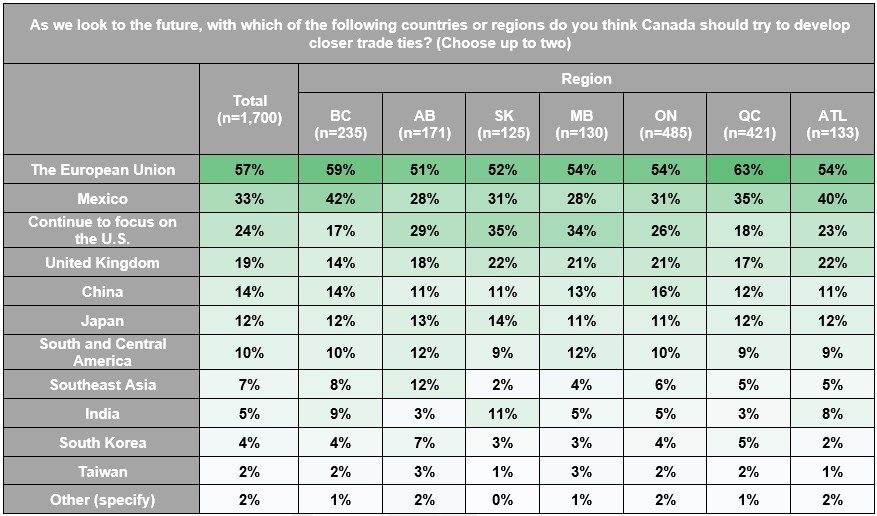
As Trump puts more barriers in front of Canada’s path to deepening economic ties with the U.S., the preference for Canadians is to look across the Atlantic rather than the Pacific for potential trading partners. The European Union (57%) is the most chosen option, while Mexico (33%) trails. A focus on the U.S. (24%) remains preferred to deepening trade with China (14%).
Regionally, focusing on the U.S. for further trade ranks higher for those living in the Prairies, while both coasts show an elevated preference for further trade with Mexico. China fares best in Ontario, with 16 per cent preferring to focus trade with the Asian economic giant:
Across trendline data compiled by ARI the biggest beneficiaries appear to be the European Union and Mexico, though tracking data for Mexico is more limited. Preference for China as a trade partner has yet to recover from pre-COVID-19 levels. In 2015, 40 per cent said they would focus on China, a decade long high point in these data:
More would limit rather than expand trade with China if possible
In general, the above hierarchy Canadians place on preferred trading partners is perhaps a reflection of the hesitation Canadians express towards China as a potential trading partner. More than two-in-five (45%) say they wish Canada would trade less with China.
Comparatively, most Canadians view Taiwan (59%), South Korea (64%) and Japan (79%) as good trading partners:
While there are many Canadians who say that they wish their country would trade less with China, that belief is less prominent than it was four years ago. In 2021, most Canadians (61%) said they wished Canada would reduce its economic links with China:
Most who want less trade with China believe Canada can recover economic losses elsewhere
The sense among Canadians who wish their country would trade with China less is that Canada could do so without an economic cost. One-in-five (21%) say Canada could completely make up economic losses from forgoing trade with China, while three-in-five (60%) believe Canada could trade less with China with little economic consequence. Those who believe it’s “not possible at all” to trade less with China without hurting Canada’s economy are in the minority (20%):
Changing priorities? Trade opportunities vs. human rights and the rule of law
For many years, Canadians preferred that Canada dealt with human rights and rule of law issues first with China rather than explore economic opportunities. That trade-off has shifted significantly as Canadians deal with the new reality of the Trump 2.0 economic relationship with the United States. While half (52%) of Canadians say they prefer Canada focus on the rule of law when it comes to China, that represents a 25-point drop from the proportion who said the same in October 2021:
Canadians’ perspective on whether to focus more on the economic relationship with China or not has also changed. The ratio between those who agreed or disagreed with that sentiment has flipped since February 2023:
Desire for closer ties with Taiwan, but worry over economic cost
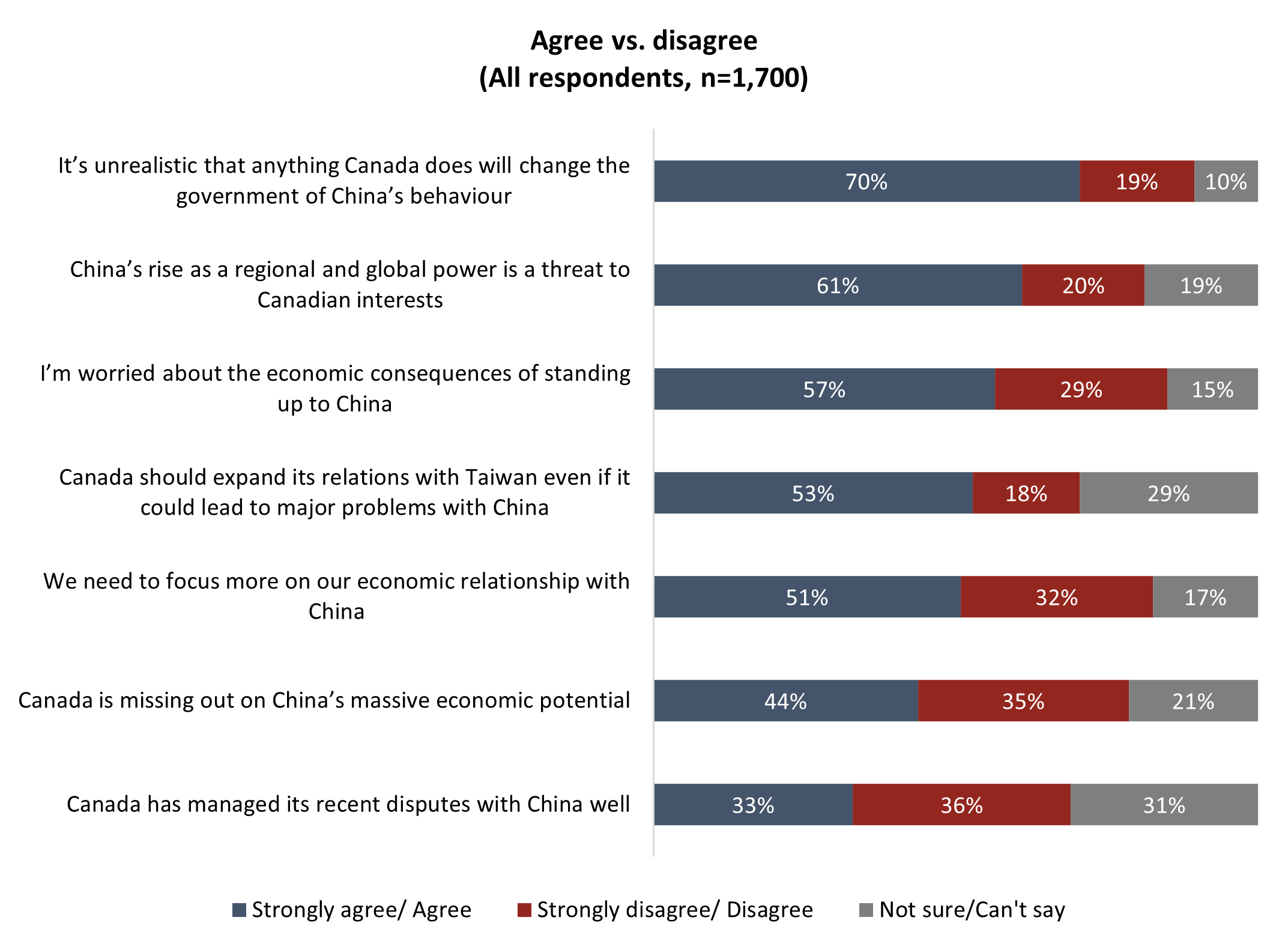
Canadians’ views of China are nuanced, however, despite an apparent growing focus on prioritizing the economic relationship. Three-in-five (61%) describe China’s rise as a “threat to Canadian interests” and a similar number (57%) believe economic retribution is possible if Canada takes too hard of a stand against Beijing’s policies. Still, half (53%) would pursue a closer relationship with Taiwan even if it would damage the Canada-China relationship.
Perhaps underscoring all of this, there is a prevalent view that Canada can have little impact on the course the Chinese government is charting. Seven-in-ten (70%) believe “it’s unrealistic” Canada can change Beijing’s behaviour.
There is also little agreement as to whether Canada has managed recent events well or not, and much uncertainty (31%):
METHODOLOGY
The Angus Reid Institute, in partnership with the Asia Pacific Foundation of Canada, conducted an online survey from Sept. 25-29, 2025, among a randomized sample of 1,700 Canadian adults who are members of Angus Reid Forum. The sample was weighted to be representative of adults nationwide according to region, gender, age, household income, and education, based on the Canadian census. For comparison purposes only, a probability sample of this size would carry a margin of error of +/- 2 percentage points, 19 times out of 20. Discrepancies in or between totals are due to rounding. The survey was commissioned and jointly paid for by ARI and APF Canada. Detailed tables are found at the end of this release.
For detailed results by age, gender, region, education, and other demographics, click here.
For PDF of full release, click here.
For questionnaire, click here.
MEDIA CONTACTS:
Shachi Kurl, President, ARI: 604.908.1693 shachi.kurl@angusreid.org @shachikurl
Vina Nadjibulla, VP Research & Strategy, APF Canada: 917.593.1406 vina.nadjibulla@asiapacific.ca