


Half of Americans say Canada ‘a valued partner and ally’; 15 per cent of Canadians say same of U.S.
March 4, 2025 – As U.S. President Donald Trump addresses congress for the first time in his second presidential term tonight, he’ll likely find a sizable audience north of the border.
It won’t be a favourable one.
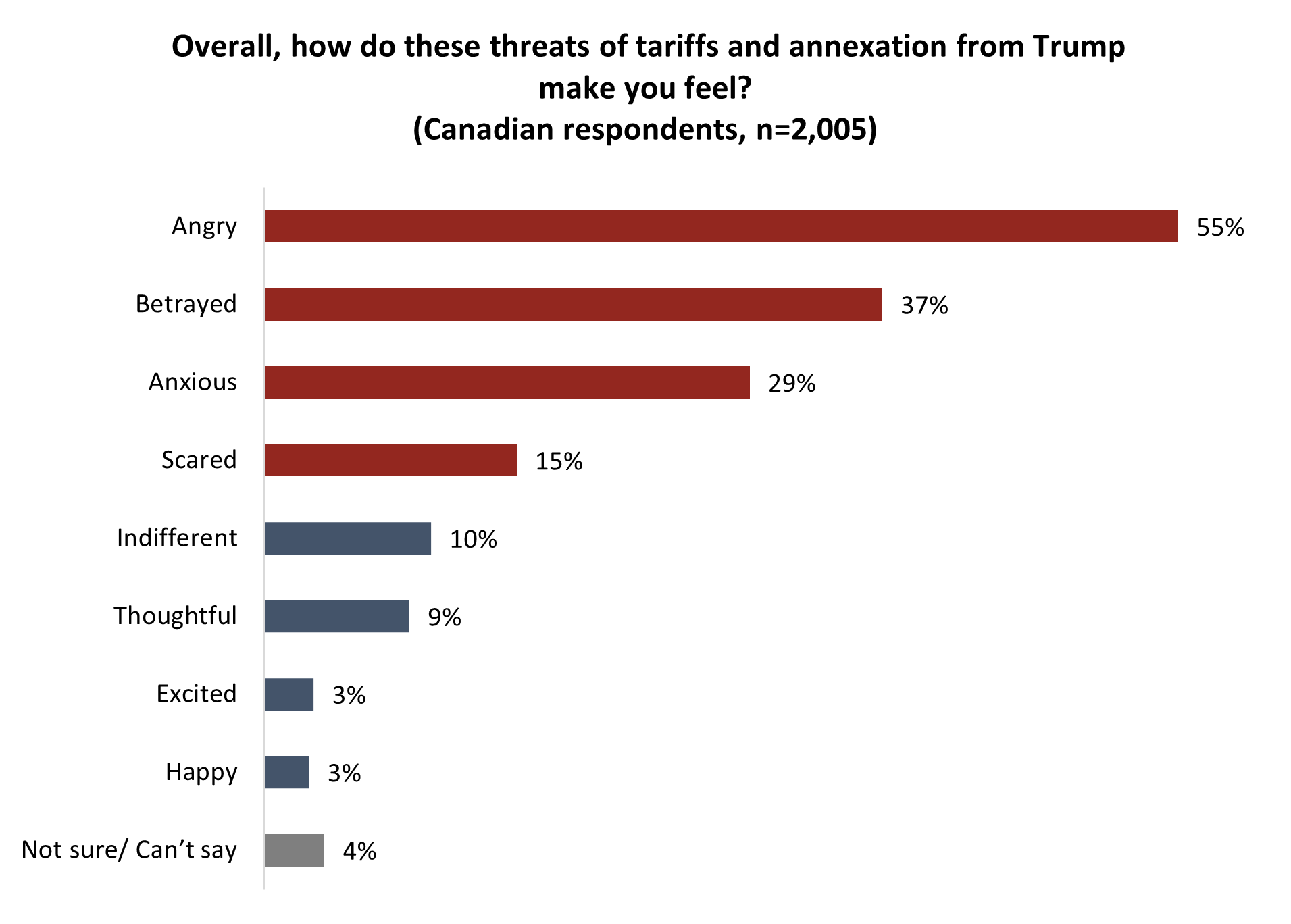
New data from the non-profit Angus Reid Institute finds Canadians feeling angry (55%), betrayed (37%) and anxious (29%) ahead of the expected implementation of tariffs on Canadian goods entering the United States.
This doesn’t mean that Canadians are feeling defeated, however.
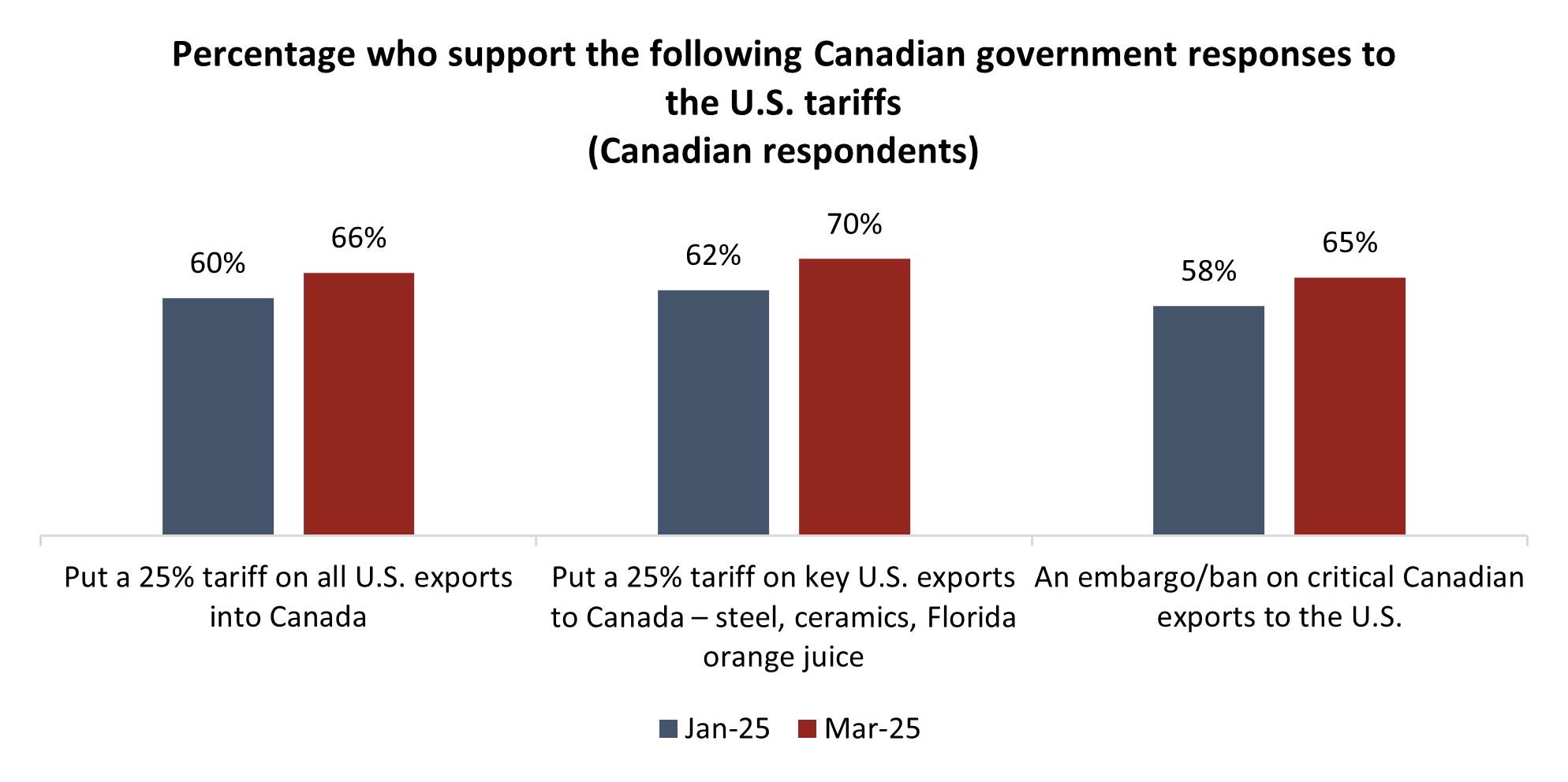
The proportion of those who support retaliatory measures in response to Trump’s tariffs has grown since January. There has been a six- to eight-point increase in support for three policy responses, including a blanket 25-per-cent tariff on U.S. goods (66% support), targeted tariffs on key U.S. imports (70%), and a ban on critical Canadian exports to the U.S. (65%).
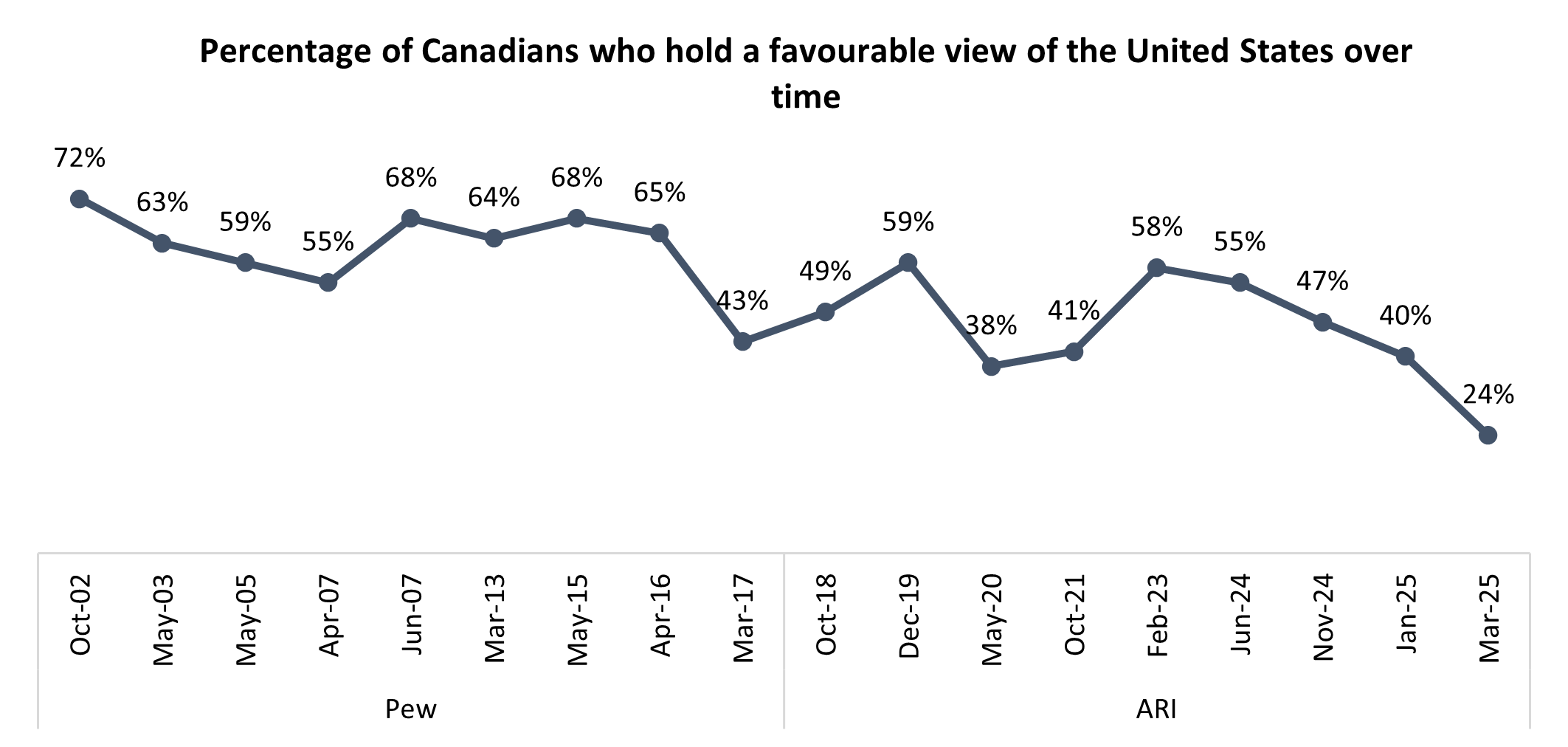
These ongoing tensions have pushed Canadian views of Trump and his country to historic lows. Three-quarters view the United States unfavourably (73%), three-times the number who say the opposite (24%). Further, just 17 per cent hold a favourable view of the president, compared to four-in-five (79%) who view him unfavourably.
More Key Findings:
- Trump’s senior advisor and “special government employee” Elon Musk is viewed equally critically in Canada. Four-in-five (79%) say they view him negatively, and seven-in-10 (71%) support a moratorium on Tesla sales in Canada.
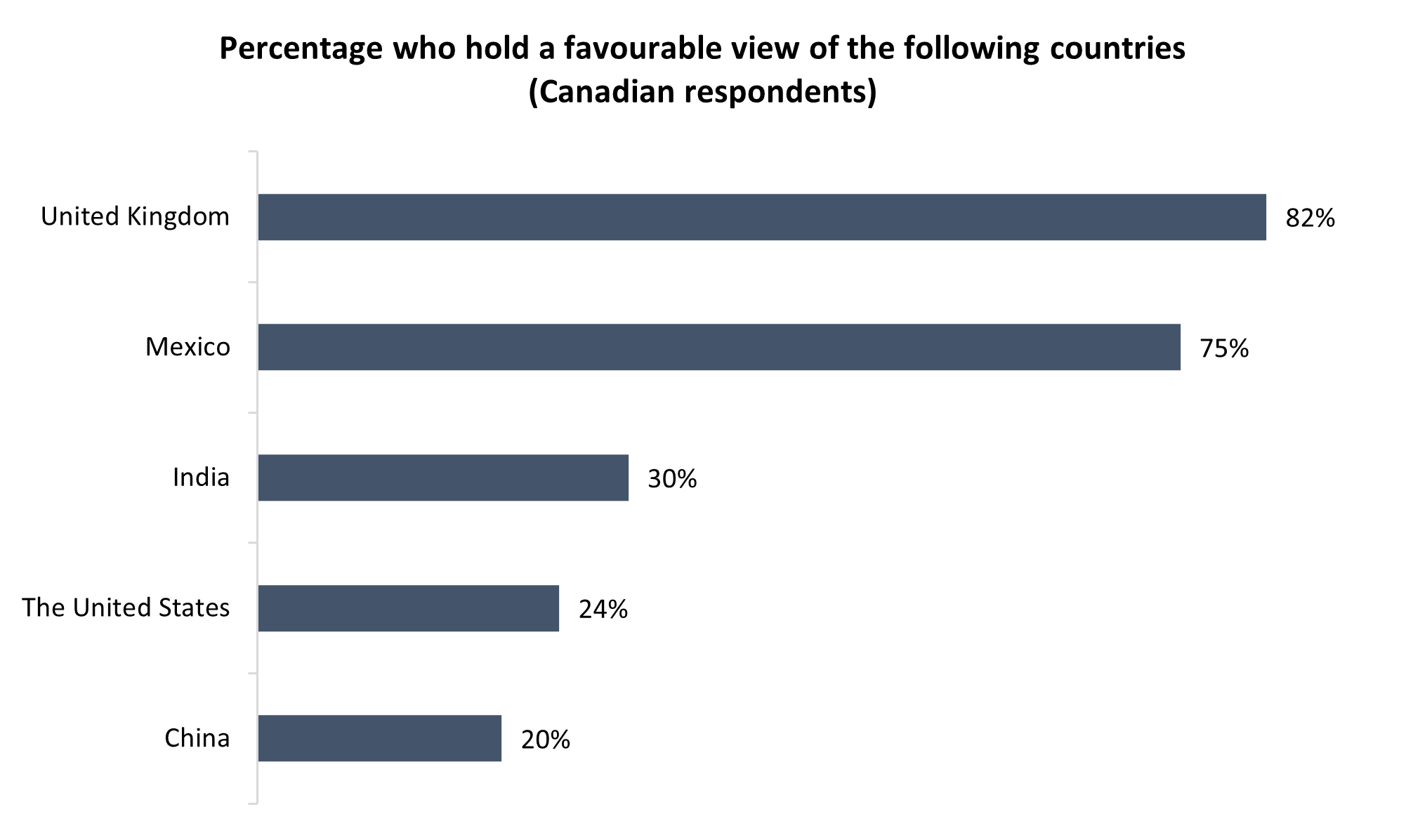
- The United States’ 24 per cent favourability is four-points higher than China’s (20%) and well behind the United Kingdom (82%) and Mexico (75%).
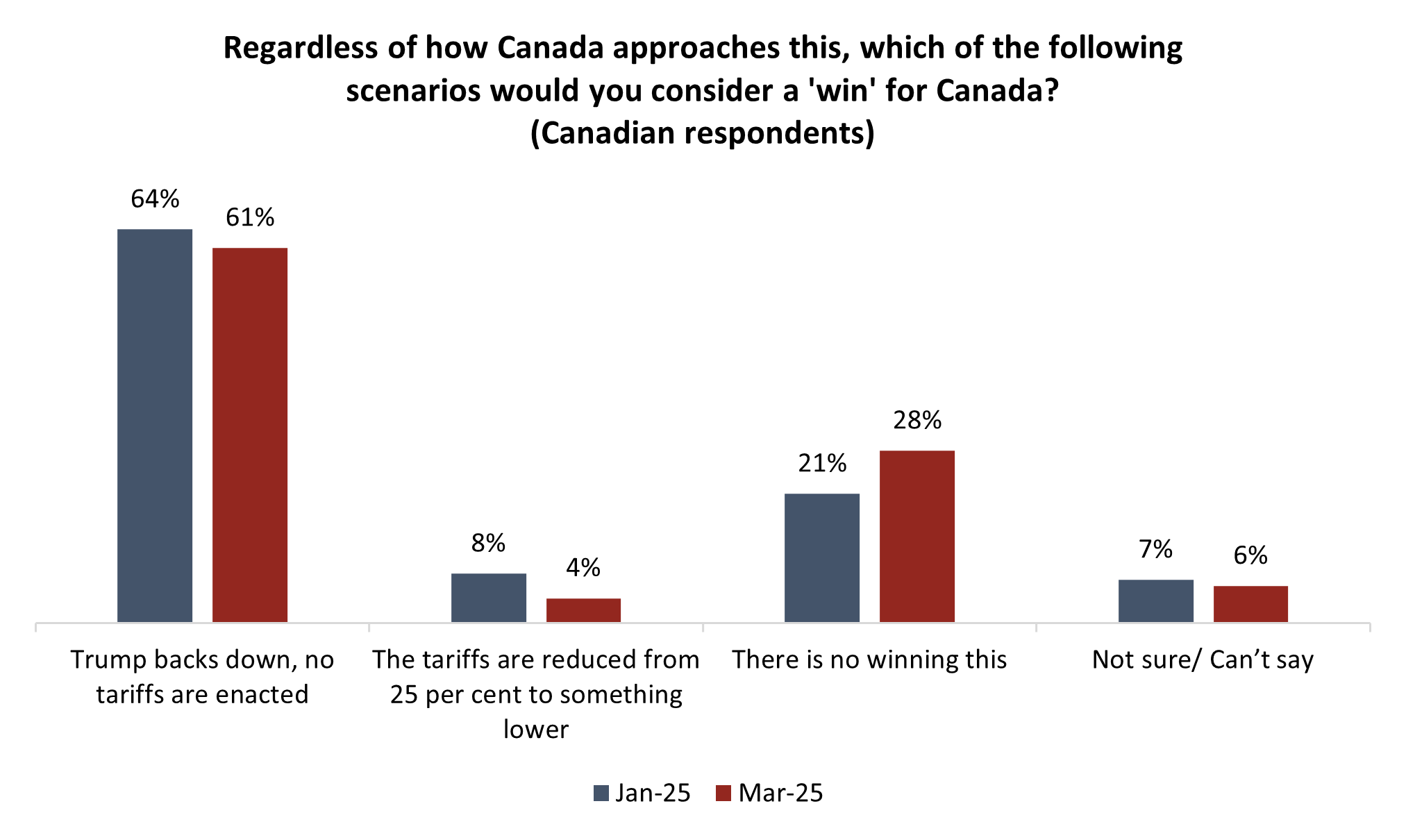
- Asked what they view as a successful outcome from the tariff threat, three-in-five say that it would be Trump backing down entirely. A handful (4%) say reduced tariffs would be a win, while 28 per cent say there’s no winning.
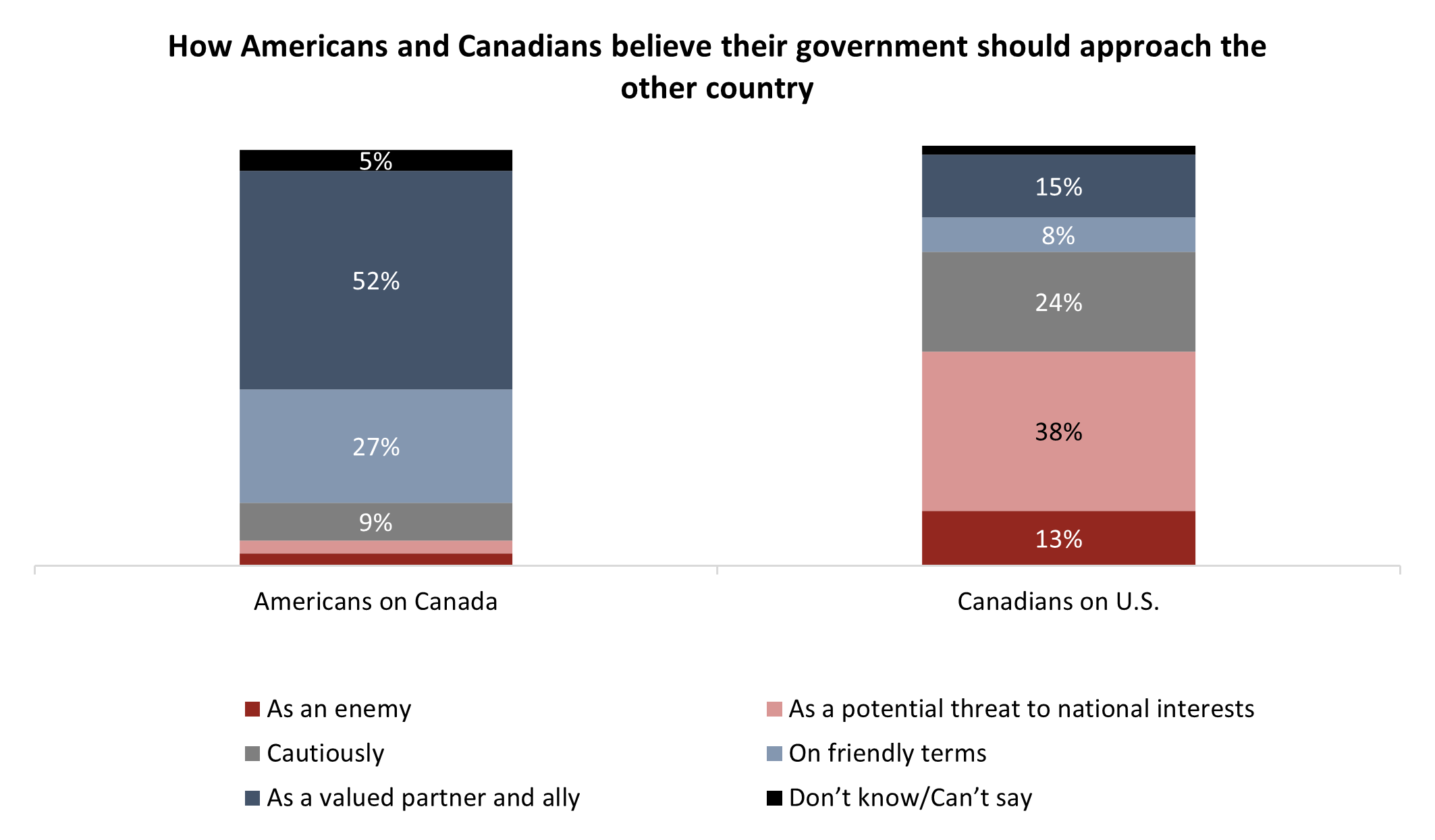
- Half of Canadians (51%) believe their government should approach the U.S. as a threat to national interests (38%) or an enemy (13%). Those views have skyrocketed from November (13% threat, 2% enemy)
INDEX
Part One: Americans on Canada
- Most Americans say Canada is ‘valued partner’, most Canadians view U.S. as threat
Part Two: Palpable Canadian anger
- Majority say they’re ‘angry’ about tariffs, talks of annexation
- Canadians’ views of U.S. lowest in ARI tracking
- Seven-in-10 Canadians have ‘very unfavourable’ views of Musk, Trump
Part Three: What to do about the tariffs?
- What does ‘winning’ look like? Two-thirds say Trump backs down
- Support for retaliatory tariffs rises
Part One: Americans on Canada
Most Americans say Canada is ‘valued partner’, most Canadians view U.S. as threat
There is perhaps a disconnect between the American people and the current U.S. president. Donald Trump has begun his second term with a significant amount of ire directed towards Canada, the biggest customer for the United States’ exports and its third largest source of goods coming in from international markets. Trump has spent much of his first days in office threatening 25-per-cent tariffs on most Canadian goods – finally implemented today – and musing about annexing Canada as the 51st state.
Meanwhile, previous Angus Reid Institute data found low support among the American public for the tariffs, which drops even further when Americans are asked the consider the ramifications of those tariffs – namely, higher gas prices. The Trump administration perhaps acknowledged the latter when they decided to place a lower 10-per-cent tariff on Canadian energy.
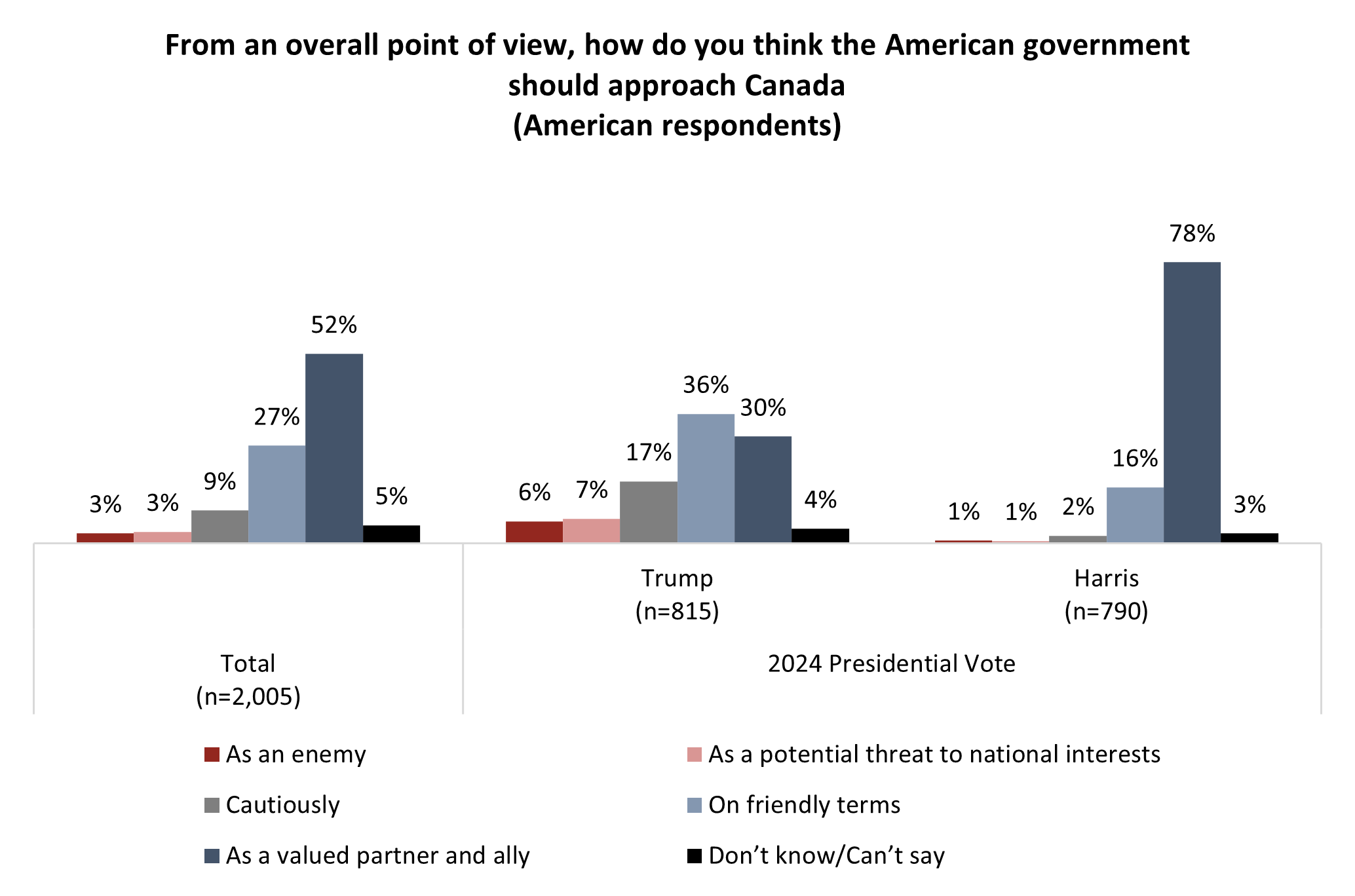
The approach in general is at odds with how Americans believe their government should approach their northern neighbour. Half (52%) of Americans say the U.S. should approach Canada “as a valued partner and ally”, while another quarter (27%) believe the approach should at least be “friendly”. Few see Canada as a threat to national interests (3%) or an enemy (3%).
On the other side of the border, tariffs and talk of annexation has not been well received. One-in-eight (13%) Canadians believe Canada needs to approach the U.S. as an enemy, while two-in-five (38%) describe America as a “potential threat” to Canadian interests:
Those who voted for Trump in 2024 are less likely to believe their government should be treating Canada as a valued ally (30%) than those who voted for the Democratic nominee, former Vice President Kamala Harris (78%). But it’s not as if past Trump voters hew hard to the other side of the spectrum. Two-thirds (66%) of 2024 Trump voters believe their government’s approach to Canada should at least be friendly:
The animosity Canadians are expressing towards the United States is newfound. Compared to data taken around the presidential election in November, three times as many Canadians believe Canada should view the U.S. as a threat to its interests (38% now, 13% in November) while the percentage of Canadians who go further and believe America should be treated as an enemy has grown six-fold (2% to 13%):

Part Two: Palpable Canadian anger
Majority say they’re ‘angry’ about tariffs, talks of annexation
Months of threats of annexation and tariff-induced economic strife has pushed Canadians away from their reputation as a polite bunch. Canadians have booed the American national anthem at hockey games, basketball games, and even WWE events; the mood in Canada is a sour one when it comes to their southern neighbour.
The Angus Reid Institute presented Canadians with a list of positive and negative words to describe their feelings about the situation and found that the majority are “angry” (55%). The other two most commonly chosen words were “betrayed” (37%) and “anxious” (29%):
Canadians’ views of U.S. lowest in ARI tracking
During the first presidential term of Trump, favourable views of the United States in Canada dropped well below where they were under Barack Obama. Nothing that happened during that period, however, elicited negative views comparable to where we are today. Currently, three-quarters of Canadians (73%) say they view the U.S. unfavourably, while one-quarter (24%) say the opposite:
Comparing this to several of Canada’s other key trading partners, the U.S. compares much more closely with China (20% favourable) than the United Kingdom (82%) or Mexico (75%):
Seven-in-10 Canadians have ‘very unfavourable’ views of Musk, Trump
As for Trump, himself, he faces a likely cold welcome if he attends the G7 Summit in Kananaskis later this year. Four-in-five Canadians view him unfavourably. An identical number say the same of one of his most prominent allies Elon Musk, the Tesla CEO and “special government employee”, who recently posted on social media that “Canada is not a real country”. This was in response to a petition to the House of Commons asking the government to strip Musk of his Canadian citizenship received more than 359,000 signatures. The petition alleges Musk has attempted to influence Canadian elections using his social media company “X” and that he is part of a government threatening Canadian sovereignty.

Part Three: What to do about the tariffs?
What does ‘winning’ look like? Two-thirds say Trump backs down
The adage goes there’s no winning a trade war. But the majority view (61%) among Canadians is that if the Canadian government can get Trump to back down, that would be a victory for Canada. Few (4%) accept reduced tariffs as a success for Canada. However, there is a growing sense that, regardless, Canada will be damaged by this tariff battle with the United States. Three-in-ten (28%) say “there is no winning this”, up from the 21 per cent who said the same in January:
Support for retaliatory tariffs rises
In the meantime, Canadians are fully willing to become engaged in the conflict. Canada is expected to respond with retaliatory tariffs on a range of goods, but is stopping short of a tit-for-tat 25 per cent tariff on all American imports into the country. Both measures would be supported by a majority of Canadians.
Newly re-elected Ontario Premier Doug Ford has mused about cutting off electricity supplies to the United States in response to U.S. tariffs. Two-thirds of Canadians (65%) support that sort of response:
Canadians’ overwhelmingly negative views of Musk as outlined earlier in the report comes alongside broad support for targeting Musk’s company Tesla by stopping sales of that brand in Canada. This may be complicated by Tesla having multiple manufacturing facilities in Ontario, which perhaps underscores the challenges tariffs pose.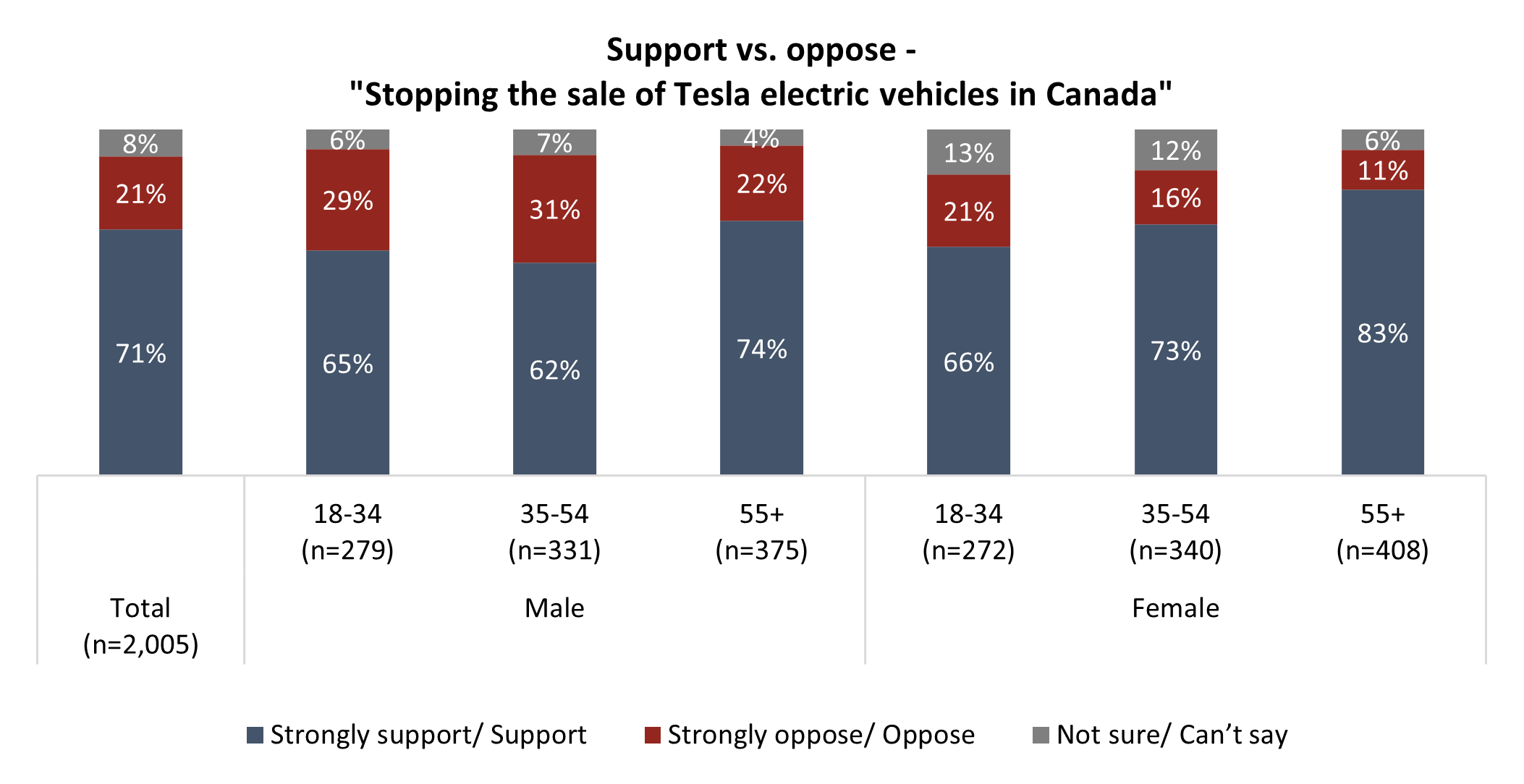
METHODOLOGY
The Angus Reid Institute conducted an online survey from Feb. 27 – March 3, 2025, among a representative randomized sample of 2,005 Canadian adults who are members of Angus Reid Forum. For comparison purposes only, a probability sample of this size would carry a margin of error of +/- 2.0 percentage points, 19 times out of 20. Discrepancies in or between totals are due to rounding. The survey was self-commissioned and paid for by ARI. Detailed tables are found at the end of this release.
MEDIA CONTACT:
Shachi Kurl, President: 604.908.1693 shachi.kurl@angusreid.org @shachikurl
Dave Korzinski, Research Director: 250.899.0821 dave.korzinski@angusreid.org
Jon Roe, Research Associate: 825.437.1147 jon.roe@angusreid.org
For detailed results by age, gender, region, education, and other demographics, click here.
For detailed results for American respondents by age, gender, region, education, and other demographics, click here.
For PDF of full release, click here.
For questionnaire, click here.