

Amid rebate debate awareness of carbon tax reimbursement rises nine points
March 25, 2024 – With help from the Bloc Québécois and the NDP, Justin Trudeau’s Liberals survived a non-confidence motion last week that Conservative MPs hoped would force an election, based on a single ballot issue – the carbon tax.
A signature policy of the Liberal government, the tax has faced intense scrutiny, pressure, and declining support for months. April 1 brings another yearly increase in the carbon price. New data from the non-profit Angus Reid Institute finds that the Liberal government’s efforts to better brand and communicate the program may be helping, but is it too little, too late?
Compared to November 2023, the proportion of Canadians supporting an increase in the carbon price in their province has risen seven points from 15 to 22 per cent. Two-in-five would-be voters for the Liberals, NDP, and BQ all say they would increase the tax as planned, while a similar number say that they would pause it at its current level.
The problem for the government is that these would-be supporters are a much smaller group than they were at this time last year. The vast majority of those who would support the Conservatives would “axe the tax” (75%) or at least lower it (9%). This, as the party leads in vote intention by nearly a two-to-one margin over the governing Liberals.
Alongside a small increase in support for raising or at least maintaining the tax is an increased awareness from Canadians of the benefits they receive in the form of rebates. Amid a rebranding of the “Canada Carbon Rebate” the number of Canadians who are certain they receive the benefit (+7), or think they do (+2), have both increased, compared to data collected in November. While awareness has risen, a plurality of Canadians still feel they are not making as much back as they pay (44%). There has, however, been a five-point increase in the number who say they see a net benefit from the program (14% to 19%).
More Key Findings:
- Most Canadians currently say that cost of living concerns (56%) should outweigh climate change concerns (31%) when making economic policy.
- Criticism of the carbon tax is driven by a sense that it is ineffective at reducing Canada’s greenhouse gas emissions (68% say this).
- Two-in-five Canadians (40%) say the carbon tax is making their life “a lot” more expensive. One-quarter (26%) say it’s increasing their cost of living “a little”, while just four per cent say it is saving them money.
About ARI
The Angus Reid Institute (ARI) was founded in October 2014 by pollster and sociologist, Dr. Angus Reid. ARI is a national, not-for-profit, non-partisan public opinion research foundation established to advance education by commissioning, conducting and disseminating to the public accessible and impartial statistical data, research and policy analysis on economics, political science, philanthropy, public administration, domestic and international affairs and other socio-economic issues of importance to Canada and its world.
INDEX
Part One: Rebate perspectives
-
Awareness of rebates has increased from November
-
Plurality still believe tax paid outweighs rebate
Part Two: Support for increasing tax rises, but twice as many say abolish
-
Affordability over climate policy?
-
Most feel carbon tax making their lives more expensive
-
Majority feel carbon tax ineffective at fighting climate change
-
One-in-five would increase carbon tax as planned April 1
Part Three: Saskatchewan vs. Ottawa
-
Majority say Saskatchewan “doing right thing” by not collecting on home heating
Part One: Rebate perspectives
Awareness of rebates has increased from November
The federal carbon tax program has been under the microscope in recent months as Canadians look for relief from the rising cost of living. The federal government has argued that the federal carbon tax – which covers all provinces except B.C. and Quebec – does not make life more expensive for the majority of Canadians because 80 per cent of households in those provinces receive more in a quarterly rebate than they pay out in taxes. Opponents, often citing the same report as proponents, say that this is not the case, because of the indirect economic costs of the tax.
In British Columbia, eligibility for a unique provincial program is capped by income level, so not all residents are eligible for a rebate. In Quebec, residents do not receive direct climate related rebates as most of the funding from carbon programs is reinvested into sustainability projects and a transition to green energy.
At issue for the federal government is awareness of rebates. In November, only two-in-five of those living in provinces subject to the federal carbon tax said they were certain their household had received a rebate.
Since then, the federal government has rebranded the rebate so now eligible Canadians receive a “Canada Carbon Rebate” in their bank accounts each quarter instead of the previous “Climate Action Incentive Payment”. Perhaps the rebrand, and the increased discussions around the tax in general, has had an effect. Half now say they’re certain their household has received a rebate, while the proportion of those in eligible provinces who believe they haven’t has shrunk from one-in-four (25%) to 17 per cent:

Plurality still believe tax paid outweighs rebate
The federal government has been insistent that four-in-five households in federally carbon-taxed provinces earn more back in rebates than they pay in taxes. However, the sense among Canadians is still that they pay more in taxes than they receive back in rebates:
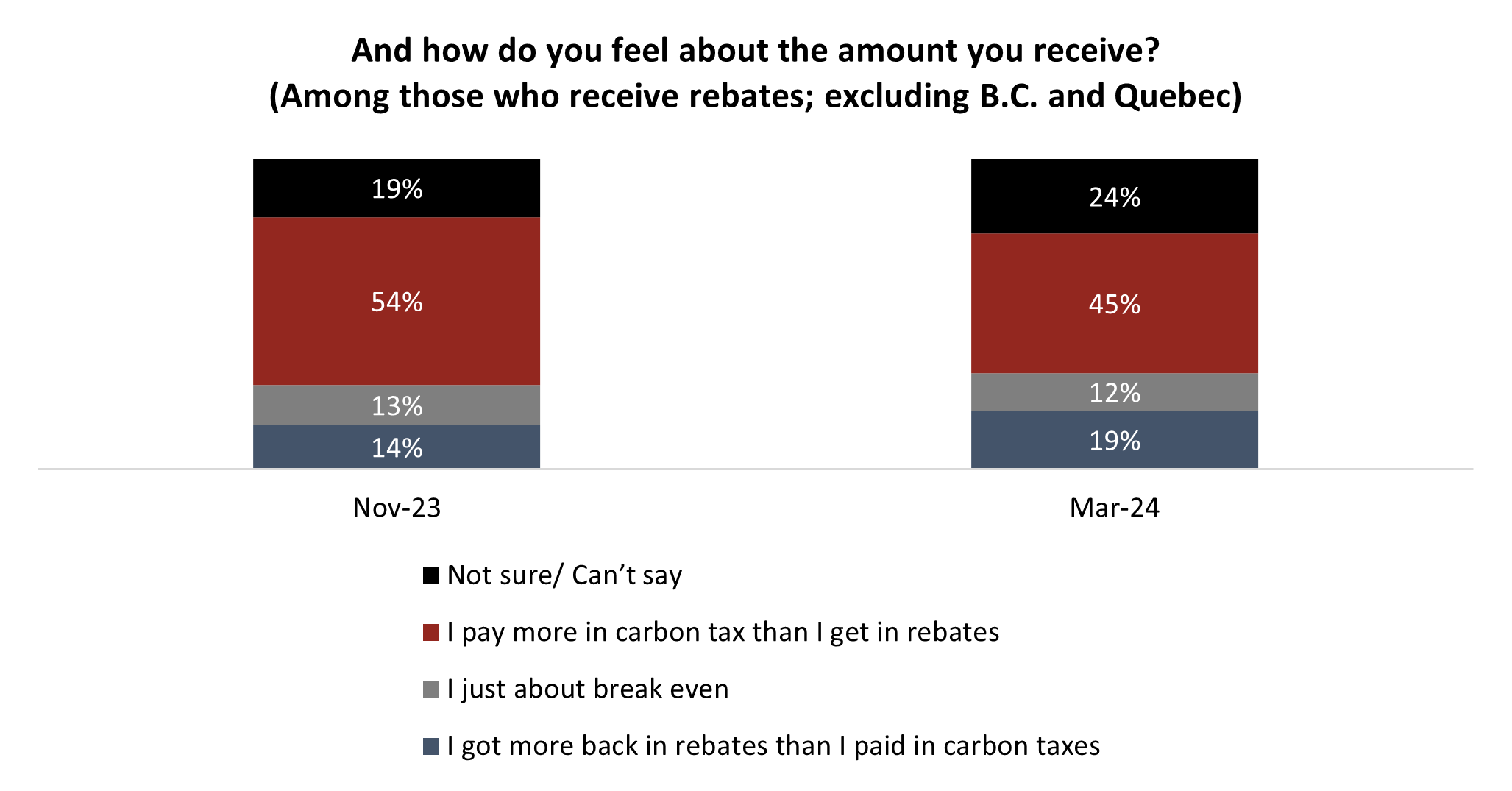
Comparatively from November, the number of eligible Canadians who say they have received no rebate has shrunk while those who think they get more back than they pay has increased. There remains a persistent one-third who say they come out behind when it comes to the carbon tax, and much lingering uncertainty:

Part Two: Support for increasing tax rises, but twice as many say abolish
The federal government’s campaign to raise awareness of carbon tax rebates has been fought as a counter offensive in recent months. The carbon tax is scheduled to rise in price annually on April 1 until 2030. The premier of every province subject to the federal carbon tax program except Manitoba has called on the federal government to pause this year’s scheduled increase to the carbon tax. The federal government has said it has no plans to pause the increase, arguing that because of the rebate, the carbon tax has no effect on affordability for most Canadians.
Affordability paramount for majority
Cost of living concerns are overwhelmingly the top issue in the eyes of Canadians and have been since inflation began rising two years ago. While most Canadians believe climate change is happening and is caused by human activities (62%, see detailed tables) cost of living is more likely to be seen as the issue which takes precedence.
Half (56%) say affordability should be prioritized over fighting climate change, while 32 per cent say environmental policies are more important.
Canadians in the middle of their working career are more likely to be feeling the cost-of-living crunch. By the Angus Reid Institute’s Economic Stress Index, 35- to 54-year-olds are more likely to be considered Struggling than 18- to 34-year-olds or those older than 55, and much less likely to be Thriving.
Perhaps relatedly, Canadians that age are more likely to place a higher emphasis on affordability concerns than climate change. Two-in-five (39%) of Canadians older than 64 say the latter should take precedence, the most of any age group:

Most feel carbon tax making their lives more expensive
With affordability a high priority, support for the carbon tax is likely further hindered by the majority belief that it is making life more expensive for Canadians. Two-thirds say either the carbon tax is making their life “a lot” (40%) or “a little” (26%) more costly. Fewer than one-in-five (18%) say it makes no difference to their day-to-day expenses.
Men are much more certain than women that the carbon tax is making life more expensive:

Majority feel carbon tax ineffective at fighting climate change
The Canadian Climate Institute recently released a study showing that carbon pricing is projected to reduce emissions in Canada, but also that the tax on industrial emitters is expected to be much more effective than the much-scrutinized one covering consumers. Other research has found that carbon pricing is effective at reducing greenhouse gas emissions, but likely won’t be enough on its own to keep global warming within the goals of the Paris Climate Agreement.
The federal government appears to have work to do to convince Canadians of the policy’s efficacy. Overall, Canadians don’t feel the carbon tax is an effective means to accomplish its end: lowering greenhouse gas emissions. One-quarter (23%) believe the carbon tax is effective at reducing Canada’s emissions, while most (68%) disagree.

One-in-five would increase carbon tax as planned April 1
One-in-five (22%) Canadians support the federal government’s path of raising the carbon tax again this year. The rest would either pause increases for now (27%), lower the carbon tax (11%) or abolish it altogether (40%). Support for the increase has grown by seven points from November, but increasing it is an option still only supported by a minority:

Abolishing the carbon tax is supported by a majority in Alberta, Saskatchewan, and Atlantic Canada. It is also the plurality view of those in Manitoba (47%) and Ontario (40%). Support for increasing the tax within their own province is highest in Quebec, which is subject to its own market-based carbon-pricing system which also increases incrementally over time, but at a different rate than the federal program:

*specific language used in Quebec regarding cap and trade system
While still the minority view, there has been an increase in support for increasing the carbon tax in all areas of the country covered by the federal program except Atlantic Canada:

Most Canadians of all current political leanings would support a temporary pause – at minimum – to carbon tax price increases. Likely CPC voters are most vocal about eliminating the tax altogether, while at least two-in-five Liberal (38%), NDP (38%) and Bloc Québécois supporters (42%) say they are on board with this year’s carbon tax increase. If the Liberals do indeed hope to retain the government in a future election, communication with respect to the carbon tax appears critical. Currently just 23 per cent of Canadians support Justin Trudeau’s party:

Awareness and satisfaction with the rebate appear to be significant drivers in support for the carbon tax increases, suggesting that the federal government has managed to convince at least some eligible Canadians they receive the rebate and come out ahead from it. Three-quarters who feel they pay more carbon tax than they receive back in the rebate want the government to abolish the carbon tax, while one-in-ten (9%) of those who are satisfied with their rebate amount say the same:

Part Three: Saskatchewan vs. Ottawa
Majority say Saskatchewan “doing right thing” by not collecting on home heating
Saskatchewan has gone its own way in fighting the federal carbon tax. It has stopped remitting the tax collected on home heating to the federal government, an illegal move which could result in fines or jail time for provincial officials. This, after the Liberal government stopped collecting the tax on home heating oil, which is primarily used in Atlantic Canada. In response, the federal government has stopped issuing rebate cheques to those in Saskatchewan, arguing the move by the provincial government will cost most families more than they save from not paying the tax.
A majority across the country feel Saskatchewan is doing the “right” thing by not collecting the carbon tax on home heating, including three-in-five (58%) in Saskatchewan. One-quarter (24%) feel Premier Scott Moe and the Saskatchewan Party government are doing “wrong” by not remitting the tax, including one-third (34%) in Saskatchewan, the most in the country.
Notably, those who are satisfied with the amount they receive in rebates are much more likely than others to say Saskatchewan is making an error by stopping collecting the carbon tax (see detailed tables).

METHODOLOGY
| The Angus Reid Institute conducted an online survey from March 20-22, 2024 among a representative randomized sample of 1,602 Canadian adults who are members of Angus Reid Forum. For comparison purposes only, a probability sample of this size would carry a margin of error of +/- 2 percentage points, 19 times out of 20. Discrepancies in or between totals are due to rounding. The survey was self-commissioned and paid for by ARI. Detailed tables are found at the end of this release. |
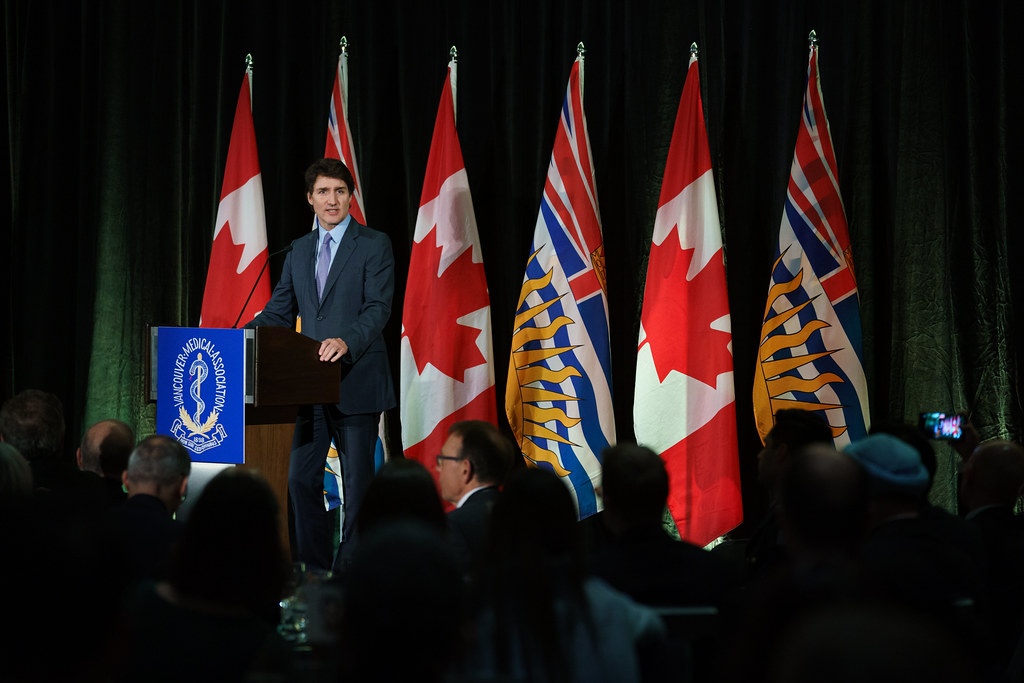
Image Credit – Justin Trudeau, Facebook
For detailed results by age, gender, region, education, and other demographics, click here.
For detailed results by opinions on climate change, the carbon tax and other cross-tabulations, click here.
To read the full report, including detailed tables and methodology, click here.
To read the questionnaire, click here.
MEDIA CONTACTS:
Shachi Kurl, President: 604.908.1693 shachi.kurl@angusreid.org @shachikurl
Dave Korzinski, Research Director: 250.899.0821 dave.korzinski@angusreid.org