


Seven-in-10 renters say they can’t afford to buy a home yet (30%) or have given up on ownership (41%)
October 21, 2024 – As Canadians absorb the implications of another change in the inflation rate – down to 1.6 per cent – many are beginning to wonder what it will mean for their financial futures and pursuits of home ownership. For some, however, relief is lagging behind this key macroeconomic indicator.
Data from the non-profit Angus Reid Institute finds persistently high grocery and rental costs, which have bucked the overall downward trajectory of broader inflation, continue to put immense pressure on lower-income households. Overall, 51 per cent of Canadians say it remains a challenge to keep up with their household food needs, a proportion that has remained relatively consistent since it rose to this level in late 2021. Among those whose annual household incomes are lower than $50,000, the number having a difficult time rises to two-thirds (65%).
Overall, on the Angus Reid Institute’s Economic Stress Index, the largest proportion of Canadians are still categorized as Struggling. This, based on a measure of their self-professed financial outlook, as well as their debt, housing, and food costs. One-in-three (33%) are in this group, the same number as were in June. Smaller groups are Thriving (23%), Comfortable (22%), or Uncomfortable (22%).
There is some cause for optimism. The proportion of those saying they’re worse off now than they were 12 months ago has dropped seven points compared to last September. The number who expect to be worse off 12 months from now is also down five points compared to last year at this time.
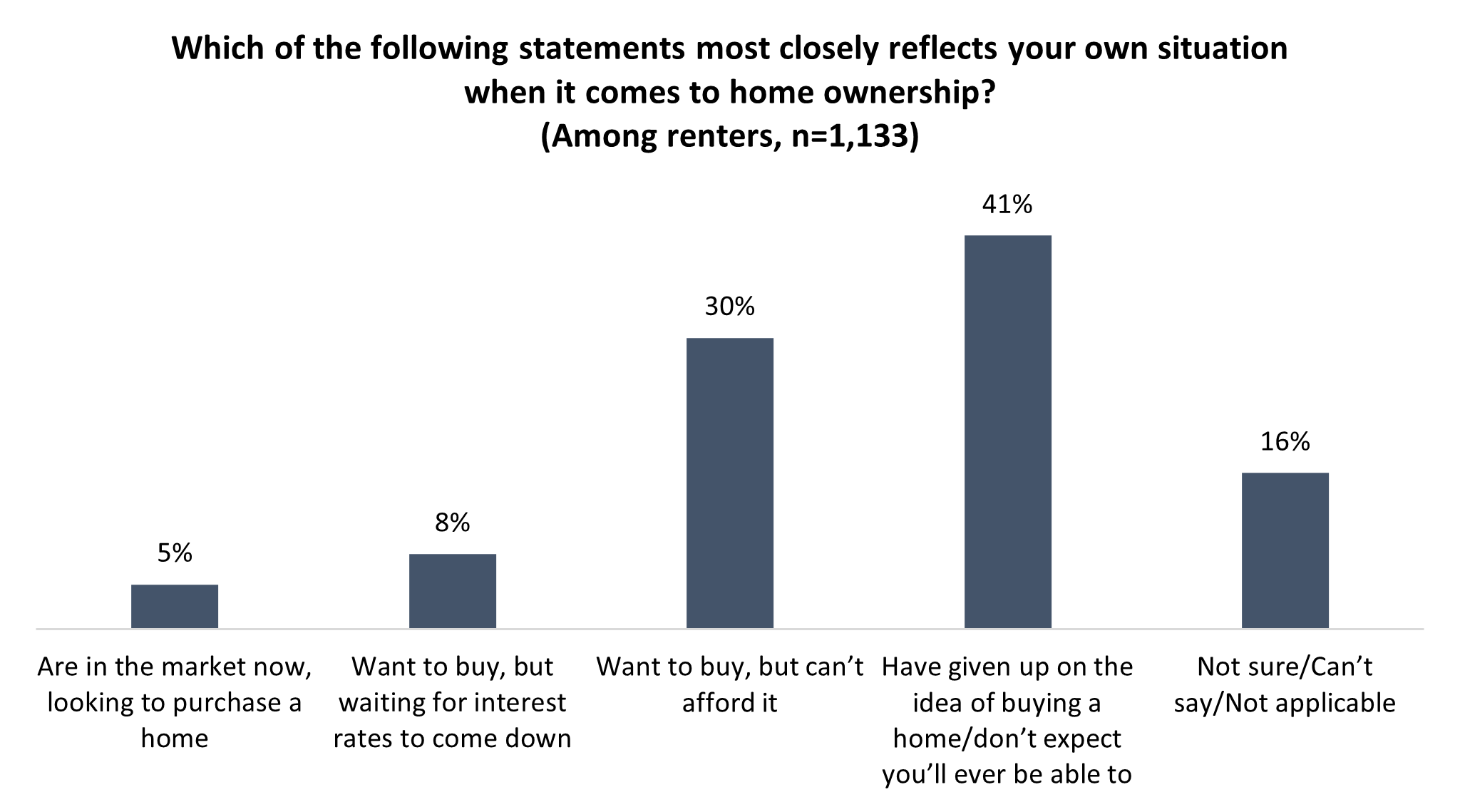
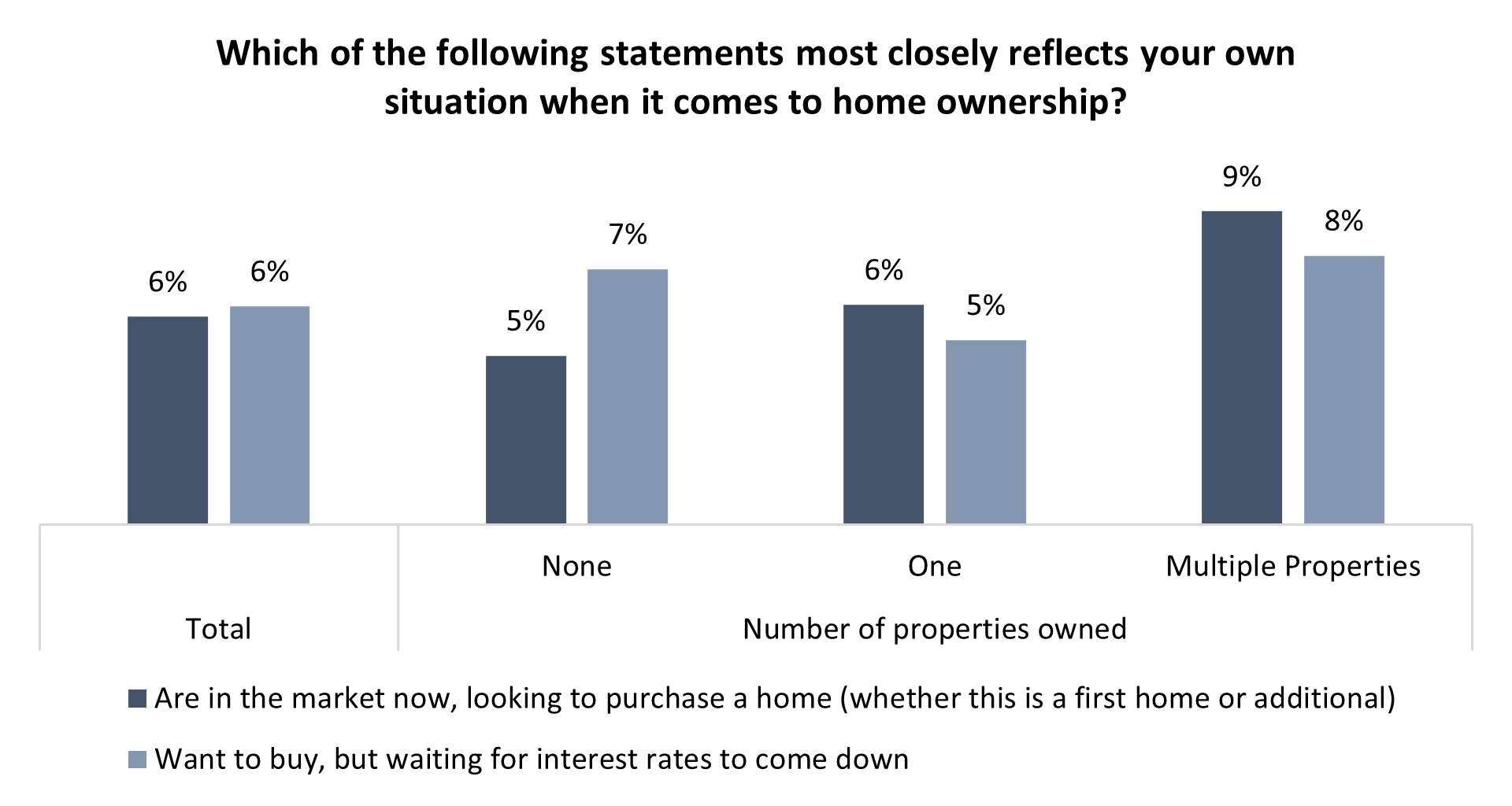
Changes in housing prices have been a mixed bag as interest rates have begun to drop. While rental costs are up overall nationwide by nearly nine per cent year-over-year, they have reportedly fallen in some key markets. Renters, themselves, continue to have a difficult time, with three-in-five saying their monthly payment is tough or very difficult to keep up. With interest rates falling, some home-seekers are feeling energized, but for renters this is less the case. Three-in-10 say they’d like to own a home but can’t afford it yet, while two-in-five (41%) have given up on ever owning a home. The most likely group to be looking now or waiting for rates to drop are notably those who already own multiple properties. Nearing one-in-five in this group (17%) are active now or expect to be soon, compared to 12 per cent within the group who do not own a home.
More Key Findings: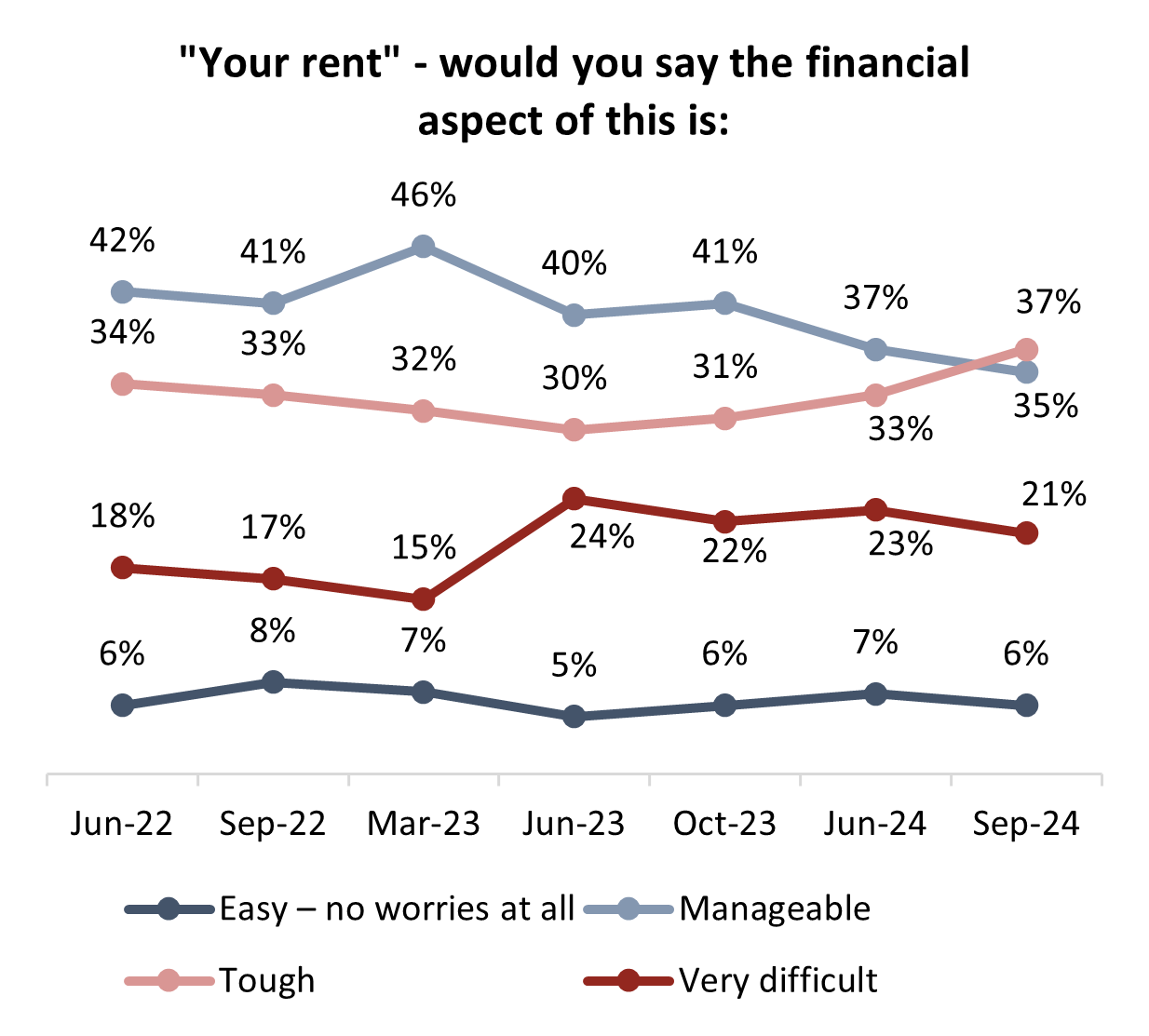
- Overall, six per cent of Canadians say they’re actively in the housing market now (whether this is for a first home or an additional property). Younger people (18-34) are most likely to say this, with one-in-10 among both men and women reporting it.
- The same number of Canadians (6%) and in each 18- to 34-year-old gender group (11% male, 9% female) say they’re waiting for mortgage rates to drop further before they engage in earnest with the home buying market.
- One-in-five Canadians expect their finances to improve over the next 12 months (20%), while 30 per cent expect the opposite. The rest expect no change (40%) or are unsure (10%).
About ARI
The Angus Reid Institute (ARI) was founded in October 2014 by pollster and sociologist, Dr. Angus Reid. ARI is a national, not-for-profit, non-partisan public opinion research foundation established to advance education by commissioning, conducting and disseminating to the public accessible and impartial statistical data, research and policy analysis on economics, political science, philanthropy, public administration, domestic and international affairs and other socio-economic issues of importance to Canada and its world.
INDEX:
Part One: Economic well-being in Canada
- Economic improvement a blip or the start of a trend?
- Grocery costs remain a challenge
- Economic Stress Index
Part Two: Housing
- Elevated challenges for renters
- Will they ever own?
- Mortgage holders struggle with stress
- Checking on the housing market
Part One: Economic well-being in Canada
Economic improvement a blip or the start of a trend?
The high inflation plaguing Canadians post pandemic appears to have passed, however, Canadians are still feeling its effects. The high cost of living continues to be one of the most pressing issues the country is facing, according to a majority of Canadians. Food prices have continued to grow at a faster rate than the headline inflation rate of 1.6 per cent in September and rent prices have increased by more than eight per cent year over year.
Canadian households face other concerns as inflation fades. High interest rates are pressuring Canadians holding various types of debts, including mortgages, though the Bank of Canada is expected to follow this period of cooled inflation with a series of rate cuts. The pace of cuts may be determined by Canada’s concerning levels of economic growth, as well as rising unemployment levels. Joblessness is a rising concern for younger Canadians, who face much higher unemployment rates than other demographics.
As these economic winds swirl around them, on balance, Canadians are more likely to feel like they are sinking than treading water when it comes to their own personal finances. Two-in-five (42%) say they are worse off financially than they were a year ago. However, that figure has declined by seven points from the proportion of Canadians who said so a year ago (49%), suggesting the financial malaise that gripped Canadians in the middle of the inflation crisis has abated somewhat.
Two-in-five (41%) believe they are in the same position financially as they were a year ago, while the smallest group of one-in-six (15%) say they are better off, both a higher proportion than who said so a year ago (36% and 12% respectively):

Despite lower levels of inflation, and the prospect of rate cuts on the horizon, there is still a relatively high level of economic pessimism. Three-in-ten (30%) Canadians say they expect to be worse off financially in 12 months time, a figure higher than at any point between 2010 and late 2018. Two-in-five (40%) say they expect to be in a similar position, while one-in-five (20%) expect to better their financial standing:

Grocery costs remain a challenge
According to Statistics Canada, while inflation as an overall marker has declined, specific elements of the Consumer Price Index remain relatively high, including the cost of groceries. This has been a defining featuring of the post-COVID-19 environment, as half of Canadians continue to say that this aspect of their household finances causes them consternation:

Higher grocery costs impact all groups across the household income spectrum, but the demarcation for majority level struggle appears to be the $100,000 per year cut off. Below this mark at least 53 per cent in each income group have a difficult time feeding their households:

Economic Stress Index
The Angus Reid Institute developed the Economic Stress Index in January 2022 to analyze Canadians’ financial stress through questions on housing and grocery costs, concerns over debt, and the above measures of economic self-appraisal, optimism and pessimism. (See the index scoring here).
As Canadians dealt with high levels of inflation, the proportion of those struggling according to the index rose from 27 per cent to 32 per cent now. That continues to be the largest group of Canadians, with fewer than one-quarter making up each of the Uncomfortable, Comfortable and the Thriving:
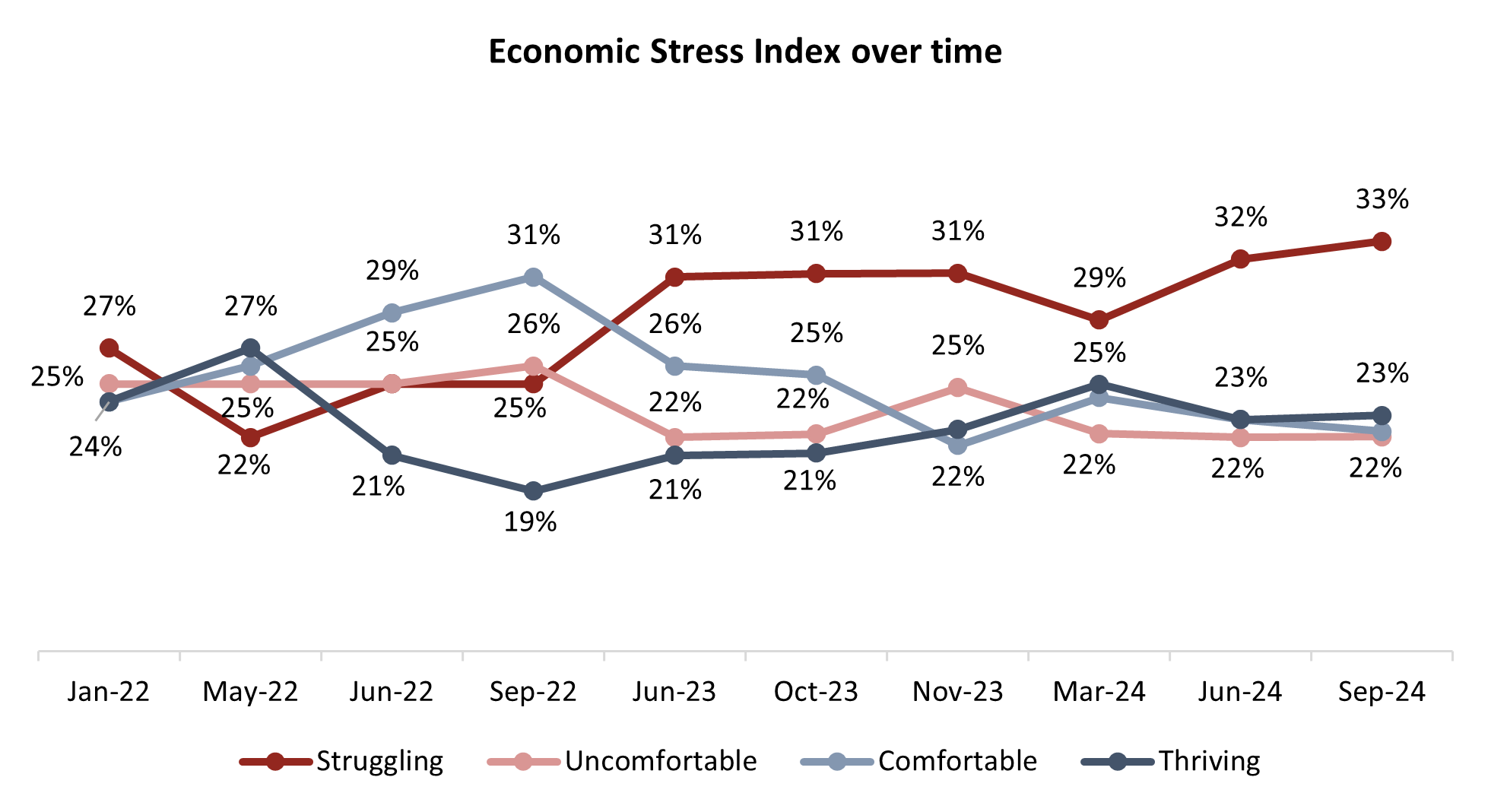
Since May 2022 the proportion of those Struggling on the Economic Stress Index has risen from 22 to 33 per cent. Those with lower incomes were suffering earlier than others, but they have been joined by larger numbers of higher income individuals. Consider that the nine per cent of those with incomes above $200 thousand has grown to 25 per cent:

Part Two: Housing
There has been mixed news on the housing front for many Canadians in recent months. Rent is declining in some of the country’s most expensive markets, with some crediting the federal government’s rules to curb the number of international students in the country. That said, the overall trend has prices up 8.2 per cent year-over-year in the rental market.
For mortgage holders, economists are anticipating further rate cuts from the Bank of Canada are on the horizon, providing potential relief for those on variable rates. However, the cost of homes is still climbing in all but Ontario and British Columbia, putting ownership out of reach for many in the country.
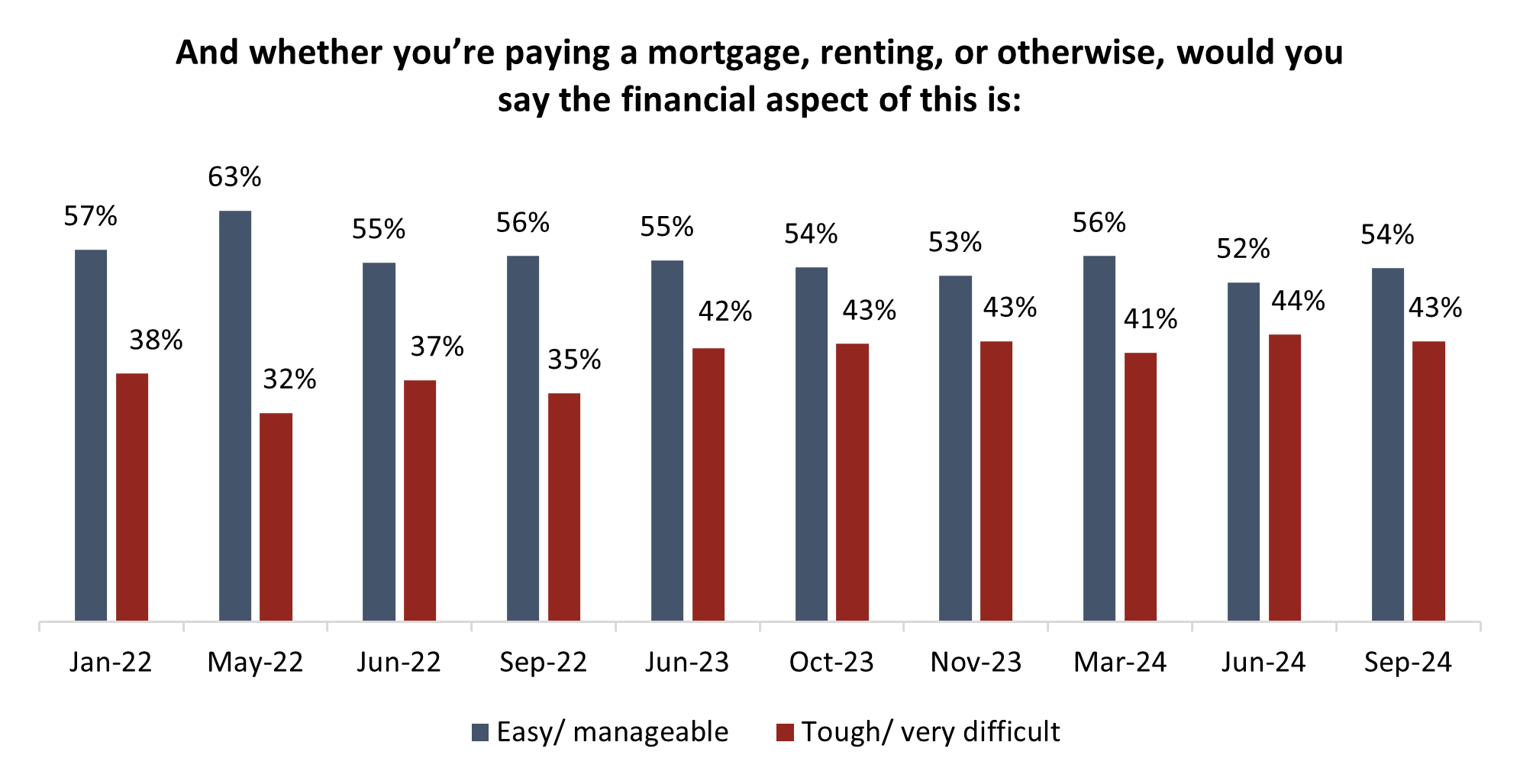
As Canadians watch for improvements in the housing market, both renters and owners alike are still showing signs of elevated challenges. 2022 was the last time fewer than two-in-five Canadians said their housing payments were tough or very difficult to handle each month:
Elevated challenges for renters
The population of renters is growing in Canada, with recent data denoting that one-in-three Canadians now rent their home, a record high. Note that within this survey, 29 per cent of respondents identified as renting. And while the rental market is in flux in some regions, most who fit this definition are still having a tough or very difficult time. Some of this is due to the relatively lower income levels and younger population who tend to be renters.

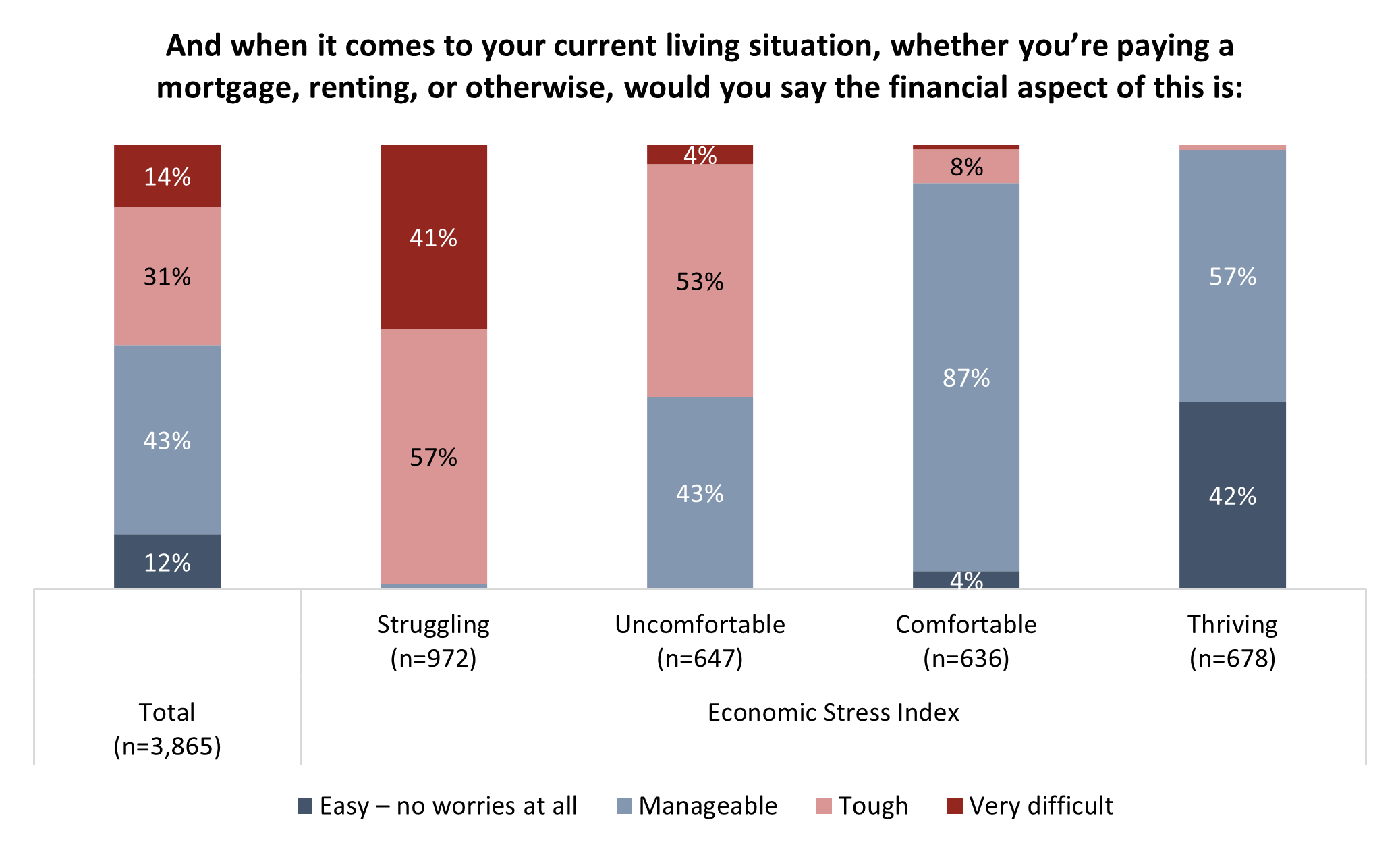
Difficulty with the cost of rents and mortgages plays a significant role in Canadians’ financial stress. Those who are Struggling are much more likely to report finding their monthly payments for housing “tough” or “very difficult”, while those who are Thriving are much more likely to say they have “no worries” about the financial aspect of putting a roof over their heads:
Will they ever own?
Among Canadian renters, three-in-ten (30%) say they want to buy a house but cannot afford it, while a further two-in-five (41%) say they have given up on the idea of buying a home. That leaves one-in-20 renters who are currently in the market to buy, while one-in-12 (8%) are currently on the sidelines waiting for further Bank of Canada rate cuts:
Mortgage holders struggle with stress
While relief is potentially on the way for mortgage holders, difficulties are still being felt by many.
As an overall measure, the Economic Stress Index finds those with mortgages and those who are paying rent showing elevated signs of stress, while those who have paid off their mortgage are more than twice as likely as each group to be Thriving:

Checking on the housing market
The economic conditions may be improving but the landscape is still a difficult one for those on the outside of the housing market. The growth of housing prices has far outpaced income in Canada this century. The average home price was about six times the average Canadian income in 2003, but now it is close to 11 times that amount.
Among Canadians, one-in-20 (6%) say they are actively looking to purchase a home, either their first or another one for their portfolio. A similar amount (6%) say they are currently on the sidelines while they await the expected interest rates from the Bank of Canada. A larger group of 14 per cent say they would buy a home, but they can’t afford one, while an even larger group of 17 per cent of Canadians believe they will never be able to buy a home.
Two-in-five of those under 35 fall into those latter two categories as many young Canadians feel the home ownership dream is out of reach because of housing affordability crisis:

Those who own multiple properties are most likely to a combination of active or monitoring rates before jumping into the market again. Approaching one-in-five (17%) multiple property owners say this compared to 11 per cent who own a single property and 12 per cent who own none:
Across the country, the proportion of Canadians who feel like they can’t afford a house in their community or have given up on the idea varies. B.C. (34% combined), Ontario (32%) and Nova Scotia (33%) lead the way, with one-third in those provinces saying they either want to but can’t afford to buy or they don’t expect they will ever be able to buy a house. Those in Saskatchewan (22%) are least likely to feel priced out of the housing market:

Survey Methodology
The Angus Reid Institute conducted an online survey from Sept. 12-18, 2024 among a representative randomized sample of 3,985 Canadian adults who are members of Angus Reid Forum. For comparison purposes only, a probability sample of this size would carry a margin of error of +/- 2 percentage points, 19 times out of 20. Discrepancies in or between totals are due to rounding. The survey was self-commissioned and paid for by ARI. Detailed tables are found at the end of this release.
For detailed results by age, gender, region, education, and other demographics, click here.
For the full release including methodology, click here.
Shachi Kurl, President: 604.908.1693 shachi.kurl@angusreid.org @shachikurl
Dave Korzinski, Research Director: 250.899.0821 dave.korzinski@angusreid.org