

Pressure of U.S. tariffs evident in New Brunswick; half say they are worse off financially than last year
April 8, 2026 – New data from the non-profit Angus Reid Institute explores the challenges facing three of the four Atlantic Canada provinces as part of its Cross-Canada Outlook series. None of Premiers Susan Holt, Tim Houston or Tony Wakeham face electoral pressure soon, which gives them time to address the lingering concerns from provincial residents on the issues of health care and cost of living, far and away the top issues in all three provinces.
For Nova Scotia, the story is majority criticism, but relative success. One-third (35%) of Nova Scotians believe the province is handling health care well, the highest mark in the country where the average is 20 per cent of provincial residents who say their province is doing well on that file.
Comparatively, 21 per cent in New Brunswick and 16 per cent in Newfoundland and Labrador say their province is doing a good job on health care.
Criticism is also high in those three provinces for how their governments have addressed the rising cost of living. Seven-in-ten (68%) in New Brunswick and four-in-five in Nova Scotia (78%) and Newfoundland and Labrador (80%) say their government is doing a poor job on that file.
The issue is perhaps more pressing in New Brunswick than elsewhere. The province has been hit harder than most others by U.S. tariffs. Perhaps that’s why half (52%) in New Brunswick say they are worse off financially than they were 12 months ago.

*Note: Because its small population precludes drawing discrete samples over multiple waves, data on Prince Edward Island is not released.
About ARI
The Angus Reid Institute (ARI) was founded in October 2014 by pollster and sociologist, Dr. Angus Reid. ARI is a national, not-for-profit, non-partisan public opinion research foundation established to advance education by commissioning, conducting and disseminating to the public accessible and impartial statistical data, research and policy analysis on economics, political science, philanthropy, public administration, domestic and international affairs and other socio-economic issues of importance to Canada and its world.
INDEX
-
Views of the premier and opposition leader
-
Government Performance Index
-
Government performance trend
-
Top issues
-
Performance on top issues
-
Economic Outlook
-
Right track or wrong track?
Views of the premier and opposition leader
Nova Scotia Premier Tim Houston experienced a significant drop in approval as covered in ARI’s quarterly Premiers’ Performance report. He is now the least approved-of premier in the region (39%) behind New Brunswick Premier Susan Holt (54%) and Newfoundland and Labrador Premier Tony Wakeham (42%).
Holt currently is faced in opposition by three-time MLA Glen Savoie, who serves as interim leader of the Progressive Conservative Party of New Brunswick after the resignation of former Premier Blaine Higgs. A new leader will be elected in October. For now, half (48%) in New Brunswick do not have an opinion of Savoie.
Claudia Chender has served as leader of the NDP in Nova Scotia since June 2022, becoming the first female leader of opposition in that province’s history after the NDP won the second-most number of seats in the 2024 election. With Houston’s recent decline in personal popularity, she is now viewed more positively (42%) than the province’s premier (39%). Houston and the PCs are only a quarter of the way through their majority mandate and have plenty of runway to turn public opinion around.
In Canada’s eastern-most province, Wakeham and the PCs secured a majority government by the narrowest of popular vote victories in the province’s history over former Premier John Hogan and the Liberals. Hogan is viewed more positively (44%) than negatively (39%) and has committed to run as leader in the next election, slated for 2029 at the latest.

Government Performance Index
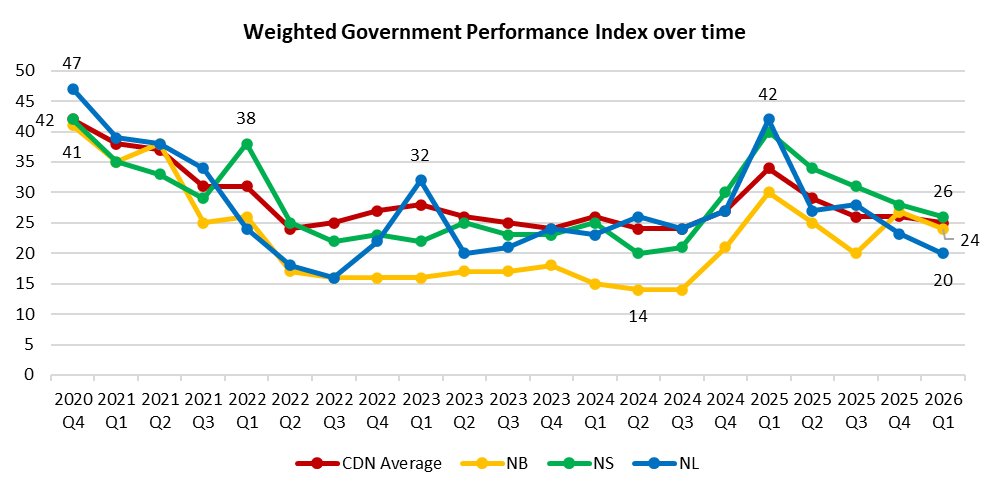
The Angus Reid Institute Weighted Provincial Government Performance Index incorporates not only the percentage of provincial residents who believe their government is performing well on a file, but also how highly that file is selected as a top issue in the province.
New Brunswick (24) and Nova Scotia (26) score about average by this metric, while those in Newfoundland and Labrador (20) are more critical of their provincial government’s performance on the top issues:
Government performance trend
In all three provinces, elections over the past two years provide waypoints to mark trends. The previous Liberal government in Newfoundland and Labrador under Hogan and predecessor Andrew Furey was more often than not near the Canadian average score, although there were moments where it scored higher and lower. Compared to last year, provincial residents are much more critical on the top issues, although it’s important to remember the “Trump bump” provincial governments received during the early fervor in the wake of tariff and 51st state threats.
Related: Premiers’ Performance: The Trump bump? Most provincial leaders see approval rise amid U.S. threats
It is also a downward trend since the beginning of 2025 for Houston and the PC government in Nova Scotia, which had improved according to the index during 2024.
Under Holt, New Brunswick has improved its index scores compared to the government under Higgs, defeated in the 2024 election:
Top issues
Across Atlantic Canada, there are two issues dominating concerns: the rising cost of living and health care. Housing affordability comes in a distant third in New Brunswick, Nova Scotia and Newfoundland and Labrador, while the economy more broadly is chosen at the fourth highest rate.
In Nova Scotia and New Brunswick, there is higher concerns over government spending and poverty than in Newfoundland and Labrador. There are more in the latter province who select public safety as a top issue:

Performance on top issues
On the top four shared issues, at most one-third in any one province believes their provincial government is performing well on the file. For Wakeham’s relatively new government in Newfoundland and Labrador, there is high criticism of the government’s performance on the key files of inflation (10% good job) and health care (16%). But the Progressive Conservatives are relatively well assessed on the file of energy policy (45%) after securing a path forward for the previously stalled Bay du Nord project.
Holt’s government in New Brunswick receives the highest marks on its relationship with the federal government. New Brunswick was the first province to sign the “one project, one review” agreement in December as the federal government hopes to move up the Sisson mine, a $579-million tungsten and molybdenum mine northwest of Fredericton that has been languishing for more than a decade.
In Nova Scotia, Houston’s Progressive Conservatives are the best performing province on health care, with one-third (35%) in the province saying the government is doing a good job. That still leaves a majority (62%) who say it is performing poorly, but relative to other provinces in the country, that is high praise.

Economic Outlook
The threats of tariffs from U.S. President Donald Trump were widespread, but the net effect on Canada’s economy on the whole has been muted because so much of U.S.-Canada trade is covered by the U.S.-Canada-Mexico Agreement. Canada’s effective tariff rate paid on exports to the U.S. was estimated to be three per cent in February by RBC, with 88 per cent of Canada’s exports crossing the border tariff free.
However, some industries – forestry, steel, aluminum, autos – have been hit hard. New Brunswick, especially, has felt the impact of U.S. tariffs; CIBC reported that it, alongside B.C., were the two provinces most vulnerable to U.S. trade disruption. Perhaps that’s why more than half (52%) in New Brunswick say they are worse off financially than they were a year ago, the most in the country.
A majority (53%) in Newfoundland and Labrador say they are treading water financially while there are similar sized groups in Nova Scotia who say they believe they are in the same place economically as 12 months ago (43%) as say they are worse off (40%):

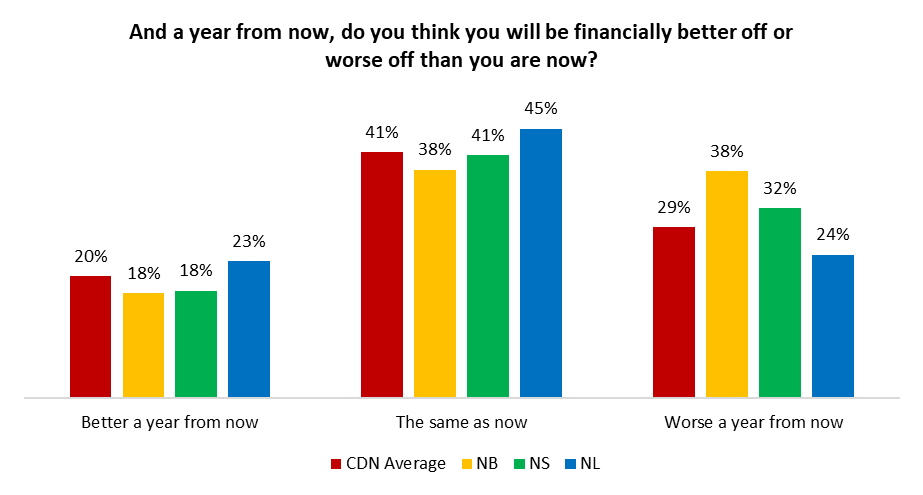
Financial pessimism is also highest in New Brunswick than any other province in the country; 38 per cent say they believe they will be worse off financially by this time next year. Newfoundland and Labrador is the province with the highest proportion in the country, one-quarter (23%), who believe they will be better off next year:
The Angus Reid Institute Financial Pressure Index includes the data from the above questions as well as measuring personal assessments on how Canadians believe their household is handling grocery prices, levels of debt, concerns over employment stability and monthly housing payments like rent or mortgage. Index scoring is available here.
A majority (54%) in New Brunswick fall into the high (27%) or medium (27%) categories of the index, the most in the country. Few (12%) are facing very low financial pressure.
A plurality in Newfoundland and Labrador (38%) are categorized in the low part of the index.
Nova Scotia index proportions line up almost identically with the national average:

Right track or wrong track?
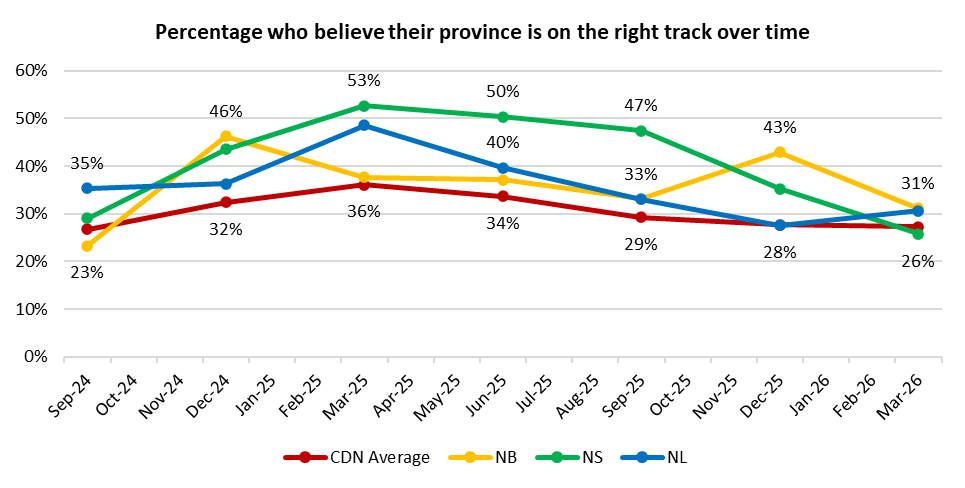
In the three Atlantic Canada provinces in this study, there is plenty of concern among residents their province is trending in the wrong direction.
This wasn’t always the case for Nova Scotia in recent quarters under Houston. A year ago, a majority (53%) in Nova Scotia believed the province was on the right track, half (26%) that number say the same now.
Criticism has also mounted in Newfoundland and Labrador, where half (49%) a year ago said the province was on the right track. Now 31 per cent say the same.
Views in New Brunswick have varied, but belief the province was on the right track was at 43 per cent in December, 31 per cent now.
METHODOLOGY:
The Angus Reid Institute conducted an online survey from March 11-17, 2026, among a randomized sample of 4,005 Canadian adults. Respondents are drawn from the Angus Reid Forum, a large-scale online panel developed to include Canadian residents in each of the 343 federal ridings in Canada and representative of the Canadian population by age, gender, family income, ethnic status and education. The sample was weighted to be representative of adults nationwide according to region, gender, age, household income, and education, based on the Canadian census. Provincial margins of error are found at the end of the release. Discrepancies in or between totals are due to rounding. The survey was self-commissioned and paid for by ARI.

Note: Because its small population precludes drawing discrete samples over multiple waves, data on Prince Edward Island is not released.
For detailed results, click here.
For PDF of full release, click here.
MEDIA CONTACT:
Shachi Kurl, President: 604.908.1693 shachi.kurl@angusreid.org @shachikurl
Dave Korzinski, Research Director: 250.899.0821 dave.korzinski@angusreid.org
Jon Roe, Senior Research Associate: 825.437.1147 jon.roe@angusreid.org