

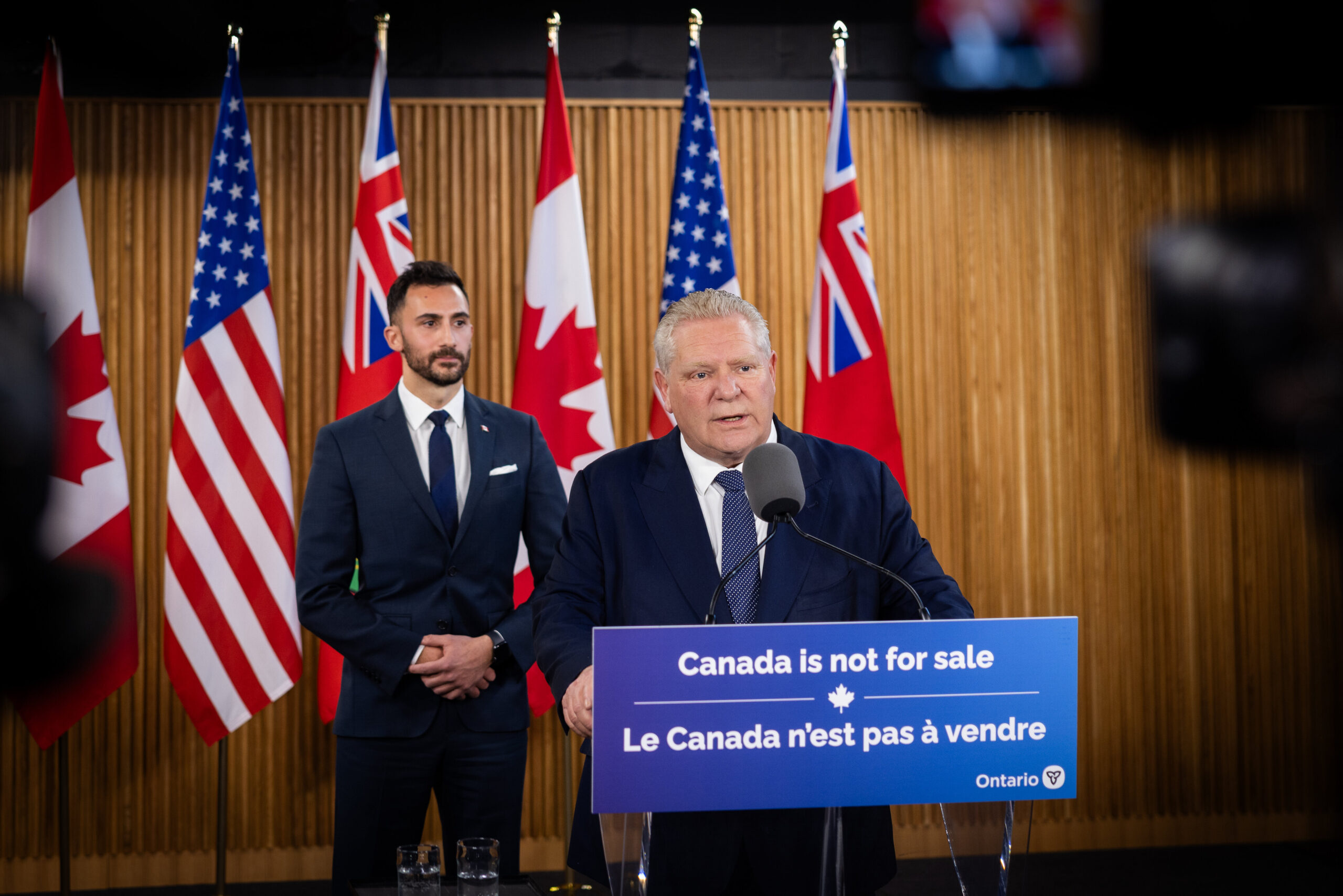
Ontario’s Ford sees highest approval in four years; Furey receives massive boost on the way out
March 25, 2025 – Trade war with the U.S. has caused not only federal political upheaval, but provincial turmoil as well. That is perhaps most evident in the non-profit Angus Reid Institute’s quarterly premier approval ratings, which show a significant turn of fortune for many of the country’s first ministers.
New data illustrates some of the country’s premiers have received a “Trump bump” in approval. Ontario Premier Doug Ford, sitting in the low 30s for nearly two years, is now approved of by half (48%) in his province after a star-turn during trade negotiations with the U.S. that has some dubbing him “Captain Canada”.
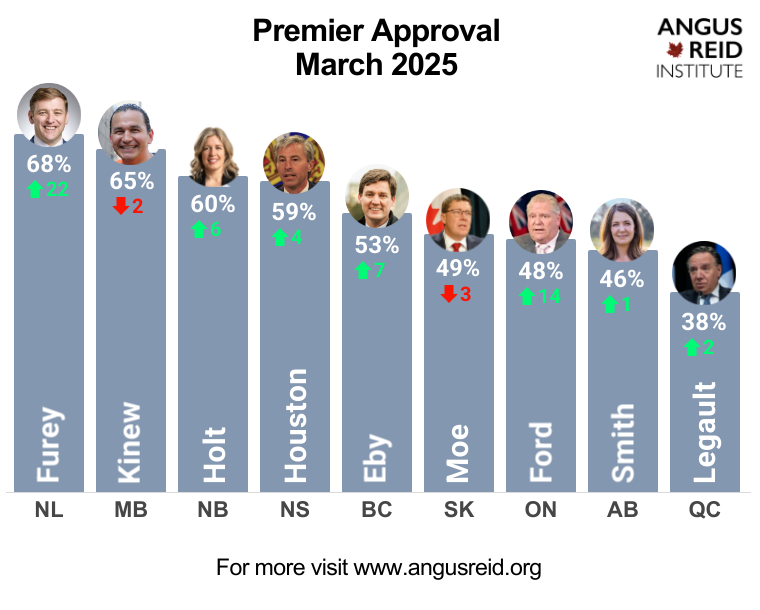
In the midst of criticism of a new bill to give his BC NDP government emergency powers to respond to U.S. tariffs, Premier David Eby also sees approval of his performance rise by seven points, to 53 per cent.
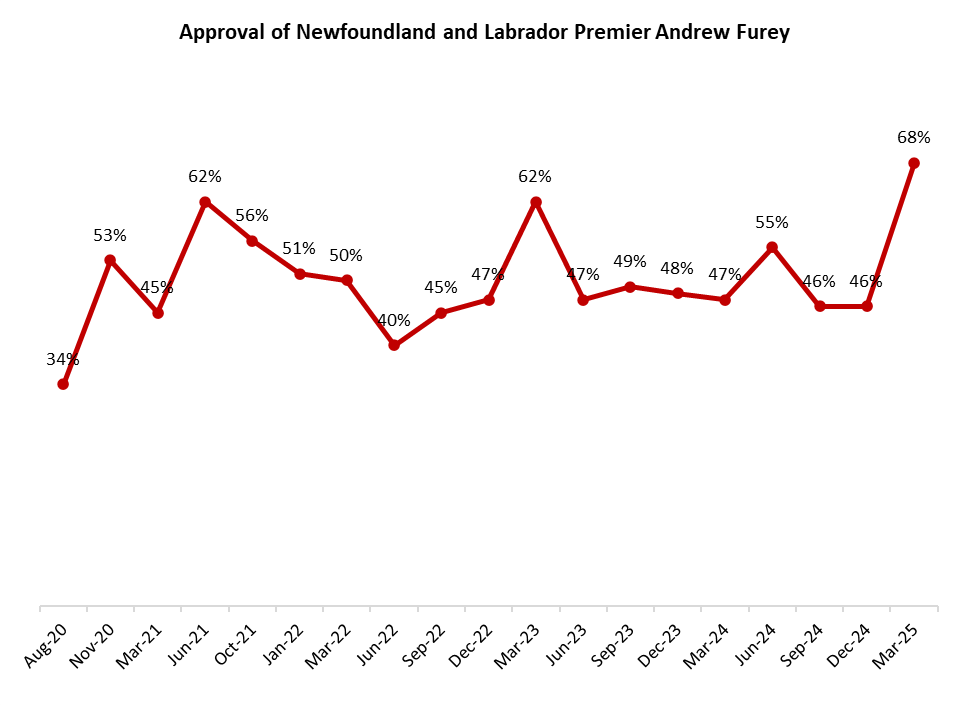
On his way out the door, and on the heels of a historic renegotiation of the Churchill Falls power agreement with Quebec, approval of Newfoundland and Labrador Premier Andrew Furey rises 22 points to make him the most approved-of premier in the country (68%).
In this sea change of opinion, perhaps what is most notable are the premiers whose approval rating is statistically unchanged from December. Alberta Premier Danielle Smith, who has also taken a lead role in U.S.-Canada relations during this trade war, sees approval (46%) that is unchanged from two years ago. In Quebec, approval of Premier François Legault is statistically unchanged from three months ago at 38 per cent. In both cases, domestic scandal – another one in health care for Smith, and one over the cost overruns of the online platform for the province’s auto insurance corporation for Legault – may be weighing down any positive lift from their responses to Trump.
About ARI
The Angus Reid Institute (ARI) was founded in October 2014 by pollster and sociologist, Dr. Angus Reid. ARI is a national, not-for-profit, non-partisan public opinion research foundation established to advance education by commissioning, conducting and disseminating to the public accessible and impartial statistical data, research and policy analysis on economics, political science, philanthropy, public administration, domestic and international affairs and other socio-economic issues of importance to Canada and its world.
Note: Because its small population precludes drawing discrete samples over multiple waves, data on Prince Edward Island is not released.
INDEX
-
The biggest bumps – Ford in Ontario, Eby in B.C., Furey in Newfoundland and Labrador
-
Maritime merriment – Holt in New Brunswick, Houston in Nova Scotia
-
Flat ratings in the Prairies – Smith in Alberta, Moe in Saskatchewan, Kinew in Manitoba
-
The bottom of the pack – Legault in Quebec
Canada’s premiers react to trade war with the United States in their own words.
The biggest bumps – Ford in Ontario, Eby in B.C., Furey in Newfoundland and Labrador
“Like a family member stabbing you in the heart.”
–Ontario Premier Doug Ford
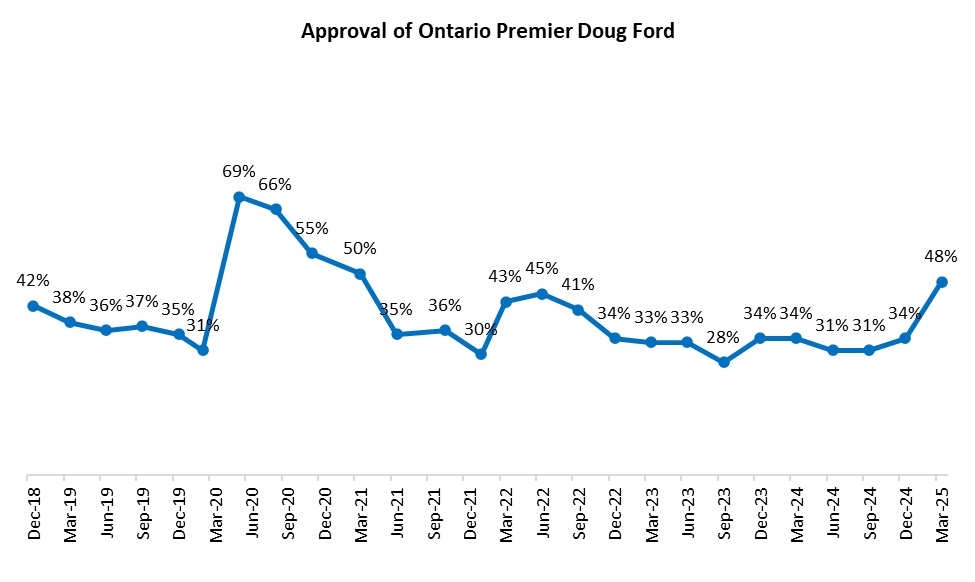
Ford has been one of Canada’s most public facing leaders since the Trump trade war began, earning him the nickname of “Captain Canada”. The three-term premier has appeared on U.S. television repeatedly and briefly implemented a 25-per-cent tariff on energy exports to American states before reversing that decision to avoid escalating counter tariffs. Ford also called an election that most Ontarians believed was unnecessary and self-serving but nonetheless led him to win another four year majority. Amid all of this, Ford’s approval rating has risen to its highest mark since the pandemic at 48 per cent after spending most of 2024 near the bottom of the provincial approval list:
“A grievous insult.”
–British Columbia Premier David Eby
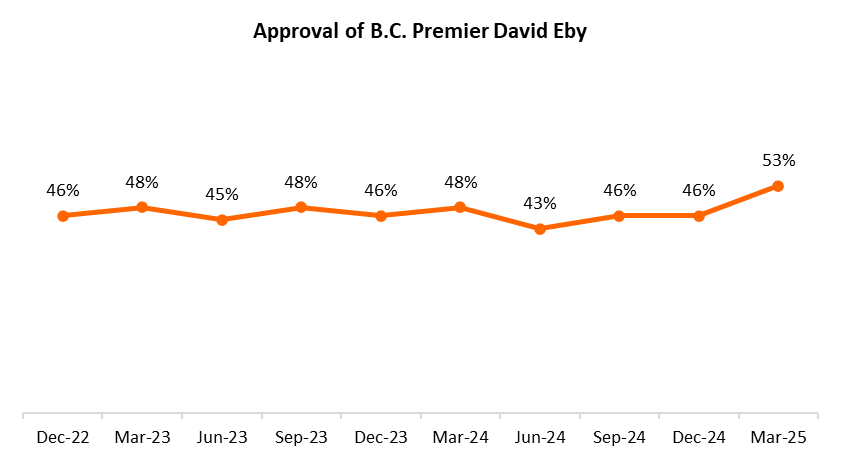
Eby described Trump’s tariff threats in this manner, shortly after stating that Canadians were “pissed off”. The B.C. premier responded by announcing that BC Liquor would remove all American products from its shelves, and that the B.C. government would no longer procure goods and services from American providers. The BC NDP have been criticized by the opposition for plans to pass a bill to give the government emergency powers typically only used during wartime or after to natural disasters. Eby has stated that the powers are needed to enable the government to respond quickly to tariff threats. The B.C. premier sees his approval rise to 53 per cent this quarter:
“This guy’s a maniac.”
–Newfoundland and Labrador Premier Andrew Furey
Furey surprised Canada’s eastern-most province with his sudden resignation from Newfoundland and Labrador’s top job in February. The province is scheduled to have an election this fall at the latest, and Furey said that “electoral timing rules” as well as “the balance of family” played into his decision. Furey steps off the public opinion rollercoaster he was on, which has seen his favourability swing from previous highs of 62 per cent to lows of 40 per cent in June 2022 (early low numbers were offset by a majority of residents saying they didn’t know enough to evaluate the new premier when he stepped in for the departing Dwight Ball).
Furey leaves the premier’s office shortly after a major milestone – signing a new deal with Quebec over the Churchill Falls power plant, replacing a previous agreement which had locked in the transfer of decades worth of power from the Labrador-based hydro generator to Quebec at far below market rates. The new deal promises $227 billion in revenue to Newfoundland and Labrador over 50 years.
Furey departs with a personal best 68 per cent approval rating, and a parting shot at “maniac” Trump, who Furey says will be a “pervasive problem” over the next four years because of his “erratic, crazy, bonkers behaviour”.
Maritime merriment – Holt in New Brunswick, Houston in Nova Scotia
“… an attack on Canada…”
–New Brunswick Premier Susan Holt
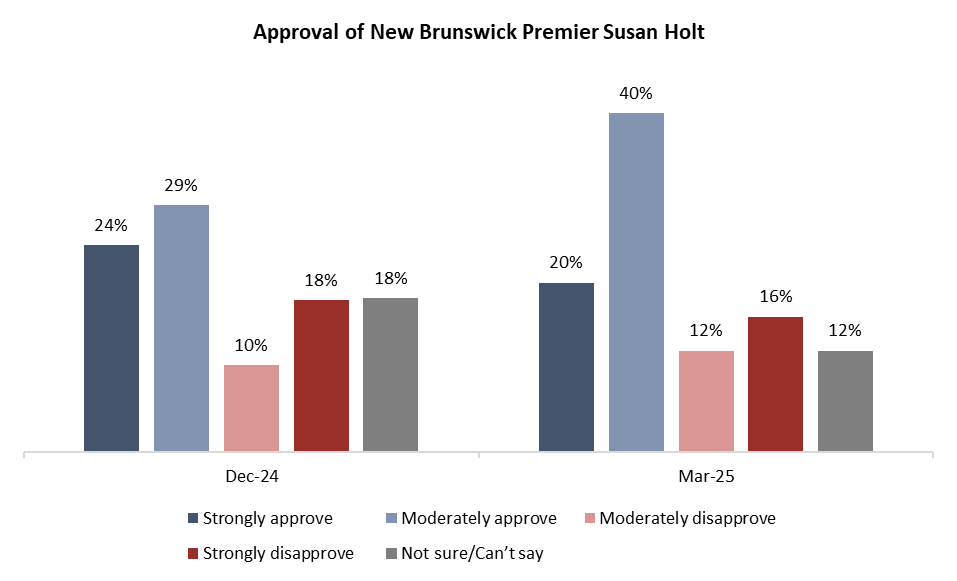
Holt has barely had time to settle into the premier’s office in New Brunswick after her November election before an economy-threatening trade war with the U.S. dropped on her desk. Nearly all – 92 per cent – of New Brunswick’s exports go to the United States. Holt’s Liberal government has responded with a $162-million plan which will offer support to New Brunswickers and businesses affected by disruptions from tariffs.
However, New Brunswick has stopped short of using the measure briefly implemented in Ontario – wielding the province’s electricity exports as a weapon in response to tariffs. New Brunswick and bordering Maine’s electricity grids are interconnected, meaning the neighbouring state could impose its own fees to counter any instituted by New Brunswick. As well, the province risks losing as customers the 58,000 people in Maine who rely on New Brunswick exclusively for power; any disruptions could force the state to extend its power grid and cost the province’s electric utility future revenue. Holt’s “cooler heads” approach earns her approval from a majority (60%) in the province.
“Donald Trump is a short-sighted man who wields his power just for the sake of having it.”
–Nova Scotia Premier Tim Houston
Houston’s rebuke of Trump in the wake of the U.S. tariffs was sharp; the U.S. is a big market for Nova Scotia’s seafood as well as tires. Nova Scotia and Houston have replied by being at the forefront of efforts to reduce barriers to interprovincial trade. The government passed a bill that removes the restrictions on out-of-province goods and workers as long as they are coming from other provinces that did the same.
But Bill 36, also known as the Free Trade and Mobility within Canada act, was illustrative of the challenges of cutting down the red tape that limits trade between provinces. Houston’s government had to amend the bill after professional regulators pointed out public safety concerns with opening up the movement of goods and labour into Nova Scotia from elsewhere in the country because the bill removes provincial regulators’ jurisdiction on veterinarians, engineers and other professionals.
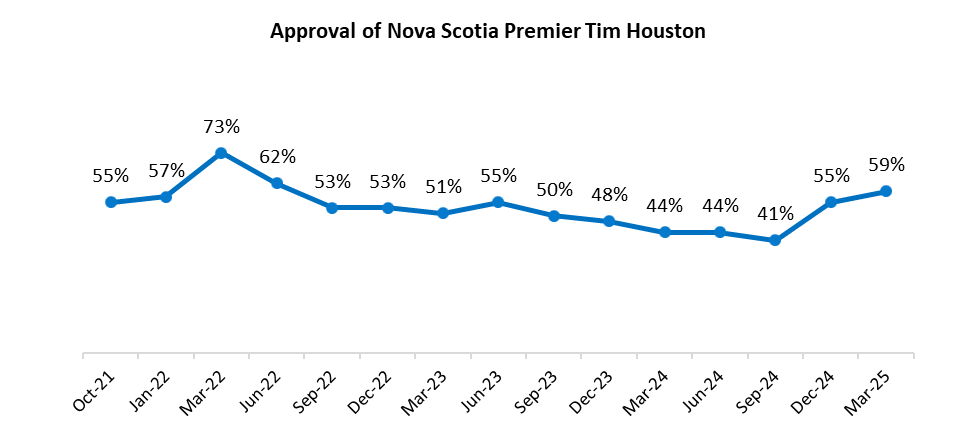
Still, it appears Houston’s proactive approach, which included setting aside $200 million in the provincial budget to help businesses and workers affected by the tariffs, has resonated with Nova Scotians. Three-in-five (59%) say they approve of Houston’s performance, his highest approval rating in nearly three years:
Flat ratings in the Prairies – Smith in Alberta, Moe in Saskatchewan, Kinew in Manitoba
“…a betrayal of a deep and abiding friendship.”
–Alberta Premier Danielle Smith
Smith hoped Alberta would avoid the looming conflict with Trump when she travelled to Mar-a-Lago in January for a “friendly and productive” conversation with him. That diplomatic approach was criticized, as was her refusal to sign on to a joint statement from Canada’s premiers early on. Still, she joined other provinces in responding to U.S. tariffs with restrictions on American alcohol sales.
There is one card Smith and Alberta has refused to play as the trade war has continued – one which Ontario’s Ford has called a “trump card”: a counter tariff on oil and gas exports from Canada. Alberta’s premier snapped back and said that her province would “never agree to such an absurd and self-destructive idea”, despite Ford’s speculation that it would “instantly change the game”.
The tête-à-tête with the United States is likely a welcome distraction for Smith and UCP government in Edmonton which finds itself embroiled in another health-care scandal. This most recent controversy was initiated by a wrongful dismissal suit filed by the former CEO of the Alberta Health Services (AHS), which alleges she was fired because she had launched an investigation into AHS’ procurement of private surgical contracts. AHS has called the suit “groundless and vexatious” and has countered that Athana Mentzelopoulos, the former CEO, was fired because of “an alarming lack of strategic vision and leadership”.
Smith has arguably been the second-most visible premier after Ford on the U.S. file since the first tariff threats were levied, but compared to Ford, she has benefitted little from this prominence in her own province. More than two-in-five (46%) approve of Smith’s performance, while half (50%) do not. Her approval has been held statistically flat since March 2023:

“President Trump is simply wrong,” but “Canada’s response needs to be economically sound and reasoned.”
–Saskatchewan Premier Scott Moe
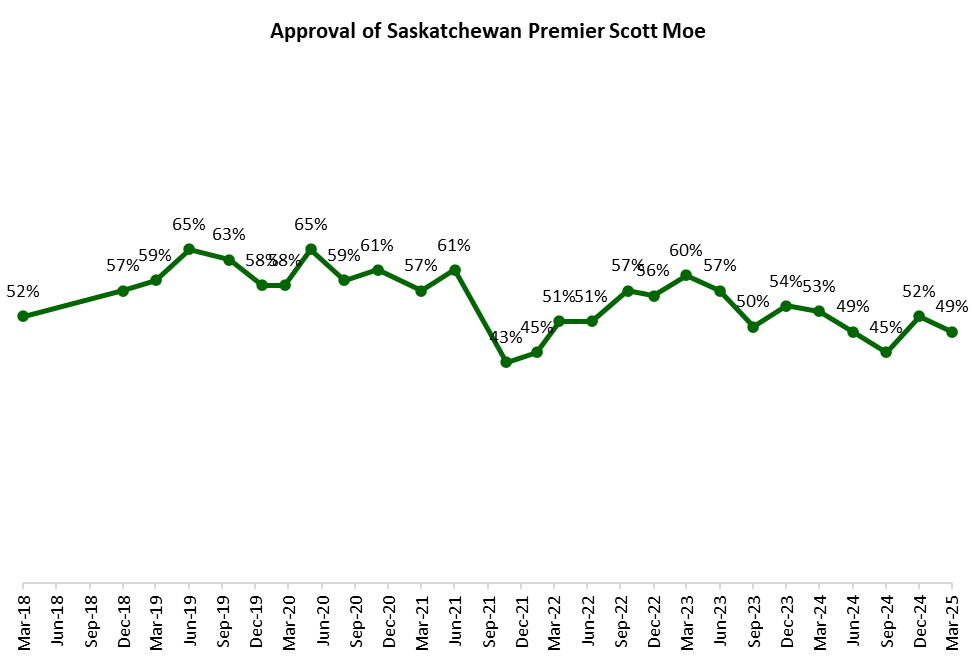
Moe adopted measures around alcohol and procurement similar to those seen elsewhere in the country, but has resisted calls from Ontario’s Ford to increase pressure on the U.S. by withholding potash, uranium and oil shipments. Moe has taken a more muted approach which has drawn criticism from the opposition NDP. The Saskatchewan premier’s approval rating stands at a statistically similar level to that seen post election last fall, with half (49%) in the province believing Moe is performing well:
“They’re talking down Canada.”
–Manitoba Premier Wab Kinew
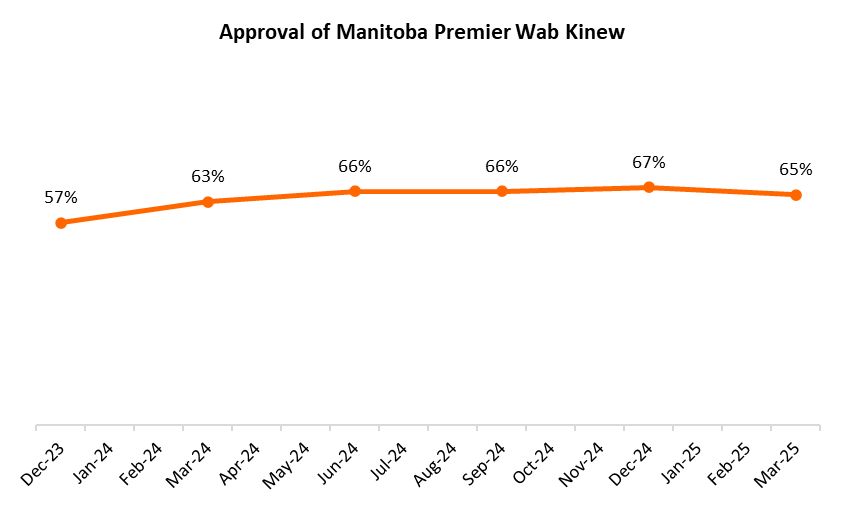
The Manitoba government will adopt its own “Buy Canadian” strategy for the foreseeable future according to Kinew, who was filmed signing his own Trump-style executive order earlier in March. These restrictions on U.S. alcohol and goods will stay in place until the tariff threat ends according to Kinew. The premier remains among the most popular leaders in the country almost 18 months into his term:
The bottom of the pack – Legault in Quebec
“We have to fight and we have to do it together, intelligently, in the Quebec way.”
–Quebec Premier François Legault
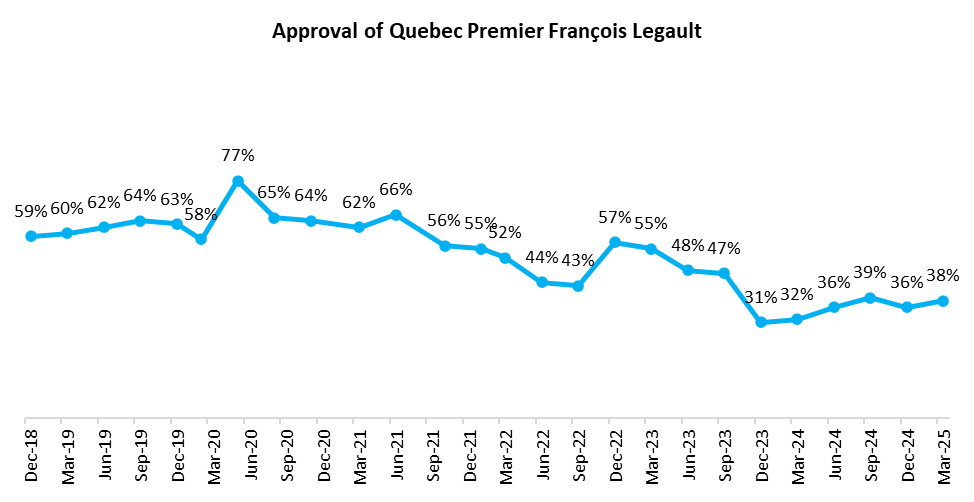
Legault is one of the few premiers who hasn’t received a bump of popularity during the trade war with Trump. With fewer than two-in-five (38%) of provincial residents approving of his performance, Legault is now the least-approved-of premier in the country. While above the low mark seen at the end of 2023, Legault’s popularity has not recovered to earlier highs.
His province faces significant economic harm from tariffs – Legault estimated job losses could exceed 100,000. In response, Legault has asked for the acceleration of government infrastructure projects and a $50-million loan and subsidy program for businesses effected by the trade disruptions.
But those tariff reactions are perhaps secondary in the eyes’ of Quebecers to lingering domestic scandals, including the cost overruns related to the launch of SAAQcliq, an online platform for the government’s auto insurance corporation. Quebec’s cybersecurity and digital technology minister resigned, and an inquiry has been launched, after the platform cost $1.1 billion to create, $500 million more than planned.
Survey Methodology
The Angus Reid Institute conducted an online survey from March 13-16, 2025 among a representative randomized sample of 4,009 Canadian adults who are members of Angus Reid Forum. Discrepancies in or between totals are due to rounding. The survey was self-commissioned and paid for by ARI.

Note: Because its small population precludes drawing discrete samples over multiple waves, data on Prince Edward Island is not released.
For PDF of full release, click here.
MEDIA CONTACT:
Shachi Kurl, President: 604.908.1693 shachi.kurl@angusreid.org @shachikurl
Dave Korzinski, Research Director: 250.899.0821 dave.korzinski@angusreid.org
Jon Roe, Research Associate: 825.437.1147 jon.roe@angusreid.org
Summary table
