

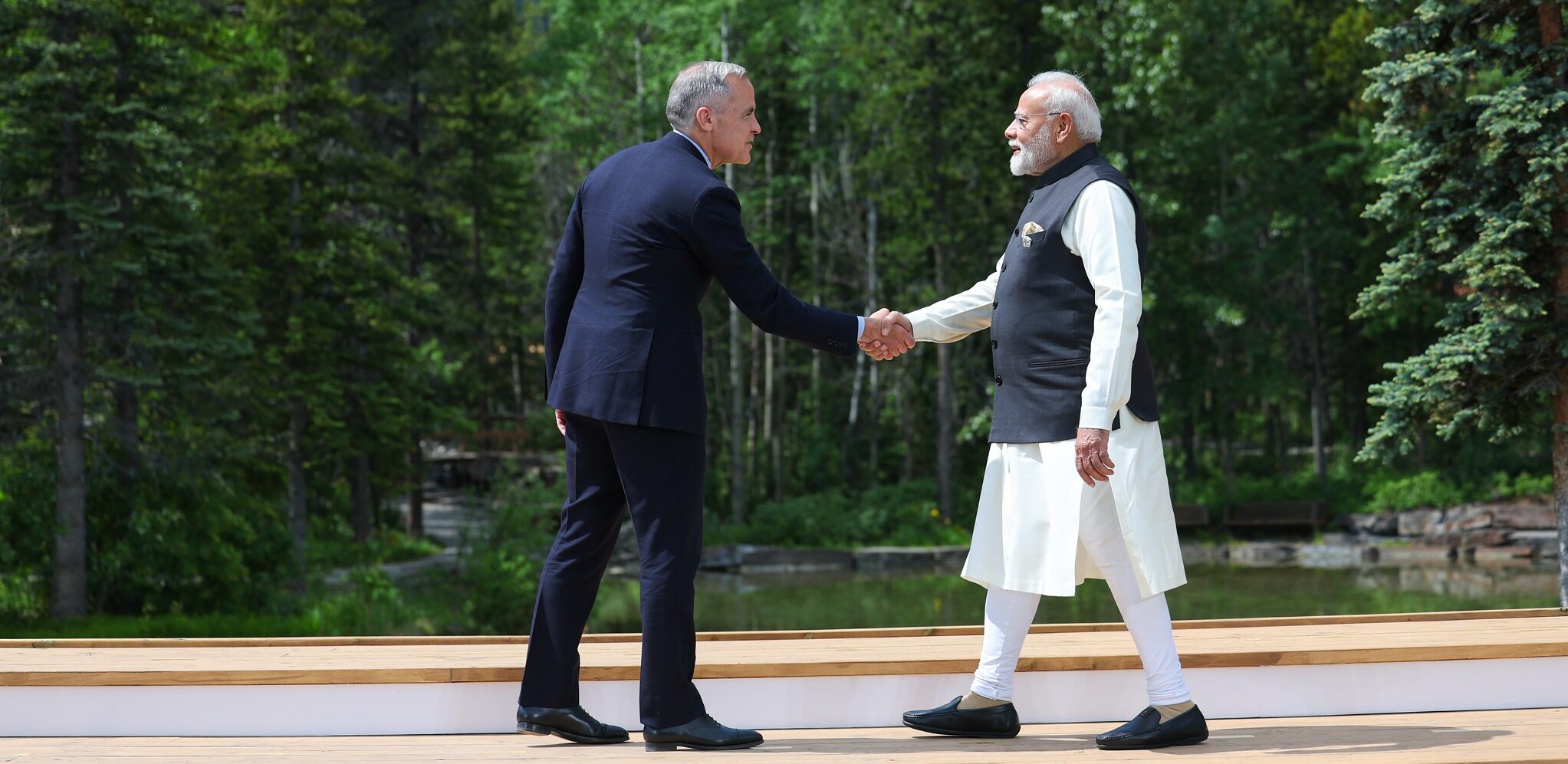
Favourability towards India unchanged from prior to thawing of diplomatic relations under Carney
March 1, 2026 – Prime Minister Mark Carney’s middle-power outreach tour is in India as he looks to continue patching up a relationship that’s frayed in recent years while broadening Canada’s economic horizons in the Indo Pacific.
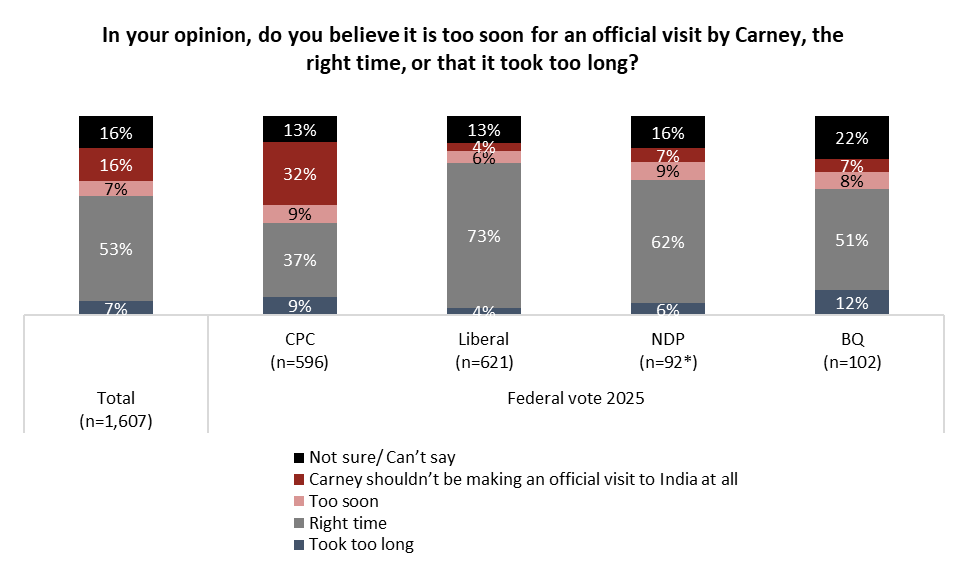
New data from the non-profit Angus Reid Institute in partnership with the Asia Pacific Foundation of Canada finds a majority of Canadians say Carney’s trip to India comes at the ‘right time’ but expressing caution about the pace of trade talks.
Negotiations around the Comprehensive Economic Partnership Alliance (CEPA) between India and Canada come after a diplomatic thaw initiated by Carney shortly after winning a minority government in last year’s election.
Ties between the two countries fizzled in the wake of allegations levelled by Carney’s predecessor of the Indian government’s involvement in the killing of a Khalistani activist on Canadian soil.
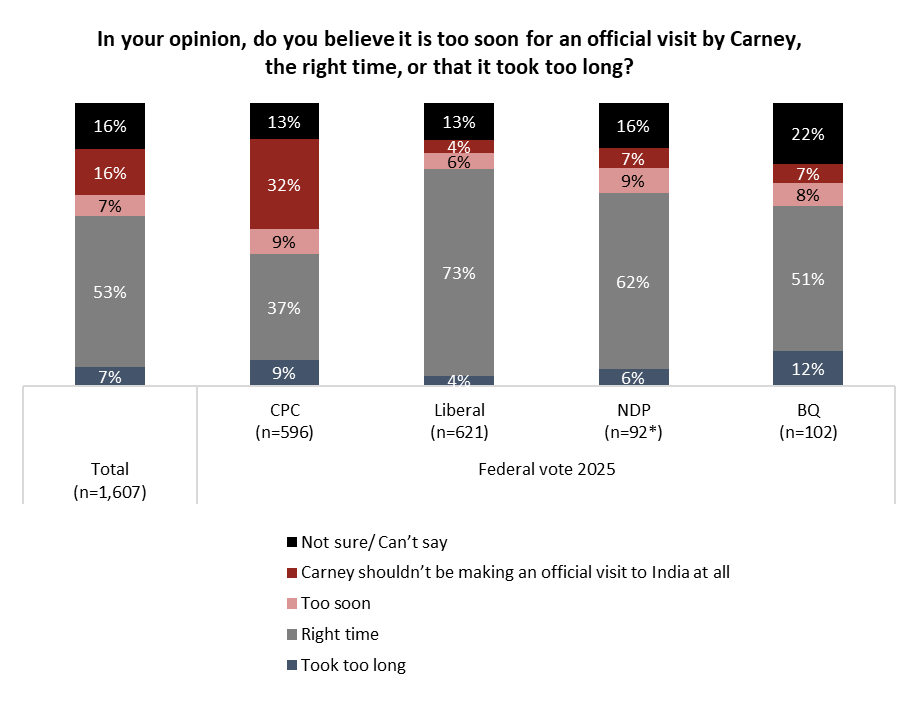
Now, half (53%) of Canadians say it is the right time for Carney to go on an official visit to India, with a further seven per cent believing the trip is too long in coming.
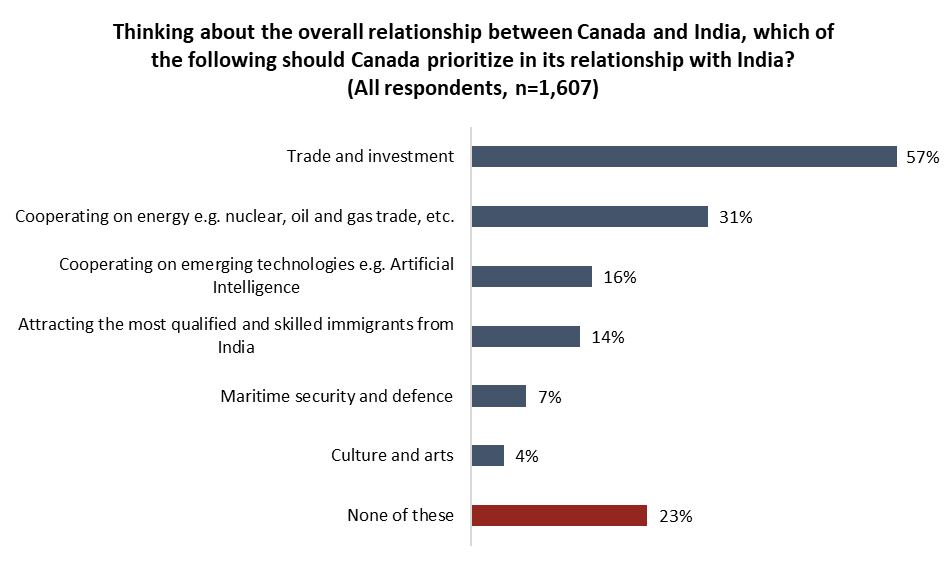
A majority (57%) believe Canada should prioritize trade and investment generally in its relationship with India, while a specific focus on energy (31%) also ranks high on potential cooperation points, above working together on emerging technologies (16%), high-skilled immigration to Canada (14%) or security and defence (7%).
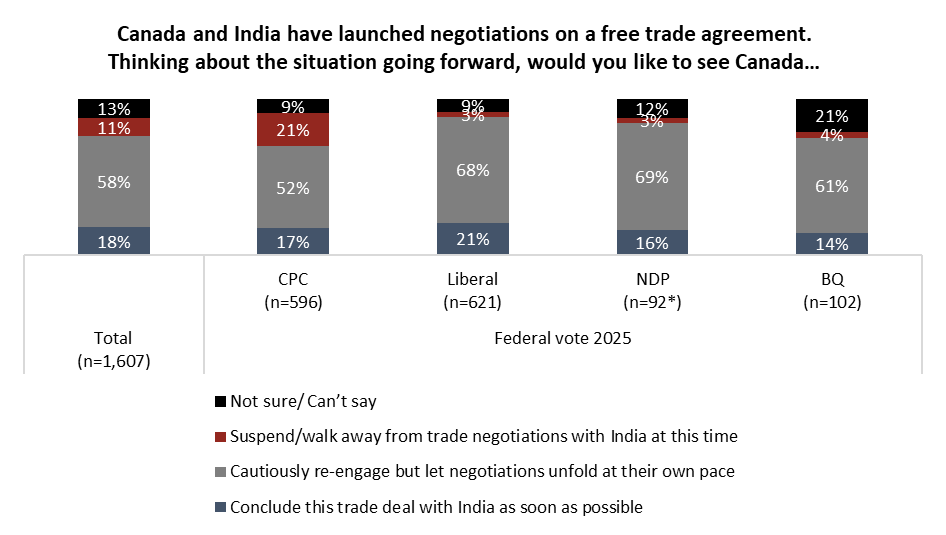
That said, Canadians are not exactly expressing urgency when it comes to the timeline of finalizing a broader free trade deal, currently under negotiation but not expected to be inked on this current trip. Three-in-five (58%) say Canada should “cautiously re-engage” on a free trade agreement “but let negotiations unfold at their own pace”. Fewer (18%) want a deal to be signed “as soon as possible”.
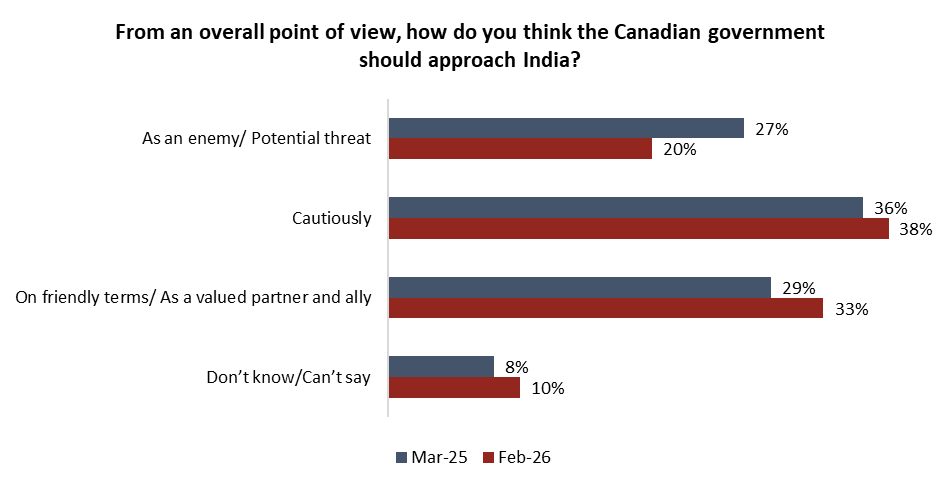
The above comes as Canadians’ views towards India have not warmed at the same pace as official relations. Three-in-ten (30%) say they have a favourable view of India, a similar number to that seen in March last year, and little improved from the lows seen in December 2024 (26%). More Canadians prefer their government approach India cautiously (38%) than on friendly terms or as a valued partner and ally (32%).
More Key Findings:
- More have a favourable view of India (30%) than of the U.S. (26%), and fewer want Canada to approach India as a threat or enemy (20%) compared to the U.S. (49%).
- Half (50%) of Canadians say the worsening of the trade relationship between Canada and the U.S. brought on by Trump has made them more likely to want their country to engage in trade with India.
About ARI
The Angus Reid Institute (ARI) was founded in October 2014 by pollster and sociologist, Dr. Angus Reid. ARI is a national, not-for-profit, non-partisan public opinion research foundation established to advance education by commissioning, conducting and disseminating to the public accessible and impartial statistical data, research and policy analysis on economics, political science, philanthropy, public administration, domestic and international affairs and other socio-economic issues of importance to Canada and its world.
About APFC
The Asia Pacific Foundation of Canada (APF Canada) is an independent, not-for-profit public institution focused on Canada’s relations with Asia. Its mission is to be Canada’s catalyst for engagement with Asia and Asia’s bridge to Canada. APF Canada is dedicated to strengthening ties between Canada and Asia through its research, education, and convening activities. APF Canada’s research provides high-quality, relevant, and timely information, insights, and perspectives on Canada-Asia relations for Canadians and stakeholders across the Asia Pacific. APF Canada also works with business, government, and academic stakeholders to provide Asia Competency training for Canadian organizations and students.
INDEX
Part One: Most say now is the right time for Carney’s India trip
Part Two: But hesitation still exists
-
Three-in-10 view India favourably
-
One-third say India should be viewed as ‘ally or friend’; one-in-five say ‘threat’
-
India viewed more positively than U.S.
-
Trade, investment seen as the top priority for Canada-India relationship
Part Three: Trade focus
-
One-in-five say a deal should be signed ASAP; most would take whatever time necessary
-
‘As a good a trade partner as any’?
-
Trump threats make Canadians more bullish on Indian trade
Part One: Most say now is the right time for Carney’s India trip
More than a year after U.S. President Donald Trump returned to the White House and altered the global economy with his trade-rupturing tariffs, the Canadian government continues its attempts at navigating a world where its largest trade partner has become hostile to economic cooperation. Since his election, Prime Minister Mark Carney has made a point of working to repair Canada’s ties with India and China, two global economic giants whose relationships with Canada had suffered due to incidents and tensions during former Prime Minister Justin Trudeau’s term.
Canada’s relationship with India took a frosty turn after Trudeau accused the Indian government of playing a role in the murder of Khalistani activist and Canadian citizen Hardeep Singh Nijjar on Canadian soil, an accusation India has denied. The two countries suspended trade talks in 2023 and later expelled each others’ diplomats.
Carney began the thaw with India by extending an invite to Indian Prime Minister Narendra Modi to the Canada-hosted G7 conference in June as developing worldwide economic ties became a key priority in the face of American intransigence. Warmth appears to be the temperature going forward, as Carney makes the first official visit by a Canadian prime minister since Trudeau’s in 2018. Concerns over lingering questions surrounding Nijjar’s murder, and surrounding potential electoral interference by the Indian government, were subject to media reports of having been dismissed by at least one federal government official. However, Public Safety Minister Gary Anandasangaree recently said there are “outstanding issues” the two countries need to work through “around safety and security of Canadians”.
Related:
- Rising diplomatic tensions and allegations of foreign interference fuel plummeting Canadian views of India
- Half of Canadians say restoring diplomatic ties with India was ‘right move’ as economic issues take priority
With the potential end of the USCMA free trade agreement between Canada, the U.S. and Mexico looming in the background, half of Canadians (53%) say it is the right time for Carney to be visiting India for an official visit, while a further seven per cent say he should have made the trip by now. That view is more common among those who voted for the Liberals (73%), NDP (62%) or Bloc Québécois (51%) in last year’s election than it is among last year’s Conservative voters (37%), who are the most likely to believe Carney should not be making the trip at all (32%):
*Smaller sample size, interpret with caution
Part Two: But hesitation still exists
Three-in-10 view India favourably
The diplomatic warmth extended by Carney’s government is not being reciprocated broadly by Canadians. Those who have an unfavourable view of India (57%) outnumber those whose view is instead positive (30%). Favourable views have recovered little from lows seen in 2024, when one-quarter (26%) said they viewed the country favourably, and are at the same level this time last year, prior to Carney’s efforts to repair the relationship.

One-third say India should be viewed as ‘ally or friend’; one-in-five say ‘threat’
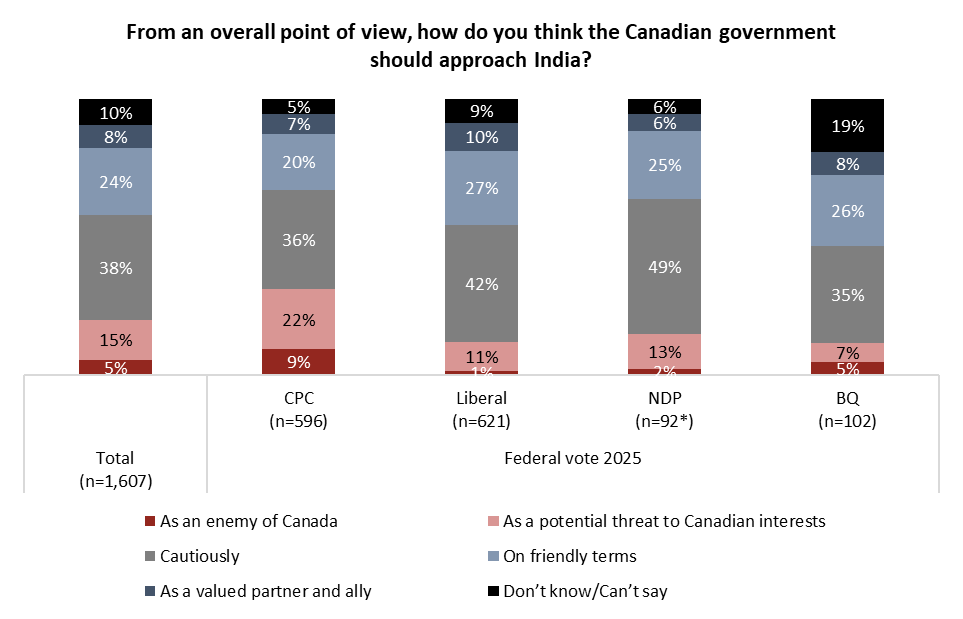
Canadians are also expressing as much caution as willingness to embrace India as a potential friend in the international community. And these views have shifted only slightly compared to last year. In March 2025, more than one-quarter (27%) believed Canada should approach India as a threat or enemy. That combined figure has declined to one-in-five (20%) now, with a slight increase on the side of those who prefer Canada approach India on friendly terms or as a valued partner (29% to 33%):
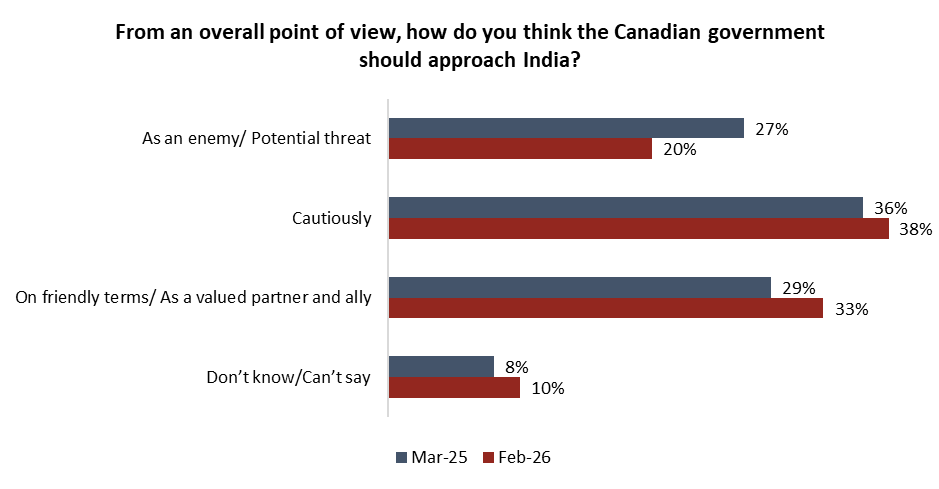
Caution is the plurality view among past Liberal (42%) and NDP (49%) voters. There is more apprehension among those who voted Conservative last year than among other political groups:
*Smaller sample size, interpret with caution
India viewed more positively than U.S.
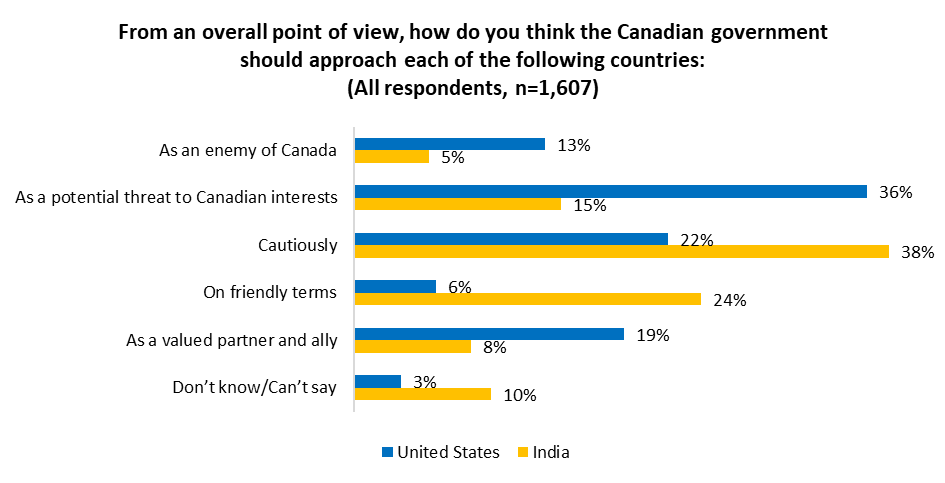
India, however, fares much better among Canadians than their country’s southern neighbour. Canadians are more than twice as likely to say Canada should view the U.S. as an enemy or potential threat (49%) than to say so of India (20%) and slightly more likely to say Canada should approach India on friendly terms or as a potential partner (32% vs. 25%). This further highlights the seismic shift in views caused by the actions of the U.S. administration under Trump.
Similarly, Canadians hold India in a more positive light (30% favourable) than the U.S. (26%, see detailed tables).
Trade, investment seen as the top priority for Canada-India relationship
Energy – oil, natural gas, uranium – is a key focal point for India on this trip. A potential 10-year deal for Canadian uranium is reportedly on the table, with Premier Scott Moe of uranium-rich Saskatchewan part of Carney’s delegation. But India is also looking for Canadian oil and liquefied natural gas exported from the British Columbia coast.
Canadians would prioritize general trade and investment (57%) between Canada and India, with cooperation on energy (31%) as a secondary choice. Other potential focuses – cooperation on emerging technology (16%), attracting skilled and qualified immigrants (14%), maritime security and defence (7%) and culture and arts (4%) – are chosen less than “none of the above” (23%):

Part Three: Trade focus
One-in-five say a deal should be signed ASAP; most would take whatever time necessary
The expectation is this current trip by Carney will yield a series of agreements, but perhaps not the conclusion of an overarching trade deal. That could be signed instead within a year, according to India’s high commissioner in Ottawa.
Three-in-five (58%) Canadians say negotiations on a free trade agreement with India should unfold at its own pace, while one-in-five (18%) prefer more urgency. Few (11%) want negotiations to stop.
However, the preference for Canadians, as Canada looks to broaden its trade connections away from the United States, is for their country to focus on developing closer trade ties with the European Union. Closer trade ties with Mexico (27%), the U.S. (22%), China (21%), the United Kingdom (21%) and Japan (19%) are also preferred above India (8%) (see detailed tables).

*Smaller sample size, interpret with caution
‘As a good a trade partner as any’?
Still, Canadians are more likely to describe India as “good a trade partner as any” (46%) or one they would prefer more economic cooperation with (22%) than a country they would have Canada trade with less (16%). Those who voted Conservative in last year’s election again stand out as including a larger minority who prefer less trade with India (28%), but it is still a minority opinion:

*Smaller sample size, interpret with caution
Trump threats make Canadians more bullish on Indian trade
Further underlining the effects of U.S. trade hostility towards Canada, half (50%) say the change in the U.S.-Canada relationship makes them more likely to want Canada to engage in trade talks with India. Two-in-five (40%) say it makes no difference:

*Smaller sample size, interpret with caution
| METHODOLOGY:
The Angus Reid Institute, in partnership with the Asia Pacific Foundation of Canada conducted an online survey from Feb. 24-26, 2026, among a randomized sample of 1,607 Canadian adults. Respondents are drawn from the Angus Reid Forum, a large-scale online panel developed to include Canadian residents in each of the 343 federal ridings in Canada and representative of the Canadian population by age, gender, family income, ethnic status and education. The sample was weighted to be representative of adults nationwide according to region, gender, age, household income, and education, based on the Canadian census. For comparison purposes only, a probability sample of this size would carry a margin of error of +/- 2 percentage points, 19 times out of 20. Discrepancies in or between totals are due to rounding. The survey was self-commissioned and co-funded by ARI and APF Canada. |
For detailed results by age, gender, region, education, and other demographics, click here.
For PDF of full release, click here.
Image – India Ministry of External Affairs
MEDIA CONTACTS:
Shachi Kurl, President, ARI: 604.908.1693 shachi.kurl@angusreid.org @shachikurl
Vina Nadjibulla, VP Research & Strategy, APF Canada: 917.593.1406 vina.nadjibulla@asiapacific.ca