

 One-in-three view India as a ‘threat’ or ‘enemy’; 64% seek at least a ‘cautious’ return to trade negotiations
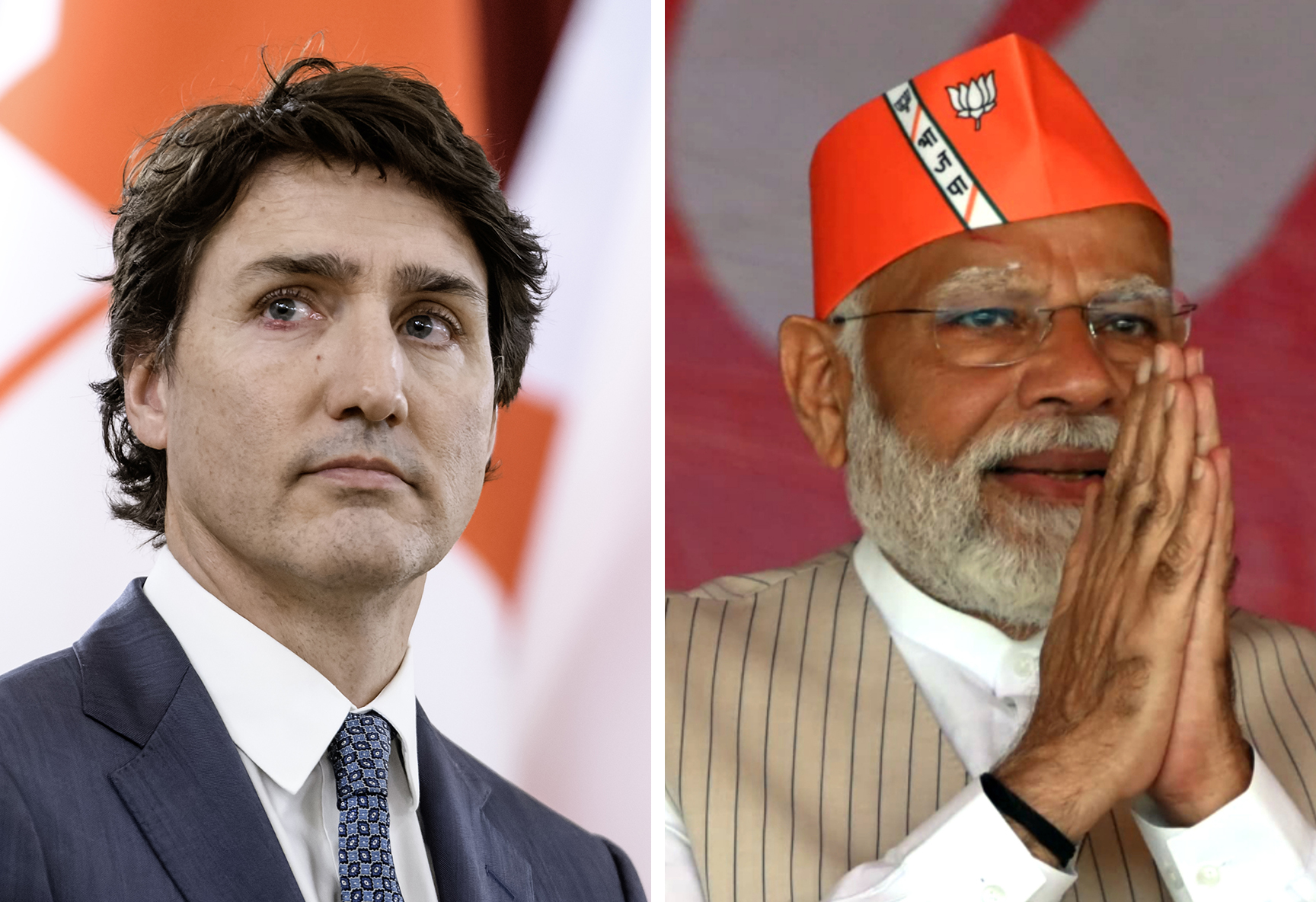
December 3, 2024 – Amid fresh, but so far denied, allegations of Indian political interference in Canada’s 2022 Conservative Party leadership race, a new public opinion poll from the non-profit Angus Reid Institute, in partnership with the Asia Pacific Foundation of Canada, indicates a significant decline in Canadian views towards the sub-continental superpower.
Where a majority (52%) of people in this country told ARI 20 months ago that Ottawa should approach New Delhi either as a valued partner and ally or on friendly terms, that sentiment has dropped by half to just 24 per cent.
Further, favourable views of India have plummeted from a high of 56 per cent in January 2020 to 26 per cent today. The inverse negative view has more than doubled.
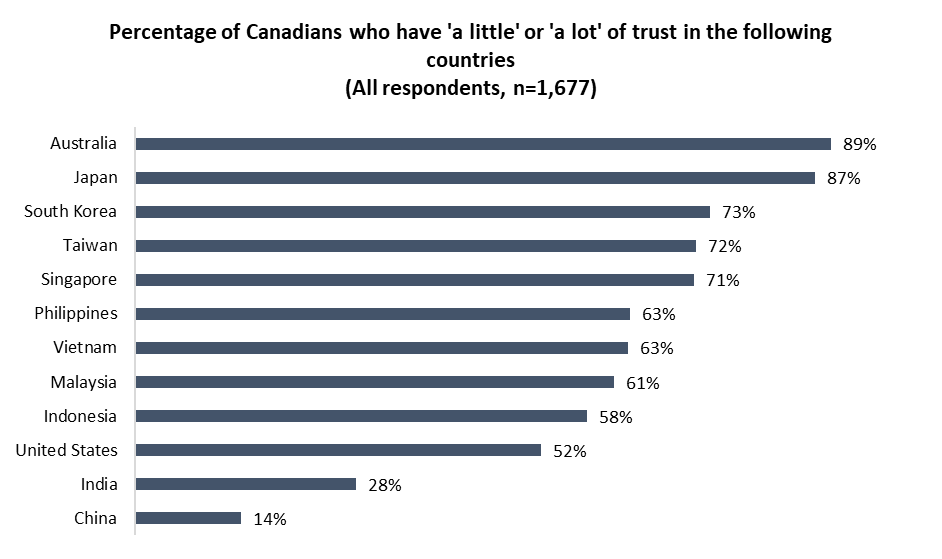
These data also reveal India is now only seen more favourably by Canadians than Russia and China, while trust in New Delhi sits at less than one-third (28%).
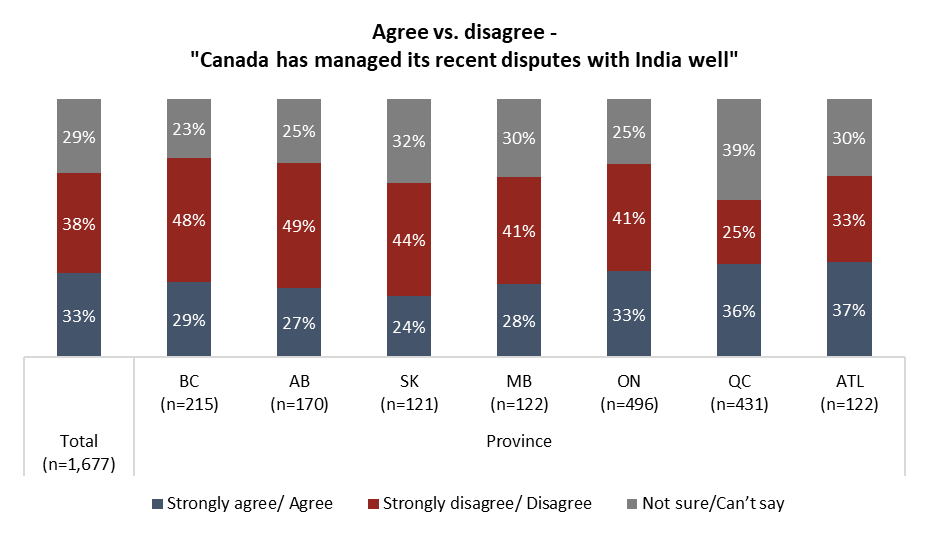
There is less consensus over how Canada is perceived to be handling the relationship, although a plurality are inclined to say Ottawa isn’t managing it well (39%) compared to one-third (32%) who say the opposite and almost the same number (29%) who say they aren’t sure. A significant political tension colours these perceptions. Those who say they would vote for the Liberal Party of Canada in the next election are most complimentary of the Trudeau government’s performance on this file, while professed Conservative supporters say the current government is mishandling the situation.
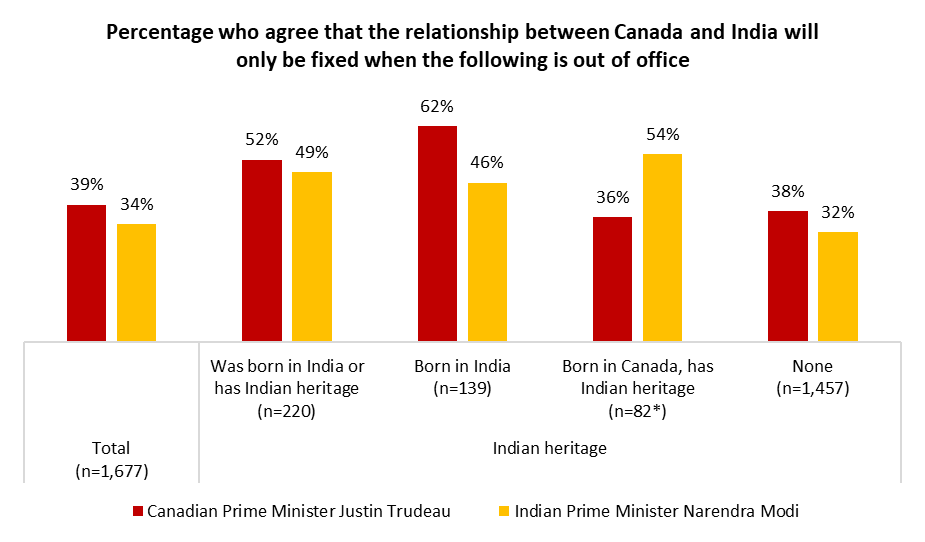
The froideur between the two nations shows little sign of warming in the short term. The belief among 39 per cent in Canada is things will not improve until Prime Minister Justin Trudeau is no longer in office, while 34 per cent say the same of Indian Prime Minister Narendra Modi.
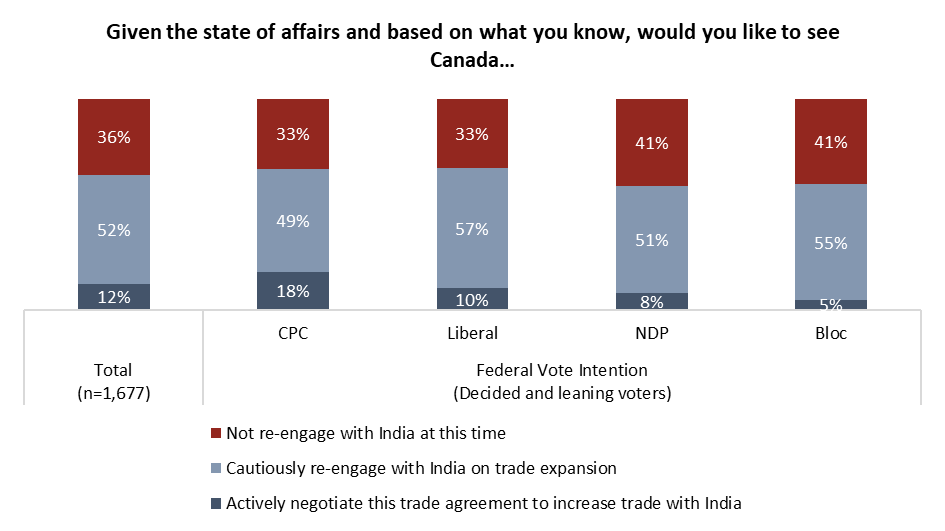
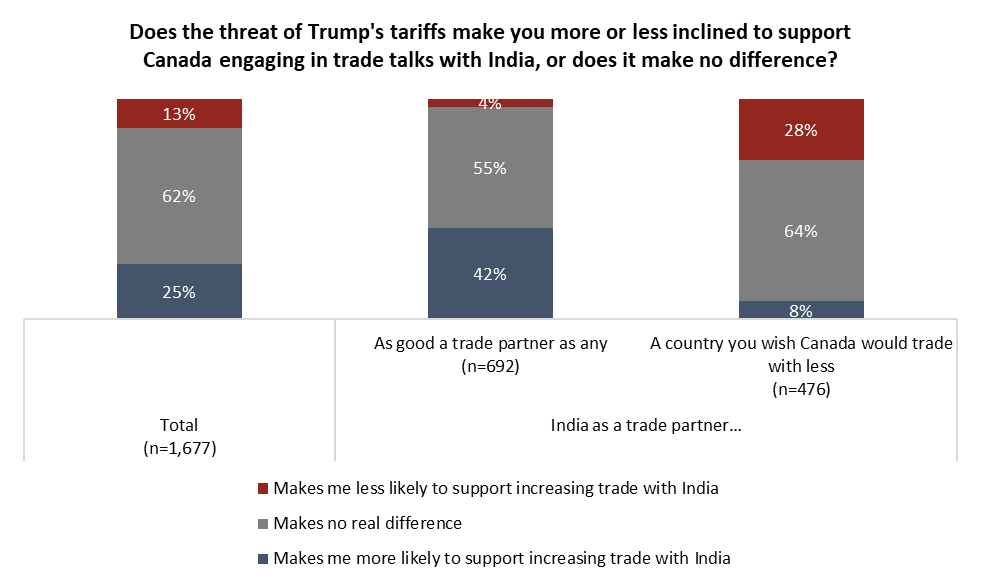
That said, two-thirds (64%) of Canadians say this country should at minimum, “cautiously” attempt to re-open trade negotiations on a free trade agreement with India, a finding slightly boosted by threats from incoming U.S. President Donald Trump of blanket 25 per cent tariffs on Canadian exports.
Click below to see Key Takeaways from the data
About ARI
The Angus Reid Institute (ARI) was founded in October 2014 by pollster and sociologist, Dr. Angus Reid. ARI is a national, not-for-profit, non-partisan public opinion research foundation established to advance education by commissioning, conducting and disseminating to the public accessible and impartial statistical data, research and policy analysis on economics, political science, philanthropy, public administration, domestic and international affairs and other socio-economic issues of importance to Canada and its world.
About Asia Pacific Foundation of Canada
The Asia Pacific Foundation of Canada (APF Canada) is an independent, not-for-profit organization focused on Canada’s relations with Asia. Our mission is to be Canada’s catalyst for engagement with Asia and Asia’s bridge to Canada. APF Canada is dedicated to strengthening ties between Canada and Asia through its research, education, and convening activities. Our research provides high-quality, relevant, and timely information, insights, and perspectives on Canada-Asia relations for Canadians and stakeholders across the Asia Pacific. APF Canada also works with business, government, and academic stakeholders to provide Asia Competency training for Canadian organizations and students.
The Full Story
INDEX
Part One: The overall relationship between Canada and India
Unfavourable views of India climb as tensions rise
Canadians’ trust of India below most Asia Pacific countries
Plurality say Canada should approach India ‘cautiously’, one-third as threat
Canadians who want country to approach India ‘on friendly terms’ halves in 20 months
Two-in-five say Canada has managed relationship with India poorly
Part Two: Perspectives on trade
Enthusiasm for further trade with India has halved in last decade
Concerns over human rights, India’s rule of law has three-in-10 expressing reservations
Half want Canada to ‘cautiously’ re-open trade negotiations
Potential of Trump tariffs slightly increases Canadian appetite for more trade with India
Part One: The overall relationship between Canada and India
It would not be an understatement to suggest the relationship between Canada and India is at or near a nadir. The decline in affairs between the two countries began in September 2023 when Canada called for a surprise pause in negotiations of a Canada-India trade treaty that had been in the works since March 2022. Canadian Prime Minister Justin Trudeau visited India that month for the G20 summit, which saw a terse exchange on the sidelines between the Canadian leader and Indian Prime Minister Narendra Modi, who expressed concerns about Sikh protesters in Canada. The two leaders did not hold a bilateral meeting during the summit, in what some described as a “snub” by Modi. Canada then postponed a trade mission to India, which had been scheduled for later that year.
And this was all just a prologue to what became a major pivot point later that month when, during a speech to the House of Commons, Trudeau accused the Indian government of involvement in the killing of Canadian Sikh leader, and Khalistani separatist, Hardeep Singh Nijjar. The RCMP announced in October of this year it had “evidence” that the Indian government was linked to crimes in Canada, including murder, extortion and intimidation. India has denied involvement, calling it a “smear campaign”. Canada then expelled some of India’s diplomats from the country, as India did the same.
While China has been the focal point of the federal commission investigating foreign interference in Canadian elections, the Canadian Security Intelligence Service has also pointed the finger at India, saying the country’s government tried to influence the 2019 and 2021 federal elections. An intelligence report tabled in the House of Commons earlier this year also accused India, alongside China, of interfering in the Conservative Party of Canada’s leadership race.
Unfavourable views of India climb as tensions rise
With all this in the background, Canadians’ views of India have deteriorated significantly in the past 20 months. As recently as March 2023, Canadians were divided over their view of India: 44 per cent said they viewed the country favourably, 43 per cent unfavourably. Now three-in-five (60%) say they have negative views of the world’s most populous country, doubling those who instead have positive impressions (26%):

Among the countries included in this survey, India is only viewed more favourably than China (15%) and Russia (11%). India is still one of Canada’s top trading partners – more on that relationship in part two of this report – but is viewed less favourably than other Canadian trade destinations including the United States (47%), Mexico (57%), South Korea (67%), Germany (74%), the U.K. (76%), Italy (77%) and Japan (82%).

According to the most recent Canadian census in 2021, there are 1.35 million people of Indian origin in Canada. India has been the top source country for not only permanent residents to Canada, but also temporary foreign workers and international students.
Canadians who were born in India have a more favourable view of the country (64%) than those who whose parents or grandparents were born there (36%) and those who have no Indian heritage at all (21%):

*Smaller sample size, interpret with caution
Canadians’ trust of India falls below most other Asia Pacific countries
In another example of Canadians’ negative impressions of India, their level of trust of the country is only higher than China among a group of countries bordering the Pacific Ocean. Approaching three-quarters (72%) instead distrust India:
Plurality say Canada should approach India ‘cautiously’, one-third as threat
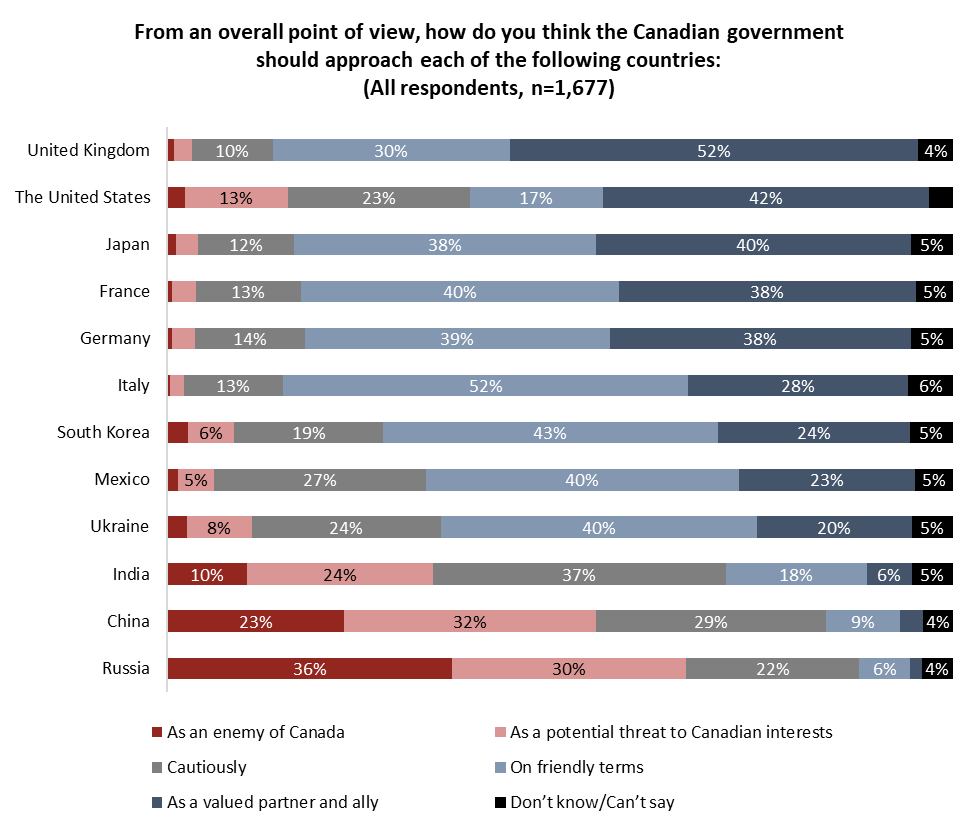
Canadians’ distrust of India is also evident when they’re asked to assess how they believe their government should approach the country. One-third (34%) select either as an enemy (10%) or as a threat to Canadian interests (24%). Two-in-five (37%) want less hostility, but still believe Canada should be cautious in its relations with India. Again, this puts India closer to Russia and China in the eyes of Canadians than other nations viewed in a more positive light:
Canadians who want country to approach India ‘on friendly terms’ halves in 20 months
This negative view is a significant change from March last year, when a plurality believed Canada should approach India on friendly terms (42%) and few believed India to be a threat to Canada’s interests:

Cameron MacKay, Canada’s most recent high commissioner to India, told CBC in October that fixing the relationship between the two countries was “not high” on India’s agenda, but did say Canada wants “a better relationship with India.” Two-thirds of Canadians believe that Canada should hold firm on its accusation even if it means a decline in relations with India, tripling the number who believe instead Canada should put aside its differences and try to repair the relationship (17%).
Those who say they will vote Conservative if a federal election were held today are most likely to believe the latter (27%). Three-quarters of likely Liberal (76%), NDP (77%) and Bloc Québécois voters (77%) say Canada should “stand up for what it believes is right” even as relations with India deteriorate:

Two-in-five say Canada has managed relationship with India poorly
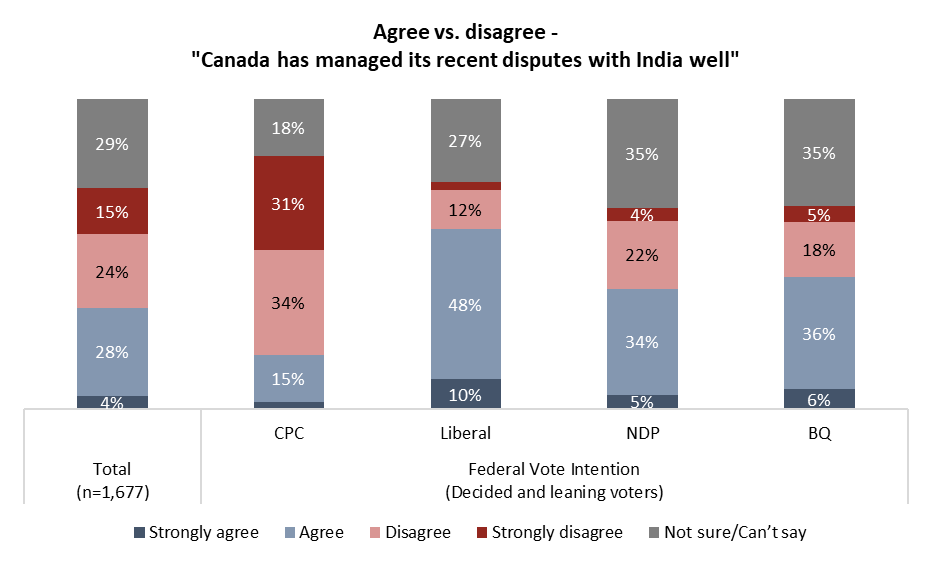
Canadians are divided in their assessment of the government’s actions as tensions between Canada and India rise. Overall, they lean towards believing Canada has done a poor job managing its disputes with India (39%), but one-third (32%) say the government has approached the recent row well.
However, there is a political lens perhaps colouring Canadians’ views on this, as the government is led by what polling suggests is a an unpopular prime minister and political party. A majority (65%) of likely CPC voters are negative in their assessments:
Those in Quebec (36%) and Atlantic Canada (37%) are most likely to say the government has done well managing the disagreements with India, but there are many in both regions who are unsure (39% Quebec, 30% Atlantic Canada):
Modi was recently re-elected to another five-year term in June. Trudeau has indicated he will run again whenever the next federal election comes in 2025. While Canadians with no Indian heritage are more mixed in their assessments, those who were born in India, or their parents or grandparents were, are more likely to believe Trudeau is holding back Canada-India relations. There are also many Canadians of Indian descent who believe Modi’s presence is having a negative effect as well:
*Smaller sample size, interpret with caution
Part Two: Perspectives on trade
Canadian officials face a challenging political and economic environment heading into 2025. U.S. President-Elect Donald Trump made global waves recently, announcing that he would apply a 25 per cent tariff on both of his nation’s bordering neighbours, Canada and Mexico. This, while Canada faces diplomatic tension with two Asian economic giants, China and India.
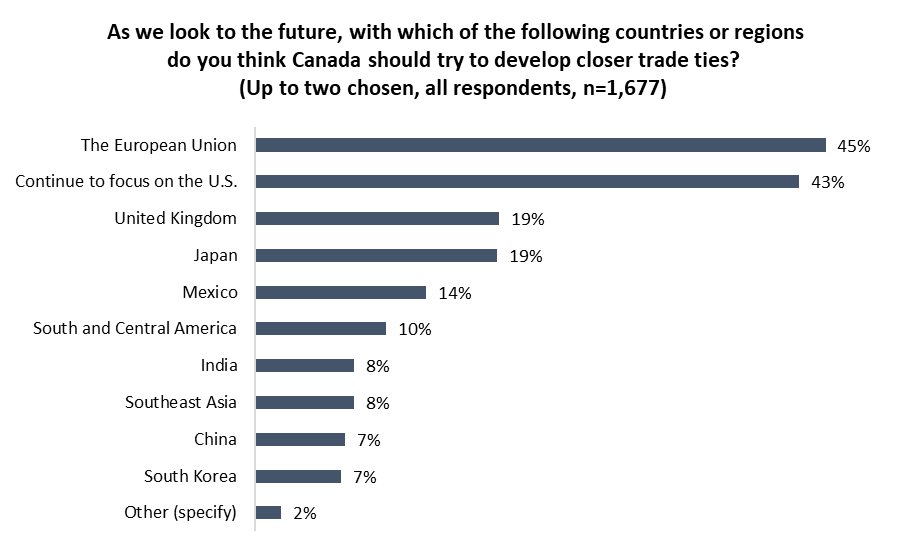
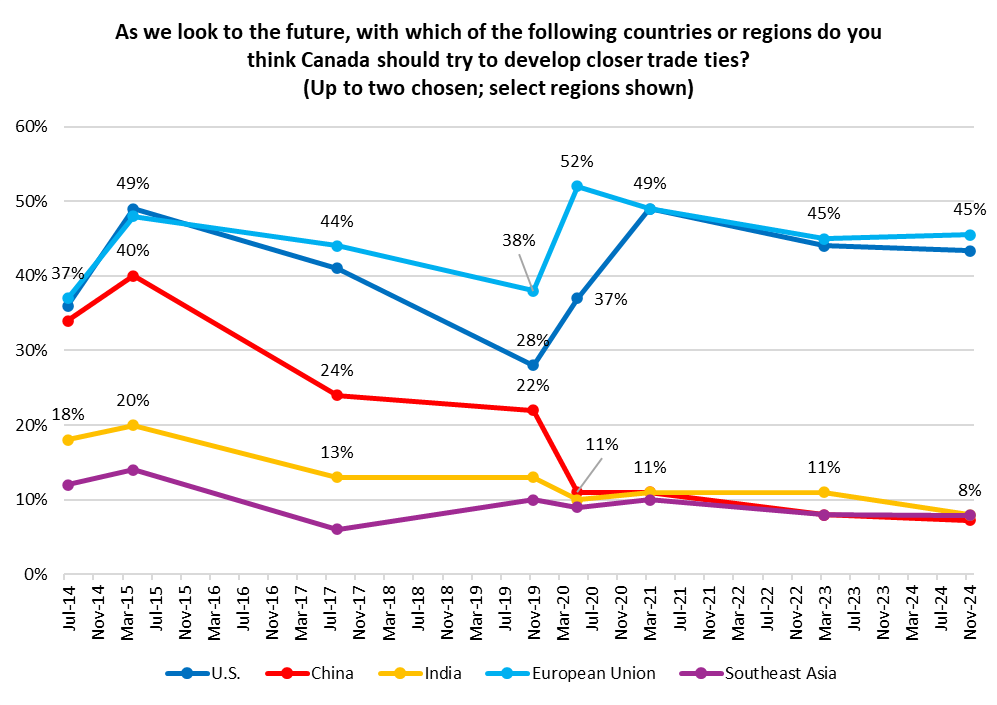
Asked where Canada should put its trade focus going forward, the United States and the European Union lead the list of options, both chosen by nearly half of Canadians. A second tier of regional preference forms with one-in-five choosing each of the United Kingdom and Japan. Both India and China are viewed as strong priorities for fewer than one-in-10 Canadians:
Enthusiasm for further trade with India has halved in last decade
The past decade has seen diminished enthusiasm for trade with both China and India. In 2015 as many as 40 per cent of Canadians said they would like to pursue trade with China, now just seven per cent hold this view. Preference for trade with India never reached that level but peaked at 20 per cent, now dropping to less than half of that mark:
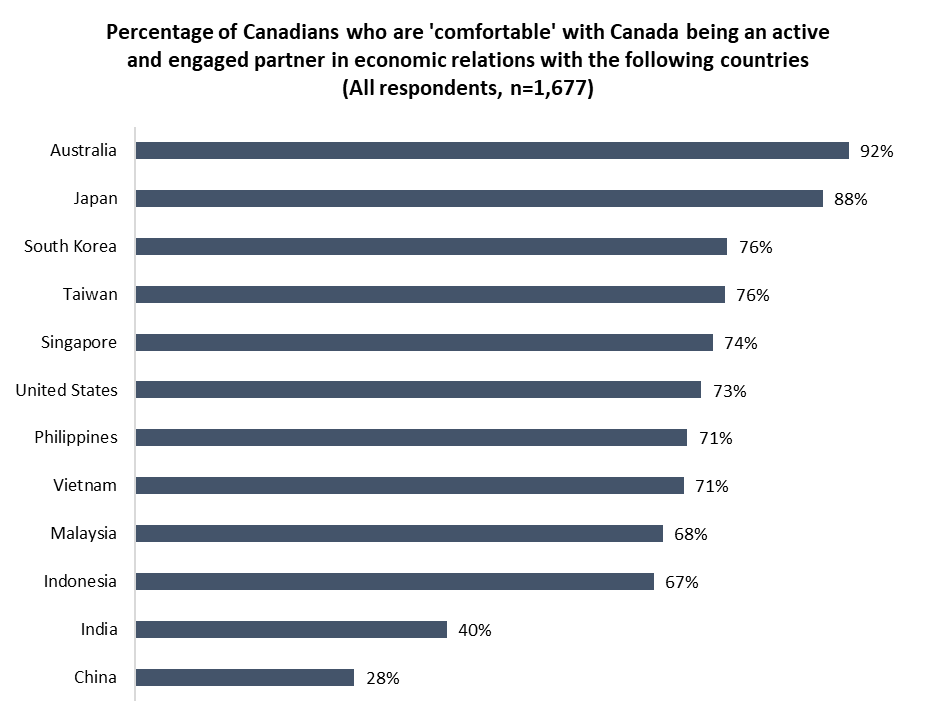
Asked another way, and with additional options for comparison, Canadians express comparably low levels of comfort in the idea of Canada trading with India (40%) and China (28%). Other Asia-Pacific region partners generate considerably higher comfort levels:
Concerns over human rights, India’s rule of law has three-in-10 expressing reservations
Some of the concern about having a cozier trade relationship with both China and India may be rooted in a sense that each nation does not uphold the rule of law and an appropriate level of human rights. India ranks 109th and China 149th on the 2023 Human Freedom Index which measures “86 distinct indicators of personal and economic freedom”. For reference, Canada ranks 13th. Three-quarters of Canadians say China does not uphold the necessary rights of individuals and two-thirds (66%) say this of India:
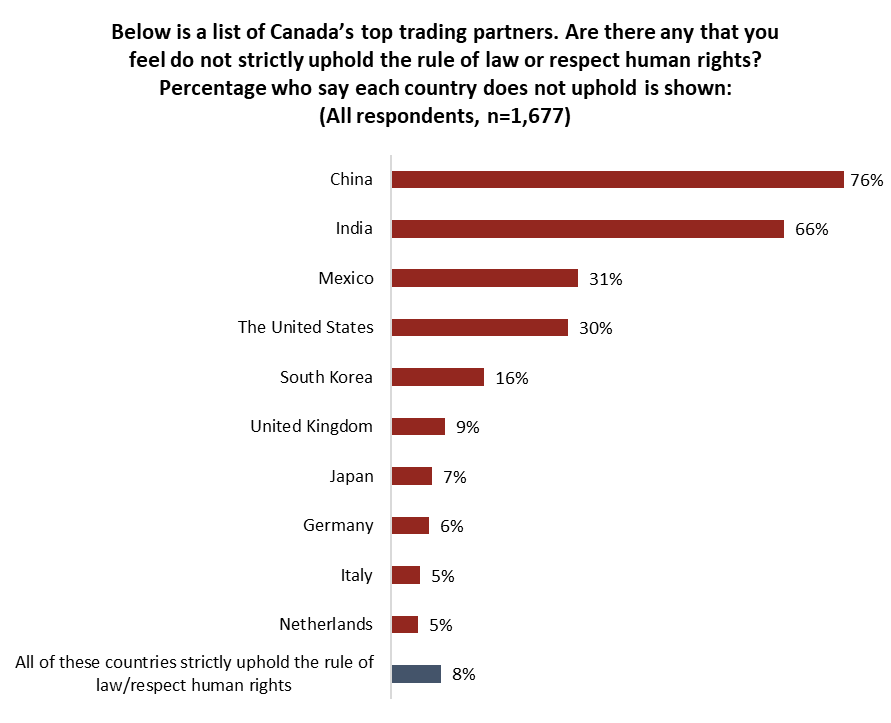
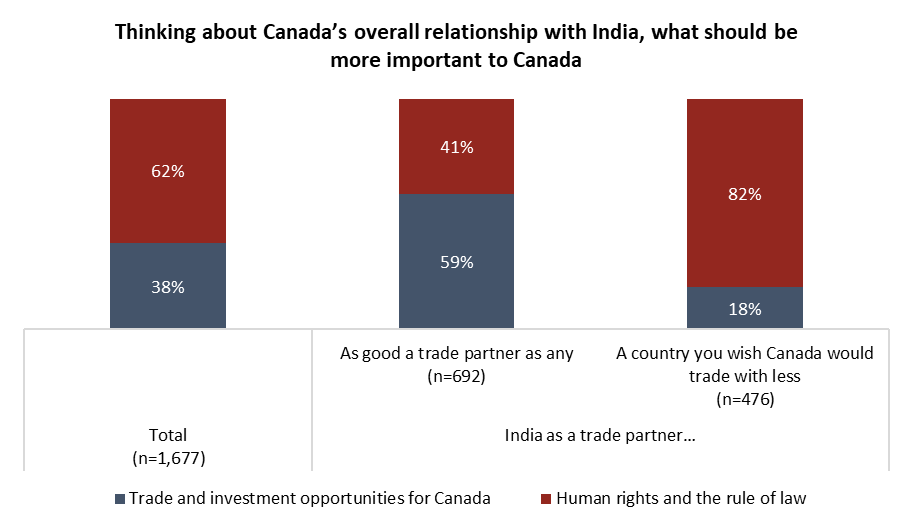
Despite these concerns, however, two-in-five Canadians say India remains as good a trade partner as any, though evidently they prefer others when the choices are limited. Notably, half of would be Conservative and Liberal voters have no reservations with Indo-Canadian trade.

Asked which concern is paramount for them, choosing between trade and investment opportunities for Canada or human rights and the rule of law, three-in-five (62%) prioritize the latter. Among that group, India is viewed much more skeptically as a trade partner:
Half want Canada to ‘cautiously’ re-open trade negotiations
So, what then is the best path forward for Canada, with trade negotiations stalled and diplomatic tensions high? A relatively small number of Canadians (12%) say Canada should aggressively kickstart trade negotiations with India, while the largest group (52%) say they would approach the talks with caution, but not let them lay dormant. One-third (36%) would do just that, not re-engage at all:
Potential of Trump tariffs slightly increases Canadian appetite for more trade with India
The threat of tariffs and the fallout from the re-election of U.S. President Donald Trump may have a spinoff benefit of making other trade partners appear more valuable. That does appear to be the case with India, as twice as many Canadians say they are more supportive of Indo-Canadian trade due to Trump’s threats compared to those who are less supportive:
Survey Methodology:
The Angus Reid Institute and the Asia Pacific Foundation of Canada conducted an online survey from Nov. 21-26, 2024 among a representative randomized sample of 1,677 Canadian adults who are members of Angus Reid Forum. For comparison purposes only, a probability sample of this size would carry a margin of error of +/- 2 percentage points, 19 times out of 20. Discrepancies in or between totals are due to rounding. The survey was self-commissioned and paid for jointly by ARI and APF Canada.
For detailed results by age, gender, region, education, and other demographics, click here.
For detailed results by Indian heritage, click here.
For the full release, click here.
For the questionnaire, click here.
Image – ID 309597153 | © Vladyslav Musiienko / ID 328103131 | India © Saikatpaul | Dreamstime.com
MEDIA CONTACT:
Shachi Kurl, President, ARI: 604.908.1693 shachi.kurl@angusreid.org @shachikurl
Vina Nadjibulla, Vice-President Research & Strategy, APF: 917.593.1406 vina.nadjibulla@asiapacific.ca