


Mark Carney seen as the only potential replacement to bring back wayward Liberal supporters
October 28, 2024 – It’s been a rocky start to the fall sitting period for the governing Liberals, which finds itself dealing with turmoil from outside and in.
The minority government has been challenged by two non-confidence votes, and more may be on the way. Meanwhile, the Liberals deal with internal strife after a caucus revolt of more than 20 MPs demanded Liberal leader and Prime Minister Justin Trudeau step down.
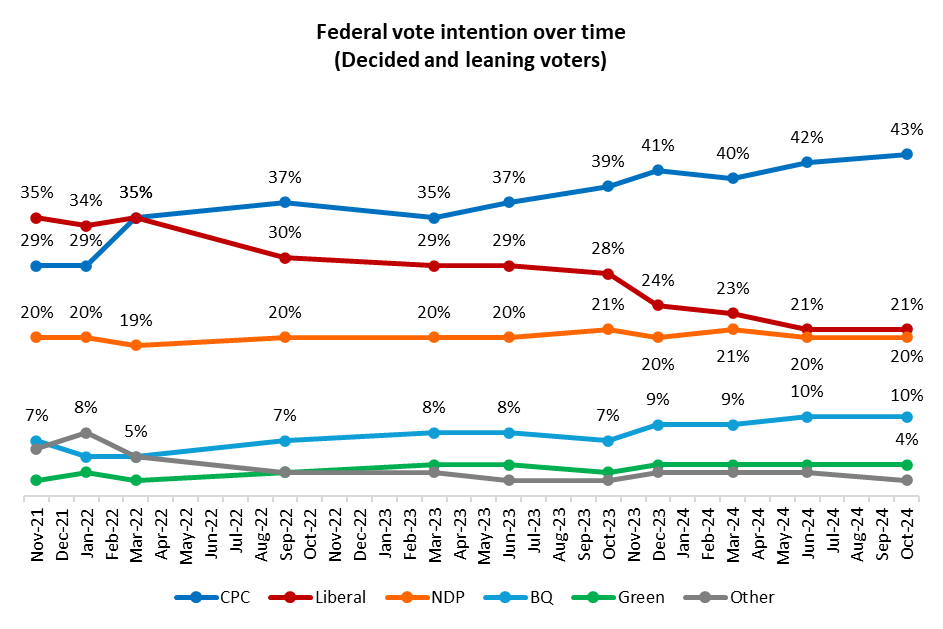
Through all this, new data from the non-profit Angus Reid Institute finds the Liberal universe remaining sizable, if in a purely hypothetical sense. More than half of Canadians (55%) say that they would consider supporting the party in a future federal election. The problem for the Liberals is that just 21 per cent of decided and leaning voters currently do.
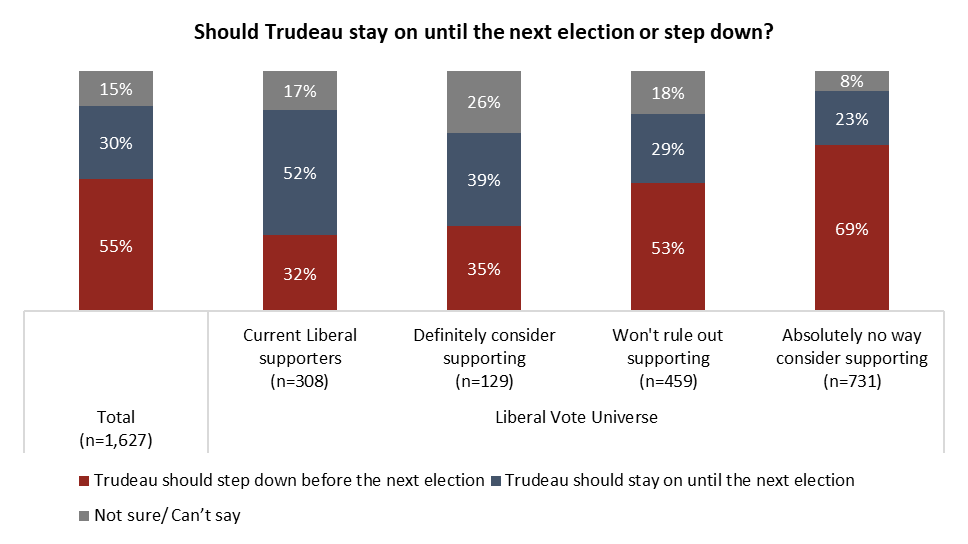
So, what do the Liberals do to reach their ceiling, and avoid the floor? While some MPs have demanded a refresh in the form of a new leader, current Liberal voters are unsure. Half (52%) say Trudeau should stay on for the next election, outnumbering the one-third (32%) of Liberal voters who believe a new leader is needed. Those who say they would definitely consider the Liberals in a future election (8% of Canadians) are even more unsure, with near equal numbers saying he should stay (39%) and go (35%). A much larger slice of the population is those who are more difficult for the Liberals to reach, the 28 per cent of Canadians who say they wouldn’t rule the party out come the next election. Within this group, a majority (53%) believe Trudeau should step away, suggesting that a new leader – assuming it’s the right leader – could broaden the party’s tent.
As to who should be next in line to lead, as noted in June, few names continue to generate a high level of enthusiasm. Finance Minister Chrystia Freeland is a popular choice among those who are closer to the Liberals but is a net negative among those who are on the fence. Former Bank of Canada Governor Mark Carney is most likely of the eight individuals presented to draw in others from further outside of the Liberal core as well as within it. Former Premier of British Columbia Christy Clark, who publicly stated she would be interested in the position, is a net negative among all groups.
Another factor to watch over the coming months is the interplay between Liberal and NDP voters. Those who currently support the NDP show a high level of mobility between the two parties, with many saying they would consider supporting the Liberals under the right conditions. This, as NDP leader Jagmeet Singh continues to endure low levels of favourability (37%).
A majority (55%) of Canadians believe Trudeau should step down before the next election. But there is more support for him to stay on among those who would vote for the party if an election were held today. Others who haven’t ruled out voting for the party are more likely to want to see a new leader.
Former Bank of Canada and Bank of England governor Mark Carney performs best among potential Liberal leader replacements when it comes to growing the party tent beyond current supporters. Deputy Prime Minister Chrystia Freeland is well received among current supporters but does not pull in support from those who are “definitely” or “might” considering voting Liberal.

The Conservatives hold a 22-point lead as they queue up non-confidence votes to attempt to bring down the government.
About ARI
The Angus Reid Institute (ARI) was founded in October 2014 by pollster and sociologist, Dr. Angus Reid. ARI is a national, not-for-profit, non-partisan public opinion research foundation established to advance education by commissioning, conducting and disseminating to the public accessible and impartial statistical data, research and policy analysis on economics, political science, philanthropy, public administration, domestic and international affairs and other socio-economic issues of importance to Canada and its world.
INDEX
Part One: Leadership
Part Two: Vote intent
Part Three: Should Trudeau go?
Half of current Liberal supporters say PM should stay for next election
Would a new leader garner more support?
Carney top choice across Liberal vote universe, Freeland divisive
Part Four: The Bloc ultimatum
Increased OAS payments welcomed
More uncertainty over protecting supply managed farm sectors
Part One: Leadership
After New Democratic Party leader Jagmeet Singh announced in early September that he would no longer uphold the Liberal minority government through a previous supply and confidence agreement, chatter in the political world turned immediately to a potential early election. Nearing two months on from Singh’s announcement, the Liberals have survived two non-confidence votes – brought by the Conservatives – with the support of the NDP and Bloc Québécois, but governing in the house has been anything but smooth.
The government faces an ultimatum from the BQ. Party leader Yves-François Blanchet said he will begin to negotiate a non-confidence vote with other parties if the Liberals do not pass two bills from the party by Oct. 29. Further, speculation that the Liberals may prorogue (temporarily suspend) parliament have arisen in recent weeks as pressure from the opposition to release documents related to green technology projects and calls from Liberal MPs for Trudeau to resign his leadership have both increased.
These political machinations are evidently doing none of the leaders of the major national parties any favours, with all three earning sub 40 per cent approval/favourability. For age, gender and other demographic data on assessments of the leaders, see detailed tables.

Part Two: Vote intent
No change in the vote intention picture is good news for the Conservative Party, which holds a 22-point lead. For demographic data on vote intention, see detailed tables. And while Singh was facing increasing pressure to break the supply and confidence agreement with the Liberals, doing so appears to have paid zero political dividend:
Each party, however, may find reason to cling to hope, depending on how one looks at the situation. Canadians were asked first which party they would support if an election were held imminently and next, which of the other parties they would consider in the future, outside of their current first choice. All three of the major federal parties draw interest from more than half of Canadians, though to varying degrees. For example, twice as many Canadians already support the Conservatives compared to the Liberals or NDP. The Liberal and NDP universes are comprises of large numbers who wouldn’t rule them out, but aren’t currently interested:

Part Three: Should Trudeau go?
One of the biggest factors in revitalizing a flagging political enterprise is a change at the top. For this reason, Trudeau’s future has been a hot topic. As the Liberals’ electoral fortunes have declined, disapproval of the prime minister has remained high. A year ago, a majority of Canadians (57%) said Trudeau should step down, while fewer than three-in-ten (28%) said he should lead the Liberals into the next election. One year later, and in the face of a Liberal caucus rebellion, this sentiment has changed little: a majority (55%) of Canadians say it’s time for Trudeau to make way for a new leader, while three-in-ten (30%) believe Trudeau should be at the helm of the party when the next election comes:

Half of current Liberal supporters say PM should stay for next election
There is variation in this belief within the Liberal vote universe. Among those who would vote Liberal half (52%) want Trudeau to be there as leader when the next election comes. Those who say they “would definitely consider” voting Liberal (8% of Canadians) are near evenly split between wanting Trudeau to stay (39%) or go (35%). Canadians who haven’t ruled out the Liberals (28% of Canadians) are much more likely (53%) to want a different leader in place before the next time they go to the polls:

Would a new leader garner more support?
Trudeau has stood firm in the face of the recent caucus revolt, saying he’s staying on and plans to lead the party into the next election. That has done little to stop the swirl of rumours as to who might line up for the opportunity to lead the party if Trudeau stepped down. Speculated candidates have included current cabinet ministers – Chrystia Freeland, Mélanie Joly, Anita Anand, François-Phillippe Champagne, Mark Miller and Domnic LeBlanc – as well as former Bank of Canada and Bank of England governor Mark Carney, who recently was appointed chair of the Liberal party’s economic advisory task force, and former B.C. Premier Christy Clark, who reportedly has been polishing up her French as she waits in the wings for an opportunity to run for the party leadership.
Carney top choice across Liberal vote universe, Freeland divisive
Freeland, who has served as finance minister and deputy prime minister under Trudeau, is the best known among potential Liberal voters, but is also perhaps the most polarizing. Equal sized groups of one-in-five (22%) say they would be more and less likely to vote for the Liberals under Freeland’s leadership.
Carney generates the highest net swing (21% more likely, 9% less likely), but has work to increase his recognition among potential voters with 46 per cent offering no opinion or saying they don’t know him.
Clark, who was the premier of B.C. from 2011 to 2017 with the right-of-centre B.C. Liberals, a former provincial party that is not affiliated with the federal Liberals, generates the highest negative swing (10% more likely to vote, 19% less likely).
These data become more nuanced when you consider the different segments of the Liberal vote universe separately. Freeland and Carney perform strongly among those who already say they are supporting the Liberals, but Freeland has a more negative effect among potential voters further on the fringes.
Carney is the only candidate who is a net positive among both those who would “definitely” consider the party (+8) and those who haven’t ruled the party out completely (+8).
Clark is a net negative among all three segments of the Liberal universe – current supporters, “definite” considerers and “might” considerers:
Part Four: The Bloc ultimatum
The next election may come sooner rather than later given the precarious minority situation the Liberals find themselves in absence of the former supply-and-confidence agreement with the NDP. All three major opposition parties – NDP, Bloc Québécois and Conservatives – must vote together to bring down the government on a confidence manner, which has opened the door for further policy negotiation. The Bloc have stepped through, issuing an ultimatum for the government to pass two of its bills or else the party will vote against the government on a future confidence vote.
Increased OAS payments welcomed
One of the Bloc’s bills has already been passed in unison by the three opposition parties – an increase to Old Age Security (OAS) payments for those aged 65 to 74, matching an increase that was earlier given to those 75 and older. However, it needs the government’s support for it to become official.
A majority of partisans of all stripes support the increase to OAS payments, but Conservative supporters are least supportive despite their party voting for the measure in parliament. Poilievre did not commit to following through on the measure if his party were to win a future election and he became prime minister.

More uncertainty over protecting supply managed farm sectors
With a Canada-United States-Mexico Agreement (the replacement for the North American Free Trade Agreement otherwise known as NAFTA) renegotiation looming in 2025, the Bloc Québécois have also asked for the government’s approval of a private member’s bill which would exempt certain farm sectors from future international trade negotiations. These sectors – poultry, dairy and eggs – are under the purview of the country’s “supply management” system and proved to be a sticking point when CUSMA was negotiated under the previous U.S. administration of President Donald Trump. Trudeau and Canada made concessions on supply managed products to get the deal done in 2018.
A plurality (40%) support exempting supply managed farm sectors from future trade negotiations, but many (35%) are uncertain. Likely Conservative voters are most opposed to these exemptions (45%) while those who would vote for the Bloc are most supportive (84%):

Survey Methodology
The Angus Reid Institute conducted an online survey from Oct. 24-26, 2024 among a representative randomized sample of 1,627 Canadian adults who are members of Angus Reid Forum. For comparison purposes only, a probability sample of this size would carry a margin of error of +/- 2 percentage points, 19 times out of 20. Discrepancies in or between totals are due to rounding. The survey was self-commissioned and paid for by ARI.
For detailed results by age, gender, region, education, and other demographics, click here.
For the full release including methodology, click here.
For the questionnaire, click here.
Image – Adam Scotti/PMO
Shachi Kurl, President: 604.908.1693 shachi.kurl@angusreid.org @shachikurl
Dave Korzinski, Research Director: 250.899.0821 dave.korzinski@angusreid.org
Jon Roe, Research Associate: 825.437.1147 jon.roe@angusreid.org