

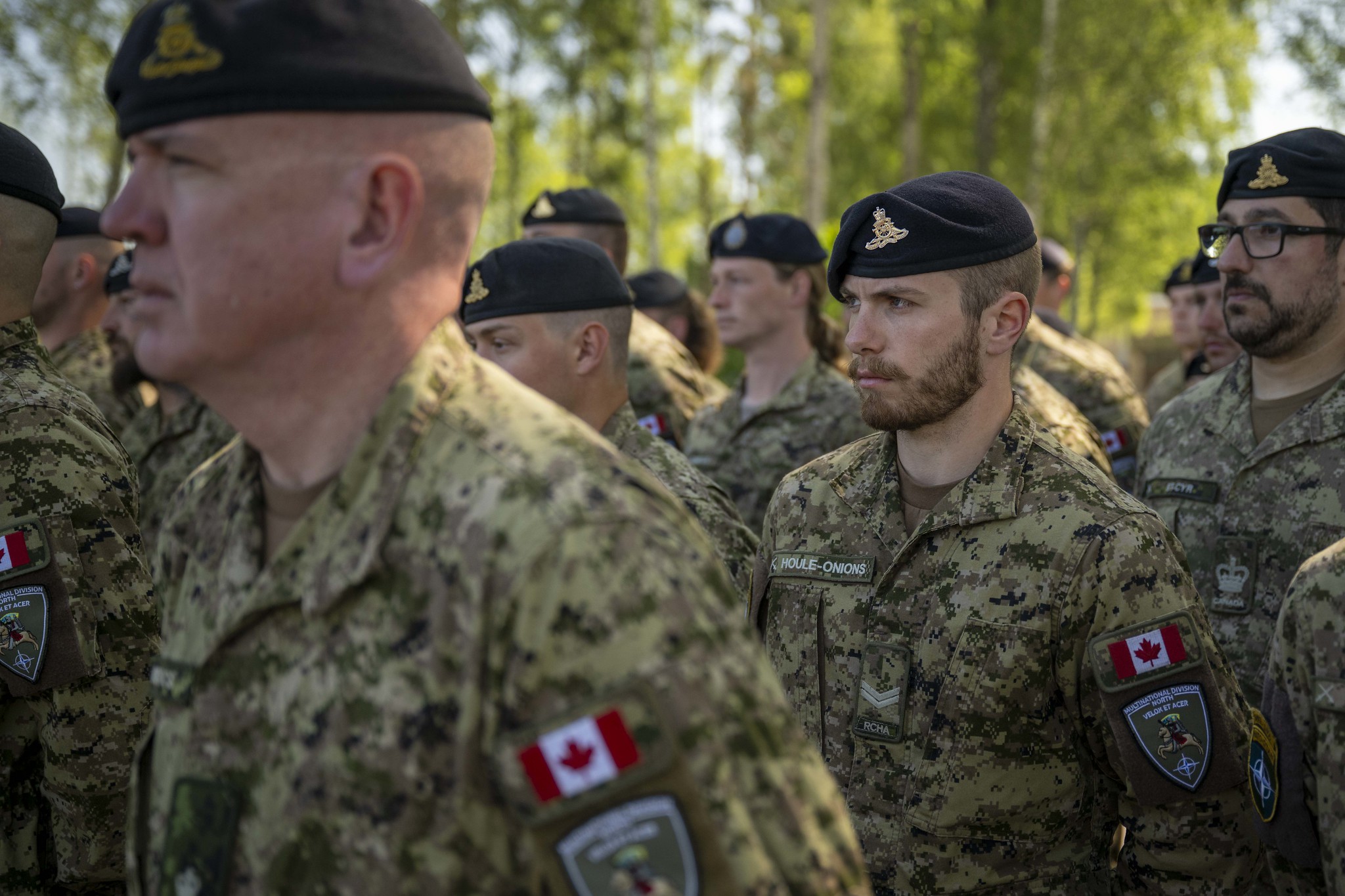
Canadians who say they feel proud of Armed Forces declines by 27 points since 2019
July 10, 2025 – As Canada looks to ramp up spending on the Armed Forces to meet NATO commitments, there appears to be hesitation from young Canadians to fight for their country.
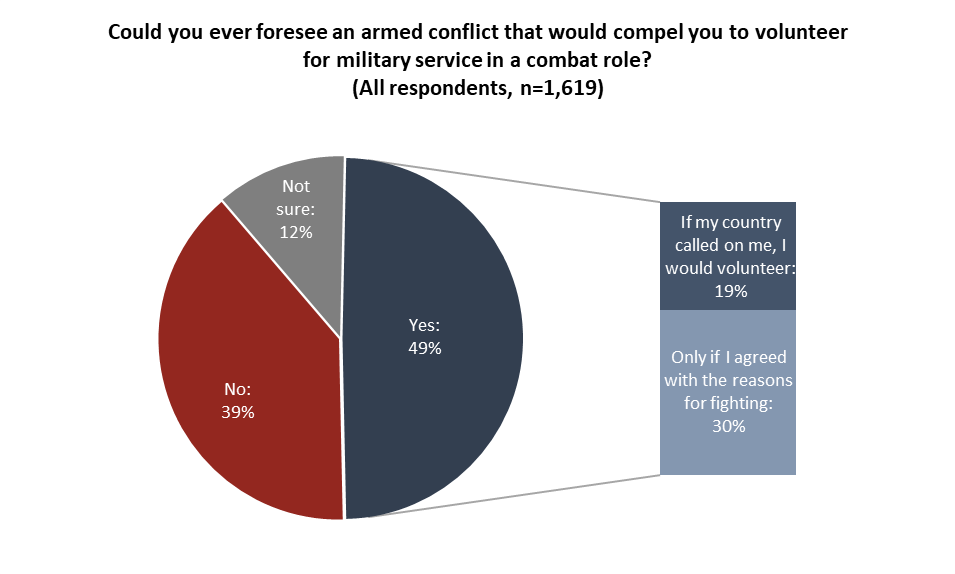
New data from the non-profit Angus Reid Institute finds half (49%) of Canadians willing to fight for their country in the event of an armed conflict, but among this half, most say they would only do so if they “agreed with the reasons for fighting”.
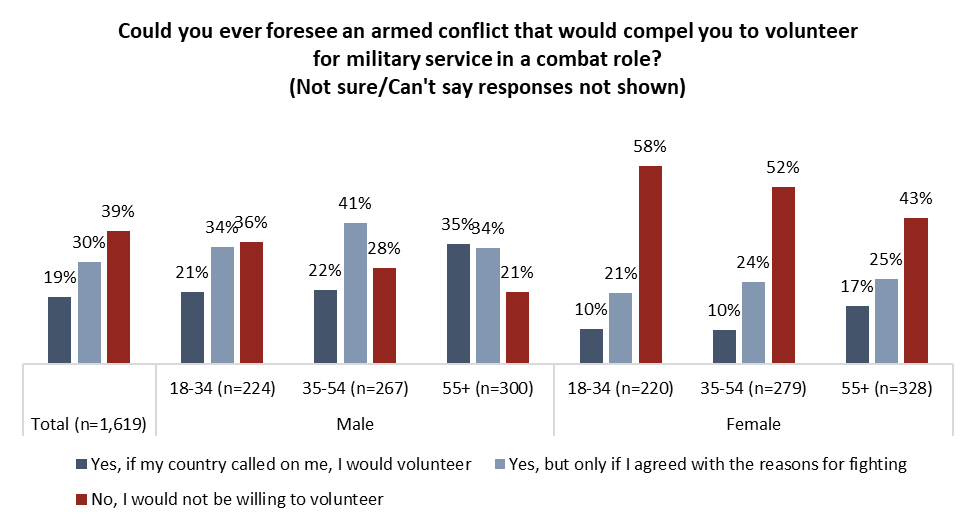
However, the most willing to enlist are those older than 54 (55%) while the 18- to 34-year-olds that will likely be necessary to fill recruitment gaps are less likely to say they foresee a situation where they would volunteer for the military in a combat role (43%).
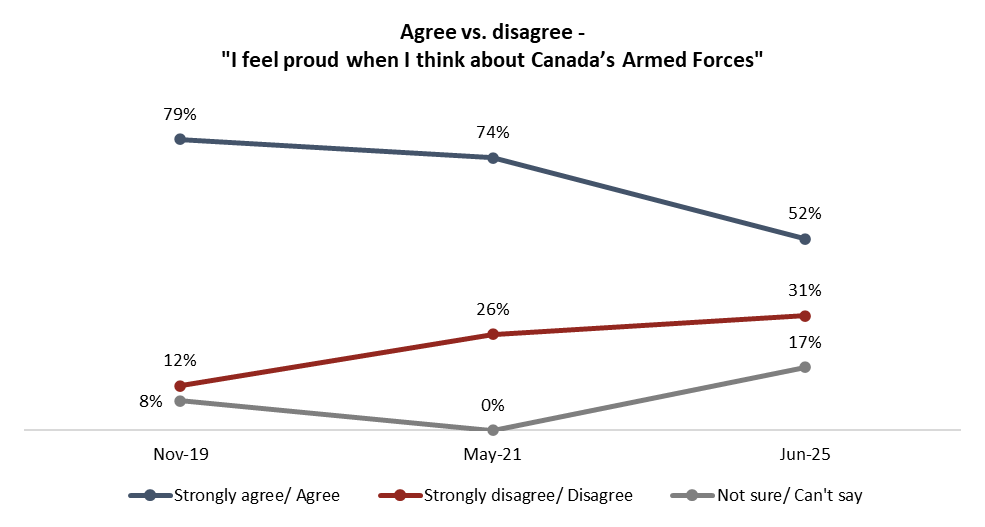
These new data come at a pivotal time for Canada’s Armed Forces as the federal government increases defence spending budget to meet the country’s pledge to NATO. Whether it is years of headlines emphasizing Canada’s relative underinvestment in the military, or the lingering effects of the 2021 sexual misconduct scandal, Canadians’ pride in their Armed Forces has declined over the past six years. In November 2019, approaching four-in-five (79%) said they felt proud when thinking of Canada’s military; currently half (52%) say the same.
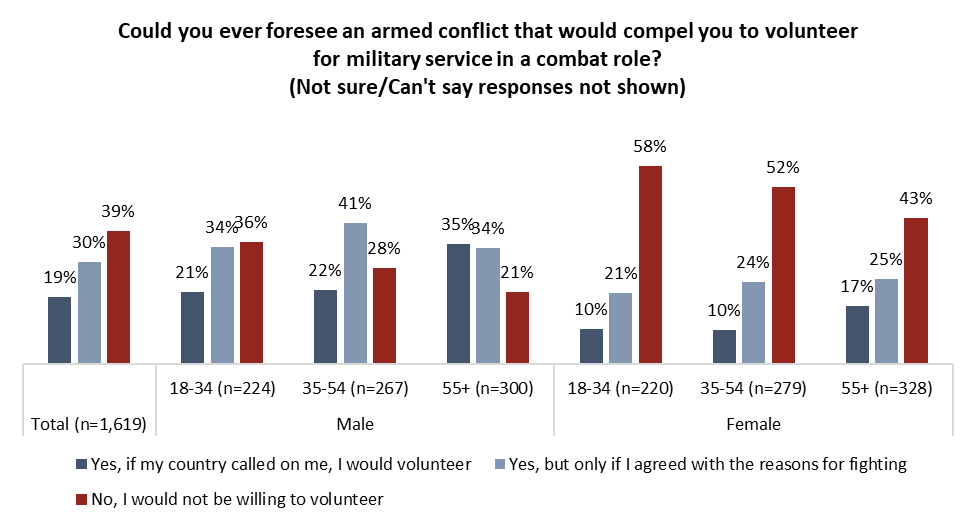
At the peak of the news cycle of sexual misconduct in the military, which saw 13 senior officers face allegations, three-quarters of Canadians said there was “a culture of disrespect toward women in the military”. Perhaps that plays a role into why Canadian women (36%) are much less likely than men (63%) to say they would volunteer to serve in the event of an armed conflict. But it may also be coded in evolutionary biology.
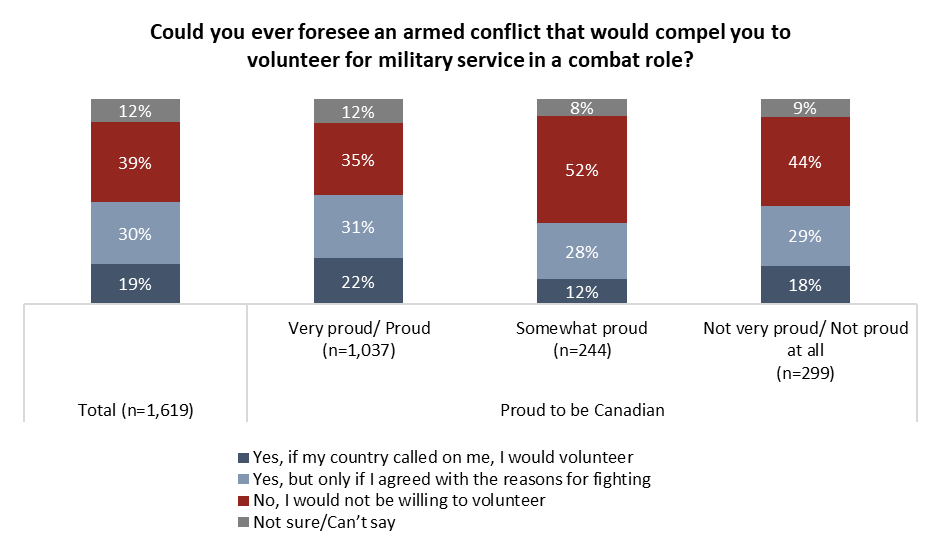
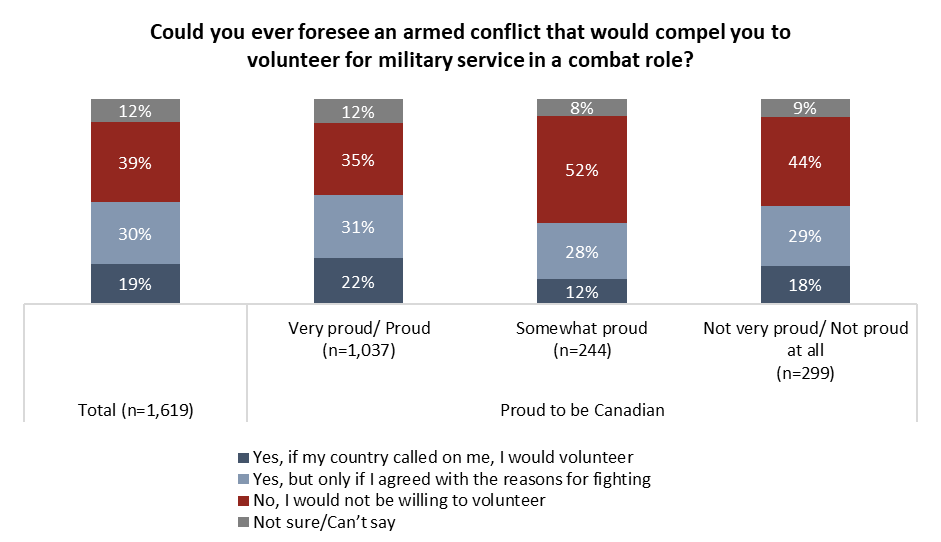
While pride in Canada has risen in the wake of the existential threats to the country uttered by U.S. President Donald Trump, it trails highs seen four decades earlier, when there was also more willingness from Canadians to fight for their country. Instilling pride may be a key to solving the military’s “recruitment crisis”, as those who say they are “very proud” or “proud” to be Canadian are much more likely (53%) to say they would volunteer to fight for Canada than those who are less patriotic.
More Key Findings:
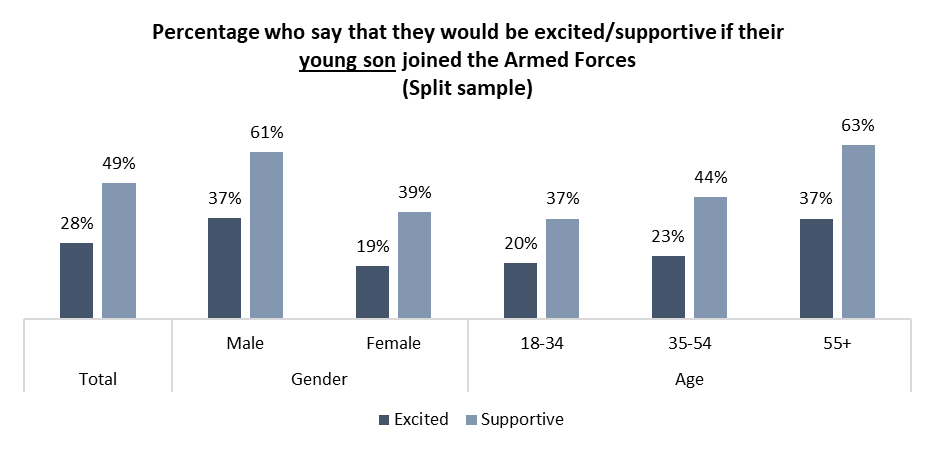
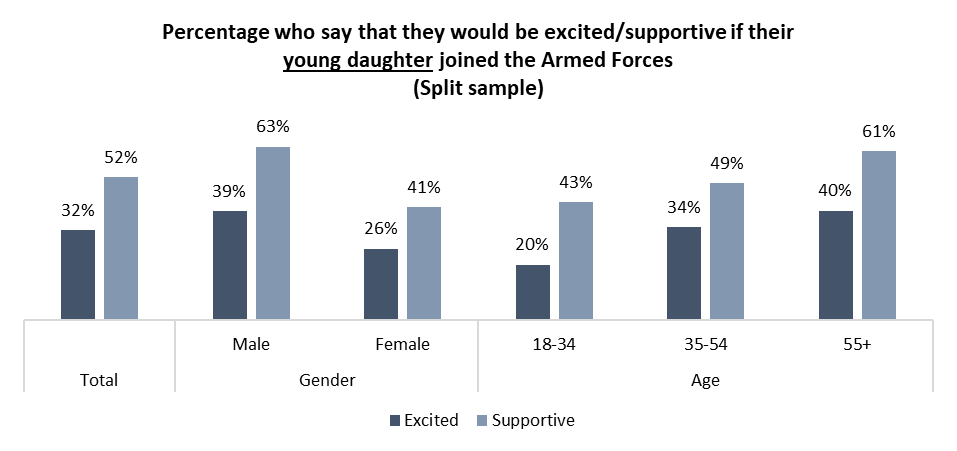
- Canadians are more likely to be supportive if their daughter (52%) or son (49%) joined the Armed Forces than excited (28% son, 32% daughter).
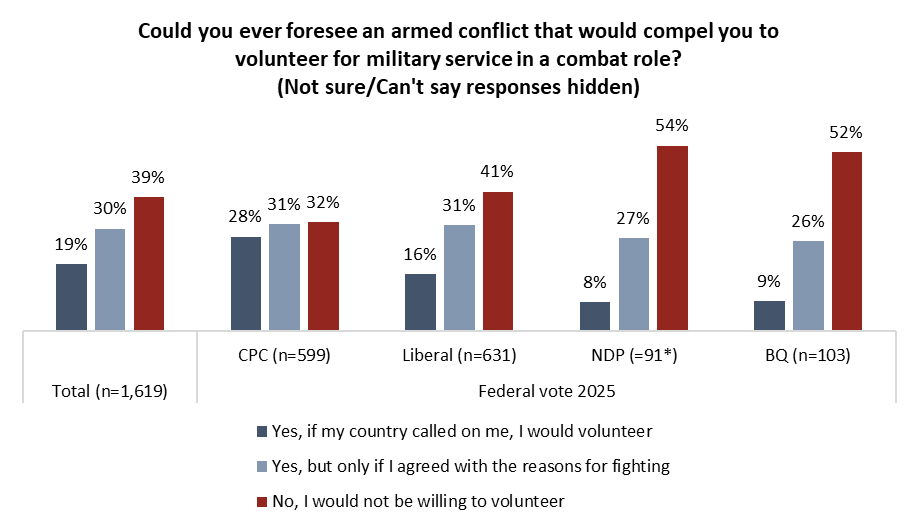
- Those who voted CPC in April are more likely to say they would volunteer for the military in the event of an armed conflict (59%) than those who voted Liberal (47%), NDP (36%) or Bloc Québécois (35%). A majority of the latter two groups of voters say instead they would not put their hand up.
About ARI
The Angus Reid Institute (ARI) was founded in October 2014 by pollster and sociologist, Dr. Angus Reid. ARI is a national, not-for-profit, non-partisan public opinion research foundation established to advance education by commissioning, conducting and disseminating to the public accessible and impartial statistical data, research and policy analysis on economics, political science, philanthropy, public administration, domestic and international affairs and other socio-economic issues of importance to Canada and its world.
Part One: Would you fight for the country?
-
Declining pride in Canada’s Armed Forces
-
Gender divide on volunteering for combat roles
-
Past CPC voters more likely to say they’re willing to fight
-
Pride in Canada and willingness to volunteer
Part Two: Canadians’ views on their children joining the Armed Forces
Part One: Would you fight for the country?
Declining pride in Canada’s Armed Forces
As Canada looks to ramp up spending on its military to fulfill its promise to the North Atlantic Treaty Organization (NATO), it is currently behind on filling out the current ranks of its Armed Forces as it stands. At the end of last year, there were more than 64,000 regular force members and 23,000 reservists, nearly 14,000 short of its intended size of 71,500 regular soldiers and 30,000 reserves. The shortfall has been described as a “recruiting crisis”, one that the federal government hopes to address by increasing soldiers’ salaries. However, the government has waffled on the size of that pay increase and when it will happen. Initially, it was supposed to be 20 per cent and immediate, but both the scale and the timeline are in doubt.
Regardless, there is evidence the military has made progress. It surpassed its recruitment targets in the past year while hitting a 10-year high in the number of Canadians signing up for the Armed Forces. The next hurdle will be retaining them, as the CBC reported in May that new military members had the highest attrition rate.
Recent headlines about Canada’s military have rarely been positive – even before the news emerged recently that two members of the Canadian Armed Forces had been charged in an alleged plot to create an “anti-government militia”. In 2021, the federal government apologized to Canadian military members who were victims of sexual misconduct after nearly 19,000 current and retired members submitted claims as part of class action lawsuit. That year, 13 senior Canadian military officers faced allegations of sexual misconduct as many criticized the military’s handling of such cases. At the time, three-quarters of Canadians told the Angus Reid Institute that there was “a culture of disrespect toward women in the military”.
However, even in the wake of the sexual misconduct scandal, three-quarters (74%) of Canadians said they felt proud when thinking of Canada’s Armed Forces. Now half (52%) say the same, representing a drop of nearly 30 points from November 2019 (79%). Perhaps the years of headlines of Canada’s relative under investment in defence spending, and the pervading sense that Canada needs to do more to invest in its military, have had an effect of eroding pride in Canada’s Armed Forces.
Related:
- 74% of Canadians say military’s culture disrespectful toward women; more call problem handling complaints ‘systemic’
- Hitting the Mark? Two-thirds support 2% defence spending pledge; almost as many say 5% ‘too much’
- Three-quarters say Canada is ‘falling behind’ on military power

Gender divide on volunteering for combat roles
Canadian military involvement in armed conflicts has been at a much smaller scale since the Armed Forces ended its deployment in Afghanistan. That conflict saw more than 40,000 members serve, with 158 deaths over the course of 13 years from 2001 to 2014.
Half (49%) of Canadians say they could see an armed conflict that would compel them to volunteer for the military, but of those, the majority (30%) say they would need to agree with the reasons for fighting to join the Armed Forces. A plurality of two-in-five (39%) say they would not be willing to volunteer for a combat role.
As a historical comparison, 40 years ago, when asked a different question by in June 1985 if they would be willing to fight for Canada if there was a war, 61 per cent of Canadians said “yes”, while 15 per cent said “it depends”.
In the present day, there is both a significant generation and gender gap in willingness to volunteer for a combat role should Canada enter an armed conflict. Men older than 54 are the most willing to volunteer (69%) both depending on the cause (34%) and regardless of the reasons (35%). However, this enthusiasm won’t be helpful in addressing current enlistment shortfalls, as the mandatory retirement age is 60 for the Armed Forces.
The youngest cohort of adult men are much more likely than older ones to say they would not be willing to fight for Canada. Meanwhile, majorities of women under 55, and a plurality of those older than that, say they would not be willing to fight:
Past CPC voters more likely to say they’re willing to fight
Across the political spectrum, those who voted Conservative in the April federal election are more likely than other past voters to say they would be willing to volunteer for a combat role (59%). Majorities of past NDP (54%) and Bloc Québécois (52%) voters say they would decline to volunteer. Those who supported Prime Minister Mark Carney and the Liberal party are the most divided; two-in-five (41%) would not volunteer, while 47 per cent say they would:
Pride in Canada and willingness to volunteer
Canadians’ pride in their country has rebounded significantly from lows seen at the end of 2024, but still trail highs seen in data dating back to the 1985, when approaching four-in-five (78%) said they were “very proud” to be Canadian.
Related:
- From ‘eh’ to ‘meh’? Pride and attachment to country in Canada endure significant declines
- Canada Day 2025: Pride & optimism rebound, but significant divides over what the country has to offer
Pride in Canada appears to be related to one’s willingness to serve in a combat role. Those who describe themselves as “very proud” or “proud” to be a Canadian are less likely to say they would not volunteer to fight and more likely to say they would volunteer for a combat role than those who are “somewhat”, “not very” or “not proud at all”:
Part Two: Canadians’ views on their children joining the Armed Forces
One’s own willingness to serve is one matter, but it is also instructive to view Canadians’ hypothetical reactions to their own adult children joining the Armed Forces. The Angus Reid Institute split the sample in four, showing each group a variation on a statement about their own child joining the military. One group was asked if they would be excited if their young son joined, one group was asked if they would be supportive instead, while the other two groups were shown similar statements about their young daughter (see the questionnaire for all four statements as they appeared in the survey).
Generally, Canadians would be more supportive than excited if their children joined the Armed Forces. They were also slightly more likely to say they’d be “excited” by their daughter enlisting (32%) than if their son did the same (28%). However, in both cases, more say they would not be excited (57% son, 51% daughter):

Older Canadians (63%) and men (61%) are the most likely to say they’d be either excited or supportive of their young son joining the military:
Similar figures are seen for the groups asked about their hypothetical young daughter instead:
Survey Methodology:
The Angus Reid Institute conducted an online survey from June 20-23, 2025, among a randomized sample of 1,619 Canadian adults who are members of Angus Reid Forum. The sample was weighted to be representative of adults nationwide according to region, gender, age, household income, and education, based on the Canadian census. For comparison purposes only, a probability sample of this size would carry a margin of error of +/- 2.0 percentage points, 19 times out of 20. Discrepancies in or between totals are due to rounding. The survey was self-commissioned and paid for by ARI.
For detailed results by age, gender, region, education, and other demographics, click here.
For the full PDF of release, click here.
For the questionnaire, click here.
MEDIA CONTACT:
Shachi Kurl, President: 604.908.1693 shachi.kurl@angusreid.org @shachikurl
Dave Korzinski, Research Director: 250.899.0821 dave.korzinski@angusreid.org
Jon Roe, Research Associate: 825.437.1147 jon.roe@angusreid.org