


Slightly more say Canada on the right track (46%) than wrong track (40%)
June 27, 2025 – There may be more white and red on display this Canada Day, as a Donald Trump-driven boost to national pride and optimism about the nation’s future continues.
But the midway point of the year after a federal election campaign and the celebration of the nation’s 158th birthday is a good time to ask, “what does Canada have to offer?”
New data from the non-profit Angus Reid Institute finds Canadians more united in pride.
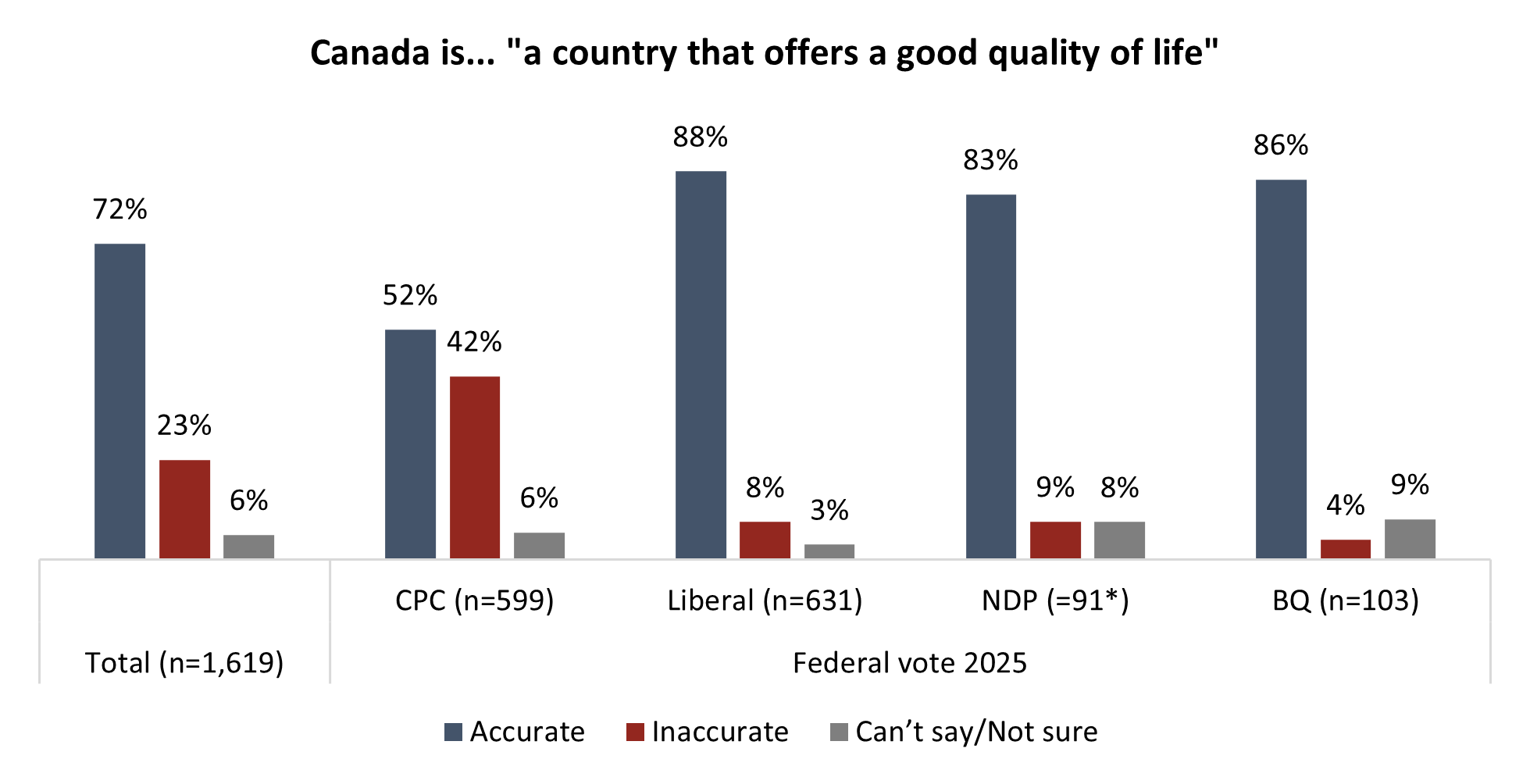
But while seven-in-10 (72%) say that Canada offers a good quality of life, 23 per cent – one-quarter – disagree. This rises to 42 per cent among those who supported the Conservative Party in the April federal election, signalling that despite recent cooperation between the party and the government, those divisions likely run deeper than an early-term assistance may indicate.
Those who are in middle of their working lives, 35- to 54-year-old Canadians, are more likely than younger (22%) and older (19%) groups to also feel this way, with 28 per cent saying the country doesn’t offer a good quality of life.
Further, as sociologists, economists, and politicians attempt to figure out ways to reverse the country’s tanking fertility rate, younger people are also least certain that Canada is a good place to start a family. The news isn’t all bad, as a majority of 18- to 34-year-olds still choose the optimistic view on this question (60%), but three-in-10 (27%) disagree. Among retirement age Canadians, for whom those families and lives have already been built, four-in-five (79%) say Canada is a great place to do so.

As Prime Minister Mark Carney continues to focus on one of the government’s foremost goals of getting Canada’s economy moving, the business environment is clearly a concern for the country. Fewer than half (45%) say that Canada is a good place to start a business, dropping to two-in-five in B.C. (39%), Alberta (39%), Saskatchewan (40%), and Ontario (41%).
Perhaps momentum is building, however, for a better future. In December of last year ARI asked Canadians whether they’re optimistic or pessimistic about what’s in store for the country. The negative responses outweighed positive by 22 points, 39 per cent optimistic, 61 per cent pessimistic. Asked now, more than half (56%) are positive and 44 per cent are negative.
More Key Findings:
- Half of Canadians say it would be inaccurate to call Canada a country where “everyone has the same opportunities”. Those 55 years of age and older are much more likely than those younger to say that this is the case.
- Ontario and Atlantic Canada show the most pride in being Canadian. Half in each region are “very proud”. Albertans are most likely to say they’re not proud (28% vs 18% national average)
- Alberta is the only region in the country that does not voice majority optimism for Canada’s future (47%). Manitoba (61%), Quebec (61%), and Atlantic Canada (65%) are most optimistic.
INDEX
Part One: “Canada is…”
- A country that offers a good quality of life
- A country where everyone has the same opportunities
- A good place to start a family
- A good place to start a business
- A country on the right track
Part Two: Pride and Optimism
- Ontario, Atlantic Canada voice most pride
- Optimism for Canadians’ own futures
- Upswing in optimism for the country grows
Part One: “Canada is…”
The nation has undergone massive shifts in perspective over the first half of 2025. The near inevitability of a Conservative government, forecast for the entirety of 2024, evaporated, and Mark Carney’s Liberals were granted the task of taking on the seemingly existential danger of American President Donald Trump, who threatened to cripple portions of the country through tariffs, and consistently stated a desire to absorb Canada into his own union. While these early-year issues have abated significantly, with Carney telling Christiane Amanpour this week that he believes Trump no longer wants to annex Canada, many have begun again look inward at domestic issues. Trump and tariffs continue to drop on the list of top priorities for the country and the Conservative Party is even supporting Liberal legislation aimed at “nation building”.
As many look to redefine and rebuild the nation, it’s worth asking Canadians, what is Canada?
A country that offers a good quality of life
The vast majority of Canadians still feel like their country is one that offers a good quality of life. Whatever challenges they perceive, the potential and opportunity is alluring to seven-in-10 (72%). This is widely the case for all non-Conservatives, with that latter group offering the bulk of the disagreement (42%). Underscoring these political perspectives, Albertans are most likely among all regions to say that Canada does not offer a good quality of life (35%) (see detailed tables):
A country where everyone has the same opportunities
Despite this widespread sentiment that Canada is a place where someone can achieve a good quality of life, there are foundational questions for which some Canadians express skepticism. Among these appraisals from Canadians, the most negative is pertaining to the opportunities every citizen is given. Perhaps most interesting is the gap in views across generations. For older men (55+) the majority view is that everyone has the same chance to make something for themselves. For women and men younger than 55, this is not viewed as the case. In fact, more than half among these groups say Canada is not a place of equal opportunity. It is worth noting that increasing income and wealth inequality is viewed as a major challenge for Canada, and a factor limiting the opportunities of many:

A good place to start a family
With housing affordability and the cost of living consistently atop the list of resident concerns in recent years, a significant minority of one-quarter, including three-in-10 18- to 54-year-olds, disagree that this is a good place to start a family. The majority still say it is, but much of this strength comes from those who have passed the age where starting a family is a consideration:
A good place to start a business
More pronounced are the scepticisms offered by Canadians about the business environment. Some of this uncertainty matches surveys of business leaders in Canada, who have contended with immense uncertainty this year, and entrepreneurship that has lagged since COVID-19. Asked if they think Canada is a good place to start a business, fewer than half of Canadians say yes (45%), with two-in-five in Ontario, the economic engine of the nation, holding this view. One-in-three (33%) overall say Canada is not a good place to do this, while one-in-five (22%) are unsure:

A country on the right track
While challenges are evident in building the public’s confidence, at least one indication is that the nation has some momentum. More Canadians now say the country is on the right track (46%) than the wrong track (40%). In January of this year the proportion choosing right track was four points lower and wrong track was seven points higher. Politically, Liberals are much more likely (72%) than New Democrats (50%) and Conservatives (17%) (see detailed tables):

Part Two: Pride and Optimism
It appears Canadians have rediscovered some of their national pride after six months of threats, jokes, and economic attacks from Trump and his acolytes. In recent years, that feeling of pride, which many likely began to take for granted, had begun to soften. After the COVID-19 pandemic, some of the fabric of the nation appeared to have stretched or even torn, as Canadians said they were less proud, feeling less compassion from their neighbours, and felt further apart as imagined communities.
The Liberal government under Justin Trudeau was seemingly unable to pull the country back together, and all federal party leaders played a role in diminishing views of Canada’s leadership. Trump’s tariffs and threats of annexation seemed to snap (most of) the population back into pre-COVID levels of pride, though it is worth noting that the high point over the past 10 years registered in 2016 still looms over these more recent data:

Ontario, Atlantic Canada voice most pride
Pride ranges across the country. In Ontario and Atlantic Canada, for example, half of the population is “very proud” to be Canadian. In Alberta and Saskatchewan that drops to 38 per cent, and in Quebec, to 30 per cent. Three-in-10 (28%) in Alberta are not very proud or not proud at all, the highest number in the nation:

Optimism for Canadians’ own futures
Personal optimism about the future had been in a decline for many years, from a peak of 81 per cent in late 2018, to 61 per cent in December 2024. After the chaos of the early months of 2025, optimism rose 11 points, before falling five points in this wave of data. Canadians are now twice as likely to say they are optimistic than pessimistic:

Upswing in optimism for the country grows
Pessimism about the future of Canada reached a high in ARI tracking in December, when three-in-five (61%) said they worried about the path the country was on. In the months since, there has been a major rebound in optimism as the country swapped an unpopular Trudeau for the currently well-appraised Carney. Now a majority (56%) say they believe Canada’s future is bright:

At the recent December nadir of optimism for the future of the country, fewer than two-in-five in B.C. (39%), Alberta (32%), Saskatchewan (39%) and Ontario (37%) said they felt Canada had a bright path ahead of it. This summer rebound in optimism is seen even in Alberta (47%) and Saskatchewan (50%), places that typically trailed other provinces in their view of the country’s future. Now a majority every except those two provinces have a positive outlook of Canada’s future:

METHODOLOGY:
The Angus Reid Institute conducted an online survey from June 20-23, 2025, among a randomized sample of 1,619 Canadian adults who are members of Angus Reid Forum. The sample was weighted to be representative of adults nationwide according to region, gender, age, household income, and education, based on the Canadian census. For comparison purposes only, a probability sample of this size would carry a margin of error of +/- 2.0 percentage points, 19 times out of 20. Discrepancies in or between totals are due to rounding. The survey was self-commissioned and paid for by ARI. Detailed tables are found at the end of this release.
For detailed results by age, gender, region, education, and other demographics, click here.
For full PDF of release, click here.
For questionnaire, click here.
MEDIA CONTACT:
Shachi Kurl, President: 604.908.1693 shachi.kurl@angusreid.org @shachikurl
Dave Korzinski, Research Director: 250.899.0821 dave.korzinski@angusreid.org