


For the first time since 1974, all three major federal party leaders score at least -12 in approval
May 9, 2024 – Many pundits and observers have speculated that politics has “never been this divisive”, with party leaders who seek to exploit differences rather than overcome them. Even Canadians have voiced concern that there is no room for compromise or that their voices aren’t heard. This frustration and division appears to have created the perfect conditions for political dissatisfaction, and this has culminated in historically unpopular leadership at the federal level.
An analysis of 50 years of public opinion data shows it’s not just a feeling: data indicates Canadians have never been as critical of all three of the major federal party leaders at the same time. There have certainly been low points, in 2011 Jack Layton, Michael Ignatieff and Stephen Harper were all in negative territory, but the intensity of dislike towards Layton was relatively slight. In the late 1980’s both John Turner and Brian Mulroney were heavily disapproved of, but Ed Broadbent soared in public opinion polls.
As of April 2024, there has never been a time when leaders of all three parties simultaneously turn Canadians off to such an extent. Conservative and Opposition leader Pierre Poilievre is most “popular” with a negative 12 net rating (favourability minus unfavourability) while NDP leader Jagmeet Singh scores his worst ever rating at negative 14. Prime Minister Trudeau’s approval has dropped to its lowest point at just 28 per cent, with a net approval of negative 38.
To understand the degree to which this period appears unprecedented, let’s take a look back along a 50-year trendline, decade by decade.
Context:
At Angus Reid Institute, we’ve spent considerable time in the ODESI vault over the years. This is an archive of Canadian public opinion research (surveys) going back to the 1940’s. The service is operated by the Ontario Council of University Libraries. Among the questions asked are all sorts of gems about the Cold War, the changing roles of the sexes, and other “of the time” ideas. Using this archive, ARI has plotted available data regarding leader approval over the last five decades. What we wanted to discover was an answer to a simple question – “have Canada’s major federal party leaders ever been less popular than they are now?” What’s the opposite of a golden age? Whatever it is, this is it. Canada’s federal party leaders have, indeed, never generated such negative opinions at the same time. Let’s break down the data.
Some parameters.
- We want to focus here on the Big Three – the Liberals, Conservatives, and New Democrats.
- Our analysis is based on a standard “net rating” commonly used when looking at political leader approval. It represents approval or favourability minus disapproval or unfavourability.
- Note: The goal here is not to transcribe every datapoint in the history of Canadian politics, but to draw a sample from as many years as possible across the decades to understand the picture of federal leadership at a given time. You can view all of the data used at the end of this release.
The 1970s
The first datapoint we found wherein both the governing party leader and the opposition leaders are archived in the ODESI database is 1974, allowing for five decades of tracking.
At this point, Prime Minister Pierre Elliot Trudeau and his Liberals had been in government for six years, and he retained a relatively strong approval rating of 48 per cent, with a disapproval of 34 per cent. He was joined by opposition leader of the Progressive Conservative Party Robert Stanfield, whose approval settled four points lower at 44 per cent, and NDP leader David Lewis, who was approved of by two-in-five. Each of these men garnered more favourability than unfavourability when Canadians were asked to appraise them. This allows us to use a “Net Rating”, which we’ll utilize throughout this exercise. All three netted out with a positive rating in the teens.

From here, we moved to the Trudeau, Clark, Broadbent era (no data available for 1975) to take us through the rest of the ’70s. While Prime Minister P.E. Trudeau’s net rating fluctuates, as he climbed out of a massive hole in 1976 (ODESI also tells us the top concern for the nation during this year was inflation), we observed relatively stable and positive leadership ratings throughout the rest of the decade. Both NDP leader Ed Broadbent and PC leader Joe Clark post positive net ratings.

The 1980s
From 1980 to 1983 we follow the same trifecta of federal leaders. This period exemplifies the cratering of approval for P.E. Trudeau which culminated in a massive majority for a Conservative government from the mid-‘80s onward, led by the late Brian Mulroney. Broadbent and Clark remain net-positive in the public’s perception of them or break even each of the four years:

1984 was a transition year, with a federal election held in September. New Progressive Conservative Party leader Brian Mulroney entered that year with a plus 26 net rating, while the outgoing Prime Minister Trudeau was a minus eight. Mulroney’s shine began to fade the late ’80s, while John Turner failed to engender strong approval at any point in his run as opposition leader. Broadbent, however, was a leader Canadians liked more than they disliked, even if they didn’t vote for him or enough of his candidates to ever be in contention to form government. He led the NDP through the decade with strong personal approval and a then-historic 43 seats in the 1988 election, before stepping down in 1989: 
The 1990s
A decade dominated by the Liberals, the 1990s were a crowded time in federal leadership ratings. The Bloc Québécois served as opposition for the first time, while the Conservative movement split, with the Reform arm led by Preston Manning, who managed to guide the party to opposition status in the later portion of the decade. Kim Campbell served for just six months as Conservative leader and Prime Minister in 1993, squeezed in between Brian Mulroney and Jean Charest.
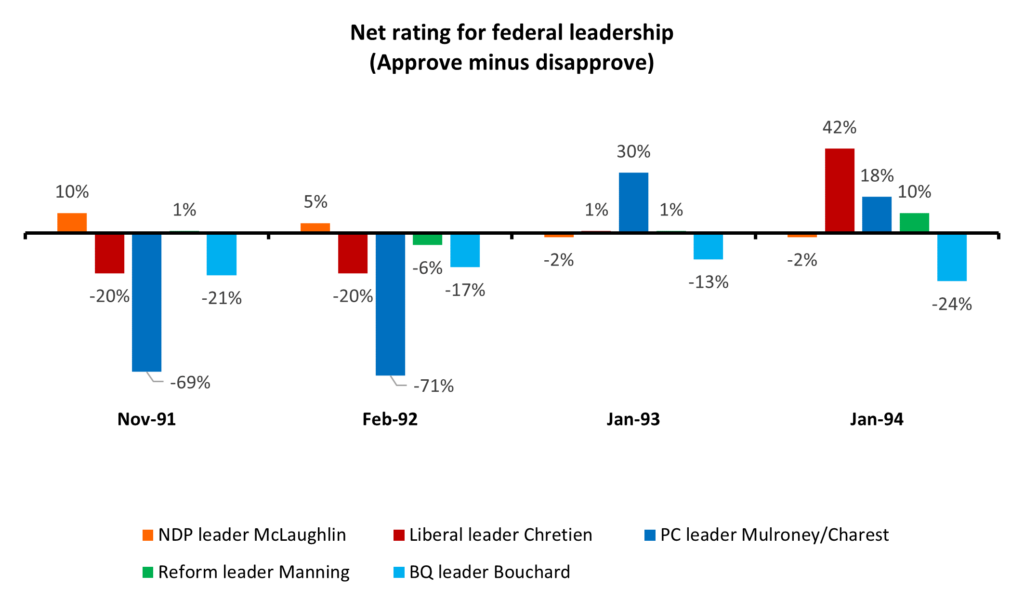
All told, Jean Chrétien maintained a strong approval rating for the majority of the decade, while both Alexa McDonough and Jean Charest posted positive marks as well. Despite historic disapproval levels for Mulroney, we still don’t find an era where all three of the major party leaders are deeply unpopular at the same time. In fact, while Reform Party leader Preston Manning and multiple Bloc leaders garner negative net ratings, the other big-three party leaders spend much of the second half of the decade in positive territory:

NDP – Mclaughlin 91 to 94, McDonough 95 to 99
PC – Mulroney 91 to 92, Campbell 93, Charest 94 to 99
BQ – Bouchard 91 to 95, Gauthier 96, Duceppe 97 to 99
The 2000s
The nation survived Y2K and entered a period of positivity toward federal leaders, driven by a young Stephen Harper’s early career popularity, the arrival of Jack Layton as NDP leader, and turmoil within the federal Liberal Party that leads to a cycling of leaders that whatever they thought of them, Canadians had little time to get to know. One major change in the first half of this decade was the uniting of the right. The merging of the Alliance and Progressive Conservatives repaired what had been a challenging fracture for the nation’s conservative movement and set the stage for Stephen Harper’s ascension in 2006.

The early Harper years saw the Liberals struggle to find a leader to stick, Jack Layton enjoying comfortable popularity, and Harper himself enjoying more approval than disapproval to round out the aughts: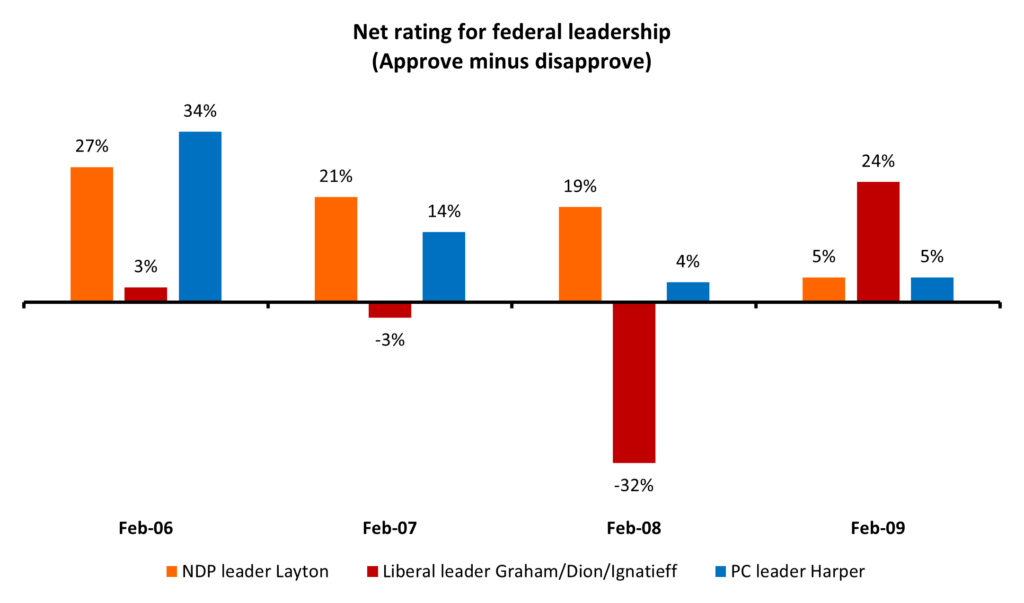
NDP – McDonough 01, Layton 03 to 09
Liberal – Chretien 01 to 03, Martin 04 to 05, Graham 06, Dion 07 to 08, Ignatieff 09
PC – Clark 01 to 03, Harper 04 to 09
Alliance – Day 01, Harper 03
The 2010s
This is the era where contenders for the least popular leadership group in the past 50 years emerge. Michael Ignatieff, the Liberal leader at the start of the decade, experienced a dramatic fall from grace between 2010 and 2011, registering a plus 24 rating in the former and a minus 37 in the latter. Ignatieff was the target of an extremely effective campaign from the CPC, which stated “he didn’t come back for you” and noted Ignatieff’s decades living in the United States and Europe. That year, 2011, is among the foremost contenders for “least popular leader year”, as all three major party leaders posted negative net ratings. This is where we have to rely on our definition, the year that the most leaders were the most unpopular. Jack Layton’s minus 5 is a poor rating, but not critical enough to help this year earn the top (or bottom) spot.
In October 2013, then-Prime Minister Stephen Harper registered among his lowest ratings of all, scoring a negative 62, but the NDP leader at the time, Tom Mulcair, managed a plus 1, so we can’t call this an all-time low year either.

The second Prime Minister Trudeau enjoyed a comfortable honeymoon period, with a net rating in the positive from 2016 to 2018, while the CPC moved on from Stephen Harper to Andrew Scheer, with disappointing results. December 2019 once again sees all three leaders below even, but it gets worse.

The 2020s
Alas, we come to the 2020s, and the answer to our question. Our leaders have never been less popular than… the last time we measured them in April 2024. We’ve certainly had unpopular individual leaders, but this is the first time in 50 years of tracking that all three major federal party leaders have garnered net ratings of negative 12 or worse at the same time.
Making unfortunate history
So, what has caused this? Well, it appears that the NDP’s supply and confidence agreement with the deeply unpopular Liberal government has increased Jagmeet Singh’s profile and influence enough that he, too, is now garnering considerable criticism. Singh breaks even among women (43% favourable, 43% unfavourable) but is a negative 30 among men (detailed tables here). While continuing to uphold the minority government, this marks the first time that Singh has been lower than CPC and opposition leader Pierre Poilievre. The latter has taken an aggressive line against the government and aligned himself with a number of unpopular positions for many Canadians, which helps to explain why he scores negatively among both men (-3) and women (-19). Poilievre began his term as opposition leader with an unfavourable mark double that of Stephen Harper and has had difficulty overcoming it.
Prime Minister Trudeau scores his lowest rating in his run as Liberal leader in April, with just 28 per cent approval. What these historic data show is usually the decline of one federal leader engendering the rise in favourability for an alternative, see the elder Trudeau’s fall and the corresponding rise of Brian Mulroney. Our fractured and divisive politics, however, appear to have created an era where all leaders can remain under water at the same time. Evidently a falling tide lowers all boats.
Perhaps a leader that Canadians can truly capture the hearts and minds of Canadians is not in the card for this election cycle. Time will tell. We will keep tracking the data.
For data from each decade, click the links below:
MEDIA CONTACTS:
Shachi Kurl, President: 604.908.1693 shachi.kurl@angusreid.org @shachikurl
Dave Korzinski, Research Director: 250.899.0821 dave.korzinski@angusreid.org
Image Credit – Facebook (Poilievre, Singh, Trudeau)