


About ARI
The Angus Reid Institute (ARI) was founded in October 2014 by pollster and sociologist, Dr. Angus Reid. ARI is a national, not-for-profit, non-partisan public opinion research foundation established to advance education by commissioning, conducting and disseminating to the public accessible and impartial statistical data, research and policy analysis on economics, political science, philanthropy, public administration, domestic and international affairs and other socio-economic issues of importance to Canada and its world.
Note: Because its small population precludes drawing discrete samples over multiple waves, data on Prince Edward Island is not released.
The Full Story
INDEX
Part One: Trump, the sequel
Canadians see negative effects for Canada’s economy, dollar and their own finances
Part Two: Tariffs, border demands and defence
Concern high over impact of tariffs
Majority believe Canada ‘needs to do more’ to secure U.S. border
Most want to hit NATO defence spending target and faster
Part Three: Can Trudeau handle Trump?
Majority ‘not confident’ in Trudeau government to deal with Trump admin
Vote intention stable with big CPC lead
Part Four: Canada as the 51st U.S. State?
That’s a hard no
Part One: Trump, the sequel
Canadians’ professed fears have turned into reality. In July, two-thirds told the Angus Reid Institute that they worried a second Donald Trump presidential term would be bad news for Canada, especially when it comes to Canada’s economy. Trump is now president-elect after winning the November election and has immediately threatened to upset decades worth of free trade between Canada and the U.S. with a 25 per cent tariff on all goods flowing into the country if Canada does not do more to secure its border.
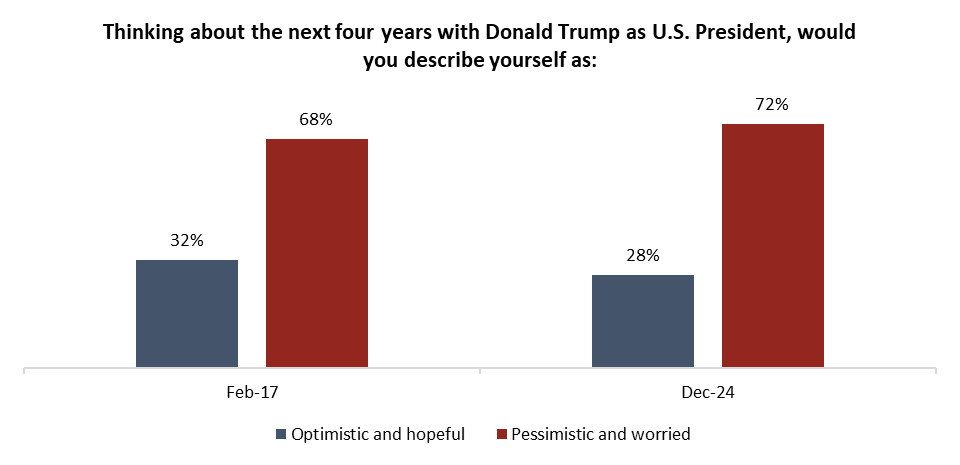
Meanwhile, most (72%) in Canada describe themselves as “pessimistic and worried” about what a second Trump term will bring. However, this sentiment is not unprecedented. Seven years ago, at the dawn of Trump’s first term, a similar number (68%) said they were concerned with how it would play out:
Canadians see negative effects for Canada’s economy, dollar and their own finances
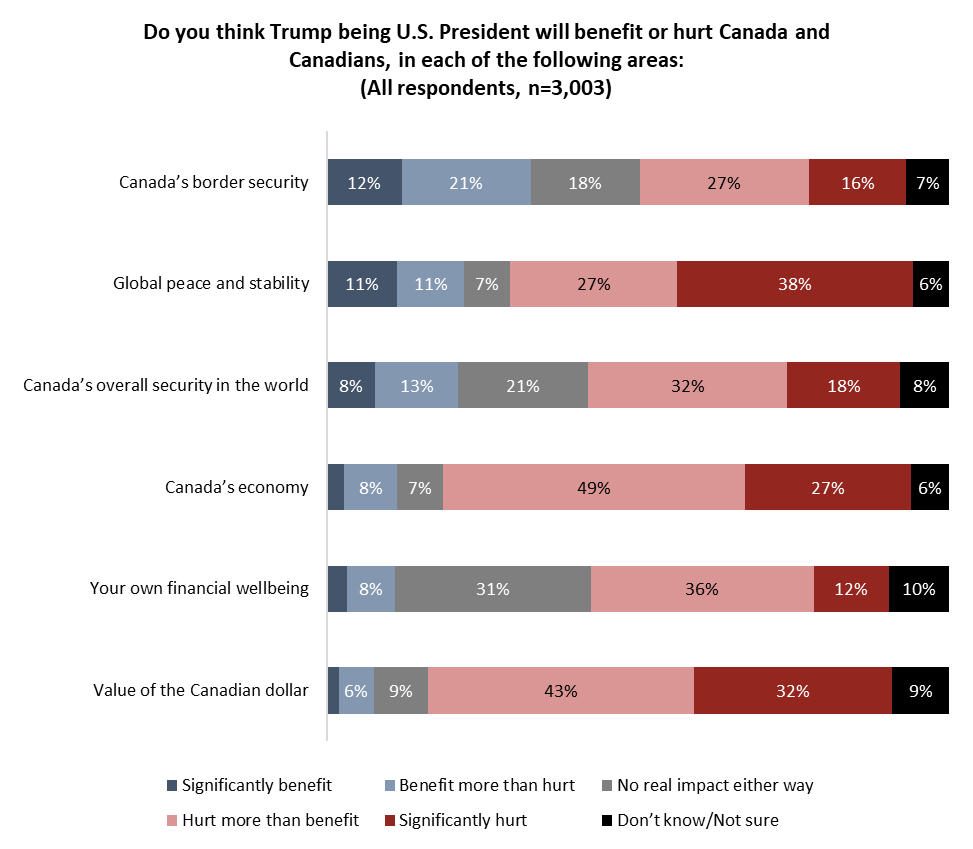
The concern for Canadians appears to be rooted in the economic ramifications of Trump’s policies. Three-quarters believe the coming Trump years will “hurt” the Canadian dollar (74%) and Canada’s economy (75%). Half (48%) say Trump will do damage to their own personal finances.
As Trump demands action at the Canada-U.S. border, there are one-third (33%) who believe his presidency will benefit Canada’s border security, but they are still outnumbered by the two-in-five (43%) who believe it will have a detrimental effect. Some experts have expressed concerns that Trump’s plan to deport millions of undocumented immigrants could result in a surge of migrants into Canada.
Part Two: Tariffs and the border
Concern high over impact of tariffs
Trump is still more than a month from taking office, but has already made shockwaves by reiterating his plan to slap tariffs on goods incoming to the United States first expressed during his presidential campaign. Canada exports over $400 billion goods to the United States annually. The U.S. is Canada’s top trading partner, while Canada swaps with Mexico for the top spot for the U.S. depending on the year.
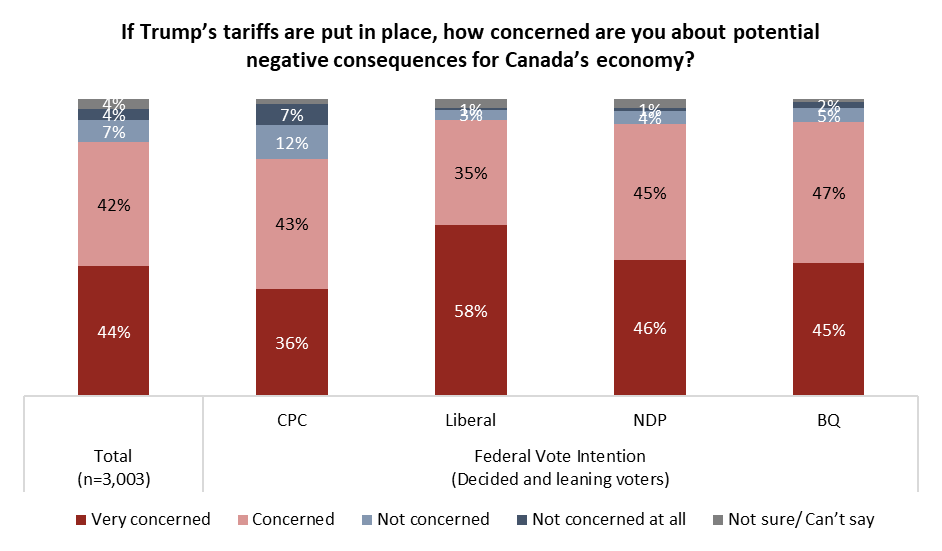
More than four-in-five (86%) say they are concerned Trump’s tariffs will have a negative effect on the Canadian economy – a fear echoed by economists and those working in automobile manufacturing, the oil industry and agriculture.
Majority believe Canada ‘needs to do more’ to secure U.S. border
Trump’s primary issue is the flow of drugs and undocumented immigrants across the Canada-U.S. border. Canadian officials have been quick to point out that nearly all of the fentanyl seized by U.S. authorities comes from Mexico, and that irregular border crossings on the northern border are a fraction of those on the southern one.
Still, Trump’s point apparently resonates with a majority (54%) of Canadians, who believe “Canada needs to do more to secure its border with the U.S.” Notably, this sentiment is highest in Quebec (59%), which was home to Roxham Road, an unofficial border crossing used by nearly 100,000 irregular asylum seekers to cross into Canada until its closure in 2023.
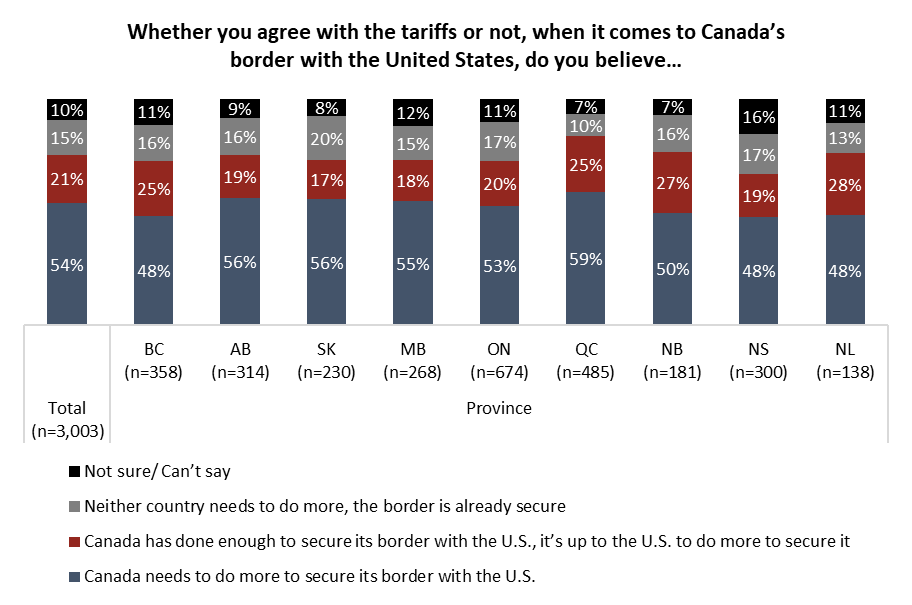
Note: Because its small population precludes drawing discrete samples over multiple waves, data on Prince Edward Island is not released.
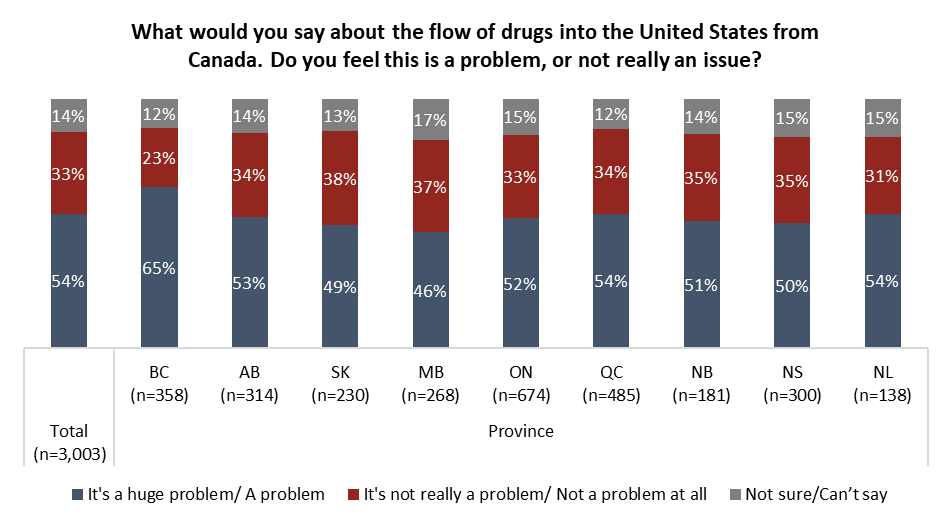
U.S. Customs and Border Protection recently told CTV it had seized 43 lbs of fentanyl at the Canada-U.S. border in the past year, while it stopped more than 21,000 lbs at the U.S.-Mexico border in the same time frame. However, a majority (54%) of Canadians believe the flow of drugs from Canada to the U.S. actually is a problem, with one-in-five (22%) describing it as “a huge” one.
Two-thirds (65%) in B.C. believe the drug trade is a problem at the U.S. border. Illicit drugs and the failure of an experiment with drug decriminalization was a central issue during that province’s recent election. There has also been evidence of fentanyl production in the province, with Burnaby RCMP recently dismantling a so-called drug manufacturing “super lab” in Langley which could produce multiple kilograms of fentanyl on a weekly basis.
Most want to hit NATO target, say Canada is moving too slowly
Another Trump beef may be on the backburner but continues to sizzle – Canada’s defence spending. The incoming U.S. president has been quieter on the issue since the election but previously threatened to not defend countries who weren’t spending on defence. Canada Defence Minister Bill Blair said at the recent Halifax International Security Forum that his country will reach by 2032 the North Atlantic Treaty Organization (NATO) target of spending two per cent of GDP on defence – and that it could happen sooner than later.
But it may not be enough. Republican lawmakers have accused Canada of “freeloading”, and say that Trump expects Canada to spend on defence quicker.
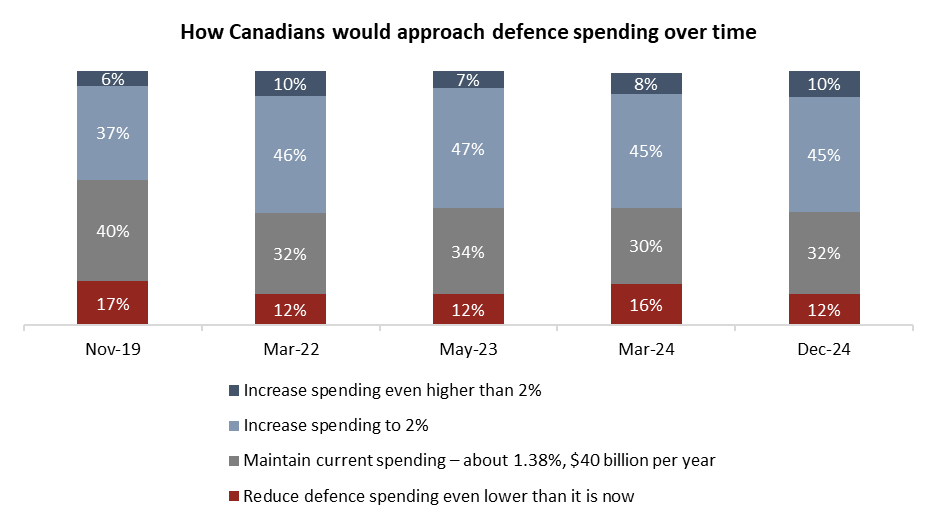
Public opinion on the subject has changed little in the more than two years since Russia invaded Ukraine. A majority of Canadians support Canada spending to the NATO target, which according to the Parliamentary Budget Officer would take Canada doubling its military spending by 2032.
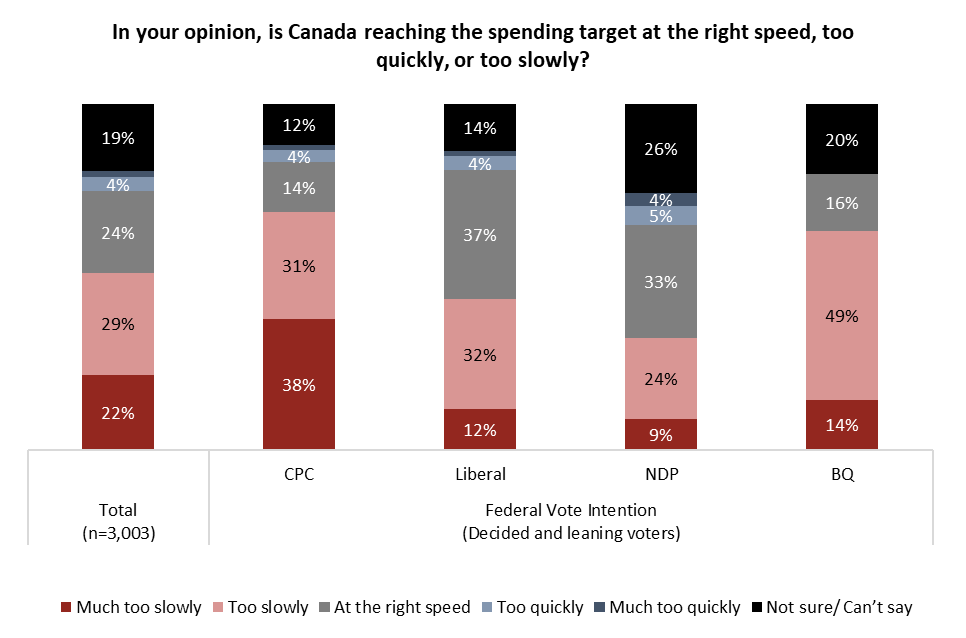
Half (51%) of Canadians say that Canada is moving too slowly to the target. That belief is highest among those who say they would vote Conservative if an election were held today, which is notable as CPC leader Pierre Poilievre has said that he would “work towards” the target but has not committed to spending up to it and offered no timeline for increased spending citing concerns around the state of the federal budget.
Part Three: Can Trudeau handle Trump?
Prime Minister Justin Trudeau holds the distinction of being the first G7 leader to meet with President-elect Trump since his victory on Nov. 5. Trudeau flew to Mar-a-Lago last week and reportedly had a “productive” conversation about tariffs, border security, and a wide range of topics.
Majority ‘not confident’ in Trudeau government to deal with Trump admin
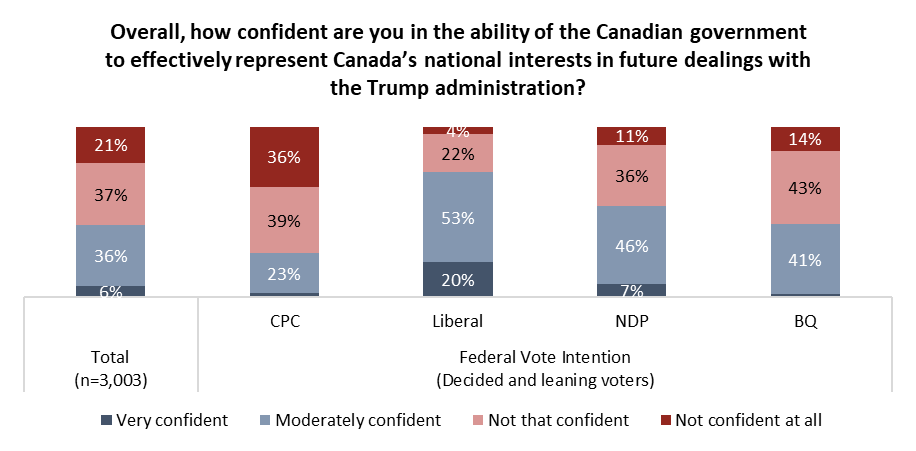
Canadians are approaching this second term of (at least initially) Trudeau and Trump working together with less confidence than they offered the federal government in 2017. At that time three-in-five had confidence in Trudeau and his team to represent Canada’s interests; that number has fallen to 42 per cent.
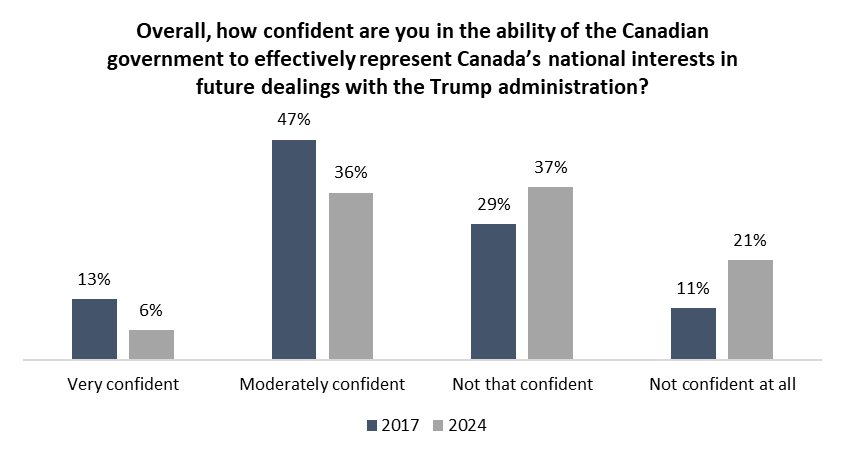
Trudeau’s voter base, though much smaller now than it was in 2017, remains relatively confident in his and his government’s capacity to deal with Trump (73%). He also receives slight majority confidence from those who would support the NDP if an election were held (53%). Among would-be Conservatives, three-quarters (75%) lack confidence and one-quarter (25%) hold it:
CPC lead by 23 points; Liberals and NDP tied with each other
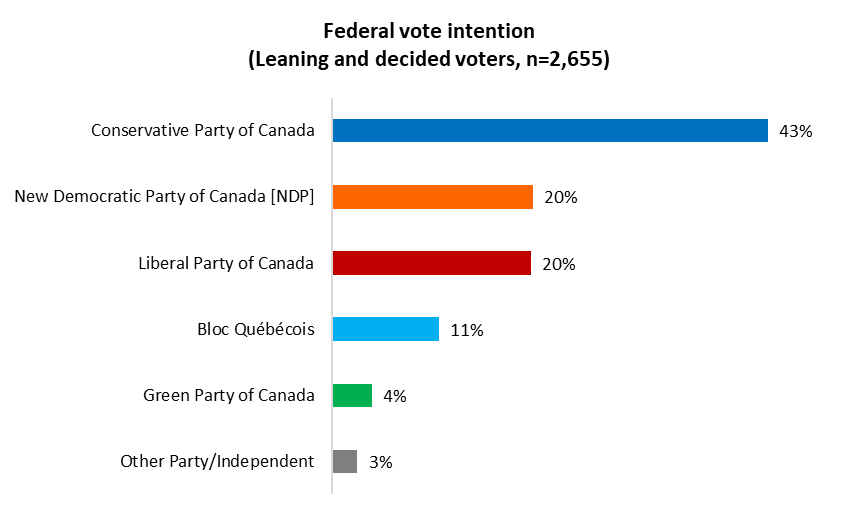
While Trudeau will begin Trump’s term as prime minister, election forecasting would suggest his time representing Canada at the table may be brief. Currently, the Conservative Party doubles both the New Democrats and the Liberals in vote intention:
Part Four: Canada as the 51st U.S. State?
That’s a hard no
The kerfuffle over tariffs led to Trump “joking” at Mar-a-Lago to Trudeau’s face that if Canada can’t handle the 25 per cent tax it should join the U.S. as that country’s 51st state. This apparently was a regular tactic employed by Trump against Trudeau during his first term. Trump then followed the quip by posting an AI-generated picture of himself on a Swiss mountain with the Canadian flag on his Truth social account.
Joking or not, Trump’s comments are landing with a thud on this side of the border. The question of attachment to Canada and whether people in this country see themselves better off with a merger is one that has punctured the national discourse of both nations for more than a century. U.S. Democratic nominee James Polk won the 1848 election on the expansionist rallying cry “Fifty-four Forty or Fight!” Exactly 140 years later, many Canadians agonized over the 1988 general election and worries a free trade pact with the U.S. would “erase” the Canadian border.
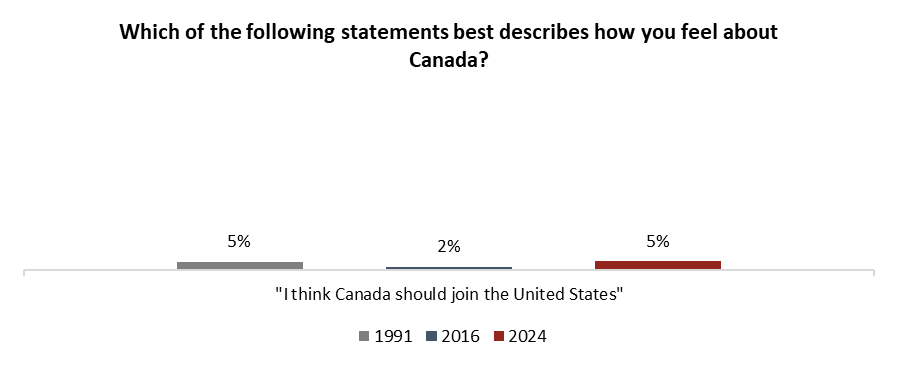
It’s an issue Angus Reid has been asking Canadians to weigh in on for more than thirty years. But rather than profess a hearty appetite for a continental merger (excluding Mexico), people in this country have consistently expressed a revulsion to the possibility. While Trump may consider himself a master dealmaker, officials dismiss his blue-skying (well, not that verb) as “teasing”. Whatever his intent, it appears to be a non-starter among Canadians. Today, just five per cent say an acquisition by our southern neighbour best describes how they feel about Canada and its future.
Survey Methodology
The Angus Reid Institute conducted an online survey from Nov. 29 to Dec. 2, 2024 among a representative randomized sample of 3,003 Canadian adults who are members of Angus Reid Forum. For comparison purposes only, a probability sample of this size would carry a margin of error of +/- 1.5 percentage points, 19 times out of 20. Discrepancies in or between totals are due to rounding. The survey was self-commissioned and paid for by ARI.
For detailed results by age, gender, region, education, and other demographics, click here.
For full release, click here.
For questionnaire, click here.
MEDIA CONTACT:
Shachi Kurl, President: 604.908.1693 shachi.kurl@angusreid.org
Dave Korzinski, Research Director: 250.899.0821 dave.korzinski@angusreid.org