


Majority of lower-income households say it’s difficult to put food on the table, with prices expected to rise
December 10, 2025 – Trees all around the country are being lit and the holiday rush is upon us. But new data from the non-profit Angus Reid Institute finds the festive feeling likely a touch brighter for some than others.
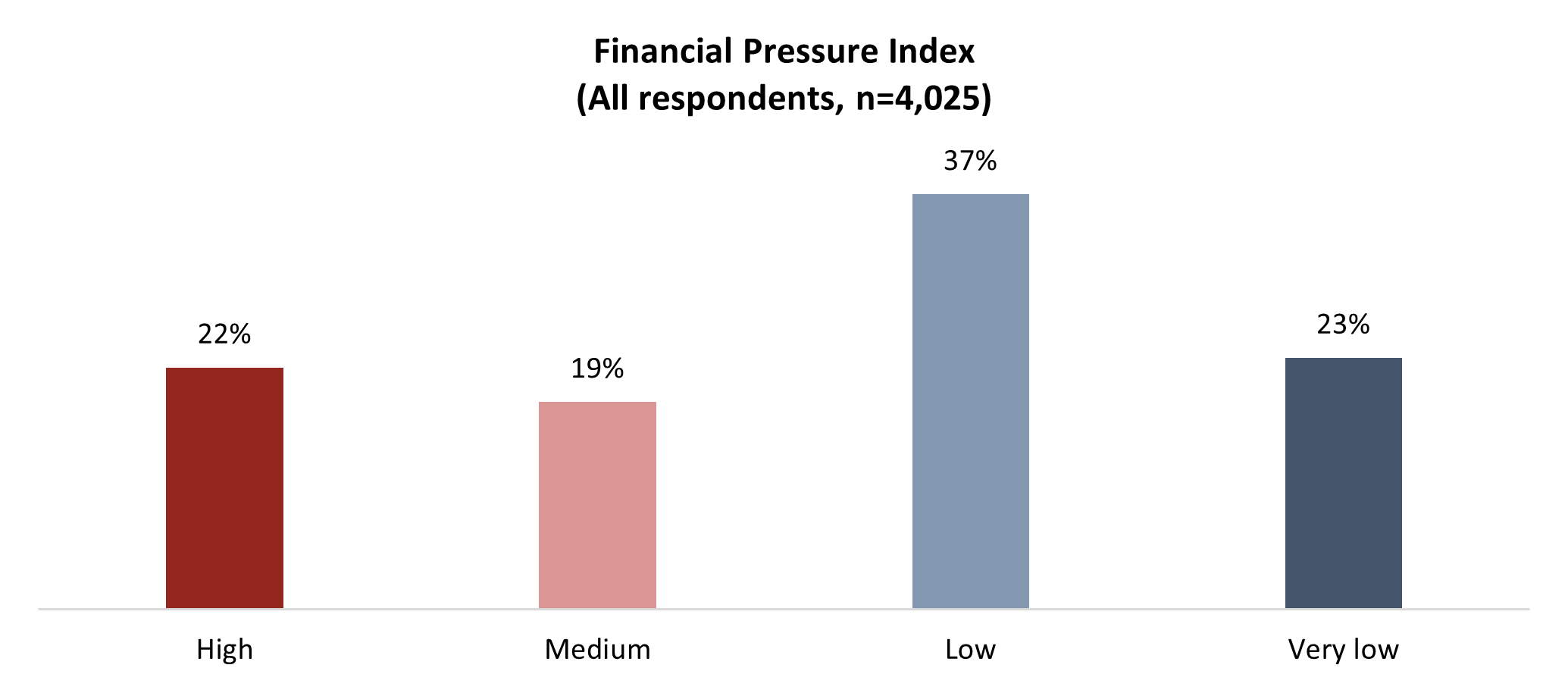
Much like Santa in a snowstorm, many Canadians are facing a high level of pressure this Christmas. One-in-five score as a “high” on ARI’s Financial Pressure Index, which measures their economic reality and outlook on eight different variables. This group is defined by higher levels of job insecurity, difficulty putting food on the table, higher debt levels, and a generally pessimistic outlook on their finances. Troublingly, three-in-five among this worst-off group say they expect worse in 2026. Another one-in-five Canadians (19%) face medium pressure, highlighted by some of the same challenges as the “high” group, but fewer of them compounding on top of the others.
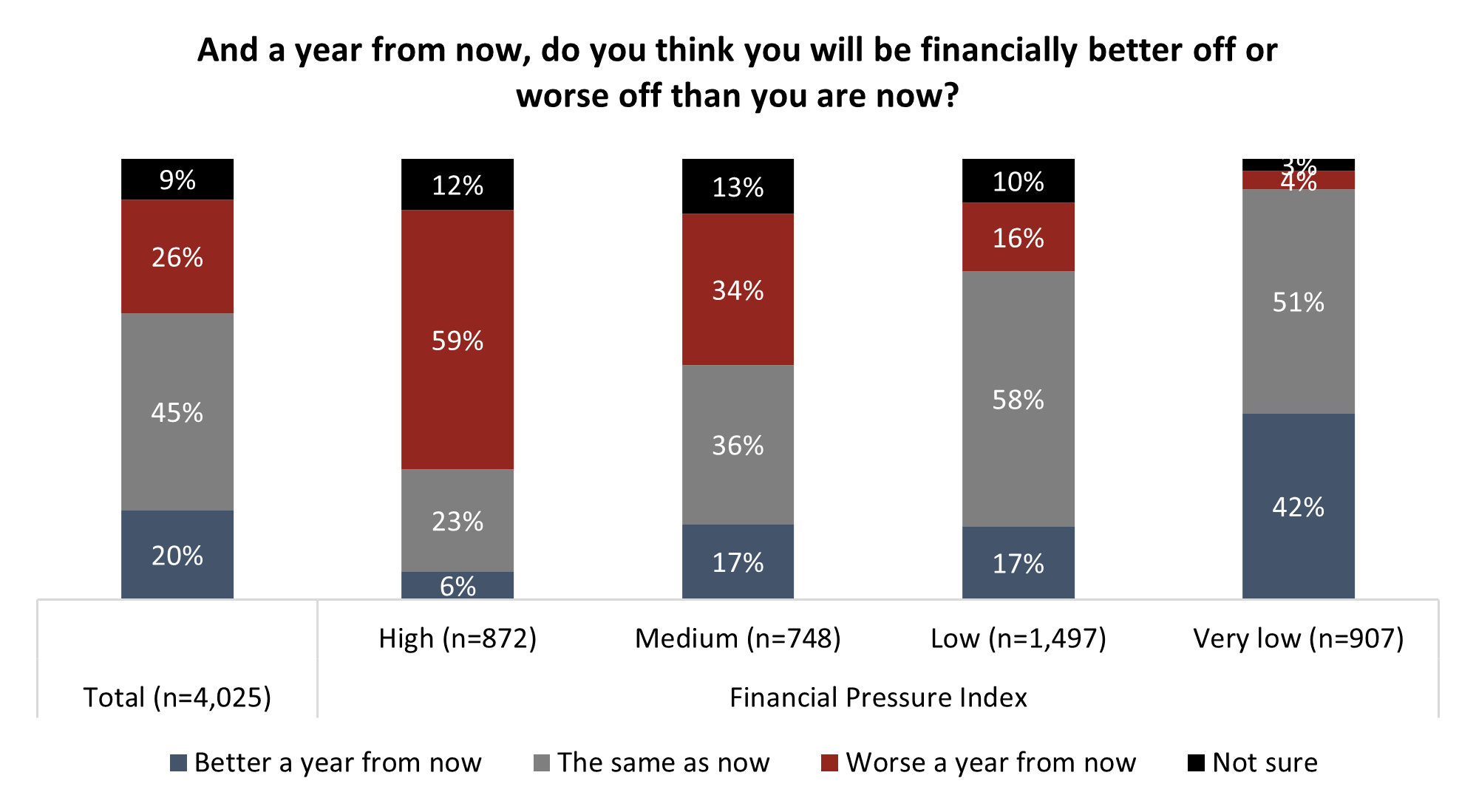
On the other end of the spectrum, those with “very low” financial pressure – 23 per cent of Canadians – expect either more of the same (51%) or improvement (42%) over the next year.
The largest group (37%) are those facing a low level of pressure. They have stable working lives, relatively stable outlooks for the coming year, and manageable (though not easy) housing payments – whether renting or paying a mortgage.
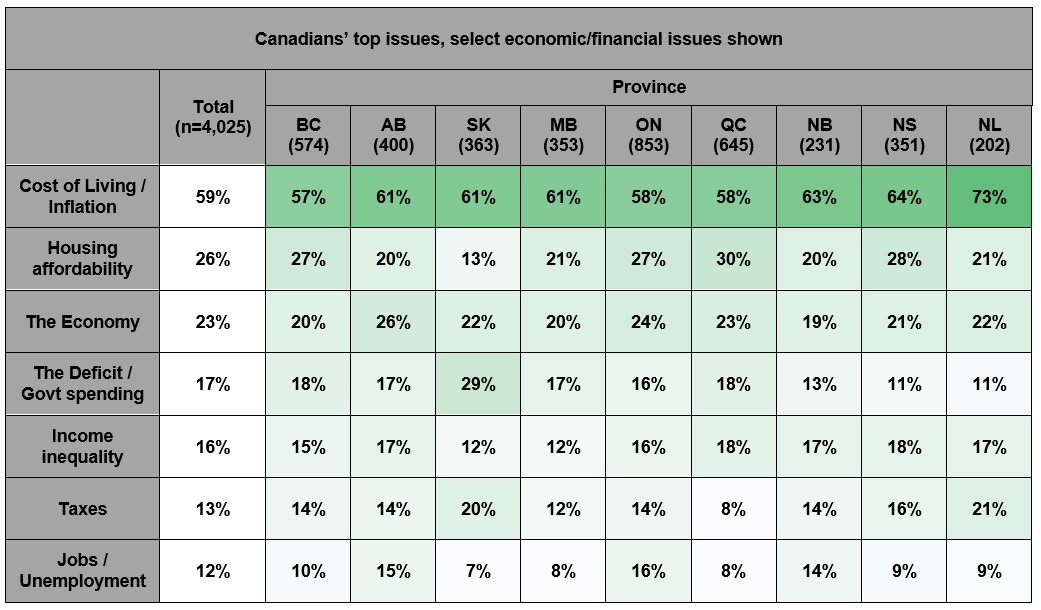
In a year full of tariff turmoil and economic anxiety, the cost of living continues to dominate the minds of Canadians heading into 2026. Three-in-five (59%) choose this as their top issue, well ahead of health care (41%), housing affordability (26%) and the economy (23%). With big plans announced by provincial and federal governments, including “major projects” and investments in housing, Canadians will be keen to see results that impact their own lives sooner than later.
More Key Findings:
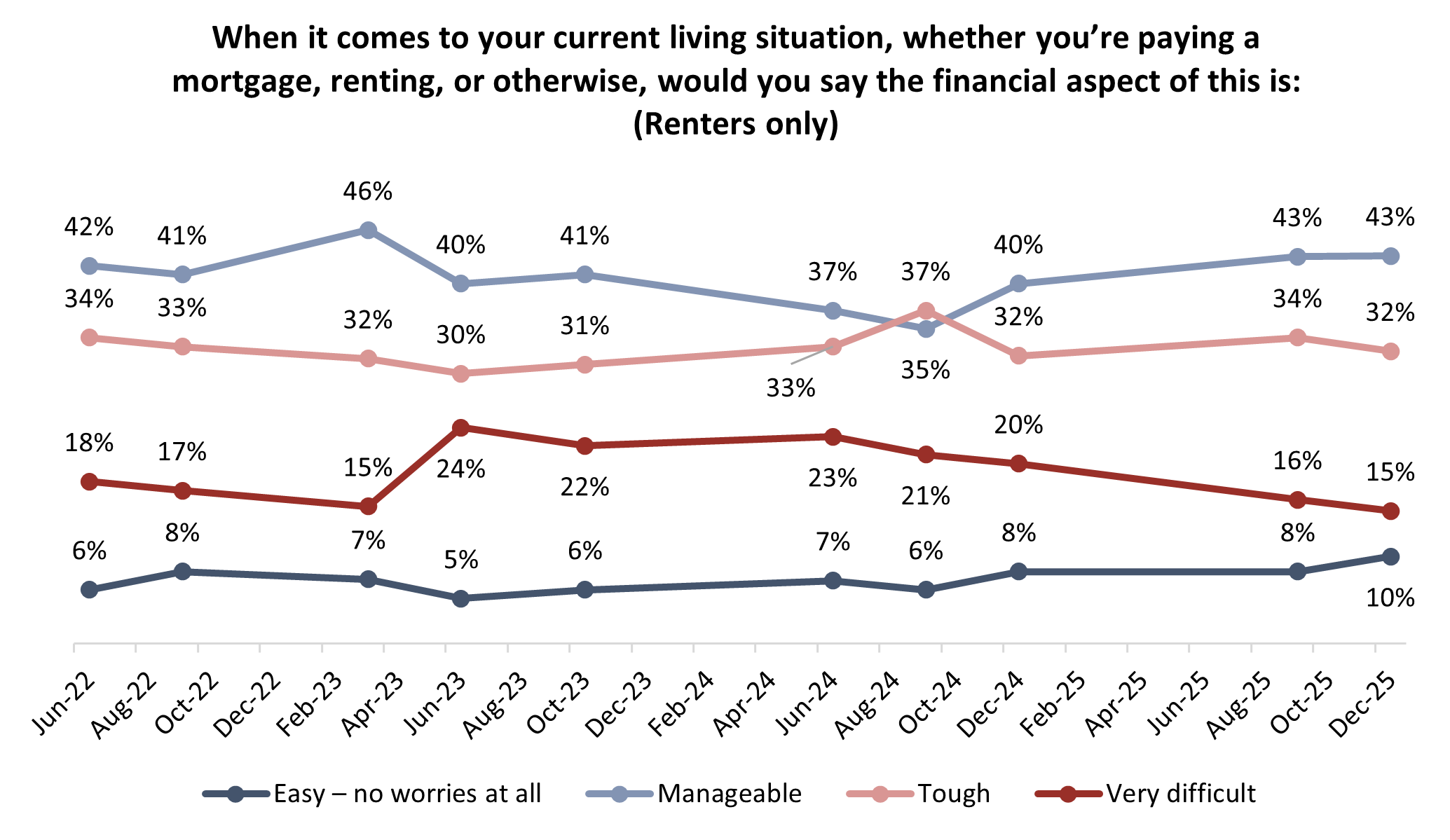
- Conditions for renters in Canada appear to be improving. In June 2024, one-quarter (23%) of renters said they found the cost of rent “very difficult” to accommodate. That has declined by eight points, with 15 per cent now saying this.
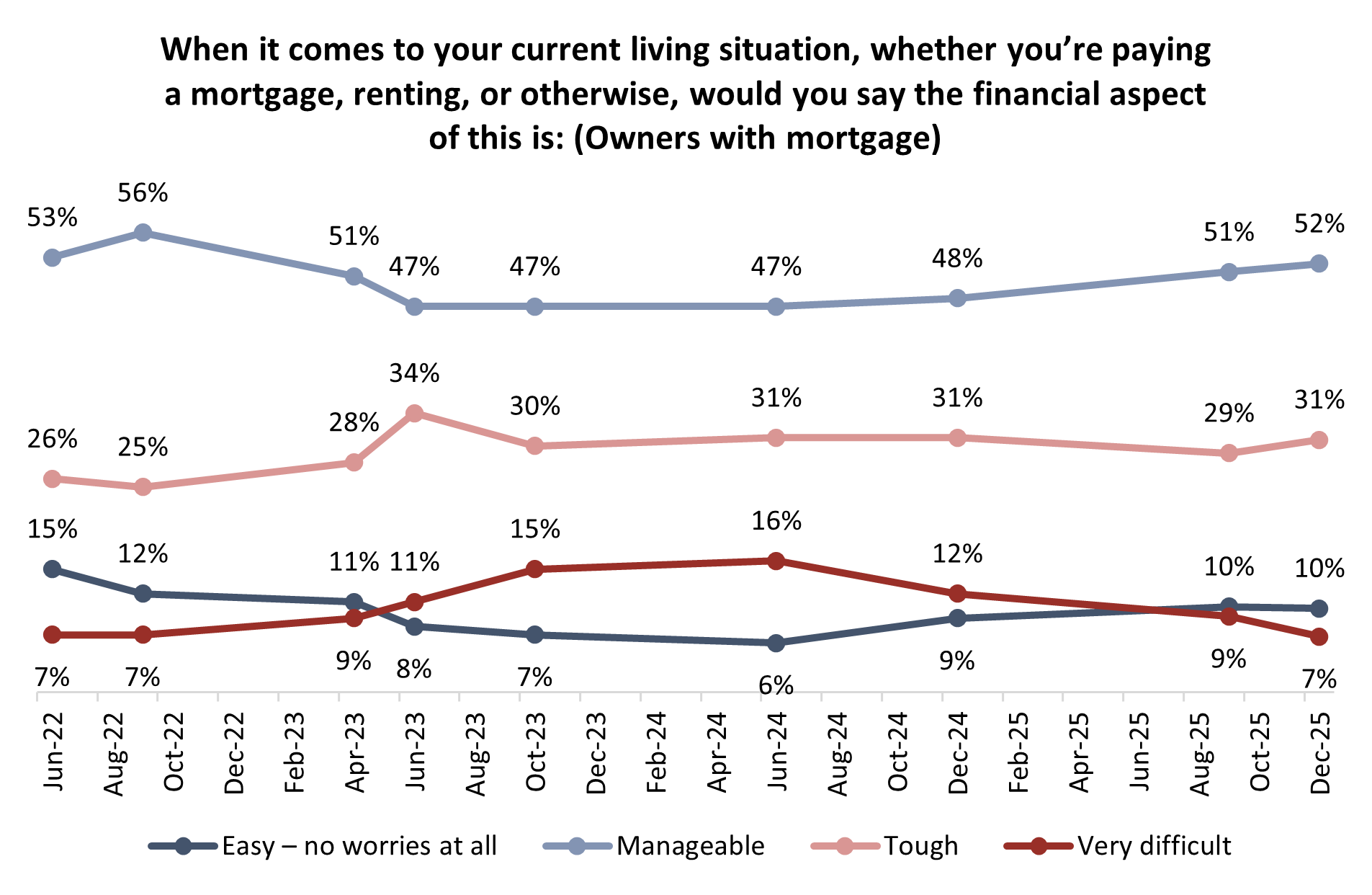
- Similar improvements are evident among mortgage holders. The proportion who say their mortgage is manageable or easy to keep up with has risen from 53 to 62 per cent since June 2024.
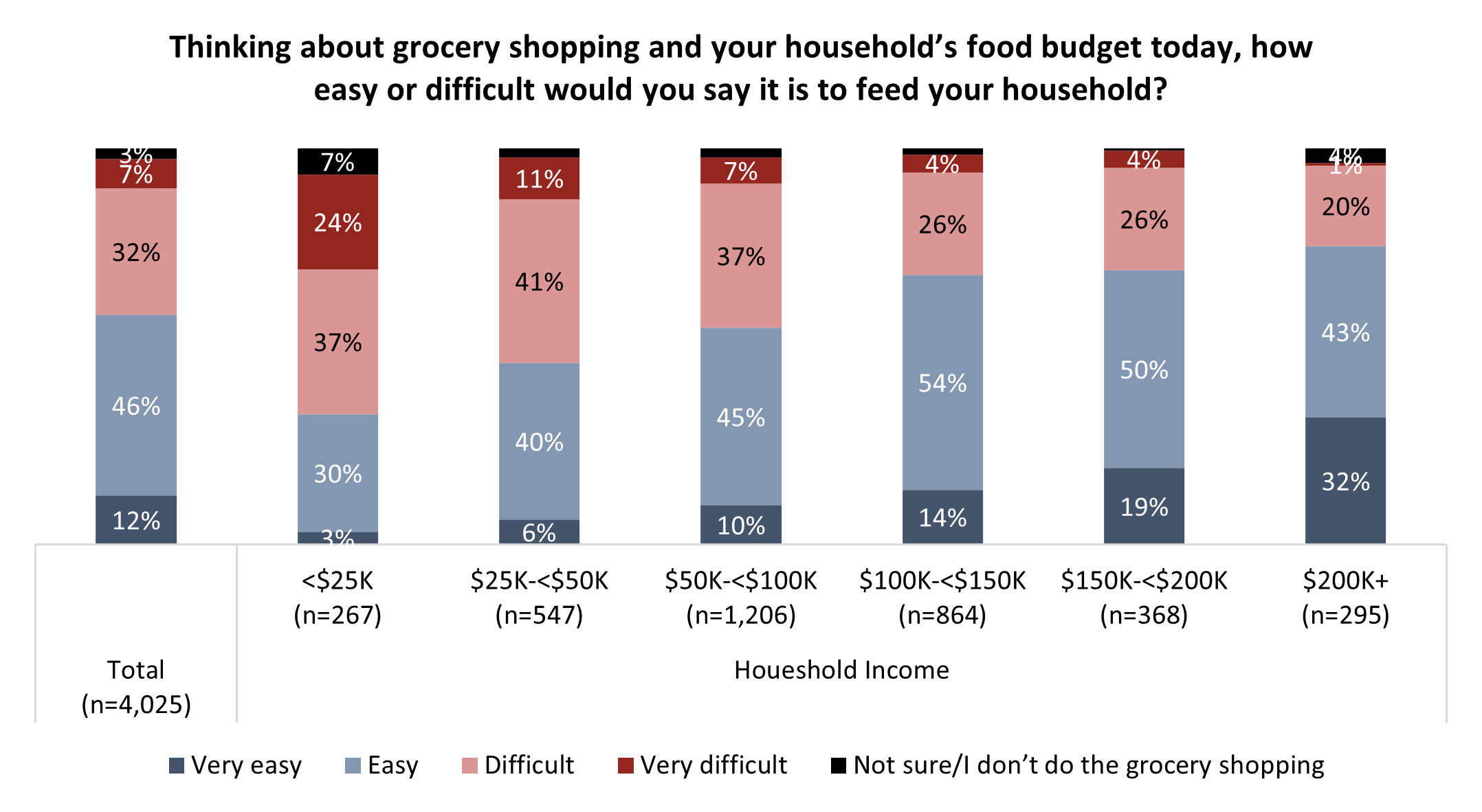
- Two-in-five Canadians (39%) say it is difficult to keep up with their household grocery bills. This rises to a majority among those whose household income is below $50,000 annually.
INDEX
Part One: Cost of living and “financial pressure
-
Top issues centre on cost-of-living
-
Financial Pressure Index
Part Two: Assessments of this year and hope for the next
-
One-third say they are ‘worse off’ than last year
-
One-quarter expect to be financially worse off next year
Part Three: Core economic indicators
-
Majority of low-income households say it’s ‘difficult’ to put food on the table
-
Debt a source of stress for three-in-five
-
Improving situations for renters and mortgage holders?
Part One: Cost of living and ‘financial pressure’
Top issues centre on cost-of-living
Canada’s inflation has slowed its pace considerably over the past two years compared to the highs of 2022 and 2023. In November, Statistics Canada’s headline inflation was 2.2 per cent year-on-year. Despite the pace of price acceleration slowing, Canadians are evidently still feeling the pinch of a high cost of living. Three-in-five (59%) select it as the top issue facing Canada, a proportion that has changed little even as inflation has slowed.
The price of food remains an area of key concern for both Canadians and policy makers. Even in a slowing inflation environment, the price of groceries has increased at a pace faster than overall inflation for nine consecutive months. The expectation is that Canadians won’t get relief on that front in 2026. A new report estimates food prices in the country will rise by four to six per cent, representing a near-$1,000 increase for a typical family of four. This suggests that concerns about the high cost of living may not be fading any time soon.
Meanwhile, one-quarter of Canadians worry over housing affordability (26%) and the economy (23%) more generally. The latter has become perhaps a greater focus after 12 months of economic upheaval caused by U.S. President Donald Trump and his tariffs. For now, although the U.S. has made plenty of noise about tariffs, 85 per cent of Canada’s trade with the U.S. is tariff free because of the Canada-U.S.-Mexico Agreement. That free trade pact is set to be reviewed trilaterally in the new year.
Across the country, concern over the high cost of living is shared, while there is less agreement on how pressing housing affordability is depending on the province:
Financial Pressure Index
Economic realities vary widely in Canada depending on a number of variables, from job security to housing affordability, to one’s own outlook on their financial health. To gauge these views, ARI created a Financial Pressure Index, which scores respondents on eight questions and sorts them into one of four groups based on the intensity of the financial pressure they face. Below are the overall group sizes:
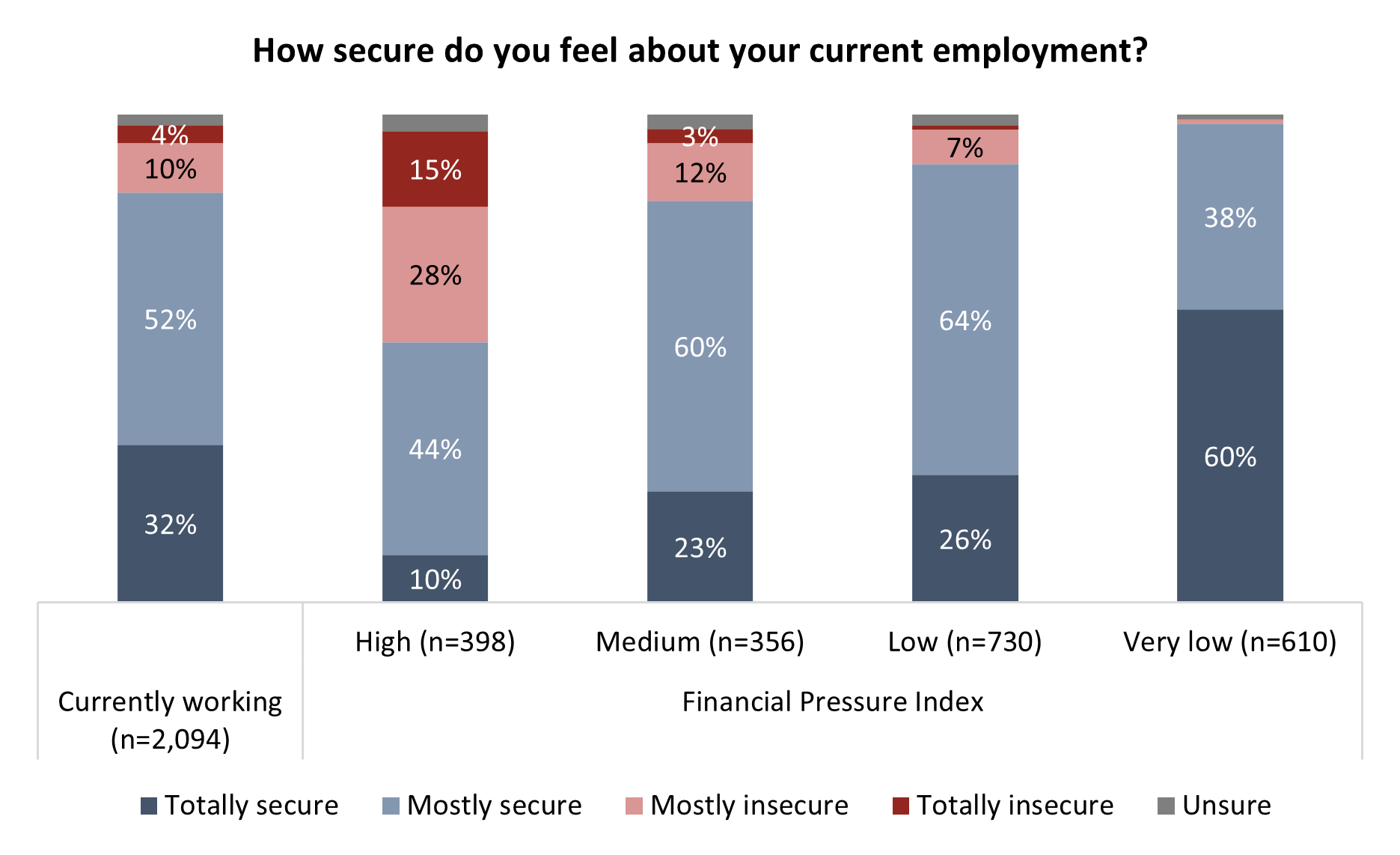
One of the key items on this index is how secure a person’s job feels. Among those with high pressure, only 10 per cent feel totally secure, while more than two-in-five feel insecure. For those with very low pressure, this simply isn’t a factor in their life.
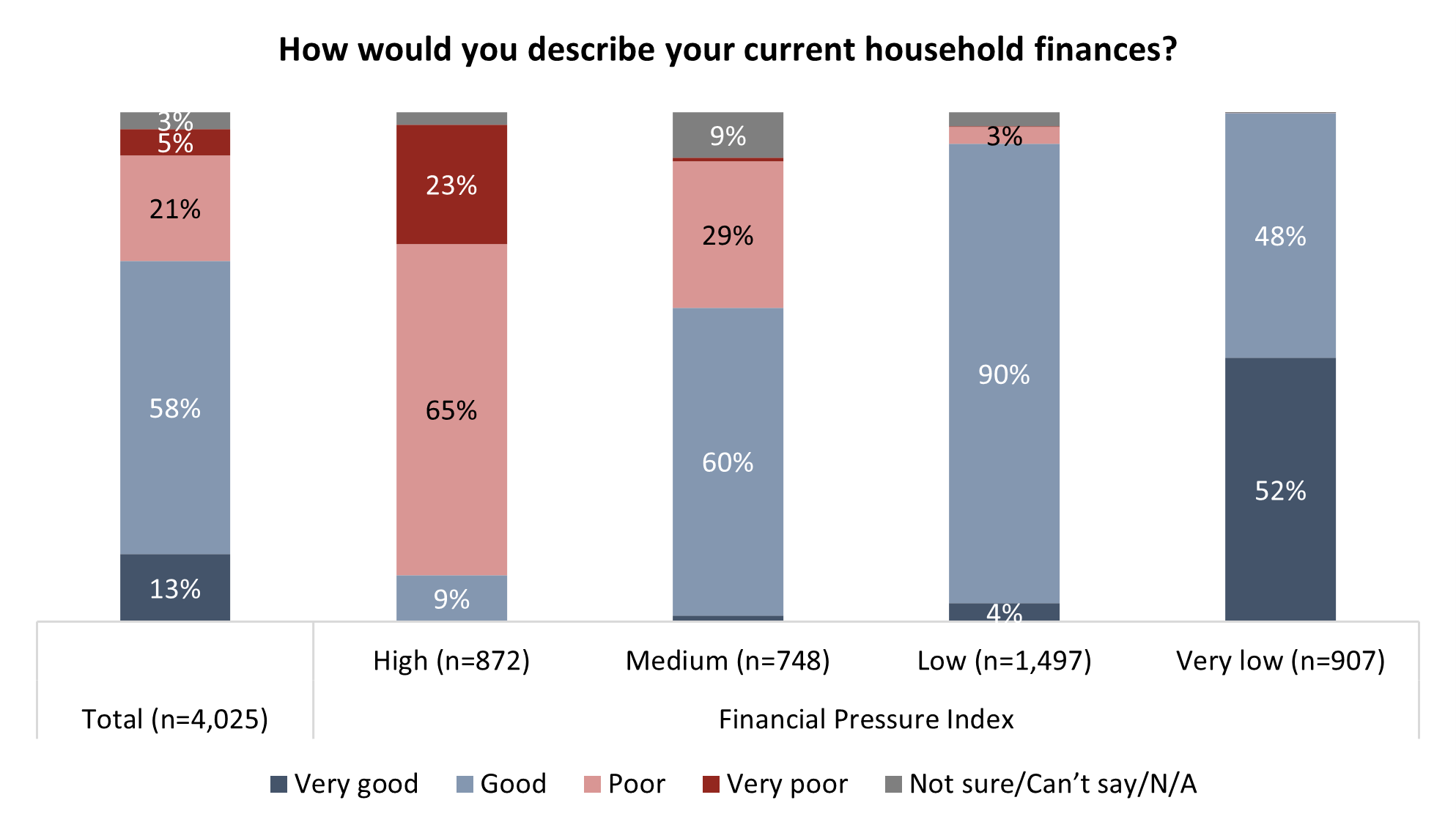
The same can be said of one’s own household finances. Each group has a different level of security that they self-profess, with that group of one-in-five high pressure individuals near unanimous in the belief that their finances are poor or very poor:
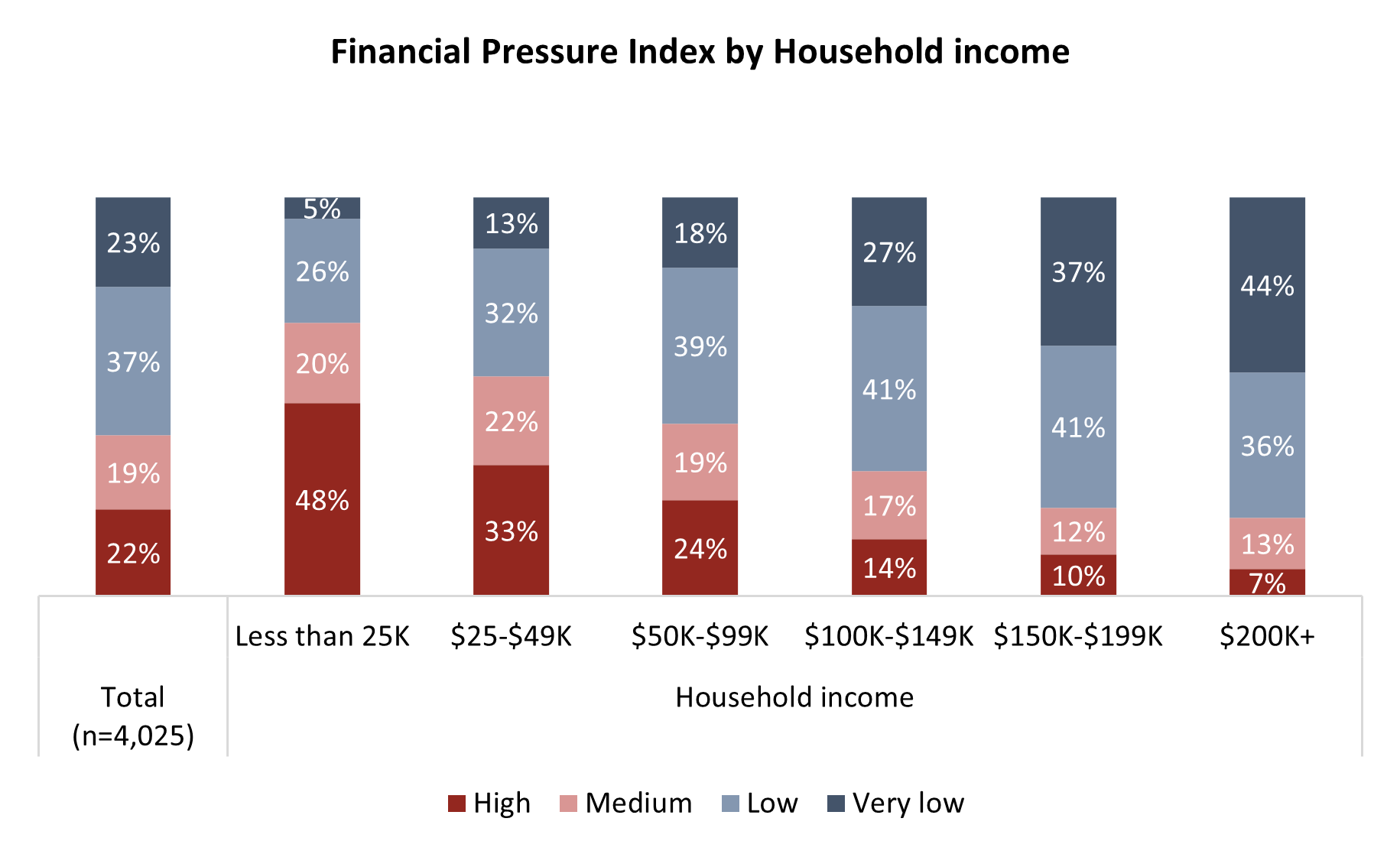
There is no group for which financial pressure is inescapable, but there are clear correlating factors. The starkest of which is household income level. For other demographics that play a role, including age, viewed detailed tables here.
Top issues for those facing higher levels of financial pressure tend to skew toward financial concerns like the cost of living, housing affordability, and jobs/unemployment:

Part Two: Assessments of this year and hope for the next
One-third say they are ‘worse off’ than last year
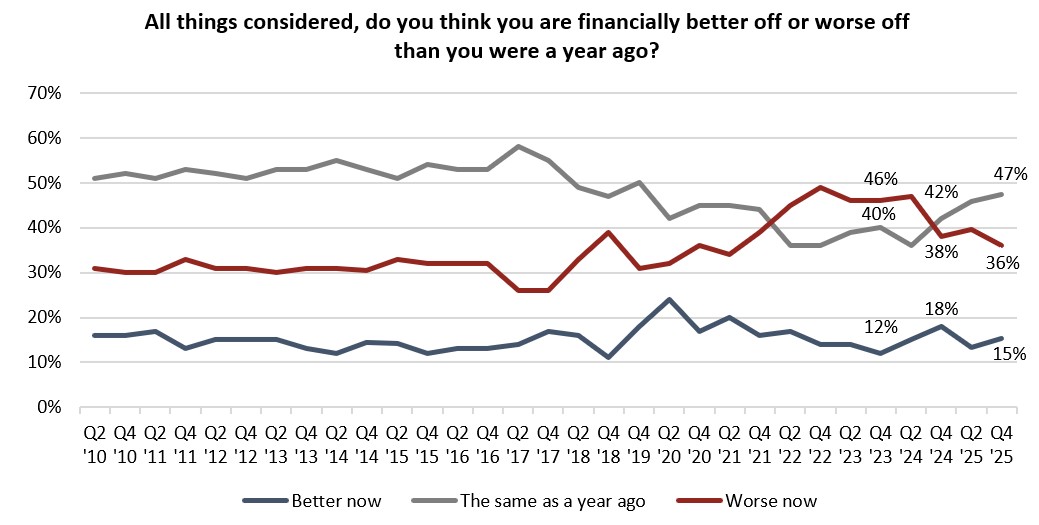
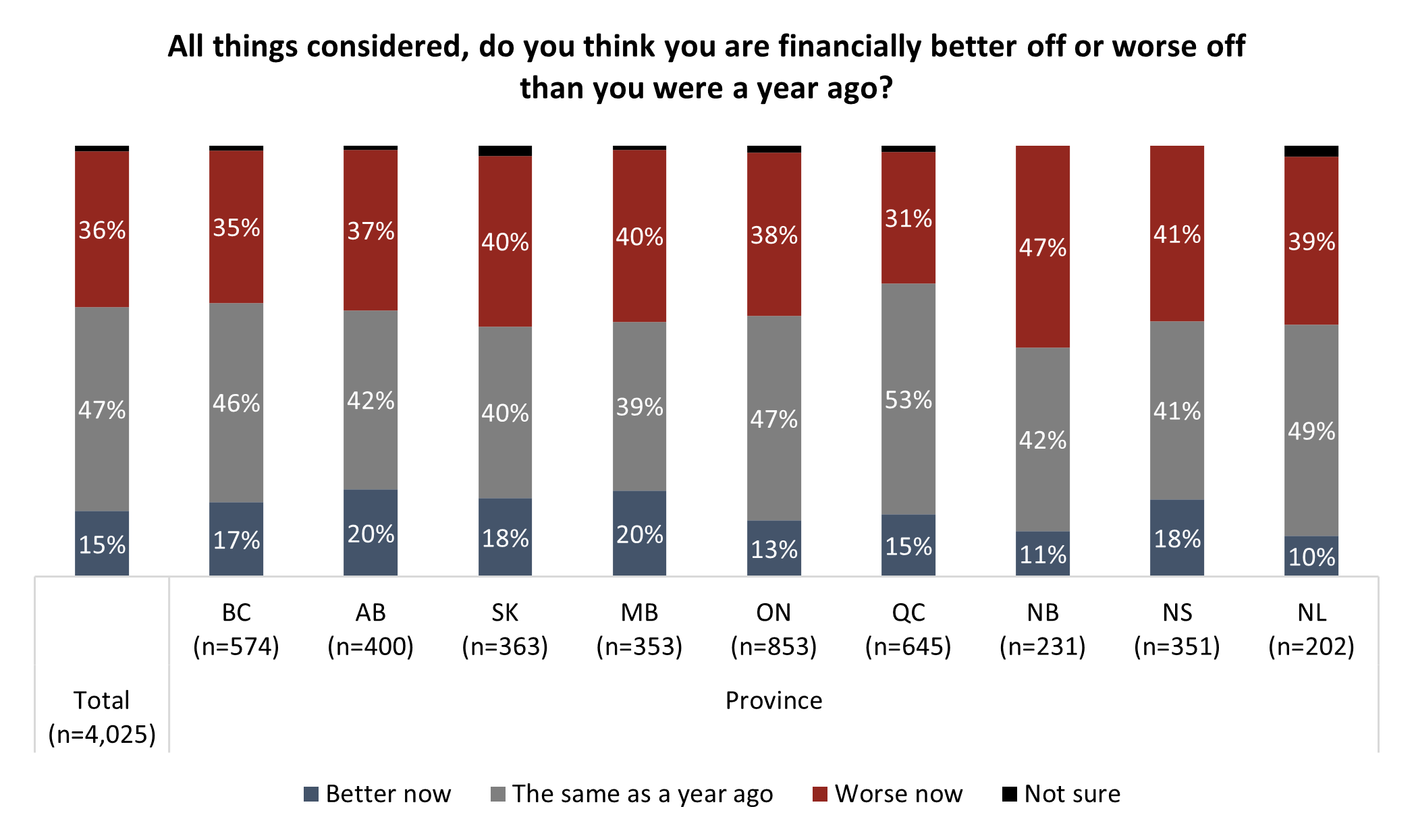
Angus Reid Institute has been tracking the economic perceptions of Canadians for more than a decade now. 2025 saw fewer Canadians saying they are worse off now than they were a year ago compared to 2024, but still a considerable portion (36%) holding this view. The largest group (47%) say they are in about the same place financially now as they were heading into last Christmas, while the smallest group (15%) are better off:
This ratio of better-same-worse holds relatively similarly across the country, though it is worth noting that the proportion of those saying they are worse off now is highest in New Brunswick at 47 per cent and lowest in Quebec at 31 per cent:
One-quarter expect to be financially worse off next year
After a year of economic turmoil, it is perhaps a small victory for Canadians that the proportion of those who say they will be worse off next year is back to the level it was during December 2024. This, after a five-point jump over the summer. One-in-five say they will be better off and 45 per cent expect no change:
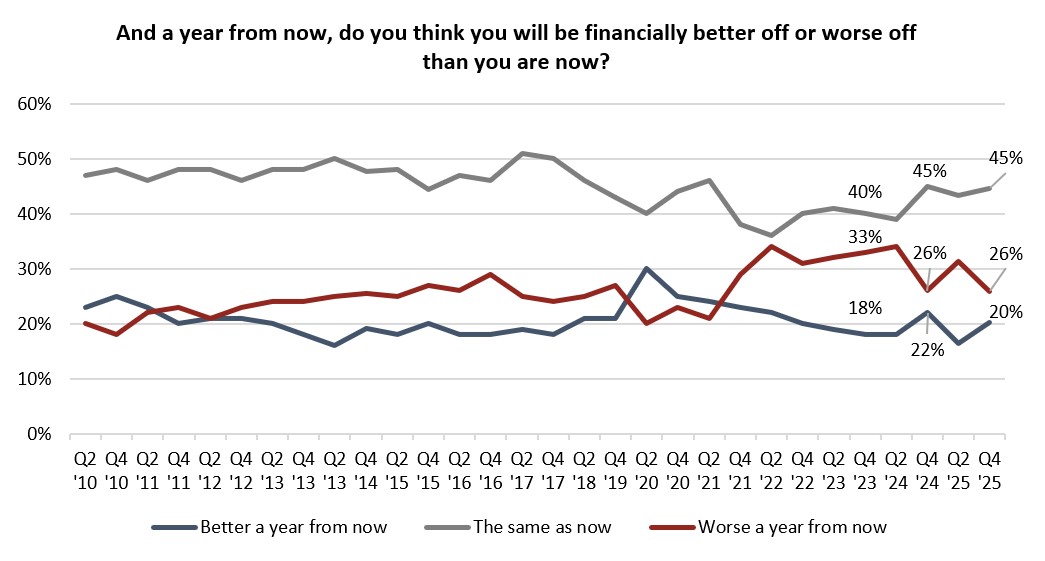
The hope for upward mobility eludes many of the worst off in Canada. Among those with high financial pressure currently, three-in-five (59%) say they expect it to be worse next year. Those with medium pressure are equally likely to say they’ll be worse off (34%) or about the same (36%) but few say their situation will improve (17%):
Part Three: Core economic indicators
Majority of low-income households say it’s ‘difficult’ to put food on the table
The challenges of grocery inflation are not a concern to three-in-five Canadians (58%) who say it is ‘easy’ to feed their household. However, that picture changes dramatically depending on the respondents’ household income. For those in the lowest income bracket, one-quarter (24%) say feeding their household is very difficult and more than a third (37%) describe it as just ‘difficult’.
Food Bank Canada’s Hunger in Canada report noted that there were 2.2 million food bank visits in March 2025, double the number there were in March 2019. With higher grocery prices expected in 2026, putting food on the table will continue to be an expensive proposition for many Canadians.
Debt a source of stress for three-in-five
The holiday season can be difficult for Canadians’ wallets, with gifts and holiday parties on the docket. At the same time, household debt continues to be a persistent issue for Canadians, who collectively hold $1.75 worth of it for every $1 of income. Canadians’ household debt relative to their income is the highest in the G7. It also continues to rise. In November, during Black Friday sales, the use of the “buy now pay later” option doubled from last year.
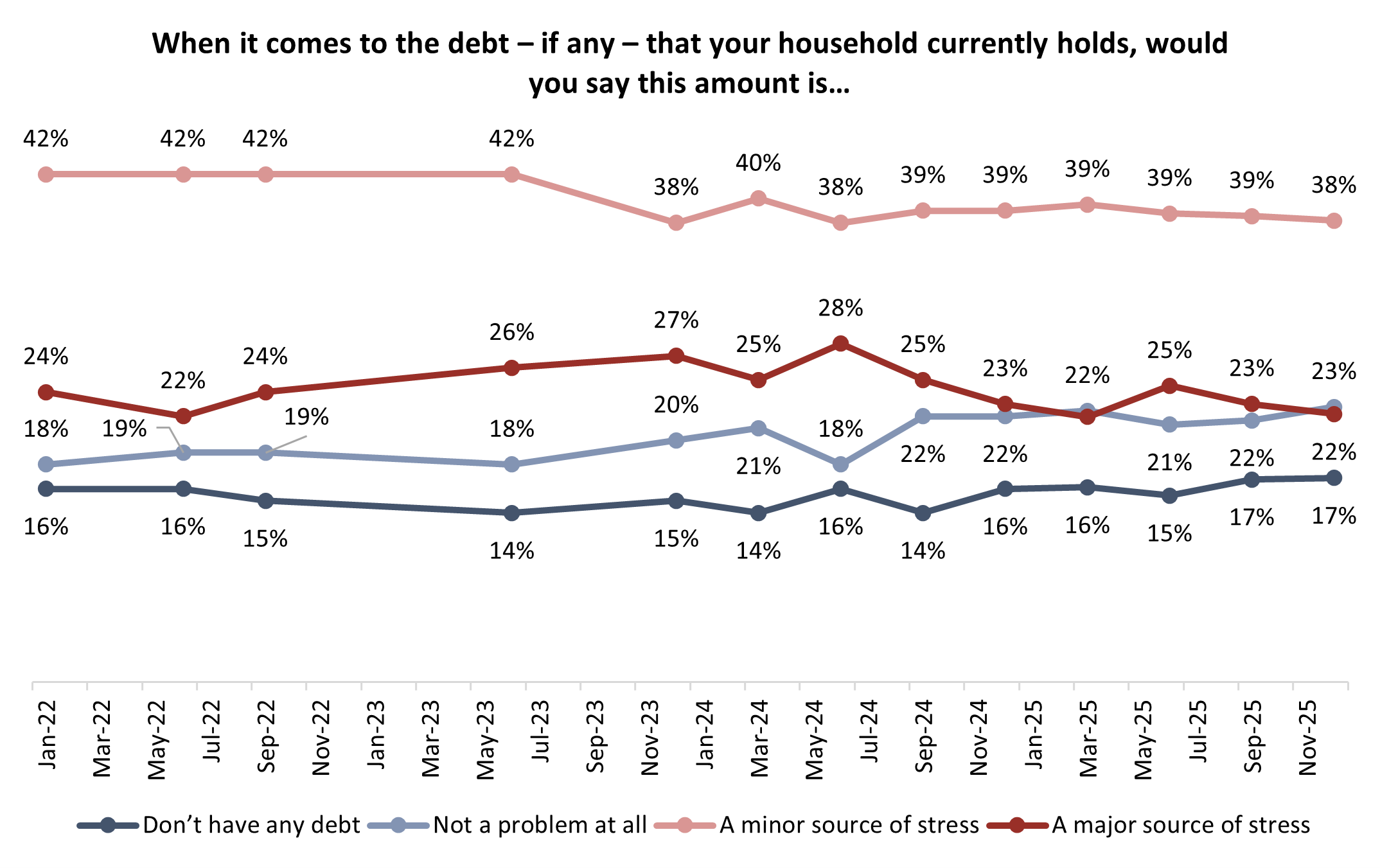
The percentage of Canadians who say they are stressed about their debt levels has been relatively stable since 2022. Three-in-five (60%) describe their debt as either a minor (38%) or major (22%) source of stress. For one-quarter (23%), they have debt but it’s not a problem, while one-in-five (17%) say they don’t have any debt:
Debt levels vary by province. Alberta and Newfoundland and Labrador are consistently the two provinces at the highest levels when it comes to consumer debt per household. Three-in-ten (30%) in Alberta describe their debt as a major source of stress, the most in the country, followed by those in Canada’s easternmost province (25%). One-quarter (24%) in Ontario also report high levels of stress from their debt:

Improving situations for renters and mortgage holders?
Although there remain lingering concerns over housing affordability in Canada, there has been improvements for renters in recent years. Rents fell year-over-year in December and the average rent in the country is now at the lowest level since June 2023. Some have pointed to Canada restricting the number of international student visas as one potential explanation for plummeting rent. There has also been a high number of purpose-built rentals coming into the market in Canada’s biggest cities.
In June 2023, one-quarter (24%) of renters said they found the cost of rent “very difficult” to accommodate. That has declined nine points, as half of renters (53%) now say they find their rent easy or manageable:
Mortgage holders too are facing a more friendly market in recent years as the Bank of Canada instituted a series of rate cuts. Interest rates were at their highest from July 2023 to May 2024. Since then, the BoC has cut its policy rate from five per cent to 2.25 per cent. But the days of rates cuts may be behind the BoC, as recent economic data has given the Bank plenty of reason to change tact.
Interest rates have improved for mortgage holders compared to 2023 and 2024 but are still above those seen during 2021 and early 2022. That matters because Canadian mortgages renew every five years, and those who locked into five-year fixed mortgages at the interest rate lows of the pandemic lending era now face renewal. These data will be a key economic indicator to watch next year as mortgage holders renew their pandemic-era loans.
For now, three-in-five (62%) of homeowners with mortgage describe the cost as easy (10%) or manageable (52%); two-in-five (38%) report more challenges.
In June 2024, when interest rates were still near the peak, one-in-six (16%) mortgage holders described their payment as “very difficult” to handle. That figure has halved (7%) since:
METHODOLOGY
The Angus Reid Institute conducted an online survey from Nov. 26 to Dec. 1, 2025, among a randomized sample of 4,025 Canadian adults who are members of Angus Reid Forum. The sample was weighted to be representative of adults nationwide according to region, gender, age, household income, and education, based on the Canadian census. For comparison purposes only, a probability sample of this size would carry a margin of error of +/- 1.5 percentage points, 19 times out of 20. Discrepancies in or between totals are due to rounding. The survey was self-commissioned and paid for by ARI. Detailed tables are found at the end of this release.
For detailed results by age, gender, region, education, and other demographics, click here.
For detailed results for homeowners, renters and the Financial Pressure Index, click here.
For PDF of full release, click here.
For questionnaire, click here.
MEDIA CONTACT:
Shachi Kurl, President: 604.908.1693 shachi.kurl@angusreid.org @shachikurl
Dave Korzinski, Research Director: 250.899.0821 dave.korzinski@angusreid.org
Jon Roe, Research Associate: 825.437.1147 jon.roe@angusreid.org