

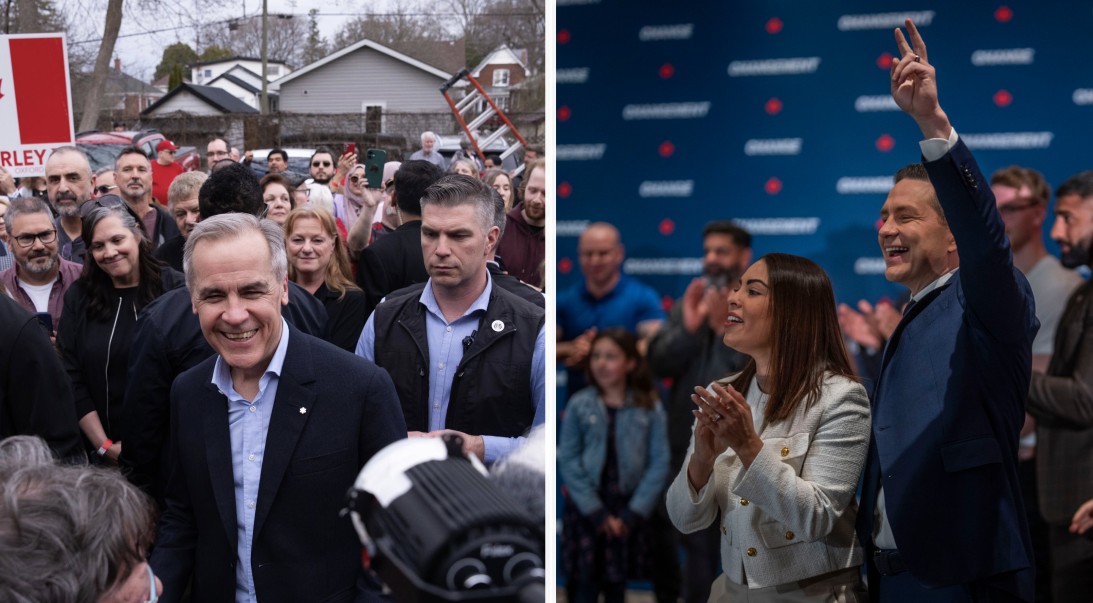
With CPC yet to release costed platform, Liberals hold slight lead that grows larger in major urban centres
April 21, 2025 – Plus ça change. Little else may sum up the state of Canada’s 45th federal election campaign after a week that has seen key race markers passed, some movement on leader favourability, but little overall impact on the vote picture according to new data from the non-profit Angus Reid Institute.
The good news for Pierre Poilievre and the Conservatives is found in positive shift in momentum for the leader. Last week, when asked if their opinion of him had improved or worsened, Poilievre scored a minus 20 on this measure – improved minus worsened. This week, post debate, that score is a minus seven. Meanwhile, Liberal leader Mark Carney scores a minus two this week, an inversion of his plus two before the debates.
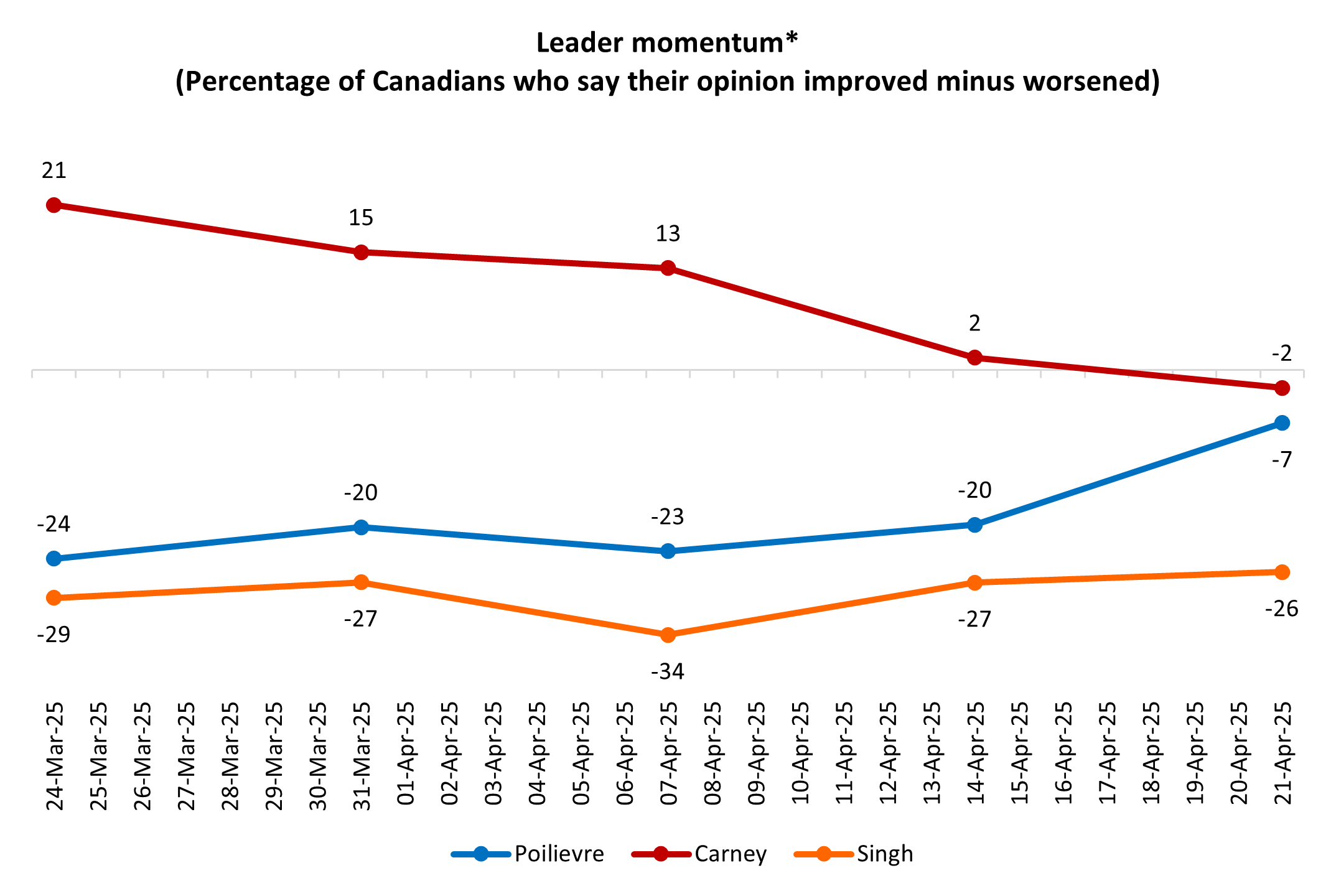
The bad news, however, is multifold: Poilievre’s increase in favourability has him once again at the same ceiling he has faced since taking over the CPC leadership in 2022 – around two-in-five (38%). Further, this positive personal momentum has made minimal difference to vote dynamics.
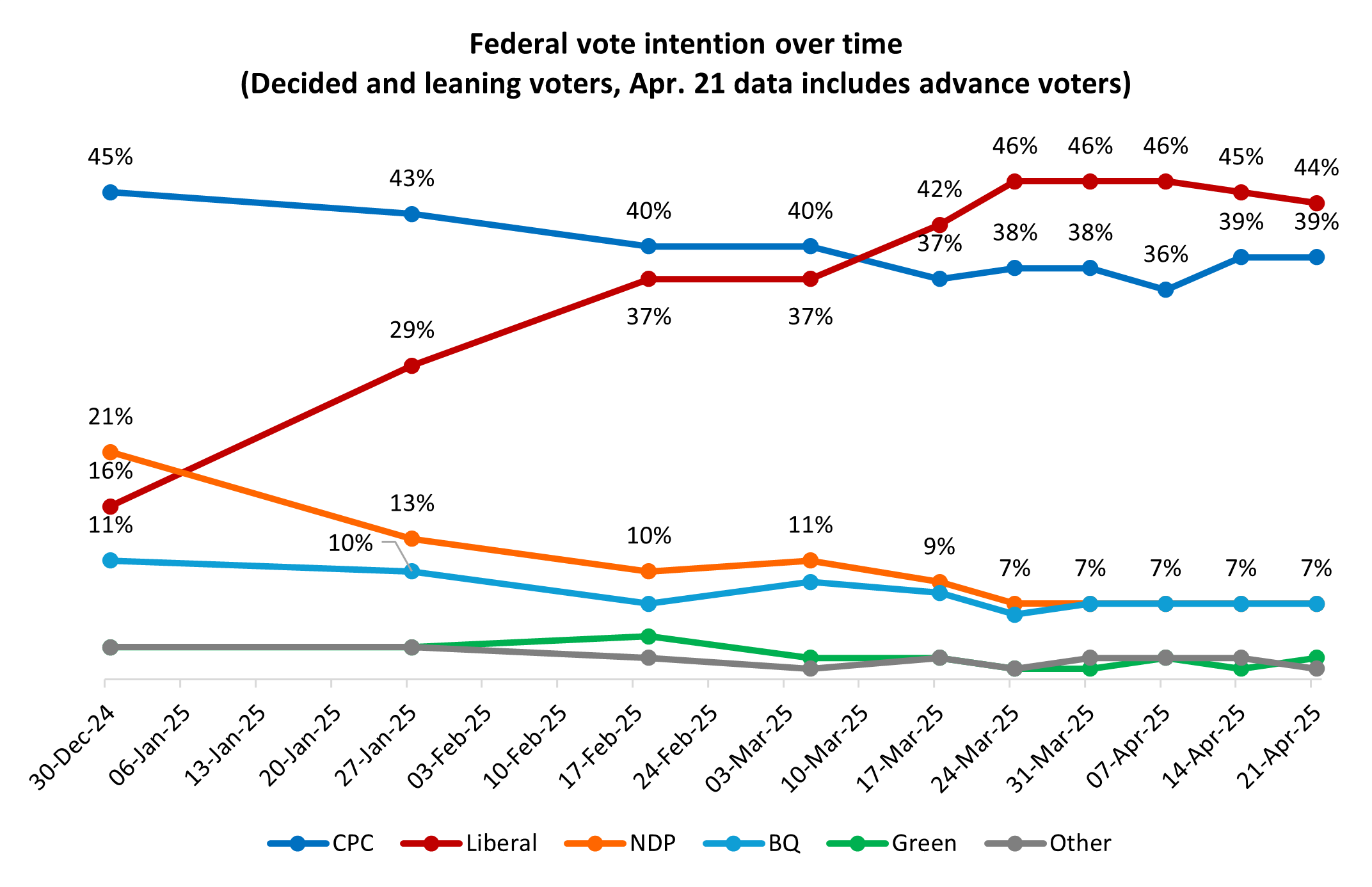
It may be time for the Conservatives to pull the goalie, as it were. The party likely hopes that the release of a costed platform on Tuesday will give it the advantage needed to tighten the race as the clock winds down. As it stands, the federal Liberals and Carney hold a five-point lead over the Conservatives (44% vs 39%), despite a pair of leaders’ debates, more than two million people having cast ballots so far in advanced voting, and two out of three parties (notwithstanding the Conservatives) having released costed platforms. Note, these voter data include both those who have already cast a ballot and those who intend to.
The story gets worse for the Conservatives when taking key urban battlegrounds into account. The Liberals have gained another five points in Toronto (416) and now hold a 34-point advantage over the CPC in that region. The movement has been smaller, but still positive and maintaining a large lead in suburban Toronto (905) and Metro Vancouver. In Montreal, the NDP have rallied some support post-debate, but are still supported in single digits, while the Liberals hold a commanding lead, doubling the second place Bloc Québécois (47% to 24%).
One other trend bodes well for the Liberals and portends a challenge for the CPC: among those Liberals who say they decided to support the party since the beginning of 2025, 45 per cent say this is because the Liberals are the best bet to defeat the CPC. This motivation is up from 30 per cent in March.
More Key Findings:
- Asked who impressed them during the English and French debates last week, Mark Carney (34%) and Pierre Poilievre (32%) were chosen among the most viewers. One-quarter (25%) said they were not impressed by anyone, while Yves-Francois Blanchet impressed one-in-five (22%). NDP leader Jagmeet Singh was chosen by 13 per cent.
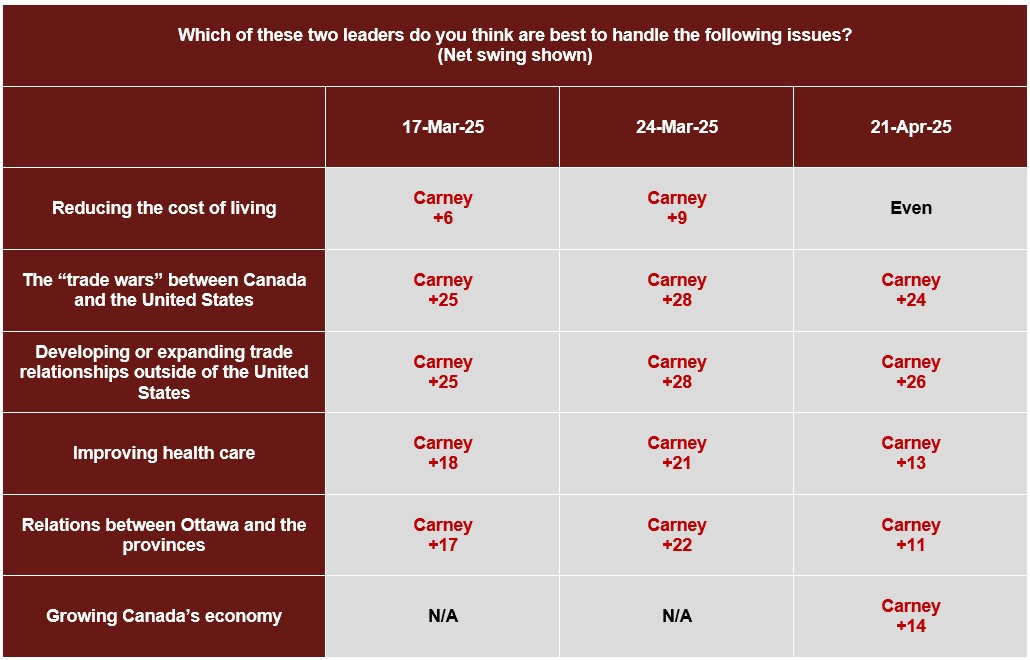
- Carney holds advantages on nearly all top issues for Canadians, though he and Poilievre are tied on “reducing the cost of living” with 37 per cent of Canadians choosing each. Carney is preferred by 24 points on handling the U.S. trade relationship, 26 points on growing non-U.S. trade, 15 points on growing the economy, and 13 points on improving health care.
- Carney’s overfall favourability holds at 54 per cent this week, while Poilievre’s ticks upward to 38 per cent. The CPC leader has still yet to surpass 40 per cent since September 2022.
INDEX
Part One: Leadership
- Carney, Trump, ‘ABC’ factor driving Liberal switchers
- Most view Carney as change from Trudeau
- Carney’s personal momentum has slowed from early campaign
- Poilievre makes gains in favourability, but three-in-five dislike CPC leader
Part Two: Vote intention
- Liberals lead by five points
- By region
- CPC making inroads among men, still struggles among women
Part Three: Issues
- Concern over U.S. relations continues to decline
- But Carney holds edge on top issues except cost of living
Part One: Leadership
Voters, armed with new knowledge of the candidates from the English and French leadership debates last week, have turned out in record numbers so far to the Easter weekend advanced polls. The debates may have been the last chance for party leaders to influence the decision of many voters, shrinking a short campaign even further for a good portion of the electorate.
Carney, Trump, ‘ABC’ factor driving Liberal switchers
The Canadian political picture turned on its head earlier this year when former Prime Minister Justin Trudeau stepped down, paving the way for new Liberal Mark Carney, and igniting a surge in the party’s support. Carney is a driving factor for Canadians who have switched to supporting the Liberals in 2025, as it was early in the campaign. Liberal switchers also continue to report the threat posed by U.S. President Donald Trump as another key reason for changing which party they intended to vote for.
The “anyone-but-Conservative” factor appears to be growing, especially among those who were previously intending to vote NDP. A month ago, three-in-ten (30%) said that was a top two reason for their pivot to the Liberals, while more than two-in-five (45%) say the same now:

Most view Carney as change from Trudeau
As Carney stepped into the office vacated by Trudeau, the question was how far he could distance himself from the previously unpopular prime minister who was almost certainly heading towards electoral defeat prior to his resignation. Most Canadians (59%) continue to see the former Bank of Canada and Bank of England governor as different from his predecessor, including more than one-third (35%) who view him as a major departure from Trudeau.
A majority of all groups of 2021 voters, except those who supported the Conservatives, view Carney as a change from Trudeau. But even among 2021 CPC voters, three-in-ten (28%) believe Carney is different (see detailed tables).

Carney’s personal momentum has slowed from early campaign
Carney had enjoyed growing positivity from Canadians in the early portions of the campaign, with more saying their opinion had improved than worsened of the Liberal leader, while his rivals, CPC leader Pierre Poilievre and NDP leader Jagmeet Singh, had struggled with growing negativity.
Poilievre has closed the gap between the two – though is still experiencing more worsening opinions than improving ones – over the past week:
*Note, the first three waves asked Canadians if their opinion of each had improved or worsened in “the past few weeks”, while the last two waves asked about “the last week”.
The debates may have helped Poilievre, but he impressed as many debate watchers as Carney. One-third (32%) of Canadians say they came away impressed by Poilievre after watching either the English or French debates or catching up on them after the fact. A similar number (34%) say they were impressed by Carney.
Meanwhile, one-in-five (22%), including 34 per cent in Quebec, came away from the debates impressed by Bloc Québécois leader Yves-François Blanchet:

Carney’s declining personal momentum has resulted in a new high of Canadians who say they have an unfavourable view of the Liberal leader – 41 per cent. However, that is offset by a majority (54%) who view him favourably:

Poilievre makes gains in favourability, but three-in-five dislike CPC leader
Poilievre’s struggle to gain traction with Canadians has persisted from when he was first elected as CPC leader in September 2022. Fewer than two-in-five (38%) say they view Poilievre favourably, which is a four-point gain for him in the past two weeks, but maybe too little too late as Canadians vote in droves at the advanced polls:

Part Two: Vote intention
Liberals lead by five points
The gap between the two parties has narrowed in recent weeks after being as much as 10 points during the campaign. The incumbent Liberals lead by five points over the Conservatives, 44 per cent to 39 per cent, with the NDP and Bloc Québécois each holding at seven per cent:
By region
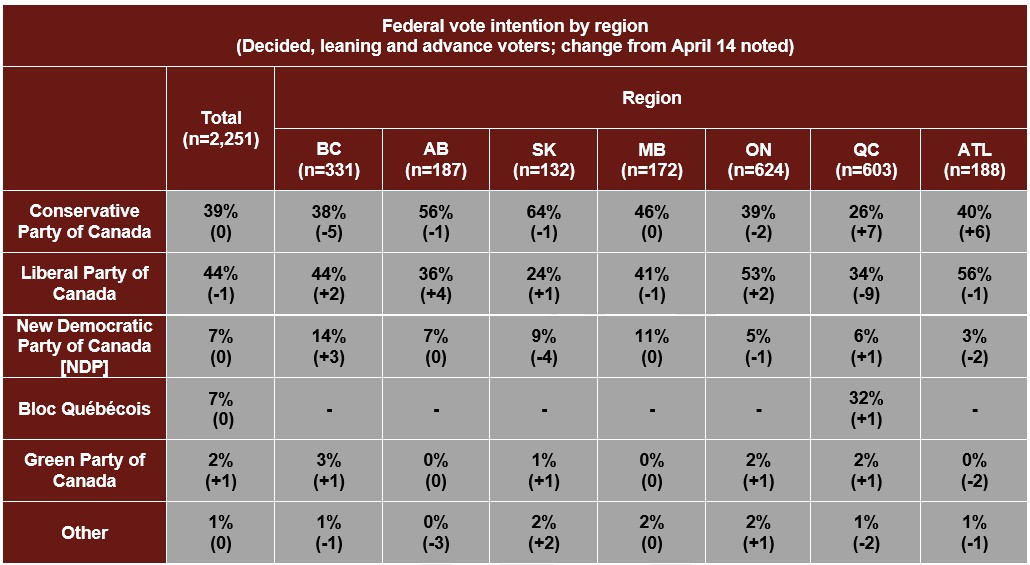
Perhaps the French debate was the more impactful of the two. Among French-speaking Canadians, 36 per cent say they came away impressed by Blanchet, 20 per cent Poilievre, and 16 per cent Carney (see detailed tables). In the wake of the debates, the Liberals have lost ground in Quebec, and the Conservatives have picked up vote intention. However, the Conservatives gains in Quebec, and Atlantic Canada, are offset by losses in B.C.:
While there has been movement in the metro regions, the overall picture is the same: at least half in the country’s biggest cities – Vancouver, Toronto and Montreal – say they intend to vote Liberal:

CPC making inroads among men, still struggles among women
The gender gap between the two parties has been a central narrative during the campaign. The Conservatives have not made inroads among women, but have picked up support among men under 55:

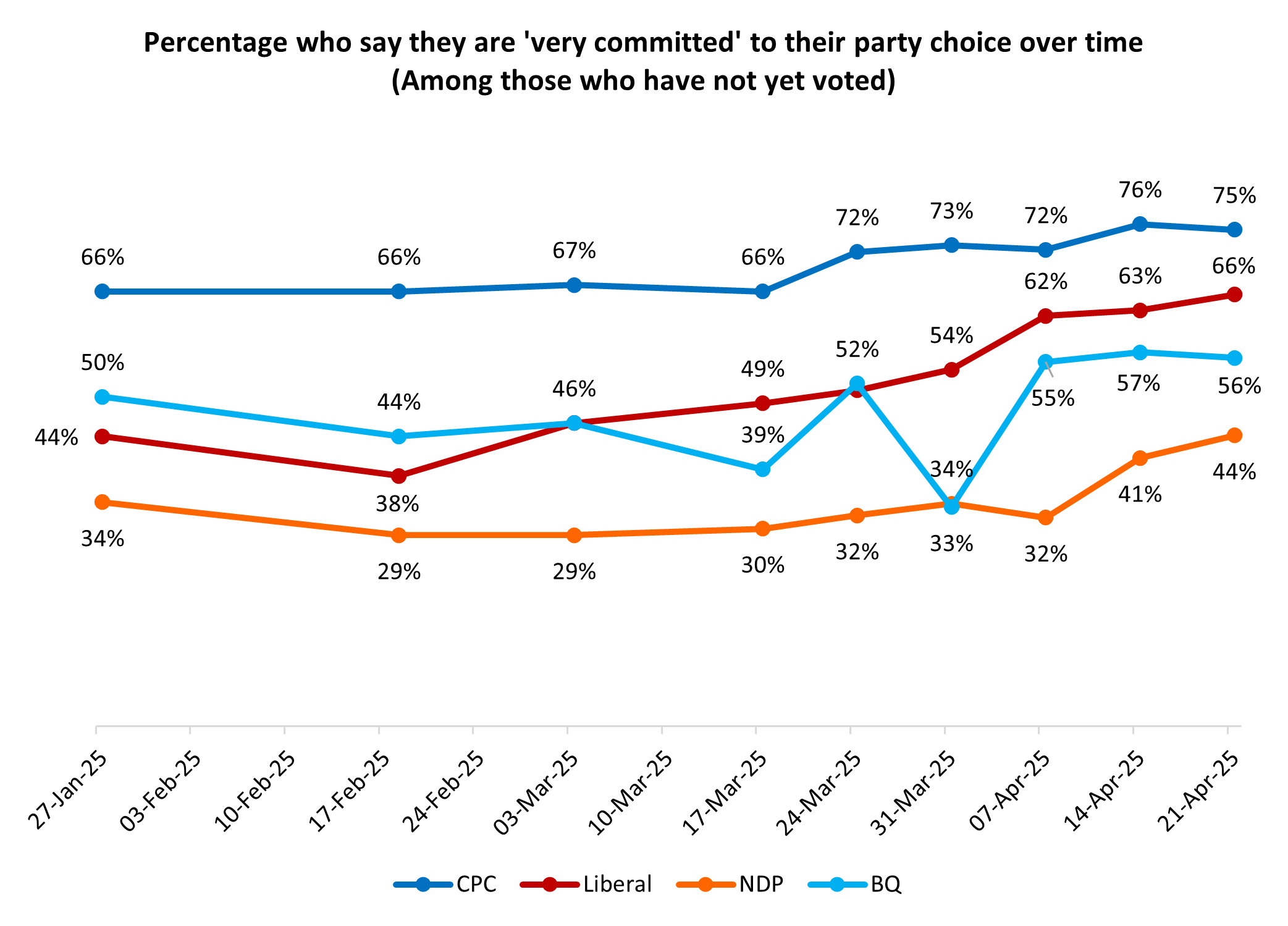
The Conservatives continue to hold the edge on voter commitment, but the Liberals have closed the gap over the election campaign:
Part Three: Issues
Concern over U.S. relations continues to decline
Given the uncertainty and chaos created by Trump in March when it came to tariffs, the April portion of the election campaign has been relatively calm. Though Canadians are still facing the consequences of the trade disruptions – especially in the auto, aluminum and steel sectors subject to 25-per-cent American tariffs and the farm sectors hit by retaliatory tariffs from Beijing – the issue of U.S. relations has faded from prominence. One-quarter (27%) of Canadians select it as a top issue facing the country, putting it at a similar level of concern to housing affordability (26%) and the economy more broadly (25%). The high cost of living (53%), of which tariffs have certainly aggravated, remains the top issue as Canadians go to the polls, followed by health care (38%), an issue many felt was given short shrift during the campaign.
 But Carney holds edge on top issues except cost of living
Overall, on most of these top concerns, Carney is viewed by Canadians as the better leader to handle them. This especially true on U.S. relations, where Carney has held a large advantage throughout the campaign. Post-debate, Poilievre has closed the gap on relations between Ottawa and the provinces, health care and the cost of living, but it may not be enough to alter the vote dynamics in the closing days of the campaign:
METHODOLOGY
The Angus Reid Institute conducted an online survey from April 17 – 21, 2025, among a randomized sample of 2,459 Canadian adults who are members of Angus Reid Forum. The sample was weighted to be representative of adults nationwide according to region, gender, age, household income, and education, based on the Canadian census. For comparison purposes only, a probability sample of this size would carry a margin of error of +/- 1.5 percentage points, 19 times out of 20. Discrepancies in or between totals are due to rounding. The survey was self-commissioned and paid for by ARI. Detailed tables are found at the end of this release.
For detailed results by age, gender, region, education, and other demographics, click here.
For PDF of full report, click here.
For Questionnaire, click here.
MEDIA CONTACTS:
Shachi Kurl, President: 604.908.1693 shachi.kurl@angusreid.org @shachikurl
Dave Korzinski, Research Director: 250.899.0821 dave.korzinski@angusreid.org
Jon Roe, Research Associate: 825.437.1147 jon.roe@angusreid.org